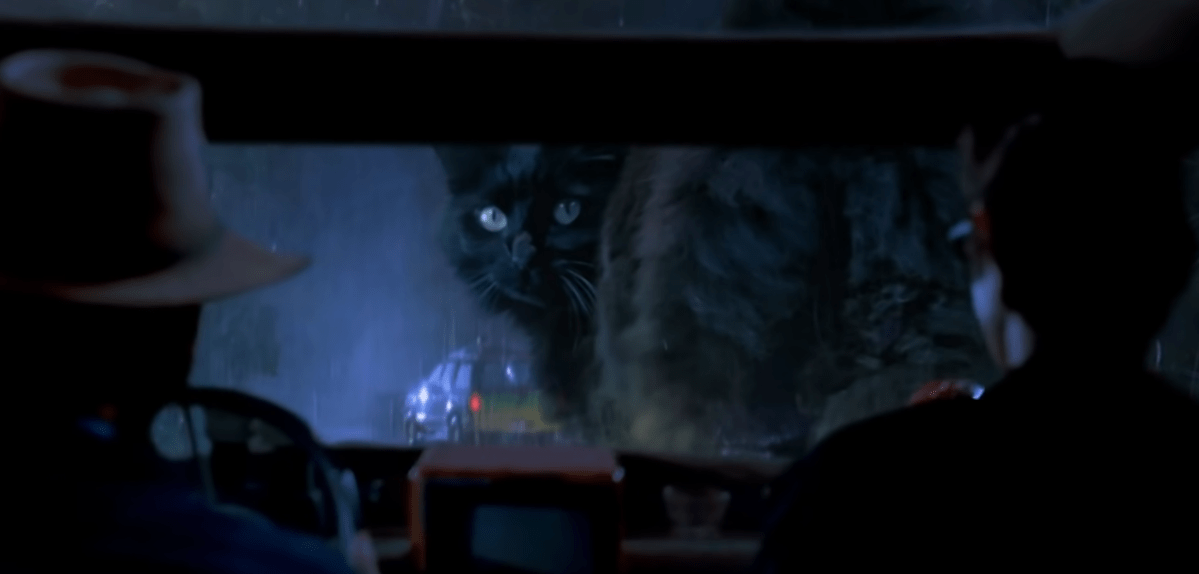
Owl Kitty’s human puts his beloved feline into an iconic scene from 1993’s Jurassic Park.
Owl Kitty’s human has put his house panther into The Matrix, John Wick, Home Alone, Titanic — and now the original Jurassic Park as a stand-in for the terrifying tyrannosaurus rex.
Despite standing at least 20 feet tall and weighing several tons, Jurassic Owl Kitty is a kindler, gentler threat to Sam Neill, Jeff Goldblum and the kids. Kitty just wants to rub up against the Jeep and purr, and perhaps score some cat food, not eat people like that evil dinosaur.
Plus we can now confirm that, even if they were twice the size of African elephants, cats would still be cute:
Both major party mayoral candidates in NYC are longtime animal welfare advocates.
We normally avoid politics on this blog except for the occasional light-hearted satire imagining Buddy as a comically inept president of the Americats, but we’ll make an exception for the New York City mayoral race, which features two animal-loving major party candidates.
Eric Adams, a Democrat, is a former NYPD captain, Brooklyn borough president and vegan who has supported TNR programs in Brooklyn, pushed for more animal-friendly housing in the city and hosted adoption events in his home borough, according to the Humane Society’s Legislative Fund.
Curtis Sliwa is best known nationally as the founder of the unarmed crime prevention group the Guardian Angels, and in New York as a host on the city’s biggest talk radio station. (He’s been on hiatus since launching his mayoral campaign to comply with election law.)
He survived an attempted mafia hit in 1992, jumping out of a cab after he was shot several times by Gotti family enforcers, and he’s a dedicated cat lover, sharing his home with 16 rescues. Most of Sliwa’s cats have disabilities or were pulled from local shelter kill lists. Not all of them are permanent, and the Sliwas consider themselves long-term fosters until they can find the right homes for special needs cats. Last year they were able to place 10 kitties in good homes.
Still, the felines come first in their 87th Street apartment.
“Guess what? It’s the cats who rule the roost,” Sliwa told a New York Post cameraman in June. “We take whatever room is left after the cats carve out their territory.”
Cat furniture dominates the studio apartment Sliwa shares with his wife, Nancy, who told the Post she’s considering adopting more furballs, including a special-needs rescue who is blind. (They had 15 cats at the time and have adopted one more since then.)
Turning to her husband, she quipped: “We might have to lose your half of the closet.”
The couple share litter box duties and clean the multiple boxes in their home at least three times a day, they told the Post.
NYC mayoral candidate Curtis Sliwa plays with his cats.
At the end of Tuesday’s televised mayoral debate, when asked which qualities they admire in their opponents, both Sliwa and Adams praised each other for their work with animals.
The city and its surrounding environs lean heavily blue. Sixty-eight percent of registered voters in the five boroughs are registered Democrats, and Adams holds a commanding 36-point lead according to the latest poll.
Like all Republicans who set their sights on the mayor’s job, Sliwa knew it was going to be an uphill battle even though New Yorkers have tired of the current mayor, Democrat Bill DeBlasio. Sliwa hopes one of his central campaign promises — to enact a no-kill policy across the city’s shelter system — will resonate with voters across the aisle.
Republicans who have won in the past have been centrist, like former Mayor Rudy Giuliani, or nominally Republican, like businessman turned politician Michael Bloomberg. The latter enjoyed widespread name recognition before he turned to politics and supplemented his campaign hauls with his own considerable resources.
Still, the Guardian Angels founder sees Gracie Mansion, the mayor’s Upper East Side home, as a potentially fantastic cat house.
“I’ve been in Gracie Mansion before,” Sliwa told New York magazine. “There is easily room in there for 60 cats.”
Buddy dispels the myth that cats follow their people around, as if they would stoop so low!
Dear Buddy,
Why do cats always follow their humans around? I mean, you guys might not want us to pet you all the time, but you sure do go everywhere we go.
Human in Honolulu
Dear Human,
This is a common misconception, one of those myths about cats like the one that says we love milk or we like it when you talk to us in baby voices.
The sad reality is that you follow us around but you don’t want to admit it, so you come up with elaborate fictions about our habits. My human believes I weave around his legs to rub against them after he wakes up, which is absurd. Clearly he steps in my path and I have to swerve, causing incidental contact. I would prefer not to, but he makes it impossible.
Or how about the myth that we like to bother you guys in the bathroom? Big Buddy knows that every day at certain times I like to put my paws under the bathroom door and cry. I mean, I do it all the time and he knows it, so he decides to use the bathroom at those times and tricks himself into believing that somehow I go into hysterics if I’m not actually inside the bathroom with him.
Do you see how delusional you people are?
What kind of crazy people say “I know my cat is going to knead and purr in this spot in the next 5 to 10 minutes, so I’m going to sit here and force him to knead on me”?
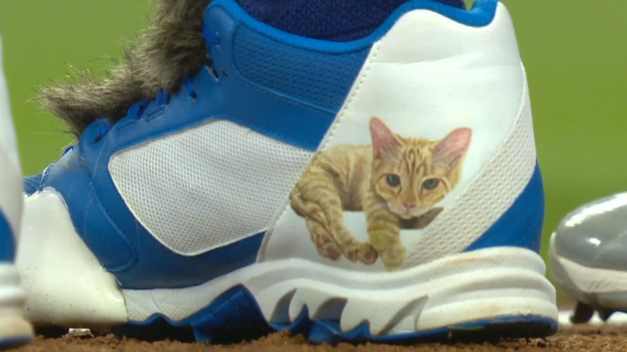
The Dodgers’ Tony Gonsolin is a consummate cat man, entering Saturday’s playoff game against the Braves with a custom pair of cat-celebrating kicks.
The Dodgers’ Tony Gonsolin was rocking a unique look during his appearance Saturday against the Atlanta Braves.
The Los Angeles reliever, known for a repertoire that includes a mid-90s fastball, an extremely effective splitter and a nasty slider, was wearing a custom pair of cleats with fake cat fur to represent his kitties, Tigger and Blu. The custom kicks also featured a graphic of a cute ginger tabby on the sides.
Tony Gonsolin’s custom cat cleats, which he wore in the National League Championship Game 2 against Atlanta on Oct. 17, 2021.
The 27-year-old hasn’t exactly been secretive about his love for cats, tweeting often about his furry friends and taking the opportunity to show them off every Caturday, but his Oct. 17 appearance was notable because he took it to a whole new level.
Alas, the Dodgers lost Saturday’s game on a ninth-inning walkoff single by the Braves’ talented Austin Riley. The 24-year-old has had a breakout season this year for Atlanta, hitting .303 with 33 home runs and 107 RBI, numbers that easily put him in the top echelon of offensive third basement.
But Gonsolin’s no slouch either. The righty boasts an impressive 2.85 ERA in three seasons in the MLB — all with the Dodgers — striking out 148 batters in 142.1 innings and posting a tidy 1.089 WHIP.
For our non-baseball-loving friends (me and Bud love us some baseball), that means Gonsolin is an extremely effective reliever, allowing few baserunners and keeping the ball out of play by frequently striking out batters.
After arriving in his Forever Kingdom, a newly-adopted cat began the hard work of training his new human.
NEW YORK — It took only six seconds for Jenna, Mikey’s new human, to open the bathroom door when guilted with mournful meows on Wednesday, the newly-homed cat reported.
The 28-year-old human woman entered the bathroom without her recently-adopted feline at approximately 6:22 pm on Wednesday.
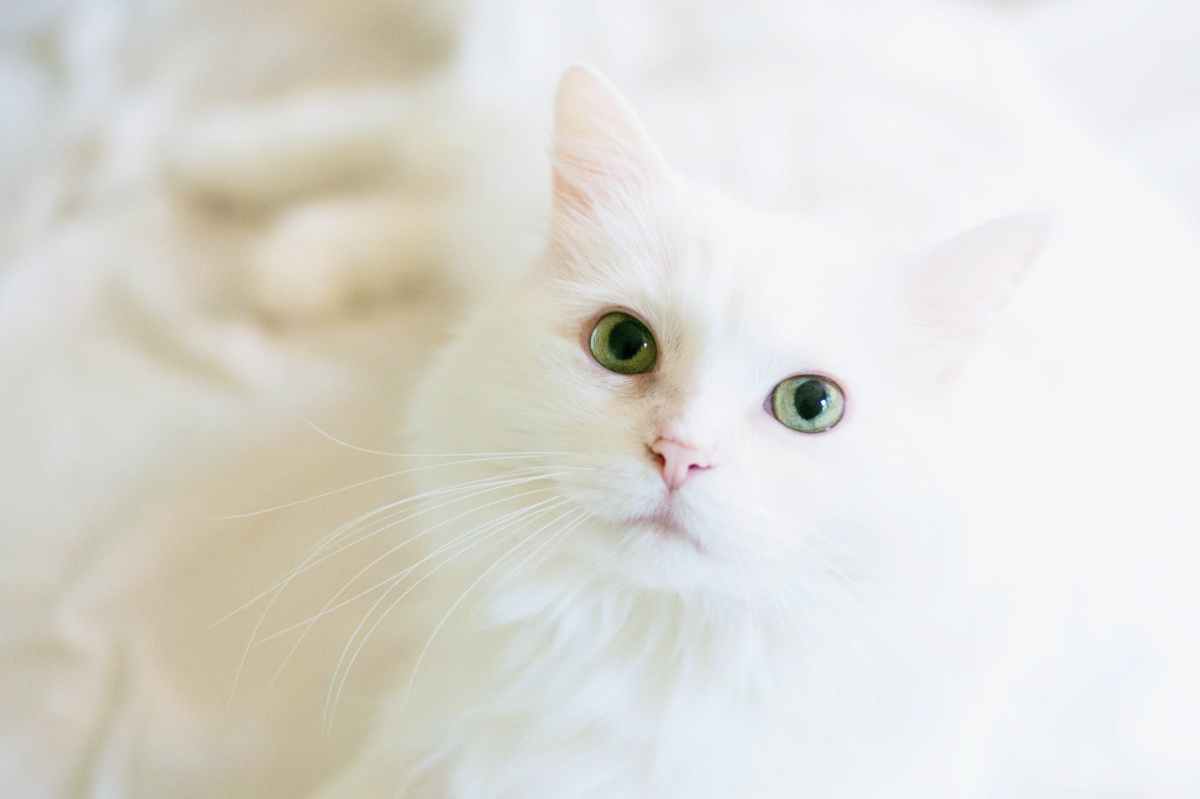
“I said to myself, ‘Mikey, we gotta nip this in the bud right away. We can’t have her thinking she can use the bathroom without us, can we?'” the white moggie said.
Mikey launched into a routine that involved scratching the frame, reaching under the door and meowing frantically — “the classics,” he said.
Six seconds later the bathroom door opened, revealing a concerned Jenna.
“Oh my poor baby, are you okay?” she asked, extending a hand as Mikey padded into the bathroom. “I was worried! It sounded like someone was strangling you!”
Mikey said he milked his new human’s sympathy for all he could get.
“I flopped onto my back, gave out a little ‘Muurrrp!’ and looked at her with my big, sad eyes,” he told reporters. “A few minutes later she was in the kitchen, showering me with snacks. Easy peasy!”
Paws under the door: A classic feline manipulative strategy that almost always yields results, especially if you can grab something!
Mikey, who spent almost three months in a local shelter as younger cats were adopted during kitten season, said he’s proceeding cautiously in his new home and plans to use his keen feline powers of observation to develop a meticulous catalogue of which buttons to push at specific times “to yield maximum snackage and massages.”
“I haven’t used my solicitation purr yet,” he said. “So far my human’s been pliable and gives me what I want, when I want it. The other night she spent four hours laying in a very uncomfortable-looking position to avoid disturbing me while I napped on her shoulder. I want to see how far I can take it before bringing out the big guns.”
Patience has paid off, Mikey said.
“Her boyfriend came over the other night,” he said. “I could have hissed, peed in his shoes, chased him off. After all, there can only be one man of the house. But he brought a gift for me, one of those track towers with the ball you swat around, you know? I have to admit, I was impressed that he knew enough to pay tribute to me. That guy’s alright.”