Dubrovnik Cat Is Back At Historic Palace, But Without Her Fancy House

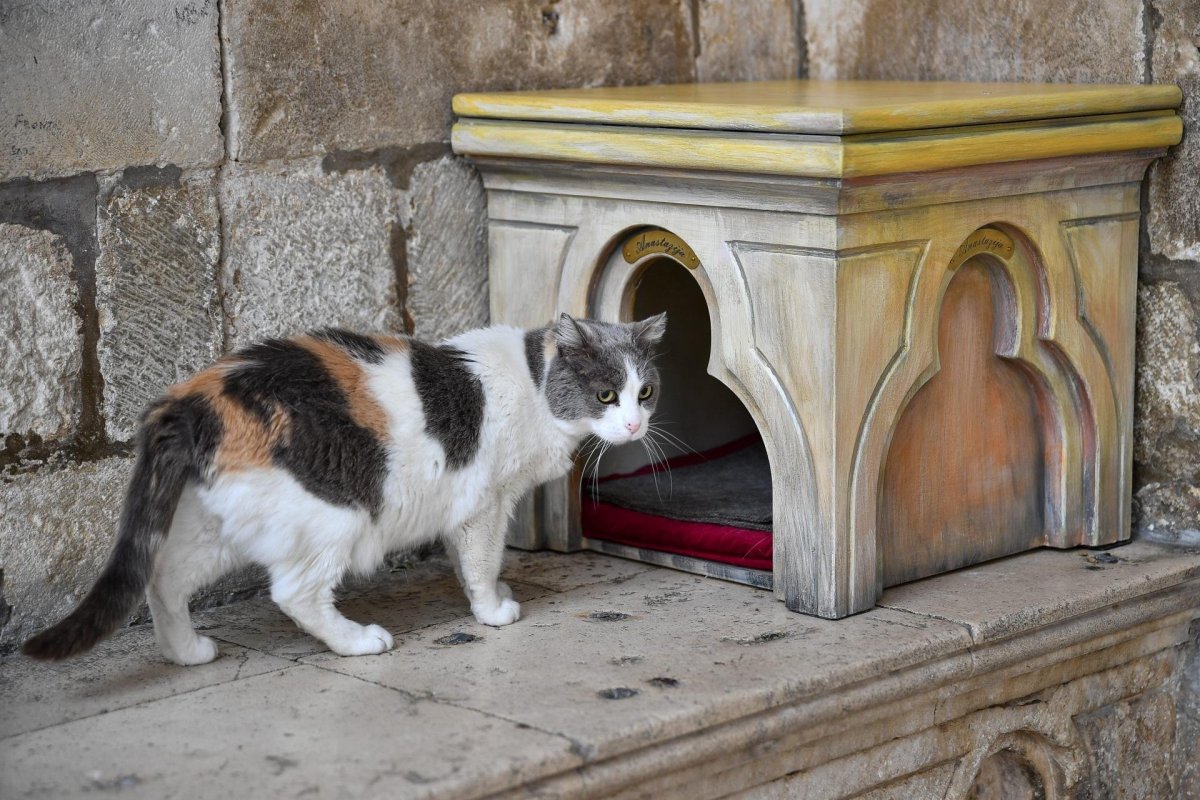
The 17-year-old Anastasia has been living on the grounds of the Rector’s Palace in Dubrovnik her entire life.

Anastasia is still living the palace life.

The community cat found herself in the middle of an uproar after staff at the Rector’s Palace, a historic site in Dubrovnik, Croatia, kicked her off the palace grounds which had been her home for 17 years.

In 2021 staff at the Rector’s Palace, a six-century-old structure which is now a museum, said Anastasia’s little nook, with food and water bowls on top of cardboard, was an eyesore and wanted her gone.

They took away her belongings in May, prompting local carpenter Srdjan Kera to build a beautiful wooden cat house that mimicked the color and architectural details of the palace, giving Anastasia a dwelling that would shield her from the elements as well as blend in with the historic building’s facade.

But palace staff wouldn’t accept the compromise and had the wooden home removed, sparking an outcry among Dubrovnik’s locals and tourists. A petition demanding Anastasia be allowed to stay was signed by more than 12,000 people — a figure greater than the number of people who voted for the city’s mayor, representing more than a fourth of the city’s population.

The furor died down and there hasn’t been much news since then, but Mark Thomas, editor of the English-language Dubrovnik Times, told PITB Anastasia is back at the Rector’s Palace and basking in her fame.

“She doesn’t have her fancy home that was built for her,” the U.K. expat told us, “but rather her spot on a piece of cardboard. She is well fed and seems to be more than happy and enjoying having her photo taken with tourists.”

Thomas said he’d last seen Anastasia just a few days ago in her usual stomping grounds at the palace.

It seems odd that staff at the palace wanted her gone because they found her original nook unsightly, then removed the aesthetically pleasing cat house created by Kera only to go back to the old cardboard arrangement, but we’re glad the senior kitty isn’t subjected to the stress of being forcibly moved from the only home she’s ever known.

Previously, staff at the Rector’s Palace said Anastasia didn’t need her shelter all year round, so perhaps they’ve come to a compromise and will allow it during the winter. Dubrovnik enjoys a mild Mediterranean climate, with temperatures bottoming out at about 50ºF (10ºC) in January, its coldest month, but while the city remains temperate, it experiences significantly more rain in the winter months.

You Can Now Play Stray As Your Own Cat And As Garfield Thanks To Mods

Who wants to play as Buddy?

More news in the world of Stray, the play-as-a-cat video game that’s taken the world by storm with rave reviews, plenty of memes and hilarious videos of real cats reacting to their humans playing the game.

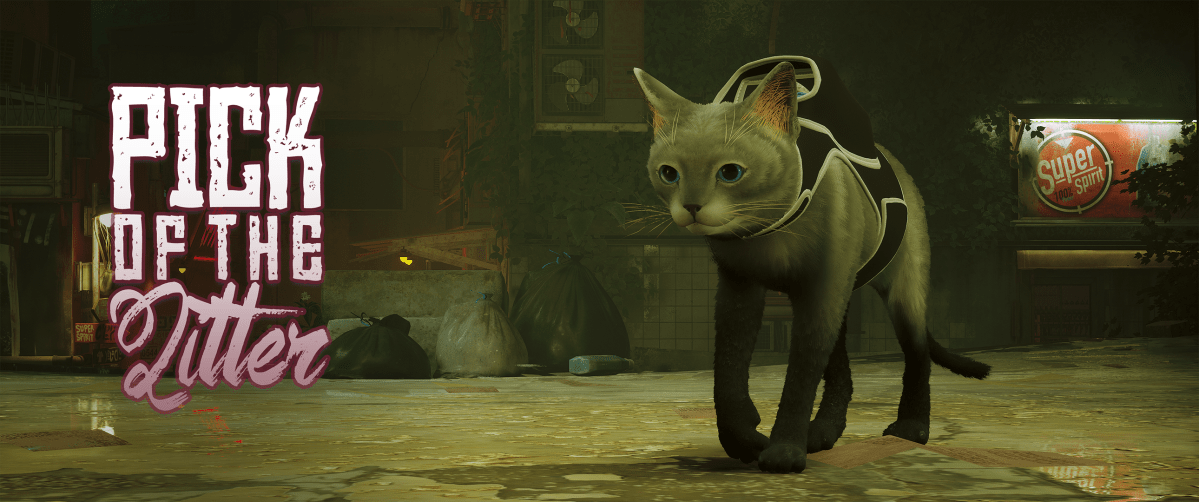
Thanks to players who create custom game mods, short for modifications, Stray players can now replace the game’s ginger tabby protagonist with cats of their choosing. Currently there are mods that make the title cat a Siamese, a black cat with yellow eyes, a white cat with heterochromia (different color eyes), a tuxedo and a Calico, among others.

The most popular mod, dubbed Pick of the Litter, features many different coat colors and patterns that users can select and switch between.

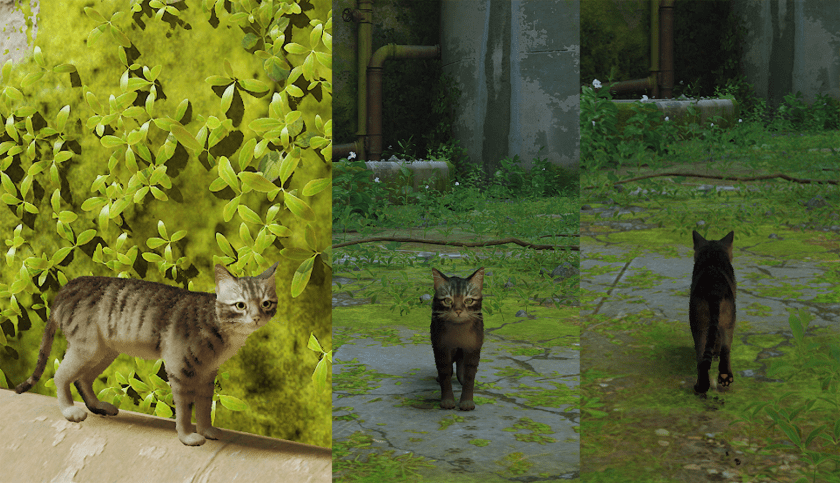
There are currently at least two gray tabby mods, but neither of them match Buddy’s chubby incredibly muscular physique.

One modder is taking commissions from gamers and creating custom cat avatars based on photographs, so if a player’s cat has a unique color or pattern — or you just want something more accurate — they have that option. Perhaps we’ll inquire if it’s possible to add huge meowscles as well as edit coat patterns and colors.

graytabbystray
Gray tabby mod: Clearly not meowscular enough to be Buddy.

Other mods allow players to substitute a dog as the protagonist (come on, now…), add snazzy spectacles to the kitty, and tweak graphics settings for greater photorealism.

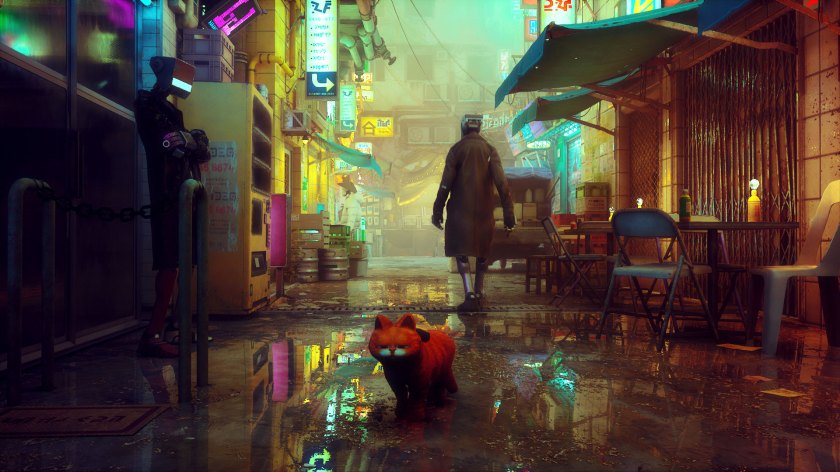
Finally, if you’re a fan of a certain lasagna-loving cartoon cat, you’re in luck: He’s now in the game thanks to the efforts of one dedicated fan, and he’s as lazy and heavy-lidded as he’s always been.

It should be noted that mods are unique to the PC, which is an open platform. If you’re playing the game on a Playstation 4 or 5, you’re out of luck.

58-1658692188-909899575
Garfield in Stray: Maybe you can feed him lasagna to restore his health?

What’s The Difference Between A Puma, Mountain Lion, Cougar, Panther and Catamount?

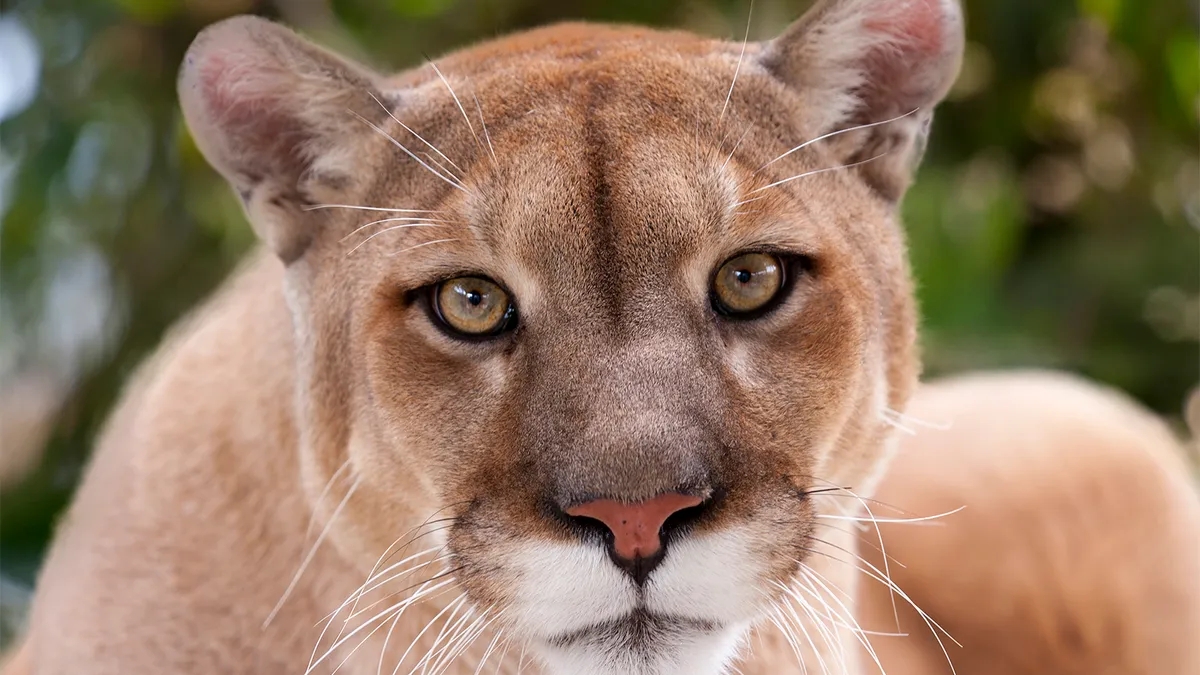
The puma is known by more names than any other mammal, a fact that reflects its incredible resilience and wide range.

The puma goes by a lot of names. So many, in fact, that it holds the Guinness world record for the mammal with the most names, with more than 40 monikers in English alone.

Add the puma’s various appellations in Spanish and the indigenous tongues of south north America, and the large golden cat has probably had at least 100 names by a conservative estimate.

Cougar, panther, mountain lion, catamount, Florida panther, Carolina panther, ghost cat, gato monte, cuguacuarana, painter, screamer — they’re all names for puma concolor, a felid with the size of big cats in the panthera genus but genetics more closely related to non-roaring “small” cats, including felis catus.

Indeed, although pumas are famously capable of the wild cat “scream,” they’re able to purr just like house cats and their small- to medium-size wild relatives.

Why does the puma have so many monikers?

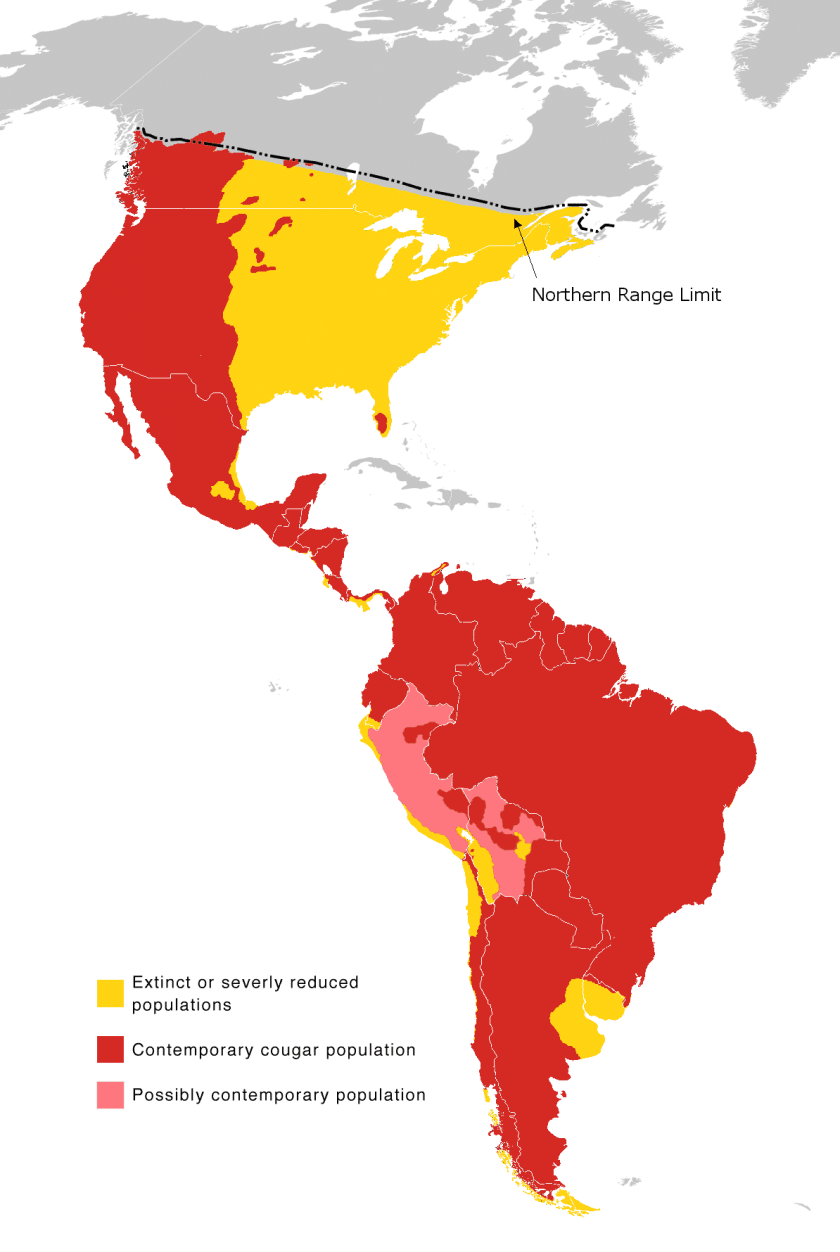
Mostly it’s because the adaptable, elusive feline has a vast range that historically covered almost the entirety of two continents:

Cougar_range_map_2010
Credit: Wikimedia Commons

Even today cougars exist in healthy numbers across most of South America and the western United States. They’re wanderers, with pockets of smaller populations in places like Florida and the midwest, and individual mountain lions have been spotted as far east as New York and Connecticut. (The New York region known as the Catskills, derived from “cat creek” in Dutch, was named after pumas when the area was part of their regular range.)

Throughout their history they’ve been familiar to a diverse group of human civilizations, societies, nations and peoples, from the Aztecs, Inca and Mayans, to the indigenous tribes of North America and the First Nations of Canada, to the inhabitants of modern-day countries like the US, Panama, Brazil, Mexico, Venezuela, Colombia, Ecuador, Paraguay, Bolivia, Chile and Argentina.

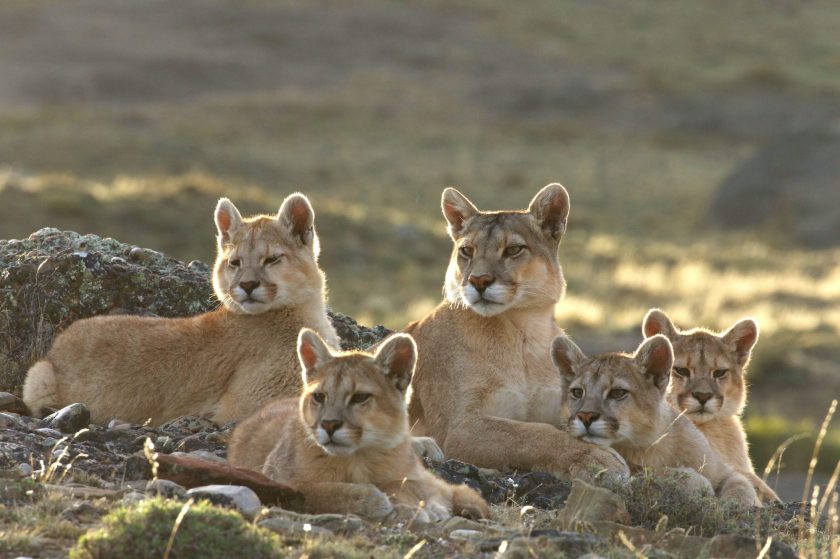
Puma
A puma with her cubs. Credit: Nicolas Lagos

But the name confusion doesn’t just stem from the puma’s many monikers bestowed by people of different cultures across space and time. The puma is also one of three cat species that are regularly called panthers. The other two, jaguars (panthera onca) and leopards (panthera pardus), are true “big cats.” That means they’re members of the genus panthera and they can roar but not purr.

Pumas are easily distinguishable from the other two: They have smooth golden fur without adornments, while jaguars and leopards both have blotches called rosettes.

It’s difficult to tell jaguars from leopards, but the biggest giveaway is the fact that jaguars have solid dot-like markings within their rosettes while leopards do not. In addition, leopards have much longer tails than jaguars or pumas, as they need the counterbalance provided by their tails to help them climb trees and balance themselves on tree limbs.

Jaguars are excellent climbers as well, but they don’t need to be as adept at living off the ground — they are the apex predators in the Americas, while leopards coexist with lions and other large animals like Cape buffalo that present a danger to the big cats even if they’re not predators.

Which brings us to our last point: Our many-named friends, the pumas, may be big and they may look dangerous, but they’re not. There have been 27 humans killed by the elusive cats in more than a century in the U.S., according to the U.S. Fish and Wildlife Service, compared to about 3,000 deaths from dog bites over the same period. Between 30 and 50 people are killed by dogs each year.

Most confrontations between humans and pumas happen when the latter are threatened and cannot escape, or when a female is protecting her cubs.

So if you live in an area where you have a chance to see these beautiful cats, admire them and keep your own kitties indoors, but don’t freak out — the puma you see one second will be gone the next.

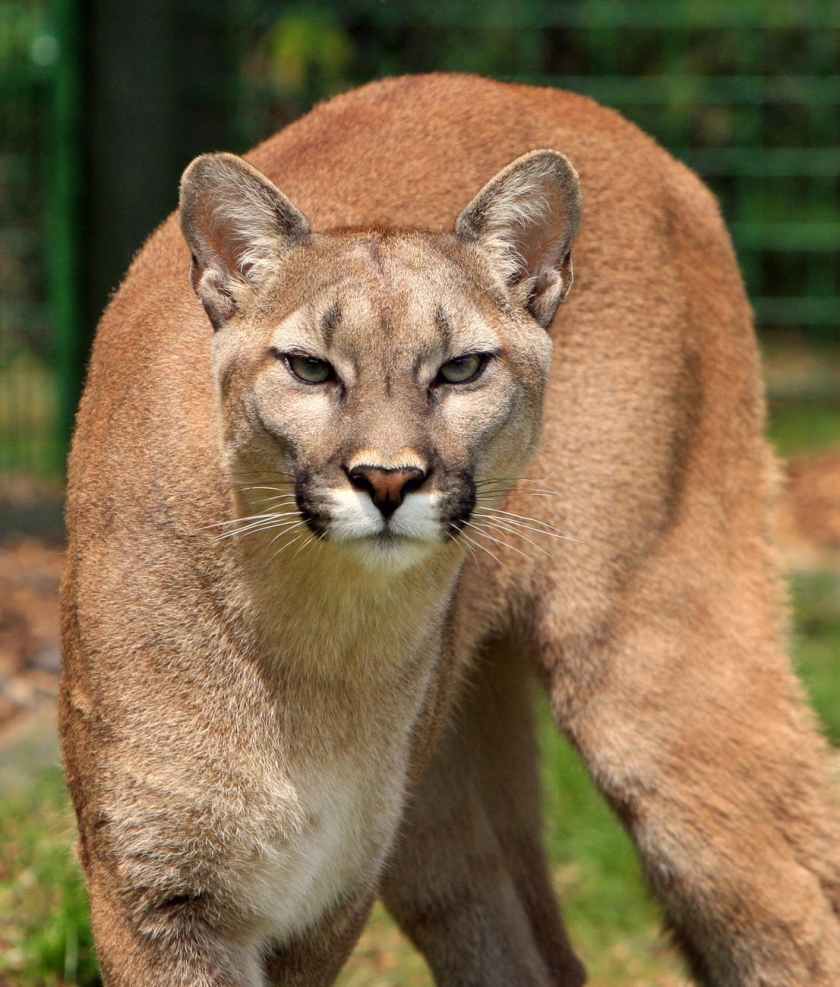
nature animal wilderness head
A captive puma. Credit: Pexels.com

Stray: A Lost, Lonely Cat Gets A Buddy

We continue our journey in Stray, the new game centered around a feline protagonist.

There’s been so much buzz about Stray, so many news stories, memes and people talking about it, that I’m probably not alone in feeling like I’m watching a TV series an episode at a time while most people binged it in a day or two.

But that’s not how I play, and it’s not how most game developers want players to experience their stories. Modern games, especially games like Stray with their bespoke environments and unique encounters, are built to immerse players in their worlds. The entire point of video games is the interactivity, the choices and agency of the players. They’re designed so when you choose to wander off the beaten path or take a few moments to linger over something visually impressive, the experience is rewarding.

Maybe you’ll find a rare item, a compelling vista, a secret passage or a funny sign. The point is, there’s incentive to look deeper. It gives games a feeling of possibility and the thrill of the undiscovered.

20220723074255_1
Standing on a keyboard, just like the good old days!

These stories are not meant to be passive experiences, nor are they meant to be devoured. I won’t be speed running through this mysterious alternate future version of Hong Kong. The journey is the entire point.

Picking up where we left off, the Good Boy (that’s what I’m calling him, for now at least) must learn to navigate this new and potentially dangerous urban environment, and he must do so with a feline’s skill set.

There are no opposable thumbs here. If our hero needs to move an object, he’s got to carry it in his mouth like a mom cat does with her kittens. If he needs to move a barrel, he’s got to get inside and run like a hamster in a wheel to propel it forward. If he needs to stop a fan’s blades from spinning so he can get through a window, he’s got to drop or swipe something into the blades to jam them up.

Appropriately, one of the main mechanisms for making new routes is knocking things over. Knock over a piece of plywood and Good Boy has a bridge. Knock over a can or a box at just the right angle to flip a switch and so on.

20220723075459_1
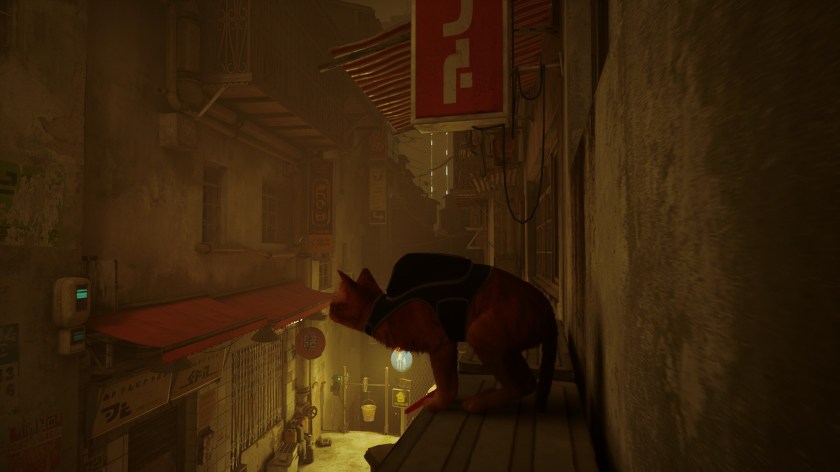
Protagonist cat can navigate the city in different ways and at different heights. Moving above street level means he’s less vulnerable and gives him a nice ambush angle should he encounter anyone who needs a good startling.

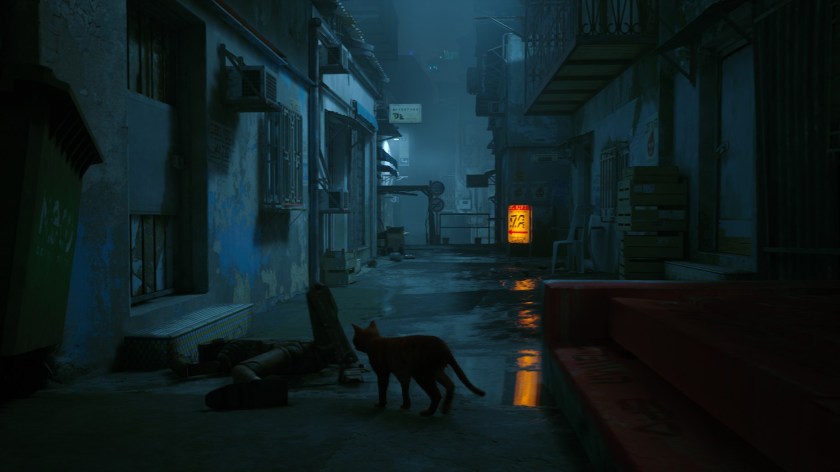
Good Boy meanders through a seemingly abandoned Kowloon City, padding through quiet streets and taking shortcuts through empty flats. There’s power, the city is illuminated by incandescent lights, neon and the glow of TV sets indoors, so someone must be around.

Our feline hero soon learns new tenants have moved in, and they’re not friendly. I’m not sure what they’re called, and the game doesn’t name them, but Kowloon is now home to swarming, artificial tribble-like creatures that attack Good Boy on sight and can take him down if he doesn’t run and shake off any enemies who manage to latch onto him. (Side note: I do not like dying in this game. What did Good Boy ever do to deserve being attacked?)

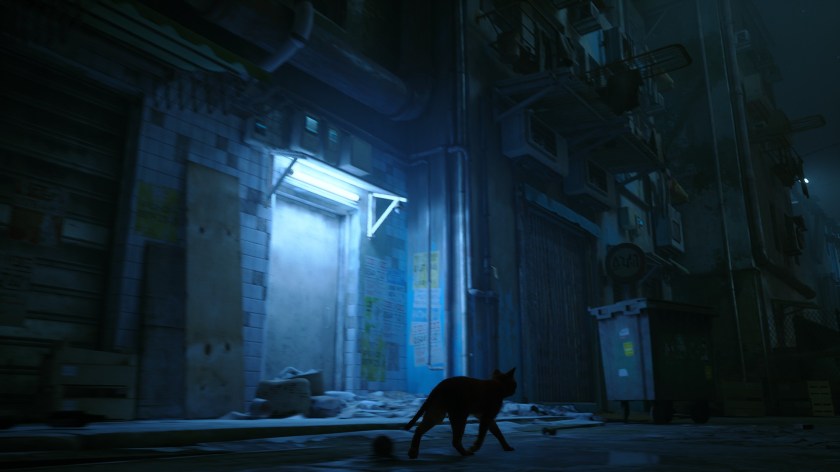
The first encounter with these enemies turns into a twisting chase through dimly-lit alleys, crumbling staircases and tight streets. Good Boy manages to evade the evil robot tribbles and finds sanctuary in a secure flat.

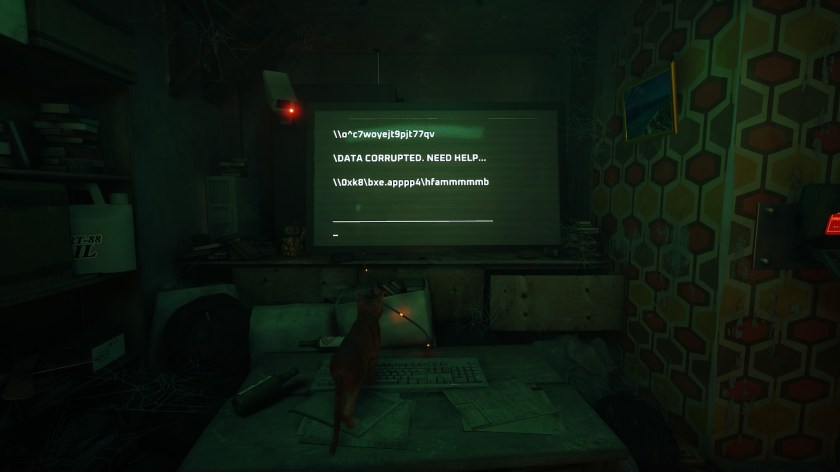
Once he attends to his needs, which include some carpet scratching and rehydrating, he’s contacted by a machine who uses TVs, computer monitors and other electronics in the apartment to communicate with the tabby.

The machine directs the cat through a few simple tasks necessary to free him, then meets Good Boy in the flesh.

The bot, a palm-size drone named B-12, is damaged and his memory is corrupted. He’s as lost and confused as Good Boy is, and he proposes a partnership. Good Boy, who sees the value in a drone who can open locks, translate signs and communicate with others, agrees. B-12 outfits his new feline friend with a harness that allows him to dock on the kitty’s back, then he saddles up and the new teammates venture forth.

For the first time, the protagonist is able to glean real information about his environment and has a sense of direction. He also gets to travel by makeshift ziplines, hopping into buckets hanging from the city’s ubiquitous wires.

Next episode: Our duo fights back! Same cat time, same cat channel.

Stray: Early Impressions, Plus Real World Cats Benefit From The Game’s Launch!

Stray gets everything right about the way cats move and behave, while rescue groups and shelters are using the game to raise money.

Stray is the real deal. The game is beautifully atmospheric and slipping into its world feels effortless.

The adventure begins amid beautiful urban decay, with the titular feline and his family of three other moggies waking from a nap on the ledge of a concrete reservoir in the process of being reclaimed by Mother Nature. Tangles of branches and leaves push through the crumbling man-made structure everywhere, creating canopies, waterfalls and pools, and our hero and his buddies navigate their idyllic home in perfectly cat-like manner, leaping up, dropping down and pausing to lap water from reservoirs of running water.

The game gets you started with a few classics from the feline repertoire. You can walk, run, leap, hop up and, perhaps most importantly, meow by pressing the Alt key. A general interactive key allows you to sidle up to your feline friends for some head bunting and allogrooming, and the furry family members purr at each other in appreciation.

But things don’t remain idyllic, of course, because this is an adventure.

Our cat, an adorable ginger tabby, is separated from his tribe when he follows them across a chasm via a rusty pipe and the metal gives way.

It’s an enormous credit to the animators that they’re able to convincingly convey the panic and fear on kitty’s face as he tries to stop his fall, clawing at the edge futilely until he takes a nasty tumble onto hard concrete a few hundred feet below. Conveying authentic emotion on the faces of human characters is challenging, but doing it with a non-anthropomorphized animal is another thing entirely.

When you land, you can hear the distressed cries of your fur friends far above but can no longer see them, and your cat is injured: He limps along on three legs through a dimly lit sewer before passing out from his injuries.

An indeterminate time later he awakes, sniffs out a cat-size path of egress from the sewer and finds himself in the neon-tinted Walled City of Kowloon in an alternate future. (The real Kowloon Walled City, infamous for its urban density and its status as a hub for Hong Kong’s triad gangs, was demolished in 1994. It’s now a park.)

There’s so much that could go wrong with a game like this. It features a radical shift in perspective, putting players closer to the ground than they’re accustomed to and in the paws of an animal who isn’t particularly well-represented among game protagonists. Animating a feline is an enormous challenge, and cats have their own version of the uncanny valley: The slightest mistake in the rhythm of a moggie’s gait, for example, can throw the whole thing off, rendering the character unnatural. (See the wacky gallops of Assassin’s Creed’s horses, for example, or pretty much any third-person game in which a human character can run. More than two decades into making modern third-person games, developers still have trouble animating human running sequences that don’t look broken or comical.)

The care that went into animating kitty is evident, as is the work that went into controlling him feel effortless and instinctive. There’s no adjustment period here. From the first moment moving like a cat feels like second nature.

20220720100603_1

20220720100526_1

We’ll have more on the gameplay and story as we spend more time in Stray’s world. So far, the game gets an enthusiastic thumbs up from Buddy the Cat and me, his humble human servant.

In the meantime, as Stray sets sales records for an indie game and continues to generate incredible buzz on social media, publisher Annapurna Interactive is using the opportunity to help real life kitties, including a game code giveaway with the Nebraska Humane Society that netted more than $7,000 in donations.

Stray is blowing up online as well, with users publishing more than half a million tweets about the game within a day of its release, per CBS Marketwatch.

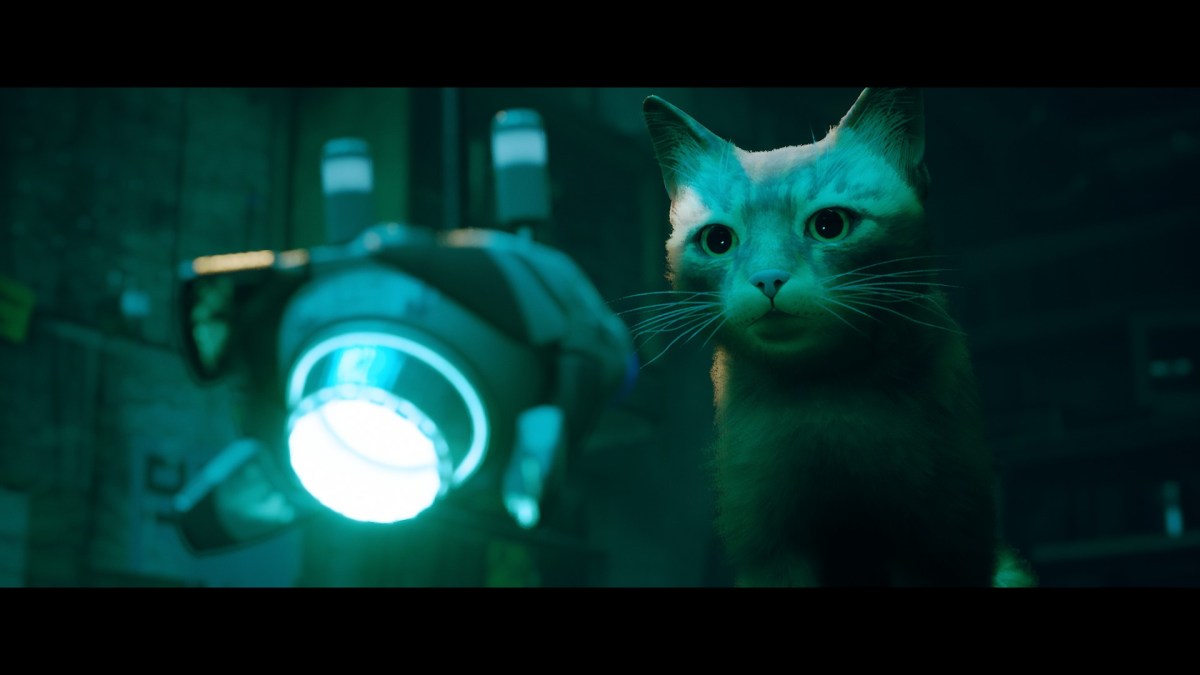
buddyinstrayweb