Defending innocent animals and innocent people aren’t mutually exclusive things.
Earlier this week New York became the first state in the US to ban cat declawing, which is a major victory not only for the many people who have been pushing for a ban for years, but especially for the potentially millions of cats who won’t be mutilated for the sake of someone’s couch or drapes.
It’s a time to celebrate, revel in a rare legislative victory for animal welfare, and look ahead toward similar proposals in other states. If more states follow New York, it could pave the way to a national ban.
Innocent, sentient creatures won’t be harmed as they have been for a long time. What could be better than that?
Here come the cat-haters
The thing is, legislation like this brings out the crazies and lots people who think protecting the innocent is a zero-sum game. In their world, helping animals and helping humans are mutually exclusive things instead of two goals that should be part of any coherent moral belief system.
Just because people are suffering in some parts of the world doesn’t mean we can’t help animals, just as helping animals doesn’t preclude us from helping people.
Declawing bans don’t take resources away from starving children in Somalia or America’s urban poor. Compassion for animals doesn’t somehow detract for compassion for people. In fact, all the research points to the opposite: That the way a person treats animals is a strong indicator of how they treat other human beings.
A comment on a story about New York’s historic declawing ban.The zero-sum game that isn’t.
Animal abuse and violence crime
That’s why there’s a link between animal abuse and violent crime against people. Animal abusers are five times more likely to commit violence against fellow humans, research shows. Criminologists have been aware of this link for many years, and smart investigators know to keep tabs on animal abusers because they often “graduate” to hurting humans.
That was the case with Luka Magnotta, a notorious animal abuser who, among other crimes, filmed himself feeding a young kitten to a python. Magnotta went on to kill a man with an ice pick, a crime that could have been prevented had detectives in Canada taken Magnotta’s animal abuse more seriously. Animal life has intrinsic value, and Magnotta should have been imprisoned for killing the kitten.
Cats scratch. Get over it.
Then there are the declawing advocates, the people who inexplicably argue that it’s okay to brutally mutilate living, feeling creatures in order to protect inanimate objects like couches and drapes.
One thing should be absolutely clear to anyone looking to adopt a cat: Scratching is completely natural behavior, and it’s your responsibility as caretaker to make sure you provide adequate scratching posts, as well as redirect your cat to those posts and vertical scratchers.
If you can’t or won’t accept that responsibility, you should not adopt a cat.
“Don’t touch my paws!”
Of course there are people who will insist declawing has no negative effects on cats. They’re wrong. That’s not a matter of opinion, it’s fact: A 2017 study, the most comprehensive of its kind, detailed a long list of negative effects that result from declawing.
Declawing is NOT a manicure
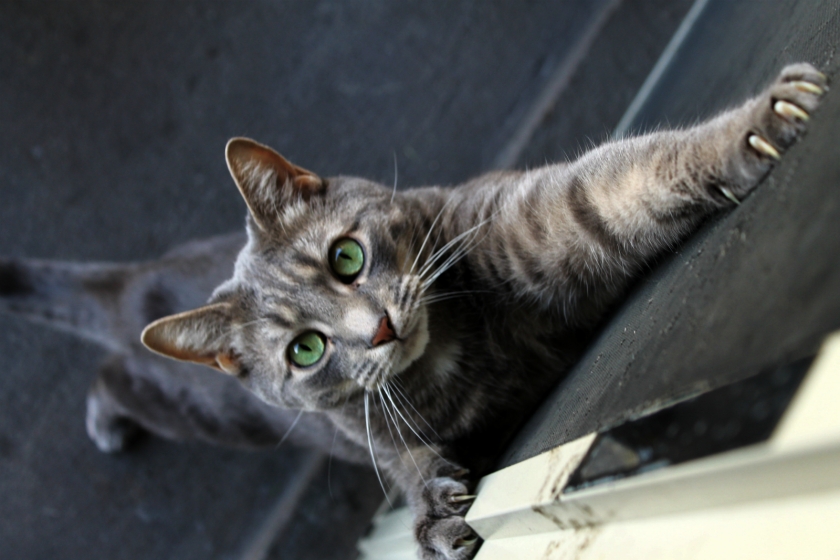
Declawing, which is the amputation of a cat’s feet up to the first knuckle — and not “kitty manicure” — causes lifelong pain in cats. Because cats are digitigrade animals, meaning they walk with their weight on their toes, the act of walking itself becomes painful. That leads to cats altering their gaits to limit the pain, which in turn leads to poor posture, which ultimately leads to early-onset arthritis and other physical problems, according to the 2017 study in the Journal of Feline Medicine and Surgery.
It’s a cascade of physical problems that leads to misery.
Because cats are famously stoic, doing everything they can not to show pain — they are prey animals as well as predators, after all — it may not be obvious, but declawing hurts them. A lot.
While people may think they’re solving a problem by declawing their cats, they’re creating new ones. Declawed cats are several times more likely to bite because they no longer have their claws for defense. They’re five times more likely to stop using the litter box, because the simple act of standing on litter granules is painful on their raw toe stumps. They’re more likely to be aggressive and ill-tempered.
Insult to injury
Those are all prime reasons why people surrender cats to shelters, causing another type of cascade: One in which a negligent owner has his or her cats declawed, then surrenders the cats because they’re acting out. Declawed cats are twice as likely to be surrendered to shelters as cats who are not declawed.
That directly contradicts claims by proponents of declawing, who say declawed cats are more likely to be adopted. In fact, declawed cats are more likely to end up without homes.
It’s 2019. The information is out there for anyone to look up, and ignorance is no longer an excuse. Declawing is wrong.
Here’s to hoping New York is just the first of many states to ban the barbaric practice.
“You don’t wanna tangle with these talons, bro. I’ll cut you. I’ll cut you for real. And then you’ll have to lather anti-bacterial cream all over your skin, and you’ll smell like medicine. Hah!”
He was small and his mew was only a squeak, but he already had a very big heart and lots of love to give.
Dear Buddy,
How did your hooman adopt you? What happened?
Head bump,
Stasi in ‘Stralia
Dapper, debonair and delightful.
Dear Stasi,
At the dawn of time in 1 AB (Anno Buddy), a mommy cat gave birth to a litter of feisty felines. They were strapping young kitties, and when the time came for them to pair up with humans and move to their new homes, they went one-by-one.
All except one, the smallest and runtiest of the bunch. He was sick and he had a limp, but he was a happy little boy. Every day he waved goodbye to his brothers and sisters, and wondered if anyone would want him. He was small and his mew was only a squeak, but he already had a very big heart and lots of love to give.
Then it happened. A mysterious stranger enquired about the runt and almost two weeks later he arrived in person to take the little kitten home. The little kitten was scared. This human put music on in the car ride home, and his singing voice was terrible!
The kitten cried.
“Don’t worry,” the human said as he drove. “Me and you are going to be best buddies! You’ll see!”
After arriving at a strange new place, claiming every inch of it and pooping under the human’s bed for two weeks, the little kitten knew he had found his home. The human’s bed became his bed. The human became his pillow. Things were turning out okay.
The human fed the kitten healthy food. The kitten’s limp improved, his coat started to look healthy, and his poops were less nasty. The kitten also learned that the box with litter inside it was for the aforementioned pooping, not for making sand castles.
The kitten still had no name. One day the human’s mom observer her son with the kitten, and after her son called the cat “little buddy,” she said: “That’s a perfect name for him: Bud. You guys are the Buddies. Buddy number one and Buddy number two.”
They were henceforth known as Big Buddy and Little Buddy.
Buddy the cat surveying his territory from an elevated position.
The big human and little cat became best friends. One day Big Buddy brought home a harness. Little Buddy didn’t like it. But after a lot of practice, Little Buddy learned to accept the harness and learned how to walk on it next to his Big Buddy.
It was during one of those walks that a human female saw Little Buddy and declared him the cutest kitten ever. Suddenly Little Buddy realized he was very handsome, and embarked on a career as a kitty model that continues to this day.
Soon Little Buddy began pumping iron, and began the transformation to the strong, regal kitty with huge muscles that you’re familiar with today.
And there you have it. Buddy’s origin story.
– Buddy the Brave
Many scientists believe Budus Felidus, left, is directly related to Panthera Onc, right, also known as the leopard. Others believe Budus Felidus is a sub-species of tiger.
Thousands of years ago an evil human was looking for a way to annoy cats and invented the first door.
Dear Buddy,
What is the sick human fascination with doors? Who invented these vile things?
Better yet, how do I get them to open?
I hate doors!
– Hater in Honolulu
Dear H in H,
Welcome to the club, hermano!
No one really knows for sure where doors came from. Our best scientists have a working theory that humans invented doors thousands of years ago as a way to torture us cats.
It worked.
Not much foils us, mind, but doors are a uniquely anti-feline feature of human homes, and we all loathe them. But take heart! They can be defeated.
Doors with handles are the easiest to open!
If the doors in your home have handles instead of knobs, and they’re low enough that you can reach them without jumping, then what are you writing to me for? Go open them!
However, if your humans were evil enough to buy doors with knobs, or if reaching the handles requires you to jump, you’re going to need a little more finesse, my friend.
I call it the jump-and-twist. You’re going to need to leap up toward the knob while at the same time twisting your body in mid-air — a trivial move if you’re muscular like I am — so that your back feet catch the door frame. Then use the leverage from your back paws to push while keeping your front paws on the knob. Make sure you turn it!
A kitty successfully completes the jump-and-twist and even manages to avoid the water trap his evil humans have laid for him. Kitty 2, Humans 0.
Finally, if you’re not athletic or the door is too difficult to open (or if you’re just lazy), you can employ what I like to call The Buddy Special.
The Buddy Special is very easy: Simply stand next to the door and cry, making your meows more pitiful-sounding by the second. Be sure to hit the sweet spot frequency that mimics a human baby’s cries: Humans are compelled to get up and investigate when they hear that sound!
Good luck and stay Buddy, my friends!
– Buddy the Wise
Not proper technique: Going under the door is a good way to get stuck! However, a single paw under the door is a good way to remind human that you are watching them poop.