Recent News Stories Claim People Have Spotted A Type Of Cat That Doesn’t Exist

It’s easy to mistake house cats for larger wildcats when photos and videos are blurry and lack familiar items to establish a sense of scale. The same phenomenon is responsible for UFO sightings and cryptid creatures like the Loch Ness Monster.

Recently several reports have been making a big deal about blurry videos of black cats, claiming they’re “black mountain lions” or “black panthers” roaming in places like Missouri and Louisiana.

The footage of the first video was shot in Missouri, where pumas once ranged, were extirpated in the 20th century, and have returned in small numbers in recent decades. Like most photos and videos of cryptid or unidentified animals, this one is blurry, taken from a distance, and lacks any object near the animal to provide a sense of scale. The second video is simply a black house cat with her kitten in rural Louisiana.

Our brains are pattern recognition machines and when the information we’re looking for — be it spatial, detail or contextual data — isn’t present, our minds tend to fill in the gaps. That’s the reason why we see faces in clouds, creatures in shadows, men on the moon and the Virgin Mary on grilled cheese sandwiches. (The technical term for “perception imposing meaningful interpretation on a nebulous stimulus” is “pareidolia,” from the Greek for “instead of” and “image.”)

Compounding the problem is the fact that the word “panther” is one of the most confusing of felid descriptors, a word that vaguely refers to physically large cats but doesn’t refer to any particular species, coat pattern or color.

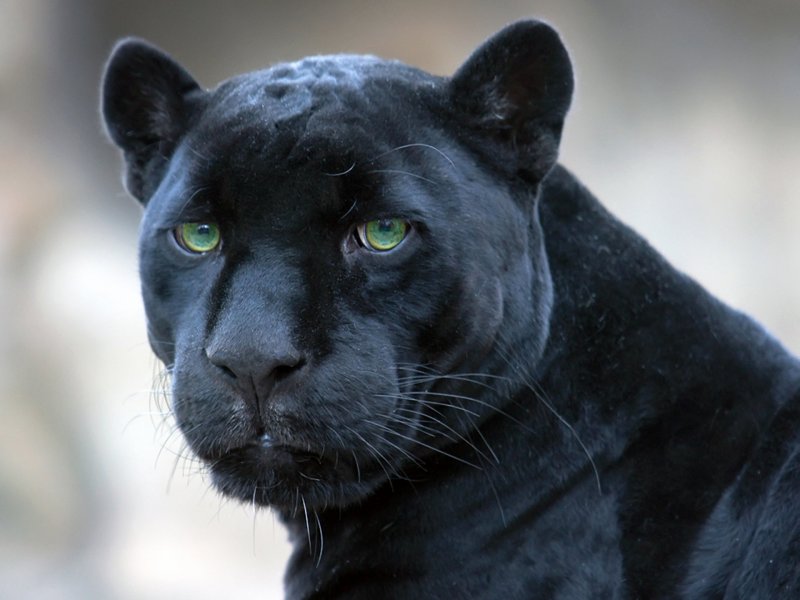
Above: A jaguar, a leopard, a puma (mountain lion) and a melanistic jaguar. Although jaguars and leopards look nearly identical, jaguars are stocker with thicker limbs and have blotches inside their rosettes, while leopards do not.

The word panther can refer to a puma, a jaguar or a leopard, but only the latter two species can have melanistic (black) coats.

Contrary to popular belief, even a black cat’s fur is not entirely black — you can still see the rosettes and spots of their coat patterns up close and in certain light conditions.

blackjaguar
This jaguar’s rosettes and spots are visible in direct light. Jaguars in the wild are rarely seen so close or in “perfect” conditions, making it difficult to see coat markings of melanistic members of the species. Credit: Wikimedia Commons

However, jaguars don’t range in Missouri, leopards are not native to the Americas, and if someone indeed spotted one of the very rare pumas in Missouri, it could not be black because melanistic pumas do not exist.

Mountain lions (Puma concolor in taxonomic nomenclature) are physically large and are the second-biggest cats by size and weight in the western hemisphere after jaguars, but they are not technically “big cats” because they are not part of the pantherinae subfamily. Pumas cannot roar like big cats, but they’re capable of the classic wildcat “scream,” and they can even meow like small cats.

By process of elimination — and the cat’s physical shape — we can conclude the Missouri video shows a house cat that looks larger because there’s nothing nearby to give us a sense of scale.

Grilled cheese Virgin Mary
This piece of a grilled cheese sandwich sold for $28,000 on eBay in 2004 because bidders believed the Virgin Mary’s face miraculously appeared on it. Credit: eBay

It may seem unlikely that someone confuses a house cat, which weighs an average of 10 pounds, with a puma, which weighs on average more than 100 pounds, with the largest males pushing 220 pounds.

But it happens all the time even in close encounters, like the incident this summer in which a man riding a dirt bike swore he was ambushed by a puma only for DNA to establish beyond doubt that his attacker was a domestic kitty. For what it’s worth, he still swears it was a mountain lion.

If you enjoy reading content from Pain In the Bud, please consider whitelisting us from your browser’s ad blocker. Thanks!
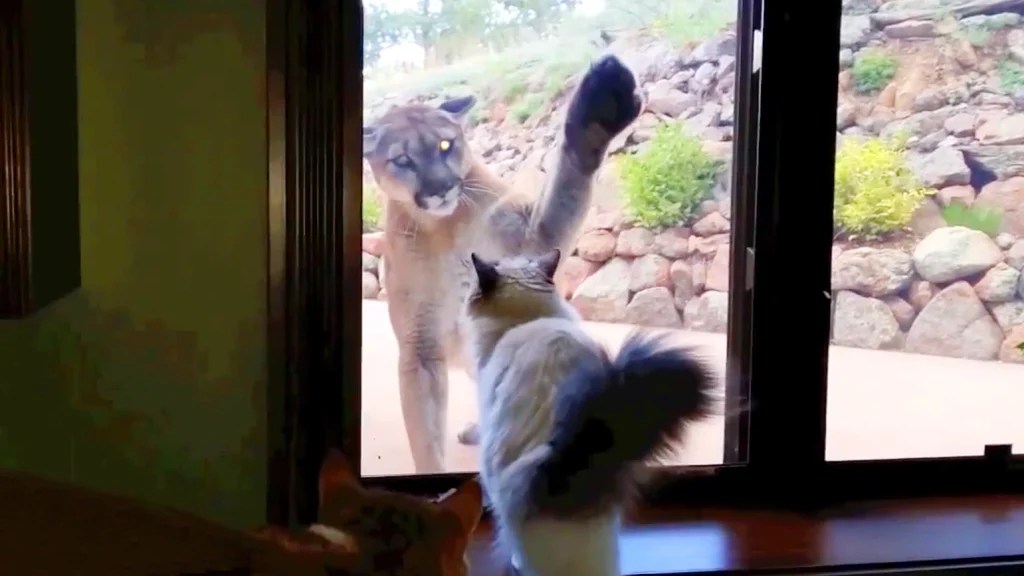
Like, OMG! This Kitty And Puma Are Totes Besties!

Plus: The awesome and terrifying cats and proto-cats of prehistory!

OMG, you guys! No cap, you gotta totally check out this adorbz video of a sweet widdle kitty witty becoming best fwiends with this mountain lion!

Phoebe the cat sees this cute AF puma near the back door of her home, curiously looking inside. It’s love at first sight as kitty and kitty see each other! Per Parade Pets:

“[T]he kitty in this TikTok video is completely fascinated by the big kitty outside her window. There’s no getting her away from her new friend! 

On Sunday, August 25, @cricketandstrawfl shared this footage of her Tuxedo Cat posted up at the back door in their house, where a cougar was hanging out. It goes without saying that the cougar in question was many times bigger than Phoebe, but that didn’t seem to scare her at all. 

It seemed like the cougar was pretty curious, too. He didn’t appear to be aggressive; instead, he was staring at Phoebe and gently pawing at the glass, trying to figure out who the tiny cat in the window was.”

OMG-hee! Look at the big kitty gently pawing at the door! He wants to give the little kitty a huggy-wuggy!

SO ADORBZ! The puma pawing at the door wasn’t testing its strength to see if he could snag a quick meal, those were totes signals of love! Teehee!

Felid predators of pre-history: They will eat you

If you’re in need of a palate cleanser after all that sugar, the BBC’s Discover Wildlife has a rundown of prehistoric cats and their particularly fascinating proto-cat ancestors, some of whom looked more classically cat-like than several species of true cats. Isn’t convergent evolution cool?

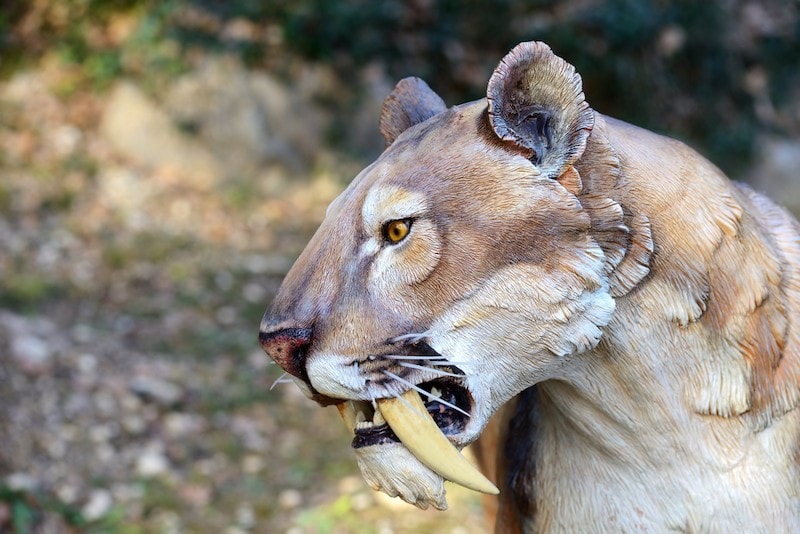
There’s the famous smilodon, the saber-toothed cat, xenosmilus, the so-called shark-toothed cat, and homotherium, the scimitar-toothed cat. Outdoing each other with increasingly sword-like teeth was apparently a big thing in the felid world back then.

There’s also the cave lion, the last of the UK’s big cats, and miracinonyx, the American cheetah, but did you know that simbakubwa, the “great lion” of Africa, topped out at almost 3,000 pounds?

Simbakubwa
Simbakubwa was massive, making modern lions look almost like house cats in comparison.
Dinictus
Dinictis looked like a cat, behaved like a cat and hunted like a cat, but was not part of the felidae family. Credit: Wikimedia Commons

Simbakubwa and dinictis were examples of “false cats.” That is to say, they were not part of the felid lineage, but closely resembled cats in body plan and behavior through convergent evolution. Nature found a niche, and several different species filled it for a time.

Dinictis in particular looks strikingly like modern big cats, which makes it even more surprising to learn it’s not part of the genetic lineage of the felid line.

Finally — or firstly — there’s proailurus, the first cat or “dawn cat,” from which all true felidae species can trace their lineage. Appearing almost 31 million years ago proailurus enjoyed napping, climbing trees and eating Temptations. Okay, we made that last part up. But still. If proailurus were around today, it would probably go just as crazy for the kitty crack as our house panthers do.

Top image via Youtube.

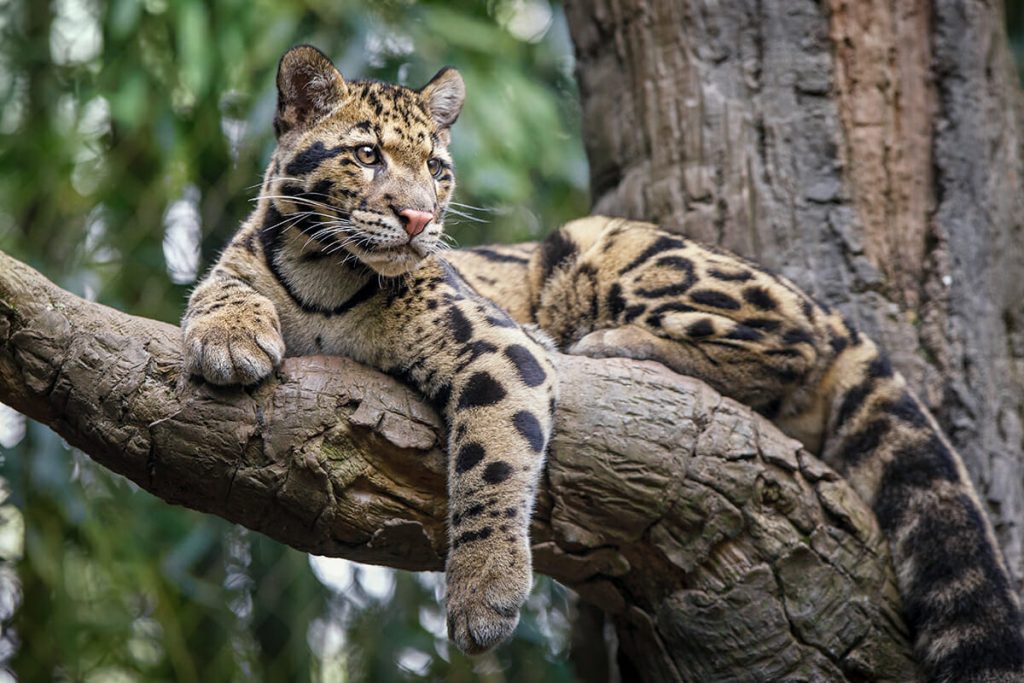
Amazing Cats: The Sunda Clouded Leopard

This singular species of wildcat exists only on two islands and has evolved to live a semi-arboreal existence deep in the jungle.

While tigers, lions and domestic cats are the stars of the felid world and command the lion’s share (pun intended) of the attention, even from cat lovers, there are obscure species living in far-off locations where they’re rarely glimpsed by human eyes.

There’s the fishing cat, the black-footed cat and the sand cat, and then there are species that are obscure even among the obscure. The Sunda clouded leopard fits into that category, inasmuch as the unique felid can fit into any category.

Like orangutans, the Sunda clouded leopard can be found in only two places in the world: the Indonesian islands of Borneo and Sumatra. They’re faced with the same existential threat that has pushed orangutans dangerously close to extinction, which is the relentless destruction of old-growth jungle to clear land for more palm oil plantations.

Sunda clouded leopard
The species has an incredibly long tail that can match or exceed the length of its body. The large tail is crucial in a jungle environment, where it acts as a counterbalance high above the ground. Credit: Panthera

Palm oil is coveted by multinational corporations in the food and cosmetics businesses, and it’s in everything from chocolate and instant noodles to lipstick and margarine, according to the World Wildlife Fund.

The problem with razing old growth jungle and forest is that it doesn’t just grow back. They’re extremely delicate ecosystems that have arrived at a natural balance over thousands of years, with every species of animal and plant contributing something vital to the vibrant tapestry of life the jungles host and support. You can’t just plant trees and usher animals to a new home. It would take hundreds of years for those new jungles to even superficially resemble the lifegiving old growth jungle.

There are heartbreaking images of shocked orangutans sitting in the ruins of their former homes, with nothing but the stumps of trees and dozer-trodden vegetation as far as the eye can see.

Those are the lucky ones. The loggers who work for massive multinational corporations aren’t bound by rules or ethics, and they won’t wait for animals to clear out before they destroy.  They often shoot orangutans on sight regardless of whether the animals are carrying young.

Baby boot camp
Roux, a baby orangutan in a “boot camp” for orphans, learns how to walk. Credit: Phys.org

That’s the primary reason why Borneo and Sumatra are now home to entire academies for orangutan orphans, who spend at least eight years learning how to fend for themselves with the help of specialists who teach lessons that would normally be taught by the orphan orangutans’ mothers. They include the very basics, like how to move and climb through the jungle, as well as crucial information such as which berries to avoid while foraging.

While there’s no “academy” for clouded leopards and the felids are more adept at avoiding human wrecking crews, they’ve suffered the same fate as orangutans when it comes to dwindling jungles.

This is the situation Sunda clouded leopards find themselves in, so when a trail camera recently captured footage of a mother and her two cubs, conservationists were thrilled.

The footage comes from camera traps belonging to the Orangutan Foundation, and it’s the first time anyone’s managed to obtain video of the Bornean clouded leopards with cubs in tow. The brief video shows the little family bounding through the jungle. They quickly move past the camera, but not before one of the cubs stops to look right at it with typical kitten curiosity.

Sunda clouded leopards are extraordinary cats. Size-wise, they are firmly in the “medium size wildcat” category, with males weighing about 50 pounds. Despite that, they are members of pantherinae, the genus of big cats, having diverged from a common ancestor shared with tigers, leopards, lions and jaguars.

As further proof of their in-between status, Sunda clouded leopards can neither purr nor roar. Typically, each species of felid can do one or the other. Even the species’ scientific nomenclature, neofelis nebulosa, references its intermediate status. (If you encounter alternate taxonomy for them, it’s because the clouded leopards of Borneo and Sumatra are considered distinct subspecies.)

“Due to a different bone structure in their neck, the clouded leopard cannot roar like the larger cats, but also cannot purr because it lacks the fully ossified hyoid bone that allows small cats this ability,” the Smithsonian National Zoo’s keepers explain.

Sunda clouded leopards have several unique adaptations that allow them to thrive in arboreal environments. Their massive tails act as crucial counterweights, allowing them to traverse branches high above the ground without falling. Their paws and paw pads are specialized for gripping tree branches, and their ankles can articulate in ways other felid ankles cannot, allowing the jungle-dwelling wildcats to descend from trees head-first.

Domestic cats infamously lack this adaptation, which is why firefighters are also part-time cat rescuers, coaxing the terrified little ones down from trees, utility poles and rooftops.

sundacloudedleopard
Credit: Panthera

The clouded leopards of Borneo and Sumatra are also undeniably cute. People have noticed, which is why one of Google’s auto-complete suggestions for Sunda clouded leopard suggests the word “pet” as an addition. It’s okay to fantasize about having a clouded leopard buddy, but in addition to the fact that they are endangered, they’re also wild animals.

Consider the fact that across the estimated 200,000 years of our species’ existence, homo sapiens have domesticated precisely one felid species, and even that’s not entirely accurate. Felis catus played just as much of a role — and arguably more — than humans did in their own domestication. As predators and obligate carnivores, they are unique among domestic animals, and it took and equally unique set of circumstances to bring cat and man together.

Instead of lamenting the fact that Sunda clouded leopards can’t be pets, we can admire them in the best way possible, from a distance, while helping ensure the survival of this extraordinary, distinctive species by donating to groups like Panthera, the WWF and Global Conservation.

Previously:

Amazing Cats: The Mysterious Marbled Cat
Amazing Cats: The Rusty-Spotted Cat
Amazing Cats: ‘He Who Kills With One Bound’
Amazing Cats: The Puma

Tribe Discovers Ancient Three-Toed Cat’s Fossilized Footprint Deep In Forest

The strange footprint may date back as far as 35 million years ago, according to a preliminary analysis.

Before house cats, tigers and lions, before sabretooth cats and their scimitar-toothed relatives, Pseudaelurus (pseudo-cat) stalked the forests and plains of Europe, Asia and North America between eight and 20 million years ago.

Before Pseudaelurus, Proailurus — an animal whose name literally means “before cats” — stalked the Earth beginning 30 million years in the past.

Proailurus was thought to be the earliest true feliform ancestor, but now there may be evidence of a felid or feliform animal that predates both Proailurus and Pseudaelurus. Feliform is a term that encompasses cat-like creatures both extinct and extant, from familiar felines to civets and mongoose.

Deep in South India’s Nallamala Forest, near one of the country’s largest tiger reserves, members of the aboriginal Chenchu tribe found a fossil that could put the cat lineage back even further.

The fossil is well-preserved and clearly defined, made by an animal whose paw was about the size of an adult man’s hand. It bears a striking resemblance to tiger pug marks, but perhaps the most striking feature is its three toes.

Feliform fossil
The recently discovered fossil. Credit: Times of India

“Based on the distinctive characteristics of the sandstone, identified as the Cuddapah subgroup Quartzitic sandstone, the estimated rock’s age is approximately 35 million years,” archaeologist Arun Vasireddy told the Times of India. “It was around this time that sandstones were formed and it is likely that the animal would have cast its prints.”

Biologists have had to reshuffle their picture of felid lineage many times over the past century and a half as new discoveries uncover previously unknown species of cats and cat-like creatures. Since they first appeared, cats have taken hundreds of different forms with significant variations in size, appearance, hunting methods and preferred terrain.

The experts aren’t popping the champagne yet. There’s a lot more work to do before they can declare a newly-discovered species or even offer more than educated guesses about its niche and appearance.

Nallamala Forest may yet hold more secrets, and research teams will look for additional prints as well as potential remains. It’s a process that will unfold over years and decades, perhaps even longer.

Still, it’s a tantalizing clue about the past and the origin of some of Earth’s most iconic animals.

In the meantime, Vasireddy said, “nothing can be said clearly until further research.”

Homotherium_serum
A reconstruction of Homotherium, a scimitar-tooth cat that first appeared about four million years ago. Credit: Wikimedia Commons
OLYMPUS DIGITAL CAMERA
Styriofelis lorteti predates modern pantherine cats and was the size of a small leopard. Credit: Spanish National Research Council and the National Museum of Natural Sciences in Madrid
Fossil foot
The recently-discovered fossil compared to a man’s foot. Credit: Times of India

DNA From Dead Sheep In UK Matches Big Cats, But Is That Proof Of Their Presence?

Rumors of big cats in the UK countryside have persisted for years, with witness claims from all over the country. The latest reported sighting was in northern England.

People who really want to believe big cats are running around the British countryside are ecstatic with the news that a DNA sample from a dead sheep reportedly tested positive for panthera DNA.

The DNA sample was swabbed from a freshly-killed sheep carcass “at an undisclosed upland location” in Cumbria, northwest England, a witness told BBC Wildlife. It’s exactly the kind of countryside where people have been reporting big cat sightings for years, although the sightings aren’t confined to that area, with other witnesses claiming they’ve seen large felids as far as the UK’s southern coast.

Sharon Larkin-Snowden, who lives nearby, told a big cat enthusiast podcaster that she disturbed the “big cat” while it was feeding. The startled felid took off and jumped a stone wall, leaving the partially-eaten sheep, Larkin-Snowden said.

“I assumed at first it was a sheepdog, but then I did a double take and realised it was a black cat,” she said. “It was big – the size of a German shepherd dog.”

Jaguar in a pub
“I could really go for a Chinese! Anyone else wanna go for a Chinese?”

A swab was collected — the details are sketchy on who did the collecting and when exactly they submitted the sample — and sent to the University of Warwick’s Robin Allaby, a professor of life sciences.

Allaby, whose specialty is studying the genetics and evolution of domesticated plants, began offering a DNA testing service for the public some 12 years ago in response to the persistent rumors of big cats in the countryside. In the past samples have yielded DNA from foxes and other animals, but Allaby says this one matched the genetic profile of a big cat, although he cannot say which species.

It’s not unusual for a DNA sample to match to a genus, in this case panthera, but not to a specific species if the sample was degraded or only partial.

Rick Minter, who has made a career of tracking alleged big cat sightings across the UK, says he believes the mystery cat is a leopard. Leopards and jaguars are the only two big cats who have true melanistic color morphs — meaning some of them have virtually all-black coats — and Minter says he believes it’s more likely the former.

Neither are native to the UK or Europe: Leopards range from Africa to Asia, while jaguars range from south to Central America, with some populations edging slightly into the US.

puma sits on tree
Britain’s big cat enthusiasts say they believe pumas are among the wild cats living in Credit: Jean Paul Montanaro/Pexels

Why isn’t a DNA match evidence of big cats in the UK?

If the lab results say the sample came from a big cat and that result is consistent with the witness account, what’s the problem?

Chain of custody, for one. We don’t know anything about who took the sample, where it was taken, the time elapsed between the kill and the sample swab, or who may have handled it before it reached Allaby.

In fact, we don’t know if there was a dead sheep to begin with.

If I were a prankster living in the UK, for example, and was friendly with a keeper at a local zoo, I could have the keeper swab an animal, bag it and hand it over to me. There are dozens of conceivable ways a person could obtain a sample even if they don’t know someone who works in a zoo.

Leopard in a pub
“So we left the sheep there at the edge of the field and made sure the lady saw us before we buggered off over the fence. Next day, we was in all the papers! A right laugh that was, mate.”

The problem is the provenance of the sample and what happens to it between the time it’s collected and ends up in the hands of a scientist like Allaby.

This is why chain of custody is paramount in criminal trials, and why there must be a complete record of who handled samples from collection in the field to the lab. Even in the absence of foul play, an improperly handled sample can be contaminated and render test results meaningless.

It’s not a matter of trust, it’s the simple fact that extraordinary claims require extraordary evidence, as Carl Sagan was fond of saying. Short of capturing one of these animals or getting clear, indisputable footage, any other claimed proof has to be ironclad.

Speaking of footage, that’s another issue. It’s extremely difficult to believe that a breeding population of big cats can exist in the UK countryside for years or even decades without a single definitive photo or video. The UK’s rural areas may not be blanketed by CCTV cameras like London, but they’re not the Amazon either. People live, work and farm in those regions, cameras are more ubiquitous than ever, and farmers take steps to protect their livestock, including installing cameras.

Big cats don’t just feed and vanish into the mist. They mark trees with their claws and urine, they leave distinct pug marks, they leave distinctive bite marks on their prey, and they make noise. To paraphrase one naturalist, when big cats are living nearby, you know it. Even if you don’t see them, signs of their presence are ubiquitous.

To accept the claims of tigers, leopards and pumas gallavanting in the fields around small towns and villages, we’d have to suspend disbelief or conclude that these are some sort of previously unknown ghost cats who can fade in and out of the physical plane.

I’m not a skeptic to be a killjoy. If big cats really were running around the UK, that would be a hell of a story. But we’d still need convincing evidence, and this isn’t it.