News sites are exploiting another tragedy for clicks.
If you’d just skimmed headlines like “Kiss of Death: Elderly Woman Killed By Cat” and “Tragedy as woman is killed by her CAT, as doctors issue a dire warning to pet owners” you’d think a woman was somehow violently killed by an enraged 10-pound cat.
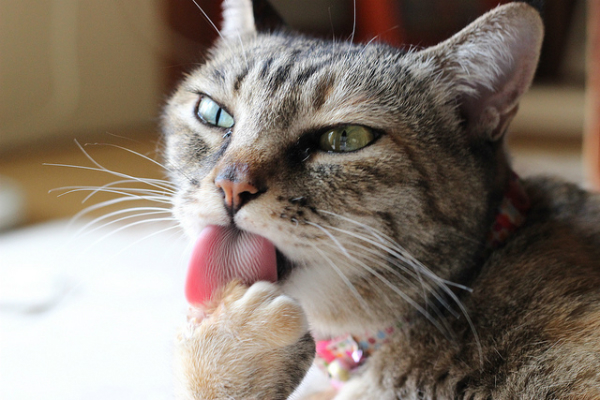
The reality is much less dramatic: A woman’s cat scratched her, then licked the wound.
Through her saliva, the cat named Minty infected the victim with bacterial meningitis, doctors told the New Zealand Herald.
The woman fell into a coma, was found by relatives and brought to Melbourne’s Box Hill Hospital, where medical staff kept her sedated as they tried to treat her. With few options, the family in consultation with the doctors decided to wake her to say goodbye, then placed her back in a coma and withdrew life support.
“Infections related to cat bites and scratches like this person, we’d get at least one a week where somebody comes into the hospital,” Lindsay Grayson, director of infectious diseases at Melbourne’s Austin Health, told the newspaper. “It is very important that if a cat is biting or scratching you, you mention it to your GP.”
The woman was 80 years old, and the story suggests she had a compromised immune system. It didn’t provide any other details about her overall health, existing co-morbidities or whether her cat was allowed outdoors. Outside cats have a greater chance of picking up bacteria that can harm humans, experts say. A separate article mentioned the victim took blood thinners.
Grayson’s warning is simple and spot-on: Take bites and scratches from cats and dogs seriously, get the wounds treated and call your doctor. Something that looks like an inconsequential scratch could prove deadly or cause major health problems.
Cats and dogs live in more than 100 million homes in the US alone and infections are exceedingly rare. Grayson is aware of that, and he’s giving solid preventative health advice to people in the pet-owning demographic.
Unfortunately calm and reasoned doesn’t draw clicks, so the story is propagating via headlines that conjure images of a cat literally murdering its owner.
It should go without saying that the cat didn’t intend to cause any harm and is incapable of understanding what happened. All she knows is that her human is dead, which she’s certainly distraught about, and it sounds like she’s not getting sympathy or affection from her new humans.
“I was in shock for a good couple of weeks,” the woman’s daughter said. “I’ve tried not to hate the cat … but then I was sitting with it trying to be nice and it lashed out at me as well for no reason.”
With all respect to the grieving, there most certainly is a reason. The cat is grieving too, she’s living with new people in a new situation, and she’s almost certainly scared. It’s an unfortunate situation for all involved.
With his bed “constantly defiled” by cat poop, the husband slept on a mat.
A judge in Singapore has granted a divorce to a 70-year-old man who was driven to desperation by his wife’s obsession with cats.
His wife says she was visited in a dream by her late mother, who told her to be kind to cats, for it was the only way she would “cross into paradise.”
The woman took the dream seriously, feeding strays and taking them home.
“This feline collection created quite a nuisance,” Judge Sheik Mustafa said. “The cats roamed around the home freely. They were not toilet-trained and would urinate and defecate indiscriminately.”
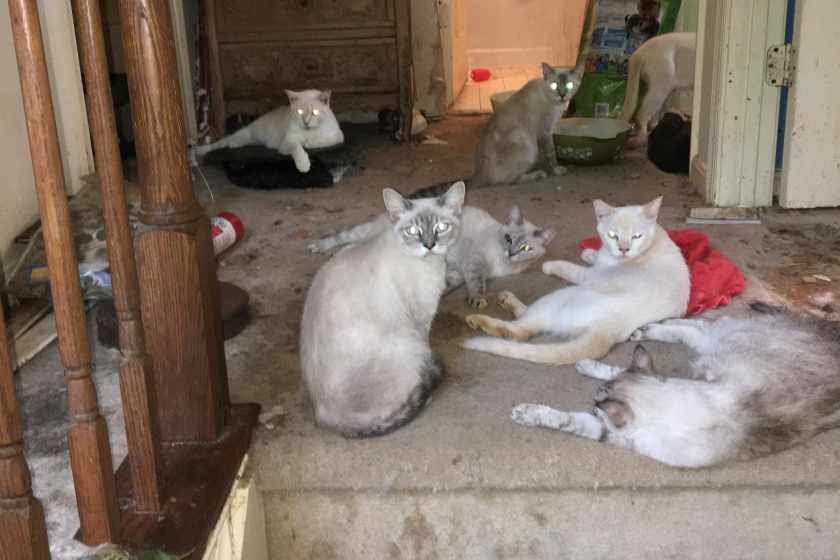
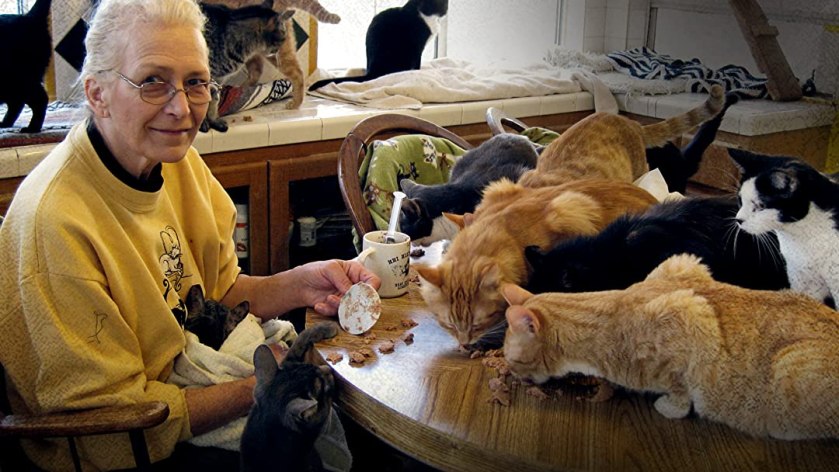
A photo taken in the home of a 62-year-old woman who had 125 cats and three rabbits in her home. Credit: Montgomery County (Maryland) Animal Control
Things got worse as the fecal output increased in proportion to the number of cats the woman adopted. Neighbors called police to complain about the “stench of cat faeces and urine emanating from the matrimonial home.”
The woman’s husband was running out of patience too: With his bed “constantly defiled” by cat poop, he started sleeping on a mat.
Cops warned the woman to curtail her cat collection, per Singapore’s Today, but she kept collecting them like Pokemon. In 2003 — six years after his wife’s allegedly prophetic dream — the man called police again and begged them to do something, but the cops said it was a domestic dispute and declined to arrest his wife or otherwise interfere beyond giving her another warning.
The final straw? The man was sleeping on his mat one night in 2007 when he woke up soaked to find one of the cats urinating on his face.
He left the couple’s two-story terrace home permanently and moved in with his brother-in-law, who presumably knew his sister had gone off the deep end and was sympathetic to her husband’s plight.
Animal hoarding is a serious problem, with the cats and dogs often living in horrid conditions. Credit: Animal Planet
The cats weren’t the only issue in the marriage: The husband alleges the wife estranged him from their children, and the wife helped herself to half her husband’s retirement pension, reasoning that she was entitled to it even though they’d been separated for years.
The wife had also been embroiled in a legal battle with a domestic servant. The maid, who helped care for the army of cats, said she wasn’t paid. The woman in turn accused the maid of killing 40 of her cats. The judge sided with the maid.
Neither party was named in legal documents from Singaporean courts. Mustafa issued his decision on May 21.
After years of fighting the divorce to avoid having to split or sell the home they owned, the wife finally agreed to a divorce settlement, ending their 45-year marriage, with Mustafa ruling that “on a balance of probabilities, the husband has proved his case.”
“I considered the possibility of reconciliation. I find that there is none. The parties’ attitudes are utterly not compromising; the husband is insistent on ending the marriage, and the wife is in vehement refusal to end the marriage,” Mustafa said. “The couple have been consciously estranged from each other for 15 years. That is a long period of time by any measure. There is no ember of love or affection left to rekindle.”
Sometimes it seems like writers at the New York Times are in a competition with each other to prove who’s the most out-of-touch.
The latest effort comes courtesy of Alexandra Marvar, who begins her profile of a designer cat breeder by reminiscing about the good old days when those lacking sense or self-awareness could be fabulous by keeping wild animals as “chic pets”:
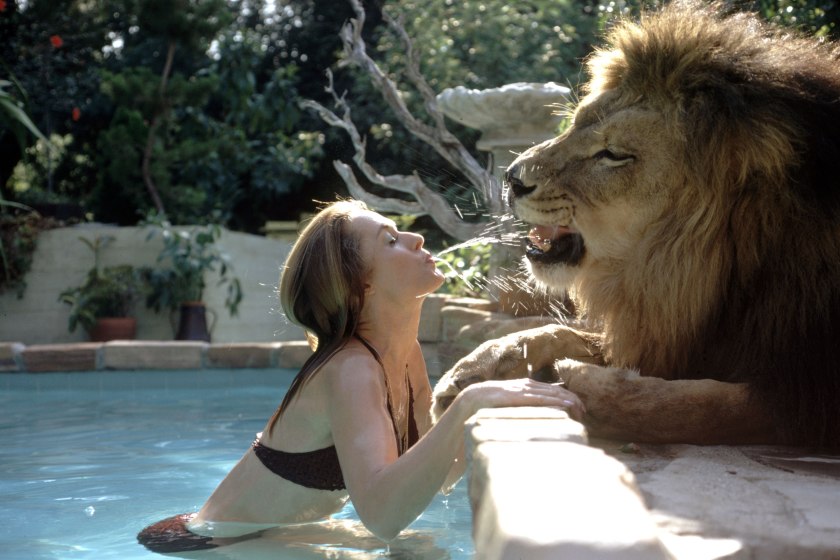
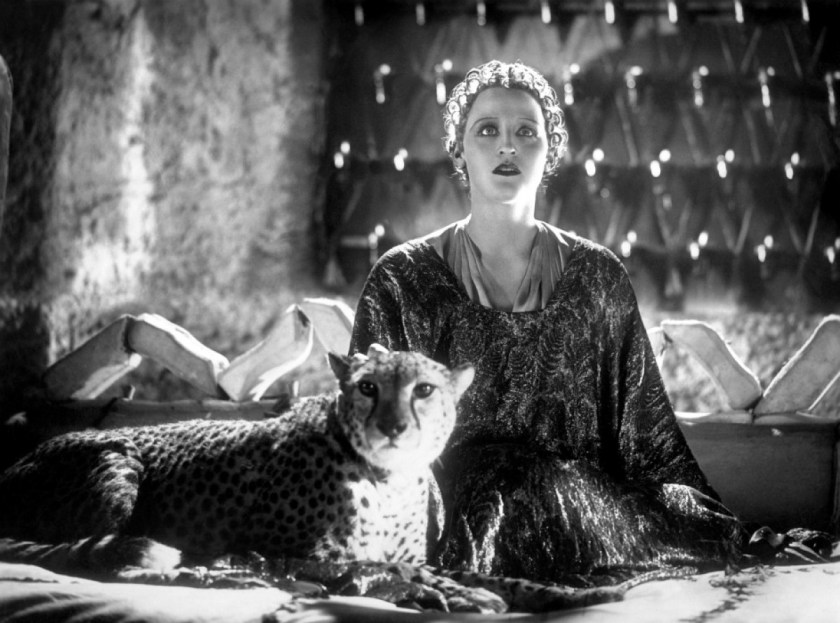
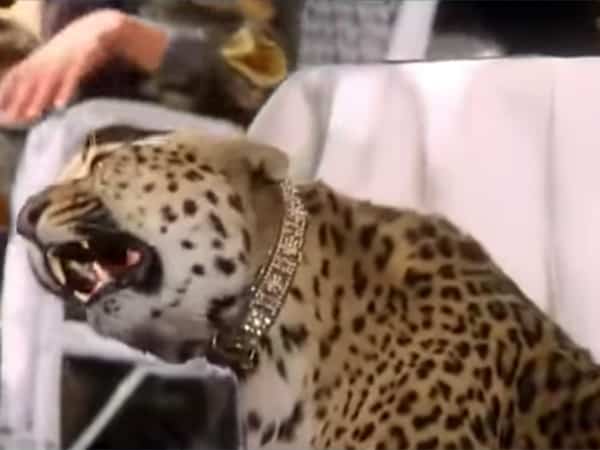
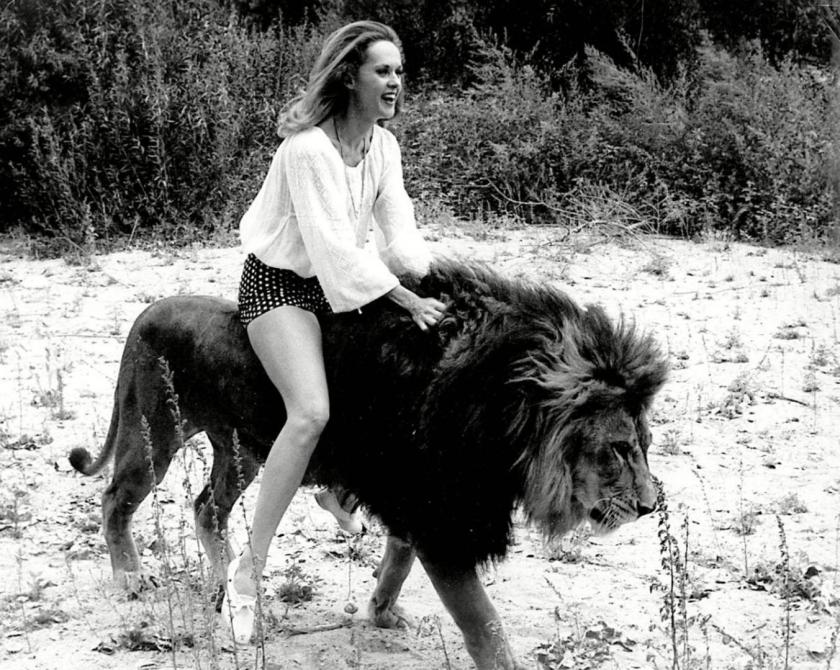
Not so long ago, wild cat companions were associated with glamour, class and creativity. Salvador Dalí brought his ocelot to the St. Regis. Tippi Hedren lounged with her lions in her Los Angeles living room. Josephine Baker’s cheetah, collared in diamonds, strolled the Champs-Élysées. In their time, these wild creatures made chic pets.
But, Marvar writes, those animal welfare activists had to come and ruin things for fabulous people:
But by the mid-1970s, a wave of awareness and wildlife protection legislation changed both the optics of owning a big cat, and the ability to legally purchase one.
Killjoys. Don’t they know Dali, Hedren and Baker were just being fabulous? They were being classy and creative! Who has time for people who claim it’s wrong to keep a wild animal that ranges 50 miles a day confined in a living room? They have gilded cages, diamond collars and meals of filet mignon!
Hedren being fabulous with one of her fabulous lions in 1971. Credit: Michael Rougier/LIFE
Now that wild cat ownership has been relegated to mulleted felons and gun-toting Texans who keep exotic cats to hold on tight to “muh freedoms” — stripping the practice of all glamour, class and fabulousness — where can the wealthy turn when they don’t just want pets, but status symbols?
The creators of the latest designer breeds, Toygers and Bengals, of course. Meet our heroes, the late breeder Jean Mill and her daughter, Judy Sugden:
Meanwhile, a cat breeder named Jean Mill was working on a more practical alternative: her leopard-spotted companion was just ten inches tall. At her cattery in Southern California, Ms. Mill invented a breed of domestic cat called the Bengal, which would offer wild cat admirers the best of both worlds: an impeccable leopard-like coat, and an indoor-cat size and demeanor.
Note: If you think a Persian makes you fabulous, surrender that cat to the nearest shelter immediately. Persians are so 2013!
[A Bengal cat breeder] recalled there used to be “tons” of ads for Persian cats in the back of Cat Fancy magazine. But the Persian’s prim, manicured aesthetic is no longer en vogue. “That look doesn’t say, ‘I can survive in the jungle,’” Mr. Hutcherson said. “It says, ‘I need somebody to open this can of cat food because there’s no way this cat is catching a mouse.’”
Carole Baskin, the founder of Big Cat Rescue and a star of Netflix’s “Tiger King,” has called toyger owners “selfish” and said creating new breeds is “strapping a nuclear warhead to the feral cat problem.” Others might argue that compared with shelter pets, designer species (the rarer of which may cost as much tens of thousands of dollars per kitten) are a different beast altogether.
Others might argue! Who are those others? Uh, Marvar and…and…nevermind. The important thing to realize is that there are cats — the riff-raff adopted from animal shelters by plebs — and there are chic, elegant, glamorous beasts. To compare a shelter pet to a Toyger would be like comparing a Geo Metro to an Aston Martin.
Brigette Helm being fabulous with her cheetah in 1932.A close-up of Josephine Baker’s cheetah, Chiquita, and her diamond collar, photographed in the 1920s. Credit: FrockFlicks
In the glowing profile of Mill’s daughter, the toyger breeder — whose cats the Times compares to the Mona Lisa and whose work it describes as a “creative effort” in “cultivating” perfect “beasts” — the newspaper devotes a single line to those who object to the industrial manufacture of designer pets when shelters are forced to euthanize cats who aren’t adopted:
…the designer cat market is a thriving one where supply rarely meets demand, and in its service, more than 40,000 registered house cat breeders around the world are devoted to supplying pet owners with Ragdoll, Sphynx and other prized breeds. (PETA has argued this clientele should instead adopt cats from a shelter.)
The fact that 1.4 million pets are put down every year in the US wasn’t considered important enough to mention in the Times story. Too much of a buzzkill. Ain’t no one got time for that!
The rest of the Times’ editorial staff and its stable of contributors will have a tough time topping Marvar’s masterpiece. But as they try — and try they will — remember these are the same people who want to teach the rest of us about privilege and inequality in modern society as they social distance in their Scarsdale homes and file their stories from their couches next to their $10,000 pets.
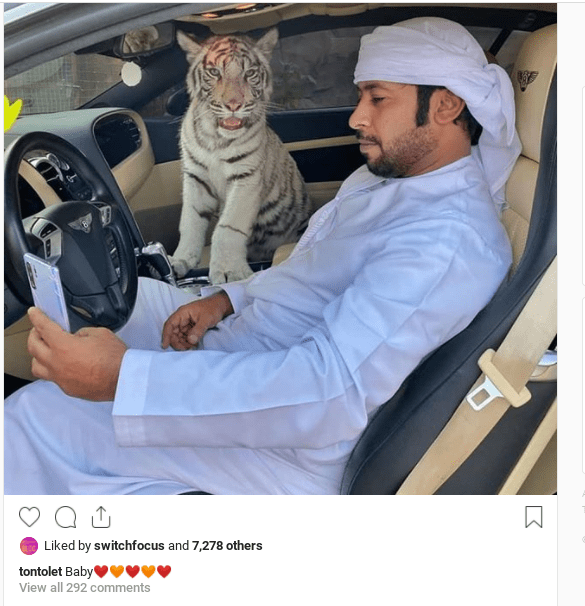
Hedren enjoying a fabulous ride on one of her chic, fabulous lions in 1971. Credit: LIFEWild cats are the preferred fabulous pets of ultra-wealthy twats who want to show off their wealth on social media.More than 3 billion people live on less than $2.50 a day, while Paris Hilton’s dog lives in a two-story air-conditioned mansion.
They’re behaving as if a tiger is loose in their neighborhood, despite police concluding the domestic cat isn’t a threat.
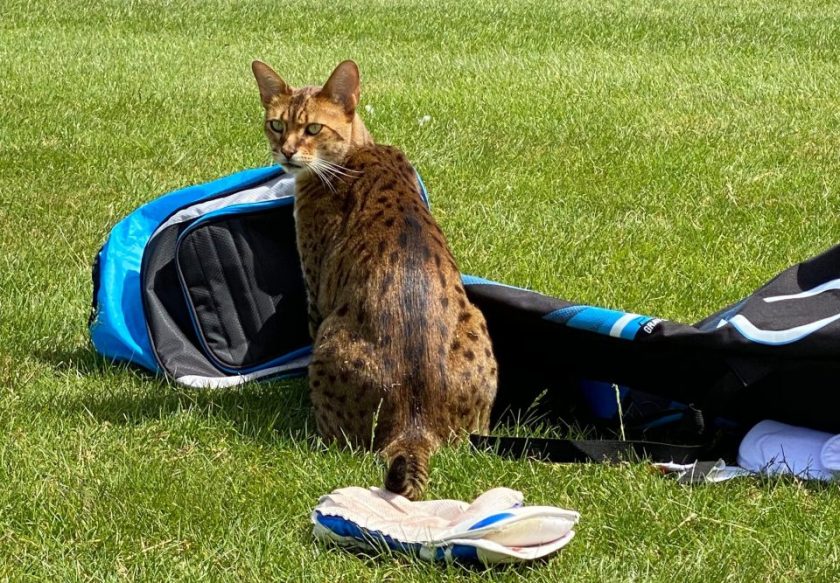
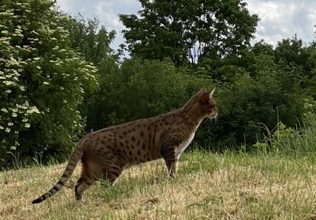
The saga continues in the case of the big Savannah who was mistaken for a leopard or cheetah in London earlier this week.
The hybrid cat — whose appearance prompted a massive police response that included helicopters and heavily armed squads — has been stalking the gardens of an opulent London burb for months, neighbors claim.
The British press dubbed the Savannah “The Beast of Billionaire’s Row” after it popped into a back garden in the upscale neighborhood of Hampstead on Monday, scaring a mom and daughter who were eating dinner outside.
They called the police to report a large wildcat, and authorities responded in force before realizing the mysterious felid was a Savannah, a cross between a Serval and a domestic cat. A wildlife expert confirmed the cat wasn’t dangerous and police stood down, leaving the cat to its own devices.
And that’s exactly the problem, homeowners in the neighborhood told UK newspapers: They say the rare feline has been wandering the area for eight months, and believe it was abandoned by its owner or escaped from its home.
“Anyone saying it’s a recent escape is talking absolute rubbish,” said Kate Blackmore of Highgate, an adjacent neighborhood less than a mile from Monday’s sighting.
The cat was scared during an encounter with a woman in her backyard. Credit: Kate Blackmore
Blackmore told the Daily Mail she’s seen the cat in her yard 10 times over the months, and shot video of the hybrid in September when it crossed her yard.
“Look at you, you’re massive. Wow! Where do you come from?” Blackmore says in the video. “What’s with the growling, mate?”
The cat looks underfed and scared, making unmistakably nervous noises as the camera rolls. At one point Blackmore raises her voice and the cat flashes its teeth in response, hissing anxiously.
Blackmore told the Daily Mail she thinks the large hybrid may have chased one of her cats, who turned up dead in a nearby road last year, but admits it’s speculation. That hasn’t stopped the Mail from reporting the Savannah “has savaged a kitten” with nothing but Blackmore’s word to go on.
Blackmore told the Daily Mail she’s “really passionate about rehoming this cat,” which contradicts statements she gave to the Sun and other newspapers, in which she seems determined to blame the scared ex-pet. She’s the sole source for severalirresponsibly speculative articles claiming the Savannah has been eating pets in the neighborhood.
“We have had ten visits from the Savannah. It scared one kitten away and eight weeks later it was found dead,” Karen Kate Blackmore told the Sun. “So you can understand my rage towards the cat — it could be killing other people’s pets.”
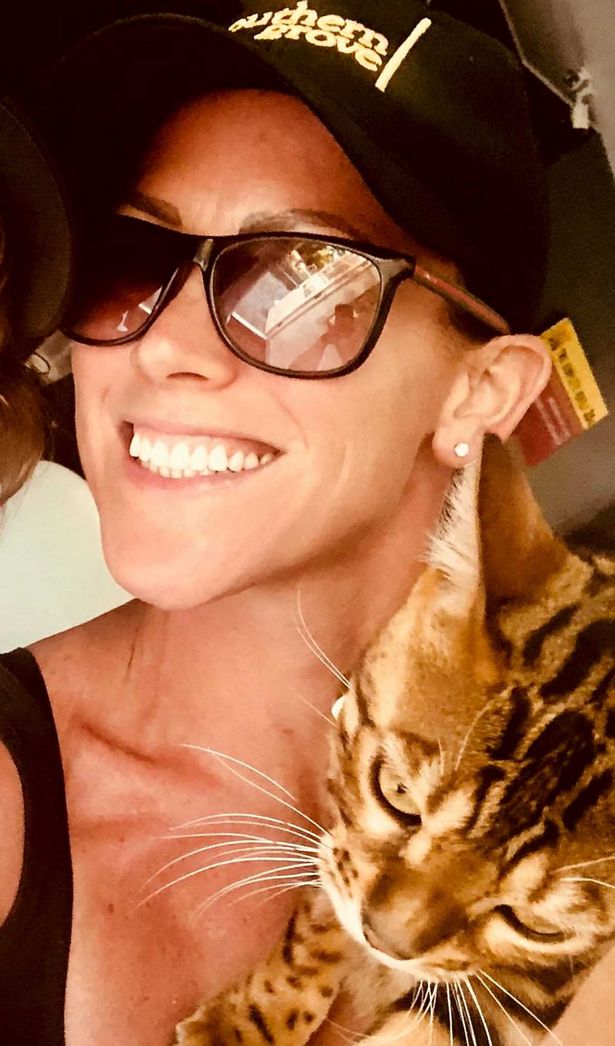
Blackmore’s crusade against the Savannah seems especially odd considering she has two Bengal cats, which are also hybrids. Bengals are a mix of domestic felines and Asian leopard cats(*). Like Savannahs they’re sold for thousands of dollars, valued for the wild-looking rosettes on their coats, and can wreak havoc if they’re not provided with enough attention and stimulation.
Kate Blackmore with one of her Bengal cats.
The Savannah at a local park, where it cozied up to a family. Credit: Laura Rosefield.
Other neighbors say they’ve encountered the animal and haven’t seen any signs of aggression. Laura Rosefield, who lives nearby, told the Sun she interacted with the cat in a neighborhood park, calling it “very tame.”
“I suddenly went ‘Oh my god what is that?’ and we saw the cat and said ‘It’s a leopard, it’s a mini leopard,’” Rosefield said.
She said the “shockingly beautiful” hybrid even sat with her family and was comfortable around people.
“We were ohh-ing and ahh-ing, and it padded around us for quite a long time, it padded over my foot for quite a long time,” she said. “My partner stroked it and it purred along while he was stroking it.”
Credit: Laura Rosefield
Looking at the cat’s condition and body language in the video, it doesn’t seem like a well-loved pet out for a fun stroll near its home — it looks like a sad, confused and abandoned former pet.
Savannah cats retain the energy and intelligence of their wild cousins and are similar to working dogs in that they need near-constant stimulation and socialization. If their needs aren’t met they can become bored, destructive and could escape to make their own adventures.
First-generation hybrids, known as F1 Savannahs, are considered too wild to be kept as pets and are used as breeders. Typically pet Savannahs are third- or fourth-generation (F3 or F4), retaining the rosette-and-dot coat pattern of their wild forebears and most of their size, but with dispositions more like typical house cats.
The animals can fetch up to $20,000 in the US, with F1s commanding the highest prices. Unlike the US, where many caretakers keep their cats indoors for their safety, it’s common for owners in the UK to allow their cats to wander outside.
CORRECTION:An earlier version of this post misstated the origins of the Bengal breed. Bengals are hybrids of the domestic cat, felis catus, and the Asian leopard cat, Prionailurus bengalensis. Thanks to reader M.A. for pointing out the error.
Another installment of True Crime porn diminishes the victims to afterthoughts while glorying the killer and the people who obsessed over him.
I finally got around to watching Netflix’s Don’t F*ck With Cats, a documentary about the effort to track down a narcissistic killer whose victims included several kittens, an adult cat and finally a Chinese-Canadian engineering student.
If you’re not familiar with the three-part documentary, here’s the short version: A man uploaded sadistic videos of himself torturing and killing cats, prompting a group of online vigilantes to conduct their own investigation and offer the information to police, who promptly ignored all of it.
The cat killer taunted the horrified netizens for two years, vowing to continue taking life and leaving a trail of breadcrumbs for them to follow each time he killed more kittens, until finally someone found the headless, limbless torso of his first human victim in a garbage dumpster in Ontario.
The murderer had arranged to meet another man he’d met on Craigslist, then filmed himself killing the incapacitated man just like he’d filmed himself killing kittens. The video appeared online shortly after the murder.
The police, who couldn’t be bothered when it was “just” cats, suddenly got really interested. The killer fled to Paris — where he became the subject of an international manhunt and media circus — then to Berlin. He stopped in an internet cafe to Google stories about himself, but the cafe’s clerk recognized him and called the police. He was taken into custody without incident, then promptly extradited back to Canada for trial.
The police don’t exactly cover themselves in glory with this case. Not only did they fail to act on information from concerned tipsters, they were either unaware or uninterested in the statistical correlation between people who kill animals for pleasure “graduating” to human victims once killing animals loses its thrill.
Jun Lin, 33, the victim of the cat killer.
They had a man in their jurisdiction torturing and killing cats, capturing the horrific deeds on camera and regularly uploading new videos. They failed to act.
The thing is, animal life has intrinsic value. We delude ourselves into believing that because the voiceless — human and animal — can’t express their suffering, it doesn’t exist. The police should have acted when the killer’s victims were “just” cats for the sake of the cats, and not only because animal abusers often move on to harming human beings.
Canadian police culture
It was also surprising to see how deferential and naïve the Canadian investigators seemed in comparison to their American counterparts. At various turns they failed to preserve evidence, missed important clues and underestimated the killer. In one scene an investigator casually mentions the discovery of a dead puppy in the same trash the human torso was found, failing to connect the dots despite the many warnings her agency had received.
When Canadian police finally got the killer into custody they handled him with kid gloves, allowing him to play the part of scared little boy who didn’t know what he was doing rather than what he was: A calculating 32-year-old man who clearly enjoyed inflicting suffering on people and animals, playing to his captive audience of several thousand people on Facebook as he led them on a scavenger hunt.
The killer routinely interrupted police interviews, shrugged off difficult questions by complaining that he was tired, and tried to buy time for himself to think by asking for things like warmer clothing, cigarettes and beverages.
In short, they allowed him to manipulate them as he had manipulated everyone else.
When the killer’s mother appears on camera, you can see the beginnings of his psychosis. She believes her son is a sweet little angel who was himself manipulated by a phantom, a person her son invented to excuse his deeds.
She also admits she knew about the cat videos and did nothing. In her view, people concerned about animal welfare are “crazy,” and those crazies shouldn’t have gotten so wound up over a few videos in which her son kills kittens while singing along to pop songs. Just a sweet little boy having fun.
Remembering Jun Lin
As for the killer himself, I’m not going to name him. His victim was Jun Lin, a 33-year-old engineering student who moved from China to Canada because, as his friend Benjamin Xu explained, the latter country is more accepting of gay men.
Benjamin Xu/Credit: IMDB
Toward the end of the documentary, Xu mentioned something I’ve often thought about: Society’s obsession with “true crime” and how our morbid curiosity gives would-be murderers precisely what they want. If they can’t achieve fame, infamy is the next best thing.
We do a great disservice by immortalizing the killers and forgetting the victims. Everyone can name the two Columbine killers, but how many of us can name the victims?
“The really sad thing is, everybody is talking about [the killer] and nobody has ever remembered Jun,” Xu said. “That doesn’t seem fair at all to my friend. He doesn’t deserve that.”
The other stars of the show
Finally, there are the two “sleuths” at the center of the documentary, who spent two years of their lives ostensibly investigating the killer while giving him exactly what he wanted. Contrary to what the documentary’s title suggests, they weren’t cat lovers, just a couple of people motivated by the thrill of the hunt.
As their Facebook group about the murderer swelled to thousands of members he reveled in the attention, intentionally leaving clues for them in each subsequent video like a scavenger hunt, a fun little game for them to play as long as he remained the star of the show.
The documentary glosses over their mistakes, and there were some big ones: At one point they were so sure a South African man was the killer that they made his life a living hell, with an entire team of online vigilantes across the world harassing him from afar.
That man killed himself and was likely collateral damage in this fun little game the “sleuths” had going, but who has time for that when there are fresh clues and leads to track down? We got the wrong guy, LOL! Oops!
In the end it was someone else — quite likely the killer himself — who provided the alleged sleuths with the killer’s name once they’d exhausted their leads and the hunt became stale. He wanted them to continue the chase.
While the would-be detectives did manage to collect some information via their own efforts, it’s not accurate to say they solved the mystery.
On the other hand it’s fair to question whether the killer would have gone as far as he did if he didn’t have tens of thousands of people on Facebook hanging on his every video and utterance.
Deanna Thompson, who has now appeared in two documentaries about the killer and has parlayed her role into a side business.
The documentary ends with one of the killer’s obsessives, a Las Vegas woman named Deanna Thompson, looking at the camera and admonishing the audience for being interested enough to watch the documentary, as if everyone shares in the guilt for the killer’s actions.
But what she’d like everyone to forget is that her actions egged him on while he was on the loose and actively taking life. Playing into his scheme is a much different thing than passively watching a documentary more than half a decade after his conviction. There’s a good argument to be made that the vigilantes should be embarrassed by their role in this story, rather than reveling in the attention they’re getting as a result.
Remember Jun Lin. Remember the poor cats. Forget about the killer and the people who helped him achieve the fame he so desperately craved.
Note:I realize refusing to name the killer on this blog is like putting a single grain of sand back in a bottle after the whole thing has been spilled, but hey, we have to start somewhere.