Bogus Science And Unverifiable Claims Drive Cat Hatred In New Zealand

Cat hatred is driven in large part by bunk science authored by researchers who approach their work with predetermined conclusions.

After news of a now-canceled children’s cat hunting contest made international headlines this week, the usual suspects came out of the woodwork with wild, unsupported claims that cats — not humans, not human industrial processes, not human-driven habitat loss, wind farms or agricultural pesticides — are singlehandedly responsible for wiping out New Zealand’s native birds and the extinction of an arbitrary number of avian species.

One of the people leading the charge is Helen Blackie, a “biosecurity expert” who told the BBC that cats are responsible for the extinction of six native bird species in New Zealand.

Blackie doesn’t say where she got that information, but noted cat-hating Kiwi Gareth Morgan’s site claims that cats have killed nine native bird species, and attributes the information to a study, “A global review of the impacts of invasive cats on island endangered vertebrates.”

The “study” was published by academics in Spain and California without boots on the ground in New Zealand and is not actually a study at all. It’s a meta-analysis of prior studies, none of which count the number of feral, stray and pet cats in New Zealand, nor do they offer anything resembling a measure of how many birds are actually killed by cats.

Notably, the study does not say cats are responsible for the extinction of nine bird species.
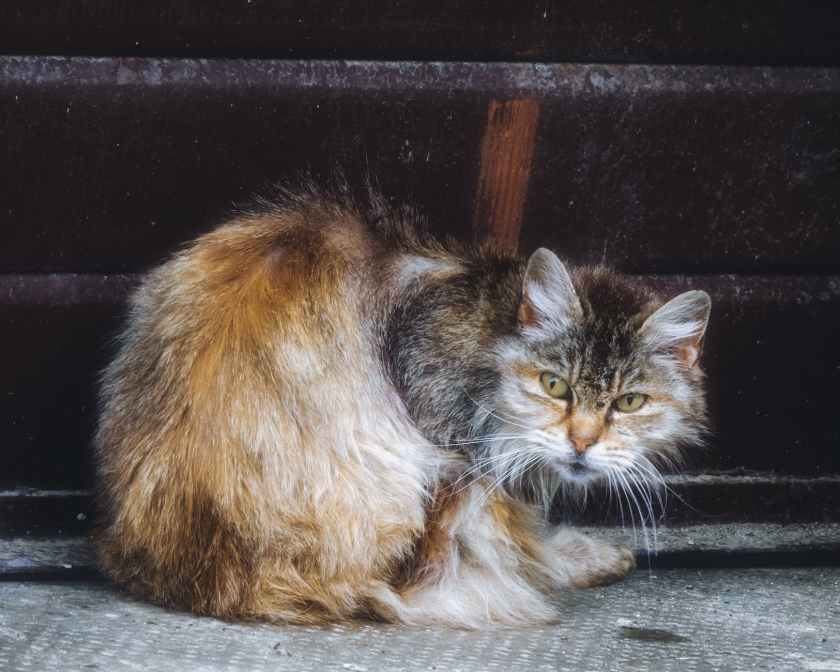
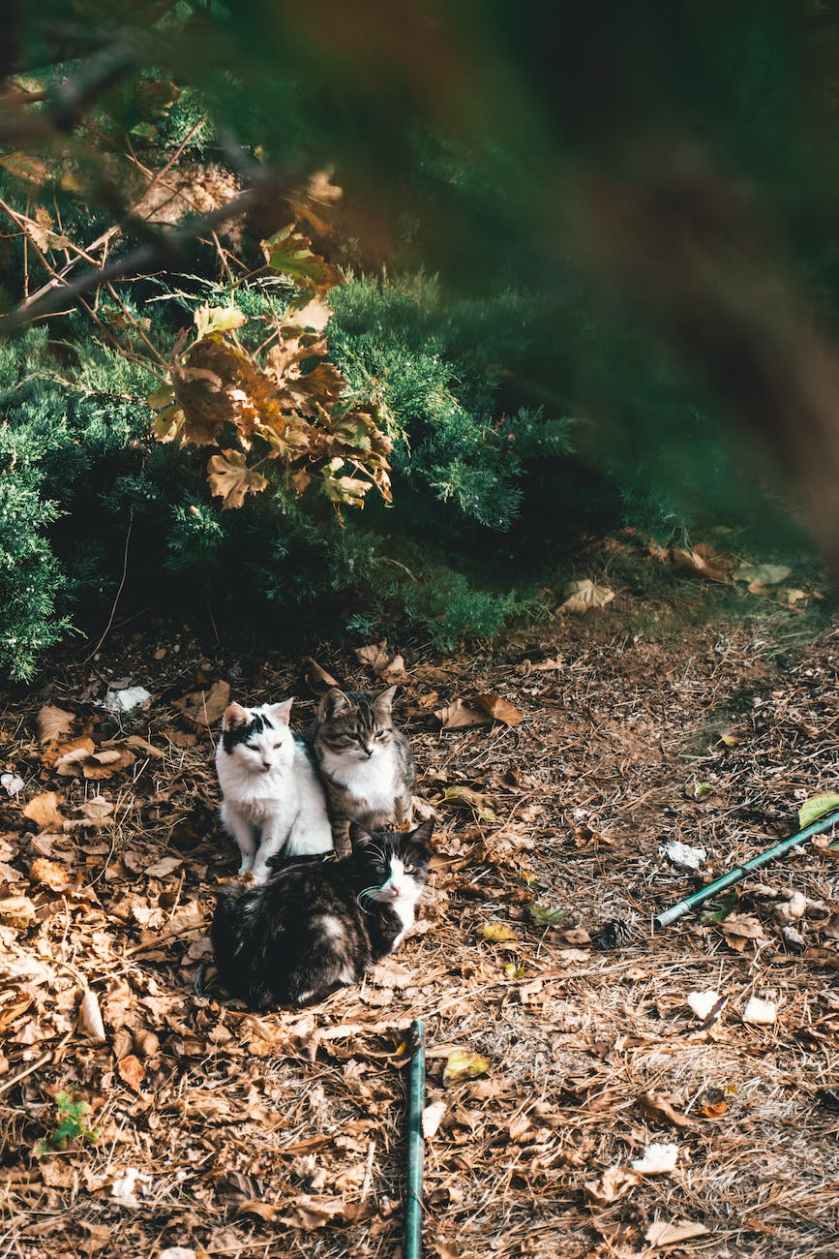
close up shot of a stray cat
Credit: Mehmet Turgut Kirkgoz/Pexels

Much like their US bird-conservationist counterparts, the authors of the study cannot say how many cats actually live in New Zealand and have no observational data about feline predatory habits.

They rely on the same methods the US studies do, which is to say they collect data from unrelated research — including a paper measuring the impact of all predators on wildlife in the aftermath of wild fires in urban environments, a report on the way pet cat personalities impact how their owners view them, and a study on cat behavior in Culver City, California — stir the data into a pot of numbers, and massage the numbers until they get the desired results.

In this case, the “desired results” are any suitably impressive-sounding figure for the total number of native birds killed by cats in New Zealand. The authors aren’t conducting a scientific investigation to find out how those native birds died, they’ve already decided that cats are the reason and they’re misrepresenting data from unrelated studies to support that conclusion. That is not science.

Of course their conclusion has no basis in reality. How is it possible that a bunch of researchers on entirely different continents are able to come up with accurate figures on cat predation in New Zealand without any actual data about cats in New Zealand, without a population count of cats in New Zealand, and without a single observational study to draw information from?

How does a study of coyote and cat interactions in Culver City, California have any bearing on cats killing birds in New Zealand, an island country 6,700 miles away with habitats that bear little or no resemblance to California? Coyotes don’t even exist in New Zealand!

How does a self-reported questionnaire about the personalities of pet cats by American cat owners tell researchers anything about the behavior of feral cats in rural New Zealand?

How does a study about the Persian squirrel on Greek island ecosystems tell a research team anything about the impact of cats on flightless birds in a completely different environment, in a different part of the world, with different types of trees and cover, different native fauna and weather systems?

How does a study of alpine ecosystems inform estimates of cat predation in the temperate and subtropical ecosystems of Aotearoa?
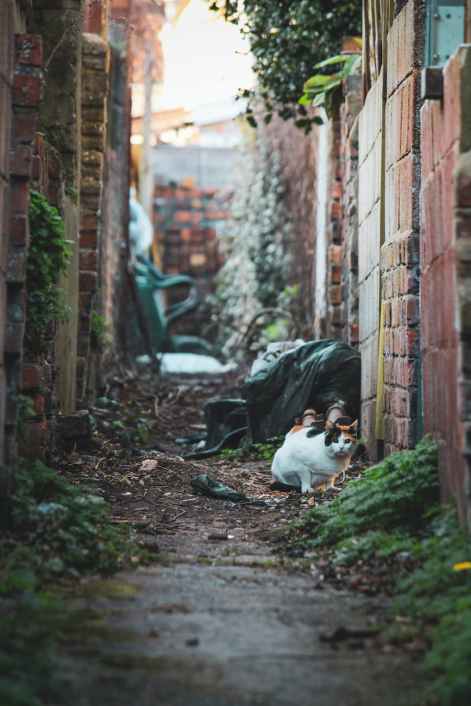
view of a stray cat on a city street
Credit: Boys in Bristol Photography/Pexels

This is not science

This sort of buffet-style, cherry-picking nonsense wouldn’t pass muster in an undergraduate class in the hard sciences, yet somehow it’s not only published in peer-reviewed conservation journals, it’s reported breathlessly and credulously by reporters at outlets like NPR, the BBC and the Guardian, who don’t even bother to read beyond the abstract.

The claims are further undermined by their inexplicable assertion that feral cats and domestic cats are not the same thing, when in fact they are the same species: felis catus. Advocates of cat hunting in New Zealand fret that it’s impossible to tell if cats are feral or pets, not understanding that they are indistinguishable because they are the same. The only difference is that house cats have homes and ferals do not.

No one is claiming that cats don’t have an impact on the environment. It would be foolish to think they don’t.

But if anyone — especially journalists with influential platforms and researchers cloaked in authority thanks to the veneer of real science — wants to make the case that cats are the primary force leading to declining numbers of native bird populations, then the burden of proof is on them, and it’s a high one.

We’re talking about life here, the lives of fully sentient animals with their own rich internal thoughts and feelings. You don’t just casually call for their extirpation or send children off with rifles to arbitrarily shoot them like little serial killers in training.

If you want to make the case, do the work. Get the grants. Hire the personnel. Do it right. The Washington, D.C. Cat Count even has a free toolkit for other communities to conduct their own feline census, so they can make informed decisions. But if you’re unwilling or unable to do the work, then stop spreading misinformation, because it has tragic consequences for real-world animals, and their blood is on your hands.

Top image credit Aleksandr Nadyojin/Pexels
Cat Hunt Canceled, Kiwi Journalist Says Cats ‘Need To Be Shot,’ ‘Run Over’ And ‘Wiped Off The Face Of Aotearoa’

Cats are blamed, to the exclusion of almost all other factors, for the decline in native bird populations in New Zealand.

A New Zealand group canceled a cat-hunting competition for kids after receiving massive backlash for the plan, but one Kiwi journalist told a national audience he thinks the cat hunt is a great idea and doesn’t go far enough.

“When it comes to feeral kets, I’m on the soide of the kea, the kākāpō and the kiwi ivery sangle doy of the week and my missige to [the organizers] is ‘Git the competition back on, git the keds back out thea,'” said the vowel-desecrating morning show host Patrick Gower. “If thea gonna hunt and thea’s feeral kets in the way, then we hif to woipe them out. Feeral kets need to be shot, they need to be run ovah, they need to be trepped, they need to be woiped off the foice of Aotearoa and I imploah the school to git it back on, and look, I’ll put up some rewoade as well foah any kets these kids git down theah as well.”

English translation: “I think the cat-killing contest is a wonderful idea, cats need to be shot, run over and exterminated from New Zealand, and I hate cats so much that I’ll put up some of my own money as prizes for the children who bag the most kills.”

You’ve got to wonder what cats have done to Patrick Gower for him to hate them so much, and fortunately dear readers, PITB has the answer!

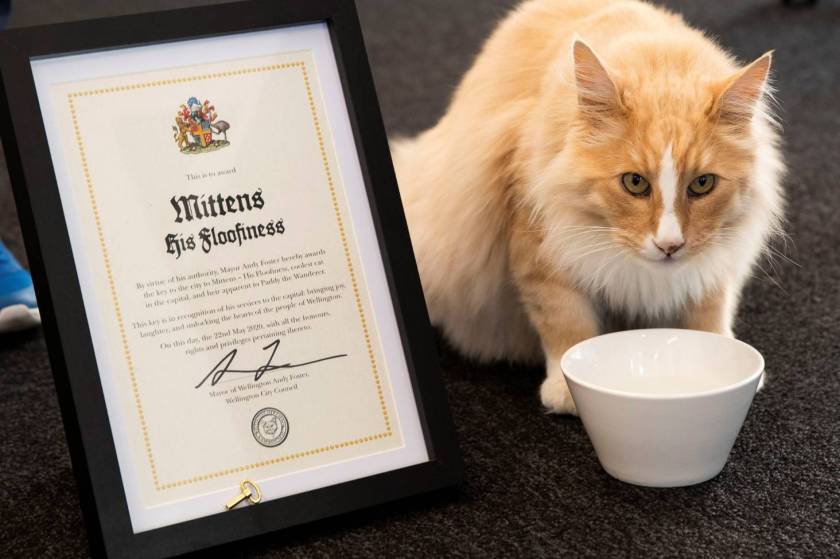
Gower lost the New Zealander of the Year competition of 2020 to a cute orange tabby named Mittens.

Think about that: All those years of doing Pulitzer-worthy breakfast show kitchen demonstrations, of slaving away at the anchor desk bringing viewers important news about reality TV stars and parroting former Prime Minister Jacinda Ardern’s declaration that New Zealand’s government is “the single source of truth” on COVID, and Gower loses the honor to a damn cat. Mittens even has the key to the City of Wellington, and Gower does not.

So sad.

Mittens the Cat
Mittens receiving honors that have eluded morning show host Patrick Gower. Credit: Wellington City Council

It’s unfortunate when a man in influential position, small country or not, enthusiastically encourages children to practice being future serial killers by slaughtering innocent animals because he thinks — despite the complete absence of evidence — that arbitrarily gunning down and running over sentient animals will save birds.

Really, you’d think before calling for the extirpation of an entire species of animal that these people would have something, even a single bogus research study, claiming that bird populations would recover if only people started killing cats on sight.

But no such proof exists, and the burden of proof rests with Gower, fellow Kiwi cat-hater Gareth Morgan and others who harbor an irrational and ill-advised hatred of tiny animals who are simply behaving the way nature designed them to behave.

What we do know is that managing cat populations can be done, but it’s difficult, time-consuming work that requires dedication and patience.

Cities like Washington, D.C., with its exhaustive cat count, and communities across the US have provided the blueprint with TNR efforts and a mass push for all pet owners to spay and neuter their cats. The results have been remarkable, and shelters save more than a million felines a year compared to just a decade ago. There’s still work to be done to bring the number of euthanizations down to zero.

Patrick Gower
Gower

It’s also worth noting that the organizers of the North Canterbury Hunting Competition and supporters like Gower are coming from a place of ignorance. In their original, now-deleted announcement, the organizers offered a “guide” to telling the difference between feral and pet cats, unaware that they are the same species. The only difference is that pet cats are fortunate enough to have homes, and strays and ferals do not.

The group said it was offering its “guide” as a way to prevent children from killing pet cats, but how exactly would they do that when a pet is indistinguishable from a colony stray or a feral? Would they find a microchip on the corpse of a cat they killed and say “Oops, guess that one doesn’t count!”?

Does a cat somehow feel less if it doesn’t have a home? Is its life worth less if it doesn’t have a collar and eat from a bowl?

It’s barbaric and so poorly thought-out, it really boggles the mind that the idea of a cat-killing competition for kids was voiced, let alone approved, planned and promoted by supposed adults.

As for the contest itself, we’re very glad it’s been called off, even if the organizers want to play victim and say their feelings have been hurt by the response to their murderous event.

That, however, doesn’t solve the problem. The fact that the organizers thought this was a good idea in the first place, and the increasingly pitched rhetoric from the likes of Gower and Morgan, are normalizing the idea of slaughtering innocent animals who have their own minds, thoughts and feelings, and who have been shaped by 10,000 years of history to live with and depend on humans.

Instead of calling for blood and whipping people into a frenzy, influential New Zealanders should read about cats and animal cognition in general, so they’re aware that felines experience the full range of primary and secondary emotions and are very much capable of suffering the same way we do when we’re injured, stressed and our lives are in danger.

That, unlike claims that cats are primarily responsible for the decline in bird populations, is hard scientific fact. We can peer into the brains of felines, watch their neurons fire, see different brain regions light up as they think specific thoughts and respond to specific smells and sights.

Maybe if people who hate cats understand what they are, they’ll feel some empathy for a beautiful species, animals who have been companions and literal life savers to humans since before deepest antiquity, animals whose lives have intrinsic value regardless of what they mean to us. At the very least, we owe them that.

New Zealand Hunting Contest For Children Offers Prizes For Killing The Most Cats

One of New Zealand’s most prominent economists has called cats “serial killers” who are driven by “bloodlust,” and is one of many who blame domestic cats for the decline of local wildlife.

An annual hunting competition for children in New Zealand has a new category this year, awarding a cash prize to the young hunter who kills the most cats.

You read that right.

The North Canterbury Hunting Competition announced the new category on Saturday and says it will offer a $250 prize to any child 14 or younger who kills the most felines.

In a statement, the local SPCA pointed out the obvious, that cats will suffer horribly, pets will die and the competition will result in bungled kills en masse, leaving wounded cats to suffer horribly before the children finish them off — if indeed they do.

“There is a good chance someone’s pet may be killed during this event,” the Canterbury SPCA wrote in a statement. “In addition, children often use air rifles in these sorts of events which increase the likelihood of pain and distress, and can cause a prolonged death.”

photo of cats
Credit: Ali Arapou011/pexels

Prompted by the same sloppy “research studies” that inspired Australia to kill millions of cats — and resulted in a mouse plague of biblical proportions in 2021 and 2022, causing billions of dollars in damage to farms, homes, businesses and infrastructure — New Zealand is on a disinformation-fueled jihad against felines.

Like all such studies, the claims that cats are singlehandedly responsible for declines in native wildlife, thus absolving direct human activities of blame, come by way of overzealous bird conservationists and others who insist the mass murder of cats will save native birds and small mammals. As if humans destroying habitats, dumping chemical waste, creating wind farms that act as bird dicers, building glass skyscrapers that millions of birds fly into every year, saturating entire swathes of the Earth with light pollution and EM radiation that harms and confuses animals — and all the other things people do — have no impact whatsoever, and it’s only those dastardly cats who are the culprits.

You’ve got to hand it to the misguided conservationists, who have picked tiny scapegoats who can’t defend themselves verbally or physically against humans.

To understand how the “hunting” (killing) competition can be real, it’s important to understand the context of the way cats are portrayed in New Zealand. Gareth Morgan, a Kiwi economist and politician, launched a campaign about a decade ago with the stated goal of eradicating cats from the island nation of 5.1 million people, which would forbid people from adopting new cats and end programs like trap, neuter, return (TNR) in favor of having local animal control departments kill felines.

Morgan, whose Cats to Go site portrays kitties with devil horns and glowing red eyes, says cats are evil animals driven by “bloodlust.”

“Cats are the only true sadists of the animal world, serial killers who torture without mercy,” Morgan has said.

Hunting Competition
A screenshot from the group’s Facebook page announcing a new prize for young hunters.

The North Canterbury Hunting Competition, which also offers prizes like dirt bikes for child hunters, pulled the new category announcement from its Facebook page on Monday but stopped short of canceling the event, blaming people who were upset by the idea of cat hunting.

Citing abusive feedback, the group said it’s “incredibly disappointed by this reaction” and said the hunt is for a good cause, raising money for local projects.

Amazing Cats: The Mysterious Marbled Cat

The semi-arboreal marbled cat is arguably the most elusive feline on the planet.

Dear readers, before you think this is a joke entry about Bud, let me emphasize we’re talking about the marbled cat, not the well-marbled cat.

chubbybuddy
“I am NOT chubby, I am meowscular!”

“I’ve never heard of a marbled cat,” you might be thinking, and there’s a good reason for that.

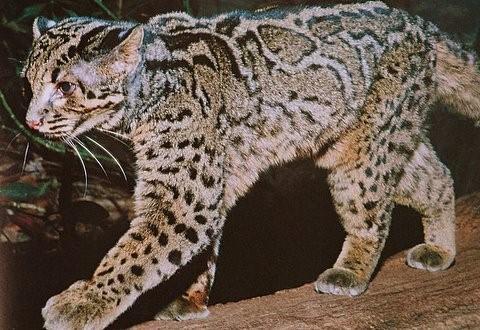
These little guys are incredibly elusive, live far from most humans and are found only in Asia. They’re extremely difficult to track and locate in the wild and haven’t been the subject of any comprehensive field study, granting them an air of mystery in an era when you can find almost anything you want to know about almost any animal with a few clicks.

There’s a whole lot we don’t know about marbled cats, including their behavior in the wild, how long they gestate, what they eat and how they’ve successfully adapted to so many varied habitats.

marbledcat2
Credit: Wildcats Magazine

The singular species is semi-arboreal. Almost all cats can climb trees. The problem is getting down afterward, which is why so many domestic cats get stuck in trees. They can’t descend head-first and they’re wary of descending tail-first, which makes them vulnerable. Marbled cats have unusually flexible claws that enable them to descend head-first with ease, so they don’t balk at climbing. Their large paws keep them sure-footed on tree limbs and they’re confident off the ground.

In 2011, a trail camera in Indonesia was tripped by a marbled cat, finally giving us a close-up view:

The striking felines are sometimes called “miniature clouded leopards,” and you can clearly see why.

The species is native to the eastern Himalayas, mostly in Nepal, Bhutan, Myanmar and tiny corners of China and India, as well as countries like Thailand, Cambodia and Indonesia. They’re extremely adaptable and live in a variety of habitats, from the forests of high-elevation mountain slopes to the humid jungles of Indonesia’s Borneo and Sumatra.

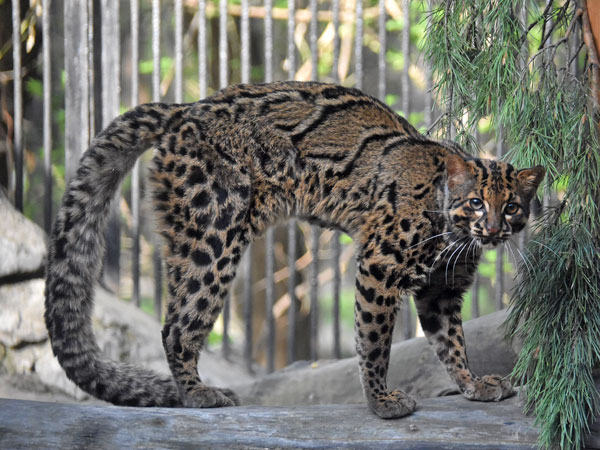
Marbled cats are about the same size as domestic cats, but they’ve got incredibly big, fluffy tails that are longer than their own bodies, which serve as formidable counter-weights for their tree-hopping. Their ears are a bit more round than the ears of their domestic cousins. They tend to have larger paws, and they have unique clouded coat patterns that are unlike any breed of domestic feline or close wildcat relatives.

Despite their relatively large natural habitat and the difficulty in pinning down population numbers, conservationists estimate there are fewer than 10,000 marbled cats. They’re threatened by the same deforestation by the palm oil industry that has devastated orangutan and clouded leopard habitats, although their strongholds in steep, high-elevation forests are safe for now. Marbled cats are listed as endangered by some authorities and as near-threatened by others, though like all wildlife their numbers are in decline.

Top image credit Joel Sartore/National Geographic Photo Ark

marbledcatrussia
A marbled cat at Novosibirsk Zoo in Russia. Credit: Zoo Institutes

Fans Flock To NY For 4th Annual BuddyFest

The fourth annual BuddyFest promises loads of Buddesian fun and celebration for fans of the fantastic feline.

NEW YORK — Screams of excitement came from the taxi as it pulled up to the Javits Center and three women filed out, each of them wearing cat ears and face paint mimicking the striped pattern of a tabby cat.

Klara Vogt, Anja Becker and Ursula Schulz had come all the way from Düsseldorf, Germany, for the party, but for them the trip was worth it.

“We originally planned to go to Das Büdenfest in 2020, ya, but the pandemic made it dangerous and inefficient to travel,” Schulz explained. “Now that die plage is ünter kontrolle and Deütschland airlines are running efficiently like clockwork again, we are able to come and celebrate Herr Büddenschrieber!”

Organizers are expecting more than 15,000 attendees for BuddyFest IV, which is jam-packed with all things Buddy for the entire weekend.

Earth, Wind and Fire will kick off the festivities on Friday night during the welcome ceremony and dance party, where guests can snack on turkey sliders and turkey-seasoned popcorn as they watch an artist chisel a 20-foot-tall ice sculpture of the beloved feline.

An area exclusively for feline guests featured a boxing ring containing 62 different boxes of various materials to sit in, as well as VIP boxes with can and bottle service. A nearby lounge offered long tables covered with objects to paw-smack onto the ground, surrounding a sizable fountain bubbling with beef and turkey fondue.

“Boxes, good eats!” raved Jasper, 3, in between rips from a catnip hookah. The Scottish fold lounged comfortably in a corrugated cardboard box with two of his catatonic friends who sat with their eyes half closed, surrounded by a permanent haze of the minty plant.

(Above: The ice sculpture at BuddyFest IV this year, left, and the sculpture from BuddyFest III in 2022.)

The main convention floor was opened Saturday morning with Buddy-themed exhibits, Buddinese merchandise and Buddificent performances from artists and musicians paying tribute to the little guy.

A Marvel comics booth will offer previews of the upcoming comic series Bud: The Silver Knight, while HBO will host a panel discussion with the stars of its newest drama, House of the Tiger, starring Buddy.

Jake Lipton, son of the late Inside the Actors Studio host James Lipton, will lead an afternoon symposium titled “Buddnipotence: Celebrating Buddy’s Benevolent Effect On Geopolitical Relations, Nuclear Non-Proliferation and the Art of Napping.”

(Above: Cover art from Marvel’s Bud: The Silver Knight, left, and a Hungarian-language comic aimed at a younger audience, right.)

Few fans were as excited as Frank Gambino, 28, a bodybuilder from New Jersey who attended as a costumed Buddy. While he described himself as a fan of Buddy’s movies, he said he was primarily interested in the buff feline’s Youtube workout series, “Snaxercize.”

“Buddy is the best, bro,” Gambino said. “I’ve got all his creatine supplements, his new line of protein shakes from GNC and that TigerFuel stuff he swears by. Buddy’s jacked, bro.”

On the first night of the festival a large crowd had gathered in front of the second stage where the poets laureate of four countries were slated to perform pieces “meant to convey Buddy’s magnificence in mere words.”

“Buddy’s simultaneous status as feline icon, movie star, sex symbol and cultural muse means he occupies a rarefied position in the American psyche,” said former New York Times book critic Michiko Kakutani. “He’s equal parts cuddly cat and terrifying tiger, and I think that’s part of what makes him so beguiling.”

PhotoFunia-1681175104
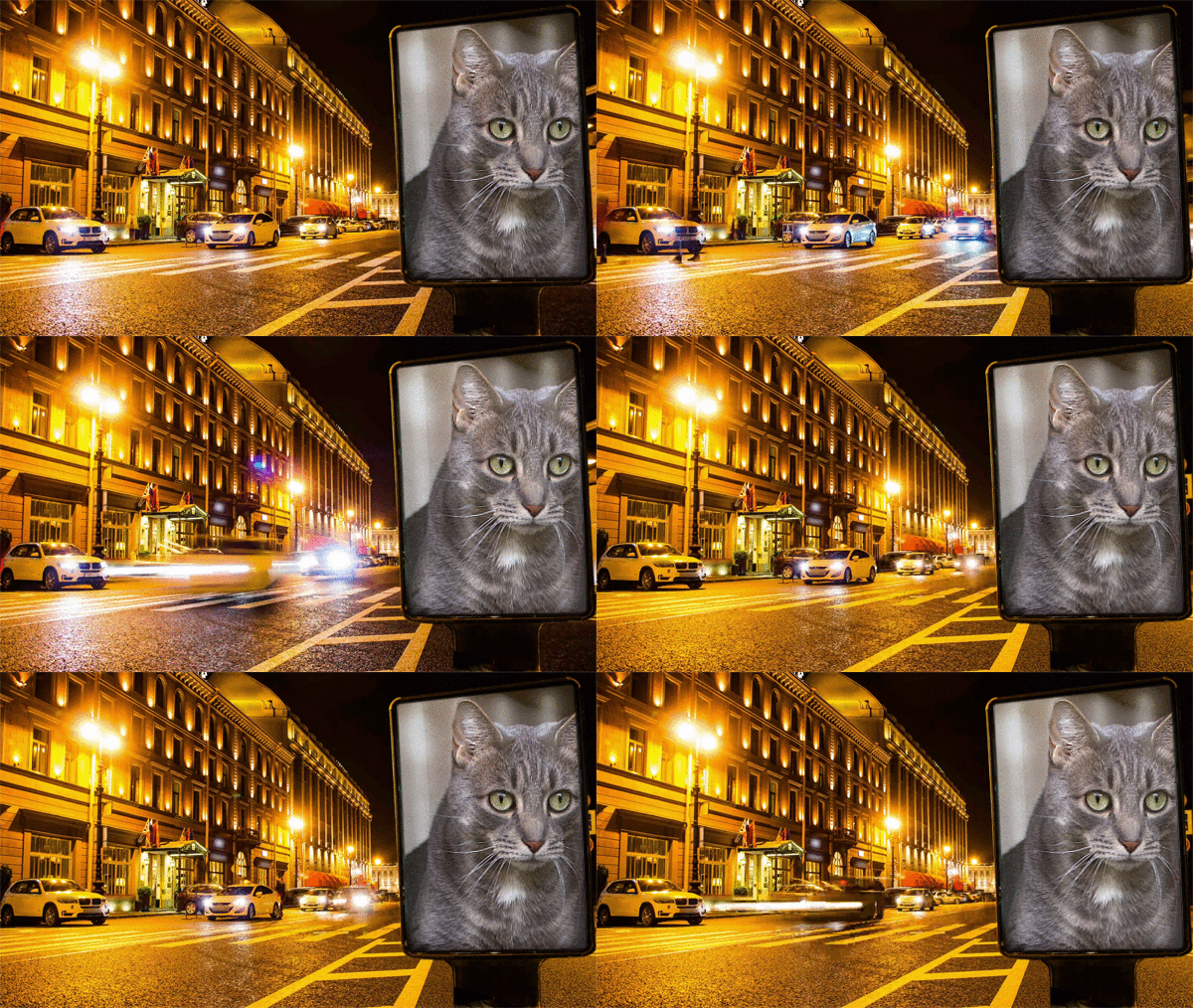
BuddyFest IV was heavily advertised with billboards and signs in major cities

Tickets for BuddyFest IV have been sold out since Jan. 2022, but determined fans of the fantastic feline can still get ahold of them — for a pretty premium. Tickets were selling for as much as $1,700 on StubHub and eBay, but Bud superfans were unperturbed.

Among them was former US President Donald Trump, who has repeatedly praised Buddy on social media.

“Received a big, beautiful letter from Buddy today,” Trump wrote on his social media site, BiglyFacts Social. “The Budster is tremendous cat, just terrific. The best cat you’re ever gonna see, believe me, folks. He’s tremendous.”