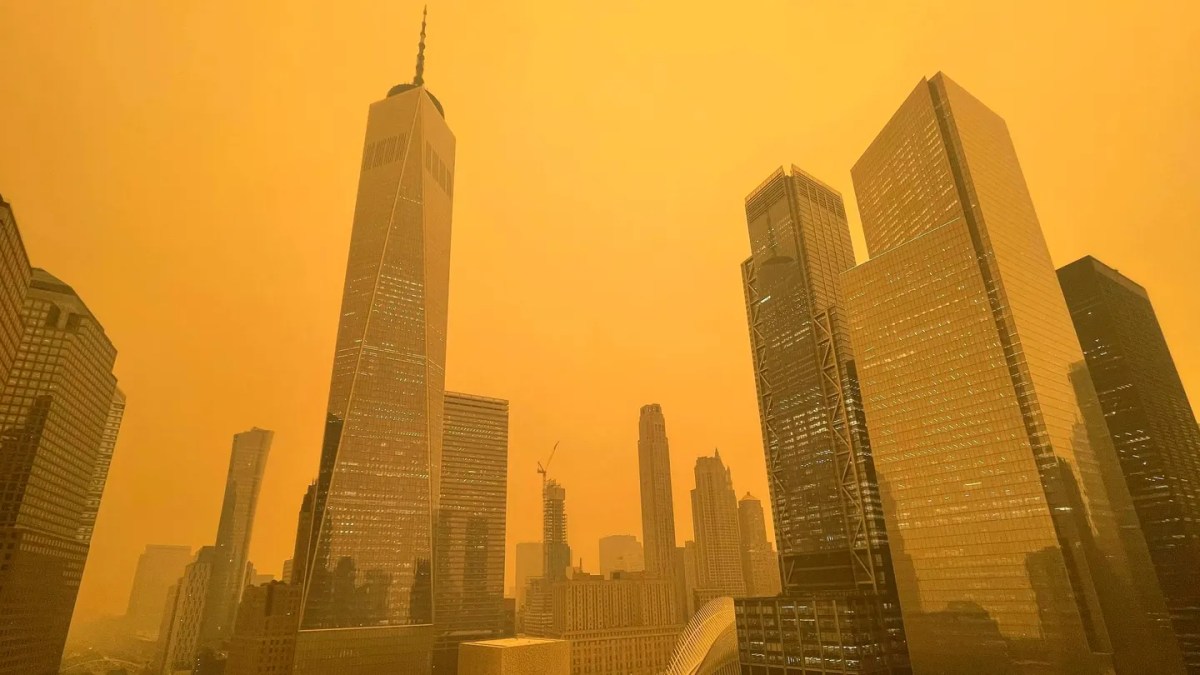
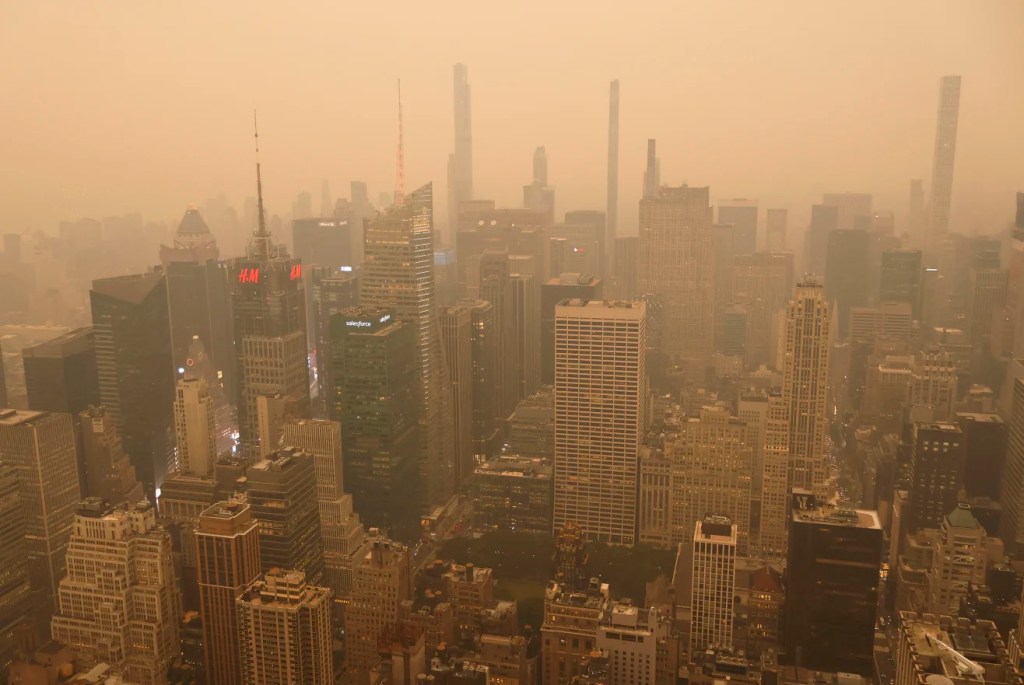
The evil, insidious Canadians have sent their terrible Canadian air south into America as the tip of their invasion force! Because they’re jealous of our freedoms, of course.
It’s mid-July but it’s seriously nasty outside with a permanent beige-gray haze over everything thanks to Canada.
I’ve been sitting here with the AC running, and when I opened the windows last night Bud mrrrrrrp’d in protest and the whole place immediately stunk of funky Canadian ash. I could actually feel the filth as I inhaled and closed the windows again.
This is unacceptable! I know President Donald Trump was joking when he called Canada the 51st state and summoned Justin Trudeau to kiss the ring in the aftermath of the 2024 presidential election (and has properly and correctly blamed the Canadians for this unacceptable situation), but it’s time to start seriously considering invading that frozen hellscape, subjugating the Canadians, and getting it through their floppy little heads with their beady little eyes that fires can be doused, and that modern countries have these organizations called fire departments which are called upon when things combust.
I mean, who just sits there and says “Aboot that fire, that’s some smoke, eh?” and allows it to continue burning? Canadians, that’s who!
I’ll stop it there lest people really think I’m some crazed American who actually wants to invade Canada, but seriously, the air quality is awful. I hope this clears quickly.
A photo from yesterday shows evil Canadian smoke hanging over New York. Credit: Wikimedia Commons
And yes, I am aware Canada has remote wilderness that is difficult to access and manage. However, I hope this doesn’t become a regular thing. It’s 2026, not 1850, and human ingenuity has led to the development of some seriously powerful, rugged vehicles and tools that make it possible to manage forests — if the will and the resources are there.
Canadians are suffering too, so it’s not as if they’re happy with the situation. Let’s hope they demand more effort and less talk aboot how difficult it is to manage remote forests.
As this weather image shows, distance does not provide protection when it comes to this sort of thing, as we’re at the mercy of winds and weather patterns. Casa de Buddy is in that tiny corner just north of the city, right smack in the middle of the deep red indicating high risk from air pollution:
SMOKE FUTURECAST Some temporary improvement today, especially north. A resurgence tonight and tomorrow before showers and thunderstorms clean the air for the second half of the weekend. @abc7nypic.twitter.com/42EuBtxSel
Cat hatred is driven in large part by bunk science authored by researchers who approach their work with predetermined conclusions.
After news of a now-canceled children’s cat hunting contest made international headlines this week, the usual suspects came out of the woodwork with wild, unsupported claims that cats — not humans, not human industrial processes, not human-driven habitat loss, wind farms or agricultural pesticides — are singlehandedly responsible for wiping out New Zealand’s native birds and the extinction of an arbitrary number of avian species.
One of the people leading the charge is Helen Blackie, a “biosecurity expert” who told the BBC that cats are responsible for the extinction of six native bird species in New Zealand.
Blackie doesn’t say where she got that information, but noted cat-hating Kiwi Gareth Morgan’s site claims that cats have killed nine native bird species, and attributes the information to a study, “A global review of the impacts of invasive cats on island endangered vertebrates.”
The “study” was published by academics in Spain and California without boots on the ground in New Zealand and is not actually a study at all. It’s a meta-analysis of prior studies, none of which count the number of feral, stray and pet cats in New Zealand, nor do they offer anything resembling a measure of how many birds are actually killed by cats.
Notably, the study does not say cats are responsible for the extinction of nine bird species.
Credit: Mehmet Turgut Kirkgoz/Pexels
Much like their US bird-conservationist counterparts, the authors of the study cannot say how many cats actually live in New Zealand and have no observational data about feline predatory habits.
They rely on the same methods the US studies do, which is to say they collect data from unrelated research — including a paper measuring the impact of all predators on wildlife in the aftermath of wild fires in urban environments, a report on the way pet cat personalities impact how their owners view them, and a study on cat behavior in Culver City, California — stir the data into a pot of numbers, and massage the numbers until they get the desired results.
In this case, the “desired results” are any suitably impressive-sounding figure for the total number of native birds killed by cats in New Zealand. The authors aren’t conducting a scientific investigation to find out how those native birds died, they’ve already decided that cats are the reason and they’re misrepresenting data from unrelated studies to support that conclusion. That is not science.
Of course their conclusion has no basis in reality. How is it possible that a bunch of researchers on entirely different continents are able to come up with accurate figures on cat predation in New Zealand without any actual data about cats in New Zealand, without a population count of cats in New Zealand, and without a single observational study to draw information from?
How does a study of coyote and cat interactions in Culver City, California have any bearing on cats killing birds in New Zealand, an island country 6,700 miles away with habitats that bear little or no resemblance to California? Coyotes don’t even exist in New Zealand!
How does a self-reported questionnaire about the personalities of pet cats by American cat owners tell researchers anything about the behavior of feral cats in rural New Zealand?
How does a study about the Persian squirrel on Greek island ecosystems tell a research team anything about the impact of cats on flightless birds in a completely different environment, in a different part of the world, with different types of trees and cover, different native fauna and weather systems?
How does a study of alpine ecosystems inform estimates of cat predation in the temperate and subtropical ecosystems of Aotearoa?
Credit: Boys in Bristol Photography/Pexels
This is not science
This sort of buffet-style, cherry-picking nonsense wouldn’t pass muster in an undergraduate class in the hard sciences, yet somehow it’s not only published in peer-reviewed conservation journals, it’s reported breathlessly and credulously by reporters at outlets like NPR, the BBC and the Guardian, who don’t even bother to read beyond the abstract.
The claims are further undermined by their inexplicable assertion that feral cats and domestic cats are not the same thing, when in fact they are the same species: felis catus. Advocates of cat hunting in New Zealand fret that it’s impossible to tell if cats are feral or pets, not understanding that they are indistinguishable because they are the same. The only difference is that house cats have homes and ferals do not.
No one is claiming that cats don’t have an impact on the environment. It would be foolish to think they don’t.
But if anyone — especially journalists with influential platforms and researchers cloaked in authority thanks to the veneer of real science — wants to make the case that cats are the primary force leading to declining numbers of native bird populations, then the burden of proof is on them, and it’s a high one.
We’re talking about life here, the lives of fully sentient animals with their own rich internal thoughts and feelings. You don’t just casually call for their extirpation or send children off with rifles to arbitrarily shoot them like little serial killers in training.
If you want to make the case, do the work. Get the grants. Hire the personnel. Do it right. The Washington, D.C. Cat Count even has a free toolkit for other communities to conduct their own feline census, so they can make informed decisions. But if you’re unwilling or unable to do the work, then stop spreading misinformation, because it has tragic consequences for real-world animals, and their blood is on your hands.