Buddy the Cat gets dramatic as he goes weeks without his precious turkey.
NEW YORK — It’s early in the morning and Buddy the Cat is wide awake, meowing insistently for breakfast.
The tabby cat’s familiar muscular physique has wasted away, replaced by a gaunt, sickly appearance. Squint and you can almost make out his ribs, while his coat — normally silky and glowing — is now coarse and dull.
After a few minutes Buddy gives up and collapses with a sigh, resigning himself to the same tasteless kibble and unsatisfying salmon, chicken, beef and tuna wet food he’s been eating for weeks.
“I haven’t had a morsel of turkey since Oct. 6,” Buddy said mournfully. “If I don’t get turkey soon, I’m not sure I’ll make it.”
With demand outpacing supply, logistical gridlock in the shipping industry and the country suffering from inflation levels not seen in decades, Americans are finding it more difficult to find and afford the foods they need.
Turkey has been especially scarce, leaving families bereft of the bird with Thanksgiving approaching, but perhaps no one has suffered more than Buddy the Cat, who normally subsists almost entirely on turkey.
“Our forecasts show things are not going to improve even after Thanksgiving,” said James McCann, a supply chain analyst and economist at Boston University. “That’s bad news for American families and the larger economy, but it’s terrible news for Buddy the Cat.”
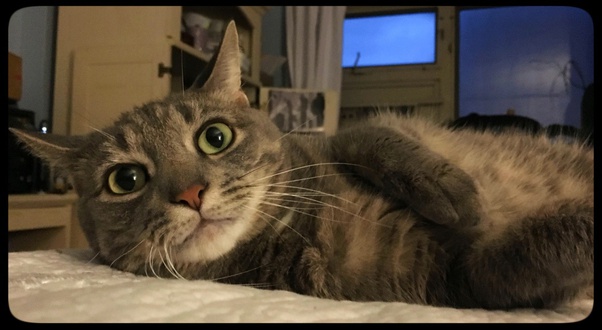
A visibly angry Buddy, pictured above, hasn’t had turkey in weeks.
Buddy’s hopes were further dashed on Thursday when his human servant logged onto Chewy.com and found his favorite brands of wet turkey on back order.
Pet food manufacturers have been “working hard to make sure America’s pets are getting the nutrition they need,” said Jan Schroeder, communications director for the National Association of Yums.
“We realize this has been hard on cats, especially Buddy,” Schroeder said. “The situation is urgent, and Buddy needs his turkey. That’s why we’ve asked suppliers to expedite shipments of the good stuff, particularly to Buddy’s home state of New York.”
But suppliers may not realize how dire things really are. Back in New York, Buddy’s once-loud meow has become a scratchy mew as his body reacts to the lack of turkey.
“Can’t…survive…much longer,” Buddy said as he was forced to eat Blue Buffalo chicken treats and moist salmon Bursts. “Need…turkey. When will…this nightmare…be over?”
New research offers more evidence that despite their poker faces, cats do care about where their humans are and what they’re doing.
A new study from Japan found cats keep track of their humans even when they’re not looking at them.
A research team from the University of Kyoto conducted the experiments in a cat cafe and in individual cats’ homes. Each cat was placed in a room without their humans. Then the researchers tested the way felines reacted to hearing their people calling their names from outside the room, followed by their reactions to hearing them inside via speakers.
When the cats heard their humans calling them from inside the room the furballs were surprised, expressing their confusion with ear twitches, whisker movement and uncertain body language.
On the other hand, when cats heard “non-social stimuli” — scientist-speak for sounds other than familiar people calling to them — they didn’t react to changes in the location and direction.
Some people might shrug and wonder what the fuss is about, but the experiment actually confirms a great deal about feline intelligence. It’s a test of what scientists call “socio-spatial cognition,” meaning cats form a mental map of things that are important to them, and nothing’s more important to a house cat than the person who provides food, security and affection.
That’s significant because it’s confirmation that cats understand object permanence, and that they are more than capable of abstract thought. Abstract thought — the ability to picture and think about something mentally, without having to see it — is hugely important in intelligence, allowing everything from creativity to understanding that other animals and people have their own points of view. For context, it takes about two years for human children to develop rudimentary abstract thinking skills.
Cats “may be thinking about many things,” Saho Takagi, the study’s lead author, told CNN.
“This study shows that cats can mentally map their location based on their owner’s voice,” Takagi said, per The Guardian. “[It suggests] that cats have the ability to picture the invisible in their minds. Cats have a more profound mind than is thought.”
Things like object permanence and spatial awareness were necessary for cats to thrive as hunters for the millions of years they’ve existed on Earth.
The results aren’t surprising from an evolutionary perspective, biologist Roger Tabor said.
“That awareness of movement – tracking things they cannot see – is critical to a cat’s survival,” Tabor told The Guardian.
“A lot of what a cat has to interpret in its territory is an awareness of where other cats are. It is also important for hunting: how could a cat catch a field vole moving around beneath the grass if it couldn’t use clues, such as the occasional rustle, to see in its mind’s eye, where they are? A cat’s owner is extremely significant in its life as a source of food and security, so where we are is very important.”
The study is also another piece of evidence showing cats are just as aware of — and concerned about — their people as dogs are, even though the conventional wisdom says they don’t care most of the time. That has implications for the way people bond with their cats, and the decisions we make about caring for them — like, for instance, how long we’re willing to leave them on their own while planning a trip.
“This is a great example of elevating our expectation of the cat a little bit,” cat behavior consultant Ingrid Johnson told CNN, “and realizing that they do have the capability of having that bond in that relationship where they actually will take comfort in their people.”
A cat in rural Colorado has tested positive for the Bubonic Plague. Health authorities say it was probably the result of an encounter with an infected rat.
A cat in Colorado has tested positive for the Bubonic Plague.
You read that right. The same bacterial infection that was called the Plague of Justinian back in the 6th century BC, killed one out of every four people living in the Mediterranean, then flared up occasionally every century or two before returning with a vengeance in 14th century Europe, where it was called the Black Death and killed a third of the population on the continent.
That plague.
The kitty ranges near a public park and likely caught the infection from a rat, local health authorities told KUSA, an NBC news affiliate.
Like many infections, it was never completely eradicated, and WHO statistics show about 100 people die annually of plague.
“While plague is a serious disease, and cases of animal-borne disease in household pets is never something we like to see, it is normal and expected for some animals to contract plague in Jefferson County each year,” said Jim Rada, director of Environmental Health Services for the county. “The good news is that modern antibiotics are effective against plague, and as long as it is treated promptly, severe complications, illness or death can be avoided.”
When we think of outdoor dangers to cats, we tend to think of abusive humans, vehicle traffic or poisons, but this is a reminder that nature can be lethal as well.
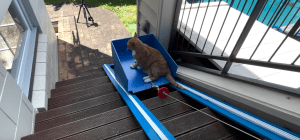
Frodo the Cat is 20 years old and doesn’t get around like he used to, so his handy human put his handy skills to work and built the little guy his own lift.
Liam Thompson is a 21-year-old Youtuber who’s known for building cool stuff.
His cat’s name may be Frodo, but Thompson said he’s in “Gandalf territory” at 20 years old and has been having trouble getting around to his favorite spots, especially a sunny corner of the backyard where he likes to sit poolside and enjoy the New Zealand warmth.
“Despite his ancient-ness, he still insists on hobbling down these stairs every day to sit out in the sun,” Thompson says in a video about his latest project. “That is, until today.”
The video shows the handy Kiwi building an “elevator” — more like a stair lift for a cat — out of wood, an electronic hoist and a handful of small hardware pieces. The passenger compartment is a simple cart, and at the press of a button the cart descends or ascends the stairs along a wooden track.
Frodo isn’t bothered in the slightest.
“Are you ready to go downstairs without having to move a muscle?” he asks his cat before the maiden ride. “I hope so, because it took me four days.”
Thompson is delighted as the elevator works perfectly and Frodo rides it without fear or protest, laughing as the orange senior cat makes himself comfortable during the ride. The current setup requires Thompson to push a button, but perhaps in the future he can add a simple button for Frodo directly on the cart.
Speaking of elevators, this cat thinks he’s Leslie Chow from The Hangover:
The Electric Life of Louis Wain tells the story of one of Victorian England’s most revered artists who was known almost exclusively for his humorous cat illustrations.
Movie: The Electrical Life of Louis Wain Director: Will Sharpe Genre: Biopic, drama Medium: Amazon Original (streaming and in theaters)
Louis Wain was an artist in the employ of The Illustrated London News, one of the most popular newspapers in Victorian England, when advances in photography and printing made it possible for newspapers to regularly include photographs in their pages.
Demoted from staff illustrator to contributor, Wain’s professional skills seemed destined for obsolescence when he and his wife, Emily, returned to their cottage one rainy afternoon in 1886 and heard the distressed mews of a kitten. They found an adorable tuxedo cat soaked and shivering in their garden, brought him inside and were instantly smitten.
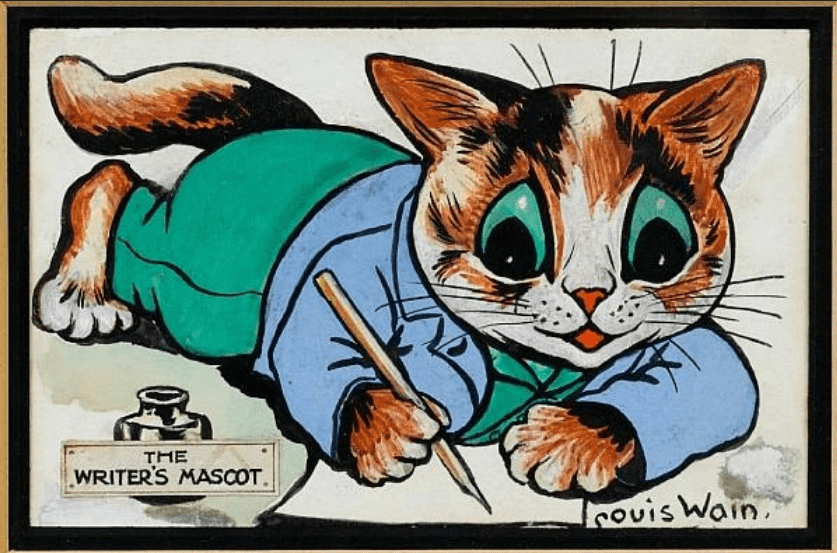
They named the baby Peter, and in the months that followed Wain made the growing kitten the subject of most of his idle drawings, sketching him in various situations and with increasingly anthropomorphic features. Wain’s cat sketches were only intended for his wife, but when Sir William Ingram, editor at The Illustrated News, saw the whimsical cat drawings he commissioned Wain to fill two pages with cats as a special feature for the paper’s Christmas edition.
Wain’s cats were a huge hit with readers, marking the beginning of a second, much more successful career as a pet portraitist and one of Victorian England’s most beloved artists. Wain gave his cats human expressions, had them do human things, and put them in contemporary clothing to the delight of newspaper readers and, later, book publishers who sold many thousands of copies of illustrated books featuring nothing but Wain’s anthropomorphic cats.
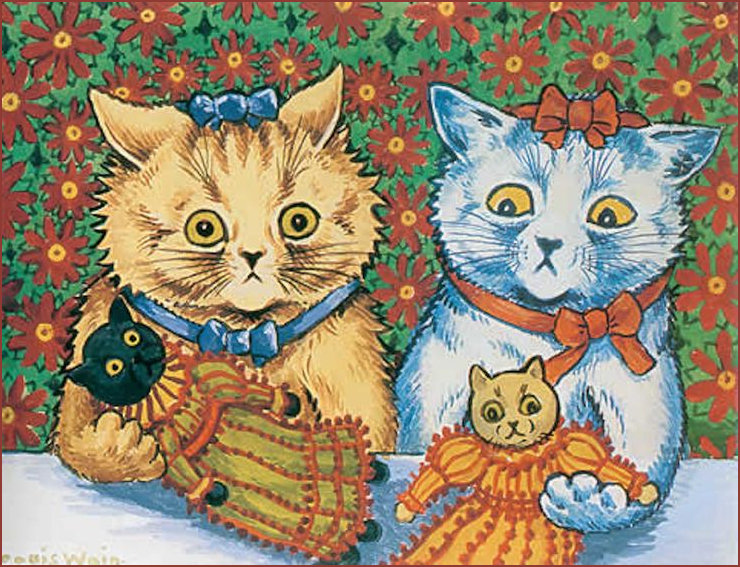
A pair of young female cats play with cat dolls.
The Electrical Life of Louis Wain weaves a narrative from its subject’s professional life and his lesser-known private life. A polymath, philosopher, amateur boxer and author of some particular ideas about cats and electricity, Wain (played by the always-excellent Benedict Cumberbatch) was an eccentric and not particularly happy with his life until his family hired Emily Richardson (Claire Foy) as governess — a home teacher — for Wain’s younger sisters.
Despite the fact that Emily was a decade his senior and such relationships were looked down upon in Victorian England, Wain and Emily married, made it clear they didn’t care what others thought about them, and learned to enjoy life in each other’s company. With the addition of little Peter, the Wains were a happy family.
Louis Wain did not, however, have an easy life. Three years into their blissful marriage, Emily was diagnosed with terminal breast cancer. Her illness, the subsequent mental deterioration of one of Wain’s younger sisters, and Wain’s own eventual struggles with mental illness cast long shadows over his outlook and his work.
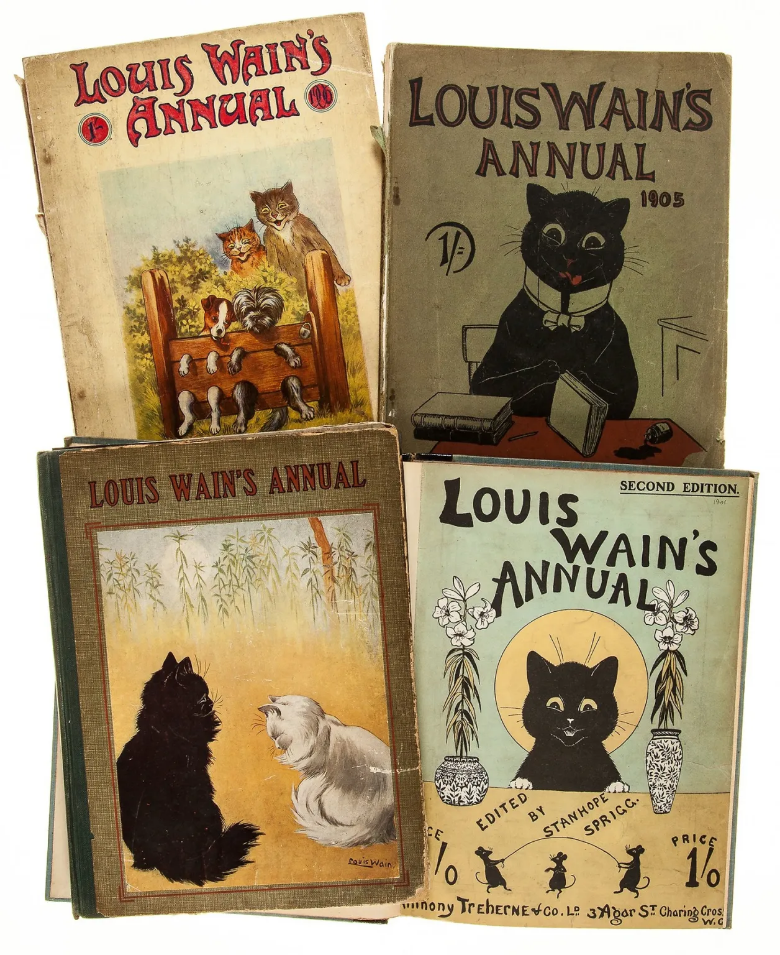
Wain’s cat drawings were so popular, they were sold in stand-alone books in addition to filling the pages of widely-read publications in Victorian England.
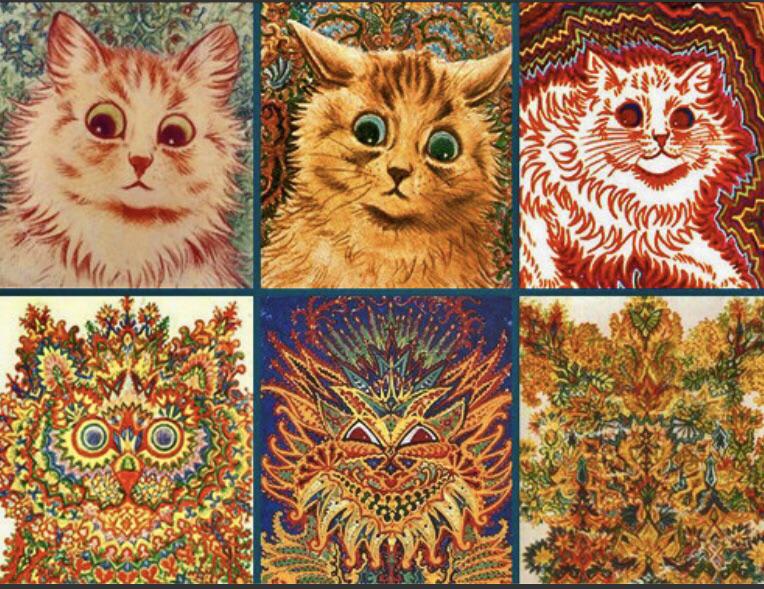
Today, psychologists, art critics and scholars of the man’s career still debate whether — and to what degree — his mental state was reflected in his artwork as his cats took on increasingly psychedelic and abstract qualities. What began as simple kitten sketches morphed into whimsical scenes of expressive cats and eventually trippy images that wouldn’t have looked out of place as album art in the late 1960s and 1970s.
Did Wain truly suffer from severe mental illness, or was he a casualty of a society that banished its “undesirables” to asylums and “lunatic houses”? Was Wain on the autism spectrum? Did the increasingly psychedelic bent of his drawings stem from medications he was given at a time when mental illness was poorly understood and poorly treated?
It depends on what you see in the illustrations. For a man so revered by the public, Wain was remarkably casual about his output — a quality Cumberbatch displays admirably throughout the film — and he didn’t bother to date his drawings. He was prolific, completing many hundreds of cat images throughout his career, in addition to the journalistic images and livestock renderings of his early career, when he was a newspaperman.
Wain’s cat illustrations took on more psychedelic qualities as the years passed.
What is absolutely clear is that Wain saw something in cats that others didn’t see until he showed it to them with his pencils. He was credited with a major shift in attitude toward cats and the normalization of keeping cats as pets rather than as mousers. Although cats enjoyed companion animal status in various other cultures earlier in human history, the idea of keeping a feline as a pet was novel in Victorian England.
The shift in public attitude was treated humorously — as much of the subject matter is — by the film, with a bewildered Wain accepting the presidency of the Cat Society of England at a fete in his honor, then explaining his theory that tabby markings were the result of electricity flowing through fur.
The subject of electricity comes up again and again in the film, bringing to mind Tesla and another famous British eccentric, Alan Turing, who was also played by Cumberbatch in the 2014 biopic The Imitation Game. Not coincidentally, both movies show that service to crown and country mattered little when British eccentrics were deemed too odd to tolerate. Like Wain, Turing — a war hero who famously cracked the legendary German Enigma cryptography machine — found himself on the wrong side of the UK’s mental institutions when he was convicted of indecency in 1952 after admitting to police, during an interview in an unrelated investigation, that he’d once had a relationship with another man.
Turing was subsequently placed on synthetic estrogen and drugs prescribed to “cure” his mental condition, which had the opposite effect: Turing, a shadow of his former self, his genius blunted by chemicals, committed suicide by eating an apple he’d laced with cyanide in 1954.
The Electrical Life of Louis Wain finds humor in both the light and dark moments of its subject’s life, and it’s a credit to the film’s writers, director and actors that lighthearted moments don’t spoil the more serious narrative themes. For his part, Wain was a man who endured a lot of suffering in his life, and if there’s a lesson to be learned here, it’s that no matter what life throws at us, spending time with cats makes things more bearable.




![Screenshot 2021-11-07 at 06-19-42 2_1890c_Louis_Wain_CatsNightmare_IllustrationChronicles_1500 jpg (WEBP Image, 1123 × 1536[...]](https://i0.wp.com/littlebuddythecat.com/wp-content/uploads/2021/11/screenshot-2021-11-07-at-06-19-42-2_1890c_louis_wain_catsnightmare_illustrationchronicles_1500-jpg-webp-image-1123-c397-1536....png?w=169&h=231&ssl=1 "Screenshot 2021-11-07 at 06-19-42 2_1890c_Louis_Wain_CatsNightmare_IllustrationChronicles_1500 jpg (WEBP Image, 1123 × 1536[...]")


 Pain In The Bud