It’ll Take More Than Sketchy Surveys To Prove Vegan Cat Food Is OK

“People aren’t ready for us to turn carnivore cats vegan but I’m going to do it,” the CEO of a vegan cat food brand has vowed.

In September of last year, a research paper about feline health was published to the open-access journal PLOS-One, going mostly unnoticed.

The paper’s authors claim their research proves cats fed a “nutritionally complete” vegan diet are not only just as healthy as their meat-eating counterparts, they’re actually less likely to need veterinary visits, less dependent on medication, and more likely to be given a clean bill of health by their veterinarians.

When a company called Wild Earth announced the launch of a new line of vegan cat food this month, the company pointed directly to that paper as proof that “cats fed nutritionally sound vegan diets are healthier overall than those fed meat-based diets,” as the paper’s lead author put it.

Wild Earth CEO Ryan Bethencourt, who does not have a professional background in veterinary medicine or feline nutrition, summed up his goal in a tweet: “People aren’t ready for us to turn carnivore cats vegan but I’m going to do it.”

bethencourt
Bethencourt calls the effort to put pets on vegan diets “vegan biohacking.” Credit: Wild Earth

He painted the new offering as a bold counter to skeptics who say vegan cat food is unhealthy.

“We expect aggressive resistance from the meat industry on the launch of this industry-pioneering vegan cat food, but we know there are A LOT of cat parents looking for healthier plant-based and more sustainable options and we want to be the leader in providing them with that choice,” Bethencourt wrote in a statement.

What he didn’t mention was the fact that the loudest voices opposing “vegan cat food” are animal welfare organizations like the SPCA and Humane Society, as well as veterinarians and nutritionists, the same people who see the consequences of cats who are deprived of meat. Over the years they have reiterated that felines are obligate carnivores who have evolved to get their nutrients from meat, with digestive systems that cannot process most plants, meaning they can’t break them down and derive nutrients from them. That’s why we don’t see servals or leopards foraging for fruit in the wild.

In addition, the announcement did not mention that the 2023 research was funded by ProVeg International, a non-profit dedicated to reducing global meat consumption, weaning people and animals off of meat and onto plant-based food.

That didn’t stop other credulous reports, like one from GreenQueen claiming Wild Earth’s vegan cat food is “built on research proving that felines can be healthy on a vegan diet.”

And that’s exactly the point — the “study” was conceived and published so that advocates of vegan cat food can point to it and say “science says” cats can survive on plants.

Bad data makes for bad science

Extraordinary claims require extraordinary evidence, but the 2023 study did not examine veterinary records or log the results of vet visits over years. Instead, the data was self-reported by participants.

A total of 1,418 people responded to the survey, and only 127 of them said they feed their cats exclusively vegan diets. The claims that their cats get sick less often and do better in veterinary check-ups are based on their subjective assessments and recollections. The paper’s authors don’t know which vegan brands the 127 respondents were giving to their cats, nor do they have information on whether the food was wet or dry, how often the cats were fed, and how much they ate.

wildearthfood
A cat eating Wild Earth’s Unicorn Pate, which is made entirely from plant products. Credit: Wild Earth

One of the metrics cited by the authors is “guardian opinion of more severe illness,” which means arbitrary feedback from people who aren’t experts in veterinary medicine or nutrition.

If including respondent opinions as “data” doesn’t bother you, consider how many people buy products like Airborne, concluding that it works because they didn’t get sick once on a cross-country flight. Airborne, you may recall, was “invented” by a teacher who claimed she figured out how to cure the common cold, something no physician has done in centuries of trying.

Like vegan cat food proponents, Airborne had its own “study” that claimed its efficacy. The company eventually paid out more than $23 million in a class action settlement for its false claims. That’s not to say vegan cat food makers are precisely like Airborne, but pointing to poorly conducted research is a tactic that works because most people won’t go to the effort of finding the study and reading it.

Current global meat consumption is unsustainable, but…

I’m a vegetarian and I’ve seen enough evidence to convince me that the current rate of meat consumption, especially in the first world, is untenable as the global population rises toward its expected 11 billion-plus peak. Those forecasts and the horrors of factory farming are motivation enough to hope human civilization consumes less meat in the future.

But I’m also a guy who loves his cat, and I think if you’re going tell me that my little pal, designed by nature to be an obligate carnivore with a digestive system and body plan that hasn’t significantly changed for ages, can stop eating meat entirely with no deleterious effects — despite the experts saying otherwise — then you really need to show me something better than a self-reported survey paid for by a vegan advocacy group.

Cat with a salad
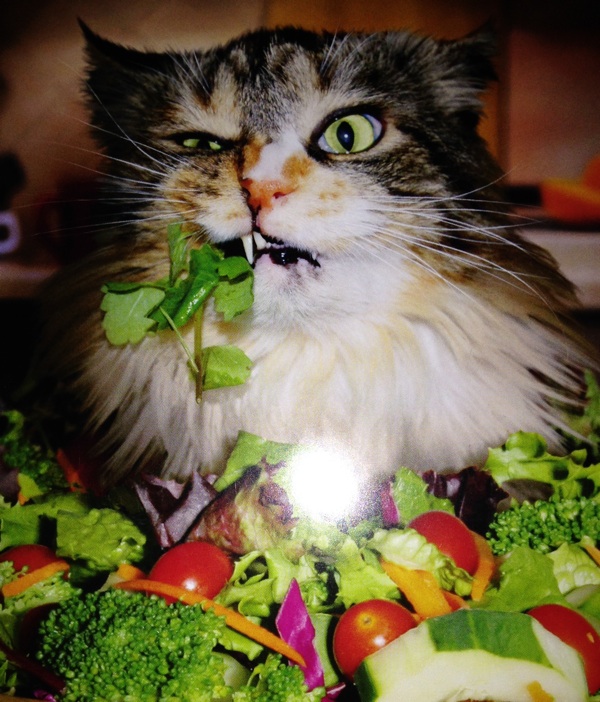
This cat is not happy. Credit: r/cats(reddit)

Especially when veterinarians who have no financial interest in the pet food industry relate horror stories of their four-legged patients slowly going blind and cats with no other ailments suffering catastrophic consequences, with their organs shutting down because they’re not getting the vital nutrients and proteins they need to survive.

It’s a horrific way to die, and it happens because misguided people think human morals should apply to cats. Notice in the press releases and marketing materials from vegan cat food manufacturers, there’s no mention of what’s in the best interest of cats — it’s all about people making “bold” choices, “disrupting” industries and leading the Earth to a shiny future without meat or suffering.

The truth is, felines cannot synthesize the proteins that are absolutely necessary for their survival, and their digestive systems aren’t evolved for breaking down nutrients from plants. Those are well-established facts, and ignoring them will not change reality. So anyone who claims “vegan cat food” is healthy faces a much bigger task than asking people to take a self-reported survey. A survey paid for by a nonprofit that lobbies for veganism isn’t proof, it’s wishful thinking masquerading as science.

Even if the authors of the paper had the complete veterinary records of the same cats, it would only be one tentative first step toward challenging everything we know about cat nutrition. Questions aren’t settled after one study, especially with such a small data set. Studies must be repeatable, and the difference between correlation and causation isn’t settled with a single well-designed, unimpeachable study, much less a self-reported survey.

When the stakes are the lives, happiness and health of innocent animals, we should be absolutely sure we’re doing right by them.
‘Study’ Claiming Vegan Cats Are Healthier Is A Mockery Of Science

A new paper claims cats are healthier when fed human diets, but the “study” is activism masquerading as science.

We have a science problem in this country.

Tens of millions of adults are scientifically illiterate and cannot articulate a simple definition of the scientific method.

That includes the usual suspects, the people who don’t understand the difference between anecdotes and hard data and say things like “Evolution’s just a theory” or “I don’t believe in science” as if it’s an ideology or religion. It also includes people who like to declare they’re “into science” as if it’s a band or a genre of cinema, and often post articles from sites like “I F—-ing Love Science,” which routinely mistakes natural phenomena like stars, interstellar space and the animal life for “science.”

To quote Sam Kriss’ wonderful essay on the subject: “‘Science’ comes to metonymically refer to the natural world, the object of science; it’s like describing a crime as ‘the police,’ or the ocean as ‘drinking.'”

Science is a formalized method for studying the natural world. That’s it. No more, no less. It isn’t natural phenomena itself, it isn’t something that requires faith. It’s meant to be challenged, with each piece of knowledge hard-won as the scientific community collectively chips away at the vast edifice of things we don’t understand.

The lack of scientific literacy is an indictment of the American education system, but the science and journalism communities are also big contributors. A flawed academic publishing system encourages researchers to make grandiose claims in abstracts and press releases to increase the chances their work will get positive coverage in the press. Few journalists are more scientifically literate than the general population, so they report dubious claims credulously and present individual studies as the final word on subjects instead of tentative first steps in contributing to the corpus of human knowledge.

We see this all the time with reporting on the environmental impact of felines, but it’s certainly not limited to that subject. How many times have you seen your local news anchors or newspapers tout studies saying coffee is healthy, only to report the next week that a new study says coffee isn’t healthy after all?

“Those scientists can’t make up their minds,” they’ll say with a forced chuckle before handing the broadcast over to the weatherman, oblivious to their own failure to provide context.

The effort to rebrand cats as vegans

A new “study,” given prominent play today by major news outlets like Newsweek and aggregators like Drudge, is a classic example of misleading claims given the veneer of scientific authority. The paper claims vegan cats are “healthier” than their meat-eating counterparts. The study — which is actually a survey — says no such thing, and its authors are surely aware that the way it’s been packaged for media consumption will cause confusion, but they’ve gone ahead with it anyway.

The research involved asking 1,369 cat owners to fill out surveys about their cats, the cats’ diets, and their veterinary health histories.

Of those surveyed, there were 123 reported “vegan cats” in their households (about nine percent of the total), and while the abstract and media pitches claim the surveys show vegan cats are healthier, the differences are statistically insignificant. The sample size is too small to draw any conclusions from, and the fact that the details are self-reported means the “data” is worthless: People who put their cats on vegan diets despite knowing felines are obligate carnivores have a vested interest in defending their decision. They’re not impartial, and their survey answers aren’t either. (The paper acknowledges that 91 percent of the respondents are female, and 65 percent are vegans, vegetarians or pescatarians themselves. Those are admirable choices for a human diet, but not for a cat.)

Relying on self-reported “data” also means the research team doesn’t actually know the true veterinary histories of the cats in question, nor does it know anything about the nutrient content of the vegan “cat food” given to the 123 cats who have been deprived of meat. It also cannot account for possibilities like the so-called vegan cats slipping out at night to hunt rodents.

a close up shot of a cat eating
Credit: Engin Akyurt/Pexels

That’s especially important because of “vegan cat food’s” dubious history. Evolution, the brand that popularized the concept, is owned and operated by a man named Eric Weisman, who has been prosecuted and repeatedly sanctioned for misrepresenting himself as a physician, veterinarian and scientist — and continues to misrepresent himself.

Weisman, a chiropractor by trade, racked up a long list of violations in his chosen field before his chiropractor license was pulled, then was charged and convicted criminally for, among other things, practicing veterinary medicine and regular medicine without a license. Weisman’s list of offenses include “treating” cancer patients, “treating” and misdiagnosing animals, and posing as a physician for years, including in advertisements and literature related to his pet food and fake veterinary practices.

Weisman is still calling himself a physician in violation of his plea agreement, and he’s still selling “vegan cat food.” Would anyone in their right mind weigh the claims of that man against the tens of thousands of veterinarians and pet nutritionists who are horrified at the idea of restricting cats to vegan diets?

(In case you’re tempted to think chiropractors are legitimate to begin with, you should know that chiropractor was founded by a lifelong quack who claimed its methods were taught to him by the ghost of a physician, which allegedly appeared to him during a seance. Chiropractor’s founder dodged accountability for years by claiming his practice was a “religion.” The fact that it’s now a $15 billion industry despite its origins, and decades of research that has found no benefit to the practice, illustrates how eager people are to believe just about anything.)

The consequences of bad science

Not only will the “study” and press coverage of it mislead people into believing its claims, it’s another black mark on the scientific community. Trust is hard-won, easily lost, and for better or worse the misdeeds of a few scientists reflects on the entire field.

Others will simply believe it, especially when major news outlets like Newsweek report the results without question, without acknowledging that it’s a lazy effort masquerading as science by a research team that already knew what result it wanted before handing out the surveys. (The “study” was funded by ProVeg, an NGO that promotes plant-based consumption and is involved in the development of plant-based foods.)

Lastly and most tragically, cats will suffer for it. Cats who are denied meat suffer slow and agonizing deaths, with health problems accumulating due to the lack of certain proteins until they go blind, become chronically malnourished and eventually suffer organ failure.

And for what?

Because some people believe human morals apply to cats?

Because, despite all common sense, they think they can change a species that has been dependent on meat for so long in their evolutionary history that their bodies literally cannot synthesize certain proteins and cannot extract nutrients from most plant material?

How would we like it if we were dependent on giants to feed us, and those giants decided we could and should live on a diet of marshmallows? We’d suffer horribly and we’d die, but at least we’d know why.

Cats don’t have that luxury. They depend on us to do right by them, and when we adopt them it’s our basic responsibility to keep them healthy and well-fed. Let’s not fail our little friends by pretending human ethics is applicable to a species that can’t understand it, or consent to participating in it.

‘Vegan’ Cats Turn To The Streets For Their Fix

As more humans force vegan cat “food” onto their felines, cats turn toward the black market for their yums.

The exchange was so swift that unless you were looking out for it, you’d miss it.

A young, skinny ginger tabby approached a pudgy tuxedo in front of a stoop. The felines exchanged a nod and bumped paws, then the tabby scurried into an alley, disappearing into the shadows between two buildings.

“Gotta get it in me!” the tabby said, taking quick breaths. He dragged a claw across the top of the pouch to open it, poured every last morsel of meat into his mouth, then dropped to the ground, leaning against the brick wall.

“Oh!” he exclaimed, his pupils dilating. “That is the good stuff! Man, I needed that.”

The tabby, who would only identify himself by his street name, Skinny G, is one of thousands of so-called “vegan cats” in New York who have been defying their humans, finding ways to slip out and connect with a burgeoning network of “can slingers.”

Resembling drug dealers in their methods and presentation, the can slingers nevertheless point out that what they’re doing is not illegal.

“We like to think of ourselves as a charitable organization even though we earn a tidy profit,” said Tuco Salamanclaw, vice president for emerging markets with Los Gatos cartel. “It’s tragic to see so many misguided humans forcing their faithful felines to eat tofu, soy and other junk that doesn’t have the nutrients we need. We’re here to help address that injustice.”

Meowfioso
Louis “Linguini Louie” Felinzio, a Meowfia capo and director of taste testing for the Meowfia’s can slinging operation.

The rise of the underground meat market — and the profits it promises to organizations that can muscle their way in — has attracted the Meowfia as well as The Buddy Organization, which was rebranded last year as Nipped In The Bud Catnip Co. Jostling for position among those three major players, as well as smaller groups, has led to a revival of the territorial battles that marked the catnip wars years ago.

“It’s just a matter of time before we see another drive-by spraying,” said Pawl Oreoson, a criminologist at John Jay College of criminal justice in New York. “Los Gatos is not an organization that surrenders territory easily, and the Meowfia also play for keeps. There’s just too much money to be made here.”

Profits from the underground cat food market set a record for the 10th consecutive quarter in March, reflecting the growing number of humans forcing their felines to eat meat-free diets of ultra-processed, plant-based “food.”

“Disgusting,” is how three-year-old Nala put it when asked about the “vegan cat food” her humans feed her. “Imagine eating damp cardboard with little clumps of carrot and celery embedded in it. No self-respecting cat should be forced to eat this stuff.”

Chonk
“After two weeks on the vegan stuff I was skin and bones,” says Slim Sal, above. “I was almost too weak to make it to the can slingers and get my paws on proper food. No cat should have to endure that trauma.”

Tigger, a striped eight-year-old from Brooklyn, was admonished by his humans two weeks into his vegan “cat food” diet when he got into the fridge and helped himself to an entire pound of Boar’s Head ham and two large chorizos.

With a child lock now preventing him from opening the refrigerator door, Tigger said he’s been squirreling away portions of the vegan kibble and dumping it off the fire escape when his people aren’t looking. He hunts rodents to keep himself from starving, but says he’s getting sick of mice.

“If these lunatics want to subsist on broccoli, quinoa and hummus, that’s on them, but I just can’t,” Tigger said. “I’ve scraped together enough cash to buy a few cans of Friskies, and tomorrow I shall feast!”

Memorandum To Human, re: Disgusting New Bug-Based Cat Food

Little Buddy makes it clear he sure as hell won’t eat insect larvae cat food. Yuck!

Dear Big Buddy,

You find yourself in receipt of this notice so there exists a written record of the amendment to section 176.2 in the Little Buddy Care Agreement, forbidding the use of repugnant and objectionable non-approved yums.

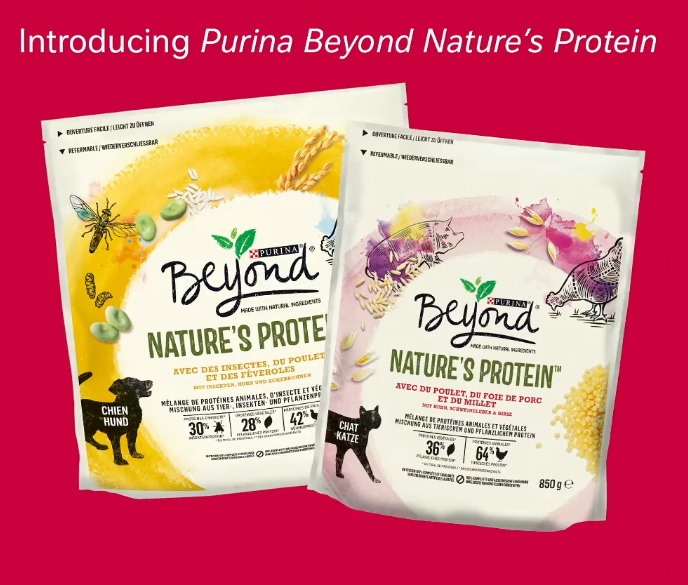
Specifically we refer to the so-called “alternative proteins” hawked by Nestle’s Purina brand, which substitutes Glorious Yums like turkey, chicken and turkey, for unacceptable ingredients such as “fly larvae protein.”

As the language of the new LBCA amendment makes clear:

“At no time shall human serve any Purina products or any products containing ‘alternative proteins’ including, but not limited to, fly larvae protein, invasive Asian carp protein, and any alleged ‘cat food’ that includes insects or non-approved yum ingredients.”

nastyshit
No. Don’t even think about it.
purinabeyondnature
Insect larvae-based pet food is attractively packaged.

Please keep in mind, dear human, that section 176.1 still applies:

‘At no time shall Buddy the Larger serve Little Buddy any abhorrent meat substitute or so-called ‘vegan cat food.’ Violations are punishable by biting and shitting in your shoes.”

We acknowledge that Nestle claims it’s motivated by “the need to diversify sources of protein in food for a variety of reasons, including environmental goals such as fighting climate change and protecting biodiversity.”

But that just means the cheap bastards are looking to increase profit margins beyond the sky-high margins it enjoys for the lowest-grade quasi-meat it uses for its existing pet food lines.

After all, a company run by the environmentally conscious wouldn’t destroy entire swaths of Indonesia and Malaysia, endangering the health of locals and children, and directly driving the pending extinction of orangutans.

As always, we expect you to adhere to the Little Buddy Care Agreement. Violations will be recorded and will negatively effect your score on the annual Service Quality Report Card, so remain vigilant. Only the best yums will do.

Sincerely,

Little Buddy, Esq.

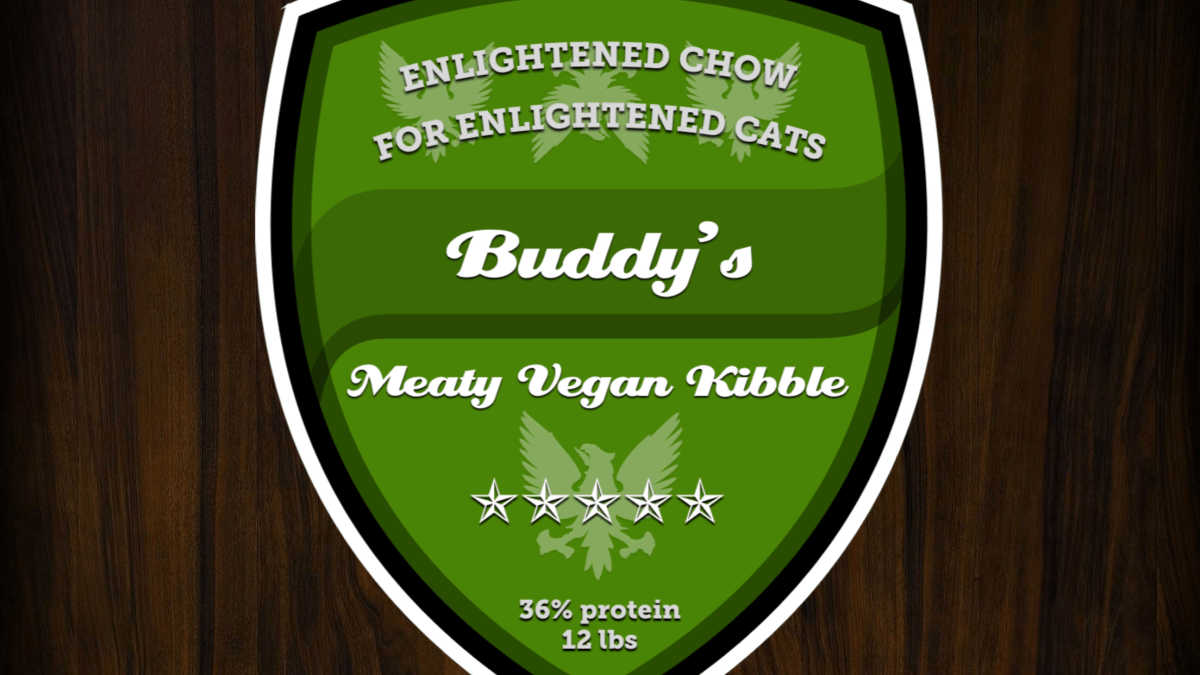
Introducing Buddy’s Old Fashioned Meat-based Vegan Cat Food!

Now your cat can eat meat AND be a vegan!

You’ve got a dilemma, one that has tormented many a vegan before you. 

While you’ve joined the ranks of the enlightened and meat-free, you also have a cat…and your cat eats meat.

Your vegan side urges you to put kitty on a strict plant-based kibble regimen. Your rational side reminds you she depends on you and cutting meat from her diet will seriously harm her.

Angry cat eating salad
“I will murder you for this, human!”

Cats may be obligate carnivores, but how can you admonish the meat-eating savages of humankind when your four-legged friend gobbles down chicken and turkey flesh every day?

Fear not, vegan friends, for a genuine solution is upon us! I present to you Buddy’s Old-Fashioned Meat-Based Vegan Cat Food. It’s vegan with meat added, meaning kitty gets all the nutrients she needs for a healthy, happy life while you get to tell everyone that you AND your cat are vegans.

After all, what is the purpose of veganism if you can’t tell everyone you meet that you’re a vegan?

Buddy’s Old-Fashioned Meat-Based Vegan Cat Food, available wherever fine cat foods are sold.

Kitten and potato
Kitten and potato sold separately.