The New York Times Is Back To Spread Misinformation About Cats

Protecting birds from extinction will take a lot more than passing laws requiring people to keep their cats indoors.

Prompted by the recent news that Polish scientists have added cats to a list of invasive alien species, the New York Times ran an enterprise story on Tuesday titled “The Outdoor Cat: Neighborhood Mascot Or Menace?”

I’m highly critical of print media stories on animals because I’ve been a journalist for almost my entire career, and I know when a reporter has done her homework and when she hasn’t. Unfortunately it looks like Maria Cramer, author of the Times story, hasn’t.

Her story identifies the stray cats of Istanbul as “ferals,” cites bunk studies — including meta-analyses based on suspect data — and misrepresents a biologist’s solutions “to adopt feral cats, have them spayed or neutered and domesticate them.”

Doubtless the biologist understands cats are domesticated, but Cramer apparently does not, and her story misrepresents the domestication process.

Individual animals can’t be domesticated. Only species can. It’s a long, agonizingly slow process that involves changes at the genetic level that occur over many generations. Domestication accounts for physical changes (dogs developing floppy ears while their wolf ancestors have rigid ears, for example) and temperamental ones. A hallmark of domestication is the adjustment to coexisting with humans.

agriculture animal beautiful cat
Photo by Pixabay on Pexels.com

In other words, if cats were wild animals it would take hundreds of years to fully domesticate them, and I’m sure no one’s suggesting we wait hundreds of years to solve the free-ranging cat problem.

Ferals can be “tamed,” but the majority of cats living in proximity to humans are strays, not ferals. The difference? Strays are socialized to humans and will live among us, while ferals are not and will not. Strays can be captured and adopted. In most cases ferals can’t, and the best we can hope for is that they become barn cats.

To her credit, Cramer does make efforts to balance the story and quotes the Royal Society for the Protection of Birds in the U.K., which places the majority of the blame squarely at the feet of humans, noting “the decline in bird populations has been caused primarily by man-made problems such as climate change, pollution and agricultural management.”

Even our structures kill billions of birds a year. That’s the estimated toll just from the mirrored surfaces of skyscrapers, and no one’s suggesting we stop building skyscrapers.

Indeed, Saudi Crown Prince Mohammed bin Salman al Saud (MBS), the de facto ruler of Saudi Araba, has been busy commissioning science fiction city designs when he’s not murdering journalists critical of his policies. The design he’s chosen for his ultra-ambitious future city, which he hopes will rival the pyramids in terms of lasting monuments to humanity’s greatness, is a 100-mile-long mirrored megacity called Neom, which is Arabic for “Dystopian Bird Hell.” (Okay, we made that up. Couldn’t resist.)

Take a look:

The point is, of the many factors driving bird extinction, humans are responsible for the majority of them, and if we want to save birds we have to do more than bring cats inside. Additionally, sloppy research portraying cats as the primary reason for bird extinction has resulted in cruel policies, like Australia’s effort to kill two million cats by air-dropping poisoned sausages across the country.

This blog has always taken the position that keeping cats indoors is the smart play, and it’s win-win: It protects cats from the many dangers of the outdoors (predators like coyotes and mountain lions, fights with other neighborhood cats, diseases, intentional harm at the hands of disturbed humans, getting run over by vehicles), ensures they’re not killing small animals, and placates conservationists.

At the same time, we don’t demonize people who allow their cats to roam free, and we recognize attitudes vary widely in different countries. Indeed, as the Times notes, 81 percent of pet cats are kept indoors in the US, while 74 percent of cat caretakers allow their pets to roam in the U.K.

We have readers and friends in the U.K., and we wouldn’t dream of telling them what to do, or suggest they’re bad people for letting their cats out.

Ultimately, tackling the problem depends on getting a real baseline, which Washington, D.C. did with its Cat Count. The organizers of that multi-year effort brought together cat lovers, bird lovers, conservationists and scientists to get the job done, and it’s already paying off with new insights that will help shape effective policies. To help others, they’ve created a toolkit explaining in detail how they conducted their feline census and how to implement it elsewhere.

Every community would do well — and do right by cats and birds — by following D.C.’s lead.

Sunday Cats: Eurasian Lynx Captured On Long Island, ‘Loneliest Cat’ Has Been Returned To Shelter Twice

SPCA staff and veterinarians believe the well-socialized wildcat was the illegal pet of someone living in or near Central Islip.

The saga of a “big cat” spotted on Long Island this week has come to an end with the animal’s capture.

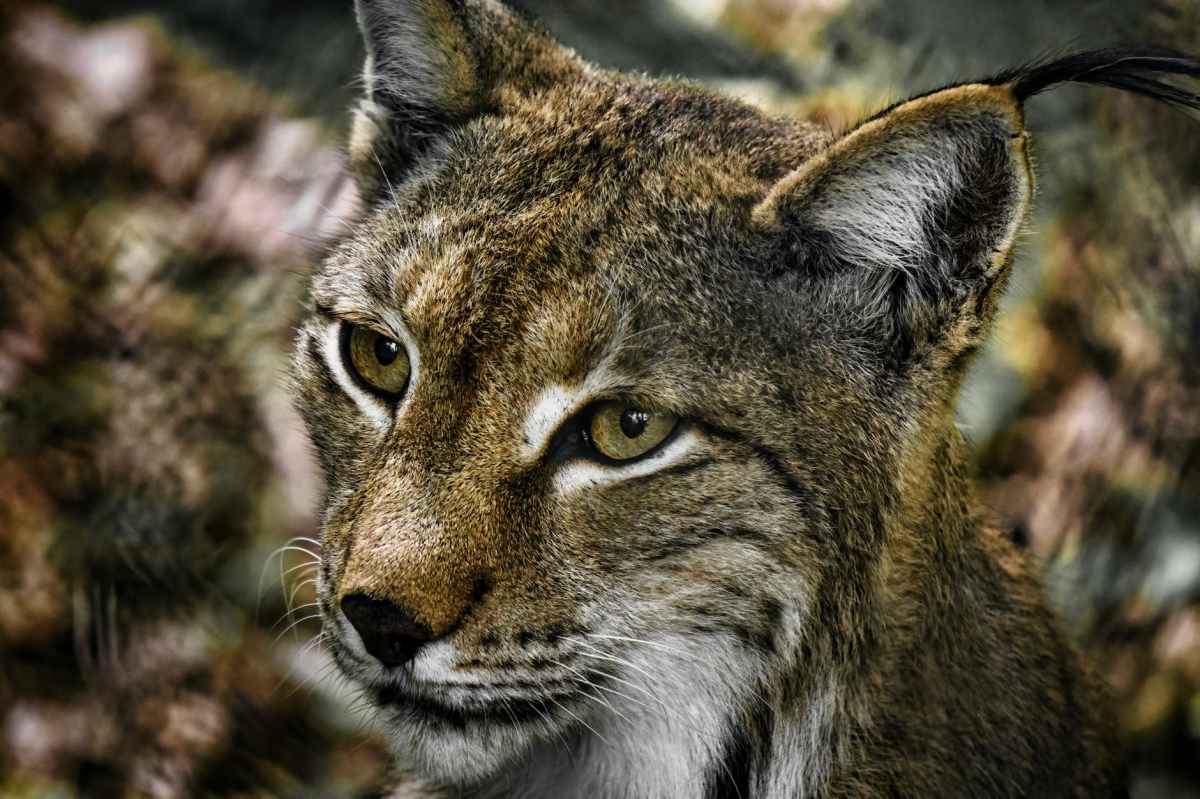
Authorities believe the cat is a Eurasian Lynx and was a pet who escaped or was abandoned by his owner. The frightened feline was first spotted on Wednesday in Central Islip, Long Island, a suburb that stretches for 118 miles just south of New York City.

“Scared the daylights out of me,” Diane Huwer, a self-proclaimed cat lover who was the first to encounter the lynx, told the local ABC affiliate.

The area encompasses two counties and is one of the most densely populated places in the U.S. with more than 7.6 million people. It’s one of the worst places in the world for a wild cat to be abandoned, with heavy traffic, ubiquitous environmental noise and endless shopping plazas surrounded by labyrinthine residential neighborhoods.

It’s illegal to own wild animals in New York, and the cat’s “owner” likely would have kept it without a proper enclosure to avoid attention from authorities.

The lynx’s sightings made the headlines in the New York papers, as well as coverage by local TV news and online publications. It went viral on social media, with users trying to determine what kind of cat it was from the handful of blurry photos witnesses were able to snap. Some media coverage suggested it was a true big cat. (Here at PITB, we thought it was possibly a Savannah cat or an American lynx.)
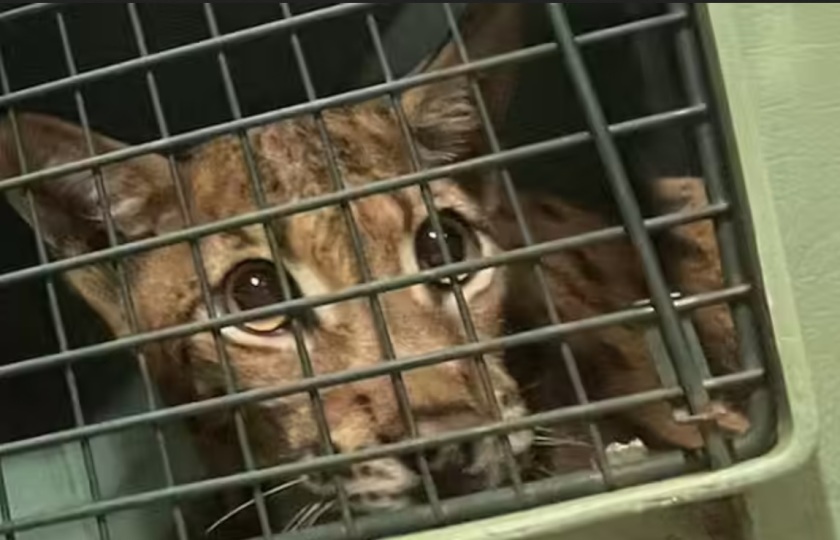
lynxleonardo
Authorities said the Eurasian Lynx was clearly socialized and wasn’t aggressive when they finally caught him. Credit: SPCA

Local authorities searched fruitlessly for three days and were about to give up early Saturday morning when someone spotted the wild cat in a residential neighborhood and called police.

The hungry feline was pawing through garbage cans next to a house in Central Islip. Authorities said the young lynx was friendly and socialized to humans.

“He was rubbing his face on the cage, looked like he was a friendly cat and from the tips we’ve gotten,” Frankie Floridia of Strong Island Animal Rescue said. “It seems these people have had him since he was a baby.”

Veterinarians have named the lynx Leonardo de Catbrio and said he’s about a year old. Despite his ordeal, the 40-pound cat was not malnourished or dehydrated, and the vets who gave him a check-up said he’s in good health. They’re waiting on lab results to confirm his species.

“Someone obviously had it as a pet,” the SPCA’s Roy Gross told Newsday. “These are wild animals, not the type of animals anyone should have. … They don’t belong in captivity this way.”

In the meantime, police, the state Department of Environmental Conservation and the SPCA are looking for Leonardo’s “owner,” who faces misdemeanor charges and a fine of up to $1,000 if he or she is convicted. They’re sure to have questions about how the person acquired a wild cat, let alone a non-native species. It’s been illegal to “import” wild animals since the Wildlife Act of 1976, and the illegal wildlife market has been a scourge on law enforcement and conservationists alike.

“I know everybody wants something that’s exotic,” Gross said. “They want something cool. It’s not cool.”

Header image of Eurasian Lynx courtesy of Pexels

A lonely cat in the UK needs a forever home

Eleven is a silver tabby who’s been returned to the shelter twice by would-be adopters, and staff at the shelter are appealing to the public to find her a forever home with patient humans.

The four-year-old with bright green eyes has been with Battersea Cats and Dogs in south London since April. Her rescuers say she takes a while to adjust to new surroundings, and they believe that’s why Eleven was returned twice within days. If Eleven’s failed adopters had been more patient, shelter staff said, they would  have discovered she’s a loving lap cat once trust is established.
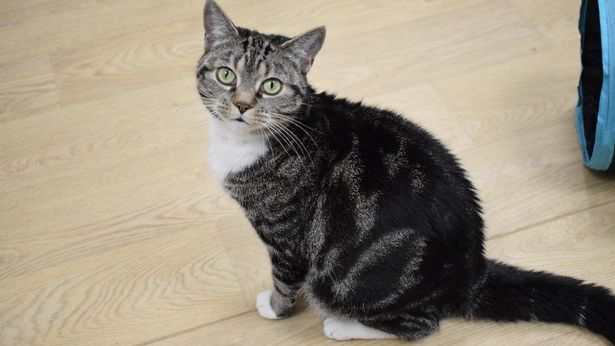
Eleven the Cat
Eleven the Cat takes a while to warm up to new people. Credit: Battersea Cats and Dogs

They hope to place her in an “understanding home” with people who “will give her the time and space to settle in, as she would be a wonderful addition to a home.”

“Eleven needs her own space when she’s settling in, so she can hiss and swipe if pushed into interactions that she is not ready for,” a shelter spokesman told the Mirror. “She expects respect, but once given she will reward you with plenty of love. She is a super clever cat, who enjoys learning and she will sit on command for a treat of course.”
Guardian Columnist Writes Cats ‘Are Pretty Stupid,’ Doesn’t Realize His Cat Trained Him

Underestimate feline intelligence at your peril, humans!

The Guardian’s Tim Dowling thought he was writing a column about his dumb cat when he inadvertently described how the cat’s got him trained.

The short of it’s that Dowling and his family have a cat and a dog who thankfully get on really well and have become best pals. The dog was in desperate need of a grooming session recently, and when Dowling’s wife brought the pup home after getting a trim, their cat regarded the dog warily and bounced. He returned from the family’s yard only to eat and kept a watchful eye on the dog each time.

In Dowling’s estimation, the cat didn’t recognize the dog after grooming, which makes him stupid.

Yet cats can tell when their humans are coming home long before the key turns in the lock, probably due to their incredible hearing (detecting footfalls), their remarkable olfactory abilities, or both. They know where we are in the home at all times because they can track our movements several different ways, and they can even tell where we’re headed in a completely pitch black room thanks to their whiskers, which can pick up micro-changes in air density — but Dowling thinks they can’t recognize a groomed dog.

The more likely explanation is the dog smelled different, which upset the cat, or the haircut itself offended kitty. Felines are, after all, notoriously averse to change.

If your cat starts acting weird after you’ve rearranged your furniture, it’s not because the cat is an idiot who can’t navigate the room. It’s because felids of all kinds don’t like changes to their territory or their belongings, especially when those changes happen without warning. (And make no mistake, if your cat rubs up against something, whether it’s a couch, your dog or even you, you are included in that tally of his or her “belongings.” A cat is marking you with scent glands when she rubs against you, and what do you think scent-marking is for?)

Dowling disses feline smarts and praises them for their perseverance in the same sentence, but hilariously doesn’t realize his cat’s been conditioning him to provide treats on demand:

But cats are actually pretty stupid – their approach to problem-solving is only notable for bottomless persistence. As I sit at the kitchen table in the morning pretending to answer emails, I can hear the cat behind me, methodically clawing at the door of the cupboard where the cat food is kept.

I say: “Don’t be insane – I fed you half an hour ago.” But I think: I really don’t want to repaint that cupboard door. After about 10 minutes, I give in.

Later, he describes the same sequence of events:

The next day while the dog is at its appointment, I sit with my laptop in the kitchen, waiting for the driving rain to stop before I cross the garden to my office shed. Behind me the cat is sitting on its hind legs, working on the cupboard door with both paws, like a boxer hitting a speed bag.

“I can’t feed you three times in the same morning,” I say. “Imagine how weak that would make me look.” Ten minutes later, I give in.

Without taking the column too seriously, it’s obvious Dowling is a man who doesn’t know when he’s being played by his furry overlord.

The “stupid” cat has trained Dowling to feed him snacks on cue: Sit in front of the cupboard and do annoying things for a while, and the human will relent and dispense the good stuff.

Buddy making demands
“Do my bidding, human, or face my considerable wrath…and annoying meows!”

Give in once and a cat will return to the same method again. Give in twice and it’s pretty much over. If you thought kitty was persistent before, now you’re going to see a whole new level of patience exhibited by your feline master if you get ideas about changing the routine.

It happens to the best of us, especially when in our human arrogance we underestimate our little friends.

When Buddy was still pretty much a kitten, I thought I was training him to come in from the balcony by shaking a treat bag. In reality he was training me, as evidenced by the fact that when I called him to come in and didn’t have a bag of treats at the ready, he would stop right at the threshold of the door and refuse to move until I bribed him with a snack.

It’s a cat’s world, and we just live in it.

Stanly Kubrick Had A 15-Page Guide To Caring For His Cats

The director was very specific about the way his cats should be treated in his absence.

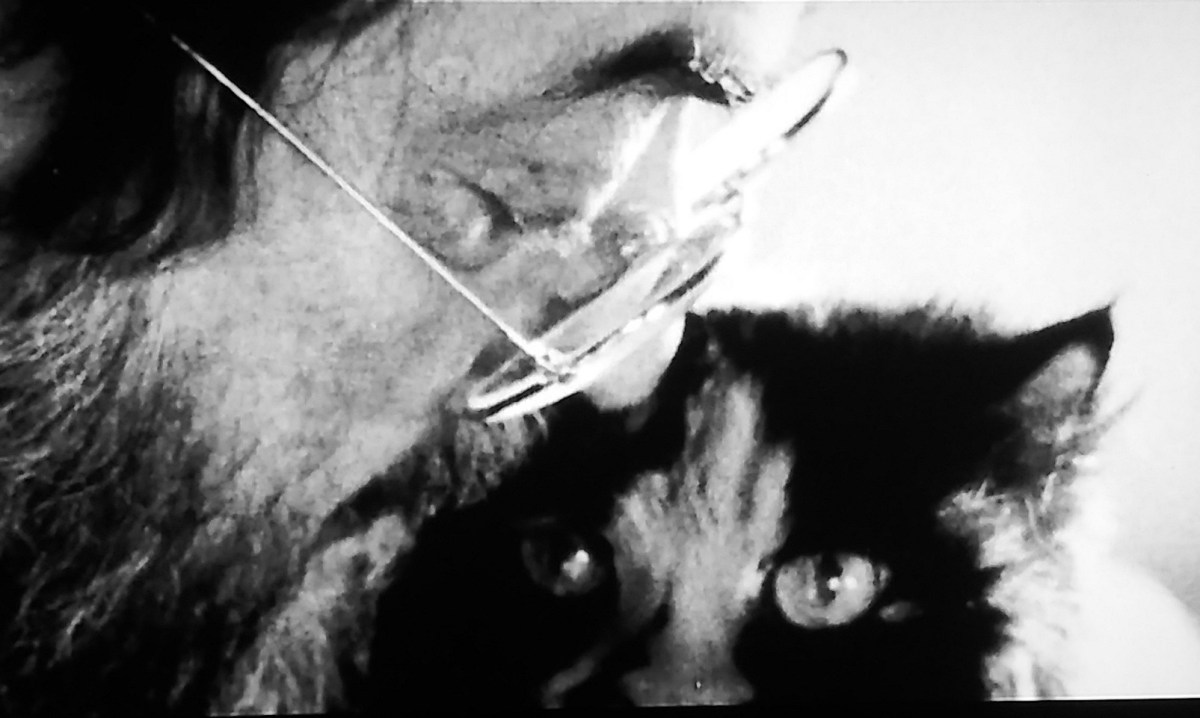
Stanley Kubrick was so particular about his cats, he created a 15-page guide to caring for the beloved felines while he was away making films.

Kubrick, who is considered one of the greatest film directors of all time, was a homebody and recluse — when he wasn’t working behind the camera — whose eccentricities have been documented in books and interviews over the decades.

Of course having cats isn’t an eccentricity, but Kubrick was very particular about how his pride of house lions should be treated, how they should eat and drink, and how their behavior should be monitored.

His lengthy instruction booklet detailing the particulars of their care had at least 37 sections!

His daughter, Katharina Kubrick-Hobbs, said the guide was titled Care Instructions: How To Look After The Animals, and the director left a version of it behind when he went to Ireland to shoot 1975’s Barry Lyndon. The 37th item dealt with breaking up potential fights among the kitties, Kubrick-Hobbs recalled:

“When we went to Ireland on Barry Lyndon, he left this 15-page document, Care Instructions: How To Look After The Animals. And the 37th instruction is: ‘If a fight should develop between Freddie and Leo–‘ and that was the father and son tomcats that we had– ‘the only way you can do anything about it is to dump water on them. Try to grab Freddie and run out of the room with him. Do NOT try and pick up Leo. Alternatively, if you open a door and just let Freddie get out, he can outrun Leo. But if he’s trapped in a place where you can’t separate them, just keep dumping water, shouting, screaming, jumping up and down, and distracting them, waving shirts, towels… just try and get them apart and grab Freddie.‘”

Kubrick died at age 70 in 1999 after a film career that spanned five decades, from 1953’s Fear and Desire, and 1960’s Spartacus starring Kirk Douglas as the eponymous warrior, to Full Metal Jacked (1987) and Eyes Wide Shut in 1999. One of his best-known works was 2001: A Space Odyssey, a 1968 collaboration between Kubrick and celebrated science fiction novelist Arthur C. Clarke. The film was groundbreaking for its realistic portrayal of space travel and exploration, and created a visual shorthand that still defines the genre today.

Stephen King adaptation The Shining (1980), Cold War black comedy Dr. Strangelove (1964) and A Clockwork Orange (1971) are among his most popular films.

Thanks To A New Treatment, These Cats Have A Second Chance At Life

Parsnip and Jupiter are fighting off FIPV, a virus that until recently was a death sentence for cats. The future looks bright for both cats.

After almost three months in treatment, little Parsnip is back to her old self.

The tabby cat with expressive sky blue eyes had been diagnosed with Feline infectious peritonitis, a variation of feline coronavirus that attacks the body’s white blood cells and can render even the most playful kittens lethargic, eventually robbing them of their ability to walk and ultimately, their lives.

Parsnip was an affectionate whirlwind of energy when 21-year-old Californian Anae Evangelista adopted her. When she lost her kitten exuberance six weeks later, Evangelista knew something was wrong. When the little cat stopped eating and drinking, Evangelista realized the problem was much more serious than an initial veterinary examination suggested.

After more tests, she received grim confirmation that Parsnip had FIPV, a virus that is almost always fatal.

But a veterinarian connected her with an online group for people whose cats have FIPV and Evangelista was able to get her kitty accepted for experimental treatment with GS-441524, a nucleoside analogue antiviral drug that has proven effective at treating all types of FIP in several trials in recent years.

After a regimen of almost three months of GS-441524 treatment, Parsnip has her energy back, she’s gained a pound and a half, and “looks perfectly healthy,” Evangelista said. Equally important, her blood work and other health indicators are all positive.

She’s overjoyed at the result. Parsnip came into her life at a difficult time, when Evangelista was grieving the loss of two friends. Losing the kitten she’d bonded with — an animal who had become such a comfort to her over the months — would have been too much.

Evangelista will graduate from college in about a week’s time, “so I’m honestly so excited to have her ‘graduate’ from her treatment too,” she told PITB.

Parsnip at the vet
Parsnip being a little trooper during one of her many veterinarian visits.

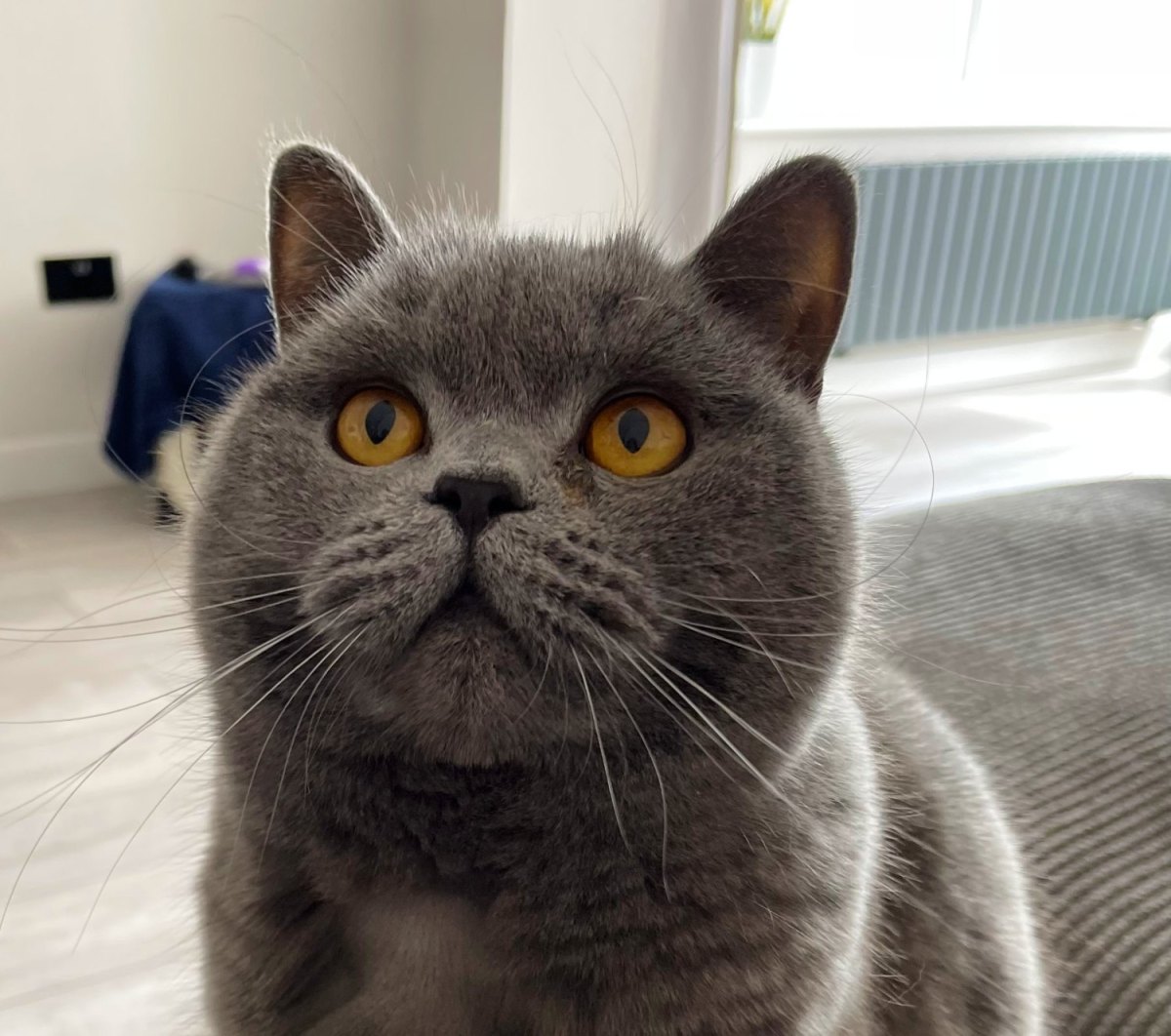
Londoner Billie’s cat, Jupiter, also suffers from FIPV. When she went to adopt him, Billie knew the British shorthair had Feline herpes virus (FHV) and that it would require careful monitoring. But the infection wasn’t life-threatening and Billie had already fallen in love with the golden-eyed chonkster.

When Jupiter’s appetite waned and his behavior changed earlier this year, Billie thought the little guy was just suffering from a FHV flare-up.

“He is very loving, he is like my shadow and he loves to play,” Billie told PITB, “but he wasn’t doing any of these things.”

As was the case with Parsnip, the veterinarians didn’t think Jupiter was seriously ill. They sent Billie and Jupiter home with antibiotics and anti-inflammatory medication, but after a week Jupiter still hadn’t improved. He was subject to a battery of tests — bloodwork, ultrasounds, x-rays — and kept overnight for observation.

“FIP is notoriously hard to diagnose, and there are so many symptoms that you could mistake for other things,” Billie said, noting veterinarians often have to “work backwards” and eliminate other potential ailments before diagnosing a cat with FIPV. “Jupiter’s symptoms were so minor initially, he just seemed a bit off and hadn’t eaten much and felt hot. I think because I know him and his behavior so well, we were able to catch it early.”

jupiterjubilee
Jupiter proudly displaying the Union Jack in celebration of Queen Elizabeth’s Platinum Jubilee.

Because the tests didn’t confirm FIPV, a third visit with more tests followed before Jupiter was placed on his meds. While the FDA has yet to approve GS-441524 treatment in the US, the UK had approved the drug in fall 2021, so Jupiter was able to begin treatment right away. Like Evangelista, who paid $5,000 for the FIPV drugs, not including the initial veterinary examinations, Billie was faced with hefty bills: The three initial veterinary visits, tests and five nights of observation added up to £5,500 (about $6,930 in USD), and the medication set her back £7,500 (about $9,400).

Her family helped her pay the initial veterinary bills, her sister started a GoFundMe campaign, and her nieces began making “FIP Warrior crystal healing bracelets,” with the proceeds from sales going to Jupiter’s treatment. (A GoFundMe for Parsnip also exists, and has raised $2,060 of its $2,500 goal so far.)

So far, Jupiter is responding well to the treatment and the signs are encouraging.

Both cats will enter an 84-day observation period after their regimens. They’ll have their bloodwork monitored and will be examined several times over that stretch to make sure they’ve recovered. They’ll also be closely watched at home for any symptoms.

Evangelista and Billie said they’re heartened by the 85 percent success rate.

Despite the cost, Billie said she didn’t balk at taking care of her cat.

“Jupiter is my whole world,” Billie said. “It is just the two of us, he is my one constant and he means everything to me. He is so loving, and so sassy. He has such a little personality and I would be so lost without him.”

Follow Jupiter on Instagram @_jupitersfipfight and Parsnip at @lilmissparsnip