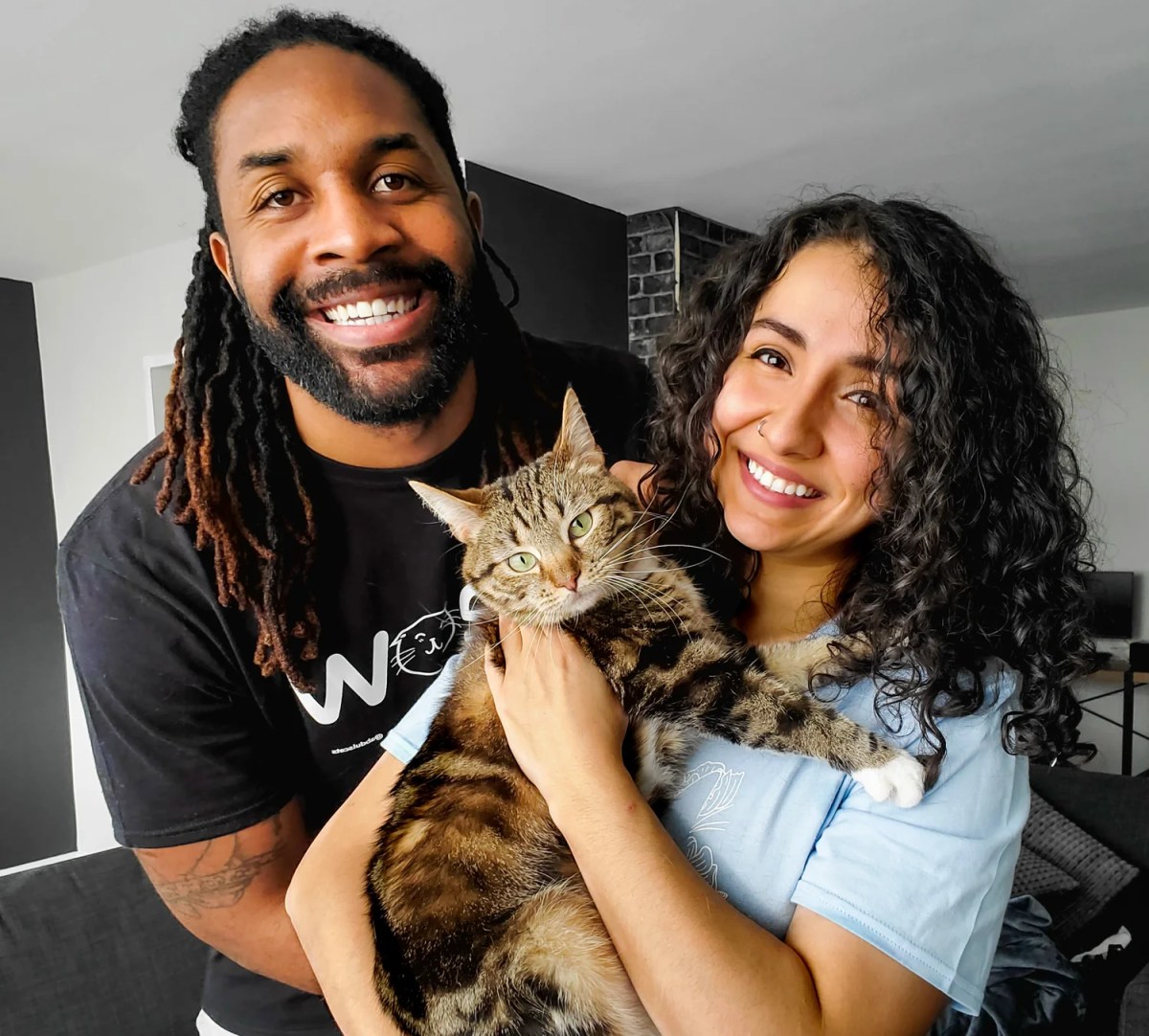
Abdul Raheem found peace when he adopted his beloved cat, Bambi. Now he wants other men to know felines are awesome.
There’s something to the idea that people who aren’t fond of felines just haven’t met the right cat.
For me, it was the experience of interacting with a friend’s affable tuxedo — just one, since all my experiences up to that point had been with people who kept an unreasonable number of cats.
For Abdul Raheem, it was adopting a cat named Bambi after he and his wife fostered and fell in love with her.
“She brought me so much just happiness, and she made my mental health better,” Raheem told the Washington Post. “My anxiety was better when I was around her. So I just want to give other people that feeling.”
Raheem and his wife, Shamiyan Hawramani, became regular fosters for a shelter near their home, and Hawramani began filming her husband’s doting interactions with the baby felines.
Raheem with one of his bottle babies. He and his wife have fostered about 200 kittens and cats since the COVID pandemic.
Their friends found the videos amusing, and lots of people online have too. Abdul’s Cats, an Instagram account documenting Raheem caring for fosters, has a large following — including young men, many of whom are thinking about adopting a cat for the first time because Raheem is showing them something that challenges stereotypes.
My favorite anecdote is about Raheem’s enthusiasm for cats spreading to his friends. At first, they got accustomed to the idea of baby cats jumping in their laps and taking curious swipes at controllers on nights when they’d hang out and play video games.
Then they came to the same conclusion Raheem had: hanging out with cats is relaxing. Several of those friends have since adopted their own feline overlords, and Raheem says one friend now has four cats running around his house.
As for stereotypes, I think cat ladies get a bad rep. They’re the ones who do all the hard work of managing colonies, trapping, fostering, volunteering in shelters and placing cats in good homes.
When you think of the sheer volume of work, and the things they’ve accomplished — including a dramatic reduction in euthanized cats thanks to TNR efforts — they are the unsung heroes. They do it because they love cats.
Jordan Poole is one of several NBA players who have professed their love of felines. In the off-season Poole volunteers with his local shelter.
But it’s also good to toss aside labels and outdated attitudes, like the insistence that cats are companions for women only, and that adopting and caring for a feline friend is somehow unmanly.
Like Jordan Poole, the NBA guard who evangelizes the awesomeness of cats to his fellow players, men like Raheem show guys that they can adopt too.
Now if you’ll excuse me, Bud and I have a busy day of lifting weights, watching football, working on the hot rod we’re restoring in the garage, and drinking beer. Then we’re gonna chant Viking drinking songs until we pass out.
Free-ranging cats do have a negative impact on wildlife, but we’re not going to solve the problem by demonizing them and culling them by the millions.
The Literary Hub story starts off with a provocative question: what if cats ruled the world?
This is a question I find amusing to ponder, so instantly my mind was filled with images of cats scandalizing foreign heads of state by insouciantly swiping gifts off tables, angering diplomats by yawning and nodding off during summits, and financing the construction of massive and unnecessary coastal walls, on the off chance the ocean decides to move inland and get them wet.
Then the writer cited the repeatedly-debunked “study” that credulous media of all stripes still reference without bothering to read the text — that infamous 2013 Nature Communications paper, published by birders who author books with titles like “Cat Wars: The Consequences Of A Cuddly Killer.”
Some journalists don’t know any better, some are overworked, and some are frankly too lazy to read the study with a critical eye, but I think one of the more likely reasons people continue to cite the paper is because it’s easier to blame felinekind for wildlife extirpation than it is to admit we’re the primary culprits. After all, according to the WWF’s most recent annual review, we’ve killed off 73 percent of Earth’s wildlife since 1970, and we certainly didn’t need house cats to help us push elephants, rhinos, every species of higher non-human primate, and innumerable other species to the brink of extinction.
We did that. We did it with our relentless development, consuming and fracturing wild habitats. We did it with careless industrialization, by dumping chemicals and garbage into our rivers and lakes until more than half of them were rendered too polluted to swim in or drink from. We did it by bulldozing old growth forest and jungle, by exploiting species for fur, folk medicine, ivory, sport hunting and in the illegal wildlife trade.
Cheetahs are critically endangered, and they’re being driven to extinction even faster by poachers, who sell them to wealthy buyers in oil-rich gulf states where they’re trendy pets. Credit: Riccardo Parretti/Pexels
More than 47,000 species — that we know of — are headed toward extinction. It’s so much easier to blame it on anyone or anything else than admit we need to make major changes to our lifestyles and policies.
But don’t take my word for it. Here’s what Alley Cat Allies has to say about the 2013 meta-analysis and its derivative papers:
“The Smithsonian-funded study published in Nature Communications is not rigorous science. It is a literature review that surveys a variety of unrelated, older studies and concocts a highly speculative conclusion that suits the researchers’ seemingly desperate anti-cat agenda. This speculative research is highly dangerous. It is being used by opponents of outdoor cats and Trap-Neuter-Return (including the authors) to further an agenda to kill more cats and roll back decades of progress on TNR. And it is being spread unchecked by the media.“
Here’s what a group of ethicists and anthropologists wrote about the claims against cats in the journal Conservation Biology, lamenting the lack of nuance and danger in arguing that cats must be stopped “by any means necessary.” The drive to blame felines, they argue, has “fueled an unwarranted moral panic over cats”:
“Contrary to Loss and Marra’s claims that the scientific consensus is consistent with their views that cats are a global threat to biodiversity, the actual scientific consensus is that cats can, in certain contexts, have suppressive population-level effects on some other species (Twardek et al. 2017). This is something that is true of all predators, native or not (Wallach et al. 2010). Thus, cats should not be profiled as a general threat a priori and without reference to important factors of ecological context, situational factors, clear definition of harms, and evidence thereof.”
“There are there are serious reasons to suspect the reliability of the new, extreme cat-killer statistics,” wrote Barbara J. King, retired chairwoman of the department of anthropology at The College of William and Mary.
Feline predatory impact varies by local conditions. Free-ranging cats in cities and suburbs kill rodents, but have minimal impact on other animals, data shows. Credit: Patricia Luquet/Pexels
Like we’ve often noted here on PITB, the authors of the Nature Communications study can’t even say how many free-ranging felines exist in the US. They say it’s between 20 and 120 million. That’s a 100 million difference in the potential cat population! How can they tell us how many birds and mammals are killed by cats if they can’t even tell us how many cats there are? No amount of massaging the numbers can provide an accurate picture if the initial data is shaky or nonexistent.
Furthermore, the nature of a meta-analysis means the authors depend on earlier studies for estimates on predatory impact, but the 2013 Nature Communications paper does not include any data —not a single study — on feline predatory impact. In other words, they have no idea how many animals free-ranging cats actually kill.
In authentic studies that actually do measure predatory impact, the data varies widely in geographic and demographic context. Data derived from the D.C. Cat Count, for example, shows that cats living more than 800 feet from forested areas rarely kill wildlife, and are much more likely to kill rodents.
Those who cite the bunk study and its derivatives are “demonizing cats with shaky statistics,” King wrote, adding she was alarmed by “an unsettling degree of uncertainty in the study’s key numbers.”
Free-roaming populations are reduced when cat colonies are managed, and the animals are fed and fixed. Credit: Mia X/Pexels
Ultimately, we agree with Wayne Pacelle, former president of the Humane Society of the United States.
The meta-analysis authors “have thrown out a provocative number for cat predation totals, and their piece has been published in a highly credible publication, but they admit the study has many deficiencies. We don’t quarrel with the conclusion that the impact is big, but the numbers are informed guesswork.”
Cats do have a negative impact on wildlife, it varies according to local circumstances, and those of us who love cats have a responsibility to keep our pets indoors and help manage free-ranging populations.
But cooler heads must prevail, approaches to managing cats must be evidence-based, and the effort requires people of all kinds working together — which becomes much more difficult when agenda-driven pseudoacademics whip people into a frenzy by portraying felines as bloodthirsty, invasive monsters who need to be wiped out “by any means necessary.”
Solving the problem of free-ranging cats requires us to own up to our own role in species extinction and to take measured, evidence-based steps to protect vulnerable wildlife. Otherwise, we’re inflicting a whole lot of suffering on sentient creatures and accomplishing absolutely nothing.
Chris Arsenault ran back into the fire in an attempt to save more cats and never reemerged.
A man who founded a cat sanctuary to honor the legacy of his deceased son was killed, along with some 100 of the cats he cared for, in a raging fire Monday morning.
Christopher Arsenault, 65, lived on the premises of the Happy Cat sanctuary in Medford, along with about 300 cats he’d saved from euthanasia, dangerous situations and difficult lives as strays.
Firefighters were dispatched a few minutes after 7 am and it took them an hour and 20 minutes to bring the powerful blaze under control. Arsenault was able to get out of the main structure on the Suffolk County, Long Island, compound, but dashed back in to save more of his cats, according to neighbors who witnessed the fire.
Chris Arsenault at Happy Cat sanctuary. Credit: Happy Cat Sanctuary
The Suffolk County homicide and arson investigation squads are assigned to the case, Suffolk police Chief of Detectives William Doherty told the New York Post.
However, it can take weeks for lab results from the state police crime lab in Albany, and fire investigators will need to comb through the remains of the ruined structure and the rubble to find a point of origin.
“It’s too early in the investigation to determine any cause,” Doherty told the Post.
The grounds and facilities at Happy Cat sanctuary were meticulously maintained, but that did not stop some in the community from complaining about the existence of the sanctuary.
Arsenault “vowed to take the unwanted, discarded, homeless [cats], the ones that people were going to euthanize, he refused and he took them into his sanctuary, sometimes for no money at all,” Lisa Jaeger, a local cat rescuer who worked with Arsenault, told NBC New York. “He started the sanctuary [in 2007]. This was his life. He gave his life to save these cats.”
The sanctuary’s Facebook page was flooded with an outpouring of grief on Monday from people who knew and supported Arsenault.
“He was always so concerned about each and every single cat he had in his care. Didn’t matter how many… they were all his babies,” one distraught woman wrote. “To think he literally lost his life trying to save them breaks my heart and makes all the sense in the world that he would never leave them behind.”
Local rescuers and the county SPCA were trying to corral the surviving 200 cats on Monday. Some fled the grounds during the fire and remained unaccounted for, while others remained close to the destroyed sanctuary despite the chaos and the significant amount of activity from first responders.
Despite his efforts, Arsenault was the subject of a harassment campaign on social media from neighbors and a small group of people who alleged Arsenault wasn’t properly caring for cats. There’s no evidence to back up those claims, and Happy Cat has not been the subject of any violations.
A petition on Change.org posted last year demanded a stop to the alleged harassment of Arsenault by neighbors and a local code enforcement officer. It garnered 28,665 verified signatures.
Despite locals standing up for him, Arsenault had found a piece of property in upstate New York and was preparing to move his cats and sanctuary to that location.
John DeBacker, who participates in local trap, neuter, return (TNR) efforts, referenced the push back against Happy Cat in a post about the fire on Monday.
“Despite being harassed for months, he continued to fight for the cats,” the post read, “and I truly hope everyone can screenshot posts from one of the groups that has been harassing him in case arson is connected.”
An outdoor area at Happy Cat sanctuary. Credit: Happy Cat Sanctuary
It’s important to note that there is no evidence connecting any of the critics to the fire, authorities have not commented on the source of the fire, and any speculation about the cause is just that: speculation. It’s also important to emphasize that just because police homicide and arson squads are investigating an incident does not mean either of those crimes has taken place. Authorities won’t know anything for sure until they can thoroughly investigate the fire scene and get lab reports on evidence.
Arsenault himself said he felt compelled to respond to critics last month in a video he posted to Youtube.
“The audacity of these people to call Happy Cat sanctuary a hoarding situation, to be claiming that we’re committing animal abuse and animal neglect,” he said “The cats that I see…these are cats that are out there and have nowhere to go. These are cats that are suffering out there. And this is where sanctuaries come in … Right now [the critics are] just taking a big handful of spaghetti, and they’re just throwing it up against the wall to see what sticks to come after Happy Cat sanctuary.”
More Americans say they can’t afford to keep their cats because of inflation, leading to an increase in surrendered and dumped cats in some places.
More than 110 years ago, American geneticist Clarence Cook Little developed a theory explaining why some cats have orange coloring and some don’t.
Now Little has been proven correct thanks to the work of separate teams in Japan and the US, which discovered the mechanism that leads to orange coloring, including fully ginger felines as well as calicos and tortoiseshells.
The explanation may be a bit too heavy on genetics for some readers, but essentially the researchers found the specific gene that leads to the growth or orange fur. They’ve known about the gene for a long time, but didn’t realize the totality of its function. Its official name is ARHGAP36, but for the sake of simplicity, scientists are calling it “the orange gene.”
“The orange gene has a known role in hair follicle development, but scientists didn’t previously know it is also involved in pigment production,” a team of geneticists and biotechnologists wrote in The Conversation, a science publication. “This means that a new pathway for pigment production has been discovered, opening the way for exciting and important research into a basic biological process.”
In partially orange cats like calicos and tortoiseshells, the blotches of color are the result of imperfect gene copies and a secondary pigment-related gene switching “on and off.” Credit: Mehmet Guzel/Pexels
Ginger cats are usually male, but the pigmant can also appear in female cats due to an error in gene copying which deletes one segment of the orange pigment-producing genetic code.
That’s why calicos and tortoiseshells have orange blotches or mixed orange fur. “[T]he orange gene is persistently switched on in orange areas but is mostly switched off in non-orange areas of a cat’s coat,” the authors wrote.
Are there more strays in 2024?
Time magazine has a story examining the problem of stray cats in America’s urban and suburban population centers, why it’s happening, and what can be done about it.
First, might as well get this out of the way: We don’t know if there are “more” cats. The claim that there are more relies on anecdotes, and there’s no hard data to back that up. You have to be highly motivated to invest the time and money into a proper census like the D.C. Cat Count, and it’s an understatement to say most towns and cities are either not willing to do that, or don’t have the resources.
What we do know is there may be more cats in certain areas, with individual shelters in some places reporting record numbers of surrenders and cats scooped up by animal control.
Rescuers say people who can’t afford food, supplies and veterinary care are surrendering or dumping their cats in larger numbers than in years past. Credit: Dou011fu Tunce/Pexels
The story quotes rescuers who say they’ve seen more surrendered pets, as well as data from Shelter Animals Count, which tallies self-reported information from shelters and rescues. The latter says 32 percent of cats taken in were owner surrenders in 2024, compared to 30.5 percent in 2019.
“It’s a combination of people surrendering their pets and people not adopting because they’re not sure they can take on the financial commitment,” Animal Care Centers of NYC’s Katy Hansen told Time.
Rescuers say that’s reflected in their experiences trapping the felines, who are friendly and acclimated to humans.
The people surrendering their pets cite inflation, not only impacting the cost of essentials like food and litter, but also more expensive veterinary care.
The story additionally includes this eye-popping detail:
“At Veterinary Care Group, a private equity-owned practice in Brooklyn, the cost of spaying or neutering a cat has soared to $850 per animal. By contrast, at the nonprofit veterinary clinic Zweigart recently founded in Brooklyn, the cost of spaying or neutering a cat is $225 and a mid-sized dog is $300.”
The lesson here: Steer well clear of veterinary clinics that aren’t vet-owned or are obtuse about their ownership. Private equity groups don’t buy clinics out of love for animals.
The cost of spay/neuter procedures ranges dramatically at different veterinary practices. Credit: Tima Miroshnichenko/Pexels
As for solutions to local spikes in stray populations, the story doesn’t offer any. It mentions TNR (trap, neuter, return) but only in the context of a lawsuit against the San Diego Humane Society for its neuter/vaccination program.
That said, there probably isn’t a one-size-fits-all technique. What works for a small town won’t necessarily work in a city, and there are dozens of factors that could influence the prevalence of stray cats and colonies. Still, city councils and town boards don’t need to reinvent the wheel. Chances are if they look, they’ll find a municipality similar to their own where locals have successfully stabilized feline populations.
As for the Buddies, I’d live in my car before giving Bud up. He wouldn’t be thrilled about that situation, and we’d have to head south because the winters here are brutal, but as long as Bud has his servant, he’s good.
A previous version of this post incorrectly described cat chromosomes. The story has been updated to remove the error.
Feeding strays is now punishable by a $150 fine in an Ohio town, the latest municipality whose elected leaders chose to ignore expert guidelines on managing feline populations.
Every time the stray cat issue comes up, local town boards and city councils act as if they need to reinvent the wheel.
Imagining that they are the first to deal with this extremely common problem, they make decisions from positions of ignorance, dismissing the concerns of people who actually work with cats. Or they “do the research” and come up with their own ineffective policies instead of simply looking at what other towns and cities have tried in the past.
At least that way, you know what works and what doesn’t, and how much your decision’s going to cost taxpayers.
But that would be the smart thing to do, which is why our local elected leaders don’t do it. Instead they pull stunts like the village board of Mogadore, Ohio, a town of 3,700 about 10 miles east of Akron.
The Mogadore board just passed a law that makes feeding strays and ferals punishable by a fine of up to $150, as if that will stop cats from finding food and breeding.
Tellingly, Mogadore’s elected leaders say their ordinance applies to “wild, stray, or un-owned” cats, which means they don’t understand they’re all the same species.
Apparently neither do the reporters at WOIO, a local news station in Cleveland. A story from the station is confidently incorrect in telling readers “[d]omestic cats that have become wild, meaning live outdoors, roam free, and rarely interact with humans, are also considered feral.”
Credit: Sami Aksu/Pexels
Felis catus is a domestic animal. By definition a domestic cat is not wild and cannot become wild. Evolution cannot happen to a single animal.
While evolution is a constant process, speciation — wolves becoming dogs, wildcats becoming house cats, wild boar becoming docile farm pigs — is a species-wide shift that takes at leasta few hundred years but often much longer, “from human-observable timescales to tens of millions of years” depending on the species.
The whole process results in changes at the genetic level. The transition from wildcats to domestic cats, for example, involved changing only 13 genes.
This is not rocket science, it’s basic stuff we all learned in high school science classes.
But that’s almost beside the point.
Fining people for feeding stray cats, including caretakers who voluntarily manage cat colonies, will not solve the problem. It doesn’t work. It has never worked in any town anywhere in the world.
It also creates a needlessly adversarial relationship with the passionate people doing the hard work of managing the feline population, often thanklessly and at their own expense. Why make enemies of them when they’re doing a public service?
Mogadore’s village board had a representative from Alley Cat Allies and people from local rescues on hand to inform them that fines don’t work, and to offer the humane and effective option of trap, neuter, return. TNR may not be perfect, but it’s better than anything else people have tried.
Mogadore’s board and mayor ignored the experts and went ahead with their plan to fine people instead.
They’re not alone. This happens thousands of times across the US, Europe, Australia and most other places where domestic cats live. Japan and Turkey take a more humane approach, and they’re better for it. But here in the US, we often deal with issues by ignoring precedent and engaging in wishful thinking.
If the residents of Mogadore are lucky, their elected officials will realize their mistake sooner rather than later.
Stray and feral cats already have a difficult existence without ill-advised laws making it illegal to care for them. Credit: Mehmet Fatih Bayram/Pexels









 Pain In The Bud