Ryan Easley “wanted to be the one with the most tigers in the ring at one time,” Joe “Exotic” Maldonado said of the Oklahoma man.
A circus big cat trainer and associate of so-called “Tiger King” Joe Maldonado was mauled to death by a tiger at a roadside zoo on Saturday.
Authorities say 37-year-old Ryan Easley was conducting a “show” at the Growler Pines Tiger Preserve when a tiger he “owned” turned on him. The captive predator mauled Easley, attacking his neck and shoulders “in full view of a group of visitors, including children,” PETA wrote in a statement calling on federal authorities to cancel the facility’s licenses.
Easley with a white tiger. Credit: Ryan Easley/Instagram
While Easley called the facility a preserve, others described it as a roadside zoo, and genuine animal sanctuaries do not put animals on public display. The roadside zoo description aligns with the Oklahoma man’s past as a circus trainer of big cats, and Maldonado — who was the subject of the popular 2020 Netflix documentary, Tiger King — seemed to confirm that description when he issued a statement on his friend’s death.
“He wanted to be the one with the most tigers in the ring at one time,” Maldonado wrote in a statement from prison. “Some of his cats were crazy in the head, but it was about having the most performing at one time at all costs.”
Easley acquired some of his tigers from Maldonado, who was convicted of conspiracy to commit murder for hire and 17 counts of violating federal conservation laws in 2019. Maldonado, who remains incarcerated in a federal prison in Fort Worth, Texas, tried in 2017 to hire two men to kill Big Cat Rescue’s Carole Baskin, an activist with whom he had a years-long feud. One of the men Maldonado tried to hire was an FBI informant.
Maldonado is serving a 21-year federal prison sentence. Mugshot credit: Santa Rosa County Jail
PETA has accused Easley of mistreating, neglecting and abusing the tigers at his facility. Tigers are apex predators and hyper-carnivores who do not recognize social hierarchy or have any innate compulsion to follow orders from humans, so “taming” them and getting them to “perform” involves coercion, including physical punishment, withholding food and torture. The brutal mistreatment required to force elephants, lions, tigers and other animals to perform is one reason why traditional animal circuses no longer exist in the west.
Maldonado admitted as much in his statement, noting “you don’t get a tiger to jump through a hoop of fire because they love you.”
“It’s never safe for humans to interact directly with apex predators, and it’s never a surprise when a human is attacked by a stressed big cat who has been caged, whipped, and denied everything natural and important to them,” PETA’s Debbie Metzler wrote in a statement.
Former big cat handler and caretaker Katherine Lee Guard, who is now an activist against keeping big cats as pets and using them in the entertainment industry, spoke to PITB about her experiences in 2023. She noted tigers can turn on their handlers at any time, even if the latter hand-reared the felids since infancy. Once their predatory instincts are triggered, the apex predators feel a powerful compulsion to attack.
Even in accredited zoos where tigers are provided with large enclosures designed for their well-being, given plenty of enrichment and stimulation, and fed well, Guard said people should never enter an area without barriers between themselves and the big cats.
“The cost is too great if something goes wrong,” she said. “And something always goes wrong given enough time.”
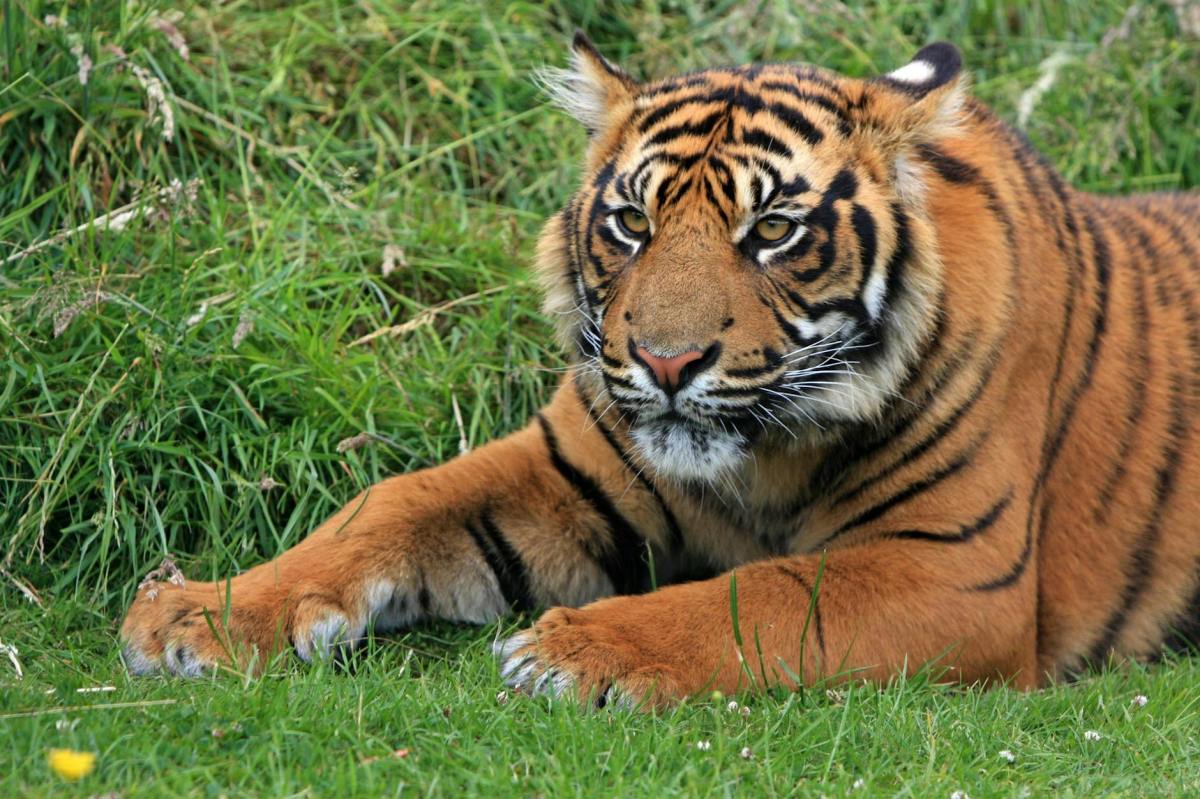
Header image of a Sumatran tiger via Pexels. Do you enjoy reading PITB? Please consider whitelisting us on your ad blocker so we can keep the lights on. Thanks!
The late Pope Benedict was well known for his lifelong love of cats, but he was also a champion of animals and spoke out about the cruelties visited upon them by humankind.
Long before he was the pontiff, when he was just a young man named Joseph Ratzinger, the future Pope Benedict was known as a cat guy.
Growing up in the village of Hufschlag, about 55 miles southeast of Munich, Benedict’s family always had pet felines and he fed strays who spent time in their garden. During his years teaching theology to students at Bavaria’s University of Regensburg in the 1970s, then-professor Ratzinger was often seen followed by an entourage of cats — the little ones he fed and cared for — as he crossed campus.
“They knew him and loved him,” said Konrad Baumgartner, a fellow theologian at Regensburg.
His affinity for his four-legged friends never faded, even as he took on more responsibility and had more demands on his time. Cardinal Tarsicio Bertone, one of Benedict’s colleagues, said the German clergyman had a natural connection with animals.
“On his walk from Borgo Pío to the Vatican, he stopped to talk with the cats; don’t ask me in what language he spoke to them, but the cats were delighted,” Bertone recalled. “When the cardinal approached, the cats raised their heads and greeted him.”
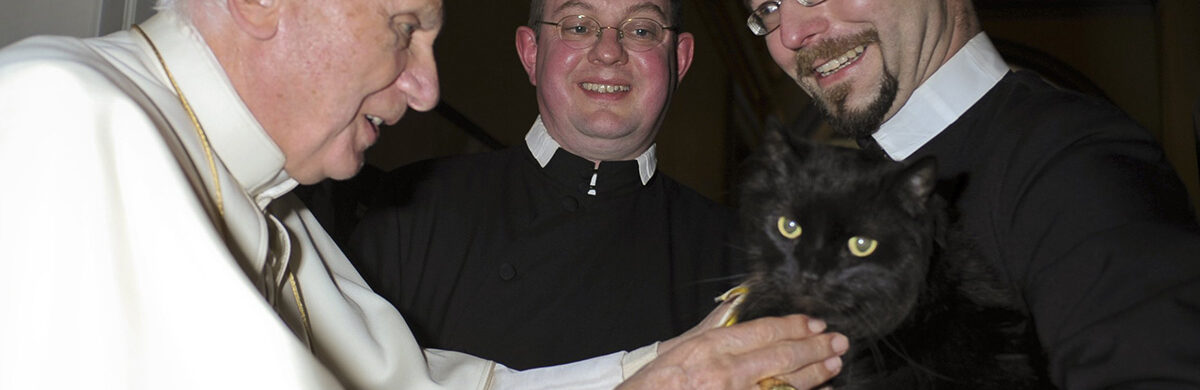
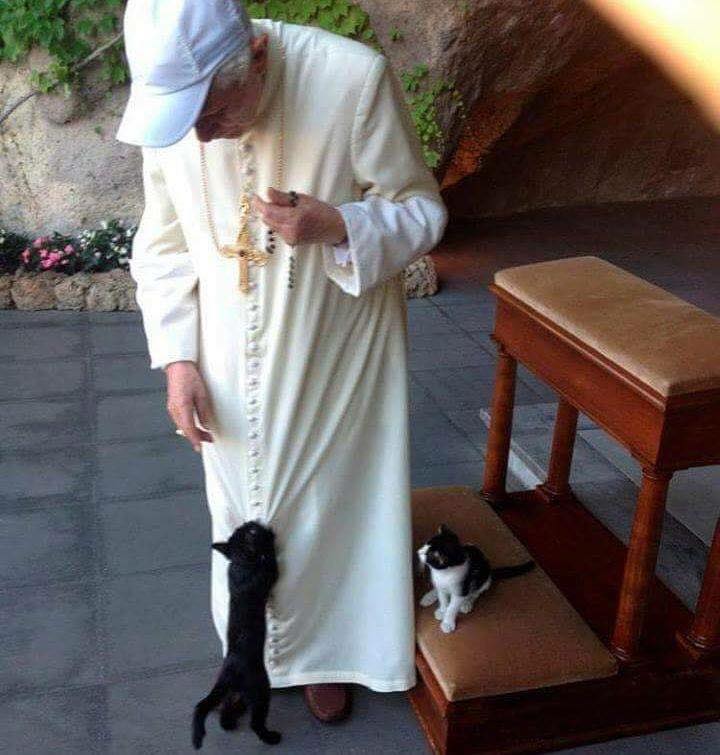
Pope Benedict with one of his cats.
As pope, Benedict continued to care for strays, and had two cats of his own — one who’d been with him since before he was made the leader of the global church, and another he rescued off the streets of Rome.
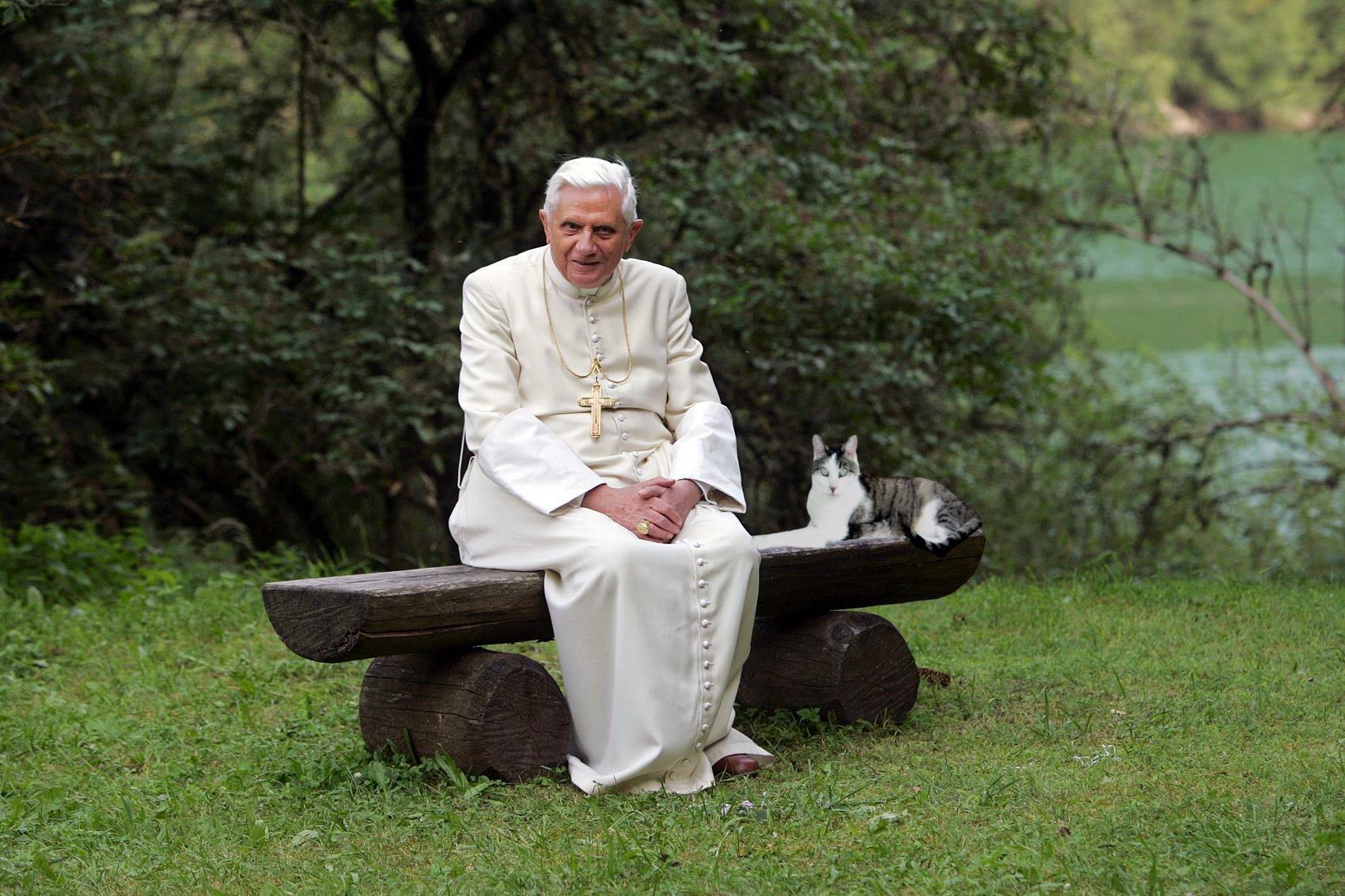
Photos of Pope Benedict with cats are different than the typical shots showing him meeting with world leaders or waving to crowds. His expression and posture are more relaxed in the presence of felines, and he’s often smiling in the images that show him holding a cat.
But it wasn’t just personal for Benedict.
“Dominion” over animals
For centuries, some people — mostly outside Catholicism, but some Catholics too — have argued that animals exist for the use of mankind, that their purpose on this Earth is to serve as resources. Proponents of the view point to a handful of Old Testament quotes, including a famous quote from Genesis that says God gave man “dominion over the fish of the sea, and over the birds of the air, and over the cattle, and over all the wild animals of the earth, and over every creeping thing that creeps upon the earth.”
Genesis 9:3 attributes this quote to God: “Every moving thing that lives shall be food for you.”
Pope Benedict was well known for his love of cats, from his childhood in Bavaria to his days as pope emeritus living in retirement.
Other verses detail precisely which animals they can eat and remain in His good graces, and many Christian sects see those lines as a clear indication that God intended for animals to serve the needs of men.
But the Old Testament also tells us we can take slaves (Leviticus 25:44-46), that parents can have their kids stoned to death for disobeying them (Deuteronomy 21:18-21), that when children make fun of others, it’s totally cool to call upon righteous bears to maul them to death (2 Kings 2:23-24), and that people with blindness, flat noses and other ugly “blemishes” should wait outside church with the rest of the rejects while the good-looking people pray. (Leviticus 21:17-24).
Don’t even get me started on Sampson and the Book of Numbers.
The point is, if you’re going to be a stickler for things supposedly okayed or forbidden in the Old Testament, animals are the very least of your problems, especially if you trim your beard, let your hair get too long, wear shirts made of two different materials, or have ever placed a bet on DraftKings.
“Animals are God’s creatures”
As we look back on the life of the late pope emeritus, it’s worth noting that Benedict and his successor, Pope Francis, have rejected the view that animals are God’s version of scripted NPC automatons who exist so we can eat steak and wear leather jackets.
“Clearly, the Bible has no place for a tyrannical anthropocentrism unconcerned for other creatures,” Pope Francis declared in 2015.
Benedict spoke out about the cruelty inflicted on animals, the incalculable suffering of animals in industrial farming circumstances, slaughtered by the billions for food after short, brutal lives in which no consideration is given to them as living, sentient creatures.
In a 2002 interview, Benedict called animals “companions in creation” and criticized the modern food industry for its “degrading of living creatures to a commodity.”
“Respecting the environment,” he said in a 2008 interview, “means not selfishly considering [animal and material] nature to be at the complete disposal of our own interests.”
Francis made the church’s position absolutely clear with an encyclical — an official letter to members of the church — called Laudato Si. In it, he condemned the “ruthless exploitation” of animals as commodities and asserts they are individuals who are recognized by God. He urged Catholics to treat them well, to respect and protect wildlife and the environment they depend on.
Animal life has “intrinsic value,” Francis said, adding that Christians must reject the idea that animals are “potential resources to be exploited.”
As if speaking directly to people who use the aforementioned Old Testament quotes to support practices like factory farming, harvesting animals en masse for pelts and hunting for the “fun” of it, Francis said:
“We must forcefully reject the notion that our being created in God’s image and given dominion over the earth justifies absolute domination over other creatures.”
Both popes also noted that, in addition to the suffering we cause, when we exploit animals as are also behaving in a way beneath the dignity of humankind. It’s a stain on our collective identity as a species, a betrayal of our roles as wardens of the planet.
Let’s put aside the moral considerations for a moment. The continued existence of the complex ecosystems on our planet — and indeed of humanity itself — depends on the many roles animals play, from carrying seeds to pollinating plants, limiting the growth of flora that would otherwise dominate and destroy other plants, rerouting water systems by creating dams, controlling the populations of creatures that would otherwise multiply unchecked, and the thousands of other roles they play in maintaining the balance of ecosystems.
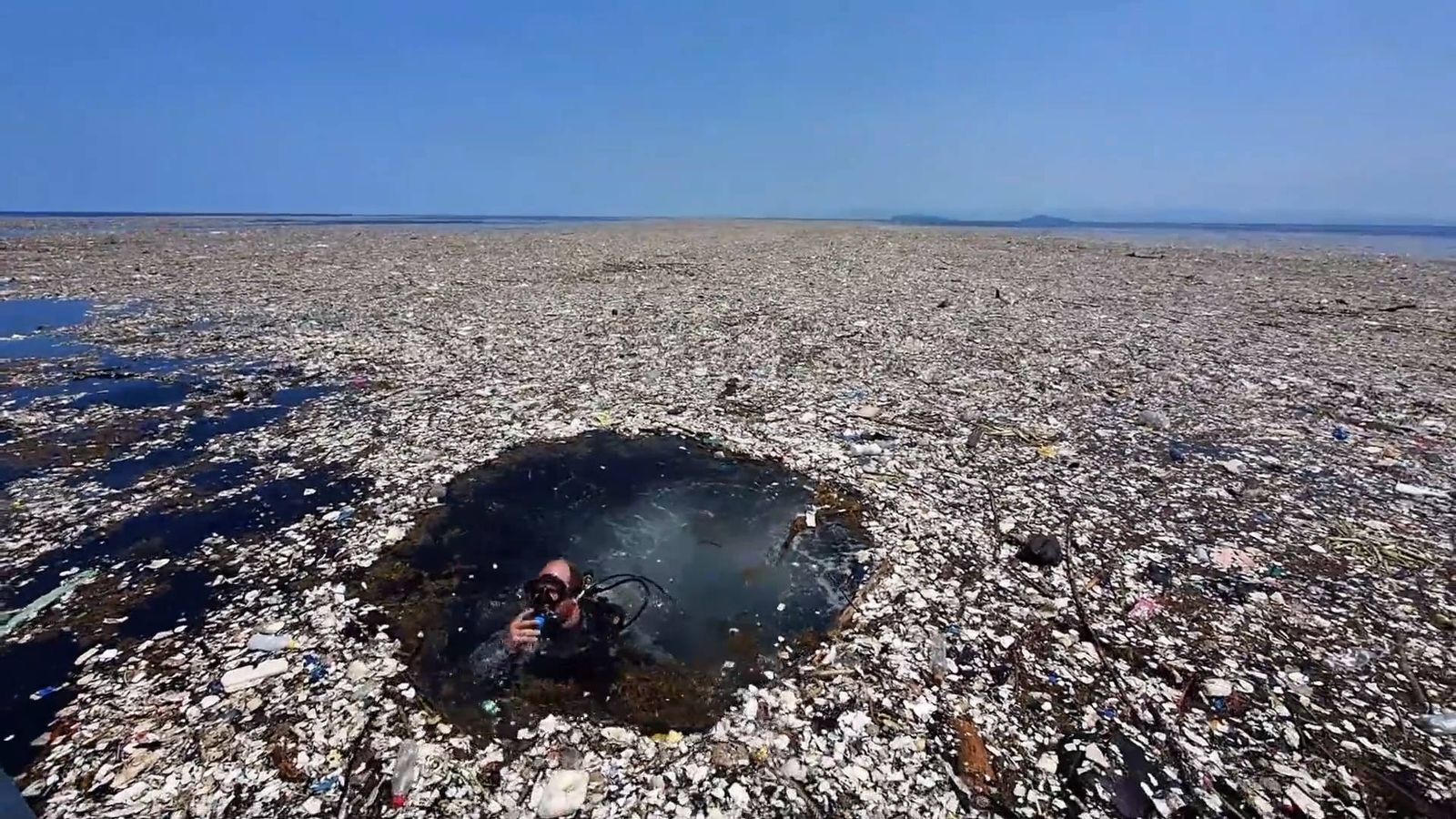
Benedict left this Earth on Dec. 31, 2022, at a time when we have killed off almost 70 percent of all wildlife in the entire world. It’s not just a matter of living on a lonely planet, or tucking future children into bed while telling them that, no, they can’t see elephants or tigers because the last of them are dead. Removing keystone species, extirpating entire genera while rendering vast stretches of the planet uninhabitable, purging the oceans of life as they accumulate literal continents of plastic waste, means we’re marching toward a cascade failure most of us won’t even see coming as we argue about carbon credits, politicize common sense, tinker with viruses and edit genomes.
It’s long past time we recognize the fact that we share this planet with billions of other minds and start living in a way that respects them. If we can save them, perhaps we can save ourselves too.
The 1.6 million square kilometer Great Pacific Garbage Patch, which weighs more than 80,000 metric tons.
The pope’s comments were made in the larger context of an imminent “demographic winter” caused by an aging population and historically low birth rates.
Popes have a mixed record when it comes to cats.
Back in the 13th century Pope Gregory IX famously declared cats were at the heart of alleged Satanic rituals in Europe, relying on the account of one Konrad von Marburg, an author of massacres, church inquisitor and all-around idiot known for brutally torturing his victims to elicit “confessions” of heresy.
Von Marburg told the pope that Satanists had a ritual involving a black cat who would walk around backwards while the Satan-worshipers kissed its ass. The pope bought the risible story and believed von Marburg’s accounts of growing numbers of heretics, especially in Germany.
The resulting papal letter, Vox in Rama, did not declare cats were evil and didn’t ask Catholics to kill them, despite widespread claims to the contrary on the internet, but it did contribute to distrust of the animals a century ahead of the Black Plague, when people thought cats were carrying the disease.
The pope who loves cats
Then there’s the Pope Emeritus, Benedict XVI.
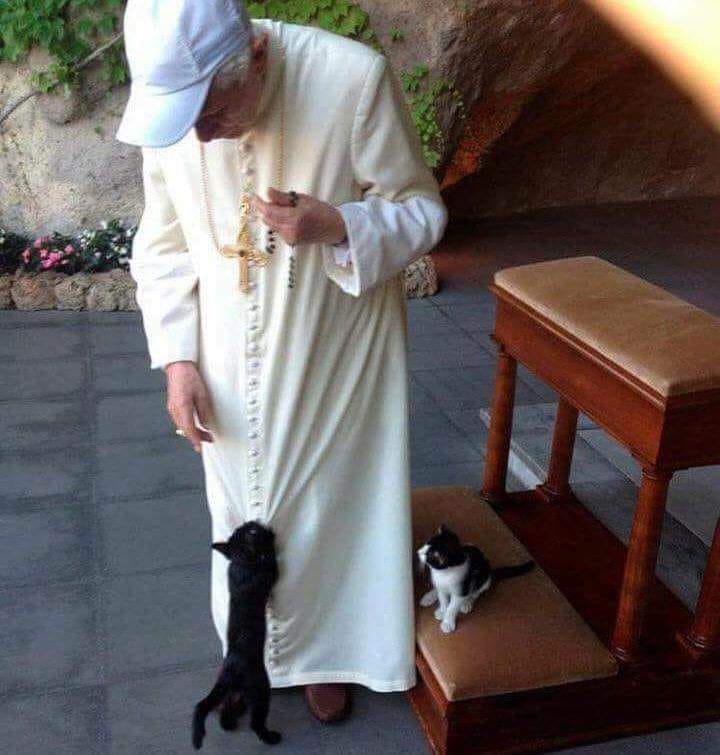
Pope Emeritus Benedict XVI with two kittens in 2017. Credit: The Joseph Ratzinger/Pope Benedict XVI Foundation.
Cat lovers around the world rejoiced when it was revealed Pope Benedict was a cat lover and had two pet felines of his own. Cardinal Roger Mahoney, the former archbishop of Los Angeles, said Benedict was wild about kitties.
“The street talk that the pope loves cats is incorrect,” Mahoney said in 2005. “The pope adores cats.”
Catholics petitioned Benedict to help with animal welfare causes and to lend his support to efforts to help the many stray cats of Rome.
Francis the Saint and Francis the Pope
That brings us to our current pope, Francis. The elevation of Francis was met with approval from animal lovers: His chosen papal name honors St. Francis of Assisi, a Radagast the Brown type figure who lived a life of luxury as a wealthy playboy and party-goer until he had a religious conversion, sold all his possessions and became a monk.
St. Francis believed true faith in God meant having a deep respect for animals. While it’s not clear what’s true and what’s apocryphal, there are stories of Francis preaching to birds, nursing various animals back to health and even convincing a wolf to stop attacking a village in Italy in exchange for the villagers feeding it. St. Francis was by all accounts gentle with animals and appreciative of nature.
St. Francis is revered in the Catholic church and beloved by groups like the Humane Society. He is the patron saint of animals, and on his feast day Catholics bring their pets to be blessed at church.
Pope Francis during a visit with former US Vice President Mike Pence. Credit: Wikimedia Commons
Pope Francis continued his namesake’s work with Laudato Si, a papal encyclical which endeared him to animal lovers all over the world.
The encyclical was notable for the church’s strongest language yet in advocating for protecting and respecting animals. PETA made Pope Francis its person of the year in 2015, and the pope was feted by many other animal welfare groups across the world.
In Laudato Si, Francis explicitly rejected the idea that animals are resources for humans to exploit, asserted the Catholic view that animal life has intrinsic value, and called on human beings to be stewards of animals and the Earth. Abusing and exploiting animals is “beneath human dignity,” he wrote, and the associated desensitization and heartlessness of practices like factory farming are a stain on the human race.
Animals, the pope wrote, not only have souls but will “take their place” in heaven, “resplendently transfigured” in the presence of God. He also pointed out the disastrous effects we’re having on wildlife by destroying habitats, carving up the remaining land, over-fishing the oceans, poaching and hunting.
What Francis said about pets
So why are people suddenly upset with the pope?
He made some off-the-cuff remarks about people choosing pets over children, said it was “selfish” to choose the former, and brought up the plight of the world’s orphans. He pointed out that people collectively spend hundreds of billions on pet food and products while humans in the third world lack basic things like clean water, food and medicine. He also said “denying” motherhood and fatherhood leaves us spiritually poorer, as the experience brings us closer to God.
As usual any time a pope speaks, his statements are taken out of context and rehashed in the media. That’s expected, especially in the age of clickbait, the 140-character tweet and the 15-second news segment. Pope Francis gets himself into trouble by sometimes speaking too candidly when he should know his message will be garbled by gatekeepers and information filters, leading to strong reactions to things he didn’t actually say.
The pope wasn’t condemning keeping pets across the board, and he wasn’t saying all pet owners are selfish. His comments were made in the context of a larger discussion on universally declining birth rates in developed countries, specifically Europe’s “demographic winter,” also called a “demographic time bomb.”
In simple terms, Europe’s population is rapidly aging and birth rates are historically low. Populations are dying off, there are fewer people to care for the elderly, and there aren’t enough babies to replace the dead. The average age in Europe is 43, which is 12 years older than the average in the rest of the world.
COVID has compounded the problem, partly due to social distancing and partly due to economic uncertainty as a ripple effect of the virus. Of course it isn’t all that simple, and the demographic winter’s wider effects are complex and well beyond the scope of this blog.
It also helps to remember the Catholic Church has a strong social justice streak. Not the kind that involves writing snarky tweets and first world problems, but real social justice through charity, schools, scholarships, food banks, shelters, soup kitchens, hospitals and innumerable other efforts.
The pope’s background as a native of Argentina, a former janitor and chemist who became the first Latin American pontiff, also colors his outlook. He doesn’t hesitate to call out the hypocrisy of first-world nations, and although we don’t like to hear it, most of the time we need to. After almost two thousand years of popes existing in or near the world’s seats of power, for the first time we have a pope who grew up from the outside looking in.
That’s not to say I agree with everything Pope Francis had to say on the matter, but I think it’s also important to recognize that he didn’t just take shots at people who care for pets out of the blue, and he didn’t condemn people for caring for animals.
Party time, the First Cat, filthy plagiarists and more!
We’re celebrating Buddy’s belated adoptaversary this weekend. I don’t know exactly when he was born, so we usually mark the occasion on the third weekend in April, which is when I brought Buddy home.
What better way to celebrate than with catnip, Buddy Biscuits treats and his beloved laser pointer?
It’s partay time! Nom nom!
Hilaria buys an Espanish cat, PETA doesn’t approve
Hilaria Baldwin, the indefatigable child collector, has added another little one to her family, but this time it’s a cat. As the San Jose Mercury News notes, as Hilaria “tries to move past her Spanish heritage scandal, she’s been flooding her Instagram with cute family photos from her busy ‘Baldwinito’ household.”
The new cat, Emilio Cookie Baldwin, is a Bengal purchased from a breeder who “specializes in producing pricey, exotic-looking hybrid cats that originate from crossing a domestic cat with an Asian leopard.” In an unusually mild rebuke (the Baldwinitos are donors to the charity), PETA issued a statement saying there’s “no doubt that [the Baldwins] didn’t realize what the impact of buying a cat from a breeder is” and that, “had they known, we’re sure that they would have gone to an animal shelter and adopted a cat who might otherwise die for the lack of a good home.”
No word yet on whether Emilio knows “how you say in English, cucumber.”
After announcing they were going to adopt a cat, the Bidens have been unusually coy about the who, what and when. Now Jill Biden says a female cat is “waiting in the wings” and will join the family soon. The arrival of the mystery cat will mark the first time since the George W. Bush administration that a cat has occupied the White House. Before India, the Bush family’s cat, there was the Clintons’ cat Socks, who became so famous the White House had a full-time staffer answering his fan mail. Socks even had his own video game in development, which was sadly unreleased but is available for download as abandonware for anyone who can’t get enough Socks.
Socks was a popular little fellow. Credit: The White House
Plagiarists and content thieves be warned
After I went searching for one of my old posts this week and found it had been plagiarized, a casual search turned up five (!) sites that have stolen my work, stripped it of credit, and posted it as their own content — and that was based on search strings from only three of my posts. Who knows how many others have been lifted?
Two of those posts were stolen by sites that copy the Bored Panda model of finding content on the internet and monetizing it. At least Bored Panda contacts the content owners, credits them and links back to them. These other guys just steal content from people like me, present it as their own and profit off of it.
Take a look around: This site does not have a single ad. I have no Patreon account and I don’t ask for donations. This site is a labor of love. At some point I probably will implement limited and tasteful ads, but in the meantime it’s kind of a slap in the face to find your own content has been stolen and has been used to make money for thieves.
So a fair warning to anyone else who might be tempted to steal content from PITB: I’ll go right to Google, file a DMCA and get your AdSense account suspended. I have zero tolerance for plagiarism and content-scraping. It’s no different than walking into a store, stealing products off the shelves and turning around to sell them. Worse, actually, since writers are rarely well-compensated. Fall back!
Thai sailors get props from PETA, a Japanese man cares for Fukushima’s forgotten cats, and Reader’s Digest offers a list of amusing cat names.
Saving Fukushima’s Forgotten Felines
It’s hard to believe that March 11 will mark 10 years since the tsunami-caused nuclear disaster at Fukushima. While more than 100,000 people were evacuated from their homes to avoid the initial reactor meltdowns and resulting fallout, Sakae Kato stayed to care for the animals who were left behind.
His main focus is Fukushima’s cats, and he cares for 41 kitties who live in his home and a nearby building he owns, per The Guardian, which has a photo gallery via Reuters illustrating Kato’s efforts.
The Fukushima disaster was the worst nuclear accident since the infamous Chernobyl meltdown in 1986. Like the area surrounding Chernobyl, a no-go exclusion zone exists around the disaster site and will not be deemed fit for human habitation for perhaps hundreds of years. While scientists are still learning about the consequences for wildlife, animal populations have flourished in the Chernobyl exclusion zone, where they’re isolated from humans.
Ridiculous and amusing cat names
If you’re planning on adopting any time soon or you’ve got an as-yet-unnamed furball and need some help finding a good name, you might find inspiration in this list from Reader’s Digest.
There are celebrity-inspired names (Kitty Purry, Catalie Portman, Bob Meowley, Cat Dennings, Catrick Swayze), Star Trek-inspired names (Captain Purrcard, Levar Purrton, William Catner, Leonard Nemeow), literary names (Haruki Purrakami is my favorite along with Holden Clawfield and Stelmaria), names inspired by history (Mewlius Caesar, Fuzz Aldrin), and names from the world of sports (Catfish Hunter, Meowhammad Ali). There are even food- and personality-driven names.
“These sailors’ courageous and compassionate actions have made a splash with kind people around the world,” PETA senior vice president Jason Baker said. “PETA hopes their example will inspire everyone to keep an eye out for animals in danger and do whatever it takes to get them to safety.”
Thatsaphon Saii, seated, carried the cats on his back to the safety of the Thai navy vessel. Credit: Wichit Pukdeelon/Thai Royal Navy











 Pain In The Bud