A netizen’s cat tolerated an astonishing 176 pets from his human!
An Instagrammer decided to test the limits of his feline overlords’ tolerance for pets, and it was instructional.
Porky, who looks like he’s a British shorthair, lasted 107 repetitions of his human’s hand rubbing his head before he’d had enough. His brother, Jim, lasted 176 repetitions!
Both are extraordinarily polite. Porky just got up and left when his human kept going despite clear signs that he was at his limit, like a swishing tail and shifting positions. Jim was still enjoying having his head stroked after the 100 pets mark.
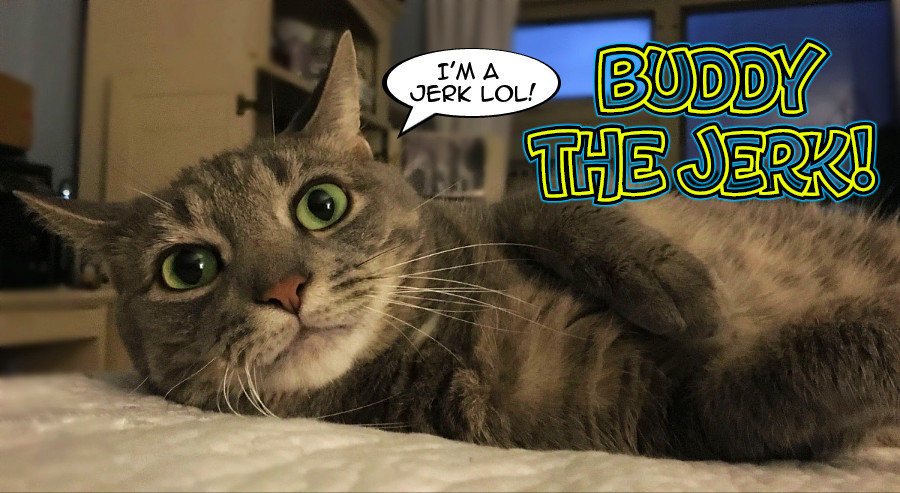
First, Bud doesn’t like that kind of palm-open head petting. I’ve gotta be gentle and very precise, being careful not to touch his ears, which clearly annoys him. The limit is maybe…four? Five?
He likes it when I rub his cheek glands, under his chin, and around his jowls. I know enough to stop and let him give me a signal if he wants more.
He’ll move if he’s had enough, but if I’m not paying attention and I persist, he’s got no qualms about smacking me or biting down on my hand. He’s learned that warning bites should be gentle, but after a clear warning, all bets are off.
I was awarded with ELEVEN scratches on my left arm last week, although that was a case of misdirected aggression, not an overstimulation outburst. I should have seen it coming, since I know the signs indicating he’s frustrated about something and needs to release energy.
Yes, my cat is a jerk. Yes, I still love him. In fact, I’m glad he’s my Buddy and he didn’t end up with people who think cats do things out of spite, or would physically punish him for acting like a cat. A jerk of a cat, but a cat all the same.
He’s taught me to pay very close attention to body language, ears, whiskers, tail swishing, and all the other ways cats signal to us aside from verbalizing their feelings.
How do your feline masters respond to petting, and what are their limits?
Bodega cats are the stars of a popular online series and could soon become legal in New York, where they’ve helped keep delis and small groceries rodent-free for as long as such places have existed.
Although it’s way too early to celebrate, Pennsylvania could become the fourth state to outlaw cruel declawing procedures after two lawmakers there introduced a new bill.
The Pennsylvania declawing ban proposal closely mirrors laws already passed in New York, Maryland and Massachusetts, and would outlaw the procedure except in cases where it’s medically necessary. (Although extremely rare, sometimes cats suffer from cancer of the nail bed and other maladies that necessitate surgery, but that’s a far cry from the elective declawing currently legal in 47 states.)
The state’s Veterinary Medical Association, the usual villain in these situations, is opposed to the ban. State veterinary medical associations argue that outlawing the procedure — which amputates a cat’s toes up to the first knuckle — would limit options for veterinarians and caretakers.
The veterinary medical associations, which contrary to their names do not represent all or even most veterinarians, also claim that declaw bans lead to more surrenders, but that claim has been repeatedly debunked by statistics from states and municipalities where bans have passed. In each of those cases, surrenders actually decreased, which is not a surprise to those who understand declawing, rather than “solving” any behavioral issues, actually causes cats to lash out even more because of the suffering they endure from the mutilation.
Here in New York, the Veterinary Medical Association successfully prevented declawing bans from making it out of committee for years, despite organizations like the Humane Society, SPCA, Alley Cat Allies and others wholeheartedly opposing elective declawing. Each state VMA buys influence with campaign donations, and relies on the lawmakers they support to kill declawing bans. Let’s hope Pennsylvania’s Veterinary Medical Association proves less adept at derailing that state’s bill.
The Last Cat of the Skies: The Iconic F-14 Tomcat
When I was a kid, the two Dream Machines that adorned posters on my wall were the Lamborghini Countach and the F-14 Tomcat. The Countach remains a car without equal with its inimitable, angular design that still manages to look futuristic more than half a century since the first models rolled out of the factory.
The twin-engine Tomcat is kind of like the Countach of fighter jets with its variable wing geometry, prominently angular air intakes and unique silhouette that makes it easy to distinguish even from the ground.
A Tomcat from the Nimitz-class aircraft carrier USS Theodore Roosevelt (CVN 71) during a combat flight over the Persian Gulf in 2005. Credit: U.S. Air Force photo by Tech. Sgt. Rob Tabor
Grumman’s air superiority fighter was immortalized in pop culture when Tom Cruise’s ace fighter pilot, Maverick, flew the aircraft in 1986’s Top Gun, and the Tomcat enjoyed a nostalgic encore in 2022’s excellent Top Gun: Maverick, displaying its staying power in a film that also heavily featured newer aircraft like the F-18 Super Hornet and the sixth generation prototype “Darkstar,” based on Lockheed Martin’s secretive SR-72.
The F-14 is the last of Grumman’s “cat” aircraft, after the Wildcat and Hellcat, and while it no longer fills a role in the US military, it remains a potent weapon for other countries half a century since its first flight. You can read all about the Tomcat in The Aviationist’s new feature here.
The Tomcat’s variable wings were a technological marvel when the aircraft was first released. The wings are swept forward for takeoff and landing, and typically swept backward during high speed, high altitude flight, allowing the fighter to maneuver in ways other aircraft could not. The wings can also shift to an asymmetrical configuration, allowing for unique capabilities in flight.
New York’s deli cats get their say
Bodega cats, longtime fixtures of New York’s answer to grocery stores, are enjoying a moment thanks to a major push to finally legalize their presence, and popular social media accounts featuring photographs of the beloved mousers keeping watch over their stores and snoozing in snack aisles.
A bodega cat in New York takes a siesta from his usual napping, eating and rodent-hunting duties. Credit: Wikimedia Commons
Now the New York Times has a feature on the popular TikTok series Shop Cats, which features “interviews” with the neighborhood felines.
Like Buddy, they seem to have an odd fascination with Mao Zedong, and their answers don’t make much sense, but that’s part of their charm. Check it out here.
Cats are blamed, to the exclusion of almost all other factors, for the decline in native bird populations in New Zealand.
A New Zealand group canceled a cat-hunting competition for kids after receiving massive backlash for the plan, but one Kiwi journalist told a national audience he thinks the cat hunt is a great idea and doesn’t go far enough.
“When it comes to feeral kets, I’m on the soide of the kea, the kākāpō and the kiwi ivery sangle doy of the week and my missige to [the organizers] is ‘Git the competition back on, git the keds back out thea,'” said the vowel-desecrating morning show host Patrick Gower. “If thea gonna hunt and thea’s feeral kets in the way, then we hif to woipe them out. Feeral kets need to be shot, they need to be run ovah, they need to be trepped, they need to be woiped off the foice of Aotearoa and I imploah the school to git it back on, and look, I’ll put up some rewoade as well foah any kets these kids git down theah as well.”
English translation: “I think the cat-killing contest is a wonderful idea, cats need to be shot, run over and exterminated from New Zealand, and I hate cats so much that I’ll put up some of my own money as prizes for the children who bag the most kills.”
You’ve got to wonder what cats have done to Patrick Gower for him to hate them so much, and fortunately dear readers, PITB has the answer!
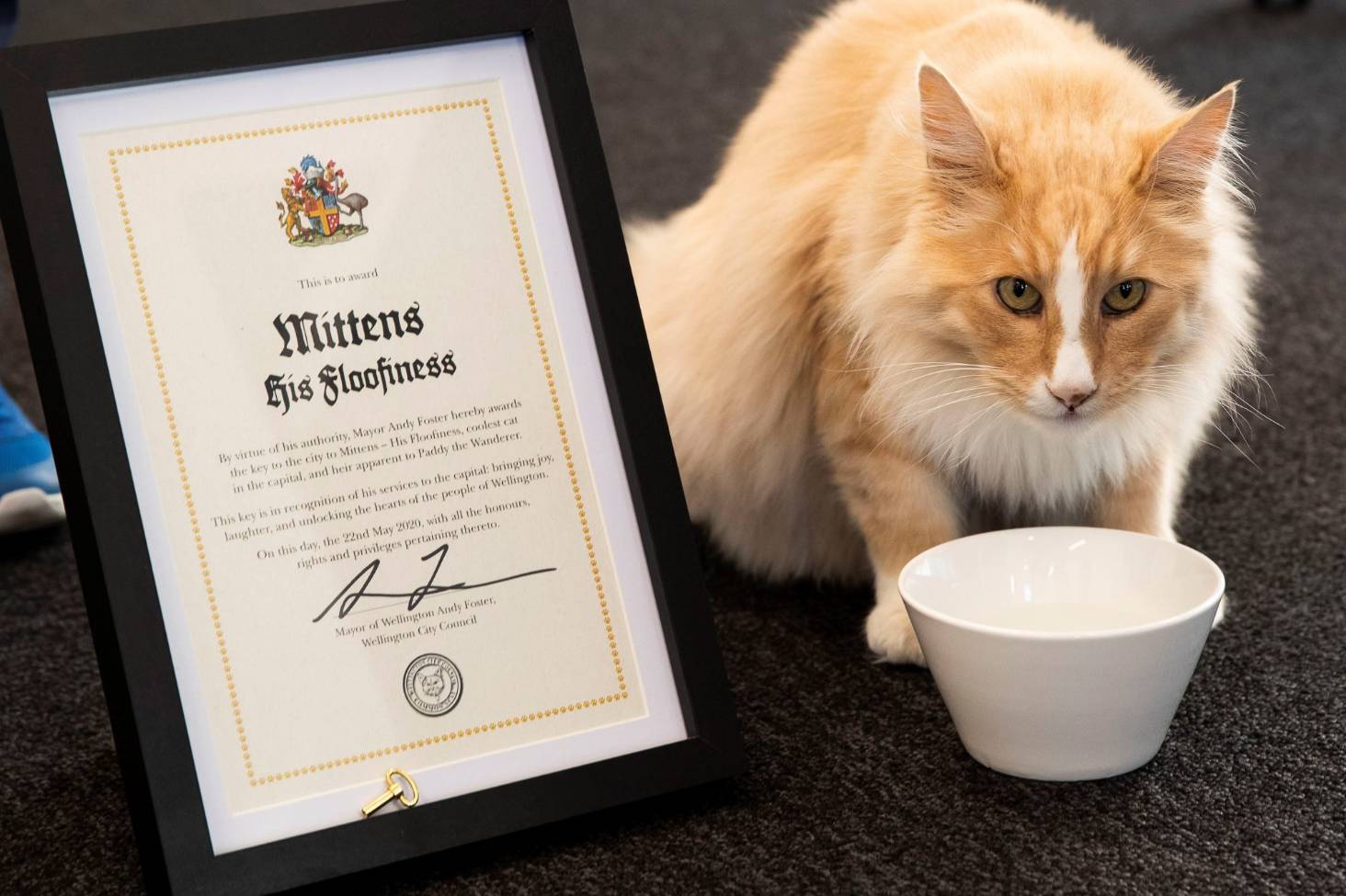
Gower lost the New Zealander of the Year competition of 2020 to a cute orange tabby named Mittens.
Think about that: All those years of doing Pulitzer-worthy breakfast show kitchen demonstrations, of slaving away at the anchor desk bringing viewers important news about reality TV stars and parroting former Prime Minister Jacinda Ardern’s declaration that New Zealand’s government is “the single source of truth” on COVID, and Gower loses the honor to a damn cat. Mittens even has the key to the City of Wellington, and Gower does not.
So sad.
Mittens receiving honors that have eluded morning show host Patrick Gower. Credit: Wellington City Council
It’s unfortunate when a man in influential position, small country or not, enthusiastically encourages children to practice being future serial killers by slaughtering innocent animals because he thinks — despite the complete absence of evidence — that arbitrarily gunning down and running over sentient animals will save birds.
Really, you’d think before calling for the extirpation of an entire species of animal that these people would have something, even a single bogus research study, claiming that bird populations would recover if only people started killing cats on sight.
But no such proof exists, and the burden of proof rests with Gower, fellow Kiwi cat-hater Gareth Morgan and others who harbor an irrational and ill-advised hatred of tiny animals who are simply behaving the way nature designed them to behave.
What we do know is that managing cat populations can be done, but it’s difficult, time-consuming work that requires dedication and patience.
Cities like Washington, D.C., with its exhaustive cat count, and communities across the US have provided the blueprint with TNR efforts and a mass push for all pet owners to spay and neuter their cats. The results have been remarkable, and shelters save more than a million felines a year compared to just a decade ago. There’s still work to be done to bring the number of euthanizations down to zero.
Gower
It’s also worth noting that the organizers of the North Canterbury Hunting Competition and supporters like Gower are coming from a place of ignorance. In their original, now-deleted announcement, the organizers offered a “guide” to telling the difference between feral and pet cats, unaware that they are the same species. The only difference is that pet cats are fortunate enough to have homes, and strays and ferals do not.
The group said it was offering its “guide” as a way to prevent children from killing pet cats, but how exactly would they do that when a pet is indistinguishable from a colony stray or a feral? Would they find a microchip on the corpse of a cat they killed and say “Oops, guess that one doesn’t count!”?
Does a cat somehow feel less if it doesn’t have a home? Is its life worth less if it doesn’t have a collar and eat from a bowl?
It’s barbaric and so poorly thought-out, it really boggles the mind that the idea of a cat-killing competition for kids was voiced, let alone approved, planned and promoted by supposed adults.
As for the contest itself, we’re very glad it’s been called off, even if the organizers want to play victim and say their feelings have been hurt by the response to their murderous event.
That, however, doesn’t solve the problem. The fact that the organizers thought this was a good idea in the first place, and the increasingly pitched rhetoric from the likes of Gower and Morgan, are normalizing the idea of slaughtering innocent animals who have their own minds, thoughts and feelings, and who have been shaped by 10,000 years of history to live with and depend on humans.
Instead of calling for blood and whipping people into a frenzy, influential New Zealanders should read about cats and animal cognition in general, so they’re aware that felines experience the full range of primary and secondary emotions and are very much capable of suffering the same way we do when we’re injured, stressed and our lives are in danger.
That, unlike claims that cats are primarily responsible for the decline in bird populations, is hard scientific fact. We can peer into the brains of felines, watch their neurons fire, see different brain regions light up as they think specific thoughts and respond to specific smells and sights.
Maybe if people who hate cats understand what they are, they’ll feel some empathy for a beautiful species, animals who have been companions and literal life savers to humans since before deepest antiquity, animals whose lives have intrinsic value regardless of what they mean to us. At the very least, we owe them that.
One of New Zealand’s most prominent economists has called cats “serial killers” who are driven by “bloodlust,” and is one of many who blame domestic cats for the decline of local wildlife.
An annual hunting competition for children in New Zealand has a new category this year, awarding a cash prize to the young hunter who kills the most cats.
You read that right.
The North Canterbury Hunting Competition announced the new category on Saturday and says it will offer a $250 prize to any child 14 or younger who kills the most felines.
In a statement, the local SPCA pointed out the obvious, that cats will suffer horribly, pets will die and the competition will result in bungled kills en masse, leaving wounded cats to suffer horribly before the children finish them off — if indeed they do.
“There is a good chance someone’s pet may be killed during this event,” the Canterbury SPCA wrote in a statement. “In addition, children often use air rifles in these sorts of events which increase the likelihood of pain and distress, and can cause a prolonged death.”
Credit: Ali Arapou011/pexels
Prompted by the same sloppy “research studies” that inspired Australia to kill millions of cats — and resulted in a mouse plague of biblical proportions in 2021 and 2022, causing billions of dollars in damage to farms, homes, businesses and infrastructure — New Zealand is on a disinformation-fueled jihad against felines.
Like all such studies, the claims that cats are singlehandedly responsible for declines in native wildlife, thus absolving direct human activities of blame, come by way of overzealous bird conservationists and others who insist the mass murder of cats will save native birds and small mammals. As if humans destroying habitats, dumping chemical waste, creating wind farms that act as bird dicers, building glass skyscrapers that millions of birds fly into every year, saturating entire swathes of the Earth with light pollution and EM radiation that harms and confuses animals — and all the other things people do — have no impact whatsoever, and it’s only those dastardly cats who are the culprits.
You’ve got to hand it to the misguided conservationists, who have picked tiny scapegoats who can’t defend themselves verbally or physically against humans.
To understand how the “hunting” (killing) competition can be real, it’s important to understand the context of the way cats are portrayed in New Zealand. Gareth Morgan, a Kiwi economist and politician, launched a campaign about a decade ago with the stated goal of eradicating cats from the island nation of 5.1 million people, which would forbid people from adopting new cats and end programs like trap, neuter, return (TNR) in favor of having local animal control departments kill felines.
Morgan, whose Cats to Go site portrays kitties with devil horns and glowing red eyes, says cats are evil animals driven by “bloodlust.”
“Cats are the only true sadists of the animal world, serial killers who torture without mercy,” Morgan has said.
A screenshot from the group’s Facebook page announcing a new prize for young hunters.
The North Canterbury Hunting Competition, which also offers prizes like dirt bikes for child hunters, pulled the new category announcement from its Facebook page on Monday but stopped short of canceling the event, blaming people who were upset by the idea of cat hunting.
Citing abusive feedback, the group said it’s “incredibly disappointed by this reaction” and said the hunt is for a good cause, raising money for local projects.
Local authorities have backed off the plan, but the story raises important questions about how local governments deal with stray cat populations.
The recent saga of a New Jersey town’s ill-advised plan to “destroy” feral cats highlights almost everything wrong with local government.
First, a notice went out from the northern New Jersey town of Matawan, informing residents that feral cats had become a “nuisance” and their presence posed a danger to “the welfare and safety of both the community and the cats.” The town, in cooperation with the police and SPCA, the notice said, would begin trapping stray, feral and free-roaming felines in November, and any cat not claimed after seven days would be “destroyed.”
The backlash was loud and immediate, and it took the Monmouth County SPCA by surprise.
After receiving angry complaints, the local SPCA posted a notice on Facebook blasting the “outlandish and outrageous campaign.” The SPCA’s leaders said they hadn’t been consulted and hadn’t approved of the policy, blaming the Matawan Animal Welfare Committee, a three-person group comprised of the town’s business administrator, Scott Carew, town councilwoman Melanie Wang and an animal control officer.
“We are completely outraged and disheartened that our organization has been attached to this archaic campaign to euthanize feral cats, when there are so many other successful, humane alternatives,” the Monmouth County SPCA wrote in its statement.
Carew backpedaled in the fallout, claiming the notice was a well-intentioned way of informing people who live in Matawan to keep their cats inside and stop feeding strays and ferals.
“By no means was the goal of the trapping efforts to destroy trapped cats,” Carew told NJ.com. “That said, since there was the chance that cats would be trapped and brought to the shelter, we wanted to alert cat owners whose cats are allowed to roam outside.”
But Carew also said he and the other were “obligated to address the complaint,” and said the town would have to enact “a resumption of trapping efforts” if it received more complaints about the cats. According to a statement by the Matawan police department, in a meeting between local leaders and people concerned about cats in one neighborhood, it was a single complaint about a possibly aggressive feral cat that prompted the plan.
That’s it. That’s all it took, in the eyes of local government officials, to justify a policy of trapping and killing sentient, human-habituated innocent animals, a group that includes free-roaming pets, former pets, strays and true ferals. A single, unverified complaint of a potentially “aggressive” cat, with no further detail about what the word aggressive means in that context, no information about what the cat supposedly did, or even confirmation that the cat was a feral and not a stray or a wandering pet.
When the dust cleared from all the finger-pointing, Carew said his committee should have informed the SPCA of its plans, and police brushed off responsibility by saying they “assumed” the notice was drafted with the cooperation and intent of the SPCA and other local animal welfare groups.
A cat caught during a trap, neuter, return program, which reduces feral/stray populations in the long term without the cruelty of culling. Credit: Pixabay
Local government leadership and incompetence has become a big problem. With the death of newspapers, particularly regional dailies that employed trained journalists, there are entire swaths of the country no longer served by local government watchdogs who have the time, skills and resources to monitor local officials and inform the public.
We’re fortunate that NJ Advanced Media, an online portal for content from more than a dozen New Jersey local newspapers, has found a way to exist as a viable business serving millions of readers throughout its home state. Without it, it’s doubtful the story would have surfaced anywhere.
Lots of people think local government is small potatoes, but the truth is that local officials are responsible for enormous budgets and wield considerable power. The decisions they make very likely have more impact on our lives than decisions made in the halls of congress, even if it’s the latter that gets people’s blood boiling.
In this case we have a meeting conducted in secret, without public notice, that would have determined the fate of an unknown number of animals. We have anonymous, nebulous complaints and allegations about “nuisances.” What constitutes a nuisance? How many cats are involved? Are the cats part of managed colonies and cared for by people who trap and neuter them? None of those questions were answered.
Additionally, instead of taking intermediary steps or using widely available resources — the “other successful, humane alternatives” the SPCA referenced, from the willing cooperation of local shelters to the free toolkit created by the authors of the incredible D.C. Cat Count — the local officials came up with their own ill-advised plan to trap and kill cats.
Outrage by animal lovers and the SPCA were enough to make sure a plan like this was quickly discarded this time around, but you have to wonder how many other places this kind of thing might be happening without so much as a blurb about it.







 Pain In The Bud