Shrill Editorial Calls Cats ‘Domestic Terrorists’ And ‘Skulking, Disobedient Destroyers’ Who Should Be ‘Locked Down’

The more bunk studies claim cats are driving wildlife to extinction, the more people in media and government call for extreme measures to contain them.

Seventy nine cats.

That’s how many felines stood in for the entirely of the UK in a 2022 study, which is the genesis for the claim that cats kill 270 million birds and small animals in that country.

Using GPS collars, owner questionnaires and samples of prey brought home by those 79 outdoor cats, a research team from the University of Reading applied data from a mix of studies dating as far back as 23 years ago, extrapolated and massaged numbers using things like “kernel density estimates” and “generalized mixed models,” and came up with that 270 million figure, which is cited routinely and credulously by UK media.

Actually, their estimate was between 140 and 270 million. An earlier study put the number at 92 million, and a 2016 study estimated UK cats kill 55 million birds and small animals. That’s a range of 215 million!

The Reading team even quotes the infamous US meta-analysis that claims domestic cats kill as many as 4 billion birds and 22.3 billion mammals a year here. That paper, as skeptics in the science community have noted, has virtually no relationship with reality, involves no original research, and relies on data from unrelated studies and surveys in which cat owners were asked to rate their pets’ hunting prowess on a point scale while imagining what the little ones get up to when they’re outside.

All of this is to say that aside from the thorough, labor-intensive and expensive D.C. Cat Count, which brought together cat lovers, birders and scientists to work cooperatively, the 2022 UK study and its counterparts in the US and Australia are exercises in pushing an agenda masquerading as honest academic research.

That’s how we get editorials like The Spectator’s “We need a cat lockdown now” by Zoe Strimpel. Though the tone isn’t tongue in cheek, I can’t imagine Strimpel dislikes cats nearly as much as she claims, and the post was probably written with wry anticipation for the click-generating fury of cat lovers indignantly sharing it on Facebook and X.

Still, it quotes the Reading study without skepticism and portrays cats as furry little wretches who abuse their human caretakers with their claws and their disdain while gleefully eating their way through endangered birds.

A cat stares down a mouse. Credit: Wikimedia Commons

Cats are predators, that much we can agree on, and outdoor cats are much more likely to negatively impact local wildlife, for obvious reasons.

Likewise, I can understand the concern with cat culture in the UK, where allowing pet cats to roam outside is the norm.

But every time the media cites the above-mentioned studies, more people are given an inaccurate impression of feline ecological impact, and more lawmakers at the local and national level consider “solutions” ranging from prohibiting people from keeping pet cats, as a government commission in Scotland recently proposed, or exterminating them outright, as some Australian states and municipalities in New Zealand have tried to do.

It’s worth pointing out that there is no data, not even a single study, showing that air-dropping poisoned sausages or arbitrarily shooting cats actually has any positive impact on birds and small mammals. All it does is terrorize sentient, intelligent domestic animals who have real emotions and experience real fear and pain.

The primary drivers of declining bird and small mammal populations — including habitat loss, environmental destruction, wind turbines and glass buildings — have nothing to do with cats. We have killed off 73 percent of the planet’s wildlife since 1970 and every species of iconic megafauna — from orangutans and gorillas to tigers and pangolins — is headed toward extinction. Are domestic cats responsible for that too, or can we be adults and fess up to our role as the main antagonist here?

An orange tabby and a mouse. Credit: Wikimedia Commons

Strimpel actually goes even further, claiming cats don’t have real affection for their caretakers and are more like psychopaths, faking love because it gets them what they want, primarily food and shelter.

Dogs have true affection for their humans but cats do not, she additionally claims, while adding that cat people are undateable because they share qualities with the “loutish and numerous creatures” they care for.

There was a time when I would have been ambivalent about Strimpel’s attitude toward cats, if not her cavalier treatment of basic facts. But then a drool-happy, friendly tuxedo cat showed me I could interact with his species without my allergies going haywire, and a tiny gray tabby kitten became my animal cognition teacher while blindsiding me with love.

Now every time I hear about some psychopath abusing cats, or terribly misguided politicians advocating a plan to kill millions of domestic felines, I think about my Bud. I think about how he cries for his Big Buddy when he’s hurt or stuck, how he meows and trills with excitement when he experiences something new, and how he began shaking, then threw up from overwhelming relief and happiness the first time I returned from a vacation after adopting him.

Buddy the Cat chillin’ on the balcony in the summer. Credit: PITB

He’s got a vibrant mind in his little head, with strong opinions and emotions. So does every cat on the street, in a shelter cage, and in the cross hairs of a birder or biologist playing God by “culling” or “harvesting” cats to protect another species.

Real science, not activism packaged as science, has proven that many times over in recent years. If people want to do harm to cats because they think birds and other animals will benefit, the burden of proof is on them to show not only that their methods work, but that the results could somehow justify the fear and misery they would inflict on innocent animals to achieve their goals.

Cats are obligate carnivores who don’t have a choice. We do.

Are Cats Really Liquid? Yes, Says Physicist Who Specializes In Fluid Dynamics

After seeing memes about liquid cats, physicist Marc-Antoine Fardin set himself the task of figuring out whether the little ones really are liquid.

Pour water into a glass or a jug, and the water takes the shape of the object immediately. Pour honey into a bottle, and it’ll likely take minutes before the slow-moving stuff fully conforms to its new container.

Both are liquid, but they’re not the same.

To differentiate levels of liquidity, rheologists — scientists who study the “deformation and flow” of liquids — use something called the Deborah number. The quicker the liquid takes the shape of its container, the lower its Deborah number, the “more liquid” it is.

On the extreme end are liquids like glass and tar pitch. It took an astounding 69 years for a single drop of the latter substance to fall at Trinity College, which set up a tar pitch experiment in 1944 and finally recorded its first drop on camera in 2013.

So what about cats? Are they really liquid?

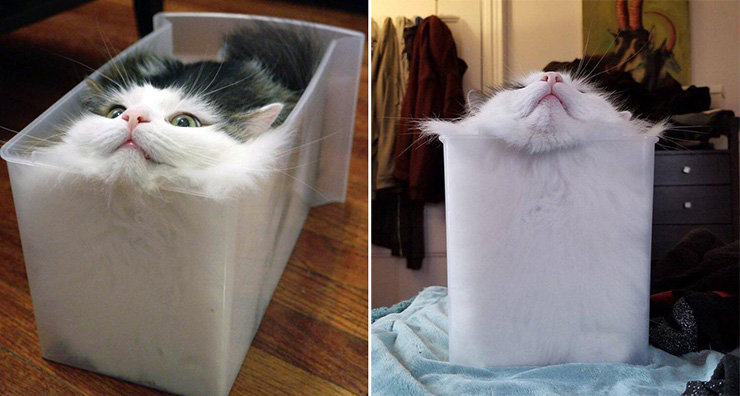
If you’re a cat lover and you haven’t been living under a rock for the last 10 or 15 years, you’ve almost certainly seen memes showing photos of felines and their uncanny ability to conform their bodies to containers, as well as their tendency to “pour” themselves.

My Buddy is an expert in the latter, often electing to drop down from the couch in the laziest possible way, by shifting his weight and letting his body follow the path of least resistance until he slides off the side and onto the floor.

“Watchu lookin’ at, human? Haven’t you seen a liquid cat before?”

Marc-Antoine Fardin, a physicist with the French National Center for Scientific Research and Paris City University, won an Ignoble Prize for taking the memes seriously and studying the fluid properties of felines. Cats, Fardin wrote in an article about feline liquidity, “are proving to be a rich model system for rheological research.”

Cats, he concluded, are a “non-Newtonian liquid” with the ability toalter their shapes to fill out the container without changing their volume,” putting them in the same general category as ketchup.

So the next time my cat gets all imperious with me, I’m going to remind him he’s a glorified condiment.

Box full.

Tigers Make A Triumphant Return To Russia’s Far East, Bringing Hope To The Species’ Future

For the first time, humans have successfully returned orphaned tiger cubs to the wild after raising them and training them to hunt.

For more than 50 years, tigers were absent from Russia’s Pri-Amur region.

Sparsely-populated, mountainous and blanketed in forest, the domain borders the heart of the Russian Far East, offering hundreds of thousands of contiguous square miles for the most robust sub-species of Earth’s most magnificent predator.

Here, tigers can roam without fear of conflict with local farmers, or roads that carve up habitat and pose a danger to animals trying to cross. Prey is abundant, and adaptations for surviving in the local terrain are coded into the tigers’ DNA.

Now that scientists have proven for the first time that tigers can be successfully reintroduced into such an environment, big cat advocates imagine Russia’s Far East as a haven for the large felids. It’s a place where tigers can thrive, mate, reproduce and change the outlook for their species, which has dwindled to only 4,000 or so remaining in the wild.

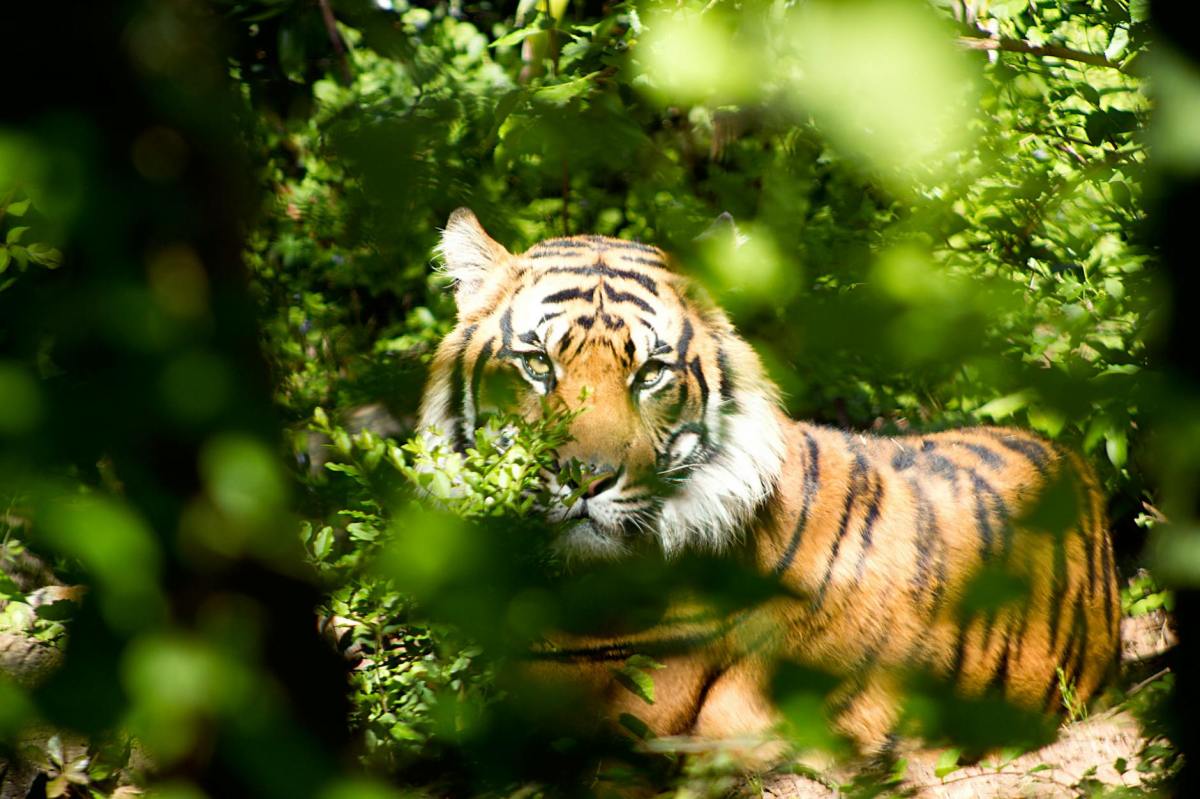
tigers in nature
Credit: Leon Aschemann/Pexels

The project to reintroduce Amur tigers to their native habitat is a cooperative Russian-American endeavor. The team started by building a tiger conservation center in the Amur oblast a decade ago.

The facility is built in a way that orphaned tigers can be raised and taught how to hunt without directly interacting with their human caretakers. That’s a crucial component, because tigers who see humans as potentially friendly or sources of food have drastically reduced chances of surviving in the wild, and are easier marks for poachers.

After 18 months, the cubs are brought to remote locations in Pri-Amur and released. Of the first group of orphan tigers released into the wild, 12 were able to survive on their own.

One gluttonous tiger failed: he crossed over the border into China and began eating domesticated animals, including 13 goats in what researchers called “a single event.”

The fattened tiger then retraced his steps to Pri-Amur, and when he didn’t show fear of humans, the team decided he had to go. They captured him and sent him to a zoo, where he gets all the free meals he wants and contributes to the captive breeding program helping his species maintain genetic diversity.

With 12 out of 13 tiger re-introductions successful, the program provides “a pathway for returning tigers to large parts of Asia where habitat still exists but where tigers have been lost,” said Viatcheslav V. Rozhnov, who leads the reintroduction project.

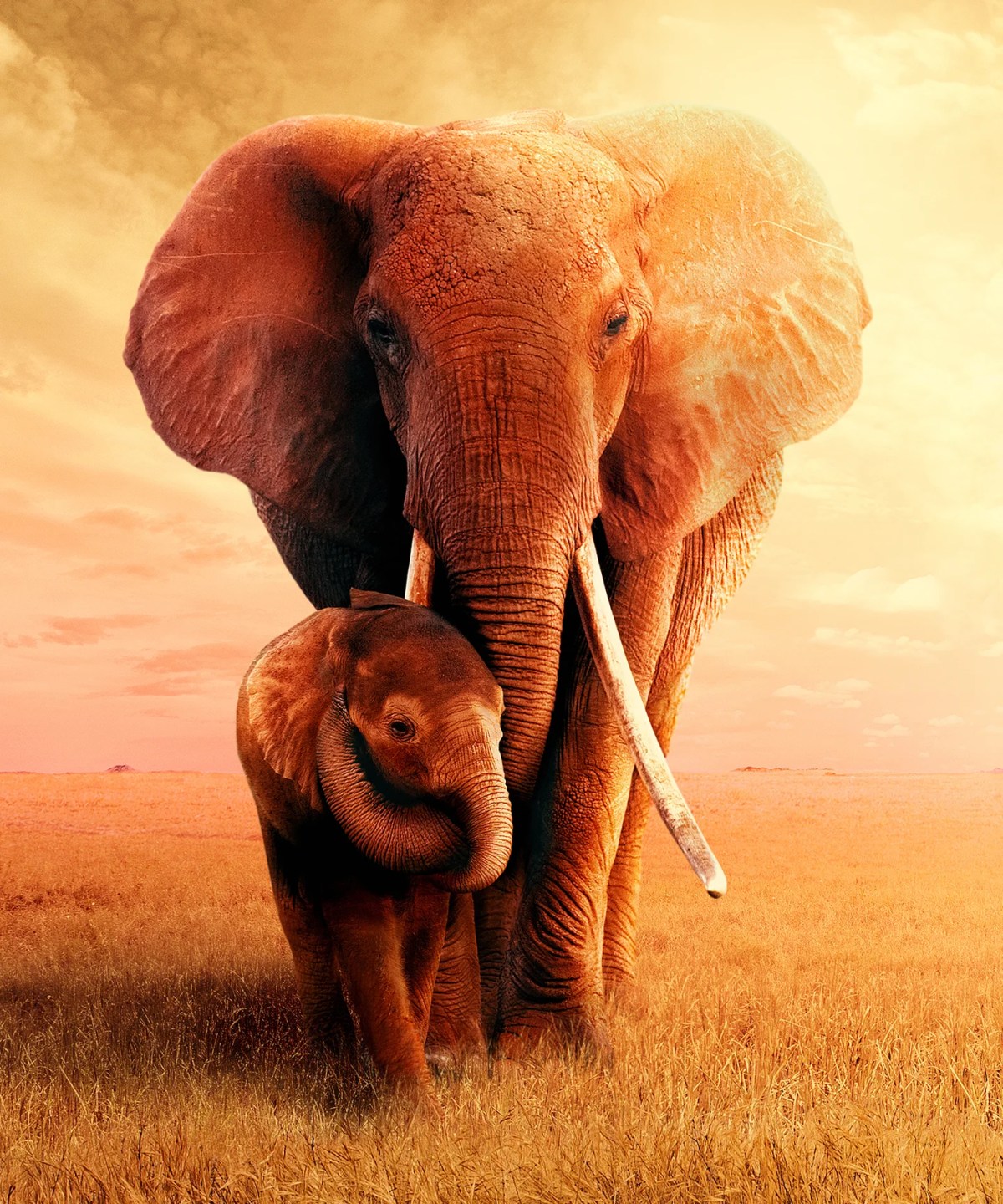
tiger
Amur tigers are the largest cats on Earth. They’ve evolved to survive in regions where winters can be brutally cold and snowy, but they also thrive in spring and summer when the snows melt and prey is abundant. Credit: Pexels

The successful reintroduction has also led to some surprising developments. Two of the cubs, Boris and Svetlaya, were unrelated but were rescued at about the same time and raised in the Russian orphanage for their species.

Using tracking devices they’d placed on the newly-released young tigers, the research team watched as Svetlaya settled into a home range and Boris made a beeline for her, “almost in a straight line,” crossing 200km (120 miles) of terrain to reunite.

The team’s hopes were confirmed six months later, when Svetlaya gave birth to a healthy litter of cubs, the first natural-born tigers to result from the reintroduction project.

Another tigress, Zolushka, also gave birth to a healthy litter when she was reintroduced in an area closer to a still-extant population of Amur tigers. The researchers believe the father was born wild in the region and was not part of the reintroduction program.

The wilderness in Pri-Amur and its environs is so vast, untouched and undesirable to human habitation that it could be home to generations of tigers, securing their future after so many decades of grim news for the iconic big cats.

“The grand vision is that this whole area would be connected,” Luke Hunter, executive director of the Wildlife Conservation Society’s Big Cats Program. “There’s lots of habitat that could be recolonized by tigers.”

More Than 400 People Applied To Adopt Foul-Mouthed Parrot

Requirements for adopting Pepper included a sense of humor and experience caring for birds. He’s now found a home with patient caretakers and another mercurial parrot to hang out with.

It’s too bad cats can’t swear.

While kittens don’t often have problems finding homes due to their overwhelming cuteness and antics, it usually takes a sad story to drum up considerable interest when an adult feline is up for adoption.

As the SPCA of Niagara learned, talkative parrots, especially birds who can swear up a storm, have their pick of homes.

In June, a potty-mouthed parrot named Pepper was surrendered to the shelter, and when the SPCA put the call out — specifying they’d prefer someone with experience caring for birds and a sense of humor — the applications kept rolling in, totaling more than 400.

“His famous line is ‘Do you want me to kick your ass?'” a shelter employee said in an interview last month shortly after announcing Pepper was up for adoption.

Shelter staff asked applicants to include photos of their bird enclosures in addition to the usual pre-adoption questions, eventually narrowing the Pepper Sweepstakes down to 10 potential homes.

This past week, Pepper was finally taken to his new abode in Olean, a small city in western New York. The couple who adopted him are not only experienced with birds, they know all about avian vulgarity. They have a parrot named Shelby who apparently “makes Pepper look like a saint.”

As for Pepper, it looks like he’s getting his bearings before heaping abuse on his new caretakers.

“He hasn’t cursed at them yet, but we know it’s coming,” shelter staff wrote in an update.

In recent decades, research has shown birds can be exceptionally intelligent. Crows, for example, use tools, can differentiate between human faces, and remember which humans have wronged them or treated them well.

While many people assumed parrots merely imitate human language, long term behavioral studies show the birds are able to use words in context and invent novel combinations of words. As with other animals, syntax remains elusive.

The most famous example was Alex the African Gray, who was the subject of research by animal cognition expert Dr. Irene Pepperberg. Alex, who died in 2007 at the age of 31, was able to count and could perform simple calculations. He was talkative, conversant and often told his caretakers how he was feeling, what he wanted, and what he thought of the tests they’d give him. (Like a child, Alex would try to get out of exercises he was bored with by asking for water, saying he was tired and wanted a nap, or just flubbing his answers.)

We are not above crude humor here at PITB, and in the past we’ve written about Ruby, our favorite talking parrot. Ruby lives in the UK with her owner, Nick Chapman, and the pair were among the very earliest Youtube stars thanks to videos of Ruby’s shockingly vulgar, extremely British tirades and Chapman’s infectious laugh.

Warning for those who are offended by bad language or are viewing at work: Ruby is known for liberal use of c-bombs-, t-bombs, f-bombs and just about every other linguistic bomb you can think of, in addition to British slang like “bollocks.” If that’s a problem for you, skip this video.

Eric the Legend, a parrot who lives in Australia, is also a favorite on Youtube for his habit of declaring himself “a fookin’ legend!

We’re glad Pepper has found a home where his idiosyncratic nature will be cherished, and we hope the future will bring videos of Pepper and Shelby going back and forth. Parrots are social animals, after all, and what fun are insults if you’ve got no one to trade them with?

Top image of Pepper courtesy of Niagara SPCA.

Foundation Offers $10m For ‘Cracking The Code’ Of Animal Language

Think you can decipher the rhythmic clicks and whistles of dolphins or the grunts and alarm calls of monkeys? A foundation is offering big prizes for progress in communicating with animals.

Looking to prompt renewed efforts at decoding animal communication, a non-profit founded by an investor and a university are offering prizes — including a hefty $10 million — to teams that can figure out what animals are “saying.”

The Coller Dolittle Challenge for Interspecies Two-Way Communication is a collaboration between the Jeremy Coller Foundation and Tel Aviv University. (Yes, it’s named after that Dr. Dolittle.)

Entrants aren’t asked to come up with a Star Trek-like “universal translator” for animals. Rather, the people behind the Coller Dolittle Challenge want to see methods that allow for two-way communication between humans and individual species.

“We are open to any organism and any modality from acoustic communication in whales to chemical communication in worms,” said Yossi Yovel, a professor at Tel Aviv University and co-chairman of the challenge.

The grand prize is a $10 million grant or $500,000 in cash, chosen by the winner, while the Foundation will offer $100,000 prizes each year for the best entries that make significant progress toward communicating with animals. The yearly prizes will be assessed “for significant contributions to decipher, interface or mimic non-human organism communication.”

While it may seem far-fetched — and there are those who believe humans will never be able to fully understand animal communication in proper context — there have been efforts to communicate with and decode the communications of bats, dolphins, whales and some primate species. Scientists have also pushed the boundaries on understanding group communication, such as the coordination involved in avian murmurations.

orangutan on tree
Orangutans have demonstrated the ability to understand abstract concepts, like using money, rudimentary sign language, and have even deceived humans. One orangutan in the 1960s repeatedly escaped his zoo enclosure by hiding a small strip of metal in his mouth and using it to pick a lock. Credit: Klub Boks/Pexels

The organizers believe artificial intelligence will be the tool that ultimately helps crack the communication barrier, but entrants aren’t required to use AI. The technology is incredibly useful for tasks involving pattern recognition and sorting large amounts of data, both of which are important in this kind of work when researchers are tasked with analyzing thousands of audio samples or hundreds of hours of footage.

Alas, we don’t think the foundation will be interested in the Buddinese language, which boasts 327 different ways of demanding food and features a timekeeping and calendar system based on meals and naps. A short trill followed by a series of staccato meows, for example, means “I expect prompt service at salmon o’clock,” while a truncated meow ending with a scoff is used to indicate displeasure when a human napping substrate tosses too much during sleep.

Still, maybe we’ll dress it up to make it look properly academic and give the challenge a try. Those prizes could buy a lot of Roombas!