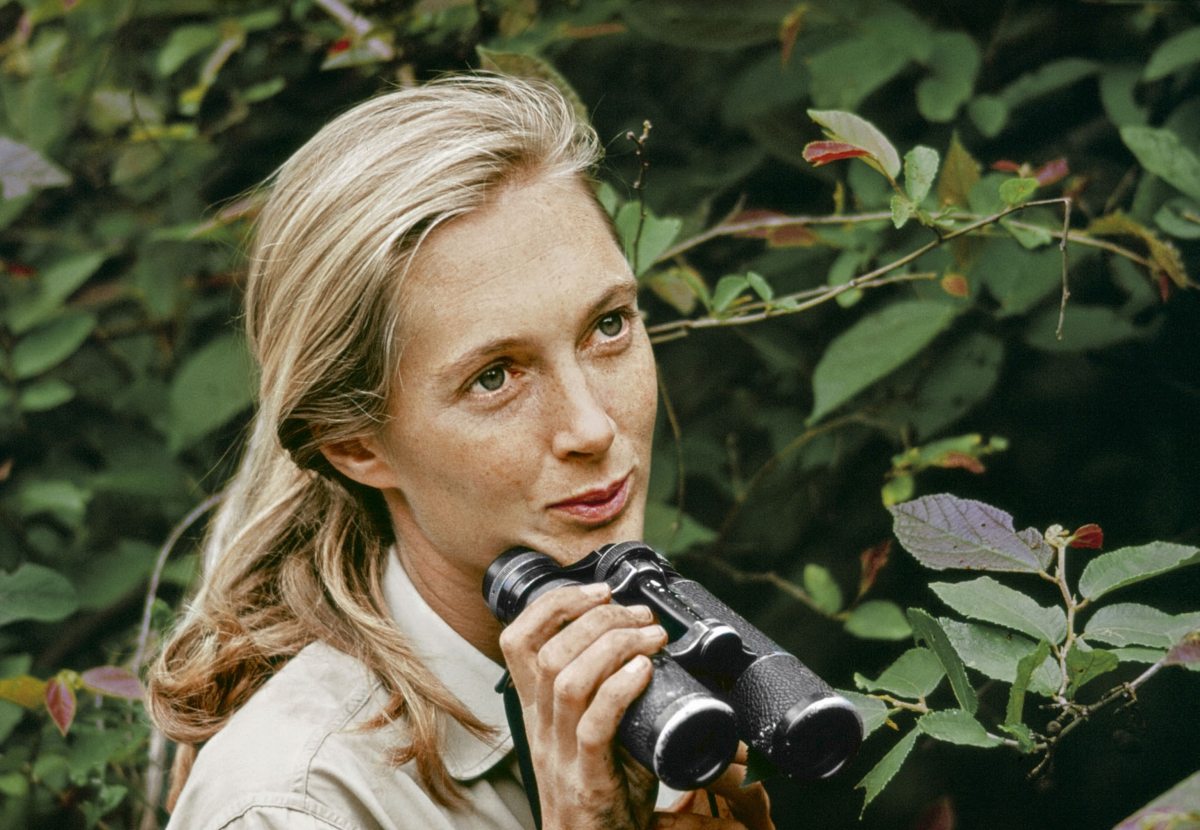
Goodall spent the better part of seven decades with the chimpanzees of Tanzania. Her discoveries were so profound, they forced the scientific community to reevaluate what separates humanity from other animals.
As I’m sure most of you have heard, Jane Goodall passed away Wednesday of natural causes. She was 91.
Goodall’s work was revolutionary and her career was extraordinary. It’s difficult to imagine now, but when Goodall first pitched camp in Tanzania’s Gombe Stream National Park in July of 1960, the scientific community knew virtually nothing about great apes.
Goodall wasn’t exactly welcomed with open arms. Being female and photogenic were the first two strikes against her in the eyes of the establishment.
She was self-taught, didn’t have a degree (she later earned a doctorate at Cambridge), and perhaps her biggest “sins” involved empathy and an attitude more buttoned-up scientists saw as anthropomorphizing the animals.
Goodall with a Gombe chimpanzee. Credit: Wikimedia Commons
Goodall gave the chimps names (a no-no at the time among scientists), carefully observed and recorded their family trees, worked out the obtuse — to human eyes– social hierarchy of primate troops, and witnessed behavior that no one had ever seen before.
She saw friendship, love and loyalty among the chimpanzees, witnessed a bitter war between the Gombe troop and a splinter group, followed families over generations, and saw one chimp die of a broken heart after his mother passed away. (I recommend Goodall’s 1990 book, Through A Window: Thirty Years With The Chimpanzees of Gombe, and the 2002 follow-up, My Life With Chimpanzees, for anyone who wants to read more.)
Her first major contribution, in October of 1960, not only fundamentally challenged our assumptions about animals, it forced us to change the way we regard our own species.
Goodall, observing the chimpanzees from a distance despite the rain that day, watched as a male she named David Graybeard repeatedly dipped blades of grass into the Earth. Curious, Goodall approached the site after Graybeard left, grabbed a few blades of grass and imitated what she’d seen the chimp doing.
She was astonished when she pulled the grass out and the strands were covered in termites. David Graybeard had been eating. He was using a tool to eat!
Goodall at Gombe in the early 1970s. The primatologist secured unprecedented access to the chimpanzees by gaining their trust. Credit: Wikimedia Commons
The discovery was huge because scientists believed tool use was, at the time, limited to mankind. We build and use tools, animals don’t, the thinking went.
When Goodall reported her findings to her mentor, anthropologist Louis Leakey, his prompt response indicated the gravity of her discovery: “Now we must redefine ‘tool,’ redefine ‘man,’ or accept chimpanzees as humans.”
Goodall never stopped working with the chimpanzees of Gombe, and today her formerly humble camp has become a permanent compound where researchers — all inspired by Goodall’s story — continue to study our genetic relatives.
But in her later years, Goodall became known for her activism just as much as her work as a scientist. She traveled constantly, engaging audiences on the subjects of animal conservation, respect for nature and understanding our place in the natural order. It’s a job that has become more necessary than ever as relentless human expansion, habitat fragmentation and human behavior push thousands of species toward extinction.
Credit: The Jane Goodall Institute
We lost Frans de Waal, the famous primatologist, in 2024. Now we’ve lost Goodall, and Sir David Attenborough is less than six months shy of his 100th birthday. We’re going to need people to pick up where they left off, and the job is much more difficult than it looks, requiring expertise, charisma and the ability to connect with audiences who know little about the subject matter.
But that’s a problem for another time. For now, let’s remember Jane and appreciate all she’s done over the span of an incredible life and career.
The surprise announcement came from Colossal Biosciences, a company best known for its project to bring back the woolly mammoth.
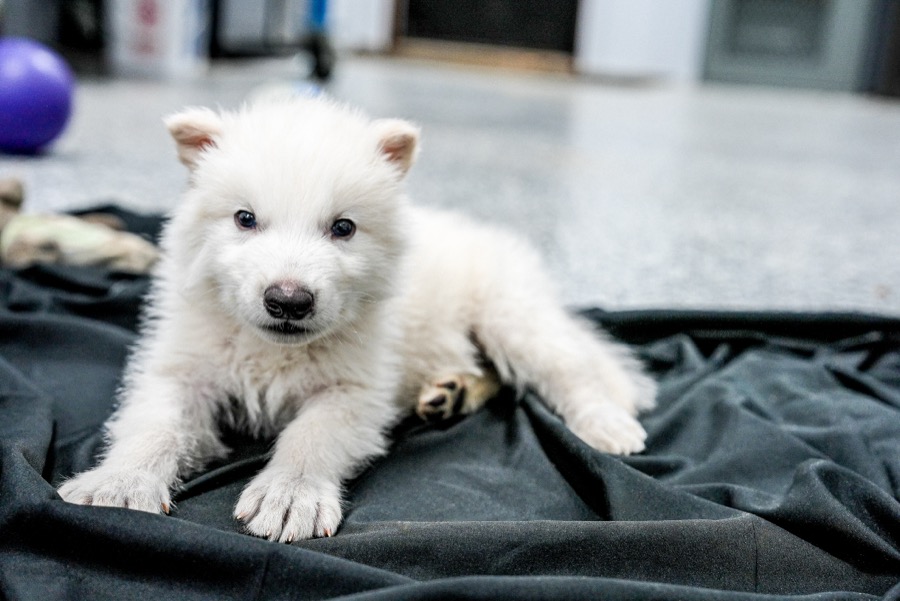
A US biotech company shocked the world Monday when it announced the births of three dire wolf puppies, bringing back a species that hasn’t lived for more than ten millennia.
Or a version of that species, at least.
Scientists with Colossal Biosciences extracted DNA “from a 13,000 year old tooth and a 72,000 year old skull and made healthy dire wolf puppies,” Colossal CEO Ben Lamm said in a statement.
Of course, it wasn’t that simple.
The dire wolf, Aenocyon dirus, was heavier, stockier and had thicker fur than modern-day gray wolves. In addition, its bite was incredibly strong, generating more force than any living species of canid.
To create the dire wolf puppies, Colossal used the genomes reconstructed from the tooth and skull, spliced them with gray wolf DNA, and made 20 gene edits in 14 genes. Healthy embryos were implanted in three surrogates — large, mixed-breed dogs — and were successfully delivered.
Romulus, one of two male dire wolf pups born late in 2024. Credit: Colossal Biosciences
Remus, who was born at the same time as Romulus. Credit: Colossal Biosciences
Whether the new puppies are officially dire wolves is up for debate and beyond the scope of this post, but just like humans and chimpanzees share 98.7 percent of their DNA, dire wolves and gray wolves share 99.5 percent of their DNA.
The species also existed concurrently with gray wolves and there was interbreeding between the populations, meaning gray wolves already have dire wolf lineage.
As a result, the puppies may be more dire wolf than some are willing to admit. Just how far a “de-extinction” project has to go for the animals to qualify as their namesakes will be debated for years, and there are innumerable questions for which we won’t have answers until the pups grow and scientists monitor their behavior in addition to their physical health.
They won’t behave precisely the way their ancestors did, since they are growing up in a captive environment with teams of specialists constantly monitoring them. The wolves are “essentially living the Ritz Carlton lifestyle of a wolf. They can’t get a splinter without us knowing about it,” Colossal’s chief science officer, Beth Shapiro, told the New York Times.
Whether bringing back dire wolves is a “good” thing is also a topic for another day, at least as far as this post goes. You may disagree, and feel free to say so in the comments, but this is a subject you could write half a library of books on, encompassing ecological, moral and philosophical questions that don’t have easy answers.
It’s made even more complex by the situation we find ourselves in, with our own behavior and relentless expansion killing off more than 70 percent of the world’s wildlife since 1970, according to the World Wildlife Fund. The company wants to use its technology to help critically endangered species, like the red fox, avoid extinction.
Colossal has partnered with leaders in the fields of genetics and bioethics, as well as organizations that specialize in animal welfare. The puppies are in a sizable, custom-built facility in an undisclosed location, secured by “zoo grade” barriers, and the company enlisted the help of the SPCA to create an environment appropriate for them. Colossal says their care regimen will include socialization and the development of pack dynamics.
A newborn dire wolf pup. Credit: Colossal Biosciences
The company has well-publicized projects to bring back woolly mammoths and the dodo, and ultimately, its founders say they want to restore balance in places where apex predators have been brought to extinction by human activity.
“This project demonstrates the awesome potential for advances in genetic engineering and reproductive technologies to recreate lost diversity,” Andrew Pask, a Colossal board member and professor of biosciences at the University of Melbourne, said in a statement. “Apex predators are critical to stabilizing entire ecosystems and their loss from the landscape can have profound impacts on biodiversity.”
The pups are named Romulus, Remus and Khaleesi. That last name is in homage to the character Daenerys Targaryen (Emilia Clarke) from the book series A Song of Ice and Fire, and Game of Thrones, the television adaptation. Dire wolves play a major part in the narrative, and the series is credited with bringing the long-extinct animals back into the popular imagination.
Jon Snow (Kit Harrington) discovers an orphaned dire wolf pup in the first season of Game of Thrones. The pup, who grows into a fierce and massive adult wolf named Ghost, plays a pivotal role in many major events in the series. Credit: HBO
Khaleesi, a female dire wolf, named after the character Daenerys Targaryen from Game of Thrones. Credit: Colossal Biosciences
A Yougov survey of Americans produced some hilarious results when respondents were asked how they’d fare in hypothetical combat.
In the opening scene of Netflix’s Afraid, a woman is using her iPad in bed when she asks her husband: “Did you know six percent of Americans believe they could beat a grizzly bear in a fight?”
I had to pause the movie right there and see if there was any truth to the claim. Sure enough, in a Yougov survey from 2021, titled “Rumble In The Jungle,” six percent of respondents — almost entirely men — said they could defeat a grizzly bear unarmed.
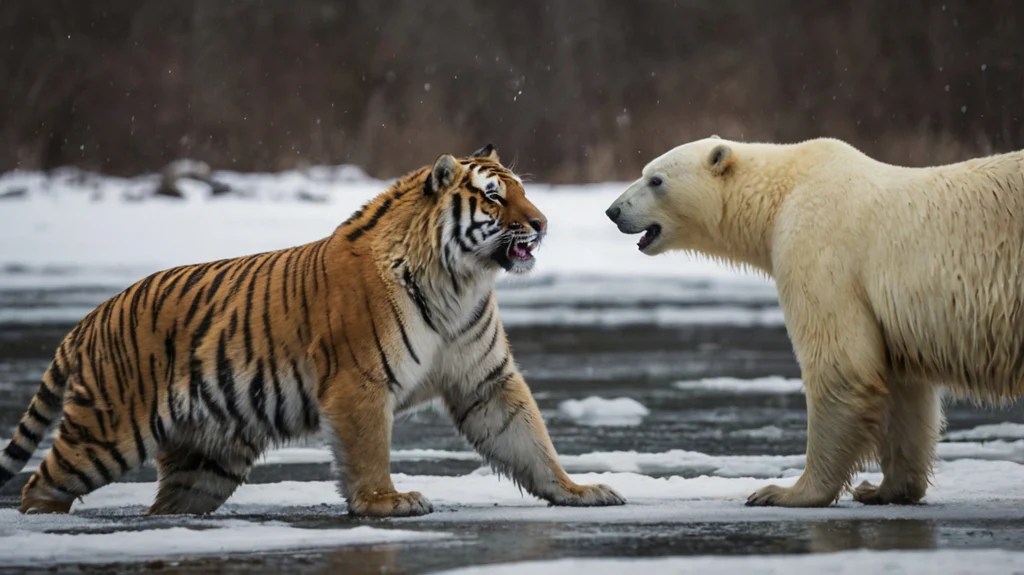
Grizzly bears top out at more than 2,000 pounds, can crush bowling balls with their paws and have claws the size of large knives. They’re also extraordinarily well-protected, with heavy fur and fat protecting their vital organs. If you think you can harm one unarmed, let alone kill it, well, good luck with that.
Incredibly, eight percent said they could defeat a lion, gorilla or elephant, while 17 percent thought they could take on a chimpanzee. Again, the respondents who liked their own odds against extraordinarily lethal animals were almost exclusively men. The survey doesn’t say what they were smoking when they responded.
Domestic cats fared poorly in the imaginations of Americans: 69 percent thought they could defeat the little stinkers in hypothetical battles. Only rats fared worse, with 72 percent sure of victory in unarmed single combat.
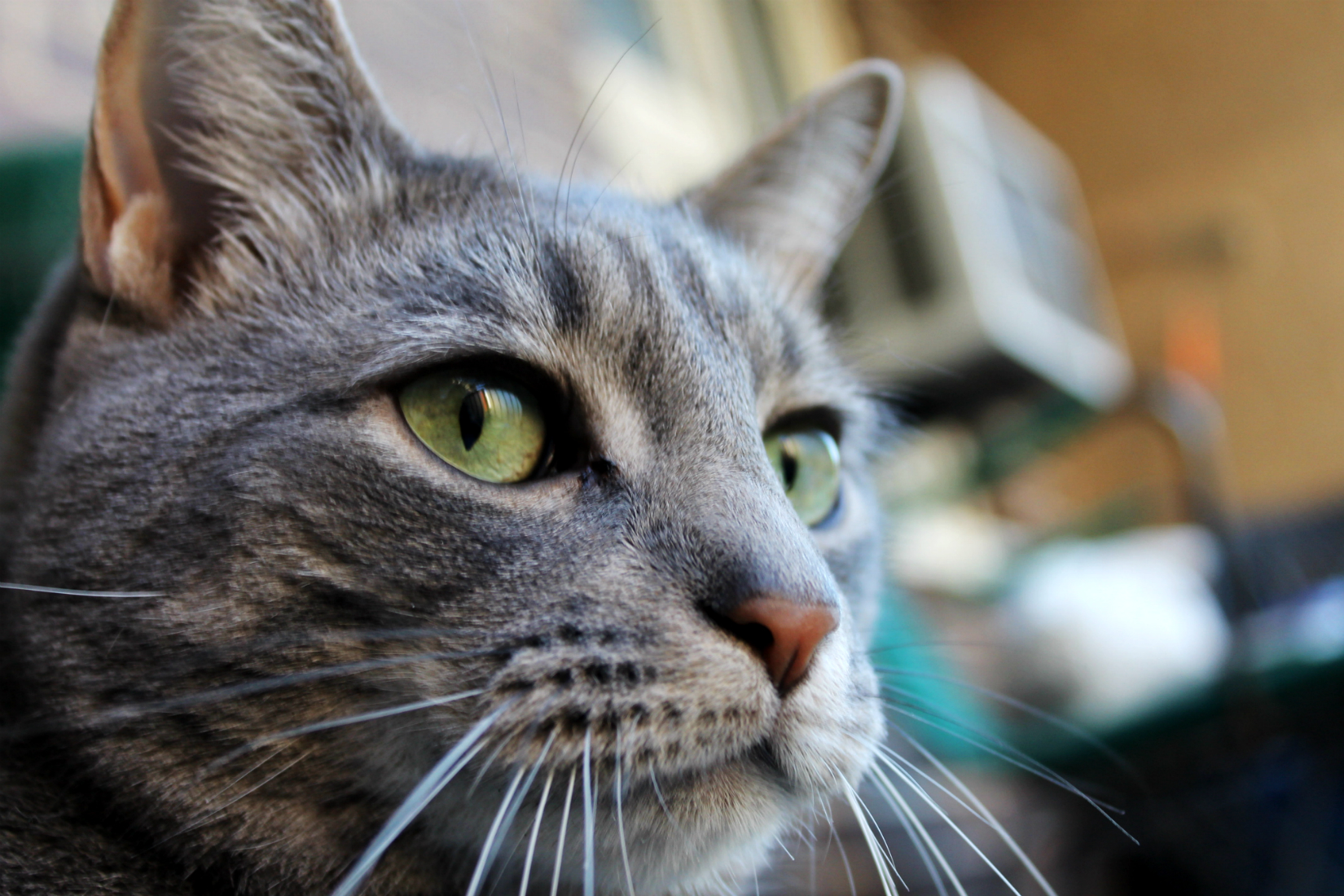
“This is really an insult to felines,” said Buddy the Cat, a combatologist at Buddesian University. “However, we jaguars fared much better, as we were projected to win about two-thirds of hypothetical fights against other animals, including elephants, rhinos and tigers. Personally I think it’s closer to 99 percent, but I won’t protest. It’s better for us if we’re underestimated.”
He chalked human overconfidence up to the fact that people are “bizarre creatures who live in a fantasy world,” and have “an unfulfilled yearning to be something more than our servants.”
“They don’t have the claws, teeth or, like, the muscle fibers we do,” he explained. “Those advantages make it possible for me to kill a caiman with a single bite or tear an anaconda apart in seconds. Jaguar means ‘He who kills with one leap,’ did you know that? Yeah, it’s pretty badass.”
The last few decades have revealed birds like crows and parrots possess astonishing intelligence. “Bird brain” might not be much of an insult after all.
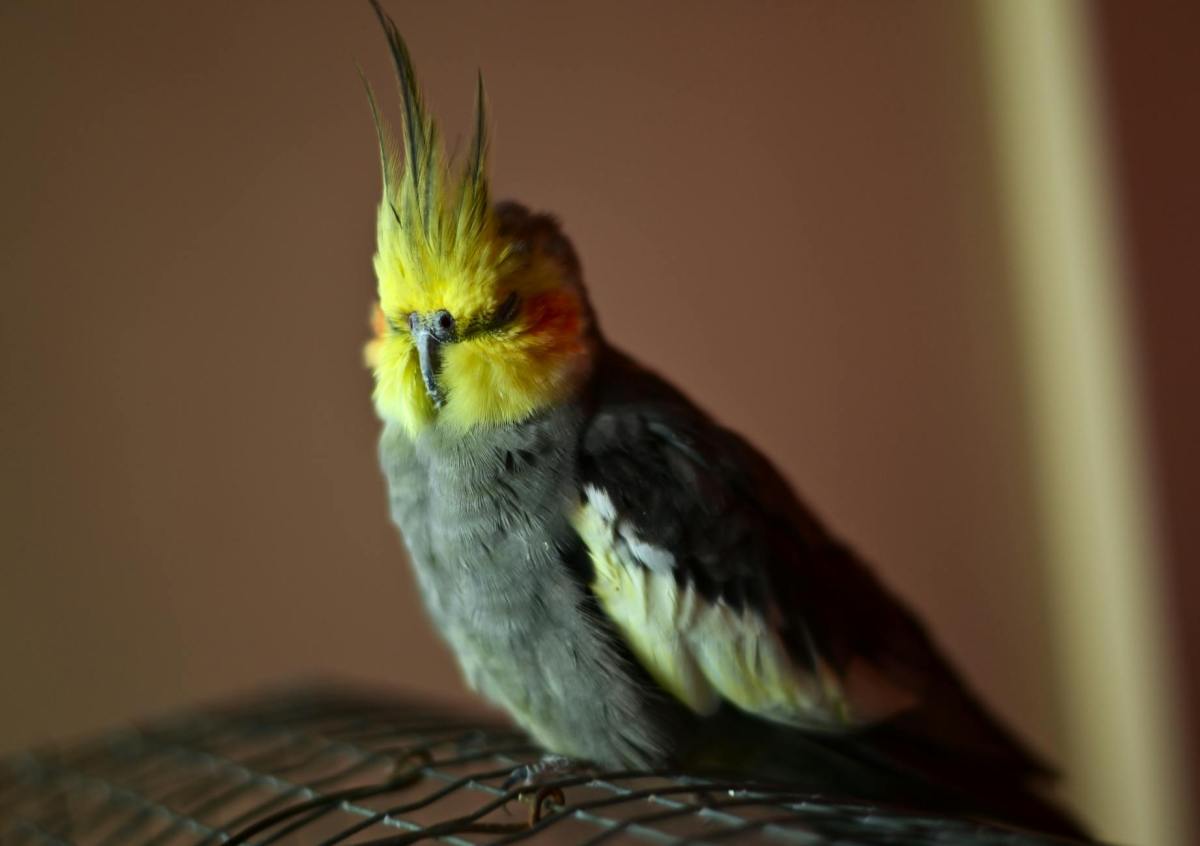
Meet Kiki the cockatiel, a bird who loves Earth, Wind and Fire so much that he sings the band’s classic hit, September, regularly — whether he’s just chilling by himself, singing along to the recording or driving his human crazy by whistling the catchy hook at ungodly hours.
“Kiki, it’s seven in the morning!” she tells him in one clip, raising an admonishing finger. “Silence!”
I’ve always thought parrots are a fascinating example of animal cognition and further proof that we share our planet with billions of other minds who think and feel.
Humans and birds last shared a common ancestor more than 300 million years ago. That means between them there’s been more than 600 million years of divergent evolution resulting in radically different physiology, abilities and minds.
Yet parrots can speak while non-human primates (apes and monkeys) cannot!
For decades scientists thought apes and monkeys, by virtue of their relative similarity to humans, possessed an inmate affinity for language and that the physical limits of their vocal apparatus is what keeps them from speaking.
But a 2016 study by a team from Princeton University found monkeys do possess the vocal “hardware” to speak, meaning their mouths and throats are capable of making the sounds necessary for human language. It’s the lack of associated brain circuitry that prevents them from talking.
If the ability to speak and the ability to dance/appreciate music and rhythm is uniquely human among the primate order, and birds arrived at it at a different point in their evolutionary history, that means language and appreciation for music/rhythm developed separately along two divergent evolutionary lines!
That’s incredible and has intriguing implications for the cognitive abilities of animals.
A common argument is that birds with the ability to form human speech are simply mimicking sounds and don’t understand what they’re saying. That’s a natural assumption given what we think we know about non-human capacity for understanding language, but research suggests it’s wrong.
Take a look at this video of the famous late African grey parrot, Alex:
When Dr. Irene Pepperberg asks Alex how many blue blocks are present on a tray with a random assortment of blocks, balls and triangular toys in different colors, Alex can’t give a rote answer. First he has to understand that a question is a request for information and not part of the strange human ritual called small talk. He can’t simply count or guess at the number of blocks either.
Instead, Alex has to perform two calculations. He must tally the blue objects and count the number of them that are blocks, or he’s got to count the number of blocks and figure out how many of them are blue.
If he was simply repeating information in context — like saying “Hello!” when a person walks into a room — Alex wouldn’t be able to correctly answer the questions, and Pepperberg’s research funding would have dried up. Instead, Alex became a focal point of research that persisted for decades.
There’s no indication Alex could master syntax, which has proven elusive for even the smartest animals. But the African grey, who died in 2007 at 31 years old, was curious, asking questions that were unique and unexpected of an animal. He once asked his caretakers to describe his physical appearance, and the night before he died, he told Pepperberg: “You be good. I love you. See you tomorrow.”
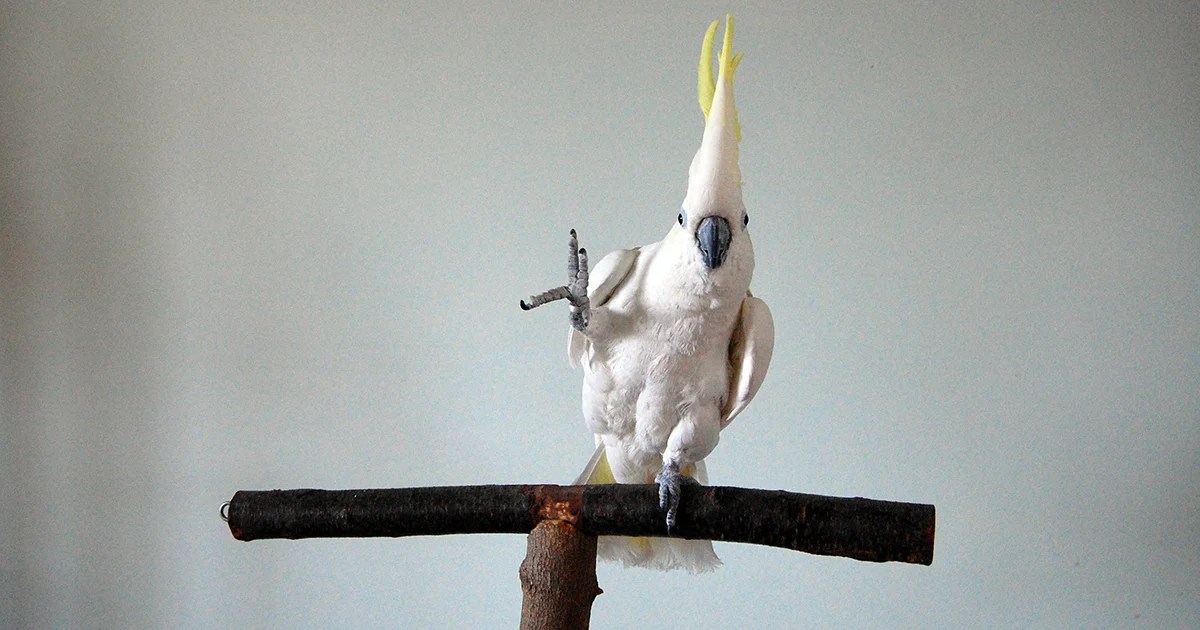
We’ve talked about parrots before on PITB, including Snowball the dancing cockatiel who not only appreciates music and has a great sense of rhythm, but also has an entire repertoire of unique dance moves. Then there’s my personal favorite, Ruby the African grey, who has demonstrated mastery of absolutely vile, uniquely British insults.
Sure, there may not be much research value in hearing Ruby hurl verbal abuse at her very loving human, Nick Chapman, but few things have made me laugh as hard as that extraordinarily foul-mouthed bird. She has to be seen and heard to be believed. (But if you’ve got kids in the room, stick with the wholesome Snowball. He’s got serious moves.)
Scientists credit Snowball with choreographing his own dance routines, with dozens of individual dance moves and combinations, and moves that change depending on the song he’s rocking out to.
Now if you’ll excuse me, I’m off to teach a certain feline a few Earth, Wind and Fire songs in the hope that he’ll give up on the screeching meows and use his natural falsetto for a more gentle wake-up experience.
Hey, hey, hey Ba-dee-ya, hey there my Big Buddy Ba-dee-ya, Little Buddy’s hungry! Ba-dee-ya, get your lazy ass up and feeeeeed me!
Mankind’s achievements in space came at the expense of dogs, cats and non-human primates, who were sent into orbit during the early days of the space race.
I’ve been watching Apple TV’s exceptional show, For All Mankind, which dramatizes the space race of the 1960s and beyond in a sort of alternate history where the Soviets, not Americans, first lay boots on the lunar regolith.
That loss lights a fire underneath the behinds of the people at NASA and convinces American politicians that the space race is the ultimate measure of our civilization. In real life, American ingenuity and the creativity fostered by a free society allowed the US to leap ahead and “win” the space race. Space missions were already becoming routine by the time the drama of Apollo 13 briefly rekindled public interest.
Then the Soviet space program faded, the competition turned one-sided, and without an arch-enemy to show up, American politicians pulled back NASA’s funding to a fraction of what it once was, where it remains today. That’s why the rise of the private space industry — Elon Musks’s Space X, Jeff Bezos’ Blue Origin, etc — will almost certainly be our ticket to Mars.
But in For All Mankind, NASA remains the budgetary behemoth and source of prestige it was in the 60s and 70s, leading to the development of a permanent moon base, lunar mining operations and a planned mission to the red planet.
There’s a quiet moment in the second season when a Soviet cosmonaut, visiting the US as part of a peacekeeping mission, shares a drink in a dive bar with an American astronaut.
“Do you like dog?” the cosmonaut asks.
“Dogs?” the astronaut replies. “Of course. Who doesn’t like dogs?”
The Soviet shakes his head.
“No, dog,” he tells her. “Laika.”
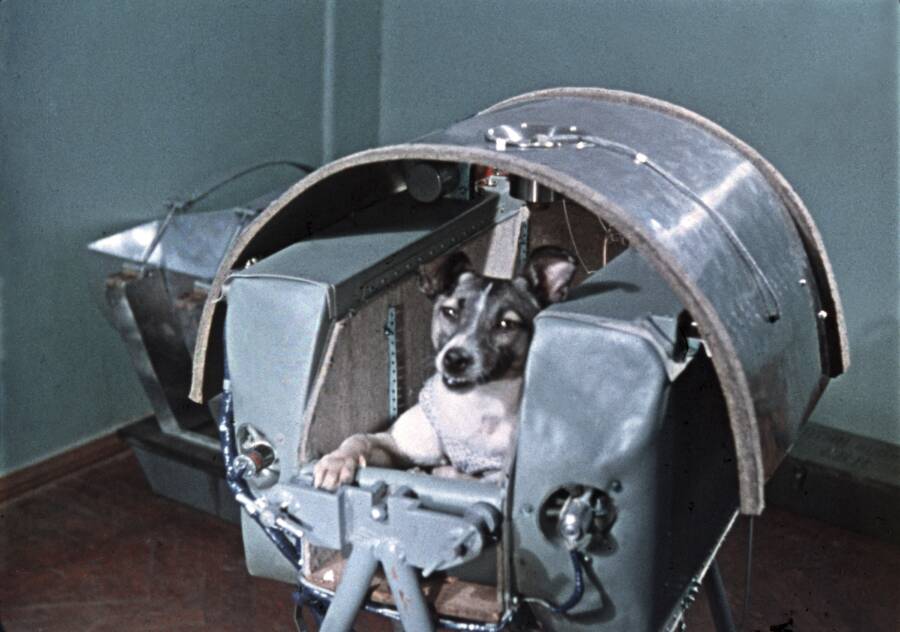
Laika was the first dog in space, or more accurately, the first dog the Soviets acknowledged sending into space. (The Soviets didn’t acknowledge their failures, and we can only guess at the number of lost cosmonauts and animals officially denied by the Russians, drifting in space for eternity or disintegrated in atmospheric re-entry.)
Laika, also nicknamed Muttnick, wanted to please the humans who had taken her in, and didn’t understand that her trip would be one way. (Historical photo)
The moment turns somber as the cosmonaut recalls the Moscow street dog who was selected because she was docile, fearless and could handle the incredible noise and g-forces of a rocket launch.
“I held her in my arms,” the cosmonaut tells his American counterpart, taking a sip of his Jack Daniel’s. “For only one or two minutes on the launchpad.”
Then he leans in and tells her the truth: Laika didn’t triumphantly orbit the Earth for seven days in 1957 as the Soviet Union told the world. She didn’t endure the mission.
She perished, alone and afraid, just hours after launch when her capsule overheated.
The Soviets never designed the Sputnik 2, Laika’s ship, to return to Earth safely. Her death was predetermined.
We laud astronauts and cosmonauts, the brave men and women who willingly strap themselves into tiny capsules attached to cylinders of rocket fuel the size of skyscrapers and depart this Earth via brute force, knowing something could go wrong and their lives could end before they realize what’s happening. We should admire them. Their accomplishments are all the more impressive when you consider the fact that the combined processing power of every computer at NASA’s disposal in the 1960s was but a fraction of what we each hold in our hands these days when we use our smartphones.
Those first astronauts and cosmonauts were extraordinarily brave — but only up to a point.
Unwilling to risk human lives in the early days of space exploration, space programs used dogs, cats and later monkeys and apes, strapping them into confined spaces, wiring their brains with electrodes for telemetry data, poring over the information they gleaned about their heart rates, blood pressure and breathing as they left our home planet.
The sad eyes of a stray dog, separated from everyone she loved, were the first to behold Earth from space. A few years later the eyes of a French street cat took in the same view before humans did.
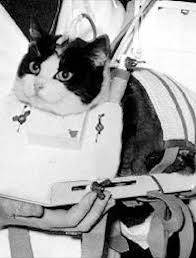
Felicette couldn’t move when she was placed into the capsule that took her to space and back.
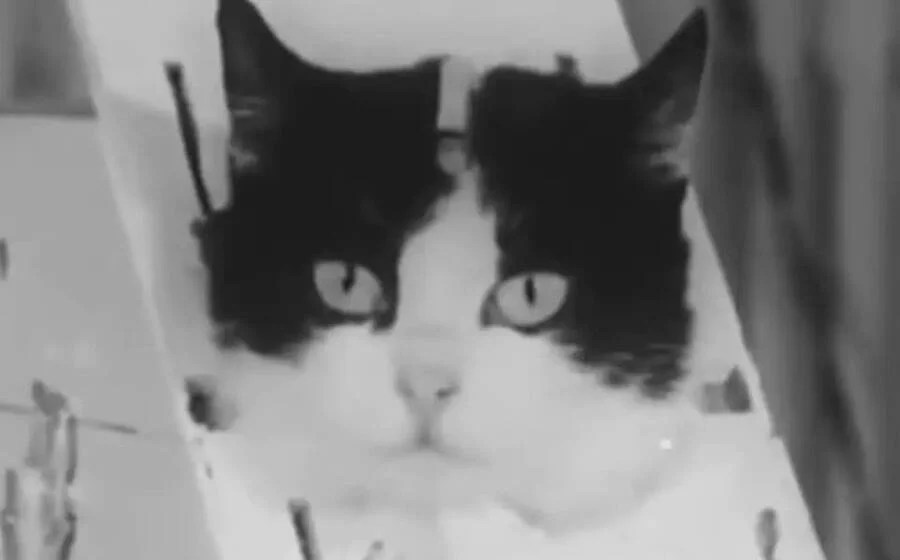
Felicette, the tuxedo cat who was launched into space by the French on Oct. 18, 1963, didn’t even have a name until the French recovered her capsule and took her back for examination.
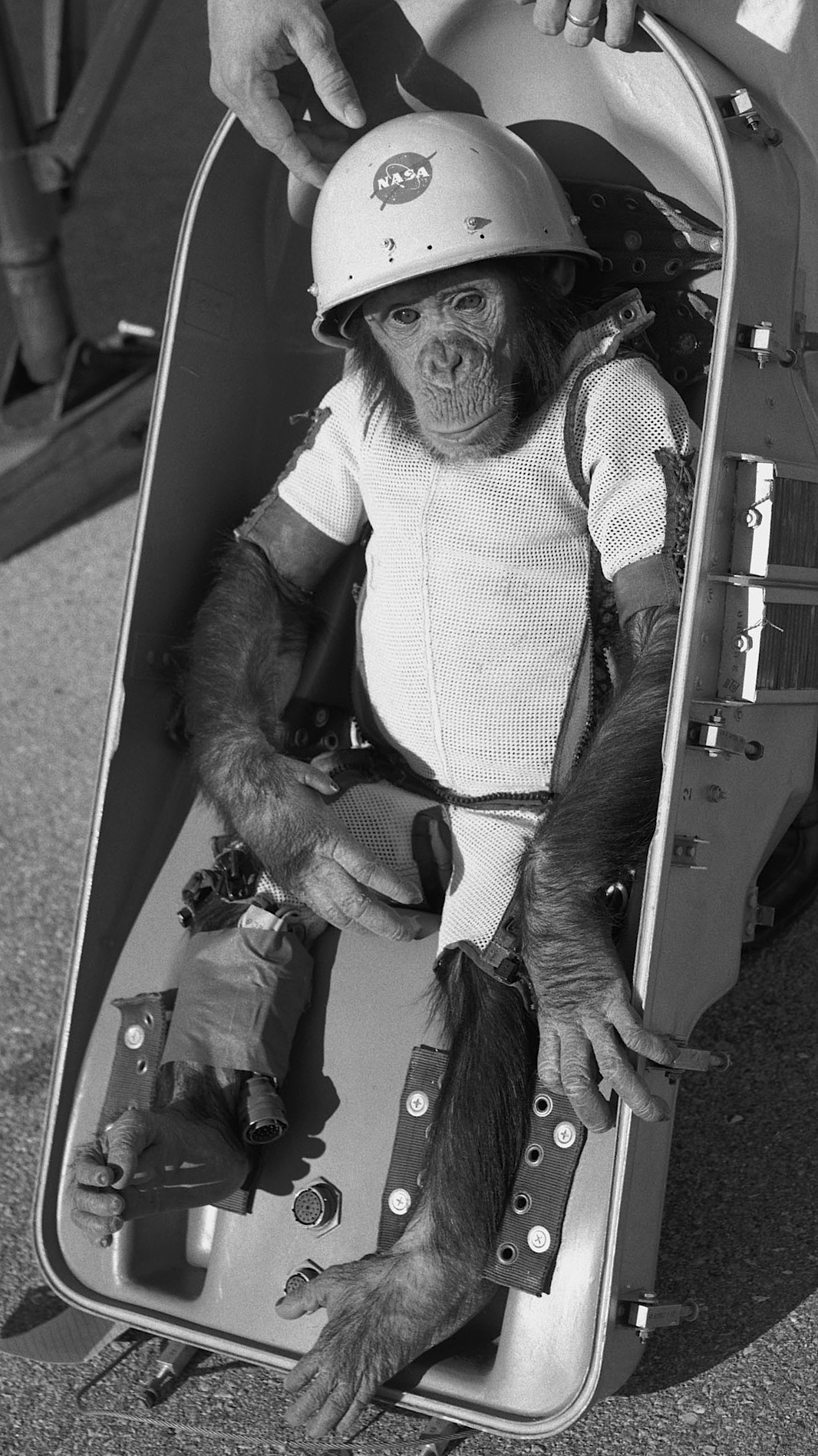
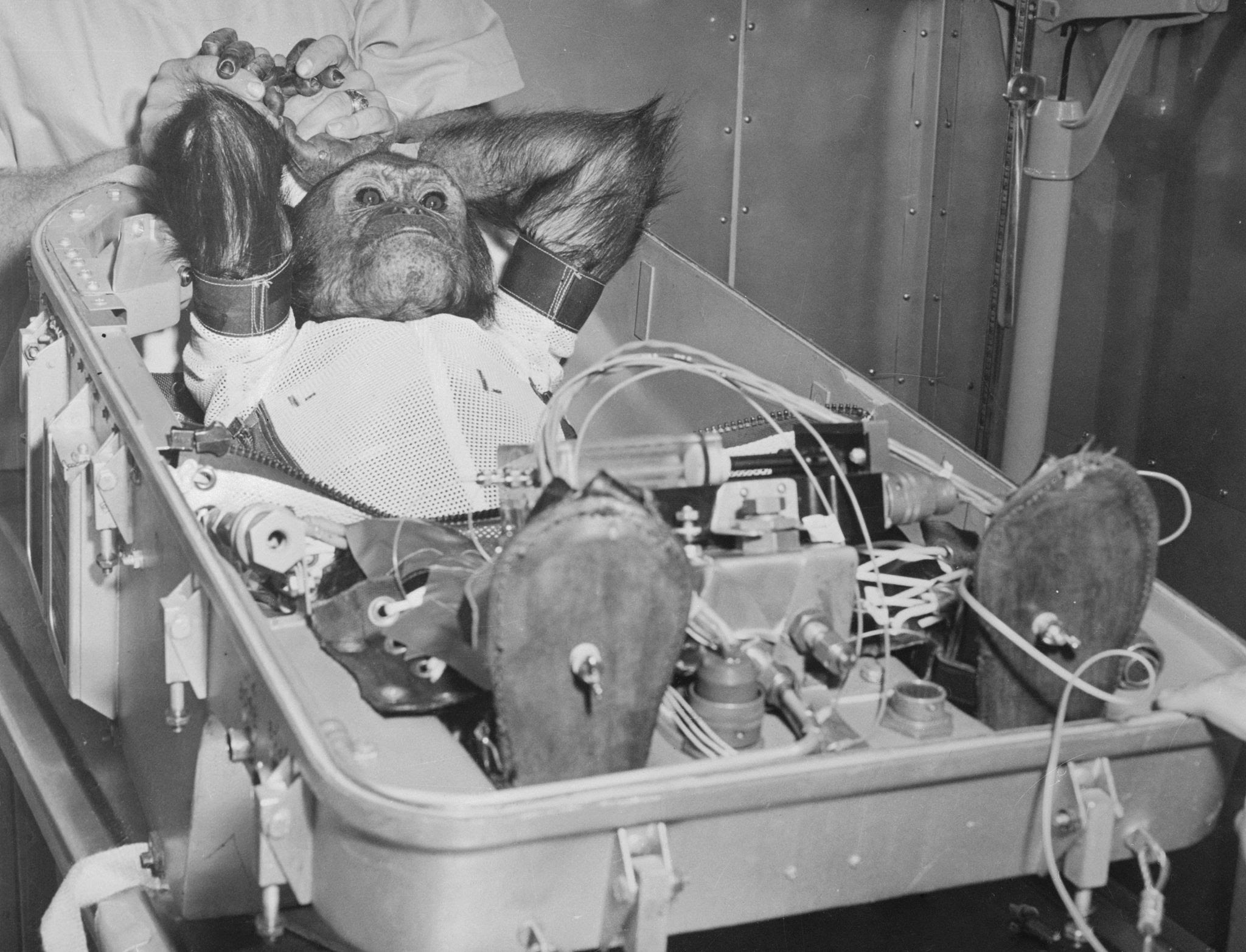
The scientists and engineers in charge of the launch didn’t want to humanize her if she didn’t make it, which was a common practice in space programs. (Ham, the chimpanzee sent into space by NASA in January of 1961, was known as No. 65 until his successful recovery. NASA was worried that a name would make him more sympathetic and lead to bad press if the chimpanzee died during the mission.)
Ham the chimpanzee was little more than a baby. Credit: NASA archives
Despite Felicette’s endurance and successful return, French scientists repaid her bravery by euthanizing her a month later so they could study her brain and learn more about the effects of spaceflight on mammalian biology.
Felicette, like Laika and Ham, was never given a choice. Those animals, with their child-like mental capacity, endured their missions out of a desire to please their human caretakers as much as any natural stoicism they may have possessed.
Would we do the same thing today? Will we repeat those experiments as we set our eyes on Mars?
Consider that the moon is a three day trip, and it’s close enough to Earth’s magnetic field to protect living beings from radiation. Mars is at least a seven month trip if the orbital conditions are right, and there will be no protection from radiation aside from what can be built into the craft. Take that trip without adequate protection and you’re guaranteed to get cancer.
It’s easy to say we wouldn’t make animals our test subjects for a Mars journey, and NASA now has decades of data on the effects of space and zero gravity thanks to the International Space Station.
And yet Neuralink, another company owned by Elon Musk, currently uses monkeys to test its brain interface technology, which allows the primates to operate computers with their thoughts. Those monkeys are forced to endure radical surgery to implant microchips in their brains. The teams working on the technology say suffering by those animals will be worth it as people with paralysis are able to do things with their thoughts and regain a measure of independence, increasing their quality of life.
Likewise, it will probably be an animal, or animals, who will be the test subjects on board craft that first venture beyond the Earth’s protective magnetosphere. Scientists and engineers will do their best to create a vessel that shields its occupants from harmful radiation, but they won’t know how successful they’ve been until the test subjects are returned to Earth and their dosimeters have been examined.
Will an astronaut volunteer for that kind of mission, knowing the “reward” could be a drastically shortened life?
Felicette pictured on commemorative stamps.
Felicette, left, was just one of several cats considered for the launch by French scientists.
To hear Musk and futurists tell it, pushing toward Mars is not just a matter of exploration or aspiration, but is necessary for the survival of our species. Earth becoming uninhabitable, they say, is an eventuality, not an if.
Others point out it’s much easier and wiser to pour our resources into preserving the paradise we do have, and the creatures who live in it, rather than banking on a miserable future existence on Mars where society will have to live underground and gravity, at 0.375 that of Earth, will change the human form in just a few generations.
To put it bluntly, while Musk and futurists look at life on Mars through the rose-colored glasses of science fiction fans, in reality living there is going to thoroughly suck.
If people do live on Mars they’ll never venture outside without a suit, never feel the sun on their skin, never swim in an ocean. They’ll never have another backyard barbecue, watch fireworks light up the sky on the fourth of July, or fall asleep to the gentle rain and crickets of warm summer nights. They’ll never hear birdsong or have the opportunity to see iconic animals like elephants and lions. Every gulp of air will be recycled, every glass of water will have passed through the kidneys of others. There will never be snow. Circadian rhythms will be untethered from the cycle that governed human biology for the 200,000 years our species has existed.
And while there could be a future — if you want to call it that — for people on Mars, there won’t be a future there for the rest of the living creatures on Earth.
As a lifelong fan of science fiction who devours SF novels, counts films like Alien and Bladerunner among my favorites, and is fascinated by shows like For All Mankind, The Peripheral and Star Trek, I understand the appeal of space and the indomitable human spirit that drives us to new frontiers. I just hope we can balance that with respect for the Earth and the animals we share it with. Let’s hope there is never another Laika, Felicette or Ham.
Correction: For All Mankind is the name of the Apple TV series about an alternate history space race. The first reference to the show’s name was incorrect in an earlier version of this story.
A close-up of Felicette’s face. Credit: French government archives
Ham the Space Chimp waits for his apple reward. Credit: NASA archives









 Pain In The Bud