Animal Rights Groups Are Begging For This UK Influencer To Be Banned From Owning Pets

The woman has been dubbed a “serial killer” of animals after eight of her pets and one of her horses met early ends, and several others simply disappeared. She’s part of an unfortunate trend of influencers and quasi-celebrities popularizing exotic pets, with “ownership” of the animals frequently leading to tragedy.

So apparently Katie Price is some sort of proto-Kardashian, a pioneer of the “famous for being famous” genre of hybrid reality/online celebrity, to use the term loosely.

Wikipedia says she got her first taste of fame in the 90s posing topless for British tabloid newspapers before moving on to loftier pursuits, like appearing on Big Brother and holding court on important topics, like whether toes have bones.

The background really doesn’t matter, except to establish that Price is someone with a lot of money, minimal common sense and extraordinarily poor judgment who has gotten so many of her pets killed or injured, PETA and other animal rights groups in the UK have begged politicians to write new laws preventing serial pet-killers from purchasing more animals.

Sort of a “10 strikes and you’re out” rule, if you will.

Four of Price’s dogs have been hit by cars, including one killed by a pizza delivery driver on her property. Another got stuck in an electric armchair and was crushed after Price gave him cannabis oil, pleading ignorance on its effects.

Previously, one of her breed cats was euthanized under mysterious circumstances at five months old, her rare chameleon fell ill and died because he wasn’t kept in a properly heated enclosure, and her “guard dog” was apparently intentionally killed by someone, although the information on that death comes from Price so there’s no way of telling what the actual circumstances were.

A horse Price owned was killed on the same road where two of her dogs met their end, which would bring the tally to nine depending on whether you consider a horse a “pet.”

Price, pictured this year.

There have also been animals — kittens, puppies, animals gifted by boyfriends, fiances, and friends — who were featured on Price’s social media feeds as babies and never heard from again, according to the UK’s Mirror. Some of them were given away to assistants and acquaintances. The fates of the others are unknown.

Price currently owns at least four chihuahuas and five Sphynx cats. An incident with one of the Sphynxes has animal lovers and welfare groups renewing calls to prevent her from buying new pets. (Price, like so many social media influencers, exclusively purchases breed pets for thousands of dollars each.)

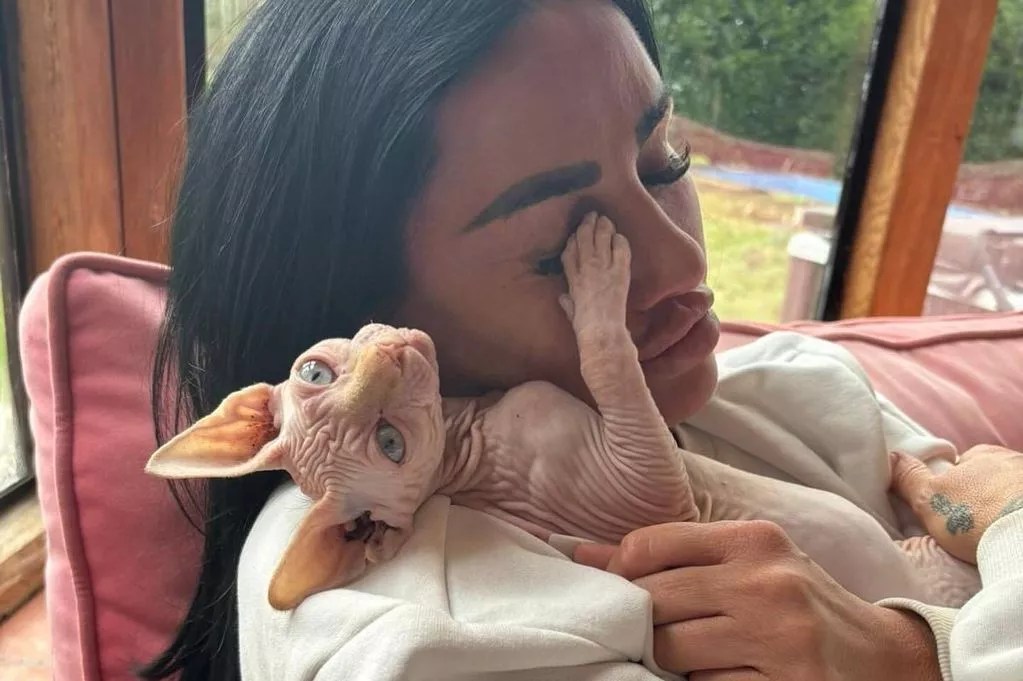
In a new video posted online, Price — who has been dubbed a “serial killer” of animals by PETA — makes duck lips at the camera and rubs one of her Sphynx cats, Kevin, explaining that the little guy suffered sunburns.

“Oh Kevin you have been in the sun today, you have got sun burnt despite us putting sun cream on you… look at his little face,” Price said in the video. A caption written by Price claims “Trying to keep the cats out of the sun is hard work.”

A screen shot from Price’s recent video in which she shows one of her cats who suffered sunburn during the ongoing heat wave.

The latest incident is drawing fresh attention to a petition that calls for the UK government to step in to stop Price from owning animals.

As of July 10, there were 37,728 verified signatures on the Change.org petition, which mentions a number of additional disturbing incidents involving Price’s pets. One accusation claims Price’s guard dog — it’s not clear if it was the dog who was killed, or a new guard dog — bit the tail off one of her cats.

“Anyone who warns Katie not to hurt the animals she takes in might as well be screaming into the wind, for all she seems to care,” PETA’s Elisa Allen said. “And here we go again: her cat is sunburnt – something she was likely warned about when acquiring a gimmick cat, bred to look odd and be hairless.”

For her part, Price claims the deaths and unfortunate incidents that have befallen animals in her care are simply the result of bad luck and circumstances outside her control. Her representatives have also accused animal welfare groups of using the influencer’s fame to raise money.

That has not changed the narrative as new incidents continue to pile up. In a 2023 live TikTok stream, Price allegedly slapped her then-puppy, Tank — who she’s since discarded — for sitting on a hoodie. “Get off! You’re sitting on my jumpers, my jumpers that I love,” Price said after the sound of a loud slap off camera, leaving viewers fuming.

Price is not alone in the world of influencers, quasi-celebrities, Real Housewife types and entertainers who apparently view animals as disposable amusements.

Hilaria Baldwin, Alec Baldwin’s wife, has earned the nickname “Cruella Seville” from her detractors for her alleged treatment of her breed cats and dogs. The nickname is a play on the character Cruella de Vil from 101 Dalmations and the Spanish city of Seville, where Baldwin claimed to have roots before claiming she was born in Mallorca.

Baldwin with two of her Bengal kittens. New kittens have appeared in her Instagram posts several times in recent years, apparently replacing older Bengals she’d purchased previously.

Baldwin, you may recall, was enthusiastically Spanish until she wasn’t. She was essentially exiled from celebrity-adjacent society in 2020 after Twitter users dug up videos of her fluctuating accent and performative “forgetting” of English words like cucumber, outlet and onion. Former classmates, acquaintances and friends came forward to say she was the Boston-born Hillary Hayward-Thomas and didn’t go by Hilaria — or speak with an accent — until around 2010, when she met Alec Baldwin.

But the actor’s wife never stopped posting to social media, and in addition to animal lovers calling foul on videos that show her allegedly mishandling her dogs, her online posts show a rotating cast of Bengal kittens. Critics have called for action against Baldwin for her alleged treatment of animals, as well as buying Bengals despite the fact that it’s against the law to keep them as pets in New York City. PETA, which previously worked with Alec and Hilaria Baldwin on a publicity campaign, also called on the couple to stop buying exotic pets.

In the music world, mainstream pop artists like Justin Bieber and Rihanna have both come under fire for purchasing baby monkeys — a capuchin in the case of Bieber, and a slow loris for Rihanna.

The Rihanna incident, in which she shared a photo of herself with a slow loris pet to social media, resulted in raids on illegal wildlife markets in Thailand, where Rihanna allegedly acquired the animal. There are nine subspecies of slow loris, ranging from vulnerable to critically endangered in conservation status, per the World Wildlife Fund.

Rihanna posing with a slow loris, a nocturnal, arboreal animal that is notably the world’s only venomous primate. The venom glands are removed from slow lorises sold on the illegal wildlife market. People continue to poach and sell them despite their declining numbers in the wild.

Bieber named his monkey Mally OG and famously ditched the then-infant in Germany in 2013, when officials there seized the primate from his private plane after it touched down in Munich, citing his lack of permits and purchase records for the animal. (They essentially accused Bieber of buying Mally on the illegal wildlife market.)

“Honestly, everyone told me not to bring the monkey. Everybody,” Bieber told GQ magazine in an interview several years later. “Everyone told me not to bring the monkey. I was like, ‘It’s gonna be fine, guys!’ It was the farthest thing from fine.”

Bieber with his pet capuchin monkey, Mally OG, who was just an infant when he was ripped from his mother’s arms so he could be sold to the pop singer.
Bieber with another capuchin monkey as part of a skit in which he joked about German authorities seizing his first monkey pet.

The singer said he’d return for his pet after retrieving the paperwork from one of his US homes, but he never did, and Mally OG was placed in a sanctuary after a long rehabilitation period.

In a follow-up story five years later, Asta Noth of Serengeti Wildlife Park said Mally was still trying to imitate human speech, and didn’t know how to communicate with his own species. That’s a common problem with monkeys who are former pets, as they do not understand the complex social dynamics of troops and family units.

His developmental problems stem from the fact that “he was taken away from his mother and natural family way too early,” Noth said. “He did not learn to be a monkey.”

Cops Claim There’s Nothing They Can Do After Bloodthirsty Thugs Sicced Their Pitbulls On Beloved Shop Cat

“Harm or death to an animal caused by another animal is not a criminal matter,” even when footage shows dog owners urging their pets to attack, the NYPD claims.

The NYPD says its hands are tied after a group of people sent their pit bulls after a well-known shop cat in Manhattan and cheered as they dogs brutally ended the tabby’s life.

Freddy was the resident moggie at Michelle Flowers, a florist on Amsterdam Avenue in Washington Heights. The little guy was outside the shop at about 9 p.m. on July 4 when a man and two women set their dogs loose on him, then celebrated and cheered as they killed him.

Credit: Cat Collective

The pit bull owners then “smoked, danced and ate food while taking photos and mimicking the grisly scene,” according to the New York Post. Surveillance cameras caught the attack and its aftermath, showing the three black-clad dog owners and others who witnessed the violence and did nothing.

A disgusted neighbor contacted the Cat Collective, a group of volunteers who feed and care for strays in the neighborhood, and they collected Freddy’s remains, then told the florist’s owner what happened.

“Someone deliberately set dogs on a defenseless cat while people watched and cheered,” Dan Rimada of Bodega Cats of New York told the Post.

Cat Collective is offering cash rewards to anyone who can identify the dog owners and the celebrating bystanders, but the police won’t do anything.

An NYPD spokesman told the paper that “harm or death to an animal caused by another animal is not a criminal matter,” citing a gap in the law.

A proposed bill, dubbed Penny’s law after a chihuahua that was mauled by pit bulls earlier this year in Manhattan, hasn’t made it out of committee in the New York State legislature, while New York’s city council is looking at a municipal law that would make it a crime to set dogs on other animals.

Credit: Cat Collective

It’s actually difficult to believe nothing can be done to get justice for Freddy, Penny and other animals aside from civil cases, which can only result in monetary damages.

Manhattan DA Alvin Bragg, who is controversial to say the least for creatively interpreting the law, seems like just the kind of district attorney who could find a way to prosecute the dog owners. The fact that the authorities are outright dismissing the possibility indicates Bragg doesn’t see this as a priority.

Working with the police to find ways to get justice is Bragg’s job, as well as the job of the attorneys working for him in the district attorney’s office. At the very least, they should be able to find something with which to charge the suspects, even if it really turns out there’s no way to hold them criminally accountable for Freddy’s death.

We hope Freddy’s killers are identified and held responsible, and we hope no more pets and strays have to be killed before lawmakers at the city and state level make it a priority to close an obvious gap in the law.

Ode To Cosmo: The Best Dog I’ve Known

Cosmo, the goodest goodboy, showed me how much love animals have to give. Without Cosmo, there would be no Buddy.

Growing up, my experience with dogs was mostly limited to Sparky, my friend’s demonic Chow who had sunk his teeth into every member of his human family and most of my friends.

Four of us formed a punk/rock band as teenagers and when we’d practice at my friend Rob’s house, he had to put Sparky into the fenced-in yard for our benefit. As we jammed and I fell into the revelry of trading off guitar solos, I’d look over and see that hellspawn of a canine, face pressed against the glass, slobber oozing from his mouth as he radiated hate. I’d taunted Sparky once, stupidly and ignorantly, and he never forgot it. That glass was the only thing between me and a mauling of biblical proportions.

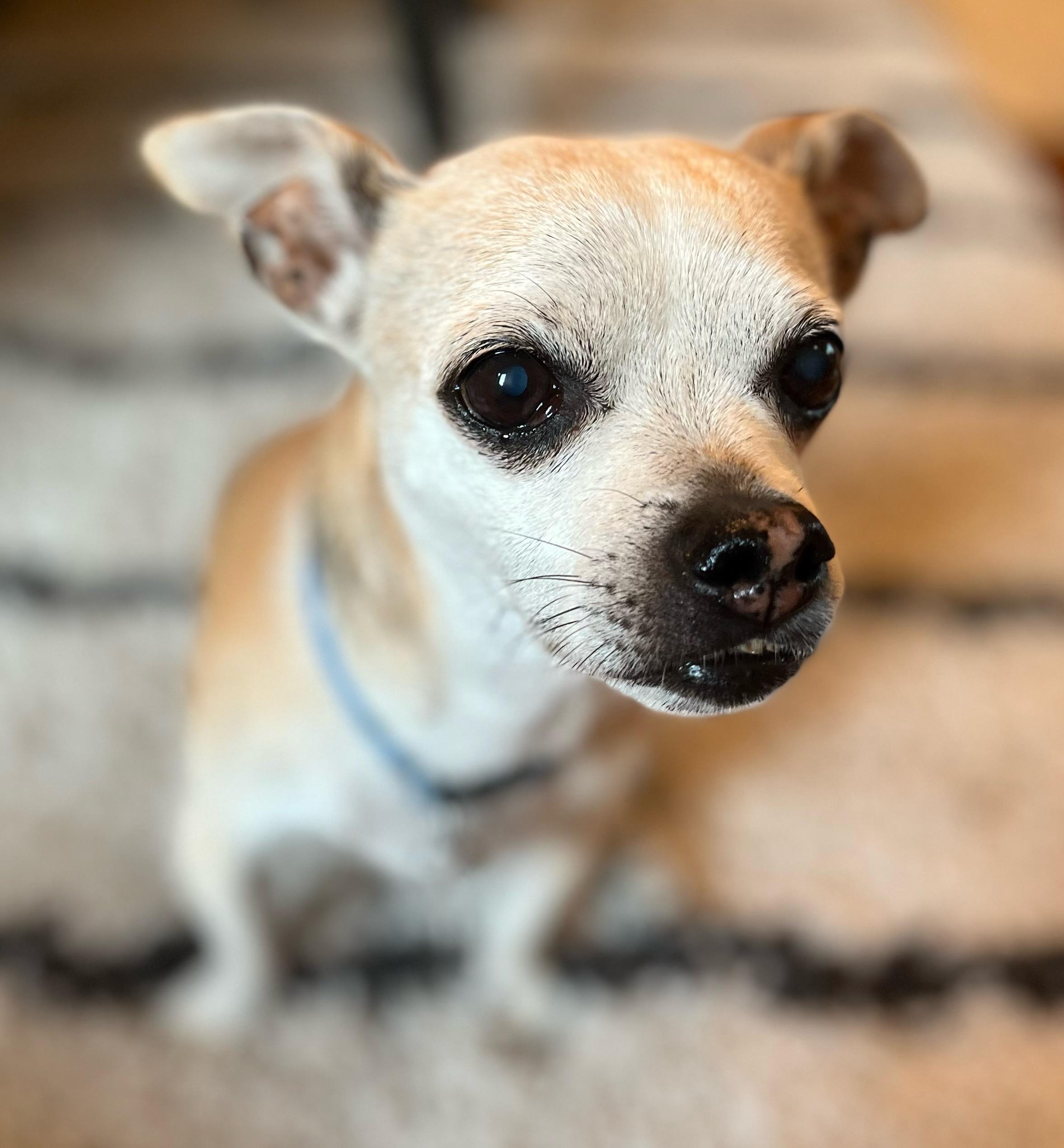
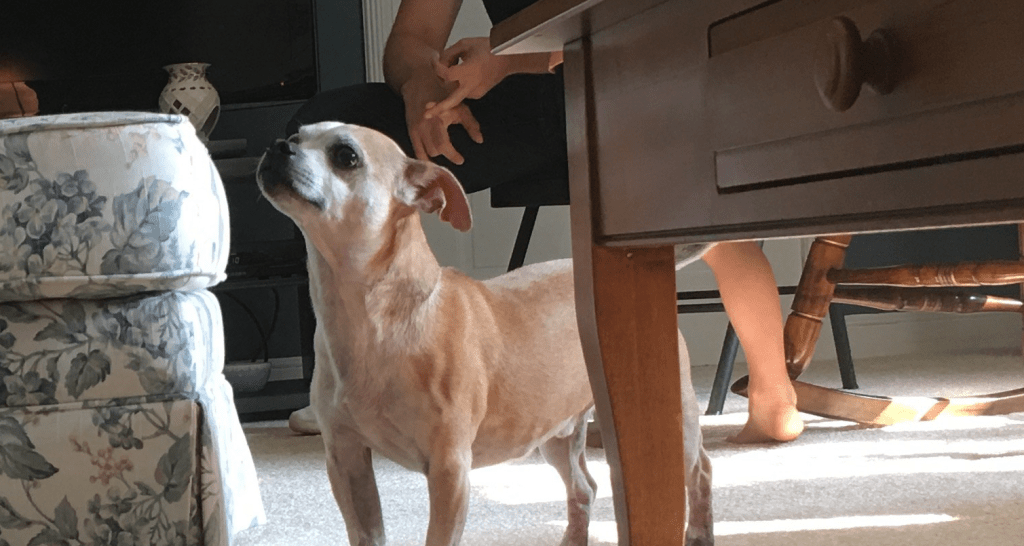
I was not fond of dogs, so in 2010 it was with reservation that I agreed to dog sit Cosmo, the Chihuahua-terrier mix adopted about two years earlier by my brother and his wife.

Cosmo was a lost puppy wandering the streets of Oceanside, California, when he was picked up by animal control, transferred to a shelter and put up for adoption. We don’t know exactly when he was born, how he got separated from his mom or how long he wandered the busy streets of that city.

Cosmo
For years I thought Cosmo was named after Cosmo Kramer, the Seinfeld character, but Mike says he was named in honor of Carl Sagan, the famous science educator whose book and movie, Cosmos, introduced generations of people to the mysteries of space.

What I do know is that it was impossible to stay ambivalent about him for long. Not with his zest for life, his puppy-like energy or his sweet nature. “Sweet” is an over-used word when it comes to animals. I wouldn’t use it to describe Bud despite the fact that he’s my cat and I love him, but it describes Cosmo perfectly. He doesn’t have an angry bone in his tiny body. He’s trusting, he has a huge heart and if you’re one of his favorite people, he’ll never let you forget it.

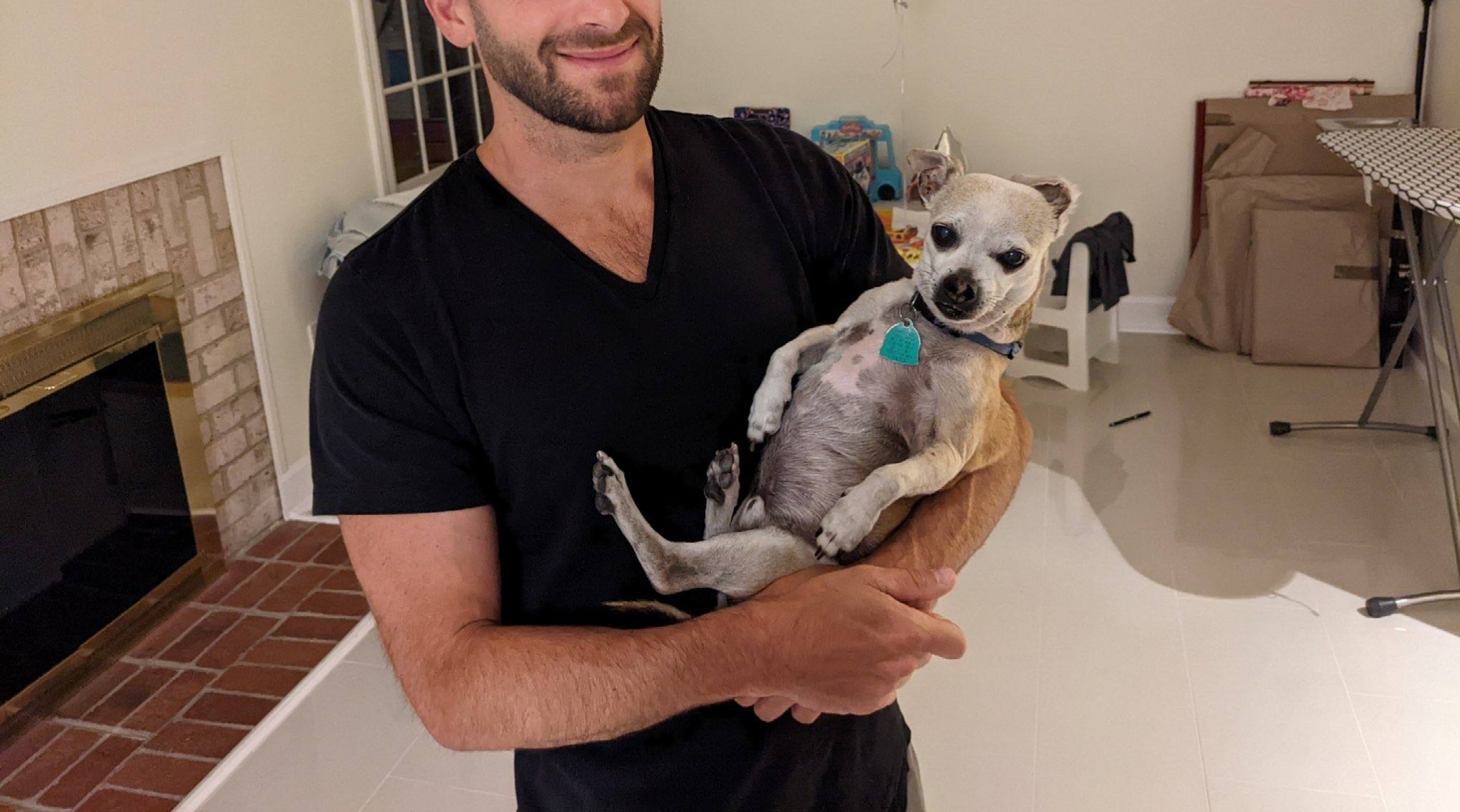
My brother and his wife saw their opening when I let the little guy jump into my lap, something I’d never allowed any animal to do. At the time it was so out of character for me, my brother took a photo to prove it happened.

So when they moved from Oceanside to Manhattan and planned a long weekend away, they asked me to dog sit and I agreed. At the time I was working evening shifts as a journalist for Newsday, the New York tabloid. I went from my office on 35th St. near Madison Square Garden to my brother’s apartment on 65th, gave Cosmo his dinner and took him for his walk. It was eventful: He barked and charged at a dog three times his size as if challenging the big mutt to a battle of nerves, and must have sensed me looking at a cute girl walking her dog because he made a beeline for her and refused to relax until we spoke to each other. Cosmo was an excellent wingman.

I put Cosmo in his crate that first night. It’ll be fine, Mike and Jen said. He’s cool with his crate, they said. He won’t keep you up all night, they said.

None of that was true. Cosmo barked and barked until I let him out of his crate, then barked some more until I let him into the bedroom and on the bed.

And that’s how I went from someone who could barely deal with animals to a fool letting a Chihuahua-terrier mix cuddle with me so I could finally get to sleep. Better to let the little stinker on the bed than be a zombie at work, I thought.

We fell into a rhythm that week. I’d come home, walk him around the quiet upper west side at night, and we’d watch a movie together on the couch before crashing.

While Bud is typical of his species and has the inexplicable ability to claim 80 percent of the bed despite his small size, Cosmo’s footprint on the bed grew smaller that week as he gently pushed down any barriers I’d previously maintained. I’d wake to find his little paws resting on my arm, or his body squeezed between my arm and my ribcage. Chihuahuas are true burrowers.

Cosmo traveled the world with Mike and Jen. He was a California sunshine dog, then a New York City dog, then a Washington, D.C. dog. He was with them for their years in Japan and, until very recently, their post in Ukraine.

Cosmo hated every minute in that dark, frigid country, even before Vladimir Putin started a bloody war there. He was overjoyed when the family moved from bone-chilling Ukraine back to sunny Virginia, unaware that he’d missed a war by a week though undoubtedly bummed that Mike, his favorite human, remained in the country for the next five months helping Ukrainian friends.

Mike and Cosmo
Best buddies.

Before they left for Tokyo in 2017, a veterinarian told Mike that Cosmo, already suffering from several ailments, probably wouldn’t live another two years.

That was more than five years ago. Cosmo made it to almost 15 years old. He was mostly deaf and nearly blind. His eyes became milky from cataracts. He limped and it took real effort to pump his little legs when Mike took him for his walks. He wasn’t able to jump up on the couch anymore, and signaled when he wanted a human to pick him up and put him in a comfortable spot.

By the summer of 2022, the little guy was on borrowed time.

My brother, ever stoic, seemed to accept it as he cradled Cosmo like a baby and told me Cosmo had cancer one night last summer. Mike doesn’t often show his emotions, but I know he’s crushed. He loved that dog. The dog adored him.

I’m not good at masking my emotions, at least when it comes to things like this. I started writing this blog post that same night before bed, a few hours after Mike told me Cosmo was dying. Tears welled in my eyes as I thought of Cosmo as a puppy wandering the streets in Oceanside, and his days as an old, tired dog. (I can imagine my brother reading this and thinking, “You pussy.” But hey, we’re all different. I’m the witty one, obviously. Also, I have more hair.)

Before we crashed on that night last summer, Mike and I watched a movie. Cosmo looked at me and gestured with his paw, signaling that he wanted up. I picked him up gently, put him down on the couch, and he nestled into my side like old times.

“He hardly does that with anyone,” Mike told me.

But that’s because we were pals. Cosmo was my buddy before there was a Buddy. Without Cosmo to show me animals could be a source of great joy, there’d be no Buddy in my life and no Pain In The Bud. Buddy would be living with someone else, and his name would probably be Rufus, or maybe Mr. Jerk. It’s difficult to imagine anyone loving him like I do, or being best pals with him. In a very real way, Cosmo gave me that gift.

Back in 2019, before PITB had its own domain and was read by a handful of friends and relatives, I wrote about Cosmo. That’s him in New York at a family gathering at my aunt’s house, and on the balcony of the apartment in Tokyo. It’s shocking to see how much he aged in only a few years.

Cosmo in Cali
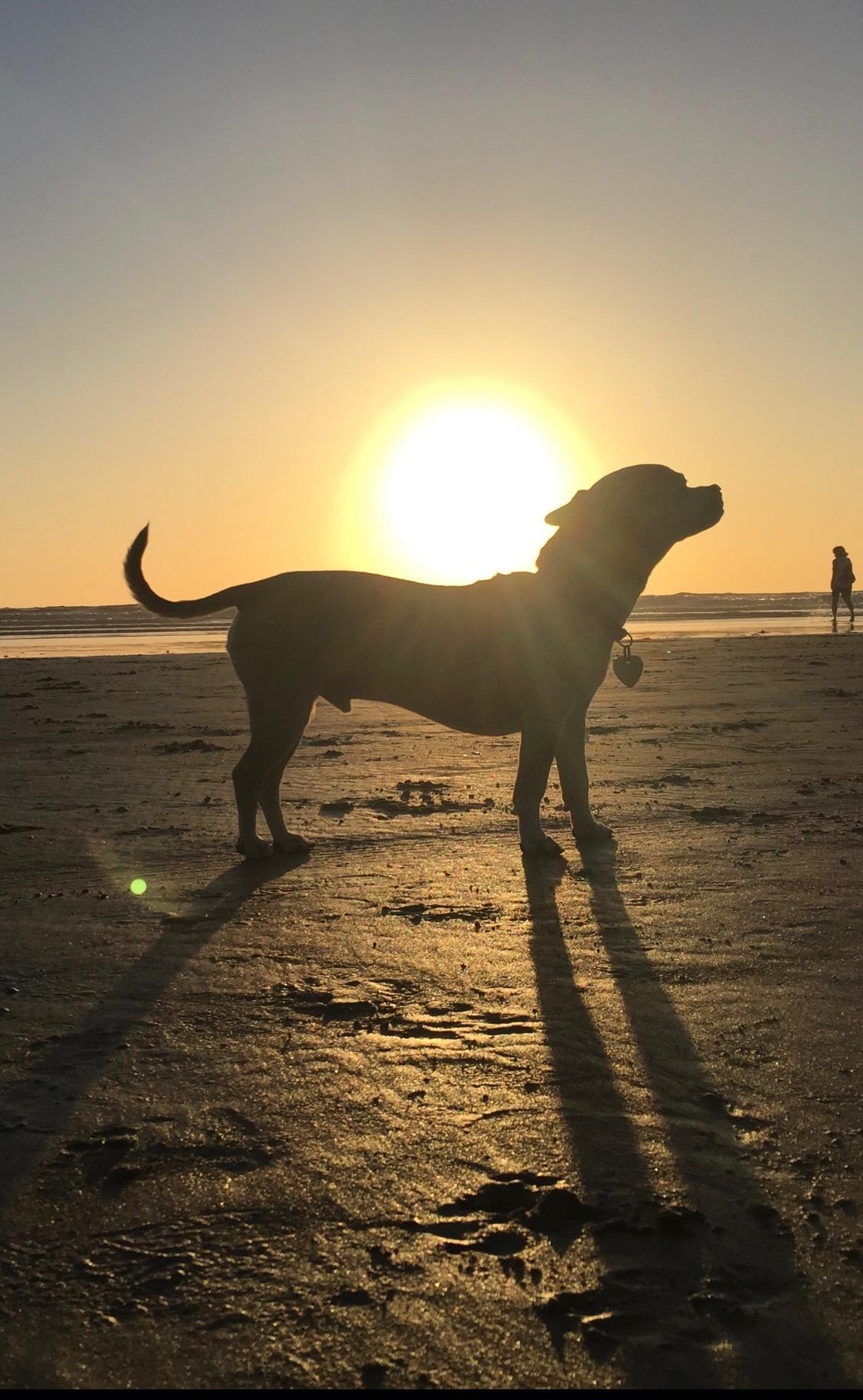
Cosmo on the beach in San Diego. As a puppy he was separated from his mom and siblings and wandered the streets of Oceanside before animal control scooped him up. Credit: BoBB (Brother of Big Buddy)

At the risk of overdoing the anecdotes, I think the following one is illustrative of what a good dog Cosmo is.

A few years ago a bunch of us were hanging out at night drinking beer and talking around a backyard fire pit when everyone went to crash except Jen, Mike’s wife. She wanted to stay up a while longer and I agreed, so we went inside to get more beer with Cosmo following us in. The temperature had dropped and the little guy was shivering.

When we went back outside, Cosmo hesitated by the door. He wanted to hang but he was freezing and didn’t know I’d brought out a few blankets. But when I called to him he came anyway, jumped into my lap and looked at me with gratitude when I swaddled him in the blankets and moved closer to the fire. He trusted me. He knew I wasn’t going to let him freeze.

I will never forget the adventures we’ve had together. The time in California when he was barely more than a puppy and got away from me on a walk, leading me on a chase through the parking lot as I wondered how I’d explain to Mike and Jen that their beloved dog was gone. I did an entire lap around the development and was gassed out when I saw the little guy had returned to the house and was waiting for me on the front steps with a look on his face that seemed to say “Where ya been, dude? Couldn’t keep up?” Cheeky bastard.

The time I was dog-sitting again and he refused to do his business on his morning walk, then dropped a fresh turd on the gleaming marble floor of the Manhattan high rise where Mike and Jen lived, right in front of a rush of commuters exiting the lobby elevators.

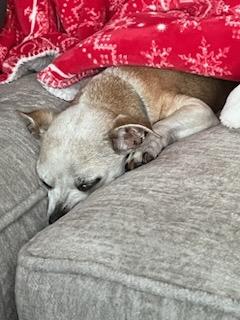
Cosmo napping
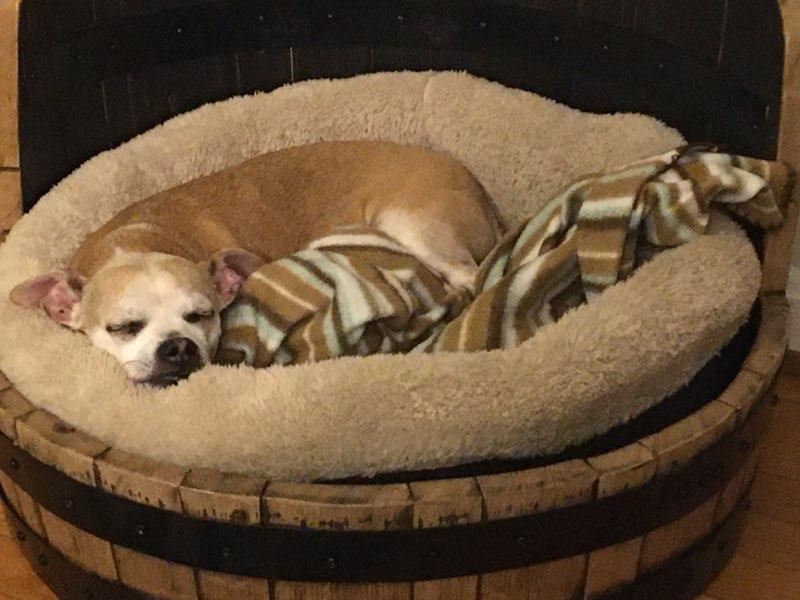
In his layer years Cosmo could give Bud a run for his money when it came to napping. Credit: BoBB or SiLoBB.

The subsequent dog-sitting stints, when we’d hang out on the couch and watch horror movies, jolting upright together during jump-scares.

The time we all went hiking in a state park near Albany and a huge bird-of-prey began circling above, apparently deciding Cosmo would make a nice lunch. (Jen had to pick him up and cradle him protectively on the walk, and the bird eventually went in search of easier pickings.)

The first time I babysat for my newborn niece, fresh off of learning how to change a diaper by watching a Youtube video, and began to freak out as she cried and Cosmo barked. They seemed to be stuck in a feedback loop and for a panicked moment I thought I was in way over my head. Cosmo took the arrival of the girls in stride. He’d gone from the center of his human parents’ world to still very much loved, but forced to share time, affection and attention with one little human, then another. He never took it out on the kids even when they occasionally played too rough, as all kids do.

And of course that first hesitant occasion in California when I allowed him to climb into my lap and decided not all animals were bad after all.

If not for Cosmo — and, coincidentally, a friend’s super friendly tuxedo cat who was also named Cosmo — I would not have known my allergies could be managed as an adult, and I would almost certainly not have looked into adopting a cat. I was coming off a brutal few months of seasonal affective disorder and for the first time I gave the idea serious thought. Cosmo showed me that animals could be good friends, stress relievers and a constant source of entertainment, as well as loyal and never judgmental. (Well, mostly…I do think Bud’s judging me every time I go to the kitchen and don’t fetch him a snack.)

Buddy owes a debt to Cosmo even though he’d never admit it.


It’s the night after Thanksgiving 2022 and I’m trying to finish this blog post after letting it rest for months. On Thanksgiving Day, Cosmo didn’t seem to recognize me in a noisy house full of family, but tonight he ran to the door to greet me, barking happily and pressing his paws against my legs just like old times. He spent the next few hours in my lap, soaking up my body heat as I scratched his head and back.

Cosmo
A younger Cosmo looking healthy and happy at my aunt’s house during the holidays. Cosmo was a pro at scarfing down any stray crumbs from appetizers or the dinner table.


It’s Dec. 29. Cosmo spent the holidays by the fireplace, swaddled in blankets. Normally no one, human or animal, would sit that close to a fire. For Cosmo, it was the only way to stop shivering as the heating system struggled against record-breaking cold.

Cosmo burrowing
Cosmo loved to burrow anywhere he could.


It’s now early August and my brother is visiting with his wife and kids. This is the last time I will see Cosmo, but neither of us knows it.

I’m relieved to see he recognizes me. The last time he was in New York there were too many people, too much commotion for an old dog. Now he wags his tail and jumps up like a puppy, and I bend down, rub his head and tell him how happy I am to see him.


Aug. 16, 2023:

Cosmo died at about 11:30 pm in Mike’s arms, in Mike and Jen’s bed, his bed. He’d been having a rough couple of days and after he’d been sick a few times and soiled himself that evening, it became clear the end was near. They were at their vacation home in the Outer Banks at the time, and the nearest emergency vet was more than an hour away. Cosmo wouldn’t have made it anyway.

Cosmo was a happy dog, but he was never happier than when he was with Mike, and I have no doubt that there’s no place he’d rather have been, no person he’d rather have holding him in those last few hours. He died with the people who loved him most, after living almost 15 years as part of their family.

I spoke to my brother the day after Cosmo passed and checked in with him a day or two later to ask how he was handling Cosmo’s death.

“Honestly, having never had a pet before, I was not expecting to be this impacted by his death,” he texted back. “It’s shitty.”

Indeed. I mourn Cosmo knowing that the day will come when I’ll mourn my own best little buddy.

If there’s any real downside to opening your home and your heart to an animal, it’s the fact that their time on Earth is unfairly short. Some people say the pain of losing them is too much, but no matter how difficult it is, it can’t compare to the years of companionship, memories and love. As my canine friend crosses the fabled rainbow bridge, he’s taught me one last lesson about pets: To cherish the time we have and remember that, one day, we’ll happily trade a puked-on carpet, a broken guitar or a scratched-up chair just to have a little more time with them.

Sunday Cats: RIP P-22, Beloved Cali Puma, Plus: Cat Lady Hot Takes

P-22 suffered a skull fracture after he was hit by a car on Sunday evening. The beloved mountain lion was in a bad way when wildlife officials found him.

When the puma known as P-22 made headlines a month ago for snatching a pet Chihuahua off his leash on a post-sundown walk, a lot of people were concerned the mountain lion would be put down or hunted in retaliation.

The dog’s owner admitted he was distraught, but also pleaded with the public not to harm the puma, who after all was just being a cat. P-22 didn’t know pet dogs are off-limits, and he showed no aggression toward the other dog or the man walking the pooches. He was hunting after dark, like pumas do.

Sadly, P-22 is now dead, although there does not appear to be a connection to the Chihuahua incident.

Late on Monday morning, Sarah Picchi of Los Feliz opened her door to find fish and wildlife officers on her property. She knew why they were there, as she’d spotted the cougar in her backyard.

“Of course, I knew it was P-22 because I’ve been following the story,” she told the Associated Press.

P-22, who was described by the National Park Service as “a remarkably old cat in the wild” at 12 years old, was showing signs of distress. Veterinarians who have been tracking and protecting California cougars for 20 years tranquilized P-22 and gave him a veterinary examination after receiving reports that he may have been hit by a car on Sunday night.

p22beforeafter
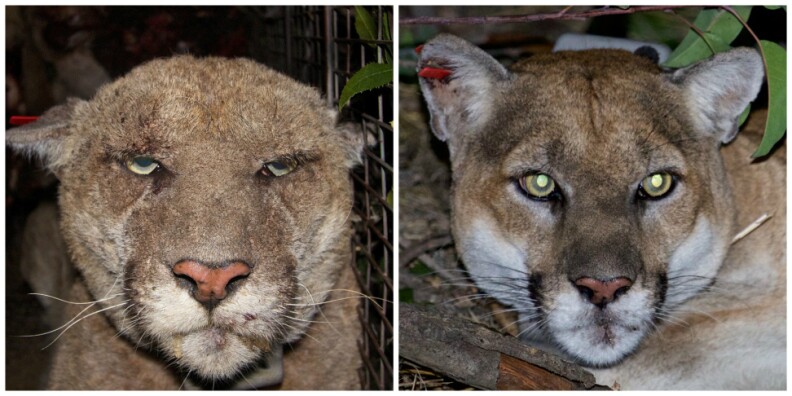
P-22 when he was healthy, right, and just a few days ago when he was suffering from infections and a fractured skull, left.

Unfortunately it looks like he was indeed hit. The beloved mountain lion, who had famously crossed his state’s busiest highways in his younger days to find a range of his own, suffered a skull fracture, an unnamed skin condition and signs of kidney and liver disease.

Veterinarians said the only option, at his advanced age and in his condition, was to place him in a sanctuary where he could be constantly monitored and cared for, but that’s a dicey proposition for a proud animal who spent his entire life fending for himself, hunting and going where he pleased. P-22 would not have recovered, they said, and would have had poor quality of life even if he lived out his remaining days in captivity.

Ultimately they made the difficult decision to euthanize him this week.

Again, there’s no indication any of the misfortune to befall P-22 had anything to do with the Chihuahua incident, although the driver who hit him without reporting the injury made a selfish choice. It’s not clear if earlier treatment could have saved P-22, but it may have saved him significant suffering.

The famous cat, who called some of Los Angeles’ most well-known neighborhoods home, leaves behind a legacy that includes books and documentaries on his incredible life and journey from southern California to his eventual home in LA. Rest in peace, big guy.

Scroll down to the bottom of this post for more photos and a link to the National Park Service’s tribute to P-22.

Wetumpka will pay the price for petty politics

Reader Leah of Catwoods fame brought our attention to this excellent analysis of the situation in Wetumpka, a town in her home state of Alabama that is now best known for extremely aggressive police officers arresting two women for the “crime” of managing a cat colony.

The women, Beverly Roberts and Mary Alston, were found guilty of two misdemeanors each earlier this week in Wetumpka municipal court. (They also spoke to PITB on Friday, discussing their plans to appeal and their worries about the health and safety of the colony cats.)

The column, by Alabama Political Reporter’s Josh Moon, echoes our own thoughts on the scandal, pointing out the petty nature of the arrests and prosecution:

It’s so utterly absurd. And to be quite honest, it reeks of small town politics. It smells suspiciously like some thin-skinned city official got peeved because some ladies had the gall to question him, and he decided to flex a little muscle, show those little gals where the power lies. 

And, lo and behold, in court on Tuesday, one major line of questioning revolved around whether Mayor Jerry Willis had told Wetumpka PD to arrest one of the cat ladies, because she had been continuously critical of the city’s animal control policies and practices. Willis, under oath, denied ordering her arrest. Testimony from a lieutenant from Wetumpka PD sure seemed to indicate that some sort of directive had come from the mayor’s office. 

Regardless, bodycam footage of the cops’ interactions with Roberts and Alston show an impressive response – three cop cars and four officers – to a call about a lady possibly feeding cats. On a roadside. With no businesses nearby. Near a wooded area. With plenty of space off to the side so traffic wasn’t impeded. On public property. 

As we did, Moon noted Alston and Roberts weren’t breaking any laws by being on public property, and there are no laws in Wetumpka prohibiting feeding stray cats.

And it’s not about feeding stray cats, as Willis claimed in his court testimony. Alston and Roberts were providing a service to Wetumpka, at their own expense, because they love animals. Trap, neuter, return is a proven process that limits and ultimately reduces stray cat populations, and does so in a humane way. Prohibiting the women from managing the cat colony will only make the problem worse as the felines mate and stray further afield looking for food, a fact that Willis and town officials don’t seem to appreciate.

Moon wrote:

A city with a decent government would have worked with Alston and Roberts. It would have given them awards for spending their days performing this public service for free. It would have explored ways to expand the very good thing they were doing. 

He quoted attorney Terry Luck, who represented the women, saying “Wetumpka is a laughingstock” for arresting Alston and Roberts, blatantly lying about the reasons and the sequence of events leading up to the arrests, and doubling down on prosecuting them even as the story spread nationally and people understandably shook their heads in disbelief at the insanity of it all.

The small-town trial, Moon noted, was covered by reporters from across the state and from national media outlets. Body camera footage of the arrests fueled public outrage, as officers treated Alston and Roberts like hardened criminals and even laughed at the idea that they were “a bunch of cops beatin’ up on some old ladies.” That’s not what you want your town to be known for.

“The city will pay a hefty price for the bad PR,” Moon wrote. “And the whole time, doing the right thing was free.”

Tribute to P-22

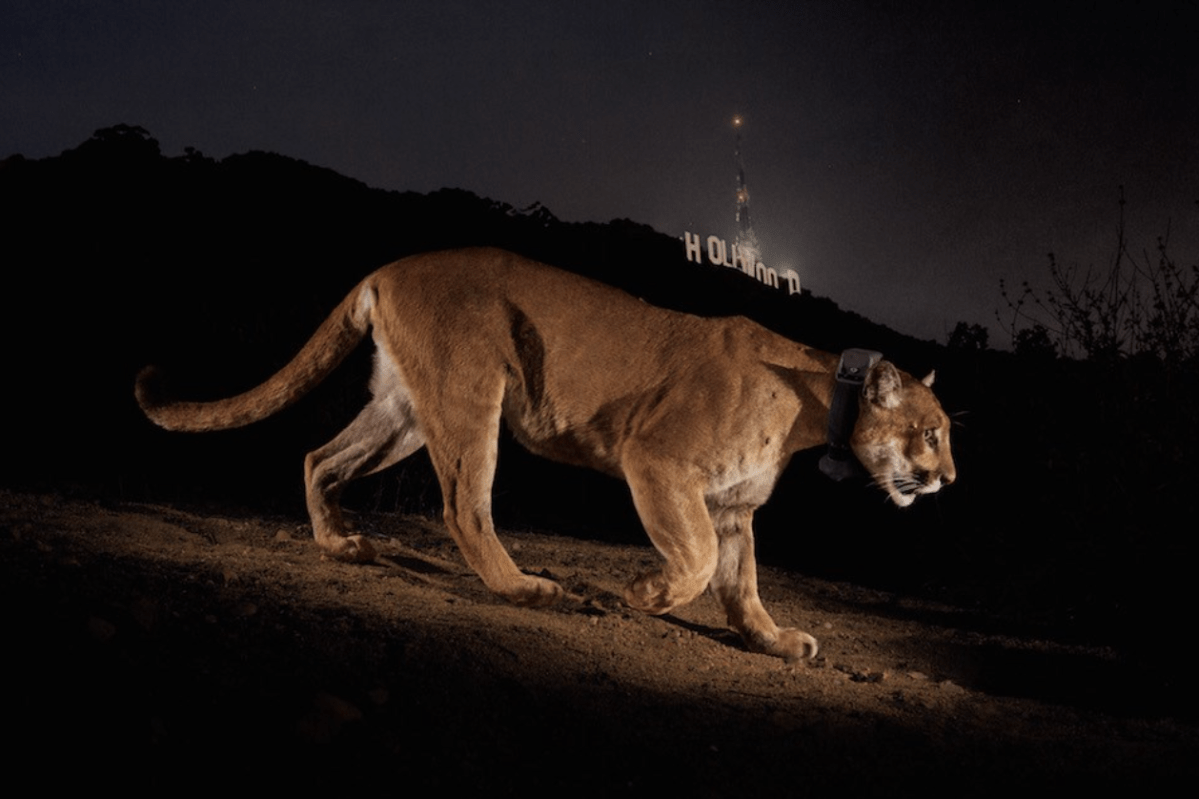
We leave you now with some photos and images that can only hint at how much P-22, the lion of Hollywood, was beloved by the people of LA. He was the subject of at least four books, two documentary movies, various festivals and fundraisers for protecting his kind, and his face graces innumerable posters, t-shirts and pins. Here’s how the National Park Service described the big guy:

Likely born in the Santa Monica Mountains as the son of adult male P-1, he somehow found his way to his tiny, nine-square-mile home in Griffith Park, separated from the Santa Monicas by the 101 and 405, two of the busiest freeways in the world. Defying expectations, he persisted for more than 10 years in the smallest home range that has ever been recorded for an adult male mountain lion.

Although he made frequent appearances on the streets of the Hollywood Hills and even, more recently, of the Silver Lake neighborhood, he was also clearly a wild cat, doing so mostly late at night, and subsisting largely on natural prey such as deer and coyotes.

In the end, he found his way into many Angelenos’ hearts and home surveillance camera footage.


‘Ghost Cat’: Famous Hollywood Puma Snatches Leashed Chihuahua On A Walk

Though the behavior is extremely rare, mountain lions have been known to attack small dogs at night.

P-22, as he’s known to the scientists who study him, is the star of two documentary movies, four books and innumerable photos captured by trail cameras, surveillance stills and the few people lucky enough to catch a glimpse of him.

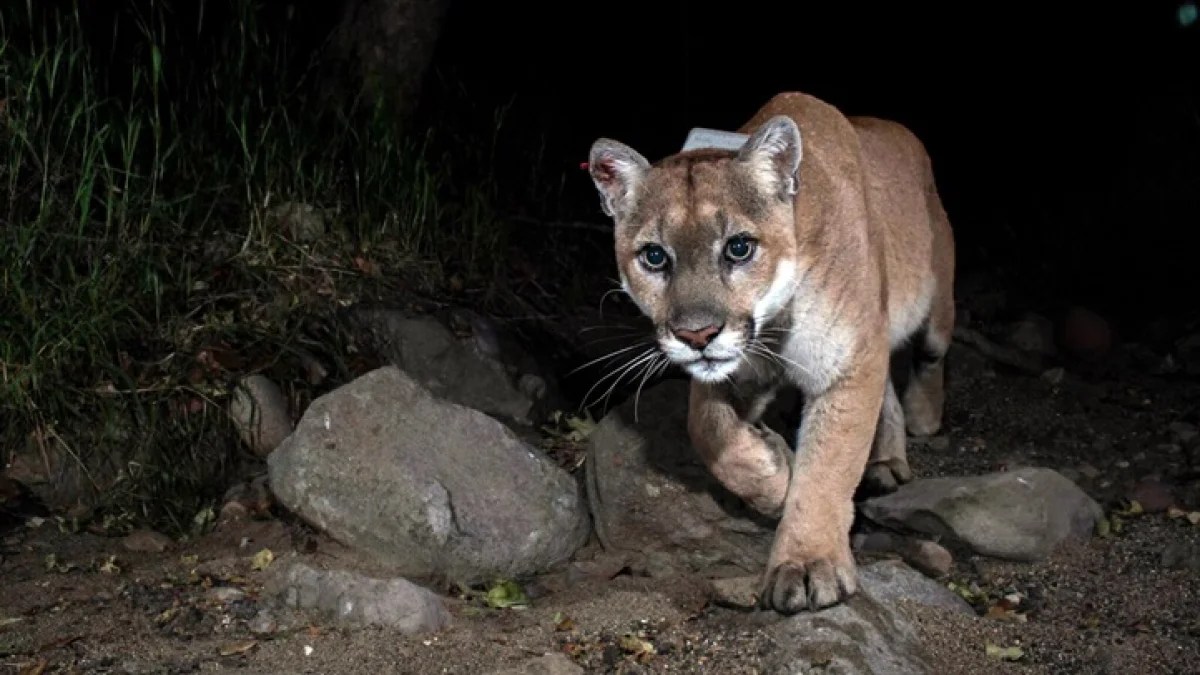
The 12-year-old mountain lion is instantly recognizable by his radio collar and his derpy, wide-eyed look.

But he’s also a predator, as the National Park Service reminded the public on Monday when it confirmed P-22 was indeed the puma who stalked a dog walker accompanying two pooches on Nov. 9. P-22 struck in full darkness about 90 minutes after sundown, snatched one of the unfortunate pet dogs and was bolting away before the walker even had time to react.

The incident was captured by a security camera in the Hollywood Hills neighborhood of Los Angeles, and grainy video shows P-22 leaping out of a bush and pouncing on a chihuahua named Piper. After consulting GPS data from the radio collar and reviewing the surveillance footage, the National Park Service confirmed it was the famous wild cat.

“They are stealth predators,” the National Wildlife Federation’s Beth Pratt told the LA Times. “They’re called ‘ghost cats’ for a reason. This is how they get their prey. It’s not like the vision of lions in Africa that chase down their prey on the plains.”

P-22_2019
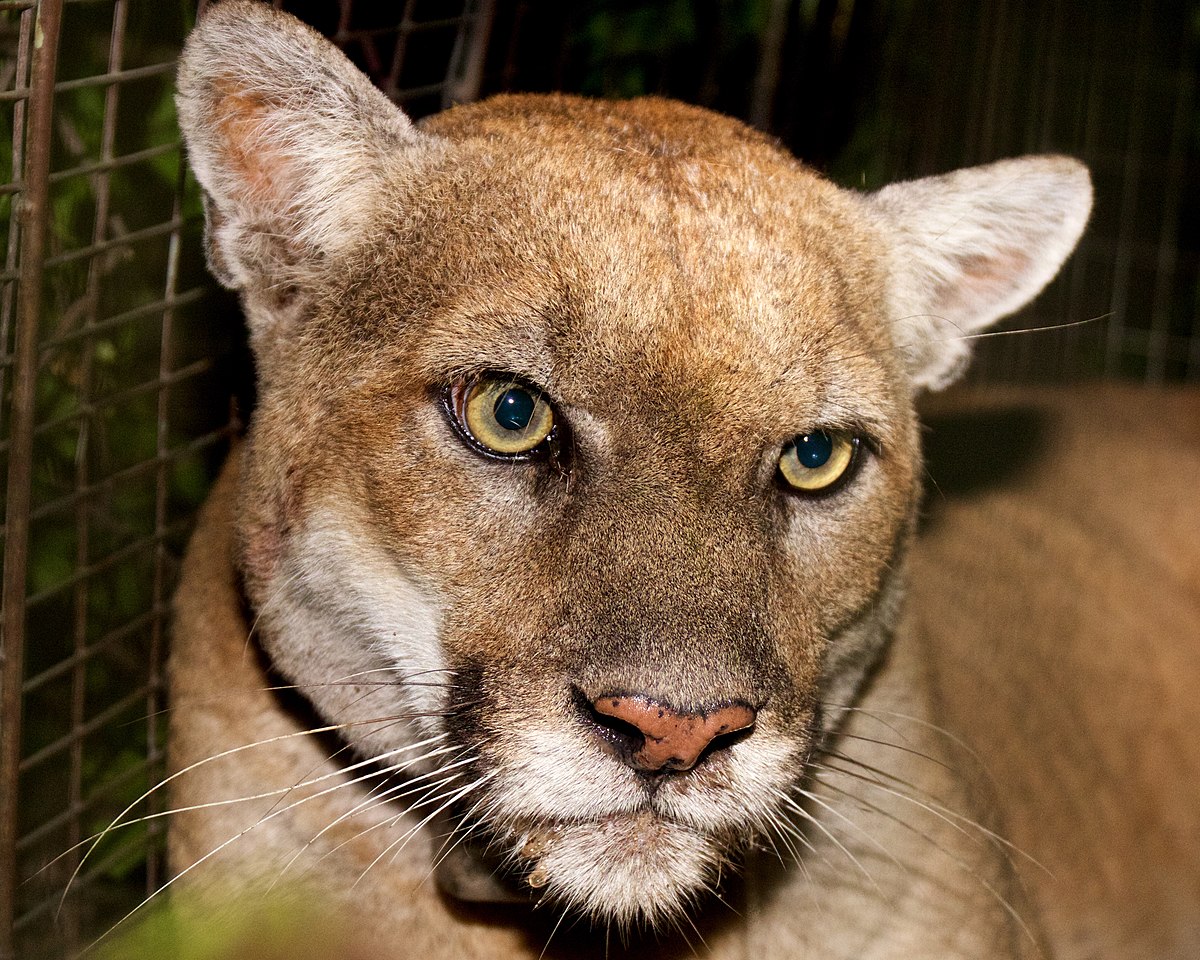
A close-up of P-22 in 2019, when he was briefly captured for a health check-up. Credit: Wikimedia Commons

While noting people are “more likely to be struck by lightning than attacked by a mountain lion,” Pratt warned that small pets can resemble the large feline’s natural prey. While P-22 usually hunts deer and foxes near Griffith Park in Hollywood Hills, pumas are also known to take down smaller prey and are opportunistic predators like their house cat and big cat cousins. (Despite their size, pumas — known as mountain lions, cougars and catamounts among many other names — are not considered true “big cats.”)

“It’s sad that P-22 killed a beloved pet,” Pratt told the Times. “But he doesn’t know that. He was just being a mountain lion.”

Daniel Jiminez, Piper’s owner, told Los Angeles’ KTLA that he and his wife are “devastated at the loss of our little dog.”

He said he thought his dog walker was joking when, while out celebrating his daughter’s birthday, he received a text from the walker saying Piper had been taken by a mountain lion. The Jiminez family adopted Piper in 2014.

Jiminez says he wants people to know what happened so they’re vigilant when walking their dogs in the area.

“I don’t want anything bad to happen to P-22,” said Jimenez. “I just want people to be safe out there so that nothing like this happens again.”

Top image credit NPS.gov