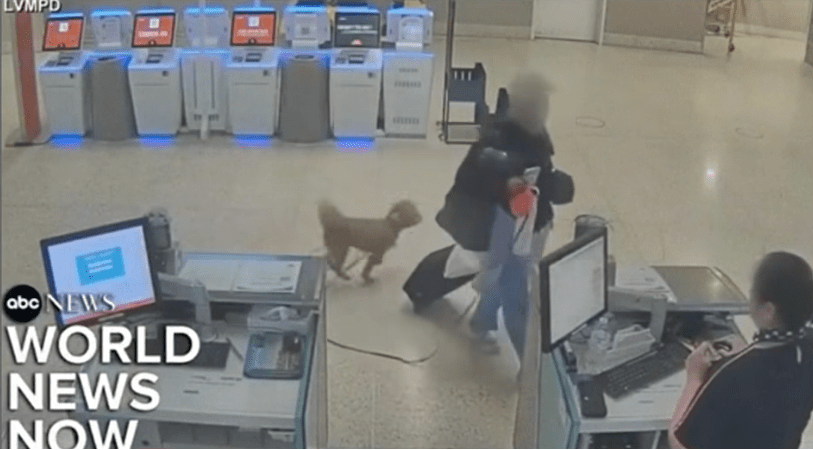
The woman left her dog tied to a post near the departure gate, telling police she didn’t want to miss her flight after the airline told her she didn’t have the right paperwork to bring her dog in the cabin as a service animal.
A dog who was abandoned by his owner at a Las Vegas airport has a happy ending to his ordeal after he was adopted by one of the police officers who responded to the initial abandonment call.
The sequence of events began on Feb. 2 at Harry Reid International Airport in Las Vegas. A woman was trying to board with her goldendoodle — a medium-size breed that is a cross between a golden retriever and a poodle — when an airline employee told her she needed paperwork proving the pooch was a service animal. Emotional support animals don’t need paperwork and aren’t certified by any agency, public or private, but service dogs must be trained and certified.
Instead of trying to work the problem out, the woman abandoned her dog, leaving him tied to a post near the departure gate. The airline’s staff called police and when officers arrived, they found the woman waiting to board her flight.
The woman pictured with Jet Blue the dog before abandoning him at the airport. Still image from a video provided by Las Vegas PD.
She was insistent she’d done nothing wrong, according to Las Vegas police, and said she could find the dog again after returning home because he has a tracking device. That excuse didn’t fly, and neither did the woman– officers pulled her off the departure line and arrested her for abandoning an animal.
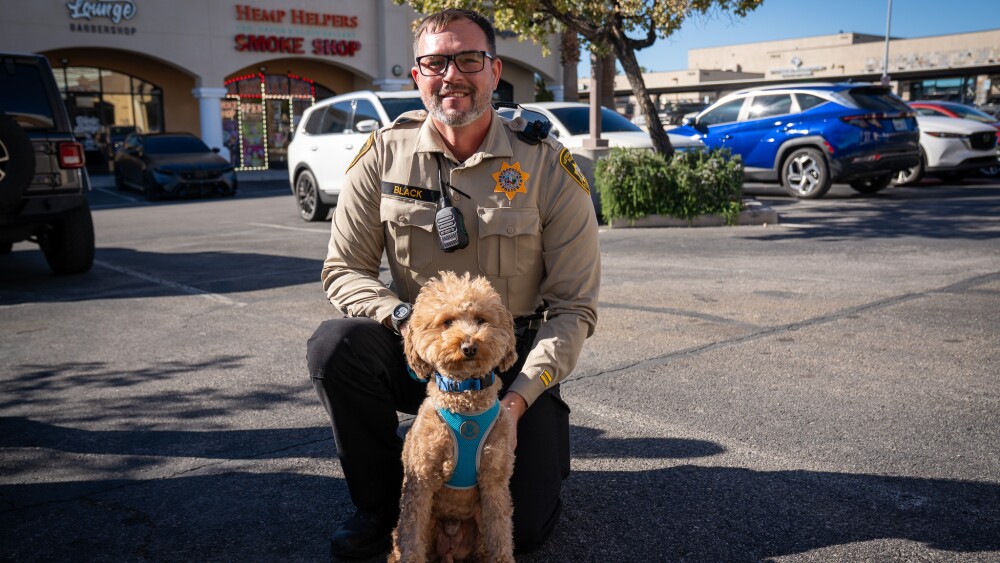
In a positive twist of fate, one of the officers who responded that day had been looking to adopt a dog of that same breed and had already applied and been cleared by a local shelter. He was just waiting for the right dog.
The officer, Skeeter Black, adopted the abandoned good boy and named him Jet Blue after the airline. Jet Blue joined his new family on Sunday after undergoing the usual veterinary checks, quarantine and a 10-day mandatory hold with animal control.
“We’re very excited to add him to our family,” Black said when animal control handed three-year-old Jet Blue off to him. “We’re gonna enjoy him. He’s gonna be very much loved.”
As for the Las Vegas Police Department, the brass issued an exasperated statement reminding people that animals are living beings with their own feelings.
“We can’t believe we have to say this,” police wrote in a post, “but please don’t abandon your dog at the airport — or anywhere else.”
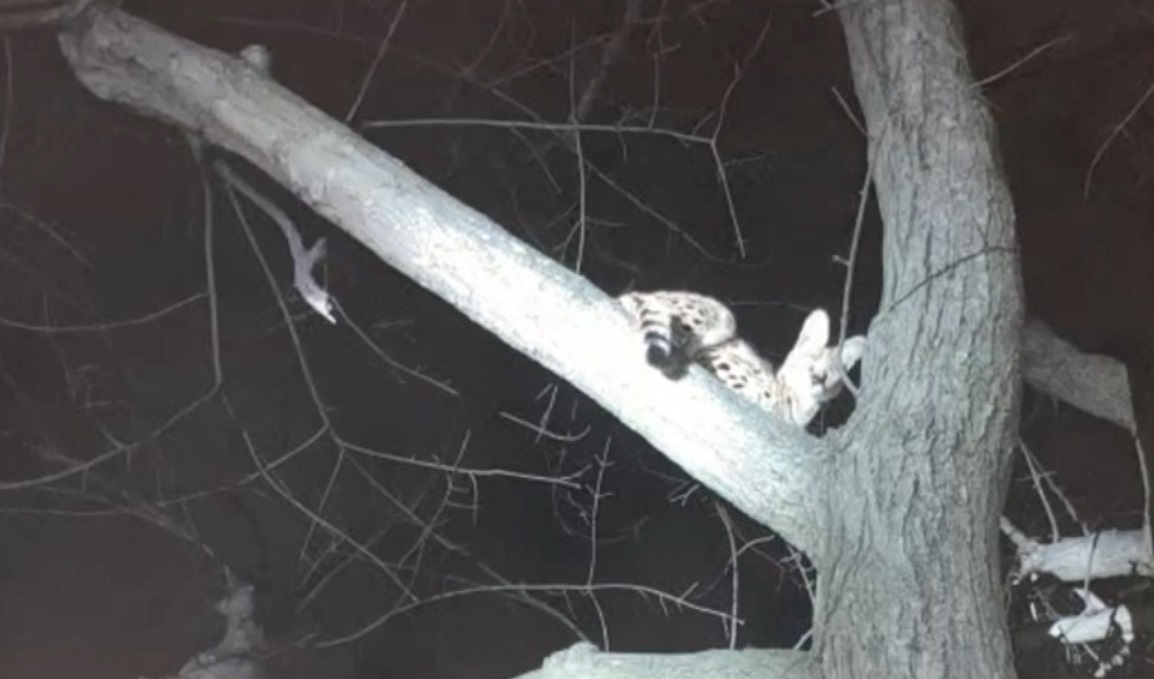
The spooked serval bolted through an open window and scurried up a tree during a traffic stop in Cincinnati.
We wish we could say this story is a viral marketing stunt for the recently-released movie Cocaine Bear, but authorities say they’re not joking.
Cincinnati police pulled a car over in what they thought would be a routine traffic stop in late January. But when officers approached the vehicle a large cat inside got spooked, jumped through an open window and took refuge in a tree.
Cops called the city’s animal control staff, initially reporting a “leopard” on the loose.
“[They weren’t] sure what they were dealing with,” Cincinnati Animal Care’s Ray Anderson told WXIX. “Hindsight being 20/20, it probably would have involved a whole lot more people.”
Animal control officers who arrived on scene thought they were dealing with an F1 Savannah, a hybrid between a domestic cat and a serval, and were able to get the cat down from the tree, but not without some difficulty. The exotic wildcat suffered a broken leg in the process. (See video of the cat in the tree here.)
The serval took refuge in a tree. Credit: Cincinnati Animal Care
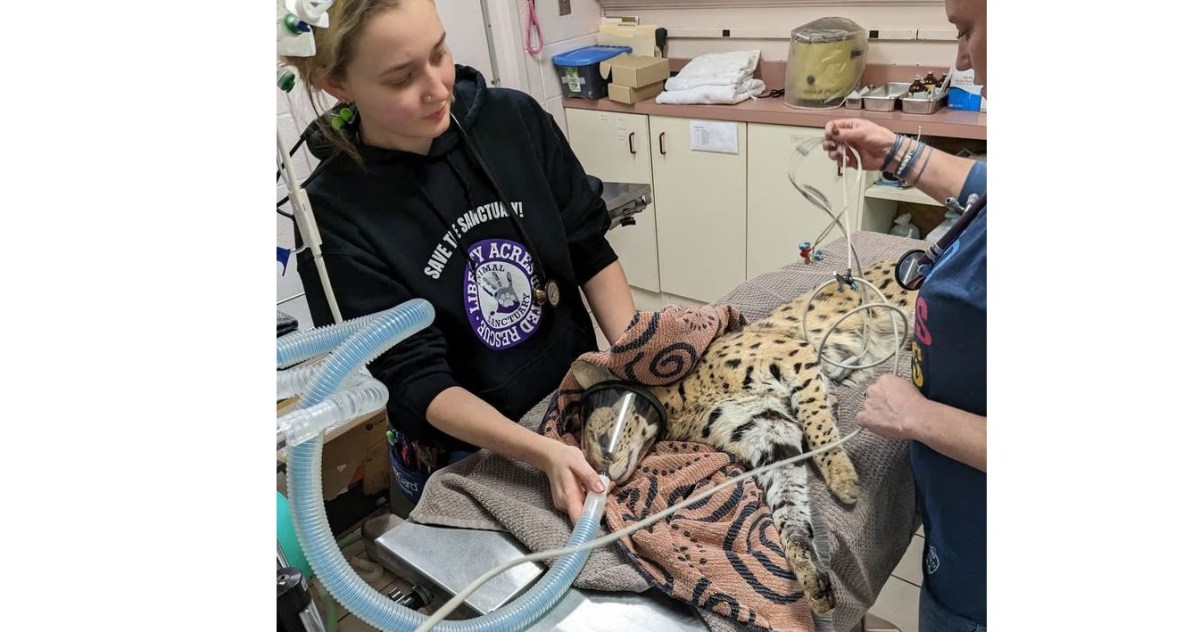
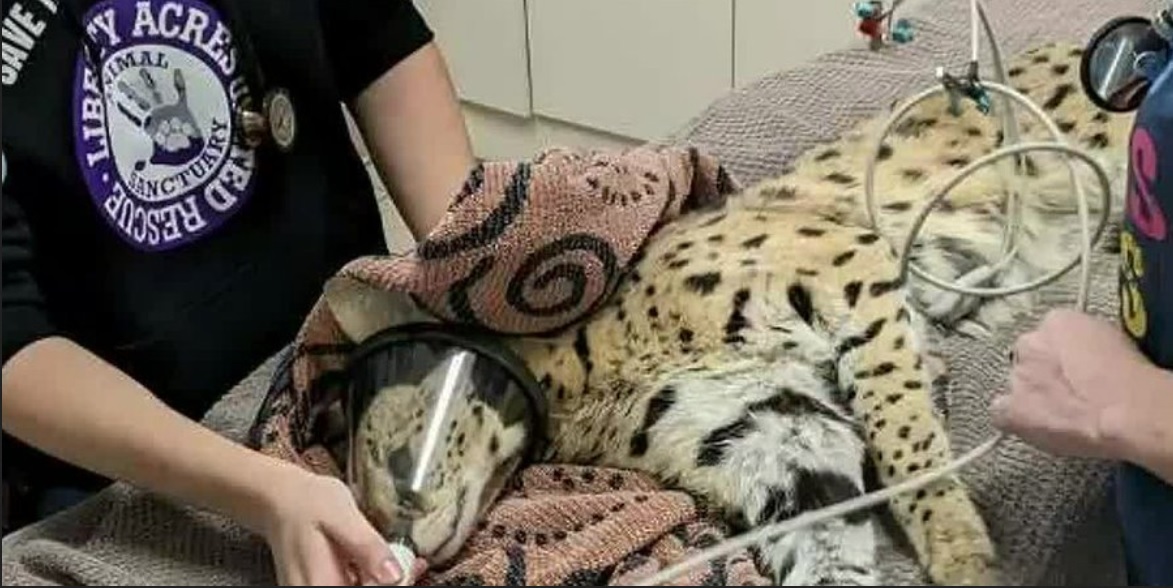
They brought the injured cat to the Cincinnati Zoo, where they were in store for several surprises: The felid was a serval, a medium-size African wildcat, and blood tests showed it had cocaine in its system. A subsequent DNA test confirmed the cat is a serval and not a Savannah hybrid.
The responding animal control officers were “pretty lucky because this cat could’ve shredded us” Chief Troy Taylor of the Hamilton County Dog Warden’s Office told Cincinnati’s WKRC.
The serval, whose name is Amorie, remains in the zoo’s care for now. Taylor said Amorie was given pain meds during treatment and is recovering. It’s not clear what will happen to him, and lots of questions about the incident remain unanswered. Local media reports say the driver was arrested during the traffic stop, but also said the driver is cooperating and has not been charged in relation to the cat or the narcotics.
It’s illegal to own wild cats in Ohio, and unless the serval found himself a bag of cocaine in the fleeting seconds between bolting from the car and scurrying up a tree, it seems the driver has some ‘splainin’ to do.
Authorities found the cat in a sweep after a New Years Day riot resulted in 17 deaths and the escape of thirty inmates.
On Jan. 1, the inmates in one of Mexico’s most notorious prisons celebrated the New Year by starting a riot.
Ten prison guards and seven inmates lost their lives in the violent chaos, and thirty inmates escaped the CERESO 3 prison, according to press reports from Mexico.
When authorities finally regained control — an effort that required the military, national guard and local cops — they conducted a sweep of the facility for contraband and weapons, and that’s when a police K9 unit found a cat wandering the dangerous grounds by himself.
Dubbed “the gangster gato” by the local press — he doesn’t yet have a real name — the feline was taken into the care of Juarez’s Department of Animal Welfare for the Rescue and Adoption of Pets while police complete their investigation.
The cat, who reportedly belonged to the late Los Mexicles gang leader, is in good health. Credit: Juarez Animal Control
He’s an Egyptian, a breed that commands up to $2,000, and reportedly belonged to Ernesto Alfredo Piñon de la Cruz, aka “El Nato,” the former leader of the Sinaloa cartel-aligned Los Mexicles gang. Cruz was the alleged “mastermind” of the escape who died on Jan. 5 when police caught up to him. He didn’t go quietly and died in the resulting shootout.
Although it may be difficult for Americans and others to imagine how prisoners could keep pets, stories about the subsequent raid and sweep say authorities found “VIP cells” stocked with amenities like space heaters, air conditioners, personal washing machines and various other electronics. The Chihuahua State Human Rights Commission and other NGOs had previously warned that the inmates were “practically running the prison,” and that guards there didn’t have the manpower or will to crack down on illegal activity in the cell blocks.
Gang leaders and others who had power were able to set up their cells like lounges, with couches, plasma TVs, video game consoles, stereos and card tables. One had a pet snake in a terrarium, and several kept safes full of cash they’d use to pay for items smuggled in through a secret entrance. There was even a mechanical bull to amuse the inmates and help them kill time.
In all, authorities seized more than 2,800 pieces of contraband, according to reports.
“The privileges are over,” Chihuahua Gov. Maru Campos said earlier this month as authorities showed some of the contraband and weapons they’d seized to reporters.
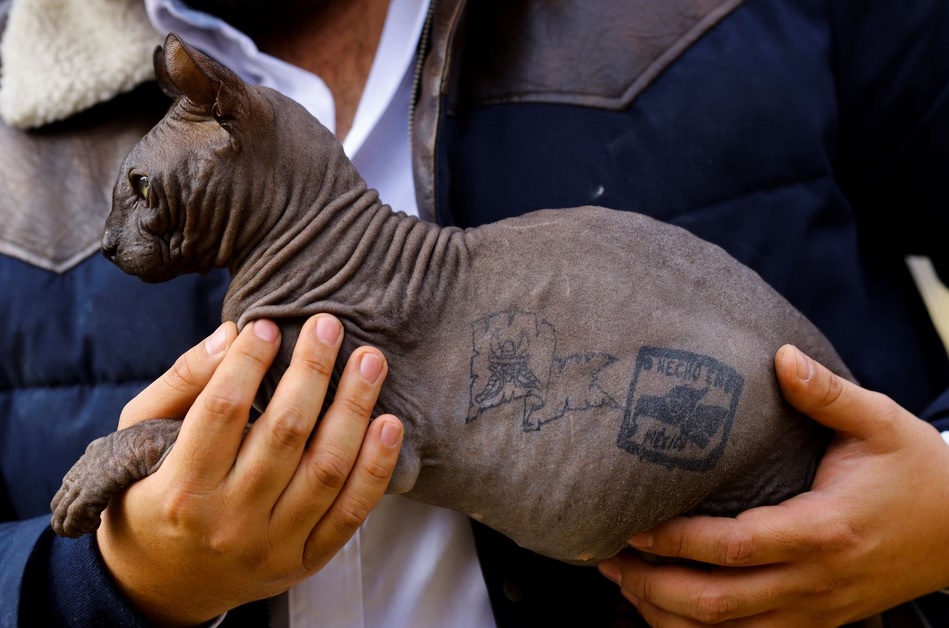
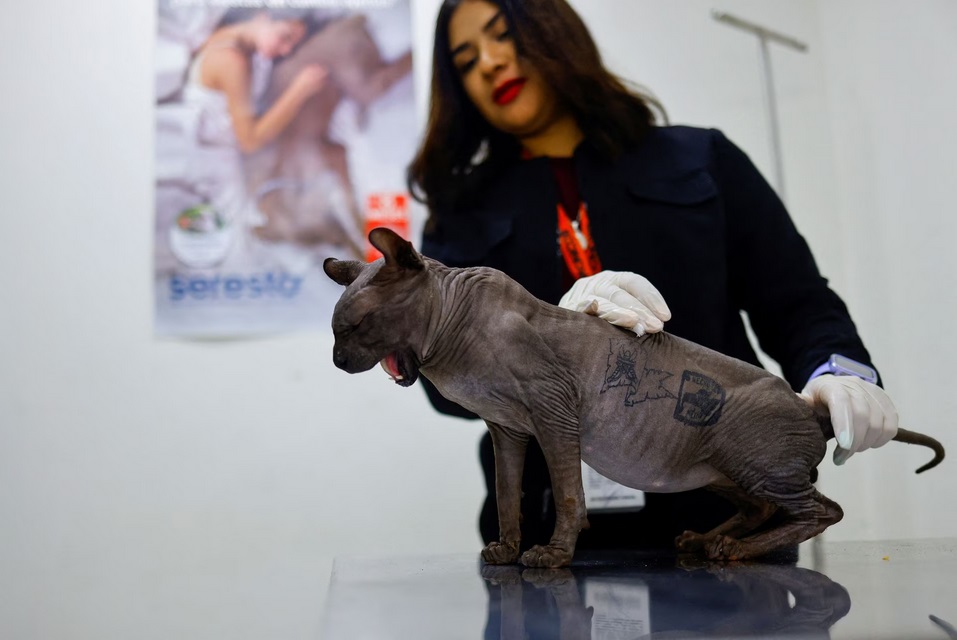
The cat is in good health, staff at the Juarez Department of Animal Welfare say. He’ll always carry scars from his time in CERESO 3, unfortunately, because the Mexicles tattooed him with the gang’s logo and an associated slogan, “Hecho en Mexico,” or “Made in Mexico.”
Despite living in such chaotic and dangerous conditions, “the cat is very sociable, and is in great shape, with no infections,” said Cesar Rene Diaz, a Juarez official.
The city is taking applications for adoption and a committee of Juarez officials will make the final decision on who gets to give the kitty a forever home. Government officials and their relatives are barred from applying to adopt the cat.
If a bystander hadn’t witnessed the event and rescued the cat, it’s likely the little guy would have starved or died of dehydration.
Authorities in a Texas town near Houston need help identifying a woman who tossed a cat, carrier and all, into a garbage can.
The woman parked her car in a nature preserve in Rosenberg, Texas, at about 11 am on Jan. 12, opened the backseat to retrieve a cat carrier and unceremoniously dumped it in a garbage can.
A bystander happened to witness — and film — the entire sequence of events, and after checking the trash it turned out there was a scared two-year-old cat inside the carrier. The bystander brought the cat to Rosenberg’s animal control department.
“If no one would have seen this happening, that cat would have been in that container in that trash can with no access to food, (or) water,” said Omar Polio, the town’s director of animal control. “Not acceptable.”
The cat is a beautiful, affectionate white and brown male the shelter has dubbed King Triton. He’s in their care for the time being. King Triton is healthy, Polio said, and it’s not clear why the woman would have dumped him instead of surrendering him to a shelter.
While shelters are crowded, “we can always find resources that can better suit these animals,” Polio said, imploring people not to abandon or toss animals away like trash.
Polio said his agency would like the public’s help identifying the woman. It’s not clear what kind of charges she might face. Anyone with information can call Rosenberg Animal Control and Shelter at 832-595-3490.
Video of the incident provides a clear look at the woman, but the resolution isn’t high enough to make out the license plate on her car.
Here’s a news segment of the incident with footage of the woman getting out of her car, dumping the cat, casually returning to her vehicle and driving off. She has dark hair that was in a ponytail at the time and was wearing shorts and sunglasses:
Local authorities have backed off the plan, but the story raises important questions about how local governments deal with stray cat populations.
The recent saga of a New Jersey town’s ill-advised plan to “destroy” feral cats highlights almost everything wrong with local government.
First, a notice went out from the northern New Jersey town of Matawan, informing residents that feral cats had become a “nuisance” and their presence posed a danger to “the welfare and safety of both the community and the cats.” The town, in cooperation with the police and SPCA, the notice said, would begin trapping stray, feral and free-roaming felines in November, and any cat not claimed after seven days would be “destroyed.”
The backlash was loud and immediate, and it took the Monmouth County SPCA by surprise.
After receiving angry complaints, the local SPCA posted a notice on Facebook blasting the “outlandish and outrageous campaign.” The SPCA’s leaders said they hadn’t been consulted and hadn’t approved of the policy, blaming the Matawan Animal Welfare Committee, a three-person group comprised of the town’s business administrator, Scott Carew, town councilwoman Melanie Wang and an animal control officer.
“We are completely outraged and disheartened that our organization has been attached to this archaic campaign to euthanize feral cats, when there are so many other successful, humane alternatives,” the Monmouth County SPCA wrote in its statement.
Carew backpedaled in the fallout, claiming the notice was a well-intentioned way of informing people who live in Matawan to keep their cats inside and stop feeding strays and ferals.
“By no means was the goal of the trapping efforts to destroy trapped cats,” Carew told NJ.com. “That said, since there was the chance that cats would be trapped and brought to the shelter, we wanted to alert cat owners whose cats are allowed to roam outside.”
But Carew also said he and the other were “obligated to address the complaint,” and said the town would have to enact “a resumption of trapping efforts” if it received more complaints about the cats. According to a statement by the Matawan police department, in a meeting between local leaders and people concerned about cats in one neighborhood, it was a single complaint about a possibly aggressive feral cat that prompted the plan.
That’s it. That’s all it took, in the eyes of local government officials, to justify a policy of trapping and killing sentient, human-habituated innocent animals, a group that includes free-roaming pets, former pets, strays and true ferals. A single, unverified complaint of a potentially “aggressive” cat, with no further detail about what the word aggressive means in that context, no information about what the cat supposedly did, or even confirmation that the cat was a feral and not a stray or a wandering pet.
When the dust cleared from all the finger-pointing, Carew said his committee should have informed the SPCA of its plans, and police brushed off responsibility by saying they “assumed” the notice was drafted with the cooperation and intent of the SPCA and other local animal welfare groups.
A cat caught during a trap, neuter, return program, which reduces feral/stray populations in the long term without the cruelty of culling. Credit: Pixabay
Local government leadership and incompetence has become a big problem. With the death of newspapers, particularly regional dailies that employed trained journalists, there are entire swaths of the country no longer served by local government watchdogs who have the time, skills and resources to monitor local officials and inform the public.
We’re fortunate that NJ Advanced Media, an online portal for content from more than a dozen New Jersey local newspapers, has found a way to exist as a viable business serving millions of readers throughout its home state. Without it, it’s doubtful the story would have surfaced anywhere.
Lots of people think local government is small potatoes, but the truth is that local officials are responsible for enormous budgets and wield considerable power. The decisions they make very likely have more impact on our lives than decisions made in the halls of congress, even if it’s the latter that gets people’s blood boiling.
In this case we have a meeting conducted in secret, without public notice, that would have determined the fate of an unknown number of animals. We have anonymous, nebulous complaints and allegations about “nuisances.” What constitutes a nuisance? How many cats are involved? Are the cats part of managed colonies and cared for by people who trap and neuter them? None of those questions were answered.
Additionally, instead of taking intermediary steps or using widely available resources — the “other successful, humane alternatives” the SPCA referenced, from the willing cooperation of local shelters to the free toolkit created by the authors of the incredible D.C. Cat Count — the local officials came up with their own ill-advised plan to trap and kill cats.
Outrage by animal lovers and the SPCA were enough to make sure a plan like this was quickly discarded this time around, but you have to wonder how many other places this kind of thing might be happening without so much as a blurb about it.