‘A Vibrant Mind In His Little Head’: How Buddy Became My Animal Cognition Teacher

Buddy’s personality is galactic in size, his emotions emblazoned in neon, his opinions shared through a bullhorn.

I used to hate cats.

When I’d hang out at my friend Dave’s house as a teenager, the little shits were everywhere, climbing all over everything with no boundaries and apparently no limit to their numbers.

Dave’s family had between 10 and 12 cats at any particular time, a small army, and as far as I could tell they were little more than inscrutable, uncommunicative tribbles, barely sentient animals who didn’t listen to anyone, could not be told “no,” and were going to stick their little faces in your food or drink no matter how many times you told them to get lost.

Worse, I’d have to dose up on Benadryl just to last a few hours and often left because my eyes were gumming up and my nose was clogged.

There were times when I sat in my car, idling for a half hour with the windows down and heat on blast on frigid nights, waiting for the worst allergic symptoms to subside. I was worried I’d be pulled over and a cop, seeing my half-shut, bloodshot eyes, would decide I was driving stoned or drunk.

Even when another friend adopted a friendly, cuddly tuxedo who became the first cat I truly interacted with, even when I realized I could safely play with one or two cats without getting sick, and even as I was actively looking for a feline of my own, I didn’t think they were intelligent or that it was really possible to meaningfully communicate with them.

At best I’d get a tribble of my own, something to feed and care for in my black depression to take me mentally out of myself.

buddykitten2
My little pal, probably around 10 weeks old.

Then Buddy came striding out of his carrier like a furry little Genghis Khan and started conquering shit.

The furry little conqueror

I was prepared for a kitten who might dive under the bed and refuse to emerge except to sneak a bite or take a sip when the coast was clear. Lots of guides for first-time adopters warned the adjustment period for a new cat or kitten could be extensive.

What I got was a boisterous, bold, imperious little dude who was kind enough to allow me to continue sleeping on my bed, which was now his bed. I got a companion who demanded my attention, wanted to be involved in everything, and was going to let me know loudly and unambiguously what he liked and what he didn’t. He took up a regular position on my shoulder, like a parrot with a sea captain. We were — and still are — inseparable.

Buddy’s personality is galactic in size, his emotions emblazoned in neon, his opinions shared through a bullhorn. There’s a vibrant mind in his little head.

If they met Bud, even the most stubborn animal haters, the kind of people who refuse to acknowledge animal intelligence because they think it diminishes our own, would know they’re dealing with a person even if they may not admit it.

That is why this site exists. It’s why I write about cats, why I’m invested in their welfare and why it hurts my soul to hear about so many casual incidents of cruelty committed by humans toward felines.

When I hear about people gunning down cats or pouring lighter fluid on them, I think about what might have happened if Bud ended up with someone else, and I think about the cats who are just like Bud who are killed or seriously injured by cruel humans engaging in senseless violence.

There is no question that those cats suffer, that they feel pain, anxiety and terror as seriously disturbed people inflict pain on them for “lulz,” or because they think hurting cats might earn them Internet Points in the bowels of the web where diseased minds congregate to share shock videos.

No Turkey?!?
“Dude, you can’t be serious.”

The fact that Buddy thinks he’s a hulking tiger is a running joke here, and it’s true. He thinks he’s the baddest boy on the block, and he doesn’t see any dissonance between cosplaying as the Buddinese Tiger one minute, and running behind my legs when he gets scared the next.

Mighty and brave!

It’s been 10 years now, and I’ve pretty much accepted the fact that he can’t be stopped from pawing at the big screen door leading from the living room to the balcony.

But every time he gets his claws caught and he’s left hanging, he starts crying for me. He sounds like a baby, and all he wants in that moment is his Big Buddy to come and pick him up, gently slide his claws out, and rub his head while telling him what a brave and tough little guy he is.

He responds by puffing his chest out and purring. He’s probably thinking “Yes, I am brave, aren’t I? I endured that ghastly ordeal and only cried a little bit!”

Buddy the Clever
Buddy with a very Buddy look on his face.

It’s not all wonder and awesomeness, of course. I never would have guessed an animal could be so resourceful and clever when it comes to being annoying. Bud graduated from cackling gleefully in the dark as he terrorized my feet at night, to repeatedly punching the flap on his litter box because he knows the squeak drives me crazy. He’s also fond of standing on my head and shrieking at full volume into my ear. Not “fill my bowl” or “I need water,” because those needs are taken care of immediately before bed.

The reason he wakes me up, why I’m ripped out of restful slumber by his high-pitched kitten voice, is because he wants me to wake up and be Buddies with him. He wants to hang out.

So as annoying as he can be, and as much as I really, really hate losing sleep, I can’t be mad at him. If only humans were so pure in their intentions and non-judgmental.

Cats are social animals

A lot of people say their cats ignore them or at best acknowledge them with a twitch of their radar ears. When I call Bud, he responds by happily padding up to me, tail raised straight up or curled like a question mark.

That’s because he knows I’ll never hurt him. He knows I’ll never force him to do anything he doesn’t want to do, nor will I grab him, subject him to unwanted petting and refuse to let him go. Trust goes a long way in human-feline relationships. In some ways, it’s everything.

Schemeowtics
Schemeowtics for Buddy the Cat. Note the huge meowscles.

Part of earning that trust means understanding my little pal, learning from him and learning about him. I’ve read more about felis catus than I ever imagined I would, and Bud’s smarts sparked a years-long deep dive into animal cognition that still has its hooks in me.

The belle epoque of feline research

For decades, dogs were the only domestic pet scientists bothered with. Cats were legendarily uncooperative, and the general consensus was that trying to wrangle them wasn’t worth it. If a research team managed to get 150 people to bring their cats into the lab, they were fortunate if a third or a fourth of them worked out.

Over the past 10 years or so, that’s changed as a new generation of scientists began to think in feline terms. Now the research teams come to the cats instead of the opposite, in recognition of how important territory and surroundings are to the species. They’ve also taken study formats originally built for children and dogs, and modified them for moggies.

Thanks to their efforts, we’ve learned a great deal.

Studies have found that, contrary to popular belief, cats really are social animals. If they’re bonded to a person, they value affection more than food or toys! They pay close attention to our whereabouts at all times, even though they’re masters at appearing ambivalent.

They know their names, they know the names of other cats they live with, and studies suggest they may be an even quicker study than toddlers when it comes to basic word association with items and concepts.

The meow isn’t a part of their regular communicative repertoire when they’re strays or ferals, and vocal communication doesn’t come naturally to them, but meows are embedded with meanings we’re only just beginning to understand.

Most amusingly, they’re capable of being dishonest with us and modifying their meows to manipulate us. But don’t let that fool you into thinking cats are real liars: it seems the one and only thing they’re dishonest about is food, probably because they realize we’re suckers.

Hap

During our time as inseparable pals, Bud and I have developed our own human-feline patois, a way of communicating that involves verbal and non-verbal cues. I pride myself on knowing what he wants the vast majority of the time, but I also realize the majority of the credit goes to little man for meeting me more than half way.

Sometimes Bud is so insistent, his meows apparently so urgent, that I don’t know what he wants. I can rule out food, water, a foul litter box or demands for pets. If he wants to snuggle or lay in my lap, he doesn’t need to ask. If he wants to play, he lets me know.

So what’s he saying? What could possibly be so important? Is he trying to tell me he’s reconciled quantum mechanics with general relativity? Has he gotten word of an anti-Buddesian plot by the devious neighbor cat, Smudge?

I don’t know. But one thing I do know, that I’m absolutely confident about, is that there are real thoughts scrolling through that little head, and a rich, authentic inner existence.

I’m lucky I’ve gotten to be his buddy, and to learn from him that animals are so much more than vacant-brained automatons I used to think they were.
Cat Brains Age Like Ours, Research Shows

Lifelong changes in the brains of felines more closely resemble aging in human brains. Studying cognition and cognitive decline in cats could help us better understand brain aging in general, scientists say.

For almost the entire history of modern science, rodents have served as a stand-in for humans in research into everything from metabolism to autoimmune responses.

They’ve even been the go-to for studies examining cognitive decline, diseases and neural mechanisms.

But now research shows there’s a better model closer to home. It turns out cat brains more closely resemble human brains in many respects, particularly in terms of aging and its effect on our mental faculties.

From Nature:

“As cats age, their brains show signs of atrophy and cognitive decline that more closely resemble the deterioration seen in ageing humans than do the changes in the brains of ageing mice, according to findings presented last month at the Lake Conference on Comparative and Evolutionary Neurobiology near Seattle, Washington.

The results are part of a large project, called Translating Time, that compares brain development across more than 150 mammal species, and is now expanding to include data on ageing. The hope is that the data will aid researchers trying to crack the causes of age-related diseases, particularly conditions that affect the brain, such as Alzheimer’s disease.”

One drawback to using mice is they simply don’t live long enough for their brains to deteriorate in ways many human and non-human animals do, scientists told Nature. They also have species-specific mechanisms that ward off certain degenerative diseases, including Alzheimer’s.

Not only do cats live longer, but their brain development and decline mirrors our own on a shorter time scale, scientists say. Tracking brain changes in cats is also more helpful than doing the same with dogs, who have been radically changed by breeding. Felines are mostly left to mate as they please, meaning they’re closer to their natural form, allowing for more useful data.

a cute cat lying on the couch
Credit: Pranjall Kuma/Pexels

Looking to our furry friends makes sense anecdotally as well. Every cat lover has seen the unfortunate confusion and forgetfulness that can afflict senior cats. Older cats tend to sleep a lot more, which is significant for a species notorious for its extravagant snoozing habits.

Thankfully, efforts like the Catage Project do not result in more cats being used in laboratory experiments. Researchers draw their data from veterinary records, brain scans and blood samples.

When asked about how his species could help humans better understand things like cognitive diseases and decline because of their similarity to humans, Buddy the Cat declared the research “fake news.”

“Where’s my bumblebee toy?” Buddy asked. “Did you hide my bumblebee toy? I’ve been looking everywhere for it!”

When told the toy was right were it’s supposed to be, in his toy basket, the 10-year-old tabby grew irritated.

“Fake news!” he meowed. “You put it back there just to mess with me. I’m onto your games! Now where did I put my favorite milk bottle cap?”

This Cat Pretends To Be Asleep To Steal His Human’s Food

The video is thoroughly amusing, but it also illustrates profound truths about feline intelligence, showing cats understand a lot more than people often give them credit for.

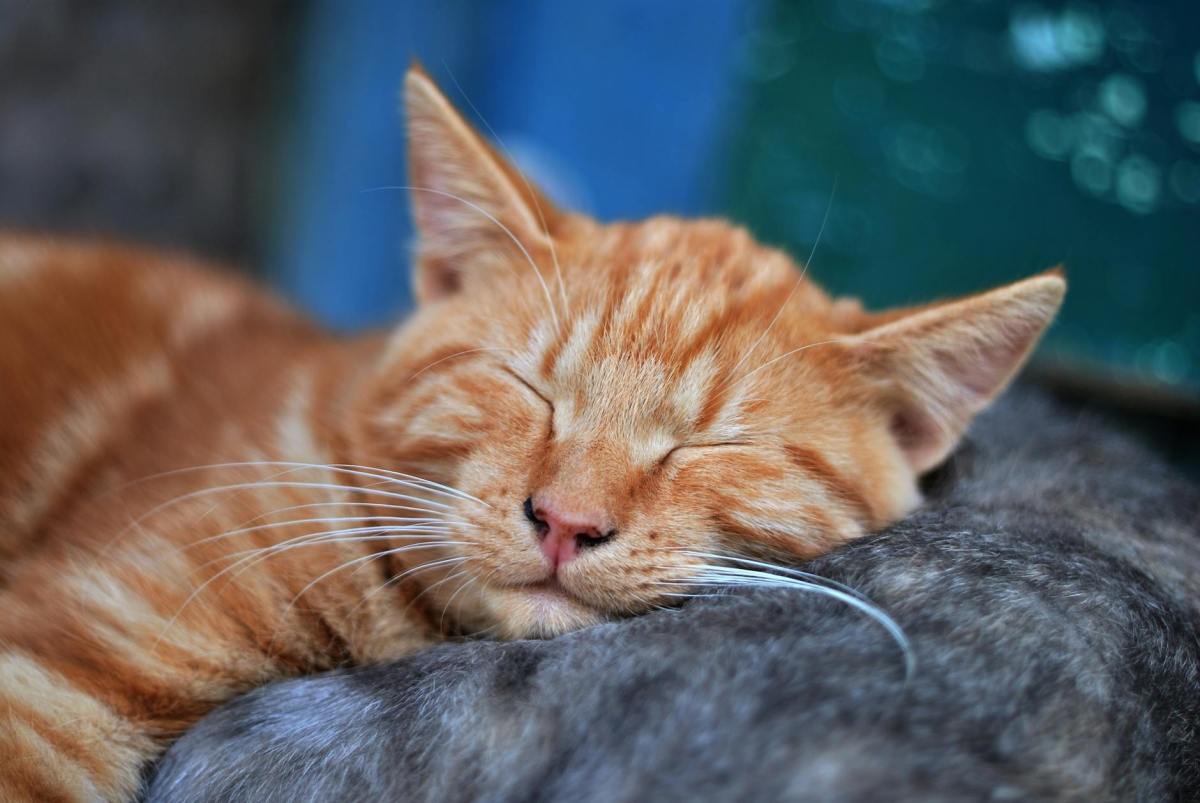
I’m loving this video of a sneaky orange tabby pretending to snooze while helping himself to his human’s food.

Little dude lays down and closes his eyes, then slowly reaches a paw out to the cap of an ice cream container, which has a glob of the good stuff on it. He checks to make sure the coast is clear by opening his eyes just a tiny bit, then slowly moves the cap over incrementally, pausing at intervals to make sure he’s still unobserved. (It looks like his human set her phone to record, then left the room so her little buddy thought no eyes were on him).

@caitlyn_davis34

“If I pretend to be alseep and move REAL slow, she won’t notice” #OrangeCatActivities #DontBeSuspicious

♬ Stealthy mischief(1088178) – KBYS

Aside from being hilarious and cute, this short clip actually illustrates something profound: Cats are much more intelligent than people usually give them credit for.

Consider the fact that to pull this off, the cat needs to be self-aware, and he needs to possess theory of mind. In other words, this cat understands he and his human have different perspectives, know different things, and that if he can move stealthily and appear to innocently nap, he can get away with eating some ice cream.

That may not seem like a big deal at first, but it means the cat understands humans can be deceived, and he understands how to do it. He cannot possibly know we have technology that can record him while we’re not looking, so that’s not a strike against him. There are plenty of things we don’t understand about animals, and we’re supposed to be the more intelligent species.

To truly appreciate how profound this is, consider that human children do not fully possess theory of mind until they’re four or five years old! That’s when they begin to appreciate the fact that other people have internal thought processes and emotions — even if they can’t articulate that — and, crucially, that what a person thinks she knows may not align with reality.

Footage like this goes well beyond refuting the old, debunked claim that animals like cats are biological automatons without thoughts or feelings. It shows they are in full possession of the cognitive tools that form the basis for higher modes of thinking. Again, while some people might hear that and say “What’s the big deal?”, it destroys all arguments that animals don’t have emotions or don’t understand what’s happening to them when humans mistreat them.

It also shows that cats are at least as intelligent as young children in all the ways that matter. They cannot verbalize their thoughts and feelings, but that has no bearing on their existence. After all, no one would argue that a child doesn’t have feelings simply because he’s unable to speak.

Lastly, there’s one more important lesson here: hide your ice cream from your fluffy pals!

Top image via Pexels.

How Do I Make My Cat Like Me?

A cat’s affection has to be earned, but the good news is it’s not rocket science. A little patience and consideration for your fluffy little pal goes a long way toward building trust and a strong bond. Once you do, you’ll have a loyal friend for life.

“How do I make my cat like me?”

That question comes up regularly on social media posts, in cat-centric discussion groups, Q&A sites and even in our inbox. People adopt a cat, and whether the little one dives under a bed and refuses to emerge, or just seems reluctant to snuggle the way people imagined, they turn to the internet to find out why they don’t have a purring, contented feline in their lap.

The short answer is you can’t “make” your cat feel anything, and it’s best to dispense with that notion as quickly as possible so you can acknowledge the truth: cats are individuals with their own thoughts and feelings.

The good news, however, is that you can earn your cat’s affection with patience, respect and love. Our patience and respect for our little buddies leads to trust, which in turn creates and strengthens the special bond we share with them.

The love of a cat isn’t as easily won as the love of a dog, and in many ways that makes it even more special. Cats don’t love just anyone.

It starts with acknowledging your cat has feelings, and understanding that you have to respect those feelings as you would those of a person.

Don’t make your cat do things she doesn’t want to do.

Despite what you might think or what you may have been told, most cats don’t like being picked up, held or feeling restricted. The majority of felines don’t like belly rubs, and people have a habit of mistaking a sign of trust — a cat showing her belly — as an invitation to pet.

Cat showing belly
A cat showing its belly is a sign of trust. It’s a vulnerable position for a cat, and not an invitation for belly rubs. Credit: Wikimedia Commons

Every cat is different, but generally the best way to make sure your kitty doesn’t want to approach you is to ignore her personal boundaries and treat her like a stuffed animal.

Those “cute” videos you see on TikTok of terminally online people spinning their cats to Taylor Swift songs, holding them like phones to reenact scenes from The Princess Diaries, or forcing them to wear ridiculous outfits?

Don’t do that. It destroys your cat’s trust in you, and the cheap dopamine hit you get from strangers “liking” your content isn’t worth stressing your furry pal out and damaging your relationship.

Tik Tok cat abuse
Don’t do this. It’s not funny, the meme is lame and you’ll teach your cat to fear you. Credit: TikTok

If you tend to restrict your cat and hold her in your lap, you’re discouraging her from sitting there in the future. If you give kitty unnecessary baths, you could create a situation in which your cat fears you.

Even if you think you’re not doing anything wrong, if your cat is reluctant to approach you, there’s something that needs fixing, and it’ll require patience.

buddysguidescritchespets

Don’t subject your cat to forced petting sessions.

Unlike dogs, cats have a limited tolerance for physical affection, and they don’t always want to be touched.

Your pal will be much more likely to regularly approach you for physical affection if you let him come to you. Ignore the impulse to reach out and start petting him like you would a dog. Instead, put your hand out and let your cat initiate the petting. You’ll develop a physical shorthand in which he signals he wants chin scratches or head rubs by leaning in and rubbing his face against your outstretched hand.

All felines have scent glands in their cheeks, and the initial contact of a cat rubbing his cheek against your fingers is an olfactory signal that says “This human is my family. I like this human.”

Even though our noses can’t detect those pheromones, they’re still important to our cat(s), and they’re the reason why cats will scent-mark objects by brushing past them in your home, just like tigers will mark their territories by scent-marking trees with urine. Same concept, but thankfully our miniature house tigers generally don’t feel the need to do the latter. (If yours does, take him to the vet. If he’s not “fixed,” get it done ASAP.)

Less is more when it comes to petting

Stop me if you’ve heard this one before: “I just don’t get it! I was petting my cat and she was purring and loving it, then without warning she bit me!”

Pro tip: A bite like that never comes without warning, it’s just that most of us don’t see the signs right in front of us.

Cats communicate by tail and whisker, and we communicate by making noises with our mouths. Adult cats don’t meow to each other. The little ones are smart enough to understand how we exchange information, so meows, trills, chirps and grunts are their way of trying to speak our language, to communicate on our terms.

But sometimes — like, say, when they’re purring and relaxed — they’re distracted and forget to meow, or they meow and we ignore them.

That’s when they bite, or swipe at us with their paws.

If you pay attention to non-verbal cues, you’ll notice your cat getting overstimulated when her tail starts swishing and her pupils dilate. If those signs aren’t enough, there are others: twitching ears, shifting positions, moving away.

The best way to avoid misunderstandings is to give kitty a few head rubs and chin scratches, then stop. If she wants more, she will let you know. If she doesn’t, she’ll be content to remain on your lap or by your side, knowing you’re not going to keep going indefinitely.

No harm, no foul, no bite.

Cat doesn't like hug
This cat is not enjoying selfie time with her human. Credit: imgur via Reddit

Don’t take your bad day out on your cat

Remember when you were a kid and your mom or dad came home from a bad day at work with a storm cloud hanging over their head? Maybe they snapped at you for apparently no reason, or made family dinner miserable with fraught silence. Maybe they unfairly got on your case about something minor.

Either way, the tension in the house was palpable because, as kids, your parents controlled your lives and you were dependent on them for everything.

That’s what it’s like for our pets. Whether we call ourselves “fur mommies” and “cat daddies” or not, the fact is that the pet-human dynamic absolutely shares some elements with the parent-child relationship.

Our pets are utterly dependent on us, they’re subject to our moods, and they’re deeply attuned to our emotions.

As a result, how we’re feeling has a big impact on them, for better and worse. Unlike children, who at least have some concept of redirected frustration, cats and dogs have no idea why we have bad moods and no way to insulate themselves from the consequences.

We’re all human and we all get frustrated with our feline friends at some point. If you’ve been sitting in traffic for three hours and come home to find Socks pooped all over the rug or threw up on your comforter, frustration is a natural response.

But for the sake of the innocent little ones we share our homes with, it’s up to us to be mindful of our moods and do our best not to let external factors impact how we treat our pets. Things as seemingly small as our tone of voice can have a major impact on their emotions.

Cat eating
A cat chowing down. Credit: Wikimedia Commons

Don’t feed them crap

This has been covered exhaustively elsewhere, so we’ll direct you to catinfo.org if you have in-depth questions about feline nutrition.

In general, wet food should make up the majority of your cat’s diet. Cats don’t have a high thirst drive and they’ve evolved to get most of their hydration from meat, so a cat who eats mostly — or only — dry food is in danger of developing  serious health problems.

Aside from that, more expensive doesn’t always mean better, and the important thing is that your cat’s food has real meat as the top ingredient. If the primary ingredient is a filler like corn or grain, or poultry/beef byproducts, steer clear and find a better alternative.

Feeding quality food means kitty will be happier, healthier, less prone to health complications and more active.

Keep things interesting

You don’t have to spend a lot of money on toys, and everyone who’s ever lived with a feline knows the fluffy little guys are just as likely to take a shine to a new box or the little plastic ring from a milk bottle as they are to the $10 new toy you bought from the pet store.

That said, there are certain toys that are almost universally beloved by felinekind, and the more you keep things interesting for your cat, the happier your furry overlord will be.

You can never go wrong with wands for interactive play. Keep it simple and manipulate the toy at the end of the wand like prey so your house panther can feel like a mighty hunter. Track toys with balls that cats can bat around are good for relatively quiet solo play. Cat tunnels are great too, especially if you toss treats inside them for kitty to find randomly.

Cat with toy mouse
A cat playing with a toy mouse. Credit: Wikimedia Commons

You don’t need a special occasion to surprise your little buddy with a catnip and play session, and you’d be surprised how enthralled felines can be by “cat TV” on Youtube. There are dozens of channels that provide hours-long videos of birds eating seeds from outdoor feeders, aquariums filled with interesting fish, and critters like squirrels and rodents.

You can also engage your cat by training her to do simple things like come when called, sit on command high five you. Those “tricks” are very easy to teach and require no more than two or three practice sessions a day, maximum 10 minutes each. Your cat will love it, especially with rewards for learning, and it’s fun to show skeptics that, yes, cats can do tricks just like dogs.

Sometimes “fun” is just something unusual, something your cat rarely gets to do or see. On occasion, I let Buddy walk up and down the hallway with me in my apartment building late at night when chances are low we’ll encounter anyone.

Gangnam style elevator
Elevators: products of foul sorcery that swallow humans and sometimes spit out Korean rappers.

He loves to stop at each door, listen and take in the strange sounds and scents. If anyone emerges from one of the doors or the elevator opens, he just makes haste back to our apartment, where I leave the door slightly ajar for that reason. As for the elevator, he seems to think it’s some sort of product of foul sorcery — it rumbles, the doors open by themselves, and when people walk in, they don’t walk out. Sometimes they enter only to emerge as a different person a few minutes later!

I’m happy to indulge his paranoia with regard to the elevator, because it means I don’t have to worry about curiosity getting the better of him.

If you’ve got rooms your cat doesn’t normally have access to, a yard with cat-proof fencing, or an activity you only do sometimes, consider breaking up your cat’s day with a little exploration or some ‘nip-fueled fun.

Portrait of the Buddies
“Extremely accurate portrait of the Buddies” commissioned by Buddy the Cat in 2024.

Treat your cat as a friend

Your cat may not have legal personhood, but he is a fully sentient being who feels emotions just as strongly as people do. Cats experience the full range of primary and secondary emotions, but not tertiary emotions. That means kitty can feel happy, sad, excited, anxious, jealous, bored, depressed and overjoyed, but she’s not going to be embarrassed if another cat’s wearing the same collar or fret over whether people and other cats like her.

The important thing is remembering cats have feelings.

It’s not rocket science, and it doesn’t cost us anything to treat our cats with respect, patience and love. Bonding with a cat requires more than just feeding, watering and scooping, but the effort is always worth it and you’ll have a loyal friend for life. Good luck!

Top image of incredibly sexy beast (Buddy) copyright Pain In The Bud.

A Vet Says ‘It Matters What You Say To Your Cat.’ Ruh Roh!

I love my cat, except when he’s standing on my head and screeching into my ear at 80 decibels to make sure sleep is not an option.

Regular readers of this blog know I dote on my cat.

I don’t call him “Your Grace” without reason. He always eats first. He regularly uses me as his pillow. He knows how to manipulate me, he always gets what he wants, and I’ve been told many times how he’s got me “wrapped around his paw.”

He rules the roost, and has done so since the night he arrived as a baby and came striding out of his carrier like a furry little Ghenghis Khan, conquering everything in sight.

No one can doubt that I love the little guy.

But if you were a fly on the wall when I wake up, well, you might think differently. Bud is, to put it bluntly, absolutely relentless when he wants something, which puts us at odds when it comes to that most crucial commodity, sleep.

Some of the most vile things that have ever come out of my mouth have been prompted by the little guy’s snooze-disturbing antics. I’ve called him ALF (Annoying Little F—-er), I’ve threatened to sell him to the local Chinese restaurant, I’ve thrown pillows at him, and when my sleep-deprived brain can’t come up with something more creative, I half-mumble “Shut up, you furry little turdball!”

Buddy roaring
Buddy the Cat: Never at a loss for meows.

Those are the more tame ones! The worst thing, the bit that makes me feel bad, is that Bud just wants me to wake up so we can hang out and be buddies.

He doesn’t want food. He’s got a bowl of dry food set out for him before bed every night precisely so he doesn’t have to wake me up. Nope. He wants to knead my shoulder, purr up a storm and have me scratch his chin while I tell him what a good boy he is. And instead of that, I’m turtling up beneath the blanket, pillow over my head, telling him he’ll be served as General Tsao’s Buddy if he doesn’t shut his trap.

All this time I’ve told myself that it’s okay because he doesn’t understand what I’m saying, and he knows I wouldn’t harm a hair on his head.

But what if he does understand some of it?

That’s the subject of a new column by Karin Spicer. Writing in the Dayton Daily News, Spicer describes her morning ritual with her cat, Pip, and how she’s encouraged her naturally vocal cat to vocalize even more by talking to him.

Buddy from above
“No sleep for you, human! There are foreheads to rub, chins to scratch and ‘good boys’ to be said!”

Like Pip, Bud is a naturally talkative cat, and like Pip, his motor mouth tendencies have been cultivated by plenty of attention, affection and interaction.

“Cats want to bond with their owners,” says Catster’s Michelle Gunter, who is quoted in Spicer’s column about Pip. “If you take the time to communicate with them in soft, calming tones, that bond will strengthen faster. Your tone and the affection you offer during these periods can help show your cat that you love them and want to spend time with them.”

You mean to tell me all this time I’ve been undoing some of that bonding by hurling vile invective at my Buddy when he tries to annoy me out of sleep?

You mean to tell me he can infer by my tone of voice that I’m threatening to sell him to Somali pirates for $15 and a pack of gum?!?

Sheeeeit!

Disclaimer: No Buddies were harmed in the creation of this content, except perhaps for some bruised egos.

Bud talking
“Mrrrrrrroooowww! Meeeeerrrrrooowww!! Mrrrrrrrp! Yeeeeeeooo!!! MEOW!”