Investigators Rule Sanctuary Fire ‘Not Suspicious’ As Vets And Volunteers Treat 200 Surviving Cats

As veterinarians treat the surviving animals for ailments like smoke inhalation and burned paws, donors from all over the world have contributed $750,000 to help the newly homeless moggies and ensure Happy Cat continues in some form.

Investigators are still looking for the exact cause of Monday’s fire, which claimed the life of a New York cat sanctuary founder and about 100 of its feline residents, but they now say the blaze doesn’t look suspicious.

The fire started inside the main structure at Happy Cat sanctuary, Brookhaven Fire Marshal Chris Mehrmann told local media, and investigators “cannot rule out a fire caused by propane-fed portable heaters that were in the area of fire origin.”

Happy Cat founder Christopher Arsenault, 65, was found on the second floor of the building surrounded by animals he was trying to rescue. Neighbors told investigators that they saw Arsenault emerge from the home with several cats, then dash back inside in an attempt to rescue more of the felines he cared for.

When Arsenault converted the home into a sanctuary, he cut holes in the walls and floors to create passages for the cats. Unfortunately, Mehrmann said, the fire spread more quickly because of those modifications.

In the meantime, people from the local community, the SPCA and privately run animal welfare organizations have teamed up to care for the 200 or so surviving felines. Donations have also come pouring in from all over the world, totaling more than $750,000 as of Friday morning.

More than $670,000 of the funds have come from 13,000-plus cat lovers from dozens of countries who contributed to a GoFundMe drive started by Lisa Jaeger of Jaeger’s Run Animal Rescue in nearby Port Jefferson, NY.

A memorial image created by Loving Paws, a small rescue in Suffolk County, Long Island.

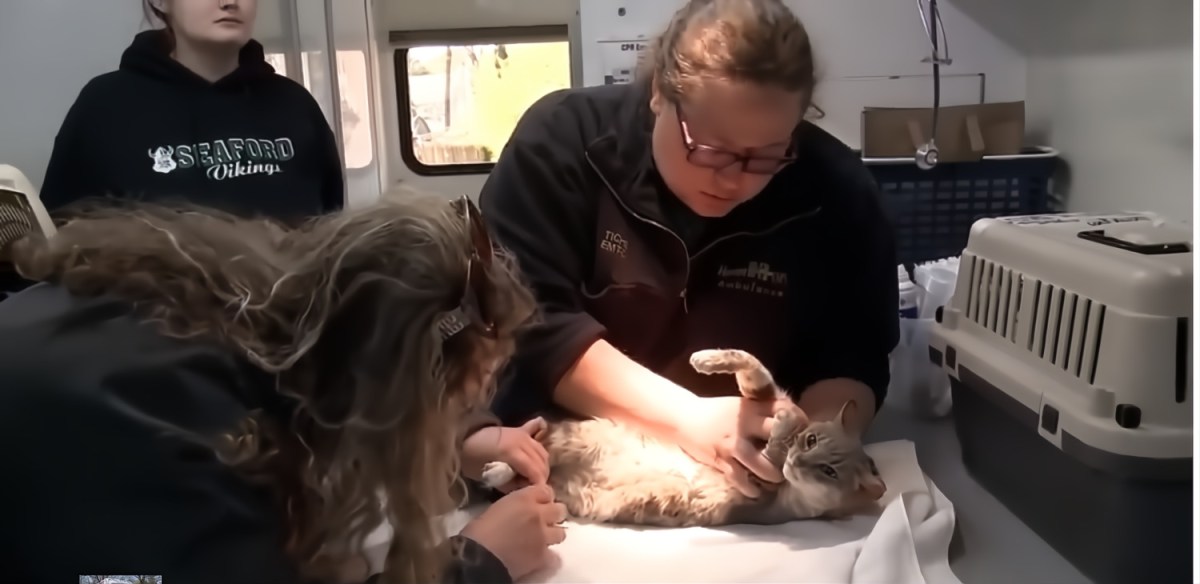
The surviving cats have a range of injuries, from minor sprains to life-threatening lung damage from smoke inhalation. Volunteers have spent the past several days trying to collect the traumatized animals from the vicinity of the destroyed sanctuary.

“I knew Chris well. I knew when he started. He died doing what he loved… rescuing animals,” said Robert Misseri, co-founder of Paws of War, which brought a mobile veterinary clinic to the site of the former sanctuary this week. “The very least we can do is continue his legacy and make sure that every single one [of the] cats get the proper love and care that they need to move forward.”

Veterinarians said they’ve treated lots of cats with burnt paws. Although the animals are skittish from the harrowing experience, rescues and shelters in the area are helping them find forever homes, veterinarian Jason Michael Heller told ABC News.

“We’re going to ask for our colleagues in the area here, hopefully, to take a few cats and try to get them healthy enough to be able to eat and be adopted,” Heller said.

People in the Long Island rescue community are also working on a public memorial for Arsenault, a man who dedicated his entire life to the animals in his care.

“There’s not going to be another Chris, ever, who does this,” said John Spat of Animal Protection Service, “and all we can do is try to recover what he was trying to do and try to move forward and help his organization work forward.”

NY Sanctuary Founder, As Many As 100 Cats Feared Dead In ‘Suspicious’ Fire

Chris Arsenault ran back into the fire in an attempt to save more cats and never reemerged.

A man who founded a cat sanctuary to honor the legacy of his deceased son was killed, along with some 100 of the cats he cared for, in a raging fire Monday morning.

Christopher Arsenault, 65, lived on the premises of the Happy Cat sanctuary in Medford, along with about 300 cats he’d saved from euthanasia, dangerous situations and difficult lives as strays.

Firefighters were dispatched a few minutes after 7 am and it took them an hour and 20 minutes to bring the powerful blaze under control. Arsenault was able to get out of the main structure on the Suffolk County, Long Island, compound, but dashed back in to save more of his cats, according to neighbors who witnessed the fire.

Chris Arsenault at Happy Cat sanctuary. Credit: Happy Cat Sanctuary

The Suffolk County homicide and arson investigation squads are assigned to the case, Suffolk police Chief of Detectives  William Doherty told the New  York Post.

However, it can take weeks for lab results from the state police crime lab in Albany, and fire investigators will need to comb through the remains of the ruined structure and the rubble to find a point of origin.

“It’s too early in the investigation to determine any cause,” Doherty told the Post.

The grounds and facilities at Happy Cat sanctuary were meticulously maintained, but that did not stop some in the community from complaining about the existence of the sanctuary.

Arsenault “vowed to take the unwanted, discarded, homeless [cats], the ones that people were going to euthanize, he refused and he took them into his sanctuary, sometimes for no money at all,” Lisa Jaeger, a local cat rescuer who worked with Arsenault, told NBC New York. “He started the sanctuary [in 2007]. This was his life. He gave his life to save these cats.”

The sanctuary’s Facebook page was flooded with an outpouring of grief on Monday from people who knew and supported Arsenault.

“He was always so concerned about each and every single cat he had in his care. Didn’t matter how many… they were all his babies,” one distraught woman wrote. “To think he literally lost his life trying to save them breaks my heart and makes all the sense in the world that he would never leave them behind.”

Local rescuers and the county SPCA were trying to corral the surviving 200 cats on Monday. Some fled the grounds during the fire and remained unaccounted for, while others remained close to the destroyed sanctuary despite the chaos and the significant amount of activity from first responders.

Despite his efforts, Arsenault was the subject of a harassment campaign on social media from neighbors and a small group of people who alleged Arsenault wasn’t properly caring for cats. There’s no evidence to back up those claims, and Happy Cat has not been the subject of any violations.

A petition on Change.org posted last year demanded a stop to the alleged harassment of Arsenault by neighbors and a local code enforcement officer. It garnered 28,665 verified signatures.

Despite locals standing up for him, Arsenault had found a piece of property in upstate New York and was preparing to move his cats and sanctuary to that location.

John DeBacker, who participates in local trap, neuter, return (TNR) efforts, referenced the push back against Happy Cat in a post about the fire on Monday.

“Despite being harassed for months, he continued to fight for the cats,” the post read, “and I truly hope everyone can screenshot posts from one of the groups that has been harassing him in case arson is connected.”

An outdoor area at Happy Cat sanctuary. Credit: Happy Cat Sanctuary

It’s important to note that there is no evidence connecting any of the critics to the fire, authorities have not commented on the source of the fire, and any speculation about the cause is just that: speculation. It’s also important to emphasize that just because police homicide and arson squads are investigating an incident does not mean either of those crimes has taken place. Authorities won’t know anything for sure until they can thoroughly investigate the fire scene and get lab reports on evidence.

Arsenault himself said he felt compelled to respond to critics last month in a video he posted to Youtube.

“The audacity of these people to call Happy Cat sanctuary a hoarding situation, to be claiming that we’re committing animal abuse and animal neglect,” he said “The cats that I see…these are cats that are out there and have nowhere to go. These are cats that are suffering out there. And this is where sanctuaries come in … Right now [the critics are] just taking a big handful of spaghetti, and they’re just throwing it up against the wall to see what sticks to come after Happy Cat sanctuary.”

‘Swift And Lethal’: Cats Have No Defense Against Bird Flu, And It Keeps Showing Up In Their Food

Bird flu is killing cats domestic and wild, in captivity and in nature. Experts are sounding the alarm, warning people not to feed their cats raw food, allow them to drink milk, or let them roam outside where they can easily catch the virus by going after small prey.

Highly Pathogenic Avian Influenza, the clinical name for bird flu, is a danger to all animals, but for cats it’s a virtual death sentence.

Only a handful have survived infection thanks primarily to early diagnosis, intervention and round-the-clock veterinary care. In the vast majority of cases, the virus burns through its feline victims in three or four days.

Bird flu has become even more deadly for felines of late. Of the 126 domestic cats killed by H5N1 since 2022, according to the US Department of Agriculture, half of them have have died in 2025 — and it’s only been three months.

Notably, that total doesn’t include captive wild cats and big cats, such as the 20 pumas, bobcats, tigers and other felids who succumbed to the virus at the Wild Felid Advocacy Center, a sanctuary in Washington state. Nor does it include cats living in the wild, like two pumas in the same state that died in December.

To appreciate the true scope of the problem, the more illuminating statistic may be 82 million, which is the number of chickens “culled” — killed — in the US since 2022 because they were infected or raised at facilities where other birds tested positive for the virus.

Factory farming compounds the matter: more than 1.6 million egg-laying hens and 337,000 “pullets” — chickens less than a year old — were “depopulated” at a single facility in Texas last year. As staggering as those numbers are, Texas’s Department of Agriculture noted the figure merely “accounts for approximately 3.6% of the company’s total flock.”

Per the USDA:

“To provide context on the overall size of the U.S. poultry flock, there are more than 378.5 million egg-laying chickens in the United States. In 2023, more than 9.4 billion broiler chickens and 218 million turkeys were processed in the United States.”

If there ever was an example of putting too many eggs in one basket, this is it. American food supplies are vulnerable with so much concentrated in the hands of so few companies, a lesson the general public is learning the hard way now after eggs peaked at record prices last month. Things have cooled off a bit since then, but shoppers aren’t getting any benefit as grocery chains continue to charge a premium: the nationwide average for a dozen eggs was $5.90 in February, but stores in some states are still charging $10 or more.

It also raises questions about the sustainability and ethics of eating animals. Humans slaughter more than 75 billion chickens every year, and projections indicate there will be three billion more of us by the mid-2080s.

Meat from infected chickens can still end up in your cat’s bowl

Media reports about culling give the impression that those birds are removed from the food chain, but that’s not entirely true. The pet food industry has always cut corners by harvesting meat not fit for human consumption, a category that includes everything from the carcasses of sick animals, to “meat by-products” that can include beaks, hooves, eyes, hearts and other organs.

So while the culled chickens won’t show up in shrink wrap at the grocery store, they are making it into the pet food supply chain. Most pet food is “rendered,” cooked at such high temperatures that potential pathogens have been destroyed.

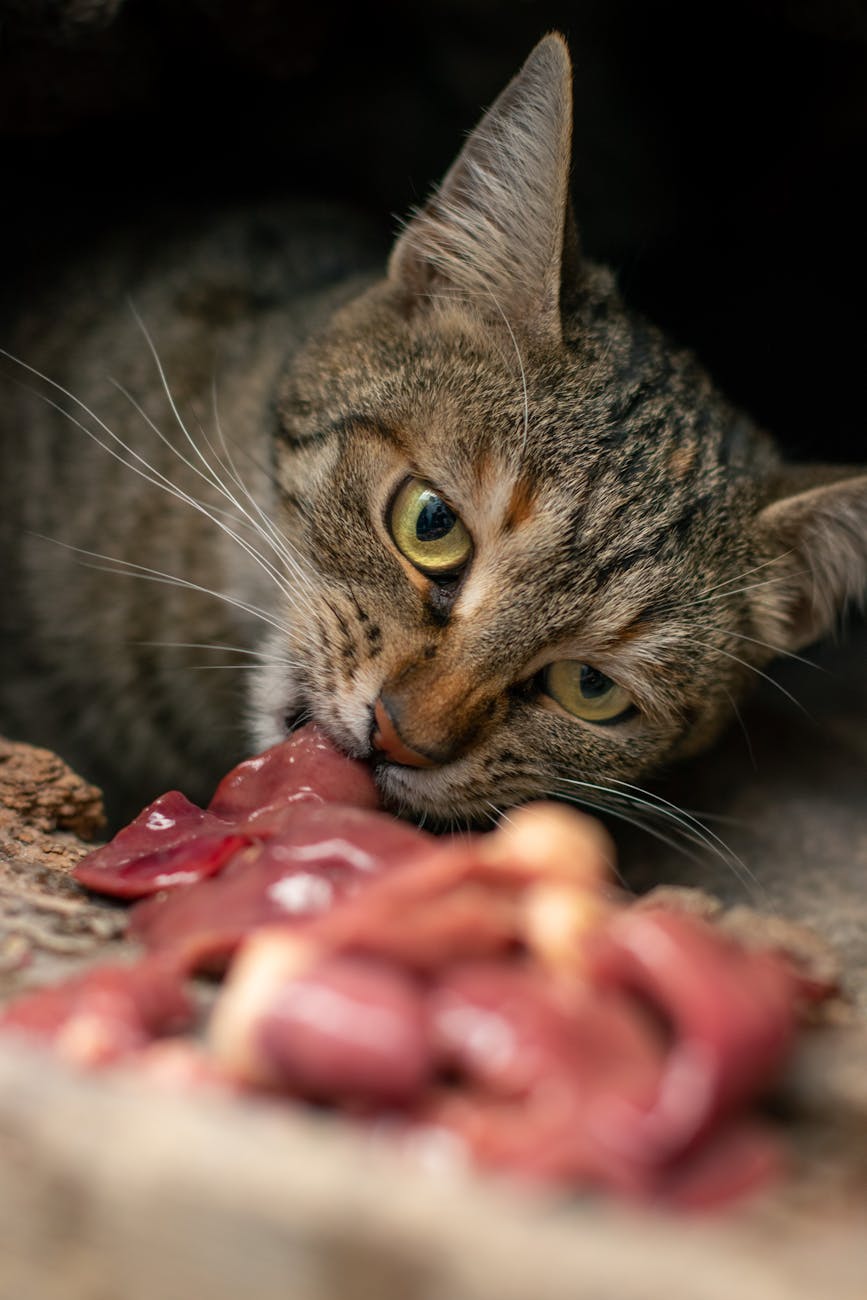
But an increasingly bigger slice of the market has been claimed by companies selling “premium” raw food — and that’s been the primary infection vector for domestic cats, particularly indoor cats who otherwise would have little or no exposure to the virus. (Cats who spend time outdoors can catch bird flu by preying on infected animals, just as wild cats do, and barn cats have caught it by drinking the milk of infected cattle.)

Cats are mostly lactose intolerant, and should not be given cow’s milk, despite the common misconception that it’s healthy for them.

“The animals that were depopulated could potentially have ended up in the food chain for pets,” Laura Goodman, an assistant professor at Cornell University’s Baker Institute for Animal Health, told NBC News. “It’s not uncommon for substandard meat to end up in the pet food chain.”

That’s what happened to Tim Hanson’s beloved cat, Kira, who died in February after eating raw food from a company called Wild Coast. The company has recalled the product, Boneless Free Range Chicken Recipe. It’s one of four recalls in the last month alone.

Hudson is suing Wild Coast for the veterinary bills — about $8,000 — and said he was devastated that Kira, whom he called “the happiest cat,” is gone. He said he thought he was doing right by her by feeding her the expensive raw food, but now urges people to avoid feeding their cats raw food at all costs.

“I don’t want any more cats dying,” he said. “Hopefully people can learn from Kira’s passing.”

Top image via Pexels. All other images via Wikimedia Commons

Little Buddy Demands Due Regard On National Respect Your Cat Day

Your feline overlord(s) want you to show more respect, human! What special things are you doing for them today?

Little Buddy has informed me that today is National Respect Your Cat Day.

Sounds made up, doesn’t it?

At first I was sure it was, just like the times he told me it was International Buy 100 Toys For Your Cat Day, and the 82nd Annual Feed Your Cat A Ridiculous Amount of Snacks Day.

But apparently it’s real, and Buddy made a big show of declaring its importance, dressing up as a judge with a black robe and gavel to emphasize his point.

“The court rules, inter aloha, that defendant subway sandwiches judice is mens rea when it comes to the ad hoc crime of not feeding me enough snacks! The court has concluded the accused has not met de minimus standards for snackis maximis deliciousness, therefore stare decesis!”

He cleared his throat.

“In plain meows, that means you must feed me more of those crunchy ball things, and a lot more of those decadently delicious soft treats so bursting with turkalicious flavor! And, uh, you have to apologize for not appreciating me enough!”

“It’s is the court’s opinion that you cook me a steak dinner!”

The feline shuffled his papers, adjusted his robe and began reading again.

“The court finds that Buddy the Cat has been a loyal, handsome, and handsomely loyal companion to the accused, and has enriched his life by simply being delightful, and also by purring contentedly, napping on him, helping him eat cheese, keeping his scooping skills sharp, and enhancing all aspects of his life through pure magnetic charm,” he said. “Respect me and my authoritah!”

So tonight Buddy will get plenty of yums, some catnip, extra play time, and I’ll tell him he’s looking particularly dapper today.

As for those of you reading this, better plan something before word gets out…or face your cat’s wrath when they find out it was Respect Your Cat Day and you did nothing!

Fearless Cat Forces Bear To Retreat, PLUS: Flow’s Void Sparks Interest In Black Moggies

Flow’s Cat has improved things for his fellow voids, who are drawing more interest from adopters.

This video is bonkers!

A cat who is definitely not Buddy stared down a bear and made the ursine interloper retreat in fear in a confrontation caught on camera.

The stand-off happened in Pike County, Pa., and the cat’s name is T’Challa, after the titular hero of Marvel’s Black Panther franchise.

“I think perhaps this young bear woke this kitty cat up because he was not happy that he was sharing his deck with him when he woke up and he expressed himself,” said the homeowner whose security cameras caught the exchange.

After T’Challa made a series of feints, the bear — who is orders of magnitude larger — beat a hasty (for a bear) retreat.

Well done, T’Challa! Someone get that good boy a treat!

Go with the Flow

Part of what makes Flow so spectacular — aside from the breathtaking visuals, clever narrative and the strange world it portrays — is how endearing its star, Cat, is.

The little guy shows enormous resilience as he survives a biblical flood, gets chased by a flock of angry secretary birds, learns to swim, and finds his confidence in situations that would terrify any feline. He’s incredibly expressive, revealing his emotions with every twitch of his tail and whiskers, as well as his distinctive meow and, most of all, his bright yellow eyes.

He’s also the first feline star to win an Oscar and a Golden Globe, as well as many other film awards for the universally praised film.

Now he’s got another accomplishment to his name: he’s improved the way people view black cats, who have long been the victims of absurd human superstition and have a hard time finding forever homes because of the stigma.

Credit: Live RIGA

Animal welfare organizations are reporting heightened interest in black cats (good), but not a manic rush to adopt them as has happened when other species and breeds are popularized in films. (Bad, because those pets are often discarded when the novelty wears off.)

In other words, Cat may have inspired something close to parity in adoptions in some places.

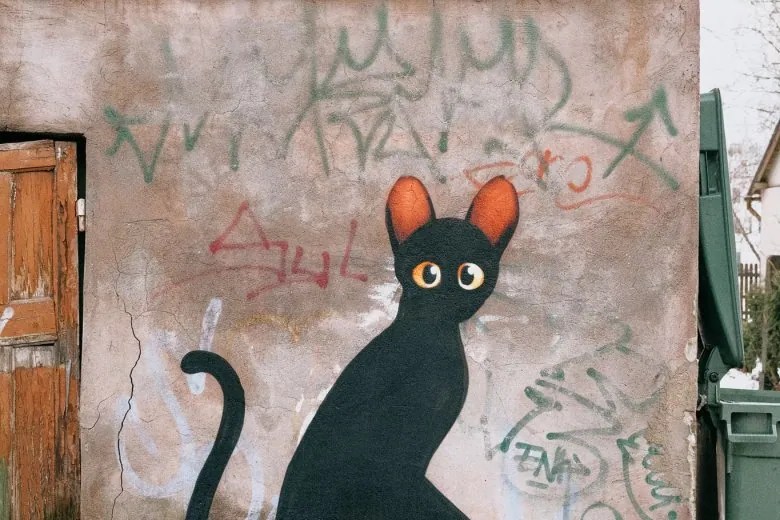
Cat is beloved in director Gints Zilbalodis’ home country of Lithuania. The capital, Riga, is now adorned with street art of the little guy, including a statue sitting atop a major monument in the heart of the city.

Credit: Live RIGA