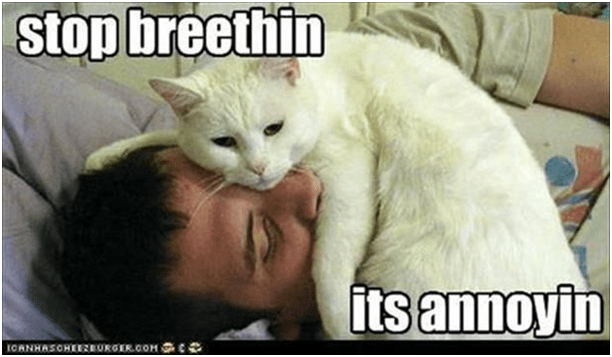
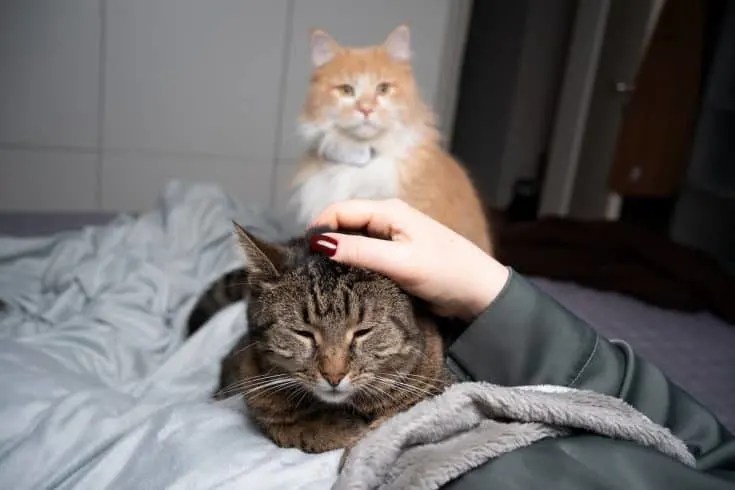
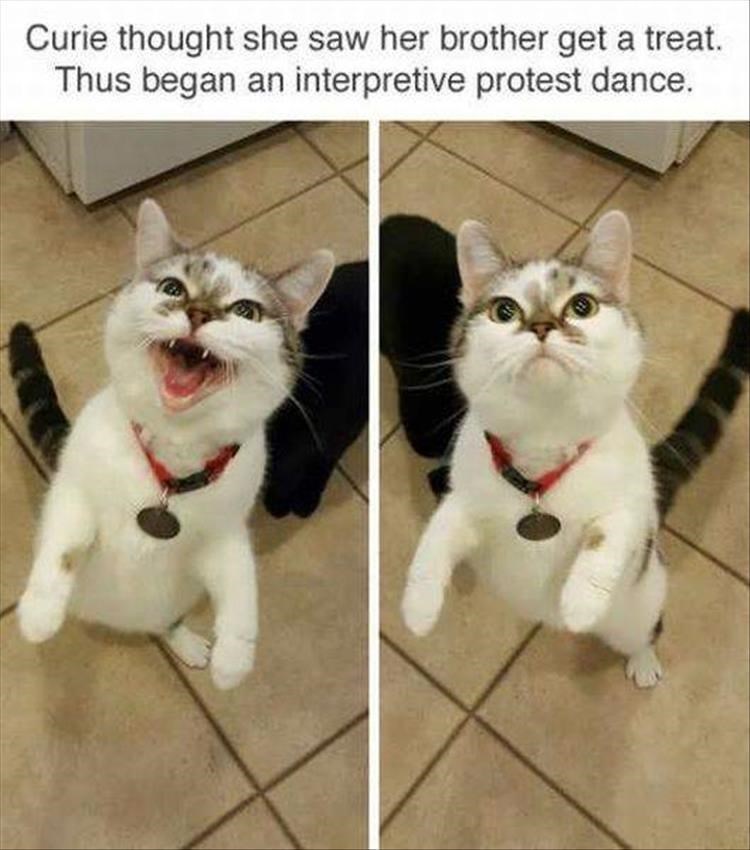
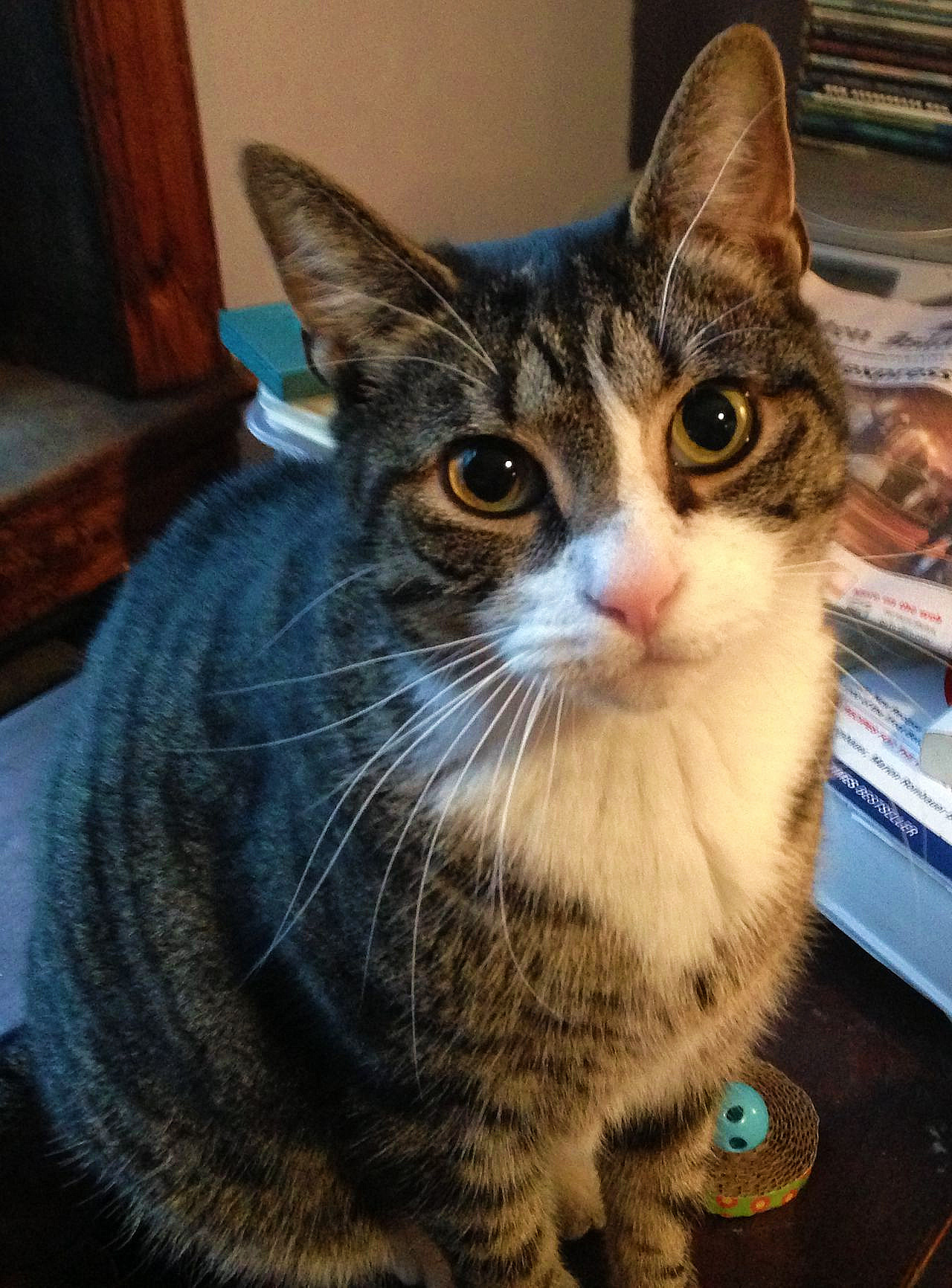
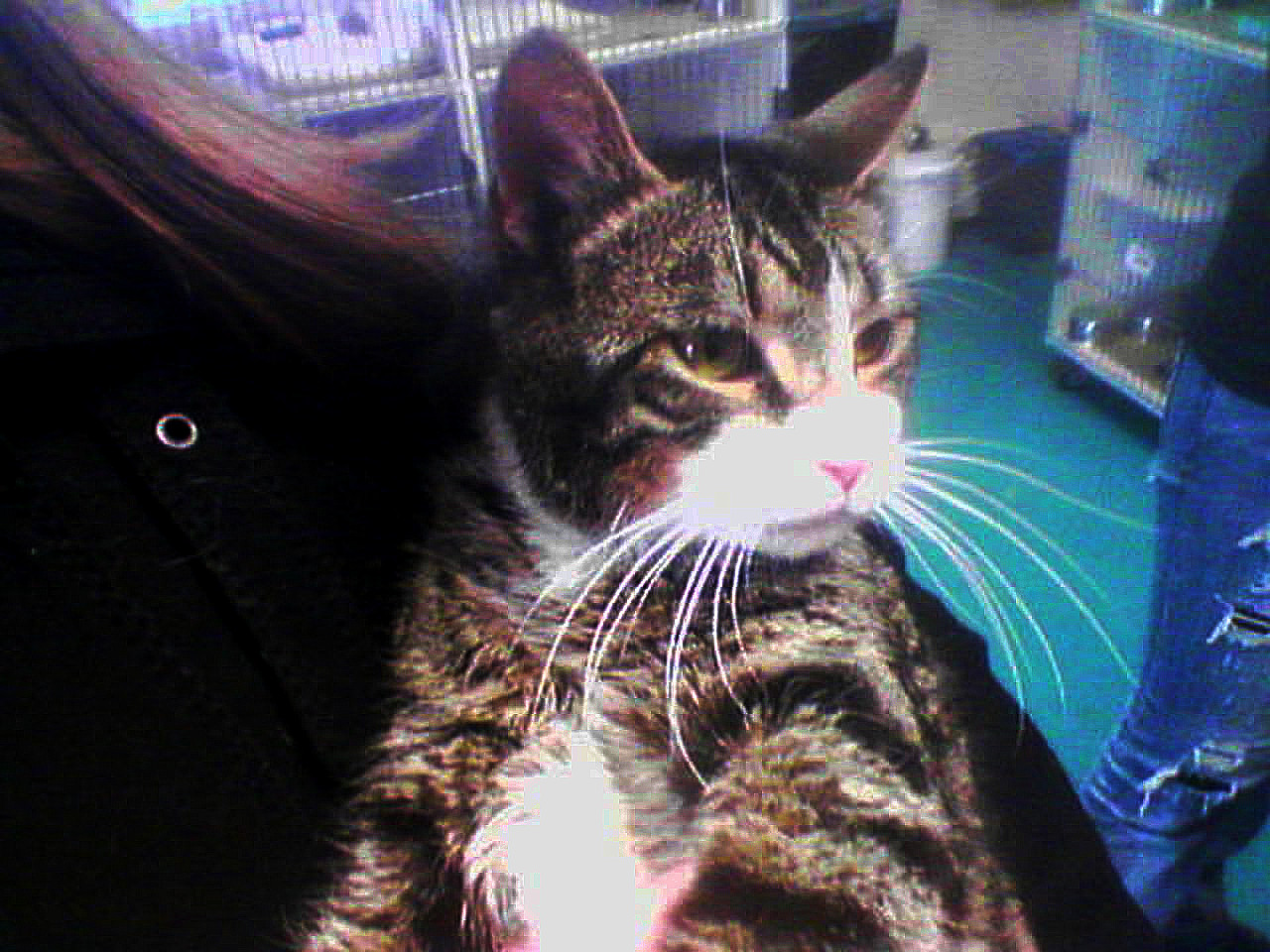
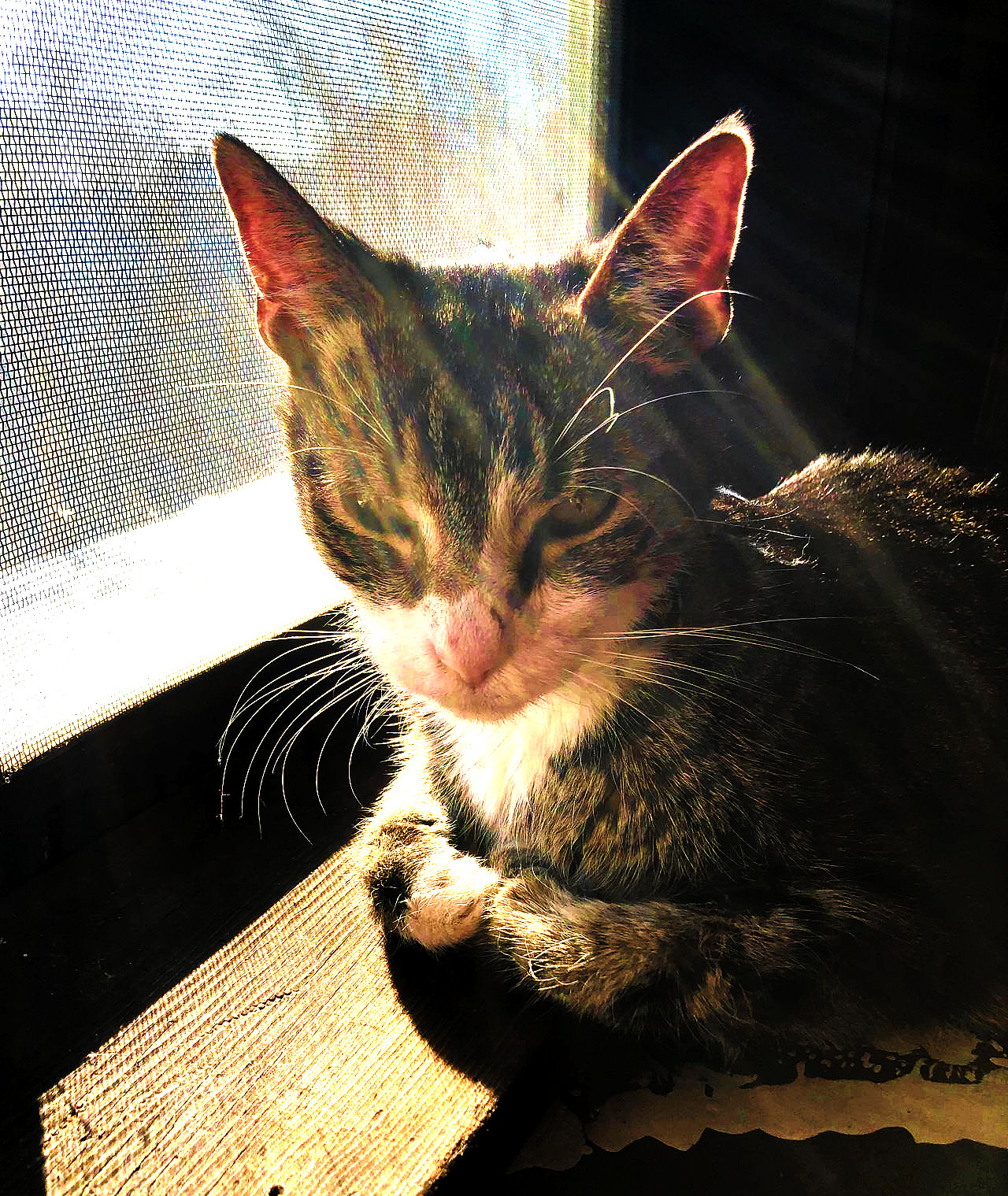
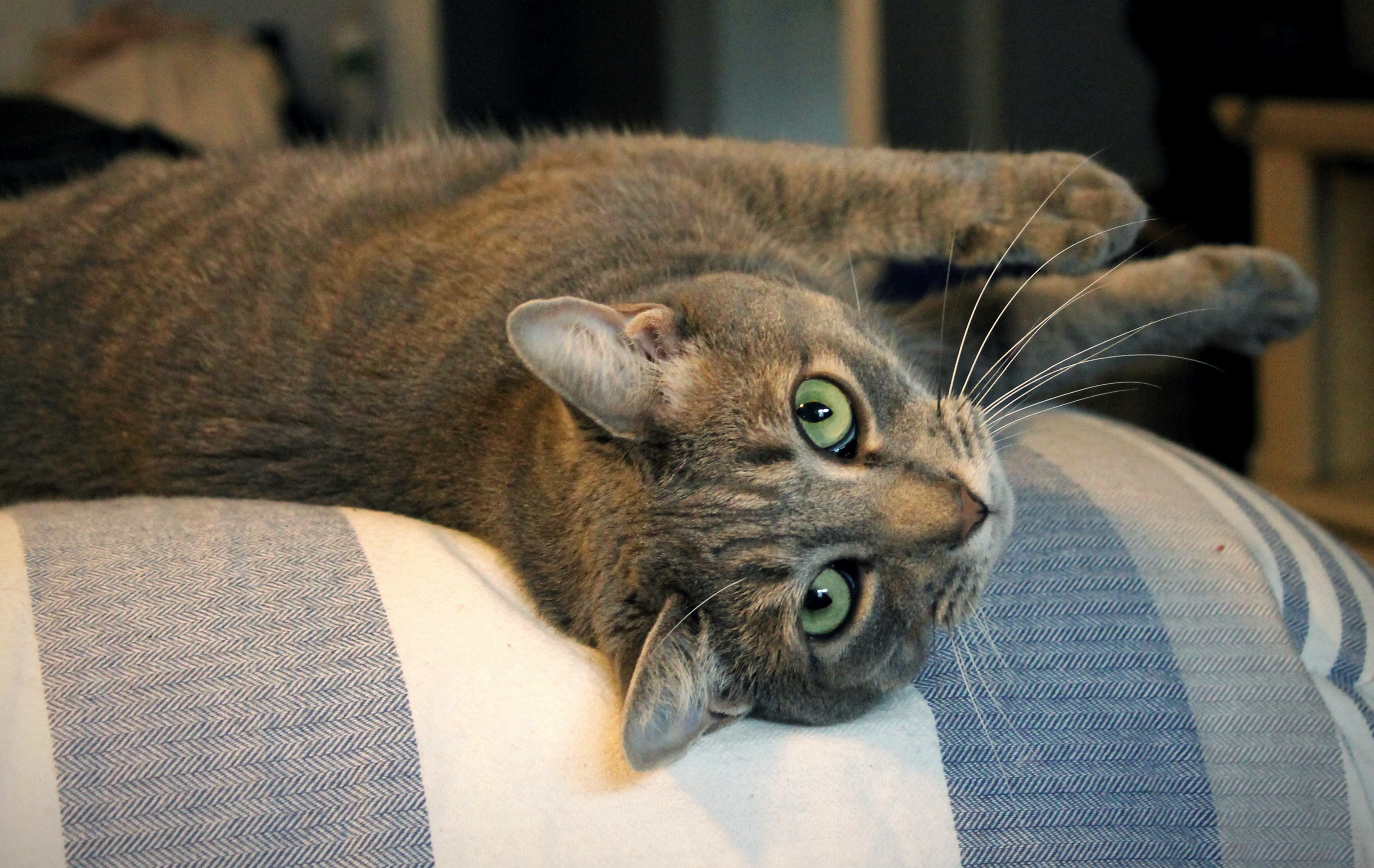
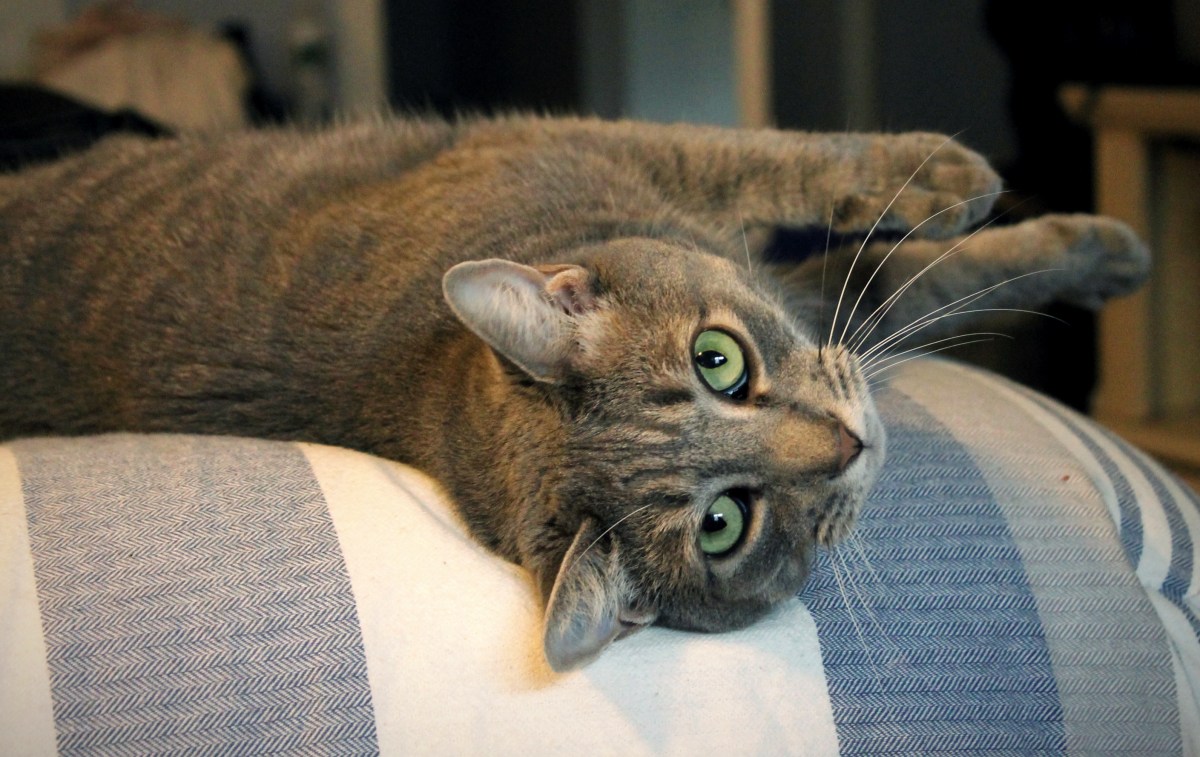
Buddy the cat argues it’s no big deal to walk on your face, human, while Buddy the cat argues it’s an outrage that you disrupt his beauty rest!
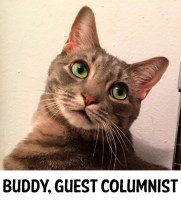
Disrupting My Sleep Is Really Rude! by Buddy the Cat, columnist.
Hey! Not cool, dude! I was sleeping and you woke me up by sitting on the other side of the couch! And yesterday I was napping on your keyboard, trying to make up sleep after only getting 12 hours the day before, when you picked me up and placed me on your bed, mumbling some sort of lame apology about how you have to do “work.”
Is it too much to ask for a little consideration around here? Is it too much to ask that you put off nature’s call for a mere three or four hours when I fall asleep in your lap? I’m not asking for much!
The next time you’re tempted to disturb my beauty rest, ask yourself how you’d feel if I did the same thing to you!
Is It Not Reasonable To Walk On Your Face While You Sleep? by Buddy the Cat, columnist
What? Why are you being so dramatic? So I walked on your face and screeched into your ear. What’s the big deal?
I was hungry. I wanted breakfast. The whims of my appetite must always come before your “need” for sleep.
I don’t know if you realize this, human, but you are very comfortable to lounge, sleep, walk and bounce on. I find my creative powers are heightened to their utmost when I’m laying on top of you, keeping you locked into an uncomfortable position while you’re willing to allow your limbs to fall asleep for my comfort.
Is that not the crux of our relationship, anyway? You feed me, take care of me, groom me, entertain me and pick up after me, in exchange for being in my delightful company, yes? It could be argued that allowing me to sleep on you and walk on your face is but a basic part of your duties as a servant.
Now let us discuss the idea of a turkey dispenser next to your my bed…
Point-Counterpoint presents two essays taking opposing positions on a topic. Join us again next week, when Buddy the Cat will debate Buddy the Cat on another important topic.
A cat who famously interrupted a soccer match earlier this month will get life-saving surgery thanks to donations.
Running onto the field in the middle of a professional soccer game is probably the best thing Topsey the cat ever did.
The nine-year-old tortoiseshell went missing in June of 2021 when her human, Alison Jubb of Sheffield (UK) was going on vacation and taking Topsey to a cattery. Topsey got spooked, bolted from her carrier, and after months of fruitless efforts to find her, Jubb thought she’d never see her cat again.
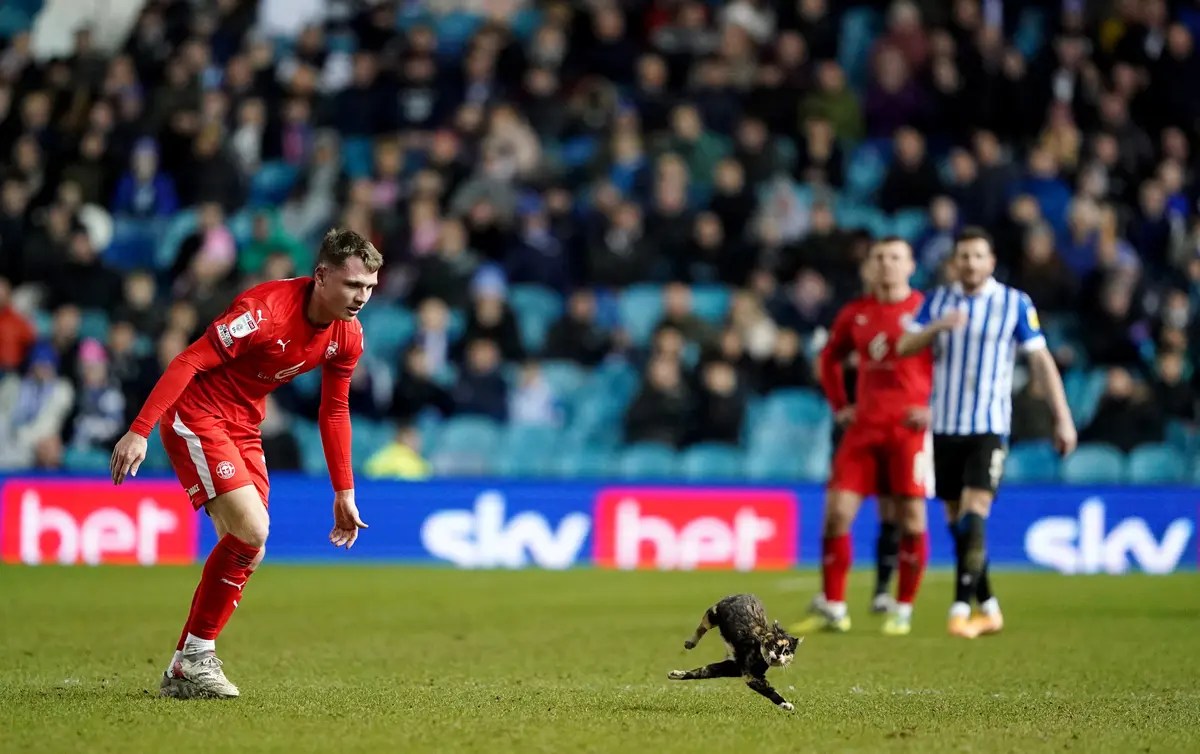
Then in the 94th minute of a Feb. 8 match between Sheffield and Wigan Athletic, a familiar-looking tortoiseshell dashed onto the field. Wigan’s Jason Kerr risked a penalty to catch and calm the clearly distressed cat while the crowd erupted in cheers.
“My daughter-in-law rang me last night and said, ‘Are you watching the football match?'” Jubb said. “I said ‘No,’ and she said ‘There’s a cat that ran on the football pitch and it just looks like Topsey.’ And I sort of laughed it off because I thought it won’t be.”
But the veterinarian rang the next day and, to Jubb’s surprise and delight, said the Sheffield woman’s cat had been identified via a microchip scan.
One of Sheffield’s season ticket holders happened to be a veterinarian, and when he offered to examine the terrified feline at the stadium, he realized she had serious injuries and brought her to a nearby clinic.
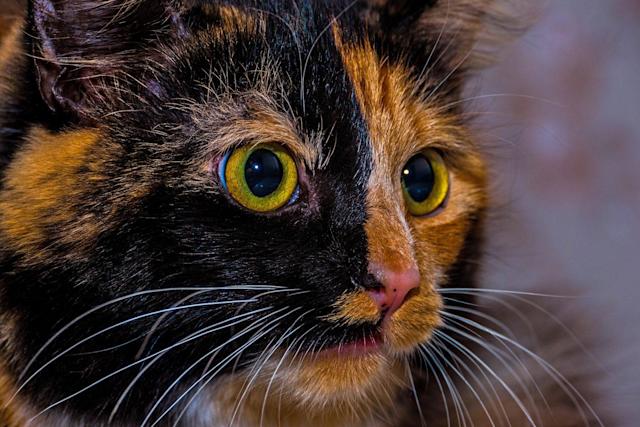
Topsey in better times before she went missing. Credit: Alison Jubb
Topsey had survived her harrowing eight-months away and her bloodwork was okay, but the veterinarian said the tough little kitty had endured an attack by a dog or another larger animal, who picked her by her neck and shook her in its jaws. Topsey suffered broken bones, a damaged spine and had teeth marks on her neck.
The veterinary bill is hefty: Jubb was told she’s looking at about £10,000, or more than $13,000 in US dollars, to cover the exams, scans, surgeries and other necessities to relieve Topsey’s pain and mend her little body.
Generous cat lovers and soccer fans helped Jubb and Topsey reach that goal in just a few days. The campaign’s donations sit at £11,585 as of Feb. 19, and any money left over from Topsey’s veterinary care will be donated to a local rescue.
Topsey can’t walk properly because of her injuries, and in the 11 days since she was rescued, she’s been in veterinary care, recovering and scarfing down food after so many lean months left her malnourished.
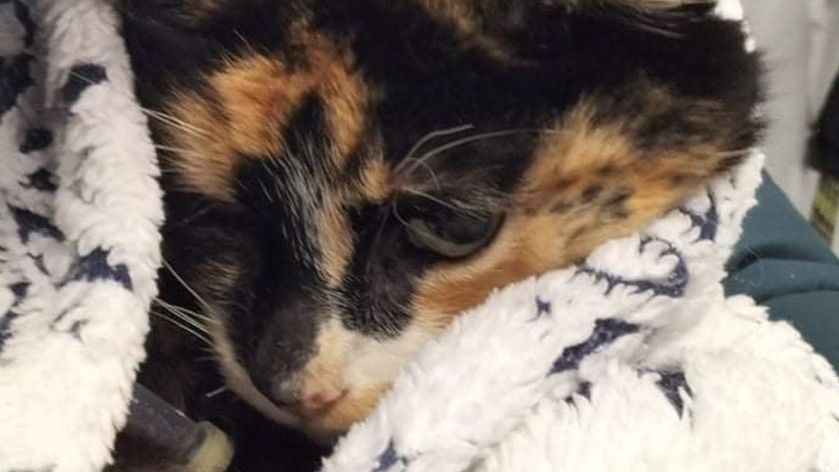
Topsey’s swaddled up in the care of a veterinarian. Credit: Alison Jubb
Despite the severity of her injuries, Topsey is “very comfy and she’s doing really well,” Jubb told the BBC.
Jubb says Topsey is constantly purring and is no doubt thrilled to be reunited with her humans and on the mend.
“Everybody has been brilliant, – my phone’s not stopped all day, it’s amazing,” Jubb said after Topsey was recovered. “And the players, I’d just like to say ‘thank you’ for being so gentle and kind with her and everybody who looked after her [on Feb. 8] because they’ve all been so nice with her and that’s lovely.”
While the answer is obvious to cat servants, proving feline jealousy in a study is a different ballgame entirely.
Bud isn’t fond of my smartphone.
Like many other humans I spend too much time looking at the damn thing, and that’s not good even though I have the excuse that I use my phone as a reader and my presence on social media ranges from extremely limited to nonexistent.
When His Grace has decided I’ve looked at the screen long enough and it’s Buddy Time, he’ll pad up and slap the phone out of my hands, or if I’m laying down he’ll climb on top of me, nudge the phone out of the way and sit on my chest so he has my full attention.
“No glowing rectangle!” he’s saying. “It’s Buddy Time! Now scratch my chin and rub the top of my head as I purr!”
Naturally I comply, and before long Buddy is leaning in, pressing the top of his head against my forehead, which is his way of saying: “I love you, slow dumb human! You have many flaws and you don’t give me enough snacks, but you’re my Big Buddy!”
Of course, intuitively knowing Buddy is jealous of — or annoyed by — my phone is different than proving it in a well-designed, repeatable experiment.
Psychology Today’s Jessica Wu writes about just such an effort by a team of researchers out of Japan.
Before I offer my criticism of the study, let me first say I have respect for the team at Kyoto University. They’re one of a handful of research teams around the world that routinely produce studies into cat behavior and cognition, and it’s clear that they view it as an important and crucial area of research. That’s significant, because even though we’ve seen something of a renaissance in cat-related studies over the past half-decade or so, many scientists still think cats are nearly impossible to work with.
The team at Kyoto also understands the territorial nature of cats makes it difficult to study them in a lab environment, so they go the extra mile and enlist people who are willing to let them into their homes to study their little tigers.
That’s what the Kyoto team did for their 2020 study on jealousy, splitting their research between typical homes and cat cafes. (Fifty two cats in total participated.) All the cats observed in the study had been living in their homes or cafes for at least six months.
Researchers took a method that’s been used to study human babies and dogs, and adapted it for felines. They brought in a plush cat and a pillow with a corresponding color and texture.
Then they asked the participants to spend time petting the plush cat and the pillow in front of their furry overlords while team members carefully watched the kitties for their reaction. Each experiment was then repeated with a stranger petting the plush and the pillow to gauge whether cats behaved differently when observing someone they aren’t emotionally attached to.
The team found the cats “reacted more intensely” to the plush cats than the pillows, but there wasn’t any marked difference in how they reacted when they watched their humans versus strangers.
Crucially, the cats didn’t show signs that they were upset, like human babies have in such experiments, and they didn’t try to physically separate their humans from the plushies, as many dogs did in their version of the experiment.
“How dare you hand out yums and not include me!” Credit: icanhazcheezburger
The results indicate cats didn’t express jealousy in the experiment, but the Kyoto team are pros, noting that it’s just one study with one approach.
“We consider the existence of some cognitive bases for jealousy to emerge in cats, and the potential effect of cats’ living environment on the nature of their attachment to their owner,” they wrote. “More ecologically valid procedures are required for further study of these issues.”
It’s my non-expert, non-scientific opinion that researchers would get better results using actual cats instead of proxies. That introduces a new set of problems and an experiment involving rival cats won’t be easy, but science isn’t supposed to be easy, and if we really want to understand how cats think, we have to get as close as possible to mimicking real circumstances.
The plush cat used in the Kyoto study. Perhaps the cats involved in the research felt the humans were insulting their intelligence. Credit: Kyoto University
It would also help to expand the scope of the experiment. How much can researchers really glean from a fleeting interaction? Jealousy isn’t something that just bubbles up and disappears. It happens within an emotional context. It’s a secondary emotion that sprouts from elements of primary emotions like fear, anger and confusion.
Scientists are very careful about anthropomorphizing animals, for obvious reasons, but sometimes they’re guilty of over-correcting as well and denying the obvious, which is why the prevailing scientific opinion for almost half a century, until 1959, was that animals don’t have emotions or cognition.
In the meantime, Buddy will continue to make sure Buddy Time is equal to, or greater than, glowing rectangle time.
One lucky cat in Ohio has an aquarium designed just for him.
Cats love watching fish almost as much as they love eating them, but felines and their aquatic counterparts are infamously difficult to keep as pets in the same house.
People who own standard aquariums inevitably learn they tend to double as unintentional treat cabinets for determined kitties who find ways to get at nature’s snacks inside. Some opt for supposedly more secure aquarium covers and resort to the usual tricks — double-sided tape, scent deterrents, foil — to keep their furry friends from climbing up to help themselves to treats.
Others take the easy route, pulling up hours-long Youtube videos of fish tanks for their cats’ amusement.
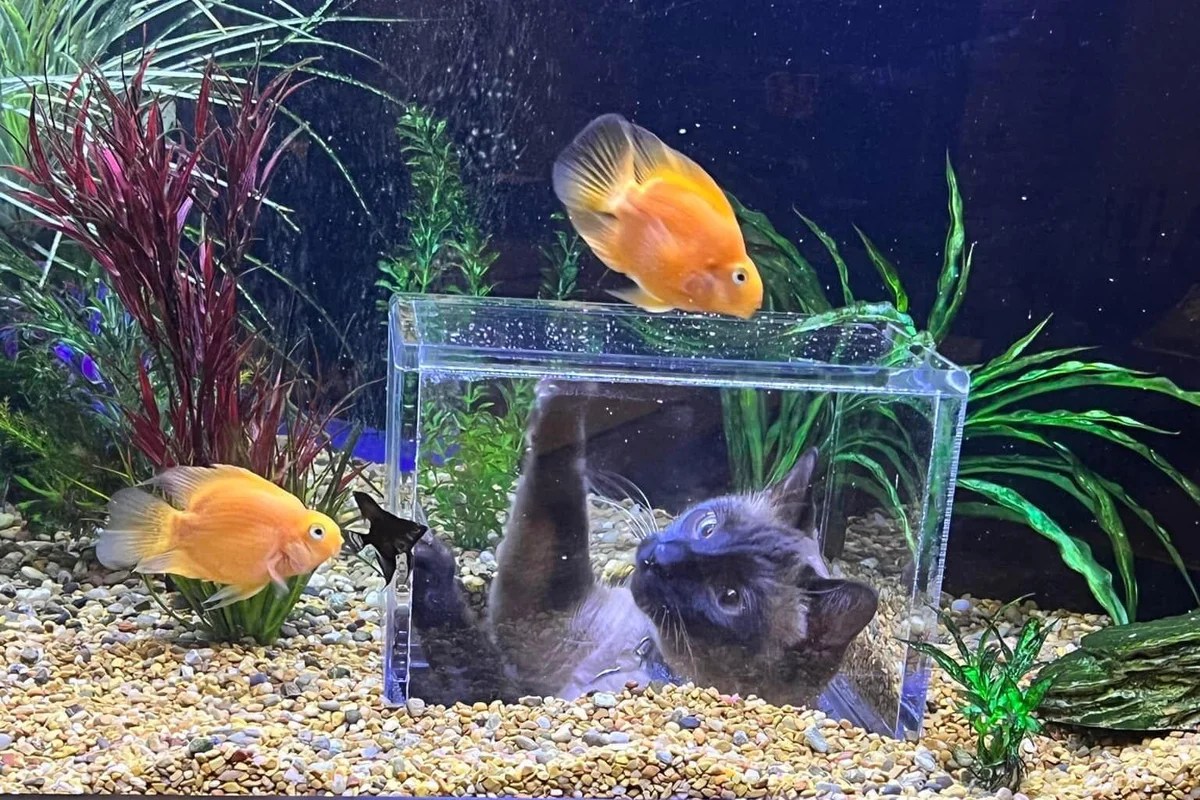
But one cat has the ultimate set-up, cat TV at its finest: A custom-built aquarium that provides him with a 360-degree view of the action from within the tank.
The cat’s name is Jasper, and his human, Melissa Krieger, bought the cat-approved tank from a Cincinatti shop that designs and builds custom aquariums.
There’s a cat-size shelf directly beneath the tank, and an observation blister built into the bottom of the tank itself, big enough for Jasper to poke his head up and get the closest view possible short of diving into the tank. Melissa even put a cat bed on the shelf so her furry overlord can watch the fish in comfort.
A man writes a stirring tribute to his beloved cat.
We take a break from our usual inanity, humor and Buddy’s mind-bogglingly terrible advice column to call your attention to this beautiful tribute to a special cat.
Tom Wrobleski, an opinion writer for the Staten Island Advance, said a tearful goodbye to his cat, Malkovich, on Jan. 11.
“I’ve cried more for that cat over the last three weeks than I have over some people that I’ve lost in my life,” he writes.
Tom says Malkovich was supposed to be his kids’ cat, but ended up bonding with him:
Mal would meet me at the door when I came home, flopping down and giving me his belly. He followed me into the bathroom. He curled up next to me in bed. He would flop in the hallway upstairs and rub his face on my foot.
Don’t let anyone tell you that cats don’t bond, that cats don’t love, that cats are stand-offish. Mal loved me. And I loved him. He was my buddy. My best boy. The top cat.
He became part of the fabric of our lives. He even grudgingly tolerated Lucy, the neighborhood stray we adopted in 2017.
Mal’s illness snuck up on Wrobleski, as so many cat health problems do because our furry friends are so stoic.
“We thought that Mal was getting a little chubby in recent months. It turns out that he was ill, with fluid gathering in his abdomen,” he wrote. “The news from the vet was dire: Mal had cancer throughout his body. There wasn’t a lot we could do.”
The author’s favorite photo of Malkovich the cat. Credit: Tom Wrobleski
The rest of it is really sad and would have made Buddy and I cry if we weren’t so manly and tough. Wrobleski writes about how much he misses Mal, and how much Mal changed his life during the 11 years he was a part of the family. (They adopted the little guy when he was four years old, and he lived until he was 15.)
His pain at losing the little guy is evident in every word and anecdote.
Be warned, though, that if you’re not as tough as Buddy and I, you probably will shed some tears, which Buddy and I definitely did not do. In fact, immediately after reading Wrobleski’s tribute to Malkovich, Bud and I watched a football game, drank Budweiser and shopped for a good old American pick-up truck while practicing our Sam Elliot voices.
Malkovich on the day he was adopted. Credit: Tom Wrobleski
Malkovich on his last day, sitting in one of his favorite spots and soaking up the sun for the last time. Credit: Tom Wrobleski
“I don’t cry about anything…except vacuums, rustling paper bags, truck back-up beepers, dinner, and being locked out of the bathroom. But other than that, I’m fearless and keep a firm leash on my emotions!”

 Hey! Not cool, dude! I was sleeping and you woke me up by sitting on the other side of the couch! And yesterday I was napping on your keyboard, trying to make up sleep after only getting 12 hours the day before, when you picked me up and placed me on your bed, mumbling some sort of lame apology about how you have to do “work.”