Dear Buddy: Why Do Humans Watch Horror Movies?

Dear Buddy,

What’s with these horror movies? My human likes to curl up on the couch under a blanket, with me protectively in her lap of course, and watch these ghastly movies about serial killers, ghost infestations and lurking monsters.

Why would anyone want to scare themselves? You don’t see us creating an entire film genre dedicated to horrors like empty food bowls or late dinners, so why do humans make these movies?

Your fan,
Mildly Curious in Manhattan


Dear Mildly Curious,

This is a question I’ve pondered for some time, inasmuch as I care about anything human-related to ponder. My human also watches those movies and he also does so with me sitting protectively in his lap.

Then I realized something. None of the people in these horror movies have cats!

The family from The Conjuring? They have a dog. Stanley Tucci’s family in that crappy movie about flying monsters that kill everyone? Dog! The family in that other crappy movie about giant axolotl-type things that terrorize people living in a coastal community?

You guessed it! They have a dog too.

You see where I’m going with this, right? Humans who serve us cats literally have no fear because no monster or crazy cereal killer would ever risk attacking a home with a cat in it.

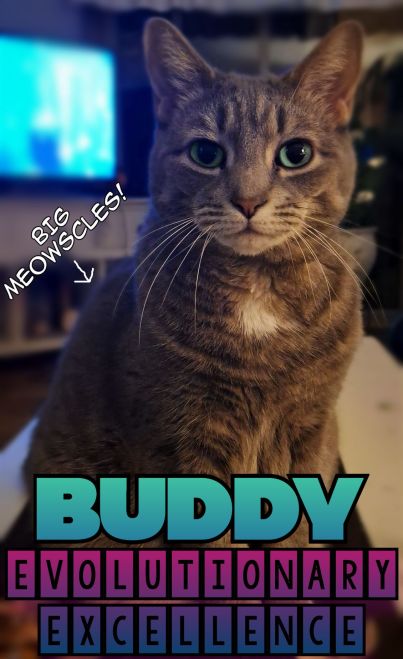
Suppose a hungry evil monster is let loose in my neighborhood and is making its way through the street at night, then sees me in all my meowscular, intimidating, tigeresque glory sitting at the window, keeping watch over the nocturnal world.

That monster is going to skip right over The Buddy Domicile and go in search of easier pickings because it sure as heck doesn’t want to tangle with me and my claws. I have that effect on monsters.

They may be monsters, but they’re not stupid. Breaking into a home with a cat is like breaking into a t-rex enclosure. You’re asking to get mauled by a huge, meowscular apex predator who will eviscerate you and look handsome and badass while doing it.

People who serve us cats know this. They know no monster or killer or robber would be stupid enough to go near a house with a cat. They can probably sense my meowscularity two miles away!

So sometimes our humans may want to know what it feels like to be vulnerable, what it would be like if they didn’t have tigers like us guaranteeing that no intruder approaches. THAT is why they watch horror movies. Take it to the bank!

Your genius friend,

Buddy the Cat

Cat: ‘No Study Time For You, Human!’

When cats demand attention they can be relentless!

I’m sure the behavior in this video, of a cat absolutely determined not to let her human get a second of studying in, is familiar to everyone who has the privilege of serving a feline:

The cat grabs at the pen, tries to chew on it, covers the book with her body, nibbles on the pages and plays pretty much every trick in the feline book to get her human to stop what she’s doing and engage in some good old Cat Time.

Or more bluntly, she’s saying: “NO STUDY, HUMAN! PAY ATTENTION TO ME!”

I never gave much thought to how students fare with cats but I know writing by hand is pretty much out of the question for me. Bud just won’t let me do it. Either he’s trying to bite the pen or he’s swatting at it with his paws, making my normally neat handwriting look like that of a deranged person demanding ransom or the work of someone stupidly drunk.

I’ve got a tradition of sketching scenes on birthday cards and other things I send to my nieces by snail mail, and Bud must be secured in another room before I can even attempt it.

Same deal with music, unfortunately. If I’ve got a guitar in my hands, little dude tries to cut in with a blazing, discordant solo of his own. Cat claws and guitar strings do not mix. If I’m using my synthesizer, Bud decides we’re going to do a duet by walking across the keyboard and yowling.

I’ve actually sat hunched at my computer for hours trying to stitch together guitar solos from several different takes because they were going swimmingly until Mr. Bud cut in with a paw and a claw, and trying to fix rhythm tracks that were perfect until Buddy the Destroyer decided 4/4 should become 5/8 or a particular chord progression should be interrupted with an accidental bit of guitar dubstep. Thank God for non-destructive digital editing in modern music production! Musicians in the days of analog multitracks must have had to put their felines under lock and key before attempting to record anything.

Do your cats stop you from doing stuff? What are their methods?

Cat Domestication Was The Start Of A Beautiful Friendship

Domestication’s real goal: to make cats cuddly as well as great mousers.

Cats have been doing things their way since the very beginning.

Unlike literally every other domesticated animal, cats were not domesticated by humans. They did it to themselves.

As if that didn’t make them unique enough, they lay claim to another major distinction: they’re the only species of obligate carnivores to undergo domestication in the entire history of human existence.

That explains why cats, more than any other animal that depends on humans, so closely resemble the wild animals they were before signing up for the good life of naps, warmth, endless rodents to hunt and free food from their new human friends.

In a new essay for The Conversation, evolutionary biologist Jonathan Losos, author of The Age of Cats: From the Savanna to Your Sofa, notes new DNA analysis settles the question of where cats came from once and for all.

Domestic cats are descended from North African wildcats, specifically the species felis sylvestris lybica. Unlike dogs, who underwent telltale physical transformations when they evolved from wolves, house cats “appear basically indistinguishable from wildcats.”

“In fact,” Losos writes, “only 13 genes have been changed by natural selection during the domestication process. By contrast, almost three times as many genes changed during the descent of dogs from wolves.”

While the change in genetics that happen with domestication left cats pretty much as they were physically, the process made dramatic changes in the feline brain, reducing regions governing fear and expanding those related to social behavior. The result? The major difference between house cats and their wildcat ancestors is disposition.

In other words, domestication made cats cuddly.

buddyevolution
Housecat evolved.

Notably, felis sylvestris lybica had to be pretty friendly in the first place, as well as bold and driven by the now-legendary feline curiosity to risk padding into human settlements with their bright lights, strange smells, open flames and the two-legged giants striding around them.

They didn’t have a way of negotiating or signaling their intent. They couldn’t say: “Hey guys, we’re here to kill and eat the tasty rodents who have been giving you problems by chowing down on your yums, but we don’t want your yums for ourselves. Plants are disgusting!”

So they had to demonstrate their usefulness, prove their worth, and enjoy the fruits of it by curling up in front of warm fires or on human laps.

That explains why it was the African wildcat that became a human companion species and not European wildcats, whom Losos notes are often “hellaciously mean” in interactions with people, even if they’re raised around humans when they’re young. It was also a matter of being in the right place at the right time, as nascent human civilization took root in the Fertile Crescent.

But ultimately, just like cats decided to domesticate themselves and didn’t really bother to consult us about it, so too do they bend us to their will with an entire repertoire of manipulative behavior, from solicitation purrs to incessant meowing and having a talent for looking their cutest when they want something.

While we may think we set the rules and parameters of our relationship with the furry little ones, as Losos notes, “cats usually train us more than we train them.”

Read the whole thing here:

Feline evolution: How house cats and humans domesticated each other

Buddy’s Cat Café Offers Cat Lovers A Chance To Pet And Feed Buddy

Buddy the Cat’s latest scheme makes him the main — and only — attraction at a new cat cafe, where customers fuss over him and feed him all day.

NEW YORK — The Big Apple’s newest cat cafe is doing a brisk business, offering cat lovers a new twist on the relaxing feline-and-coffee combo.

Instead of a typical cat cafe which could feature a dozen or more adoptable cats to interact with, Buddy’s Café and Catnip Lounge features one cat: Buddy, its proprietor.

For just $5 customers can come inside, enjoy a cup of coffee and spend their time petting and feeding Buddy. A separate menu offers a range of treats and catnip products which they can purchase to lavish on the gray tabby cat.

“It’s not easy being a one-cat operation, but I’m dedicated to my customers by making sure they can feed me and pet me as much as they want,” Buddy said as the cafe began to fill up.

buddyhiphop
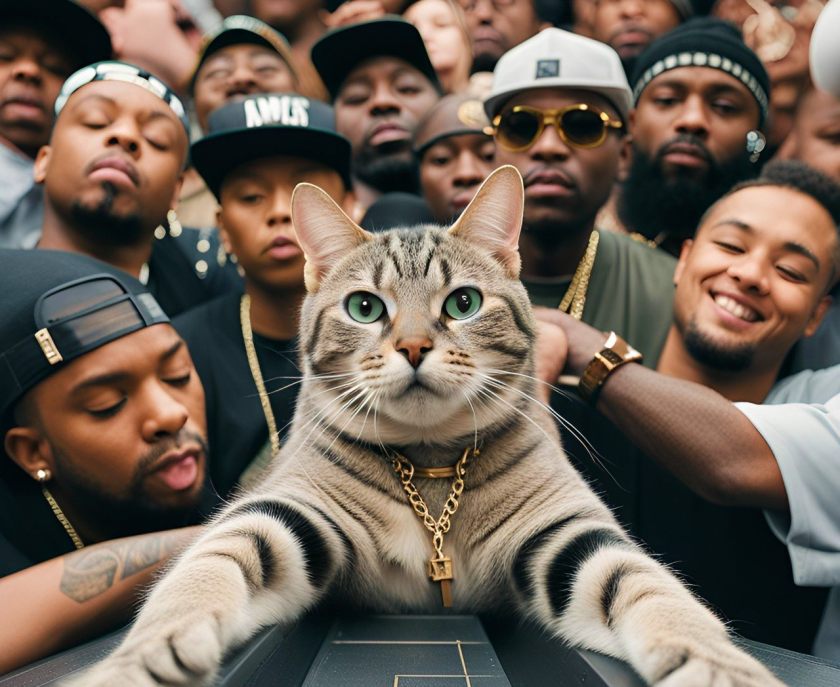
Buddy posing with regulars for Freestyle Fridays at Buddy’s Cat Cafe. Many young musicians come to Buddy for advice, as well as to pet and feed him.

By late afternoon several groups were seated at tables situated around a dais where Buddy stretched and yawned on a Roman-style chaise longue.

“Please, ladies, there’s enough of me to go around,” Buddy told a pair of customers who were arguing over which one of them was petting the feline first. “Sandra, why don’t you scratch behind my ears? Ah, that’s wonderful! Kim, my chin is free for scritches. Yes. You see? We can all get along.”

buddycatcafecrowd
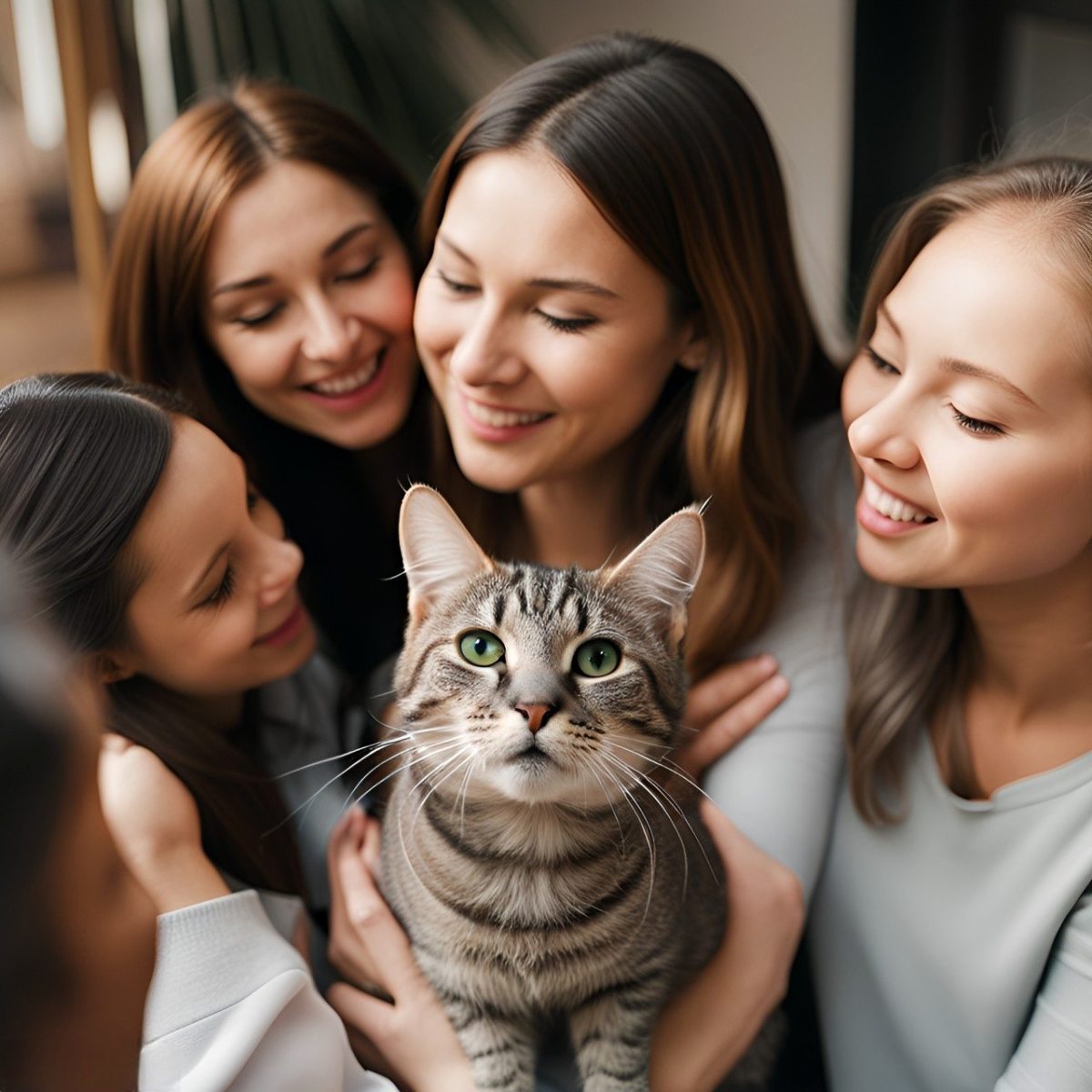
Buddy with students from Mrs. Nakamura’s fourth-grade class. The students come to Buddy’s Cat Cafe once a month to visit, feed and fawn over their feline friend.

Buddy was able to prevent another argument when he announced he needed to use his litter box and four customers volunteered to carry him there. He gestured toward a gilded palanquin in the corner of the room which was carved with elaborate feline motifs.

“You can each take a corner and carry me,” he said, settling himself down on the palanquin’s cushion. “You are all privileged today, my human servants.”

Buddy’s Cat Café even offers a VIP-tier membership package, the Frequent Feeder Program. Frequent Feeders are given priority seating closest to Buddy and are the first permitted to feed him snacks and give him massages during the afternoon rush.

“Buddy so kawaii!” said one admirer, Hideshi Igawa. “I like to read shinbun and admire Budditsu.”

Not everything always runs smoothly at the cafe, however. Earlier this week a man entered claiming to be “Buddy’s human” and demanded the beloved feline “stop this ridiculousness and come home.” Buddy looked skeptically at the man and pretended not to know him.

“Sir, you’re going to have to buy a cup of coffee like everyone else and wait your turn,” said 27-year-old Kelly Hogan, a regular at the cafe. “Buddy, do you know this man?”

Buddy looked at his Big Buddy and pretended not to recognize him.

“I don’t,” he said. “Security, toss this troublemaker out! He’s trying to cut the line, and I won’t have my regular customers disturbed!”

Big Buddy screamed at his cat as two burly men dragged him out.

“I’ll get you for this, you little $#!+!” he yelled as the men tossed him out the front door. “No bed, no snuggles, no TURKEY!”

Buddy turned back toward his customers and cleared his throat.

“Where were we? Ah, yes. Little Jeffrey here was scratching my back, his mother was feeding me crunchy treats, and Mrs. Novello was next up with a bag of catnip. Let’s get back into it, shall we? People are waiting patiently!”

Athens Gets Its First Cat Cafe

The proprietors say they wanted to create a space that “calms and relaxes” guests and gives Athens’ street cats a chance to find forever homes.

Natalie and Dimitris went all in on their dreams for a cat cafe.

After experiencing similar places overseas and falling in love with the concept, they quit their jobs in tech and hospitality, found a nice spot in the Athenian neighborhood of Thissio — known for its prime views of the acropolis and Parthenon — and established the first cafe in Athens’ 3,000-year history.

0-6-1024x656
Guests film their favorite cats as the little ones play on a network of walkways and cat trees. Credit: Greek City Times

When I visited a cat cafe in Tokyo, slots were segmented into 30 minutes at 2,000 yen (about 13 bucks) per and coffee was from a vending machine. (To be fair, Japan’s vending machines are excellent and many of them brew fresh coffee internally.) Cat cafes in New York tend to operate in a similar manner, although without the vending machines and with strict separation between food prep areas and the sections where the cats roam, lounge and poop.

But Natalie and Dimitris wanted a cafe that reflected the pace of Greek life, so appointment is by reservation, there aren’t any limits on how long people can hang out, and half the cafe’s space is a fenced-in yard where people can enjoy the cats and the Mediterranean weather.

People can even serenade the kitties, who are all former strays by sitting down and playing a piano inside the cafe.

But ultimately, the couple told the Greek City Times, they opened the cafe — called simply Cat Cafe — because they love cats. Unlike their Turkish neighbors across the Aegean, Greeks aren’t known for caring for street cats despite many of them eking out a living in Athens and other cities.

In Greece, Natalie and Dimitris said, cats are “very misunderstood animals.”

“From the beginning, our goal was to bring people who don’t have cats into contact with cats,” they told Greek City Times. “To interact with them and get to know them. And decide to adopt one.”

Note: The original interview was in Greek and translated to English for the Greek City Times, so there’s some funky phrasing. Readers who are fluent in Greek can read the original here. Top image credit: Pexels