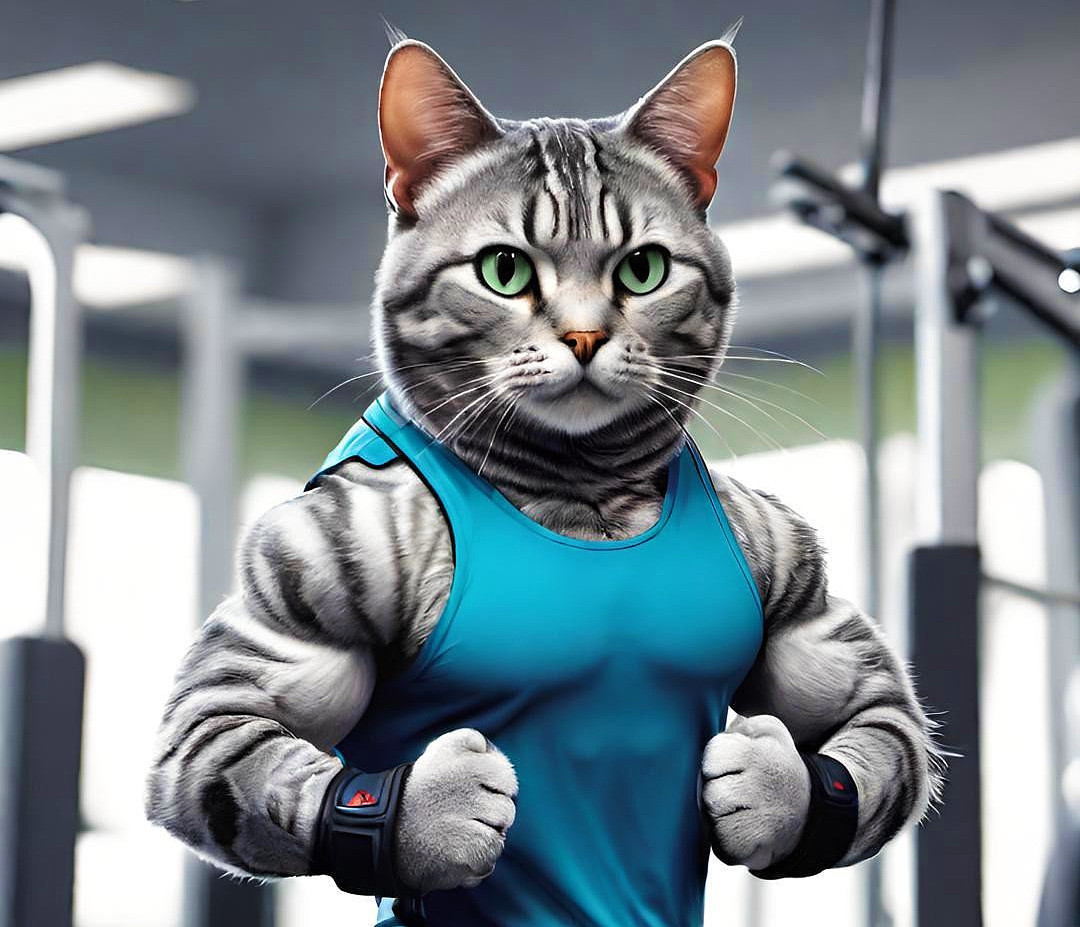
Buddy didn’t get his ripped body by just laying around doing nothing. He also ate a lot of snacks to meet his protein requirements!
Dear Buddy,
I want to be as ripped and meowscular as you are. What’s your secret, Oh Great One? How do you pack on so much meowscle mass and walk around looking like Thor if Thor were a cat?
Buddy taking a break between reps at the gym.
Buddy flexing powerfully as he readies for another set of bench presses.
Respectfully,
Awestruck in Arlington
Dear Awestruck,
It’s true, I’m pretty ripped. It’s not Photoshop either. Those are 100% real feline meowscles.
I’d say you should set realistic goals for yourself first. Half of it’s genetics, and as you know I’m a Buddinese Tiger. We’re a particularly buff breed of cat.
But if you’re committed and don’t mind rigorous workouts, you can make gains like I have, my friend! They’re the result of a grueling regimen of eating, sleeping and working out.
I break my fast first thing after waking up by screeching at my human for meowscle-building treats, which are high in protein. I usually do a light workout by making a few laps around the house, then it’s time for First Nap so I can solidify my gains and let my body heal.
The rest of the day must run like a precisely tuned machine. It’s absolutely essential that you force yourself to set aside long periods of doing absolutely nothing in order for your muscles to heal and grow.
For example, after Third Snack I like to work my abdominal muscles by having my human dangle the wand toy above me when I’m laying on my back, allowing me to perform sets of rabbit kicks. When I’m feeling the burn I do another lap, maybe chirp at some birds, and then it’s nap time again to consolidate the gains and replenish my stores of energy.
Another great workout is what I call box jumps, which are exactly what they sound like: jumping in and out of boxes.
After 7th Nap and 10th Snack I’m usually wiped, which is when it’s time for pre-bedtime sleep using my human as a pillow. His body heat helps me burn more calories and fuel meowscle growth.
It’s a daunting regimen, but if you’re committed you can look like a Catdonis just like me!
In Netflix’s Three Robots, a trio of intelligent wise-cracking machines tour post-apocalyptic Earth after humanity nukes itself out of existence. While humans are long gone from the planet, felines are not, and before long the robots encounter a gray tabby.
“What’s the point of this thing?” one robot asks its friends, looking skeptically at the yawning cat.
“Apparently there’s no point, they [humans] just had them,” the second robot says.
“Well, that’s underselling their influence,” the third robot says. Humans, it explains, “had an entire network that was devoted to the dissemination of pictures of these things.”
The ongoing joke that the internet and modern telecommunications systems were invented solely for the purpose of sharing cat photos and videos won’t die any time soon now, thanks to NASA.
To inaugurate and test its new Deep Space Optical Communications (DSOC) system, which uses lasers instead of radio signals to transmit data, the famed space agency streamed a high definition video of a cat named Taters chasing a laser.
The 15-second clip took half a second to transmit from the spacecraft Psyche and 101 seconds to cross the 19 million miles (30 million kilometers) between Psyche and Earth. For context, that’s a journey about 80 times as long as the distance between Earth and the moon.
So why is NASA doing this? Why create a new communications network when the old one still works? And why send a video of a cat?
Taters the cat. Credit: NASA
The answer to the first question is simple: Our machine proxy explorers need more bandwidth to send back data and ultra high definition photos/video of the strange worlds they’re exploring.
We send robotic probes to destinations like the asteroid belt and Venus because we can’t go ourselves, and because it’s the most efficient way to explore. The indomitable human spirit drove us to explore our own planet, and it’s expected that eventually human eyes will see the oceans of Europa and the surface of Mars. But we still have some big engineering challenges ahead of us, like figuring out how to build ships that adequately shield astronauts from radiation, and medical/biological challenges like how to prevent vision, bone density and muscle loss in low or zero gravity.
So in the meantime robotic probes are our ticket, and their numbers are growing quickly.
There are more than 30 active probes exploring our star system now. Most belong to NASA, but others belong to space agencies from the EU, South Korea, Japan, Russia and India, among others. Another 27 new spacecraft are expected to launch this year, headed to destinations like Venus, Mars and the many moons of Jupiter, and at least that many are scheduled to join them in 2026.
That’s a lot of probes.
Each of those craft will have to transmit data back to Earth — scientific data, but also high definition photos and videos of planetary and moon surfaces, asteroid compositions and more.
There isn’t a traffic jam — yet. But there will be soon if every probe’s data is bottlenecked by the lower-bandwidth radio system.
While laser and radio transmissions both travel at the speed of light, the shorter wavelength of laser light allows more data transfer. In simple terms, the DSOC network is like upgrading from an old phone modem to broadband.
As for why NASA chose a video of Taters chasing a laser, there are two main reasons: Fun and honoring history.
Taters’ human, Joby Harris, works for NASA as a visual strategist. When NASA employees were talking about the significance of sending the first high-def video from a probe to Earth, one staffer mentioned that one of the first — or perhaps the first — test videos in the dawn of television was a simple video of a statue of Felix the Cat.
The rest fell into place. Transmitting a video of a cat chasing a laser seemed like the natural choice to test a laser-based comms system. Taters has become something of a celebrity in the process.
One thing we can be sure of: if aliens are watching us from afar, there’s a good chance they’ll conclude felines are the ones running things down here. They may not be wrong.
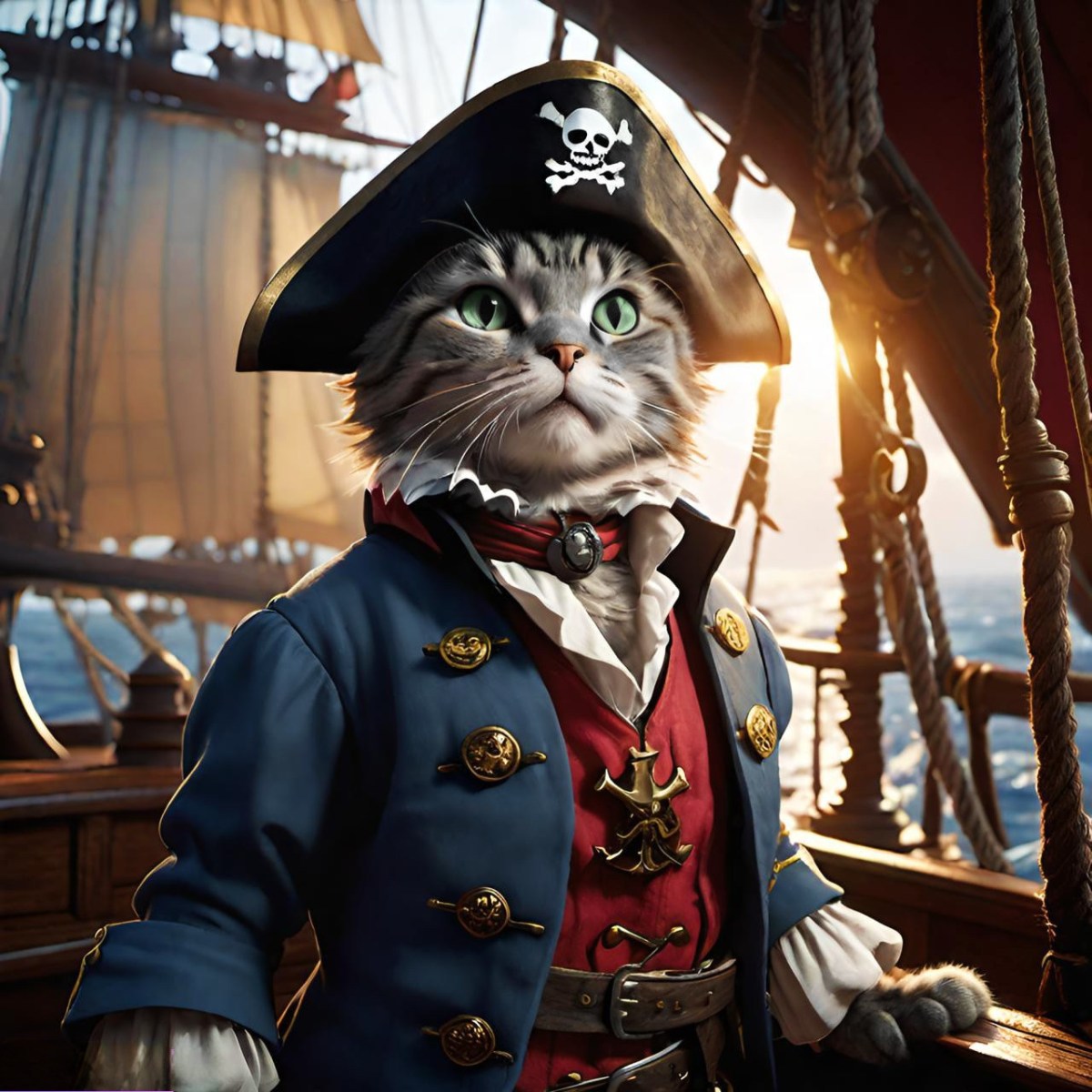
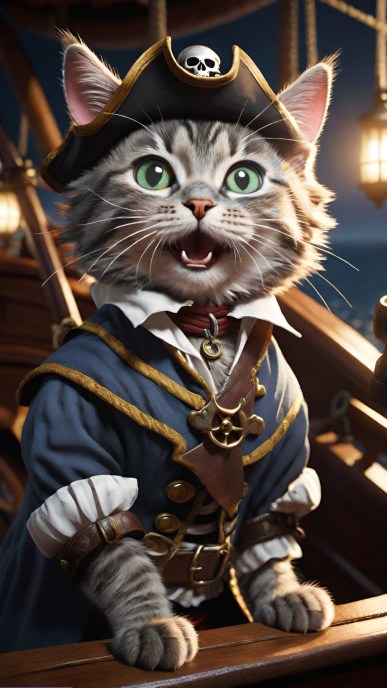
Buddy, aka Graybeard, has departed for his annual adventure on the high seas aboard his ship, the Fowl Play. He really gets into talking like a pirate.
Ahoy, me hearties!
Tis that time of year when I depart the frigid coasts of me headquarters of New York bound for the pirate heaven of Somalia! ‘Tis tradition ever since me Big Buddy temporarily sold me to pirates for a hoard of booty an a jest and I spent a season learnin’ the life of a cat-o-the-sea.
Havin’ obtained me all the plunder I could carry, I returned to New York in time for the spring, rich in gold and the vocabulary of a true privateer. (And a proper cutlass too, though truth be told it were redundant with me sharp claws.) Ye landlubbers were mighty surprised!
So now I be known as Graybeard and my ship, the Fowl Play, is the Scourge o’ the Seas, makin’ sailors tremble in their boots at the sight o’ me mast with a big hulkin’ tiger eatin’ a plump turkey.
“Ahoy! Land ho! Be prepared to drop anchor, all hands to the poop deck!”
Ahoy! ‘Tis many an incautious feline captain who met the watery grave of Davy Jones’ locker fer understimatin’ the Foul Play, tis it true. Many a red ensign me plunder for the rum, many a seadog know the name o’ Ol’ Graybeard an heard it true me put a shot across they bow!
Them sons o’ biscuit eaters become sharkbait if they underestimate Graybeard, so ye better strike colors an succumb to the inevitable — that Buddy’ll strike anchor, invite hisself aboard ye vessels and help hisself to the prime booty!
Only problem is, not a spot o’ turkey to be had on the high seas, so I have me men squib the deck, get the Fowl Play shipshape and make port often to keep the turkey larders topped up for the galley, ye savvy? Anyone who raid me turkey stash be playin’ with Jack Ketch and be sure to feed the fish, if ye catch me drift!
Avast me, ol’ Graybeard’s adventures on the high seas will continue till I find the legendary pieces of eight or the grog strike me with a clap o’ thunder, I always say.
Fer legend has it that there be an island where turkeys have eight wings, each more delicious than the last, and it be Graybeard’s obsession to find this isle o’ wonders. Just imagine how awesome it would be! Arrrr…belay that! Put it in yer mind that Graybeard’ll be rich in plunder and turkey if the mythical isle be found!
I have me pigeon here who’ll carry me dispatches back to that landlubber Big Buddy, so he can continue the bloggin’ an apprise ye buckos of me adventures. Until such time as the Fowl Play make port, I’d advise ye stay off the shippin’ lanes between the kingdom and the Caribbean.
Yer captain,
Buddy
Pictured: Captain Graybeard on the deck of the Fowl Play.
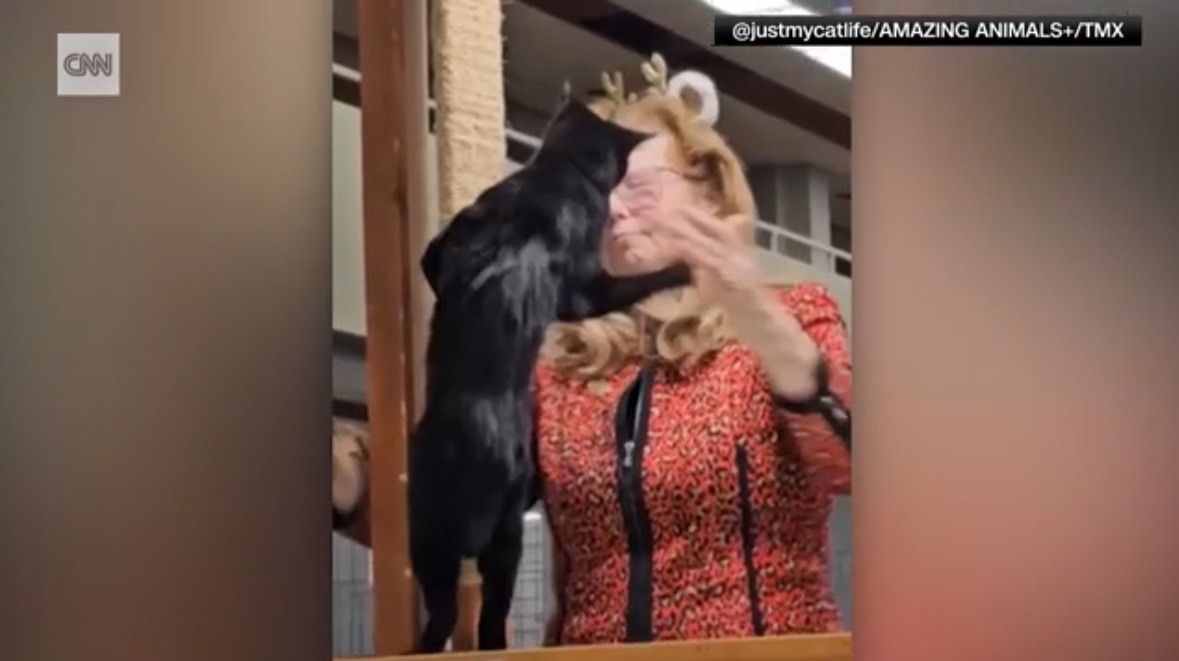
The short clip shows just about everything wrong with cat shows.
Amid the subdued noise of the show, in which hundreds of people collectively try not to freak out the felines who definitely don’t want to be there, Beethoven — number 176 — was called up.
Anyone who knows anything about cats could tell little dude was not gonna do well.
“Beautiful coat, shiny, nice green eyes,” said a judge, a woman wearing cat ears.
Having exhausted her supply of superlatives, she ran a hand down Beethoven’s tail, then grabbed both his front legs from behind in a way I’ve never seen anyone try to move a cat and tried to spin him around.
Beethoven wasn’t having it.
The void unleashed a symphony of hisses, feints and dodges while trying to get away, but the judge — seriously, has she ever dealt with a cat before? — shoved him, then tried to grab him again as if the pointless evaluation could be saved.
That’s when The Conductor lunged in for a hard right paw-slap, leaving #177– a white chonkster on deck — with a look that said “Oh no he didn’t!”
Contestant 177 needs popcorn. Someone get this cat some popcorn!
“I need the owner here now,” the judge said, like a doctor snapping at a nurse for a scalpel as a patient’s blood pressure plummets on an operating table.
Beethoven was disqualified, but he should have gotten points. He should have gotten all the points.
Oh, people who participate in “cat fancy” will tell you their ridiculous soirees are really just social events for the feline-inclined, as if they don’t privately rage when their cats lose like Patrick Bateman stewing over the fact that Bryce prefers Van Patten’s business card to his own.
But seriously, what the hell is going on at these shows?
Most of them are celebrations of the cat world’s worst excesses, with people lugging their terrified $10,000 Savannahs, $4,000 Bengals, currently out-of-fashion Persians and other breed cats to gymnasiums or hotel ballrooms where they’re mishandled, judged like collector’s items and measured against absurd arbitrary standards written by God-knows-who.
The breed standards read like wine descriptions in obnoxious catalogues: “The tail should be long and sturdy, powerful yet restrained like a rhinoceros in a steel cage. The coat should be of moderate length and silky, yet not so shiny as to invite comparisons to the Arkenstone of Thráin, that wondrous jewel. The head should be angular, recalling the good old days of colonial occupation in Siam when elegant men and women would lounge in opulent royal palaces enjoying stiff cocktails as the locals fanned them. The paws should leave tigerian pug marks, but the toes should not be arranged so close together as to appear inartful…”
The insanity of it makes me want to pose as a judge, grabbing a cat and taking a deep huff from its behind as horrified cat fanciers look on.
“I get notes of summer in New York, rotting garbage and the perpetual smell of urine on the 6 line. Hints of jasmine, cinnamon and Temptations Seafood Medley filtered through the miraculous feline intestinal system! The flavor profile is ecstatic. Oh! The aftertaste! Bitter yet triumphant!”
Except for the non-breed portion of the show, which you get the impression is treated like a non-televised undercard fight at a UFC event, the participants are basically big-upping cats who come from breeders, holding them up as the feline ideal while allowing a few scraps to fall off the table for those dirty little moggies who were the result of two cats voluntarily copulating, not some breeder putting Big Tom and Queen #7 in a cage together until BT puts one in the bun.
Ew, a shelter cat!
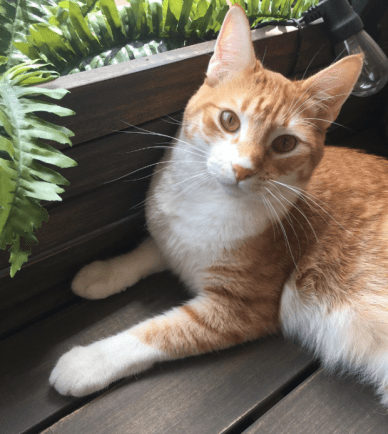
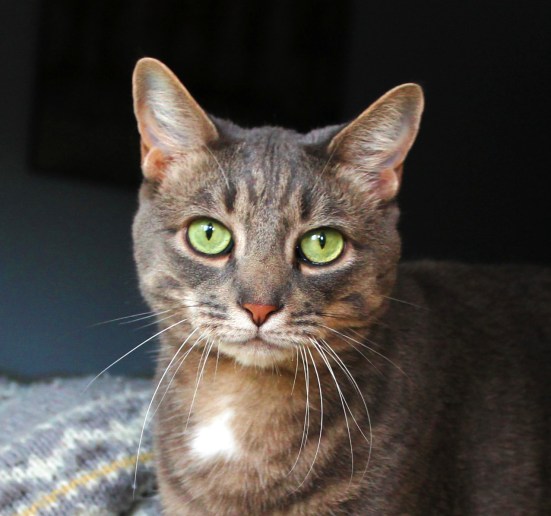
You know what I say to these cat shows and their judges? Look at this dude! Look at him! Behold his handsomeness:
Not only is he charming and ridiculously good looking, his office has many leather-bound books and smells of rich mahogany. Cat judges, eat your hearts out!








 Pain In The Bud