Grudge the Cat makes Star Trek history in Discovery’s latest episode.
Grudge the Cat is having a season of firsts on Star Trek: Discovery.
The floofy Maine Coon is the beloved companion of Cleveland Booker (David Ajala), a mercenary and cargo-runner who turns out to be a galactic do-gooder, stealing animals from the illegal interstellar wildlife trade and bringing them to the safety of sanctuary.
Considering the illegal wildlife trade is thriving and directly contributing to the extinction of many species here on Earth, it’s not a stretch at all to imagine people in the future would pay a hefty premium on ultra-exotic pets from alien worlds. The Booker/Grudge storylines may even prompt more people to pay attention to what’s happening here on our own world.
Ensign Tilly tells Grudge she’s not a cat person, but Grudge conquers all.
In Thursdays episode (mild spoilers ahead), the crew of the Discovery receive a hail from outside the cloaked and secret Federation headquarters of the 32nd century. Anyone with the top-secret location of the base — and the ability to hail ships within it — must be VIP or have urgent business, so the acting captain orders the hail on screen, and the entire bridge crew braces as the image resolves into…
…floofy Grudge sticking her face into the camera.
The cast does an excellent job of looking befuddled and amused at a cat contacting the Discovery on a priority channel when they were likely expecting Orions or Andorians or any number of antagonists.
Grudge looking regal on the bridge of Booker’s ship.
And so, for the first time in Star Trek history, a cat has hailed another starship.
It turns out Booker, anticipating trouble on a dangerous mission, set his ship to auto-return to Discovery’s Commander Michael Burnham if he didn’t make it back in time. That sets up the episode’s main plot in which Burnham goes to rescue Book.
The best line of the night goes to Michelle Yeoh’s Commander Phillipa Georgiou: “That cat can’t get lost. It has its own gravity field!”
That’s floof, not fat, Georgiou!
Grudge is referred to as a female cat in the show, but she’s played by Leeu, a two-year-old, 18-pound male Maine Coon.
Cats were recognized for their efforts to transform laziness into an art form.
NEW YORK — Domestic cats swept the Laziest Species category at the 212th Annual Animal Awards on Friday night.
Accepting the award on behalf of all cats, Chonkmatic the Magnificent waddled on stage, took a short nap, then was helped up to the podium, where he yawned and addressed the audience.
“Thank you!” Chonkmatic said, allowing others to hoist the award for him. “We didn’t work hard at all to earn this recognition, and that makes it even more satisfying.”
Chonkmatic went on to list several other cats who made the award possible by demonstrating remarkable laziness, before handing off the list to his assistant so he could be carried off stage for a snack and another nap.
Jaguars, the apex predators of South America, were recognized in the wild cat category for the remarkable achievement of ruling more than two million square miles of rainforest while napping approximately 70 percent of the time.
Prolific nappers: Panthera Onca, the jaguar.
The big cats of the Amazon prerecorded an acceptance speech because the award show was scheduled to interfere with their napping schedule.
“We are honored to receive this award,” Ahau-K’in, the King of Jaguars, said in the message. “If you could just deliver it to us, that’d be great. In fact, you can leave it at the Temple of Palenque, but bring it up the stairs, mind. We don’t want to have to drag that thing up here.”
Buddy the Cat sleeping on Big Buddy the Human.
Sharing in the recognition was Buddy the Cat, who “showed us all that a new style of napping is possible by training our humans never to move if we’re sleeping on top of them.”
“The New York cat also developed new techniques for prompting humans to deliver snacks directly to their feline overlords,” the judges wrote. “After all, why should we come running at the sound of a crinkly bag being opened? The snacks should be placed before us, requiring as little effort as possible to eat them and leaving more time for yawning, stretching and lazing.”
BRING THE SNACKS TO ME.Chonkmatic the Cat has been chosen to negotiate on behalf of all living beings on Earth. Credit: SPCA of Wake County
MeowTalk uses machine learning and algorithmic AI to learn cat vocalizations and what they mean.
It’s gonna be the future soon, and I can’t wait!
It was only a matter of time before someone leveraged machine learning and algorithmic AI to parse cat vocalizations, and thanks to Javier Sanchez, translating your cat’s meows — and trills, huffs and chirps — is now a reality.
Sanchez was a member of Amazon’s machine learning team contributing to the development of Alexa, the now-ubiquitous virtual assistant operated by voice commands.
“I got to see how the sausage was made, how they train their models and work with all the data science platforms,” Sanchez said. “So I was fresh off the heels of that and I was thinking, ‘Well, we could do something similar with cats and it could be an app.’”
Sanchez with his cat.
Sanchez’s new employers at the tech firm Akvelon saw promise in the idea and gave him the green light.
The resulting app, MeowTalk, is now available on iOS and Android.
There are two layers to the concept: The first one involves nine or 10 “intents” common to all or most cats. They include vocalizations for “Feed me,” “Hey human!”, “Let me out,” and “Pay attention to me,” among others.
Sanchez didn’t guess or intuit the meanings — they’re based on research by a team at the University of Milan, who built a data set of cat vocalizations by attaching tiny microphones to cats and recording everything the fluffsters say. Each feline utterance was analyzed and catalogued by frequency, rhythmic quality and context, among other traits.
Two cats who participated in the University of Milan study: Note the small black microphones on their collars.
The second layer is where it starts to get really interesting: By using MeowTalk like Shazam, the app will start recording your cat’s particular trills, chirps and meows and — with your help — eventually piece together what they mean.
As with dictation software and machine learning in general, the more data the app gets, the better its translations become.
This is important because, while cats share many sounds, each cat develops its own unique vocalizations:
With MeowTalk, you can create a profile for your cat and start using its auto-recognition to translate your cat’s meows and start mapping its language. While some translations are built-in and inherent to the app, translations specific to your cat require you to train the app to recognize your cat’s specific vocabulary and intentions. Translations you deem to be incorrect can be corrected via the app. MeowTalk is not static; instead it learns and evolves with each translation that you confirm, adding to its corpus, just as we would add new words into our own memory banks or language processing programs.
At the same time thousands of other cat owners are also using the app, feeding the algorithm more data, which the app uses to improve itself. Development is ongoing, with future changes reflective of user (and cat) feedback.
“A tool like this can help certain people bond even more with their cats, especially if they can’t be in contact with other people on a regular basis,” Sanchez said. “So this could be a real game changer for a key demographic that have cats.”
MeowTalk’s user interface.
Applying what they’re learning via the app, Sanchez and his team are also working toward their next goal: Giving your cat a human voice. They’re developing a small device that clips on a cat’s collar and translates meows into human speech in real time.
That tech has the potential to give me nightmares. Imagine Buddy having a human voice and saying “Gimme snacks now, servant!” “Open the door, butler!” “You’re 23 seconds late with dinner!”
Maybe I’ll pass on the collar device. In the meantime I plan to download the iOS version of MeowTalk and give it a spin. I’ll report back in a week or two after giving it some time to adjust to the Budster. If any of our readers give it a shot, we’d like to hear your impressions as well.
Did you know? The Buddinese language includes 22 separate words for “jerk” and 37 different ways of demanding food.
A cat sets off the events of 1985’s Explorers by doing what cats do best: Jumping on a keyboard.
When I was a kid, my best friend’s dad had a trove of science fiction on VHS tapes, running the gamut from 1950s flying saucer classics to 80s fare like The Last Starfighter, Flight of the Navigator and Explorers, a little-known Disney film that quietly came and went from theaters in 1985.
The Joe Dante-directed movie attained cult status in subsequent years via home video, and it’s easy to see why: Explorers is the stuff kids’ dreams are made of.
The movie follows three boys who dream of a bizarre symbol — a symbol that, when entered into a computer, spawns self-writing code that generates a floating sphere.
The sphere is an an airtight, transparent, inertia-less magnetic bubble. The boys soon realize they can make the sphere move and manipulate its size. More importantly, they can ride in it.
Wulfgang (River Phoenix) and Ben (Ethan Hawke) activate the sphere for the first time, before Wulfgang’s cat shows them how to make a space ship out of it.The dream symbols from Explorers: Not bad for 1985 computer-generated graphics.
Naturally, they build their own space ship out of junk parts — an old Tilt-A-Whirl ride, a garbage can, a TV screen and washing machine doors for windows — and use the magnetic bubble as its invisible shell.
The boys build a space ship, which they dub Thunder Road, out of parts found in a junkyard.
After their first flight — in which they lose control of their new ship, crash through the snack bar at a drive-in theater and draw the attention of police — the kids refine their invention, discovering a way to reach outer space.
Explorers is Ethan Hawke’s first movie. He plays Ben, the dreamer of the trio, the kid who lays on his roof at night and gazes at the stars, wondering what’s out there.
The late River Phoenix also made his film debut with Explorers and plays Wulfgang, the proud nerd and young scientist who uses his computer to control the ship-in-a-bubble.
And former child actor Jason Presson plays Darren, the kid who comes from a rough existence with an alcoholic dad, and befriends Ben and Wulfgang when he defends them from bullies at school. (This being the 80s, the bullies are very blond, very stupid and very cruel.)
So where does the cat come in? By showing the three kids the potential of their invention, of course.
Wulfgang’s cat jumps on the keyboard, sending the sphere zig-zagging through his basement.
Wulfgang and the boys first conjure their magnetic sphere into existence in using a computer in Wulfgang’s basement lab, and marvel at it as it hangs in the air, impenetrable and seemingly immobile.
That’s when Wulfgang’s orange tabby does what cats do and flops down on the keyboard, sending random spatial coordinates to the sphere which then zig-zags throughout the basement. As the sphere tears holes in old junk, punctures a window and comes to rest a few feet away, the boys realize it can not only move, it can be guided.
Takeoff!
Every boy dreams of exploring space at some point, and Explorers is that dream realized through a child’s eyes. Three kids from the suburbs build a ship that can reach outer space, offering answers to the tantalizing questions about what’s out there.
We’re not the only ones with fond memories of the movie. A Hollywood script-writing duo which includes the director of True Detective has been working on an updated version that would play out as a live-action TV series. Here’s to hoping if their project gets the greenlight, the cat stays in.
Grudge the Cat makes her long-anticipated debut on Star Trek: Discovery’s third season.
One of the most anticipated new characters in Star Trek: Discovery’s third season made her debut this week, continuing a proud tradition of felines in the Federation.
Grudge the Cat is a Maine Coon and the beloved pet of new character Booker Cleveland, played by David Ajala. (Ajala should be familiar to science fiction fans of his roles as Captain Roy Eris from Nightflyers and Drifter from Kill Command.)
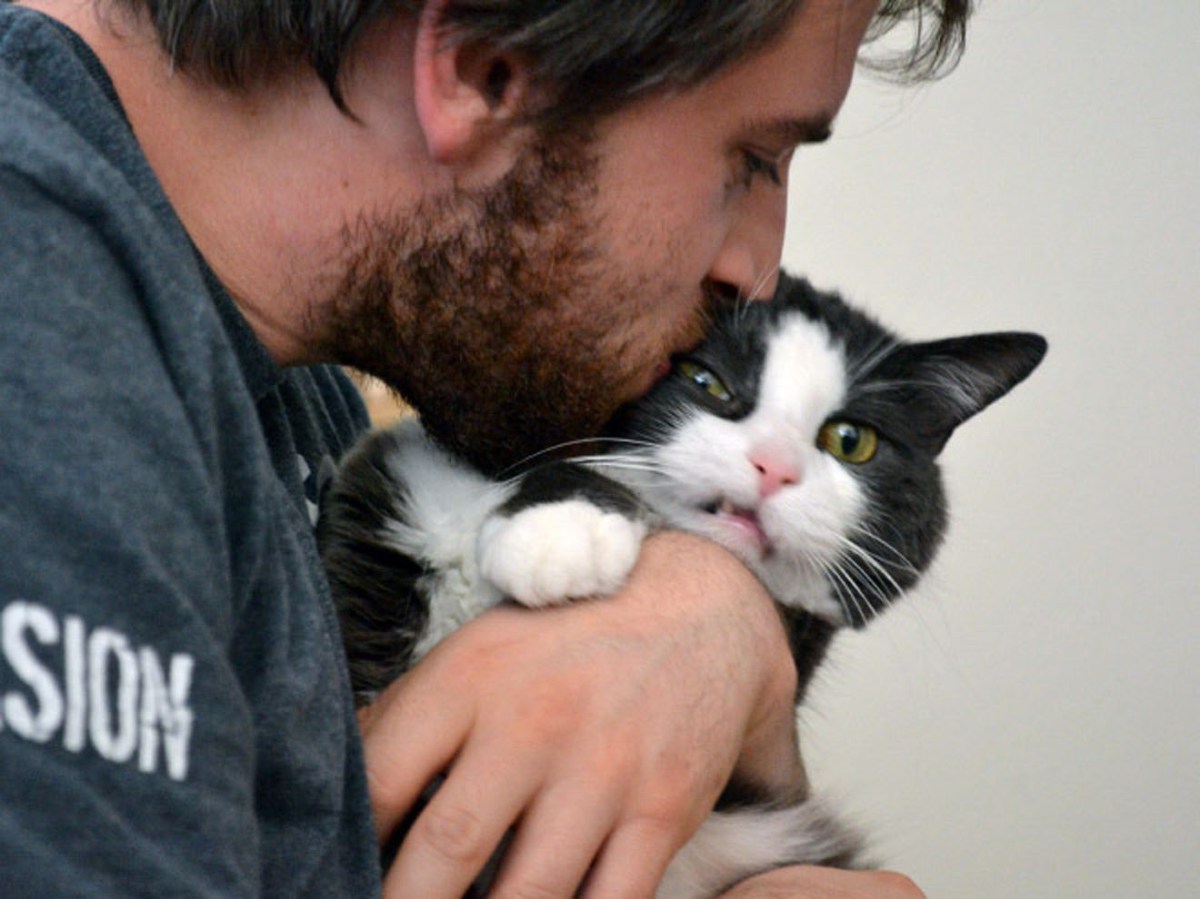
Ajala’s Booker plants a kiss on Grudge’s head as the floofy feline hangs out on the bridge of his starship. Later, when a mercenary courier tries forcing Booker to reveal the location of priceless cargo and Booker refuses, the mercenary threatens Grudge.
“She is a Queen!” Booker says indignantly, clearly more upset at the threat to his cat than to his own personal safety.
Grudge is played by Leeu, a male Maine Coon who was chosen after the producers put out a call for a large domestic cat.
The floofy tabby follows in the paw steps of Spot, Commander Data’s beloved orange tabby on Star Trek: The Next Generation, as well as the show’s most prominent species of felid aliens, the Caitians.
Now we just need to get Buddy his own guest spot on Star Trek — preferably as the captain of his own ship.