The suspect had been spotted by several people who live in the neighborhood, who said they saw him luring cats with food and injecting at least one feline with a needle.
For the past two years, people in Santa Ana, California, have sworn there was a serial cat killer in their midst.
The allegations picked up steam this week after a local TV station aired a segment from angry and confused neighbors whose pets disappeared, as well as others who saw the suspect injecting at least one cat and scooping up others. The neighbors shared information on a hyper local platform, zeroing in on one particular neighbor.
On Wednesday, the Santa Ana Police Department arrested 45-year-old Alejandro Oliveros Acosta and charged him with felony animal cruelty in connection with the case. Investigators were able to put together enough information to obtain a warrant, and a search of Acosta’s home turned up the corpses of “dozens” of cats, according to Officer Natalie Garcia, public information officer at the Santa Ana Police Department.
Heartbreakingly, Garcia said there were too many bodies in Acosta’s home for police to put an exact number on how many cats he’s allegedly killed. Police are still putting together the details, and more charges are likely.
A press release from Santa Ana police says the department is working with animal control and a neighboring police department. In addition to the evidence they collected in Acosta’s home, several neighbors positively identified Acosta as the man they saw luring neighborhood cats with food, scooping up a breed cat, and injecting another. One cat was left hanging from a tree, while others simply disappeared, preventing their people from finding closure.
“Isaw this same man grab [a] neighbor’s cat, inject it with a needle and some sort of substance,” one local told KTTV, a Fox affiliate in Los Angeles. “And [the neighbor] saw him and she yelled, ‘Hey!’ at him to get his attention. He got up and ran, jumped in his truck and left. And from what we know that cat died, and the owner went and put in a police report.”
Santa Ana is about 10 miles southeast of Anaheim, not far from Long Beach. Acosta was charged and sent to county jail. It wasn’t immediately clear if he’d retained an attorney.
“I had to leave work because I was a wreck, fully believing my cat was on the verge of life and death. It’s cruel that people do this,” one victim said.
Two weeks after his beloved cat vanished, Justin Hills received a phone call that simultaneously gave him hope and filled him with dread.
The man on the line spoke with practiced professionalism and told him that his cat, Little Wayne Shorter, had been found badly injured after he was hit by a car.
Little Wayne urgently needed surgery, said the man who identified himself as a staffer with Seattle Animal Shelter. Veterinarians were ready to begin surgery if Hills gave them the go-ahead and sent $2,800 via Venmo.
“The back of my head is screaming, ‘This is a scam. This is a scam.’ But at the same time, because it’s such an emotional pull, I’m thinking, even if there’s only a 10% chance that this is real, you know, I want to go ahead with it,” Hills told Seattle’s WKIRO.
Little Wayne Shorter
“The guy was rehearsed, was smooth. He sounded like, you know, an experienced person,” Hills said. “They had done some research on me before they called. You know, they knew my name. They knew my cat’s name, you know, the address and all this.”
When Hills called his bank, they warned him it was a scam. Hills said he’s glad he didn’t send the money but also devastated his cat is still missing — and that he was given false hope by someone trying to manipulate him in his desperation to be reunited with Little Wayne.
He’s not alone. In a post to Facebook group for missing pets in King County this week, Seattleite Harris Alex described a call from a person who claimed to work for Seattle Animal Shelter.
“They said someone found my cat, Binx, and that he had been hit by a car. They told me if I didn’t pay for surgery, he would die or be paralyzed within the next hour,” Alex wrote.
A caller said Binx, above, was seriously injured and needed urgent — and expensive — veterinary care.
Alex grew suspicious when the caller asked for a payment via Venmo, Paypal or Chime.
“I called the shelter to confirm they do not have him,” Alex wrote. “I had to leave work because I was a wreck, fully believing my cat was on the verge of life and death. It’s cruel that people do this. Be careful out there.”
Staff at Seattle Animal Shelter, which is run by the city, are aware of the scam and have gotten several calls from people asking if the shelter has their cats after being in contact with the impersonators.
“We would never ask somebody over the phone to make a payment,” said Don Baxter, manager of field services at the hospital. “We’re going to get that pet to a veterinarian and get it care and treatment, and then we’ll work out how to get the pet back to the owner after that.”
The lost/injured pet scam isn’t limited to Seattle, and the perpetrators will often switch to targets in another city if too many people become aware of their efforts, only to pop back up again later. The scam’s combination of social engineering and emotional urgency encourages victims to act quickly without giving the situation too much thought.
Experts advise people to keep their cool despite their hopes or fears, and demand proof that the person has the animal:
“This is one of the more difficult scams to deal with emotionally. If someone really has your pet, they should be able to at the very least send photos. Most people should be able to do a video call.
In general, scammers will pressure you to send money in advance. They will often make lots of excuses for not being able to provide proof they have your pet or meet in person.”
This general category of scam isn’t new, but social media has enabled scammers to believably pose as shelter staff using information pulled from the victim’s own lost pet posts and profiles, the FBI notes. The bureau also warns of several variations on the scheme.
Binx
The people running the con find their victims by scanning local missing pet groups on sites like Facebook and Reddit. They gather names and descriptive details, spin a narrative that shocks their intended victims, and create a sense of urgency by saying the cat will die if there’s any delay in performing surgery.
That’s what happened to Susan Burgess, who’d posted about her 15-year-old tabby cat, Linus, going missing. The caller said Linus was hurt and he needed to confirm her name, but Burgess realized he would have known it if he’d scanned Linus’ microchip.
She gave the scammer a piece of her mind before hanging up on him.
“On the off chance that you do have my cat, I hope that you are able to show some compassion and do the right thing,” she told the caller. “But I’m pretty sure that you don’t, and what you’re doing is very cruel.”
PSA:Speaking of scammy behavior, I can’t control the ads that are shown on PITB, but if you’re seeing ads for an amazing-looking, ultra-realistic toy rabbit presented as a great Easter gift, don’t fall for it. Here’s a video revealing what you’ll actually get from the deceptive seller:
The bishop of Little Rock called the allegations “disturbing” and said Thessing would not serve his two home parishes while the criminal case plays out.
An Arkansas priest was suspended by his diocese this week, one day after police found dead cats during a search of his home.
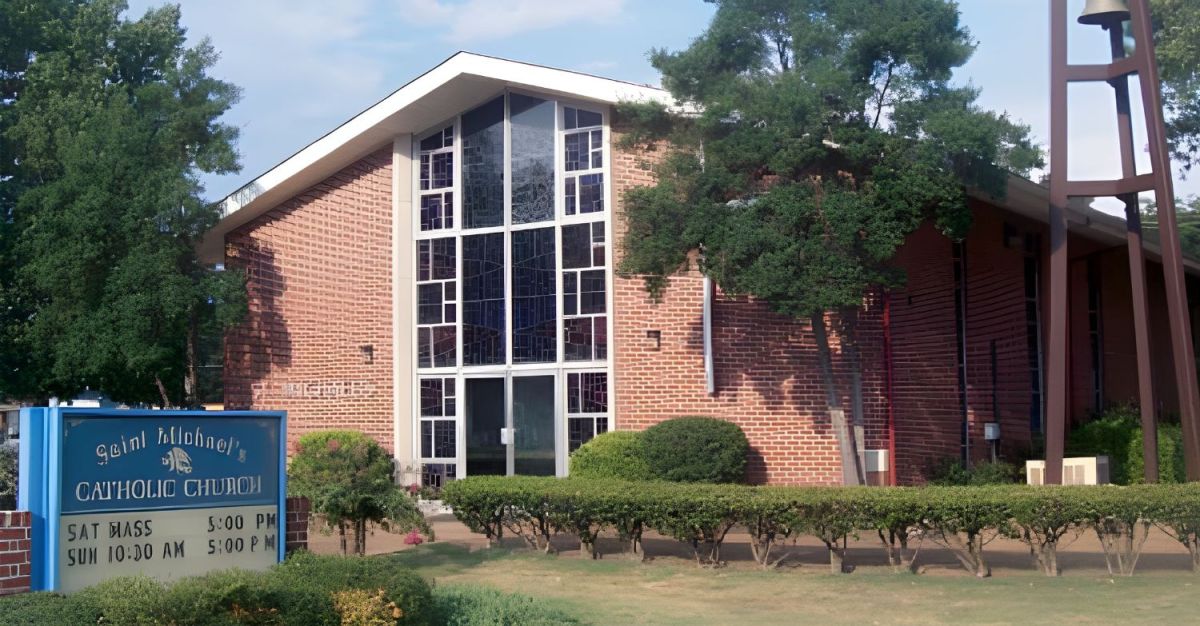
Charles Thessing, a 63-year-old “senior priest” and pastor at St. Michael Church in West Memphis and Sacred Heart Church in nearby Crawfordsville, was charged with two felonies on Tuesday. Police, working from information provided by a tipster, found a pair of dead cats, a water tank where Thessing allegedly drowned the felines, and animal traps, according to the West Memphis Police Department.
The Rev. Charles Thessing. Credit: Diocese of Little Rock
The tipster initially contacted a shelter on Feb. 7 with the information, according to police.
“We were very fortunate that someone, a concerned citizen brought our attention to the situation and we addressed it immediately,” Kerry Facello, Director of West Memphis Animal Services, told local CBS affiliate WREG. “The West Memphis Police Department worked so fast in obtaining a search warrant and allowing us to investigate further and see exactly what was going on.”
In a letter to parishioners at St. Michael and Sacred Heart, Diocese of Little Rock Bishop Anthony Taylor confirmed the arrest, adding “the allegations are disturbing, and as your bishop I take them very seriously.”
“Having heard from numerous voices within the parish, the school, and the broader community; having consulted with others; and having given this matter much prayer and consideration, I have determined that Fr. Thessing cannot continue serving as an effective pastor for your parishes,” Taylor wrote.
Thessing also has supporters, Taylor noted, while asking for parishioners to pray for the priest.
Thessing’s mugshot. Credit: West Memphis Police Department
Thessing, who has not spoken publicly since his arrest, smiled in his mugshot, which was released by West Memphis police. Per the bishop, Thessing will not minister to his parishes or perform any of his regular duties while the case reaches a disposition. The bishop did not say what could happen if Thessing pleads to the charges or is found guilty.
Thessing has been a priest for 37 years, according to the diocese.
Police say their investigation is ongoing, and they’re asking anyone with more information about Thessing to contact them. Under Arkansas state law, aggravated cruelty to animals is defined as “knowingly torturing a dog, cat, or equine,” and is a felony.
If Thessing drowned the cats, as police allege, that would put him at odds with the church. Pope Francis has been particularly outspoken on animal welfare. He was born Jorge Mario Bergoglio, and chose Francis as his name for his papacy, after the Catholic patron saint of animals.
His 2015 encyclical, Laudato Si, was the church’s strongest and most unambiguous condemnation of human treatment of animals, including cruelty, factory farming, exploitation and pushing animals toward extinction with our behavior and our public policies.
In the encyclical, Pope Francis condemned “tyrannical anthropocentrism unconcerned for other creatures” and stated clearly that animal life has intrinsic value, rejecting the argument often used by literalists who claim that God, through Bible verses like Genesis 1:26, created animals and the Earth for our use, as if they’re merely tools or resources for the advancement of the human race.
“[N]owadays we must forcefully reject the notion that our being created in God’s image and given dominion over the earth justifies absolute domination over other creatures,” the pope wrote.
He also echoed psychological concerns about the mistreatment of animals as a strong indicator that a person will harm humans.
“We have only one heart,” Francis wrote, “and the same wretchedness which leads us to mistreat an animal will not be long in showing itself in our relationships with other people.”
The cat survived but her personality has radically changed from loving and affectionate to distant and wary, her human said.
A councilman in a rural UK village resigned from his post and is the subject of renewed police scrutiny after allegedly trying to blow up a neighbor’s cat twice in 2023.
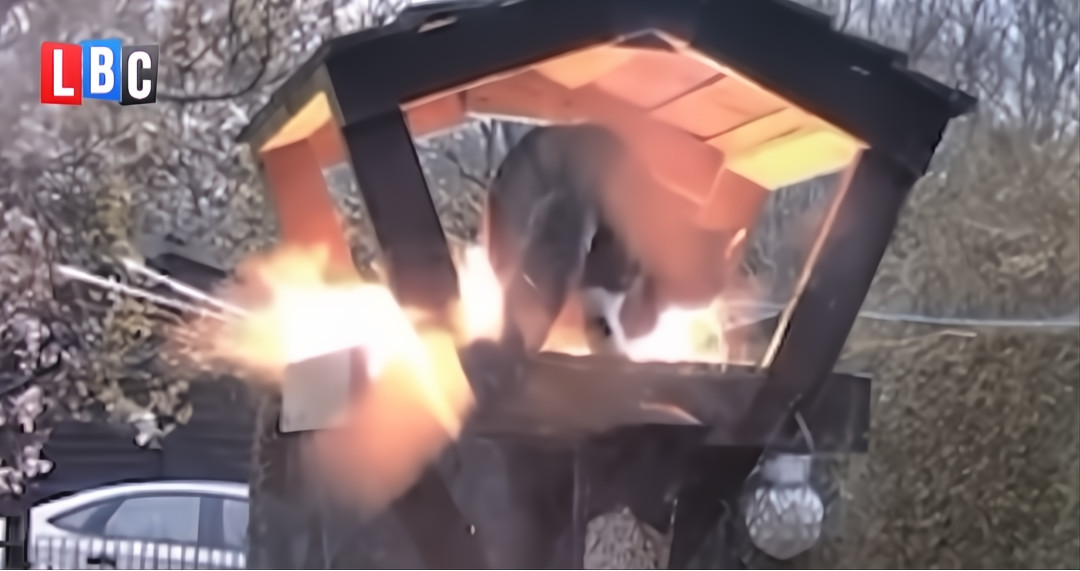
Councillor James Garnor was reportedly trying to stop the cat from climbing into a bird feeder, and decided the best way to do it was to rig the feeder with explosives and lure the curious feline in, according to a report on UK broadcaster LBC’s website.
Garnor was apparently so amused by his handiwork that he distributed video of the incidents to his friends. The footage shows a cat named Suki leaping onto the bird feeder on April 9, 2023, and nibbling on some of the bird feed before the explosive detonated. An injured Suki took off immediately and ran home.
She “came home one day missing her whiskers on her face – they looked like they’d been dissolved – so I put a post in my local community page on Facebook… just to warn people in case there was something she’d rolled in that had dissolved them,” said Suki’s human, a woman named Nikki.
Suki’s whiskers were singed off by the heat from the explosion. Image credit: Provided by owner to LBC News
“But somebody contacted me to tell me it wasn’t what I thought it was, that somebody had actually blown my cat up – and that it was my neighbour and local councillor. It made me feel physically sick.”
After she received the video, Nikki filed a complaint with local police, who elected not to arrest Garnor. However, after a second video surfaced with a clearer view of Garnor’s alleged actions, police responded to the public outcry and said they were reviewing the case again.
Per LBC, which broke the story:
“The incident is one of at least two occasions that cats in Whittlebury, Northamptonshire, were allegedly targeted by Councillor James Garnor in 2023 using remote-detonated explosives.”
It’s not clear if the new video shows a second attempt, or a different angle on the first. Garnor “was dealt with using anti-social behavior legislation,” a type of civil admonishment usually associated with things like noise complaints, littering and damaging public property, not trying to kill an animal.
Still images from a video showing Garnor allegedly setting off an explosion targeting Suki the cat. Credit: Photos provided by owner to LBC
Garnor resigned from his post on Feb. 7, and the council distanced itself from him, saying its members “understand the concerns raised by the community and want to assure everyone that we take all matters of animal welfare seriously.”
That hasn’t mollified people living in the small community, who are wondering why police didn’t press charges the first time they were presented with evidence of the attempt on Suki’s life.
“You can clearly see the videos have been slowed down [and] edited. It’s very set-up: the animal has been enticed on the bird table with food whilst said individual was sitting there with the detonator waiting for [the cat] to appear,” a neighbor told LBC. “He is a member of our parish council, so it makes you worry what decisions are being made there by the individual… he has offered no apology [and] shown no remorse.”
In the meantime, Suki has been permanently impacted by the incidents. The tabby was affectionate and friendly, Nikki said, wrapping her little body “like a scarf around your neck.”
“Now she very rarely comes near you, and if she does, she’s got her claws out – she hisses, she growls,” Nikki added. “She’s not the loving cat she used to be – and I don’t blame her… the change in her happened pretty much overnight.”
Cheetahs are on the precipice of extinction because of relentless poaching on behalf of the children of oligarchs, and showing off collections of rare big cats has become de rigueur on social media.
Imagine you’re an obscenely wealthy Emirati heir, a Saudi prince, or the scion of a global business empire in Dubai.
You started an Instagram account, but sadly photos of your Lamborghinis and McLarens aren’t really moving the needle. In the circles you run in, everyone has those. Likewise, your $20 million digs are pedestrian by the standards of Gulf opulence, and showing off private jets is so 2023.
You need something to stand out, to show the peasants that you’re not just a fabulously affluent heir, you’re also really cool and everyone should envy you.
You need a big cat.
Maybe even cats, plural, if you can’t swing an ultra rare white lion or an 850lb liger on the illegal wildlife market.
“I’m not trying too hard in this photo, am I?”
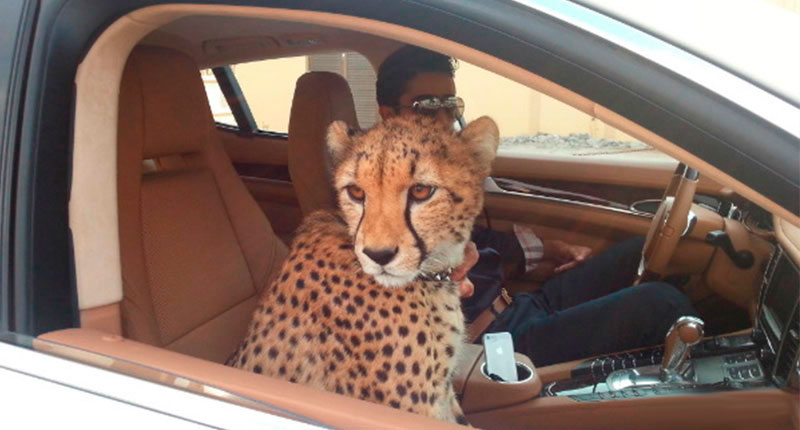
Just imagine your follower count blowing up, and how jealous the peasantry will be when you post images of your apex predator pet chillin’ in the passenger seat of your Sesto Elemento, with a pair of $20,000 sunglasses on his head for the lulz.
That’s what’s currently happening in the Gulf among the incredibly well-off children of royalty, aristocrats, oil oligarchs, shipping magnates and other bigwigs, a report in Semafor notes.
“Of course you can’t put them in the Lamborghini, beratna! You don’t want those claws near your leather seats. Besides, my liger shall have his own custom made Koenigsegg with a gear shift he can operate by paw!”
In addition to providing compelling ‘tent to their social feeds in the form of photos and videos, it’s clear the owners believe big cats offer a kind of osmotic badassery: if you have your very own lion, you must be a powerful and interesting person!
This kind of thing is not new. Years ago there was a brief outcry when wildlife groups begged authorities to protect cheetahs, who are already critically endangered and risk extinction if global elites are allowed to continue to poach them and their cubs from the wild.
“While many of these states – including the United Arab Emirates and Saudi Arabia – ban the private ownership and sale of wild animals, enforcement is lax.
The overwhelming majority of these cheetahs end up in Gulf Arab mansions, where Africa’s most endangered big cats are flaunted as status symbols of the ultra-rich and paraded around in social media posts, according to CCF and trafficking specialists.”…
The trend is of “epidemic proportions,” according to CCF, an organization devoted to saving cheetahs in the wild. At the current rates of trafficking, the cheetah population in the region could soon be wiped out.
“If you do the math, the math kind of shows that it’s only going to be a matter of a couple of years [before] we are not going to have any cheetahs,” said Laurie Marker, an American conservation biologist biologist and founder of CCF.
Youtube has its share of dauphins showing off cats and cars, and Instagram has an entire sub-genre of pages featuring men in pristine white robes posing in million-dollar hyper cars next to cheetah cubs or tigers who have been sedated to their eyeballs.
As the Semafor report explains, technically keeping big cats is illegal in most Gulf states, except for the super rich. They can skirt existing wildlife laws by getting permits as private “zoo” and “sanctuary” operators, and who’s to say a good zookeeper can’t keep his jaguars in an enclosure with Maseratis and Aston Martins?
One guy even runs a place called Fame Park, a private zoo. The only way to get in is if he deems you famous enough, and thus worthy, to gaze upon his wondrous menagerie of endangered beasts.
The park’s motto is “Where luxury meets wildlife wonder,” and its operator styles himself as a conservationist who just happens to enjoy rubbing elbows with esteemed figures like Andrew Tate and Steven Seagal.
“What pet? I am a licensed zookeeper! In my zoo, enrichment is provided by Ferrari.”
Things really haven’t changed much in the last few hundred years, have they? One way royals and aristocrats amused themselves was by sending explorers to far off lands and instructing them to bring back strange animals.
That’s how elephants ended up in the courts of European kings, and how Hanno the Navigator found himself in mortal danger when he tried to capture gorillas, then decided they were “too violent” to drag back home and had them executed.
A court elephant photographed in 1851 by Eugene Clutterbuck Impey, an English administrator in the British Raj. This elephant is pictured in regalia used for royal processions and other ceremonies. Credit: National Gallery of Scotland
These days, the centers of power have shifted, but human behavior has not. Part of me still has hope, but the cynic in me fears people with the means to exploit rare and endangered animals will continue to do so until there are no more animals left to exploit.
Another critically endangered pet cheetah in a hyper car. Credit: Some clown’s Instagram
Everyone knows that in the wild, big cat cubs nurse from Ferraris and Lamborghinis, and cheetahs learn to run fast by participating in drag races against the hyper cars. Credit: Another clown’s Instagram









 Pain In The Bud