Stray: Early Impressions, Plus Real World Cats Benefit From The Game’s Launch!

Stray gets everything right about the way cats move and behave, while rescue groups and shelters are using the game to raise money.

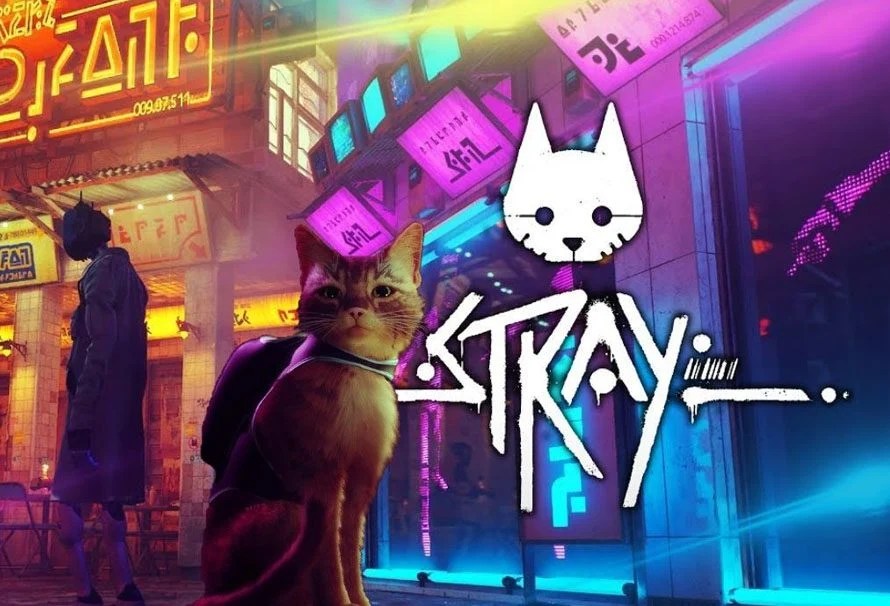
Stray is the real deal. The game is beautifully atmospheric and slipping into its world feels effortless.

The adventure begins amid beautiful urban decay, with the titular feline and his family of three other moggies waking from a nap on the ledge of a concrete reservoir in the process of being reclaimed by Mother Nature. Tangles of branches and leaves push through the crumbling man-made structure everywhere, creating canopies, waterfalls and pools, and our hero and his buddies navigate their idyllic home in perfectly cat-like manner, leaping up, dropping down and pausing to lap water from reservoirs of running water.

The game gets you started with a few classics from the feline repertoire. You can walk, run, leap, hop up and, perhaps most importantly, meow by pressing the Alt key. A general interactive key allows you to sidle up to your feline friends for some head bunting and allogrooming, and the furry family members purr at each other in appreciation.

But things don’t remain idyllic, of course, because this is an adventure.

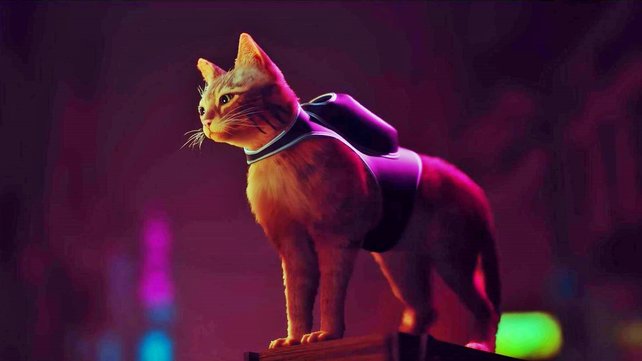
Our cat, an adorable ginger tabby, is separated from his tribe when he follows them across a chasm via a rusty pipe and the metal gives way.

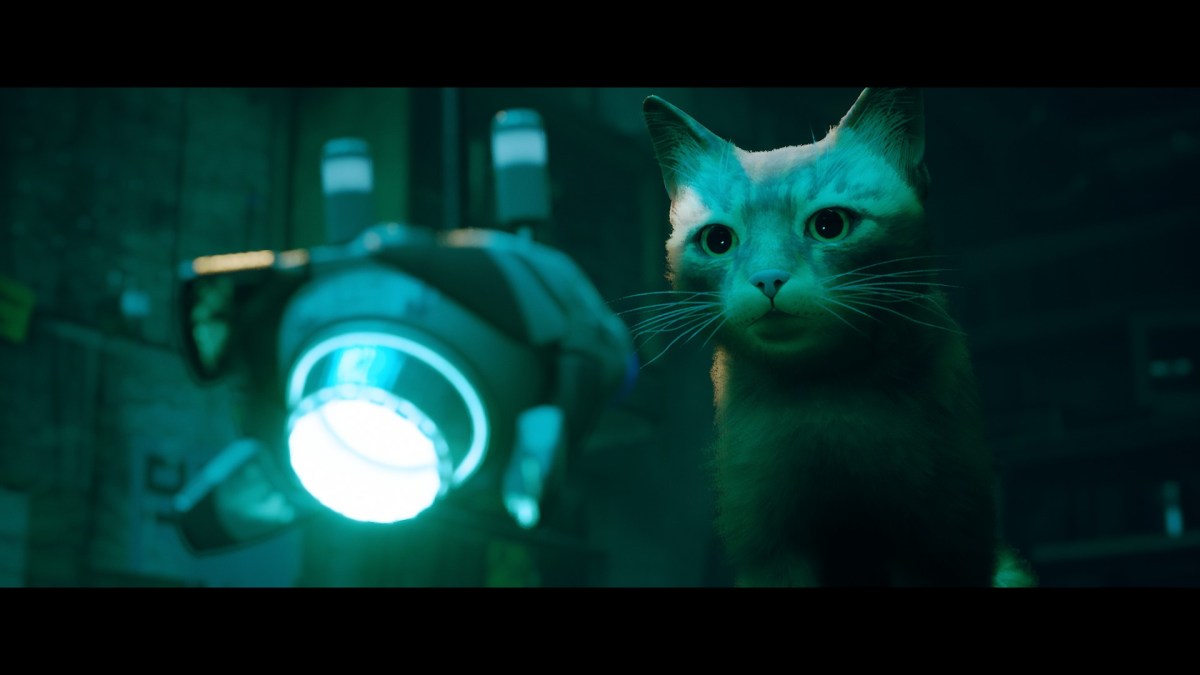
It’s an enormous credit to the animators that they’re able to convincingly convey the panic and fear on kitty’s face as he tries to stop his fall, clawing at the edge futilely until he takes a nasty tumble onto hard concrete a few hundred feet below. Conveying authentic emotion on the faces of human characters is challenging, but doing it with a non-anthropomorphized animal is another thing entirely.

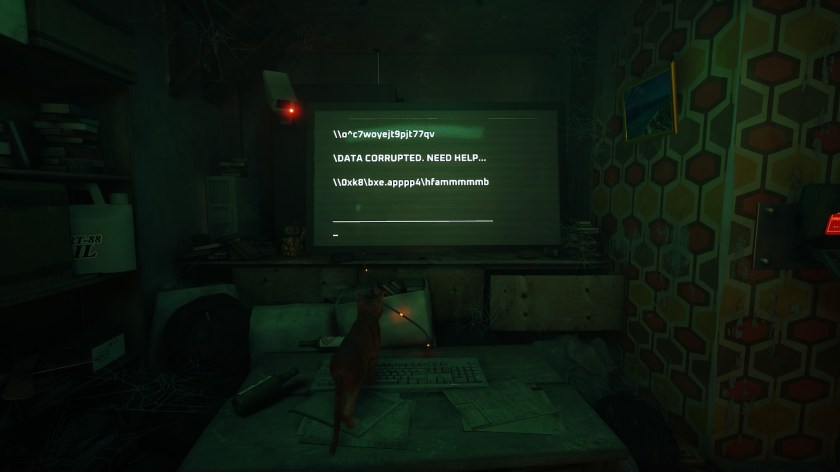
When you land, you can hear the distressed cries of your fur friends far above but can no longer see them, and your cat is injured: He limps along on three legs through a dimly lit sewer before passing out from his injuries.

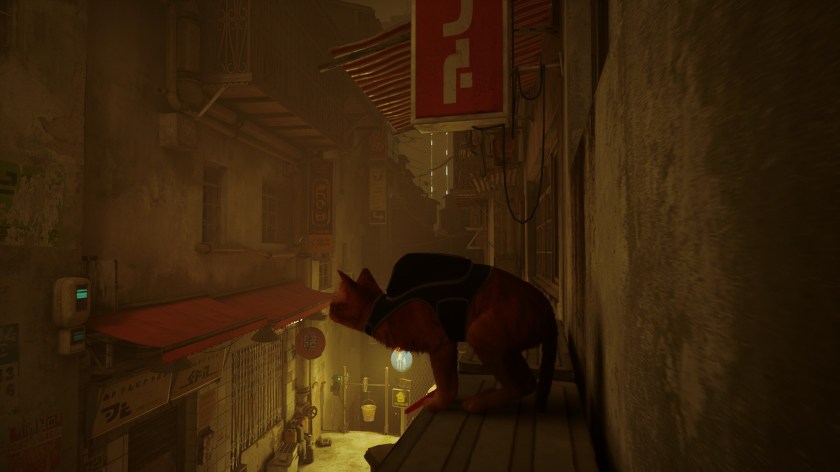
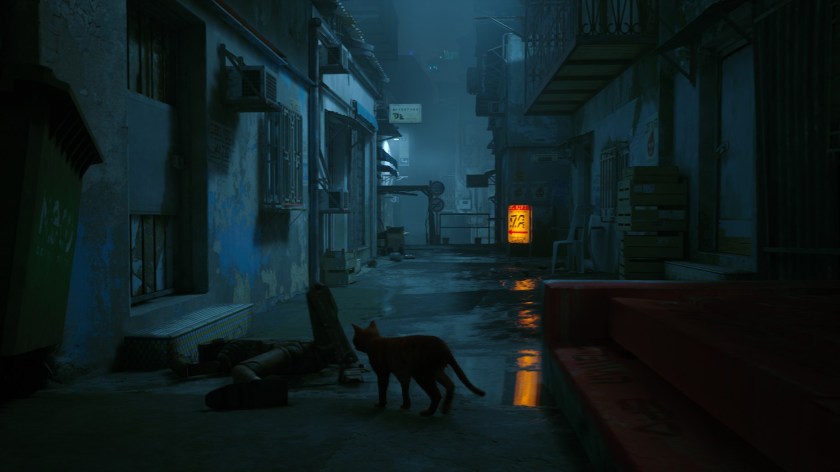
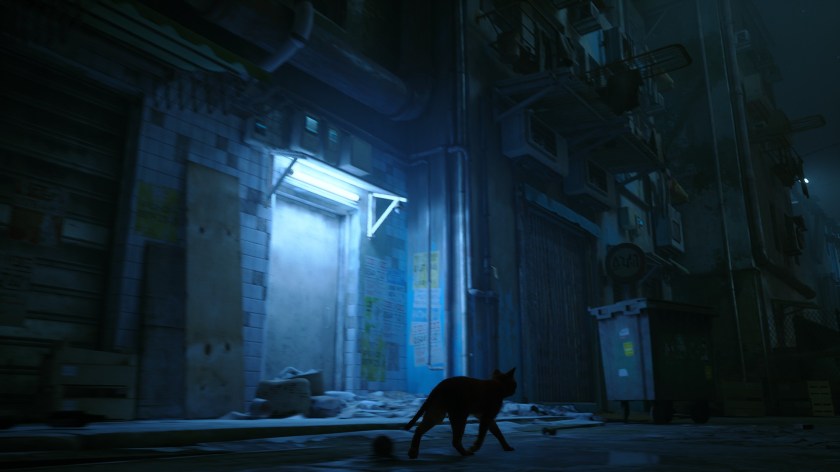
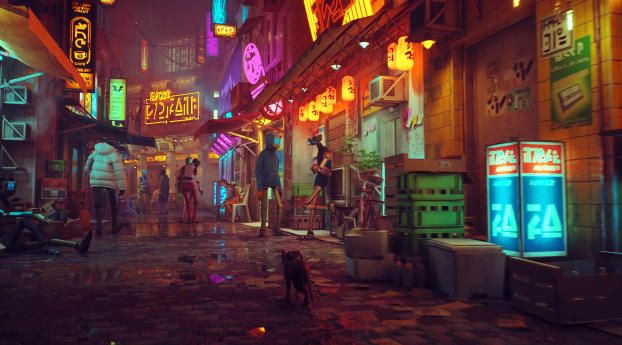
An indeterminate time later he awakes, sniffs out a cat-size path of egress from the sewer and finds himself in the neon-tinted Walled City of Kowloon in an alternate future. (The real Kowloon Walled City, infamous for its urban density and its status as a hub for Hong Kong’s triad gangs, was demolished in 1994. It’s now a park.)

There’s so much that could go wrong with a game like this. It features a radical shift in perspective, putting players closer to the ground than they’re accustomed to and in the paws of an animal who isn’t particularly well-represented among game protagonists. Animating a feline is an enormous challenge, and cats have their own version of the uncanny valley: The slightest mistake in the rhythm of a moggie’s gait, for example, can throw the whole thing off, rendering the character unnatural. (See the wacky gallops of Assassin’s Creed’s horses, for example, or pretty much any third-person game in which a human character can run. More than two decades into making modern third-person games, developers still have trouble animating human running sequences that don’t look broken or comical.)

The care that went into animating kitty is evident, as is the work that went into controlling him feel effortless and instinctive. There’s no adjustment period here. From the first moment moving like a cat feels like second nature.

20220720100603_1

20220720100526_1

We’ll have more on the gameplay and story as we spend more time in Stray’s world. So far, the game gets an enthusiastic thumbs up from Buddy the Cat and me, his humble human servant.

In the meantime, as Stray sets sales records for an indie game and continues to generate incredible buzz on social media, publisher Annapurna Interactive is using the opportunity to help real life kitties, including a game code giveaway with the Nebraska Humane Society that netted more than $7,000 in donations.

Stray is blowing up online as well, with users publishing more than half a million tweets about the game within a day of its release, per CBS Marketwatch.

buddyinstrayweb

Stray: The Buddies Are Locked And Loaded

We’re ready to play as a cat!

I bought my copy of Stray and I’m all ready for when it goes live at noon on Wednesday. I expect Buddy will find his place on my shoulder, drawn by the meows of the game’s protagonist, and perhaps even “attack” enemies on screen like he’s done in the past.

straygame

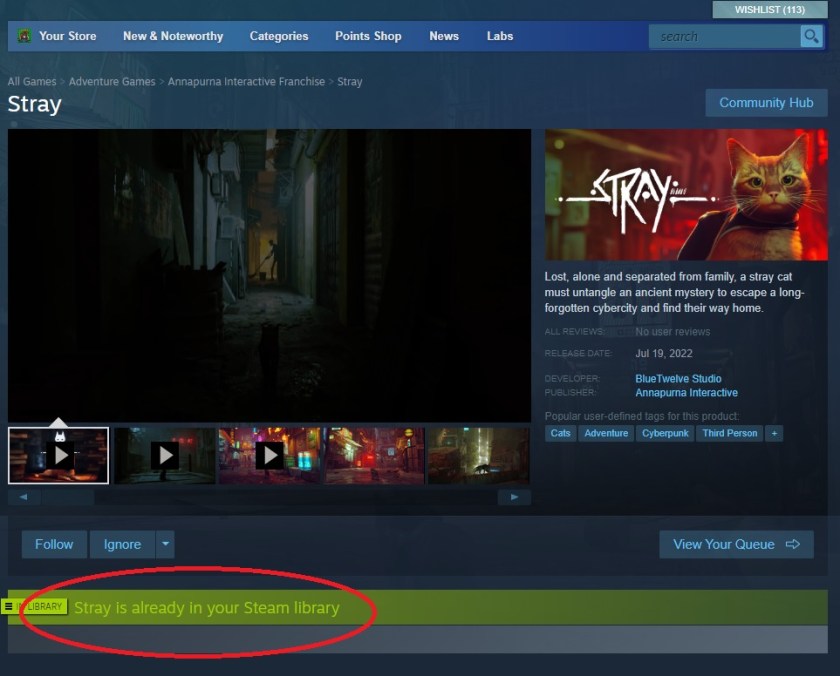
In the meantime, Stray has become Steam’s most-wishlisted game. Steam is by far the most popular digital platform for PC players, so reaching the top is quite an achievement for an indie studio. Stray is also an exclusive launch on Playstation, so XBox players will miss out on this one for the time being. (Sorry, dudes.)

Early reviews are in, with a developing consensus that Stray provides a refreshing change in perspective for the adventure game format. Some are even calling it one of the best games of the year, which is great news: The history of gaming is full of titles that looked amazing in previews and generated incredible hype only to fall flat when players finally got to experience them.

Of course we’ll have our own review here on PITB, and we’ve been looking forward to this game for years now, so I don’t want to go in with too many preconceived notions.

I can’t wait to jump into the paws of the game’s furry protagonist and experience the eerie future Hong Kong for myself.

If you can’t get enough Stray in the meantime, the developers have written a blog post introducing the world to Murtaugh, the real-life inspiration for the game’s feline protagonist. Murtaugh was rescued from under a car near Montpellier, France, he’s one of two cats who count studio founders Viv and Koola as their human servants, and he’s known as “The Boss” to the development team.

“Even though the character in the game is not a direct reproduction of Murtaugh, he was definitely a huge inspiration for its appearance and was a great support during the whole development,” Stray producer Swann Martin-Raget wrote.

stray-cat-550x309

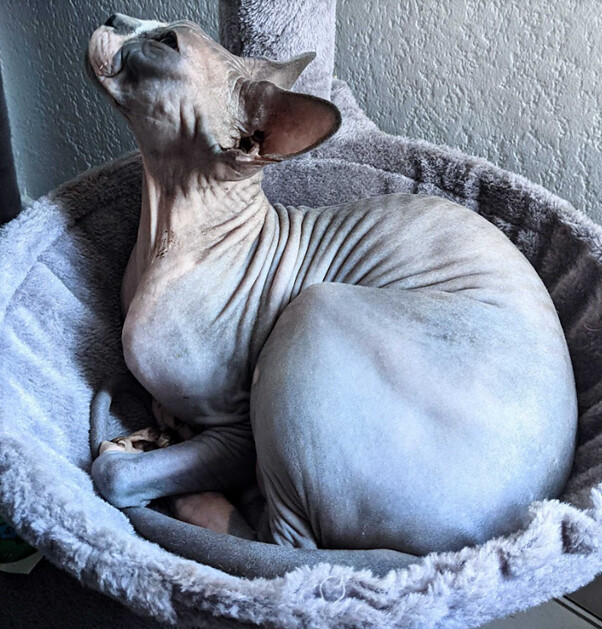
Main character animator Miko also looked to Oscar, a Sphynx, when trying to capture the grace of feline movements. Oscar’s lack of fur allowed Miko to see his underlying musculature work as he went about the daily business of being a cat.

“Oscar is a Sphynx who comes to work with us at the studio almost everyday and was super helpful when Miko needed to have actual video reference of some jumps and runs,” Martin-Raget wrote. “Animating a quadruped is already quite challenging but the subtleties of a cat’s movements are incredibly precise and hard to convey properly.”

52217034480_67515464b1_z

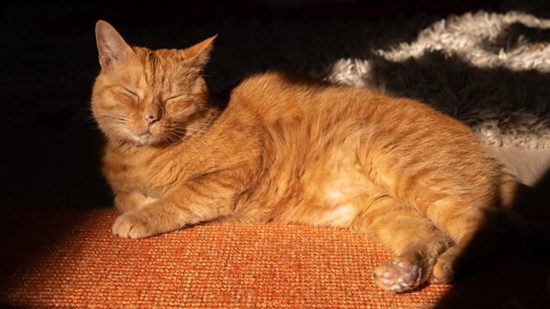
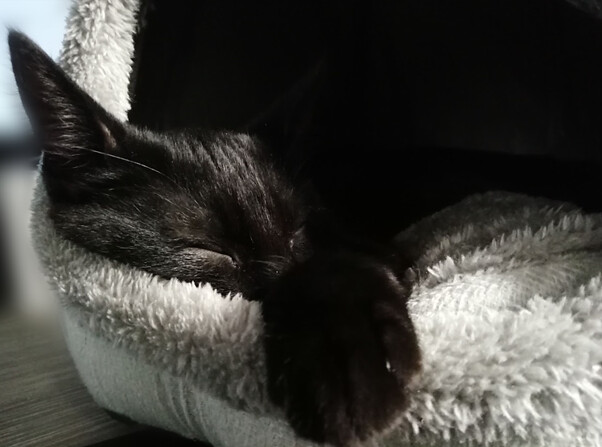
And finally there’s Jun, whose official title is executive chief general president commander director officer at the studio. Jun was responsible for supervising the humans working on the game, and of course, napping:

52216824524_1887e79a72_z

Baseball’s Best Pitcher Is An Unapologetic Cat Dad

Dodgers pitcher Tony Gonsolin is a big-time cat guy who celebrates all things feline as he dominates from the pitcher’s mound.

Tony Gonsolin hasn’t been shy about his love for cats.

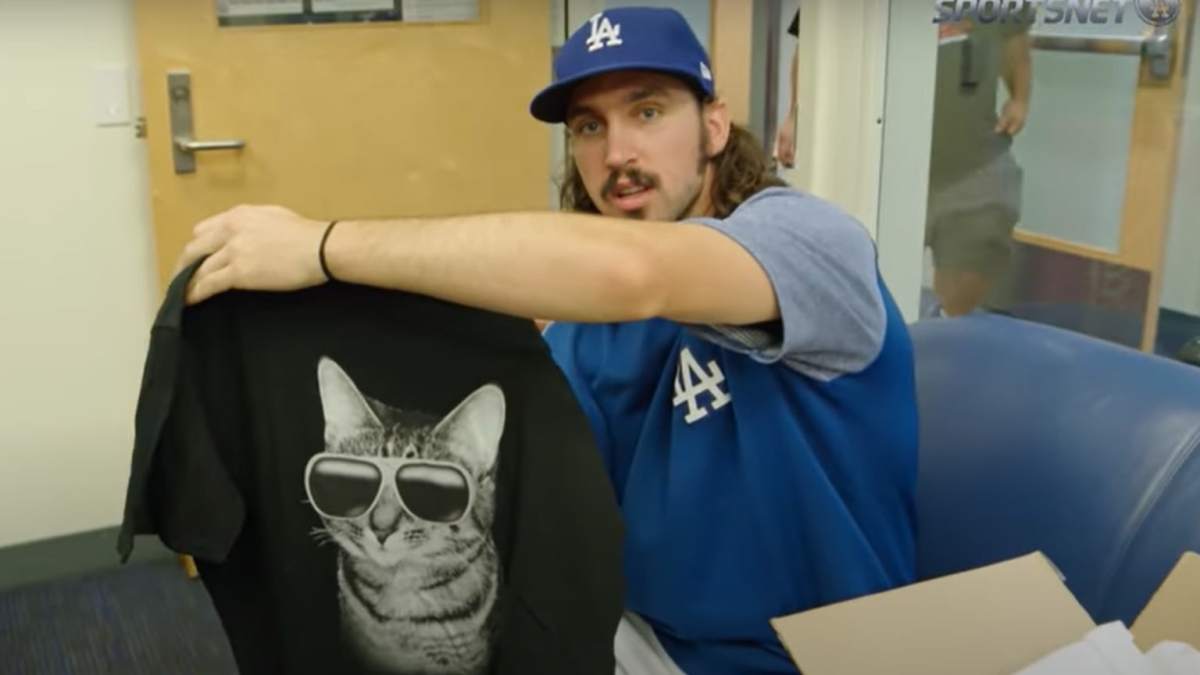
The Los Angeles Dodgers pitcher rocked cat shirts and spoke often about cats during his time in the minors, continued the habit when he was promoted to the majors, then last year kicked it up a notch when he wore cat-themed cleats as a starting pitcher.

Now the 28-year-old Gonsolin has the highest profile of his young career as he leads all of major league baseball with an astounding 1.58 ERA, 0.84 WHIP and a 9-0 record, and he’s continued using his platform to spread love for all things feline.

For our readers outside the US, as well as those unfamiliar with the sport, the numbers above mean Gonsolin has been exceptional and virtually unhittable this year. Pitching is often compared to chess, and for good reason. Being a pitcher is paradoxical — a pitcher’s job is to throw the ball across the plate while at the same time making it as difficult as possible for the batter to actually hit the ball. As a result, pitchers use deception, psychological tricks and a wide variety of tiny physical adjustments to make the ball behave in different ways.

People with a passing knowledge of baseball think these guys just throw as hard as they can to blow the ball past the batter at 100 mph. While some pitchers are capable of that, it’s not a viable strategy. Throw the same pitch again and again, and hitters will know what’s coming. That’s not what you want to do, unless you enjoy getting clobbered by home runs.

Instead, a great pitcher will follow that 100 mph fastball with an 82 mph breaking ball, throwing the hitter’s timing off and baiting him into swinging early. Or he’ll throw a 12-6 curveball, which drops off by several feet as it crosses the plate.

One of Gonsolin’s go-to pitches is a split-finger fastball, also known as a splitter because of the grip pitchers use to throw the pitch. It combines the speed of a fastball with the drop of a curveball and is very difficult to hit when executed by a skilled pitcher.

In addition to wearing cat-themed cleats, getting his teammates and manager to wear cat shirts and using social media to talk about his love for all things feline, Gonsolin celebrates every “Caturday” with posts about cats.

As he climbed the ladder from minor leaguer to pro, Gonsolin was a cat man without a cat because the uncertainty and travel schedule of a minor leaguer doesn’t leave much time or stability for a pet. In addition to the constant possibility of being dealt to another team, minor leaguers can be shuffled between different levels of play (AAA, AA, single-A, fall leagues, etc) and sent up to their MLB team for short stints if big leaguers get hurt and the team needs a temporary replacement.

Now that Gonsolin is an established major leaguer, and the Dodgers value him so much that it’s very unlikely they’ll trade him to another team, Gonsolin adopted an orange tabby named Tigger. It’s safe to say little Tigger is a well-loved cat who is doted on by his adoring human.

gonsolincattigger
Credit: Tony Gonsolin/Instagram

Note: As longtime readers of PITB know, Little Buddy and I are Yankee fans. I was born and raised here in New York, started watching the Yankees as a child when they were lousy in the early 90s, lived through the glorious Joe Torre Era when Derek Jeter, Bernie Williams, Paul O’Neil, Mariano Rivera (my favorite Yankee), Andy Pettite et al won four (!) World Series in five years from 1996 to 2000, and have been waiting patiently for the Yanks to win it all again for the first time since 2009. This is our year! The Yankees are historically great in 2022. Buddy himself might not fully understand baseball, but he has a mean mid-20s swipe ball and he likes it when the Yankees win and I’m happy. We wish Gonsolin well, but if the Dodgers and Yankees end up in the World Series this year, well, I’ll be rooting against him, cat cad of not. Sorry, Tony!

Yankees
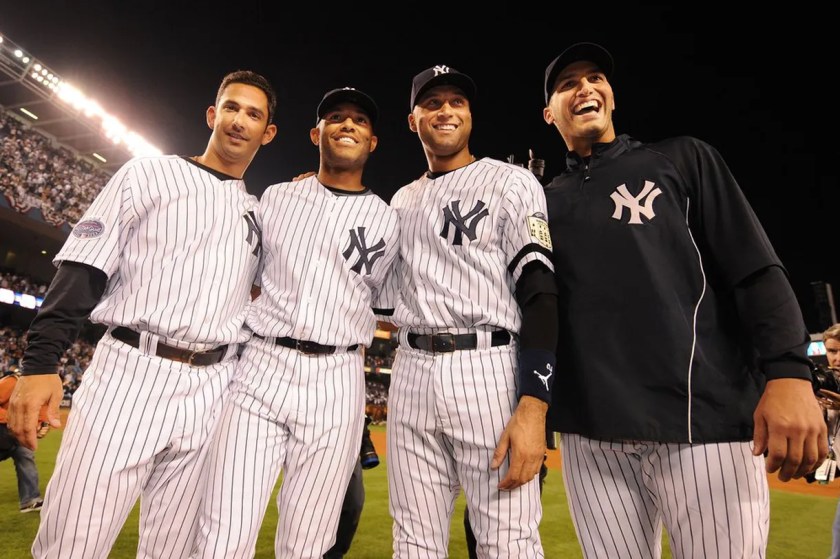
Jorge Posada, Derek Jeter, Mariano Rivera and Andy Pettite, four of the greatest Yankees in the 1996-2000 dynasty.


Long-Anticipated Play-As-A-Cat Game ‘Stray’ Releases In July!

Stray puts players in the paws of a feline protagonist.

As a game that puts players in the paws of a feline protagonist, Stray is all about forgoing familiar video game tropes in favor of forcing players to think like a cat.

To do that, Stray’s developers spent a lot of time looking at vast amounts of reference material via the digital archive of feline images and videos known as the internet, and studying two of their co-workers — the office cats who play, lounge and provide inspiration for the development team.

“They are called Oscar and Jun,” producer Swann Martin-Raget wrote, “and even if they are not the most productive employees to be honest, they definitely add a lot of cheerful liveliness to the studio.”

Stray’s tight-knit team spent seven years bringing the heroic moggie and his world to life, and on July 19 players will finally get to explore the neon-drenched environs of a futuristic Hong Kong from a cat’s eye view.

stray
Stray’s feline hero must navigate a future Hong Kong.

The developers worked hard to get the approval of Oscar and Jun, who could not be bribed with snacks.

“Seeing them interact with objects around the office (even sometimes shutting down our computers at the worst possible moment!) gave us quite a lot of inspiration for the various cat interactions that are possible throughout the game,” Martin-Raget wrote.

We’ve been following the development of Stray for a few years now at PITB and can’t wait to give it a spin. Check out the launch trailer here:


PITB Reviews: Ghostwire Tokyo: Cats Play A Central Role In This Japanese Horror Game

Felines play a major role in Ghostwire: Tokyo, a horror adventure from Japanese studio Tango.

The premise of Ghostwire: Tokyo is simple: The entire human population of the city has vanished in some mysterious, cataclysmic supernatural event, leaving the heart of Tokyo silent, vacant and draped in an ethereal fog.

Instead of the bustle of humanity, the city is now populated by demons and yōkai, which are roughly equivalent to ghosts in Japanese folklore.

Only one human survives: Akito, our protagonist. He remains alive due to pure luck after a spirit named KK inhabits his body, intending to use it to fight the supernatural forces that have emptied Tokyo of its human inhabitants.

Akito and KK come to an uneasy truce sharing one body due to their aligned goals. KK’s presence not only allows Akito to survive the malevolent forces at work, but also imbues him with fantastic elemental powers to wield against the yōkai prowling the otherwise empty streets: He can summon wind, fire and water, and cleanse spirits and locations with Shinto prayer rituals.

Akito is set on rescuing his sister from sharing the same fate as hundreds of thousands of others, while KK spent his human life — and now his afterlife — trying to stop the mysterious figure behind the spirit invasion from harvesting human souls. For Akito to do the former, he and KK must do the latter.

Oh, and there are animals — lots of scared, confused cats and dogs who don’t know what to make of the city’s supernatural new inhabitants and don’t understand why the humans have gone missing. KK’s powers allow Akito to read animals’ thoughts.

“I can’t smell my buddy anywhere,” a confused dog tells me early in the game, whimpering as he wanders near the Shibuya scramble crossing.

It’s worth paying attention to Ghostwire’s lost pets. Feed a dog and the good boy could lead you to a cache of cash or a Jizo statue where you can say a prayer and augment your powers. Stop to pet and talk to a cat, and she might tell you a yokai is hiding nearby, disguising itself as an every day object.

True to a country obsessed with felines going back centuries, a cat isn’t always just a cat in the world of Ghostwire: Tokyo.

There are your regular domestic pets and strays, which are simply called neko, the Japanese word for cat. Akito encounters them often, comforts them and can read their thoughts with KK’s powers. Like the dogs, they’re confused, scared and hungry.

Then there are nekomata, which are the spirits of domestic cats who have become yōkai. Nekomata have made themselves at home in the absence of humans, showing their entrepreneurial spirit. The ghost cats have taken over every convenience store and kiosk in the city, urging Akito and KK to buy their snacks and supernatural wares to “be purrpared” for what awaits them.

“You’ve gotta spend money to make money,” one nekomata tells me, “so why not spend it here with meow?”

Nekomata are not to be confused with bakeneko, who are also yōkai but differ from their spirit cat cousins in subtle ways. Bakeneko can be friendly, mischievous or ambivalent, they can move without making a sound, and like nekomata they can speak and understand human language. Unlike nekomata, which have two tails, bakeneko only have one.

Finally, there are maneki neko. You’ve seen maneki neko even if you don’t realize it, probably on the counter of your local Japanese grocery, sushi house or Chinese restaurant. They’re the smiling, beckoning cats who are said to bring good fortune, health and other benefits. They’re based on the legend of a friendly cat who led a road-weary Japanese feudal lord and his men to a sanctuary just before a violent thunderstorm centuries ago, and have become ubiquitous in Japan and wider Asian culture.

For a game with a grim premise set in an empty but lived-in city, there’s plenty of bizarre humor as well. One mission has you delivering toilet paper to a human spirit who really, really needs to wipe after an epic bowel movement before he can move on and rest easy in the afterlife.

On another occasion I stopped to admire the detail and near-photorealistic beauty of a street bordering a shrine when I heard a nekomata hilariously meowing a cheerful song out of tune. When I turned toward the little cat, I saw him floating in the air and bouncing to his happy song.

As Akito, the player is tasked with lifting the fog from neighborhoods of central Tokyo, rescuing the spirits of deceased humans before they can be harvested by the demons and yōkai, and investigating the what, why and how of Tokyo’s takeover by malevolent spirits.

Akito and KK accomplish the former by “cleansing” Tokyo’s many shrines using a ritual performed at the shrine torii gates. Once a torii gate is cleansed, the fog around it subsides and more of Tokyo opens up for exploration and investigation. Meanwhile, Akito and KK must fight off yōkai to reach the floating spirits of Tokyo’s citizens, using a talisman to secure them. The duo can then “wire” the spirits to an ally outside the city, who helps return them to their bodies. The game keeps track of how many souls are saved, with the count rising to the hundreds of thousands for adept players.

The game remains true to Japanese folklore in the way it presents enemies, who are usually corruptions of human souls who have deep regrets about their lives. The spirits represent anxieties unique to, or prevalent in, Japanese society.

There are Rain Walkers, unnaturally thin salarymen toting umbrellas who advance on you inexorably, representing the angry spirits of men who spent their entire lives in service to a corporation, hardly spending time with their families or raising their kids because they work so much.

There are the Students of Pain and Misery, headless schoolgirls and schoolboys representing the spirits of teenagers whose grades couldn’t carry them into good universities, damning them to a life of tedious, low-paying jobs. Those are real concerns in a country where students spend in excess of 10 hours a day, six days a week in school. Teenagers are under enormous pressure to get top grades, and teen suicide is a major contributor to the country’s unusually high suicide rates.

Spirits of Lamentation are dangerous and move in sickeningly unnatural ways as spirits of people who were estranged from loved ones, while the small, raincoat-clad Forsaken are the spirits of abused children.

These malevolent spirits and others wander the streets, linger in alleys and leap across rooftops, but they also form groups called Hyakki Yagyo, which are parades of oni and yōkai who march through the streets of Japanese cities on summer nights, according to folklore.

Hyakki Yagyo
You’ll hear the Hyakki Yagyo before you see it, tipped off by the booming taiko drums that accompany the ghostly parade.

The arrival of Hyakki Yagyo in Ghostwire is impressively atmospheric: Lights and neon signs flicker and die out, while taiko drums boom from the mists. Then you see the spirits — yōkai with their umbrellas, massive demons, bizarre apparitions.

The first time I encountered a Hyakki Yagyo, I was so engrossed in watching the procession that I didn’t realize I was in its path until it was too late. I learned that if you get too close, the spirits yank you into an ethereal plane and surround you in numbers, determined to end your physical existence and make you one of them. Those encounters are among the most difficult in the game, but they’re also a fun test of skill.

Ghostwire gives us the most complete recreation of Tokyo in any game to date, and it’s magnificent. The metropolis extends seemingly forever in every direction, with 36 million people living a metro area that sprawls for almost 1,000 square miles. (That’s three times the size of New York with all its boroughs.)

Because of that, no game studio can handle the challenge of recreating the entire city on a 1:1 scale, and Ghostwire doesn’t attempt it. Instead the game world encompasses the famous Shibuya district and part of Minato City, two of the most bustling and famous districts in the heart of Tokyo. It’s a massive playground stretching from west of the scramble crossing, through Roppongi and all the way to Tokyo Tower.

Ghostwire is beautiful, polished and a hell of a lot of fun to play. You’re not going to find the gloriously intuitive combat of a game like Control, or even an experience like the fluid melee action of Shadow Warrior 2. Ghostwire’s combat is pedestrian compared to those games, but it becomes more fun and interesting as the game progresses and you’re given different powers and options to deal with a growing variety of ghastly enemies.

The lure of a game like this is its moody atmosphere, magnificent visuals, tense sound design and a plot that weaves hundreds of years of Japanese folklore into the mix, creating a world unlike anything else in gaming.

The writing deftly transitions between serious and funny, tense and lighthearded, and the partnership between Akito and KK allows for a running dialogue throughout the game, with the two of them asking each other questions, arguing over tasks and reacting to the craziness around them. What starts out as an uneasy alliance held together by necessity becomes grudging mutual respect and eventually friendship.

Rounding out the cast of characters are Mari, Rinko, KK’s friend Ed, and the masked protagonist. Rinko is the spirit of a woman who worked with KK in their human lives. Rinko and KK were killed for their determination, and in death they continue the fight against the malevolent spirits. Ed is a weirdo: He’s KK’s man on the outside, helping to reunite the severed souls of Tokyo with their human bodies when Akito and KK rescue them, but the only way to talk to Ed is by payphone — and even then, he only answers in recordings.

Mari is Akito’s sister, who was unconscious and helpless in a hospital when everyone vanished. More than anything, Akito wants to protect her.

Finally, there’s the man in a oni mask, the mysterious mastermind behind the supernatural takeover of Tokyo. Who is he? What does he want? Can he be defeated?

To answer those questions requires an adventure very much worth having.

Title: Ghostwire: Tokyo
Release date: March 25, 2022
Platforms: PC, Playstation 5
Audience: Mature
Cats: Many