Cats are well known for grooming themselves, but are they as clean as we think?
I remember the first time I saw my brother’s dog drag his posterior across the living room carpet.
The friendly little good boy, a terrier-Chihuahua mix, had just returned from a walk with my brother. He hopped up onto the couch, then down, leaning back into an odd-for-a-dog sitting position.
Then, with his little back legs spread, he used his front paws to drag his butt across the carpet with a heavy exhale, the canine equivalent of an “Oh yeah!” sigh of relief.
I know there are many feline behaviors that gross out dog loyalists, but thank God we don’t have to watch our kitties use carpets and area rugs as butt-scratchers.
Cats have more dignity than that. Cats are legendarily fastidious animals.
Or are they?
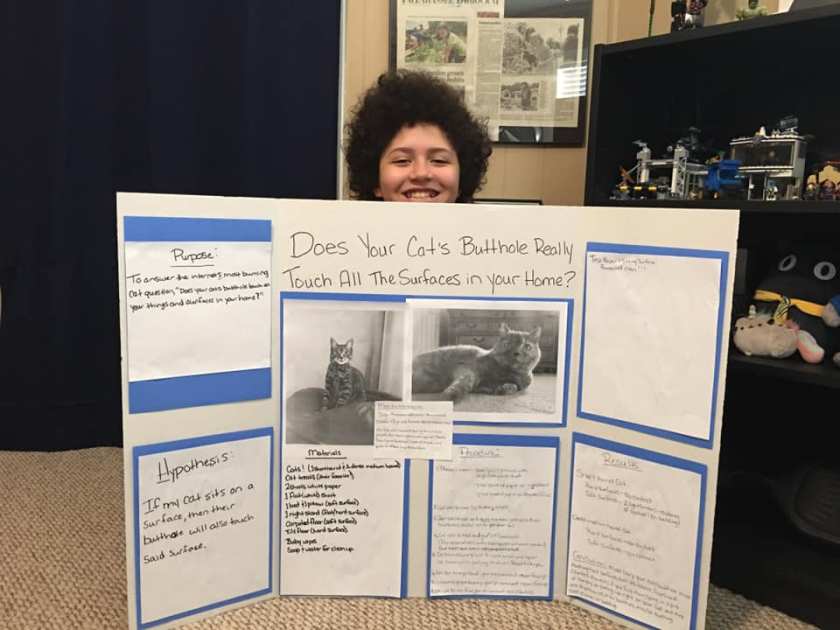
Kaeden, an enterprising sixth-grader from Florida, set out to “tackle the challenging task of answering the internet’s most burning question, drum roll please,” his mother, Kerry Griffin, wrote on Facebook. “Does your cat’s butthole really touch all the surfaces in your home?”
He would go on to present his findings and methodology at his school’s science fair.
Kerry has a doctorate in animal behavior with a concentration in feline behavior that she says she “never used.” She put it to good use for the project, helping her son come up with a plan: They’d use non-toxic lipstick and apply it to the cats’ “bum-bums.” Then they’d place each cat on a sheet of paper and run through commands.
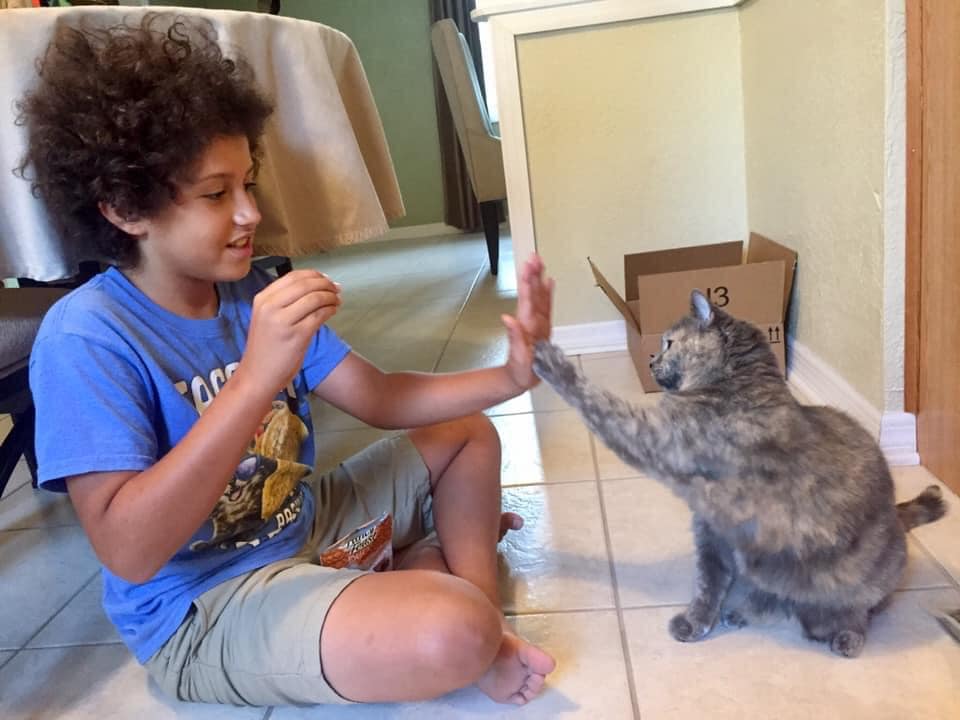
“Both cats have been trained since kittenhood with a variety of commands. They also know how to high-five, spin around, and speak,” Kerry wrote. “They were compensated with lots of praise, pets and their favorite treats, and the lipstick was removed with a baby wipe once we collected our data in just under 10 minutes.”
They tested each cat on soft surfaces, like carpet and bedding, and on hard surfaces like tiled floors. If the cat left lipstick residue on the sheet of paper, it was counted as positive contact.
The results?
“Long and medium haired cat’s buttholes made NO contact with soft or hard surfaces at all,” Kerry wrote. “Short haired cats made NO contact on hard surfaces. But we did see evidence of a slight smear on the soft bedding surface.”
So there you have it. If your cats are long- or medium-hair, congratulations. Now if you’ll excuse me, I’ve got to have a little chat with the short-haired Buddy…
“Noooo! We surrender, okay? Just don’t hurt the cats!”
Before the great civilizational clashes at Thermopylae, Plataea and Salamis, there was Pelusium.
The strategically important city on the Nile Delta was where the Egyptians under Pharoah Psametik III made their stand against the invading armies of Cambyses II, the king of Persia, in 525 BCE.
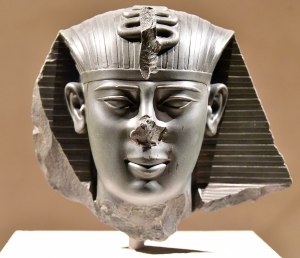
Amasis II was the last great Egyptian pharaoh before Persian King Cambyses defeated his son, Psametik II, and took that title for himself, beginning two centuries of Persian rule over Egypt.
It was a sound decision: Pelusium was heavily fortified, with high stone walls and ramparts. The pharaoh dedicated tens of thousands of men to the city’s defense, lining the ramparts with archers, stone throwers and catapults designed to launch flaming projectiles at the attacking, lightly-armored Persians.
For his part, Cambyses faced the prospect of a long siege or a bloody frontal assault that would cost thousands of lives as his men were tasked with scaling the walls under fire.
But the Persian king knew the Egyptians were not only famously fond of cats, they believed cats were representations of deities.
In a shrewd early example of psychological warfare, Cambyses figured out a way to use felines to his advantage in battle.
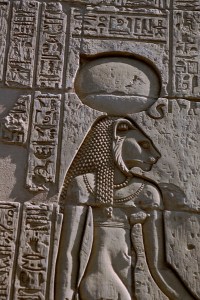
Cats were everywhere in ancient Egypt: Goddesses like Sekhmet and Bastet were portrayed as lion- and cat-headed, while Egyptian artists and craftsmen produced statues, rings, pendants and hieroglyphic cartouches with feline imagery. The beloved pets of royalty and other powerful Egyptians were buried in their own elaborate sarcophagi, while regular people mourned the deaths of their family cats by shaving notches in their eyebrows.
An image of the Egyptian cat goddess Sekhmet carved in relief among hieroglyphic inscriptions.
Cats are found in virtually every significant ancient Egyptian archaeological site, often elaborately mummified alongside their humans, and Egypt is home to the largest and most enduring cat statue in the world, the Great Sphinx. Not only do weathering patterns show the Sphinx is older than previously thought, it’s believed the Sphinx was originally carved with a cat’s head, then later defaced in the image of a pharaoh. That theory is supported by the fact that the head is disproportionately small compared to the Sphinx’s body, indicating it was carved down from its original form.
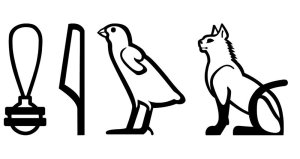
An Egyptian hieroglyph for “miu,” an umbrella word for “cat” that could mean domestic or wild cats, including big cats.
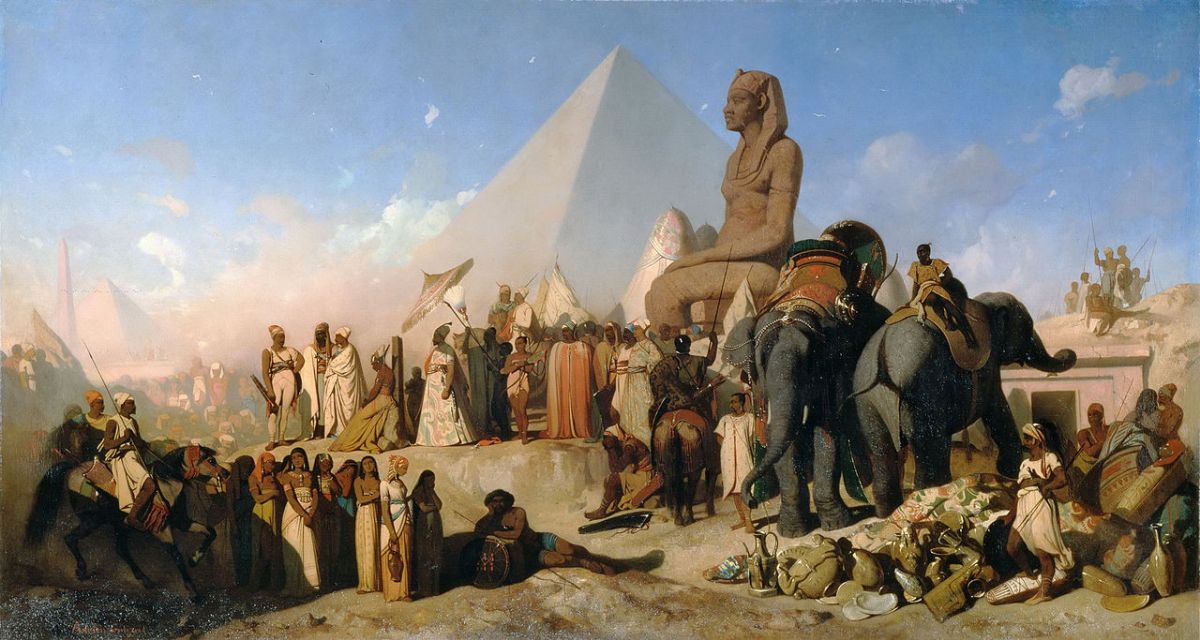
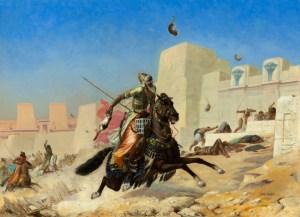
Cambyses realized there was a way to turn the Egyptian fondness for all things feline to his advantage: He had his men round up thousands of cats and carry them into battle as if they were just another part of the soldier’s kit along with weapons and armor.
If they opted to fight they would be killing sacred animals who were avatars of some of their most important gods. If they surrendered Egypt would be subsumed into the growing Achaemenid Empire, joining the Medians, Babylonians, Elamites and other once-proud nations in bending the knee to Persia’s king.
An artist’s depiction of the battle shows Cambyses atop a horse as his men catapult cats over the city walls.
They chose the latter, bringing about two centuries of Persian rule in Egypt and leaving the Persians with no remaining obstacles between them and the loose confederation of city-states of Greece.
The kitties, however, would have their revenge against the Persians, for it was a man named Leonidas (“lion”) who led the fabled Spartan warriors to the narrow mountain pass of Thermopylae, where they and a few thousand fellow Greeks held the pass for three days against an invading Persian army that was the largest fighting force the world had ever seen. (Herodotus, the Greek historian prone to patriotic exaggeration, said the Persians were a million strong, drinking entire rivers dry en route to mainland Greece. Modern historians put the number at about 300,000.)
Regardless, the Lion of Sparta and his men inflicted so many casualties on the Persians that the latter’s morale was shattered, and held the pass long enough to give the other Greeks time to muster their army.
When the Persians finally broke through they sacked Athens and rampaged through Attica, until they met an unstoppable force: All of Greece united under the co-leadership of Athens and Sparta, with 50,000 pissed off Spartan Peers leading the defense. The combined forces of the Greek city-states routed the invading army.
We’re sure the Greeks broke out plenty of catnip for their kitties to join in the resulting celebration, and Herodotus just forgot to include that little detail in his histories.
Buddy has been shipped to Somalia for a new life with new owners. What a relief!
When I started Pain In The Bud, my goal wasn’t to celebrate cats or to express my love for my cat by sharing his quirks and amusing anecdotes about his allegedly adorable behavior.
I had one goal and one goal only: To make money. That’s why you see ads all over this site, and it’s why I’ve been relentlessly hawking certain pet products. The companies behind those products pay me big bucks!
Which brings us to our next bit of news. Since I’ve been writing about Buddy online, creating a fictionalized version of him that is delightful and loveable, and selecting only the best photos to make him look handsome and dashing, I’ve received several offers to buy him.
To be clear, the reason I didn’t sell him before was not because I was hesitant to part with him. He’s annoying AF, he’s a degenerate catnip addict and he never, ever shuts up.
The real reason? I was holding out for more money. The more I wrote about him, the more delightful and adorable he’d appear to readers, driving his price up. It’s kind of like a basketball team giving more playing time to a player on the trading block, pumping up his stats so he’ll command a higher price on the open market.
A promotional image that was part of my dastardly campaign to drive up Buddy’s price in the recent bidding war. He is not a tiger.
So when the most recent offer came in last week, I felt I’d driven Buddy’s price up as high as it would go. A potential buyer in Somalia offered $20,000 for the little stinker! In the meantime, another interested party — a competitive table-setting champion from Skokie, Illinois — offered $22,000.
It was time for a bidding war!
Ladies and gentlemen, I’m happy to report that Buddy has been sold to the Somali for $28,550. The lucky (or unlucky, really) bidder, a pirate who plunders the commercial shipping lanes off the coast of his native country, believed all the nonsense about Buddy being a fierce and powerful miniature tiger, and was in the market for a guard cat to help keep his booty safe.
They tell me there is no turkey where Buddy has gone, and he was very angry about that. Oh well. His new owner is also a neatness freak with OCD who vacuums his home six times a day, which I imagine does not sit well with Buddy, given his history with vacuum cleaners.
But who cares? I got almost 30 grand out of the deal! I’m going to buy a new Les Paul to replace the one “Buddy” (real name Jerkus Maximus) broke, my home is blissfully quiet, and I can sleep through the night without being woken by that infernal little tribble with a tail licking my face. Who in their right mind wants to be roused in the middle of the night by a purring cat? It’s absurd.
So it is with a not-so-heavy heart that I announce an end to Pain In The Bud. He really was a huge pain in the bud. Now he’s someone else’s pain in the bud. Huzzah!
P.S. With Buddy gone, I plan to refocus this blog on the wonderful world of Hummels and the extremely profitable Hummel resale market. Wanna buy the hottest Hummels at street prices? Hit me up.
Thanks to our patented Silky Smooth™ technology, your new Buddy’s fur will feel velvety and softer than ever when you pet him!
A very special package came in the mail today:
FRAGILE: “Hmmm. Must be Italian.”
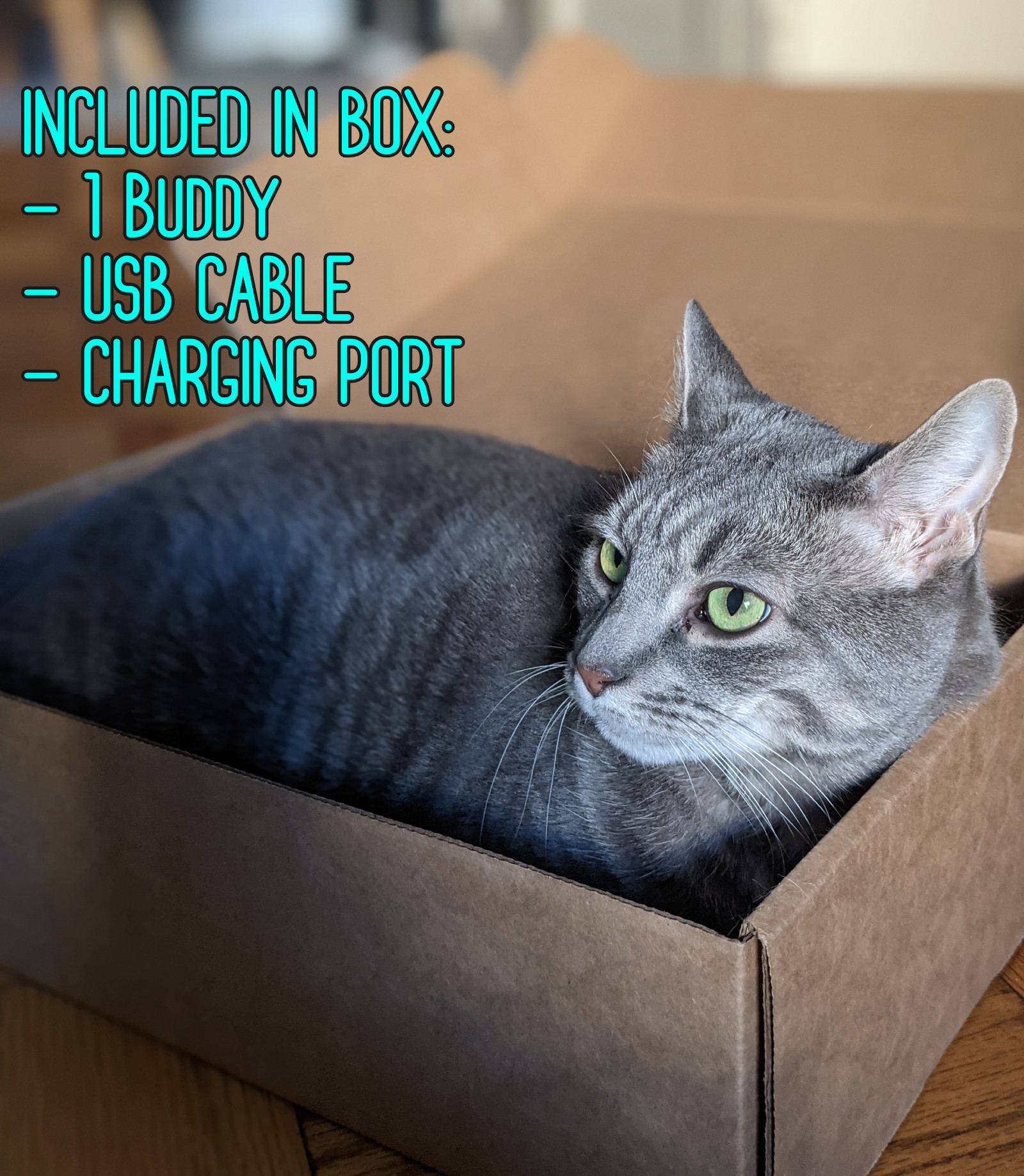
Amazon gave me free shipping on my brand new Buddy, which is supposed to be a vast improvement on the original first-generation Buddy. This Buddy is “more delightful than ever,” according to the marketing materials:
“The amazing Buddy 2.0 is 15 percent cuter, 0.003 percent more brave, and is better than ever at impressing your friends with his vast knowledge of poultry and useless trivia! Thanks to our patented Silky Smooth™ technology, your new Buddy’s fur will feel velvety and softer than ever when you pet him! IMPORTANT: Do not feed Temptations to your new Buddy. Doing so will void your product warranty.”
This model must be plugged in 12 to 16 hours a day to recharge. Indicator lights (his eyes) will glow when fully charged.
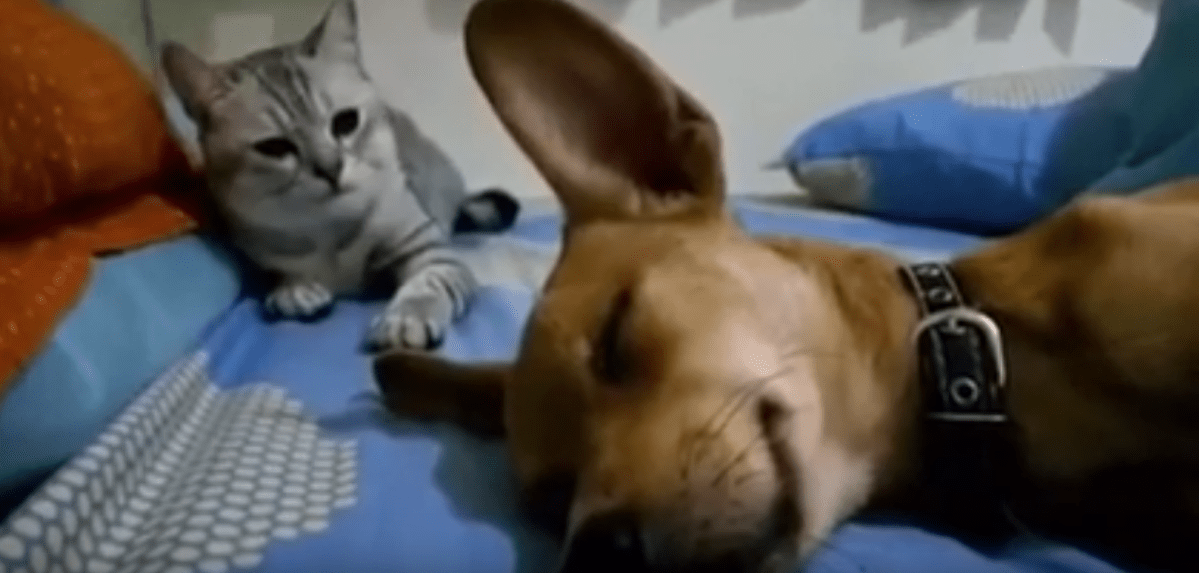
Look at that dog. So happy, enjoying sweet dreams and playing a little unconscious trumpet solo. There’s a slight delay as the olfactory consequences waft their way toward the cat’s nose. The cat’s eyes narrow in fury. Kitty isn’t having it!
We have never been accused of having a mature sense of humor, which is why this made us legitimately lol. Don’t mess with cats, yo:



 Pain In The Bud