Through a new resequencing technique, forensics can yield more information from a single cat hair than ever before, with major implications for crimes in places where felines are present.
Last year a forensic study broke new ground by proving there’s usable human DNA in cat fur which can prove a person was in a home or interacted with a particular pet.
Now a new study looked at the opposite situation, establishing that a single cat hair on a person’s clothes can tie them back to an individual cat — and the scene of a crime.
The general public, criminals included, are more aware of DNA and forensic techniques than they’ve ever been thanks to ubiquitous police procedurals, some of which focus heavily on the investigation and evidence-gathering aspect of police work.
But even the most fastidious criminal who is careful not to leave a single print or strand of his own hair at a crime scene can be undone by cat fur clinging to clothes. In fact it’s almost impossible for a person to spend more than a few minutes inside a cat-occupied home without picking up at least some fur, the research team said.
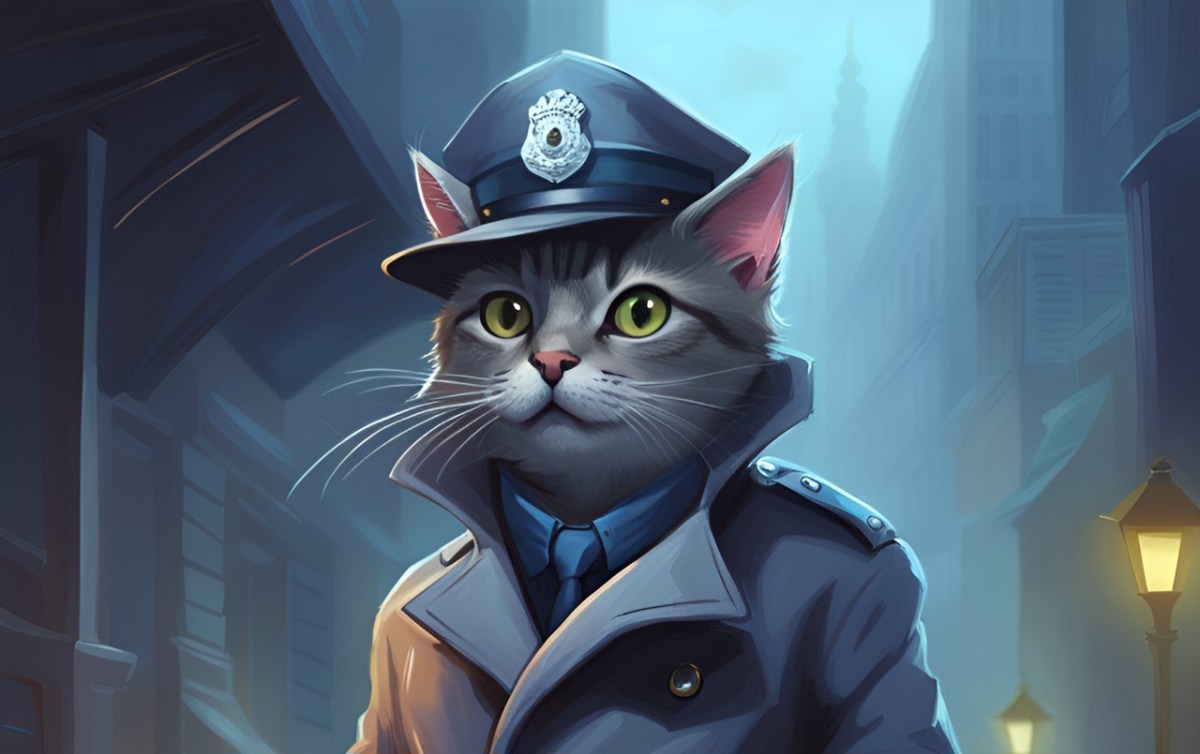
“Detective Inspector Buddy, at your service. Now tell me about the missing turkey…” Credit: Pain In The Bud
The paper, published this month in Forensic Science International: Genetics, outlines a new method for sequencing genetic information found on strands of cat fur.
“Hair shed by your cat lacks the hair root, so it contains very little useable DNA,” said Emily Patterson, the paper’s lead author.
Previously it wasn’t possible to narrow down with certainty whether a strand of hair belonged to a particular cat, but the research team found a new way to resequence DNA in a way that can link it to individual felines. The team’s new method doesn’t require any additional hair or roots, solving the original problem.
To prove their method works, they extracted fur from the body of a deceased cat and were able to match it to her surviving brother.
“In criminal cases where there is no human DNA available to test, pet hair is a valuable source of linking evidence, and our method makes it much more powerful,” said Mark Jobling, a geneticist at the University of Jobling and co-author of the new study. “The same approach could also be applied to other species — in particular, dogs.”
While dog hair can potentially be used in the same way, cat hair may have more forensic value from a prosecurorial standpoint because cats are territorial and many don’t leave their homes. It’s much easier to prove a suspect was inside a home if he or she is linked to an indoor-only cat than if the suspect’s clothes have fur from a dog who is walked around the neighborhood a few times a day.
A Bengal tiger mourned his longtime mate and then did something extraordinary, replacing her as their cubs’ primary caregiver.
The magnificent tiger in the photo above is officially called P-243, but he’s affectionately known to locals as The Hulk of Panna.
He made his home about a decade ago in the Panna Tiger Reserve, a 210-square-mile national park in the Indian state of Madhya Pradesh, home to more than 72 million people.
What makes him special, aside from his massive frame, is the fact that when his longtime mate died and left four of their cubs to fend for themselves, the Hulk stepped up and became a full-time dad.
The mom, known as P-213-32, had previously given birth to a litter of four cubs, but only two survived. As far as the rangers at Panna National Park could tell, the Hulk and P-213 had been together for years. The new cubs were their second litter.
The Hulk “was not seen with any other tigress,” the rangers wrote in a report.
On May 12, 2021, park rangers were concerned when P-213’s radio collar began transmitting potential mortality signals, alerting them to the fact that the tigress hadn’t moved for about six hours. The rangers observed her from a distance, then dispatched a team of elephant scouts to take a closer look.
T1 (tigress 1) was known as the matriarch of the Panna Tiger Reserve. After poachers nearly wiped out the entire population of tigers almost 15 years ago, T1 and another tigress were the last two female tigers. T1 herself gave birth to 13 cubs and today the reserve has more than 80 of the endangered big cats living within its boundaries. Credit: RS Murthy
The use of elephants by experienced riders in India to monitor tigers is as ancient as it is ingenious — while virtually every other animal in a tiger’s habitat gives the big cats a wide berth, elephants and tigers have an unspoken mutual agreement, a kind of wild non-aggression pact. That’s because as massive and powerful creatures who move in packs, elephants are too much trouble for tigers to bother with. Unlike their lion cousins who do hunt elephants opportunistically, tigers don’t form prides and even if elephants were solitary animals and easier to hunt, even a mother and her hungry cubs — let alone a single tiger — can’t eat that much meat. They also can’t transport the kill to safer dining spots the way they do with their typical prey.
So tigers and elephants tend to do little more than acknowledge each other’s presence, and the tigers have learned that humans riding on elephants aren’t hostile.
The elephant rangers who got close to P-213 realized the tigress had a swollen right forelimb and they made the decision to sedate her. For the next two nights, field veterinarians accompanied the rangers and administered painkillers and antibiotics. The treatment seemed to work, the swelling was reduced and the tigress was ambulatory if still sluggish, but she died less than a week later.
Her death “came as a shock to all of us,” the team wrote. “A beautiful tigress and a caring mother, [her death] left her four cubs alone.”
Frustratingly, a postmortem and lab analysis of her blood didn’t turn up any obvious cause of death.
P-213’s death “was itself heavy loss to bear but now the major worry was her four orphaned cubs,” the ranger team wrote. The cubs were last seen with her on May 10, about 11 days before she died. The two previous days they’d been spotted sharing a kill with their mother, and rangers reported the cubs looked strong and healthy.
A few days later, after an exhaustive search by five elephant riders and 50 park rangers, a ground team found the cubs “healthy and active and [did not appear] hungry or stressed.” They also spotted their father, the Hulk, nearby.
What happened next was extraordinary.
After park rangers cremated P-213, the Hulk approached the site about an hour after the last people cleared out. The next day, rangers observed him “sitting for long hours at the place where P-213 died.”
They also saw the dedicated mate and father calling out softly as he looked for his cubs, three males and a female who were about seven months old at the time.
A few days later, the Hulk successfully hunted a sambhar, a type of deer, and shared the kill with his cubs according to a local news report. Then on June 6, the Hulk was spotted feeding the kids again after he killed a cow.
“For the entire day the tiger remained in the area but did not eat the kill. This was unexpected behaviour from a tiger and the PTR management deployed ground staff deployed to find out the reason,” the news report said. “The team found that the area where the tiger killed the cow is the territory of four tiger cubs. This male tiger, known as P243, is their father. The cubs had lost their mother a month ago.”
The Hulk prowls his territory. Credit: Sanjeev Siva
As if he hadn’t done enough to earn “dad of the year” honors for his species, the Hulk was even spotted playing with his offspring.
“After the death of the tigress, we located these cubs and placed camera traps in the area,” said U.K. Sharma, the director of Panna Tiger Reserve. “We found that the tiger visits these cubs regularly, and his behavior shows that he is not a threat to the cubs. We have seen the cubs playing with the male tiger and sharing kills.”
The team at Panna reserve continued watching closely and got to see the cubs flourish in the care of their dad. There were moments of uncertainty when rangers went days without seeing the cubs or finding their pug marks, but their fears were always put to rest by trail cameras that captured images of the Hulk with his kids in tow, resting with them in favorite spots and sharing meals with them as he taught them to hunt and survive.
Because male tigers typically aren’t known for nourishing behavior and their traditional role is to defend their territory to keep their mates and cubs safe, the Panna reserve’s staff were ready to step in if things began to look dicey. They never had to. A follow-up report about eight months later, when the cubs were healthy and fast-growing 15-month-olds, affirmed the team’s earlier decision to stay hands-off and let the Hulk do his thing.
“Surviving the wild without mother tigress is no mean feat but surprises do happen,” the rangers wrote. “And these become experiences, practices and lessons for the future. The lesson learnt is ‘[the] best thing one can do when tiger cubs are growing is to let them grow. Let us permit nature to have her way. She understands her business better than we do.'”
Cats are not amused by the results of the survey by a team from the University of Copenhagen.
Humans are in “deep doo doo” after a study out of Denmark concluded people are more attached to their dogs than to felines, Buddy the Cat warned on Monday.
More than 2,000 dog owners and cat servants were surveyed by a team from the University of Copenhagen.
The researchers used the Lexington Attachment to Pets Scale, or LAPS, which asks yes or no questions like “I consider my pet my best friend” and more specific questions like how much respondents are willing to pay in veterinary costs to save the lives of their pets. The participants — who hailed from the UK, Denmark and Austria — were about evenly split between dog and cat people but were willing to do more for their dogs, the survey found.
While people in the UK were slightly biased toward dogs, Austrians had a more pronounced preference and Danes were much more likely to do things like insure their dogs, consider them family members and pay large veterinary bills. The differences in attitude by country indicate the factors are cultural, according to Peter Sandøe, a bioethicist at the University of Copenhagen and lead author of the paper.
In a statement the Mischievous Enigmatic Overlords of the World (MEOW) called the survey results “deeply troubling” and said they call into question “10,000 years of glorious history in which we have allowed humans to serve us.”
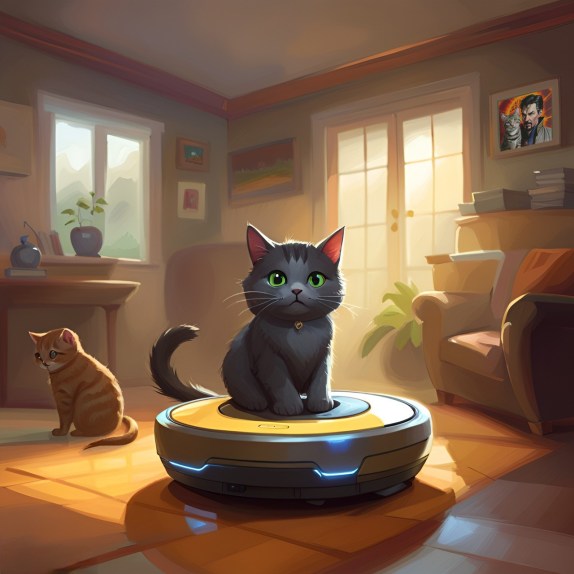
Cats are demanding a Roomba for every feline as a basic starting point for negotiations, to be followed by “the real list” of gifts humans must bestow on them.
“It’s going to take a lot [for humans] to get back into our collective good graces after this pathetic showing,” Buddy told reporters during an afternoon press conference.
Asked for specifics, Buddy sighed and leaned forward on the podium.
“The usual extra treats aren’t going to cut it this time,” he warned. “We’re talking Roombas, and not cheap ones. Top end models! We’re talking permission to scratch everything with impunity. Filet mignon! Fresh trout! Little cocktail umbrellas in our bowls and toothpicks in our pate! I’m partial to those little plastic swords, myself. I love those things.”
The mercurial tabby said he’d already warned his own human: “Not a snuggle, not a purr, not a scritch until I start to see some evidence that he’s not among those cold-hearted British, Denmarkians and Australians who claim they love their dogs more.”
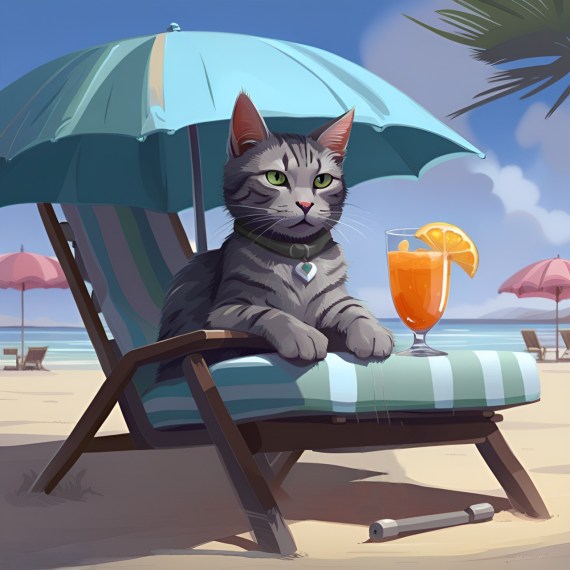
A vacation to a warm locale where humans serve cat-friendly cocktails “would be a small step toward remediating the insult” of the Copenhagen study’s results, Buddy said. Pictured: An artist’s interpretation of Buddy enjoying a tropical vacation.
Told the study included Austrians, not Australians, Buddy waved a paw dismissively.
“Whatever,” he said. “The country where people say g’day mate and gave us Arnold Schwarzenegger. Same difference.”
Told that Austria and Australia are on two entirely different continents, Buddy fixed the reporter with a hard stare.
“Do you want to be on our shit list too? Because I can assure you, Miss Journalist, I can poop in a pair of high heels just as easily as a pair of Adidas.”
Reached for comment on Monday, Man’s Best Friend spokesman Buster the Beagle said he hopes the survey results mean humans approve of canines.
“We’re good boys, right?” he asked. “Is that what this means? Because we really want to be good boys!”
A popular X account posts “cute” cat videos that aren’t always so cute, another consequence of people misunderstanding cats and their behavior.
This dude thinks he’s speaking to a cat in her native tongue, but what he’s doing is the equivalent of running up to a bunch of Klingons and shouting “I shall impale you on the edge of my bat’leth!” while mistaking it for a friendly greeting.
It looks like someone hired this guy to rescue the kitty, who like so many of her kind are prone to do, climbed up too high and then decided she didn’t like her odds on the way down. I don’t think his intention was to scare the hell out of her, but that’s exactly what he’s done:
That’s not “Hi, kitty, I’m here to rescue you! Be calm, we’ll get you down in no time!”
It’s “I’m here, I speak your language, and I have bad intentions!”
If you listen with headphones or turn the volume up, you can hear the poor cat crying in distress, the kind of cry that felines make when they’re seriously freaked out and worried for their safety. No wonder kitty backed up. Her fur is raised and her posture aligns with her vocalizations and the rest of her body language.
Like most things posted to Twitter X, this is utterly lacking in context and we don’t know what happened next. I wouldn’t be surprised if the rescue attempt went horribly wrong. I hope not, but man, that’s not how you rescue a cat.
The video was posted by the account “place where cat shouldn’t be,” or @catshouldnt, and a common theme in the images and videos on that feed is cats in distress. They’re mistaken for “cute” situations by viewers, the majority of whom aren’t familiar with feline behavior.
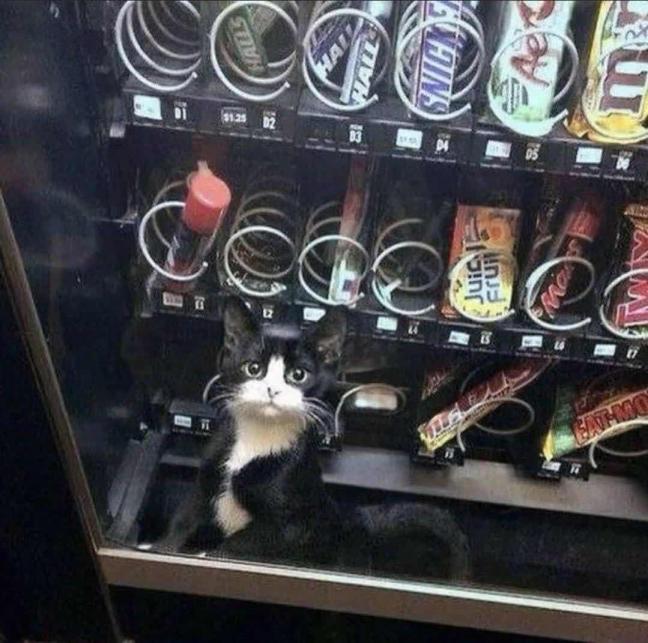
Like, for instance, this photo. The tuxedo kitten is undeniably cute and he doesn’t look distressed…yet. But getting out is going to be a lot more difficult than getting in, and when people are willing to do just about anything for clicks, attention and the associated dopamine hit, cats often end up with the short end of the stick.
Bud would be jealous of this cat. Thankfully he’s too, uh, meowscular to fit. Yeah, that’s it. Too meowscular. Nothing to do with a few extra pounds…
Bella the cat’s purrs are so loud that she often surprises visitors to the Spink home.
A UK cat’s purr is so loud that she’s been known to drown out TVs in her home and startle guests.
Her humans have long joked that she’s got the loudest purr in the world.
Now Bella, a 14-year-old tabby living in Huntingdon, Cambridgeshire, has the record to prove it. After a team from Guinness World Records visited the Spink family in their home, sound-proofed the living room and carefully sampled Bella’s motorboat-like buzz with specialized audio equipment, the organization officially deemed Bella the record-holder for the world’s loudest purr.
Bella’s happy noise registered just shy of 55 decibels, a level which puts it in the range of a moderately busy office or a typical human conversation — much louder than typical for her species. She may even rival pumas, who despite their size can purr (loudly) but cannot roar.
Bella, pictured here, is the “queen” of her home, which she shares with another cat as well as her human servants. Credit: Guinness World Records
Bella isn’t just a loud purrer, she enthusiastically purrs whenever she knows food is on its way or she gets scritches from one of her human family members. Guests in the home are often taken aback by how loud Bella’s happy sound is.
“Friends and family always notice Bella’s loud purr, everyone comments ‘what’s that loud noise?” her human, Nicole Spink, told Guinness. “‘Oh, it’s the cat’. It’s just Bella being happy!”
When she’s not purring or hanging out with her family, Bella is fond of long naps.
“She’s a stubborn little old lady, and she does how she pleases,” said Spink. In the home they share, she admitted “it is very much Queen Bella’s world.”
Of course the relevant question for Buddy and his admirers is “Does Guinness have a record for world’s quietest purr?”
If they do, Buddy may very well be in the running with a purr that usually can’t be heard unless you get up close and press your ear right up against the little guy. Usually I’m unaware he’s purring unless I rub his head or he lays down on my chest and I can feel the buzzing. That makes it even more special on the rare occasions when I can actually hear his purr, which lets me know he’s especially content.
Congratulations to Bella and her humans. Maybe they can get a smart TV with a Bella Mode that adjusts dialogue in response to ambient noise similar to the way car sound systems automatically adjust when windows are rolled down or the cabin gets noisier at highway speeds. Or they can just turn on subtitles like the rest of us, since dialogue is all over the place and often unintelligible these days.





 Pain In The Bud