Why Do Some Shelters Refuse To Adopt Out Black Cats In October?

While stories about Satanic rituals involving black cats are overblown, it’s better to be safe than sorry when it comes to the welfare of helpless cats.

Life isn’t easy for strays and shelter cats, and black cats have it rougher than most. They’re less likely to find forever homes and more likely to be euthanized than cats with other fur colors and coat patterns.

As if that wasn’t enough of a disadvantage, black cats are particularly vulnerable at this time of year due to their association with Halloween and lore surrounding Satanic rituals.

On the somewhat less tragic end of the spectrum, some people “adopt” black cats as temporary Halloween decorations, using them as accessories for parties or decorative dioramas. When Halloween is over, the “owners” bring the cats back to the shelter.

But rescue groups and advocates say the most unfortunate black kitties end up in the hands of cultists or people reenacting cult rituals. Those rituals never end well for the poor felines.

As a result, some shelters and rescues put black cat adoptions on hold during October.
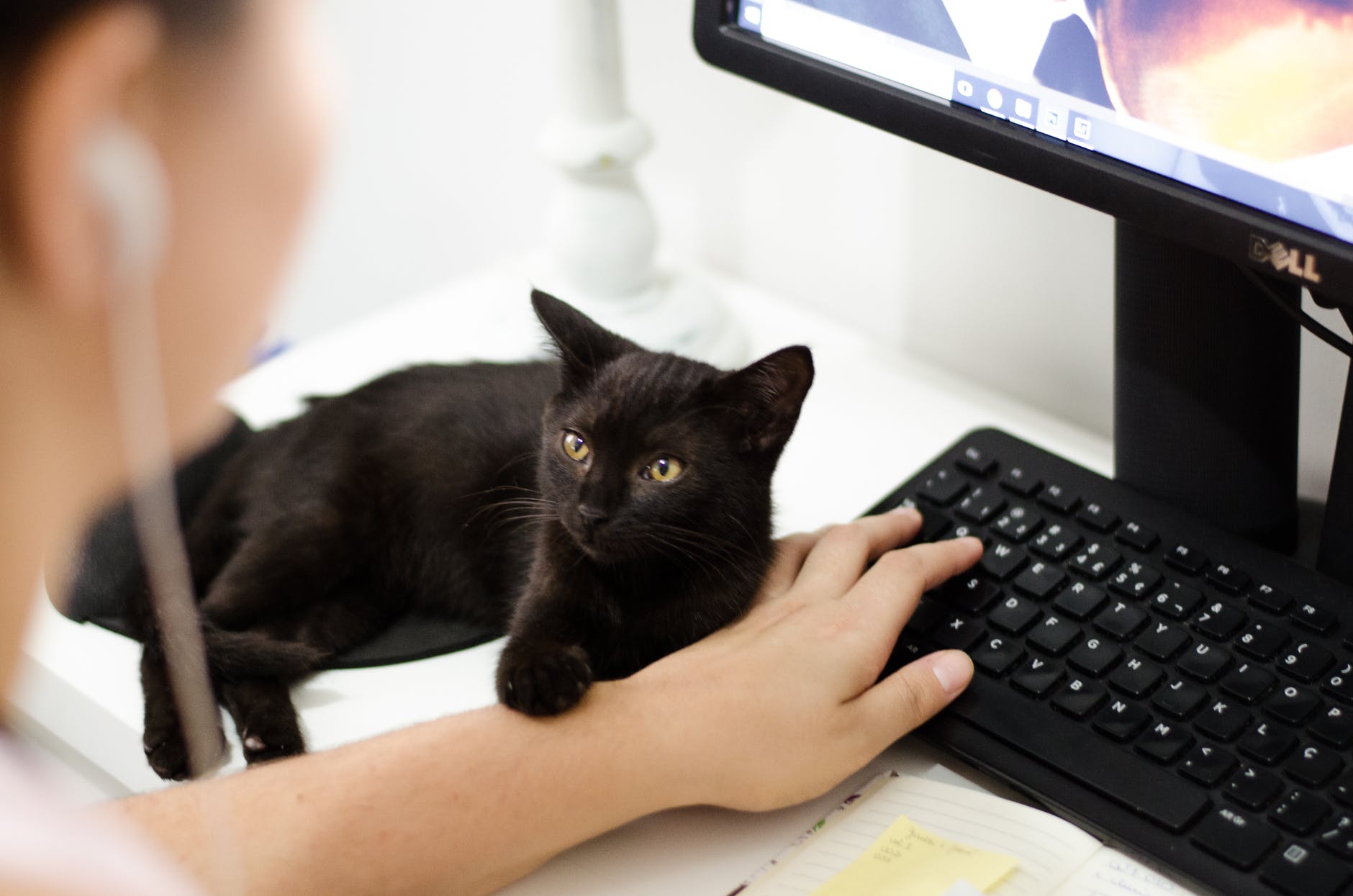
black cat holding persons arm
Credit: Ruca Souza/Pexels

The origin of the “evil black cat” trope is usually traced back to the 13th century papal decree called Vox in Rama. (“A voice in Ramah.”) Despite sounding like an Arthur C. Clarke short story, the decree was not entertaining — it called for a renewed push to find and punish heretics, and condemned a Satanic ritual that was allegedly performed among hidden cultists:

Afterwards, they sit down to a meal and when they have arisen from it, the certain statue, which is usual in a set of this kind, a black cat descends backwards, with its tail erect. First the novice, then the master, then each one of the order who are worthy and perfect, kiss the cat on its buttocks. Then each [returns] to his place and, speaking certain responses, they incline their heads toward to cat. “Forgive us!” says the master, and the one next to him repeats this, a third responding, “We know, master!” A fourth says “And we must obey.”

Stripped of context, it’s almost comical: A cat walks around and people line up to kiss its ass? Well, they’re just expressing their fealty as servants and vowing not to be tardy with kitty’s meals!

Alas we’re talking about the dark ages, a time when skepticism wasn’t really a thing and zealots were eager to prove their loyalty and value to powerful leaders. One of them, a German nobleman named Konrad von Marburg, had the pope’s ear, and Marburg was the one responsible for whispering to the pontiff about the supposed back cat ass-kissing rituals.

While the papal decree was real and Marburg really was an overzealous jerk who turned public opinion against the church for his brutal inquisition against heretics real and imagined, there’s debate about how much impact the decree ultimately had, and whether a resulting purge of felines from Europe during the Black Plague resulted from superstition or panic as more people got sick. (Serious academic opinion tends strongly toward the latter, particularly because people mistakenly believed cats were carriers of the disease.)
close up shot of a black cat
Credit: Magda Ehlers/Pexels

Clickbait sites have run wild with the Vox in Rama story, which has grown more outrageous with each retelling, resulting in headlines that make it sound like the Vatican dispatched shock troops to purge cats from the European continent and urged Catholics to slaughter them on sight. In reality, the papal bull dealt with a small area in Germany and was little-known even at the time it was issued.

The dozens of clickbait articles that surface at the top of search results for “Vox in Rama” omit the actual text of the papal bull, and many make the unfounded claim that the pope called for cats to be killed.

Was the decree real? Yes. Did it result in the slaughter of cats? Highly unlikely, and there’s no evidence to support that claim.

Likewise, the “evidence” that black cats are abused on Halloween is purely anecdotal as this Snopes story from 20 years ago notes. The fact-checking site called the claims about black cats used in Satanic rituals “inconclusive.”

But individual shelter managers trust their gut — and the many stories about black cats disappearing this time of year — in deciding it’s better to be safe than sorry, which is why many shelters won’t adopt out in October and others are more rigorous with their adoption screening.

There’s nothing wrong with that. As anyone who’s searched for cat news knows, there are disturbing stories about cat abuse every day, and people are sadly capable of incredible cruelty toward animals.

Better for black cats to be taken off the adoptable list for a few weeks than end up in the hands of people who want to do them harm. As cat lovers, there is something we can do: Consider black cats the next time we’re looking to adopt. Plenty of PITB readers have black cats, and they’ll be the first to tell you the little house panthers are just as sweet and amusing as cats of any other fur color.

close up photo of black cat
Credit: Marcelo Chagas/Pexels

Cats and Stand-Up: George Carlin Talks Felines

The trail-blazing comedian talks about all the ways cats amuse — and perplex — him.

Our previous posts on cat-related stand-up featured Zoltan Kaszas and Corey Rodrigues from Dry Bar Comedy, which is a comedy channel that specializes in “clean” sets without vulgarities or obscenities.

This time around we’re checking in with George Carlin, so fair warning: There will be bad language, and Carlin pokes fun at cuteness aggression in a way that probably won’t go over well by people who take it literally.

It’s 100 percent Carlin. After all, we’re talking about the man who was pretty much single-handedly responsible for a 1978 Supreme Court decision on the government’s authority to censor public broadcasts after his now-legendary “Seven Words You Can’t Say On Television” bit.

George Carlin
George Carlin in the 1960s.

It’s obvious Carlin’s spent a lot of time around cats, as he’s got their behavior down and he finds humor in the feline tendency to be relentlessly one-minded. He laughs at the way cats make biscuits — “looks like they’re into some bad drug!” he says as he imitates a cat’s ecstatic kneading — and how quickly they become whirling tornadoes of claws and teeth as kittens.

“You take a baby baby — that is, a human — a baby dog and a baby cat, and you attack all three of them, which I try never to do if I can help it,” he says, drawing laughs. “You’ll get three different results. You attack a baby, he cries. You attack a puppy, he cowers. You attack a kitty cat, he fights!”

Carlin makes a meowing sound, swiping one hand like an annoyed cat.

“One day old and they’re looking for some sh–! They don’t even got their eyes open, they’ll get right in. Nasty cute little thing. Cute little nasty guy! Oh, they’re wonderful, God love ’em.”

While dogs love pets and never want you to stop, Carlin points out that with a cat “you just put your hand out and he’ll do all the work.”

Cats love rubbing against people so much that they’ll start to rub against your leg “even if you’re not there yet,” Carlin observes, imitating the way the little ones change their body language the instant they decide it’s rubbing time.

“They love to rub on you. If you’ve got a leg and a cat, whew, you’ve got a party! ‘Oh boy, oh boy, I’m rubbing on his leg!’ If you’ve got two legs, sh–, jubilee celebration time! ‘Oh boy, two legs! Hot sh–, I can do the figure eight! Oh boy!’” Carlin says, stalking across the stage.

“There’s one other quality cats have that I admire. Cats don’t accept blame and they don’t embarrass, at all. A cat does something dumb, you’ll never know it by lookin’ at him. Dog knocks over a lamp, you can tell who did it just by looking at the dog. Not the cat. Cat doesn’t accept any blame, cat moves along to the next activity. ‘What’s that? Not me, f— that, I’m a cat! Something break? Ask the dog.’

Bohemian Catsody: Cats Sing Queen

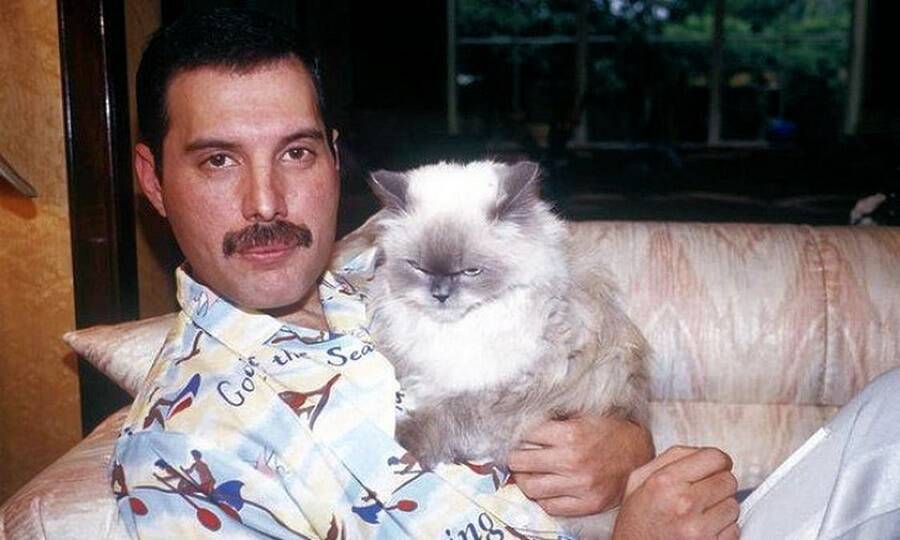
A Kiwi Queen fan rewrote Bohemian Rhapsody from a feline perspective in honor of frontman Freddie Mercury, who loved cats.

Queen frontman Freddie Mercury loved his cats so much that when he found himself missing them on tour, he’d ask his girlfriend to put them on the phone.

“He’d get to a hotel, we’d dial through, and he really would talk to his cats,” Peter Freestone, Mercury’s personal assistant of 12 years, wrote in his memoir.

Mercury’s feline infatuation began years earlier when Mary Austin, his girlfriend and eventual fiance, adopted a pair of kittens named Tom and Jerry when she and Mercury moved in together. Austin would stay home to take care of the duo — and a subsequently growing pride — when Freddie did gigs.

“Mary would hold Tom and Jerry in turn up to the receiver to listen to Freddie talking,” Freestone wrote. “This continued throughout the years with succeeding feline occupants of his houses.”

Mercury was a servant to 10 cats throughout his life, and loved them so much he dedicated an album to them, devoted a song to his cat Delilah, and took great joy in picking out presents for them at Christmas.

Thus, Bohemian Catsody seems both inevitable and so natural, it’s a wonder someone hasn’t done it before. New Zealander Shirley Șerban uploaded the video on Oct. 1 and it’s already got 89,000-plus views.

The lyrics couldn’t be more appropriate:

“I choose to employ you, now attend to me
Open the door, then I’ll come, then I’ll go
Feed me now, don’t be slow!
Stalk you in the bathroom
Privacy don’t matter to me…to me!
Mama, just killed a mouse
Ate it all except the head
That’s your present on the bed
Mama, a sign of my love
Why did you scream and throw it all away?
Mama, ooooh, oooh!
Didn’t mean to make you cry
I’ll try to find a bird for you tomorrow!”

Reason #488 To Keep Your Cats Indoors: They Hunt Whether They’re Hungry Or Not

Cats who have regular outdoor access and hunt wildlife still get 96 percent of their nutrition from pet food, a new study found, suggesting their predatory behavior is driven by instinct, not hunger.

A new study from the UK debunks the claim that cats need access to the outdoors to supplement their diets with wild kills.

Cats who spend a significant amount of time outdoors and regularly kill local wildlife still get 96 percent of their nutrition from meals provided by their humans, according to research by a team at the University of Exeter.

The scientists connected with cat owners through ads on social media, TV and in print publications, specifically seeking out “cat owners living throughout southwest England whose cats regularly captured wild animals and brought them back to the house,” the study’s authors said.

They gave the owners a questionnaire to collect some basic information on the kitties — age, sex, breed, whether they had unrestricted access to the outdoors, and how much time they spend outside — then split the 90 participating cats into six groups.

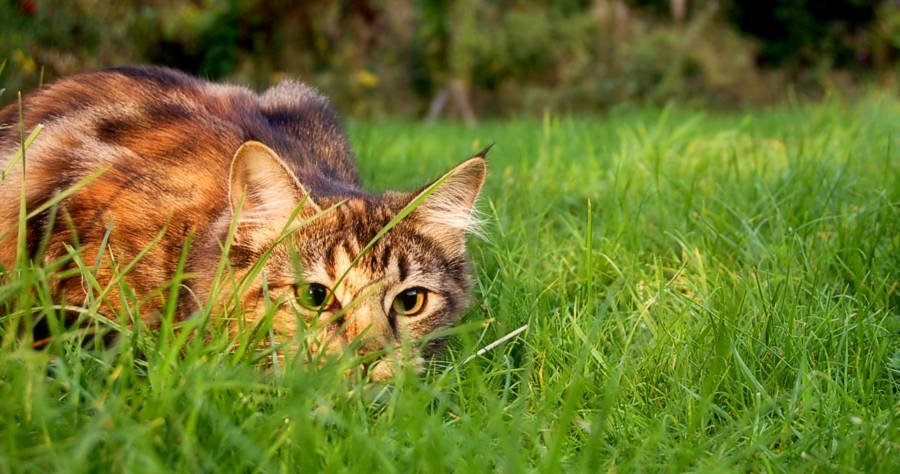
Cat hunting
A domestic tabby cat stalking in the grass. Credit: Wikimedia Commons

To set a baseline, the scientists trimmed small sections of whisker from each of the cats, then trimmed a second sample at the end of the study.

By comparing stable isotope ratios in the whisker samples, they were able to determine what the cats were eating. Despite regular access to the outdoors and successful hunts, pet food accounted for the vast majority of their diets.

As a result, the researchers concluded, outdoor cats hunt because they’re driven by predatory instinct, not hunger.

“When food from owners is available, our study shows that cats rely almost entirely on this for nutrition,” said Martina Cecchetti, the study’s lead author.

“Some owners may worry about restricting hunting because cats need nutrition from wild prey, but in fact, it seems even prolific hunters don’t actually eat much of the prey they catch,” Cecchetti said. “As predators, some cats may hunt instinctively even if they are not hungry – so-called ‘surplus killing’ – to capture and store prey to eat later.”

A second component of the study was designed to find the best mitigation strategy to change the behavior of outdoor cats.

Each group was given a different strategy: In one group, cats were outfitted with bells on their collars, while another group wore reflective break-away collars and cats from a third group were fitted with BirdBeSafe collars. The other groups were told to make habit changes inside the home. For example, one set of cats was fed a higher-protein diet without grain filler, another group was fed with puzzle feeders, and the last group was given extra interactive play time.

While high-protein diets and play time helped cut down on hunting, the BirdBeSafe collars had the biggest impact on hunting success. The collars come in bright colors designed to stand out to avian eyes, taking away stealth and the element of surprise from cats.

The study was sponsored by Songbird Survival, a British non-profit that funds bird conservation research and looks for ways to mitigate the dwindling numbers of many avian species.

Susan Morgan, Songbird Survival’s executive director, said her group hopes cat owners will do their part to help: “Pet owners can help us reverse the shocking decline in songbirds via three simple, ‘win-win’ steps: fit collars with a Birdsbesafe cover; feed cats a premium meaty diet; play with cats for five to ten minutes a day to ‘scratch that itch’ to hunt.”

Of course there’s an obvious solution the study didn’t include: Keeping cats indoors. While keeping cats indoors is common in the US, cat ownership culture in the UK is different — another subject for another post.

Read the full text of the study here. Header image credit Pexels. Body images credit BeSafeCollar.

Previously:

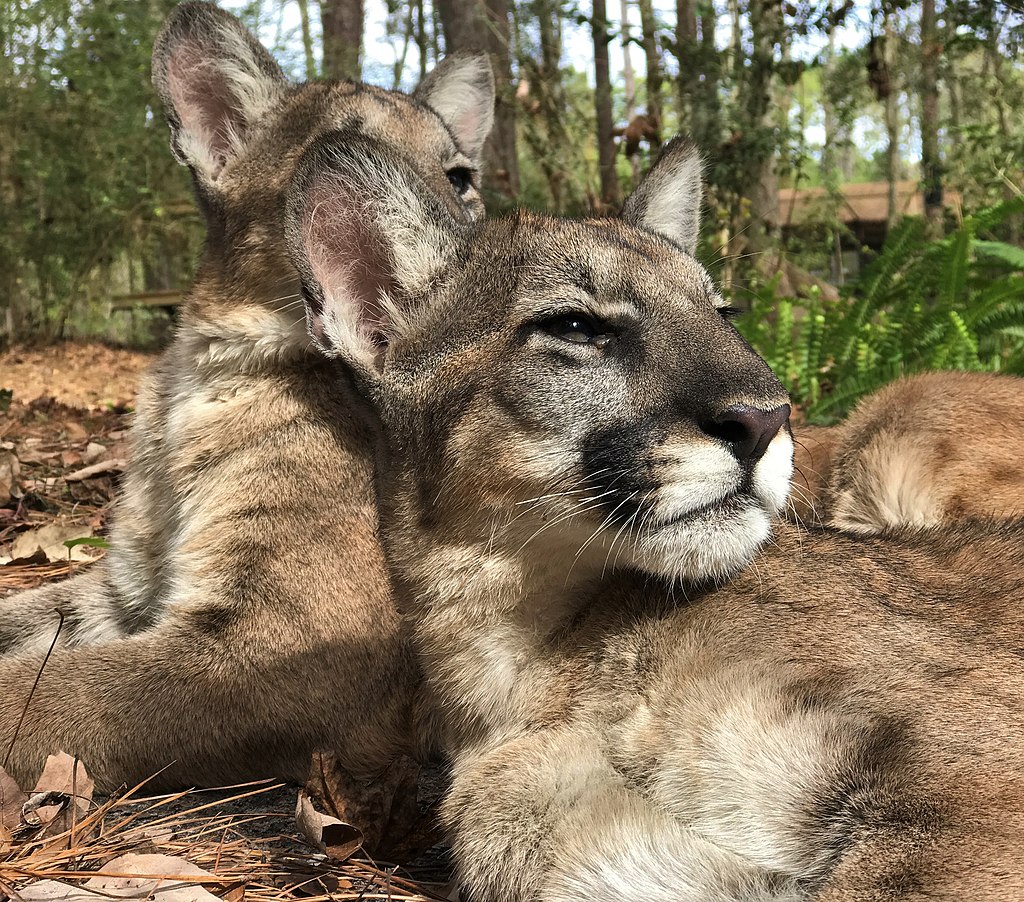
1024px-Florida_panther_kittens
A pair of young mountain lions in Florida. Credit: Wikimedia Commons/WOConservation

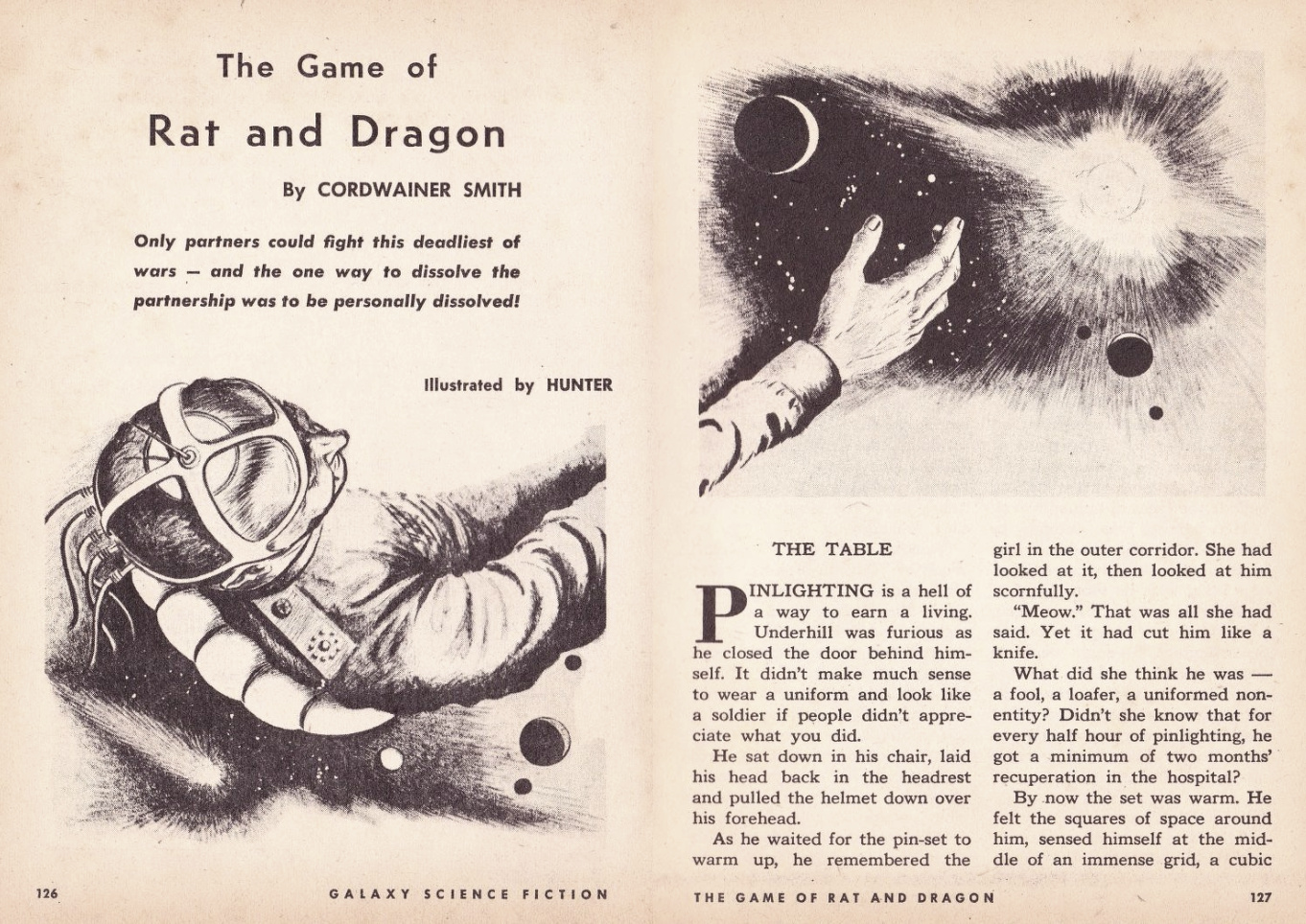
Bud’s Book Club: The Game of Rat and Dragon

When an interstellar enemy threatens human progress, cats step in to save the day in this science fiction classic from 1954. The Game of Rat and Dragon explores the feline psyche and the cat-human partnership that has existed for 10,000 years.

A week ago we kicked off Bud’s Book Club with a short story, The Game of Rat and Dragon, and a non-fiction book, Man-Eaters of Kumaon. This post deals exclusively with the former. (If you haven’t read the story yet, it’s available here free. Most people will be able to read the story in less than a half hour at a moderate reading pace.)

By now everyone who’s read the story knows what it’s about: Cats, of course! But the story requires a bit of world-building setup before the kitties are introduced:

In an unspecified future humans have become a true spacefaring species, mastering interstellar travel and founding colonies in new star systems.

It’s a lot like the days of colonial powers founding settlements in the New World, but without the ugliness of terrestrial colonization or the quaintness of crossing a mere ocean.

Using a form of traveling called planoforming — essentially faster-than-light (FTL) jumps — human ships are able to reach distant star systems without traveling for the decades or centuries it would normally take to cross the unfathomable distances between solar systems.

Just when it looks like no obstacle remains for humanity to spread out into the galaxy, the intrepid explorers on the rim of human-occupied space realize there’s an insidious threat lurking in the void between stars.

Huge entities, invisible to the human eye, live in the vacuum of the interstellar medium. They haunt the void and attack human ships without warning. They are “beasts more clever than beasts, demons more tangible than demons, hungry vortices of aliveness and hate compounded by unknown means out of the thin tenuous matter between the stars,” author Cordwainer Smith writes.

When the mysterious entities attack, most people are mercifully killed in an instant, but the unlucky ones survive in a permanent state of insanity, their minds unable to cope with whatever alien malevolence they’ve witnessed.

As they learn more from each disastrous encounter, humans come to understand these creatures prefer the deep dark, shying away from star systems and their abundant sunlight.

But without a way to make it across the void, it becomes clear the era of human exploration and colonization is over unless something can be done to stop the enemy.

ratanddragon

To extend the nautical theme, you can think of the dragons as giant krakens who prey on trade ships and passenger liners crossing between the American colonies and Europe during the Age of Sail. Although pushing the boundaries of new frontiers has always been dangerous, you can imagine how quickly intercontinental trade and settlement would grind to a halt if, say, half of all ships were sunk en route.

Humans can’t see the dragons, but that isn’t the primary reason they can’t successfully fight them. After all, the history of human warfare proves we’ve become adept at destroying enemies we can’t see, whether a ship’s dropping depth charges on a submarine hidden in murky waters, or some 20-year-old kid on an aircraft carrier hundreds of miles out to sea is using a joystick to lob drone-fired missiles on mainland buildings.

The real problem is that people just aren’t quick enough, unable to target and fire on the dragons before the entities react and speed away to safety.

So they turn to cats.

Kitties to the rescue

With their incredible reflexes, reaction time and hunting instincts, cats are more than a match for the dragons, and here’s where the story starts to get really fun. Cats, we’re told, travel alongside human vessels in their own little football-shaped ships that are equipped with precision miniature nuclear warheads.

Cats are happy to destroy the dragons — if their humans present the conflict as a game, make the “dragons” look like rats, and offer substantial rewards in the form of fish and poultry.

Space Kitty
“I come from the Great Litterbox in the Sky!”

That’s why the cats are called Partners: Using some sort of brain link, specially trained humans pair up with the cats, mentally project images of the dragons as “gigantic rats,” and act like spotters so the kitties can pounce on their space rodents before the latter can hurt the human passengers.

Because the dragons are harmed by light, the cats lob “ultra-vivid miniature photonuclear bombs, which [convert] a few ounces of a magnesium isotope into pure visible radiance,” neutralizing the threat before anyone can be harmed.

The mind link between human being and cat is a two-way connection, affording cats a close-up view of human thought patterns just as the humans can feel the kitty’s mental processes.

We learn that our hero, Underhill, loves the feline Partners, and he’s deeply offended when a fellow soldier mocks his work by meowing at him. We also learn the cats understand that, while their task is dressed up as a fun hunting game, they face real danger when they fight the dragons.

The mind of a cat

Through Underhill’s eyes, we meet several of the Partners.

My favorite is an unnamed tomcat, described as “a greedy old character, a tough old male whose mind was full of slobbering thoughts of food, veritable oceans full of half-spoiled fish. Father Moontree had once said that he burped cod liver oil for weeks after drawing that particular glutton, so strongly had the telepathic image of fish impressed itself upon his mind. Yet the glutton was a glutton for danger as well as for fish. He had killed sixty-three Dragons, more than any other Partner in the service, and was quite literally worth his weight in gold.”

astrocat
“To boldly go where no moggy has gone before!”

We’re told that the cats recognize the complexity of human minds, but aren’t necessarily impressed by them. The things humans concern themselves with and worry about are “silly” from a cat’s perspective (which, perhaps not coincidentally, is how the philosopher John Gray imagines how cats view us), and cats can quickly grow bored with a human too focused on highly abstract thoughts or subjects that simply don’t have much bearing on feline life:

“Usually the Partners didn’t care much about the human minds with which they were paired for the journey. The Partners seemed to take the attitude that human minds were complex and fouled up beyond belief, anyhow. No Partner ever questioned the superiority of the human mind, though very few of the Partners were much impressed by that superiority.

The Partners liked people. They were willing to fight with them. They were even willing to die for them. But when a Partner liked an individual the way, for example, that Captain Wow or the Lady May liked Underhill, the liking had nothing to do with intellect. It was a matter of temperament, of feel.

Underhill knew perfectly well that Captain Wow regarded his, Underhill’s, brains as silly. What Captain Wow liked was Underhill’s friendly emotional structure, the cheerfulness and glint of wicked amusement that shot through Underhill’s unconscious thought patterns, and the gaiety with which Underhill faced danger. The words, the history books, the ideas, the science—Underhill could sense all that in his own mind, reflected back from Captain Wow’s mind, as so much rubbish.”

Underhill is as fond of Captain Wow and Lady May, a friendly Persian, as they are of him. He’s happy when he’s called upon to defend a ship and finds out he’s been paired with the latter:

“When he had first come into contact with her mind, he was astonished at its clarity. With her he remembered her kittenhood. He remembered every mating experience she had ever had. He saw in a half-recognizable gallery all the other pinlighters with whom she had been paired for the fight. And he saw himself radiant, cheerful and desirable.”

spacecats

What’s unique about this story — and what makes it particularly memorable, in my opinion — is Cordwainer Smith’s decision to explore the feline mind.

Out on a limb, from a feline world view

Minds, human or animal, are called “black boxes” for a reason. Even with the benefit of advanced science, even with fMRI and other forms of imaging, even with algorithmic AI that can read thoughts and sketch rudimentary images from our minds, we really don’t know what others are thinking, human or animal.

Smith goes out on a limb by imagining what must go on in the minds of cats, and it’s obvious he’s not only a cat lover, but he had a lifetime of experience with our furry friends when he wrote the story.

The idea that cats are all about emotion and tangible things — and are bored by things humans concern themselves with — seems dead on, as does the idea that cats aren’t impressed by our intellectual superiority, which only counts as superiority in human terms. Even if they had opposable thumbs and the means to create, would cats be interested in the kind of things we do?

Probably not. God only knows what kind of structures cats might build and what songs they’d write, but I’m pretty sure my cat would write paeans to turkey.

Did you like the story? What are your thoughts?