Thanks To A New Treatment, These Cats Have A Second Chance At Life

Parsnip and Jupiter are fighting off FIPV, a virus that until recently was a death sentence for cats. The future looks bright for both cats.

After almost three months in treatment, little Parsnip is back to her old self.

The tabby cat with expressive sky blue eyes had been diagnosed with Feline infectious peritonitis, a variation of feline coronavirus that attacks the body’s white blood cells and can render even the most playful kittens lethargic, eventually robbing them of their ability to walk and ultimately, their lives.

Parsnip was an affectionate whirlwind of energy when 21-year-old Californian Anae Evangelista adopted her. When she lost her kitten exuberance six weeks later, Evangelista knew something was wrong. When the little cat stopped eating and drinking, Evangelista realized the problem was much more serious than an initial veterinary examination suggested.

After more tests, she received grim confirmation that Parsnip had FIPV, a virus that is almost always fatal.

But a veterinarian connected her with an online group for people whose cats have FIPV and Evangelista was able to get her kitty accepted for experimental treatment with GS-441524, a nucleoside analogue antiviral drug that has proven effective at treating all types of FIP in several trials in recent years.

After a regimen of almost three months of GS-441524 treatment, Parsnip has her energy back, she’s gained a pound and a half, and “looks perfectly healthy,” Evangelista said. Equally important, her blood work and other health indicators are all positive.

She’s overjoyed at the result. Parsnip came into her life at a difficult time, when Evangelista was grieving the loss of two friends. Losing the kitten she’d bonded with — an animal who had become such a comfort to her over the months — would have been too much.

Evangelista will graduate from college in about a week’s time, “so I’m honestly so excited to have her ‘graduate’ from her treatment too,” she told PITB.
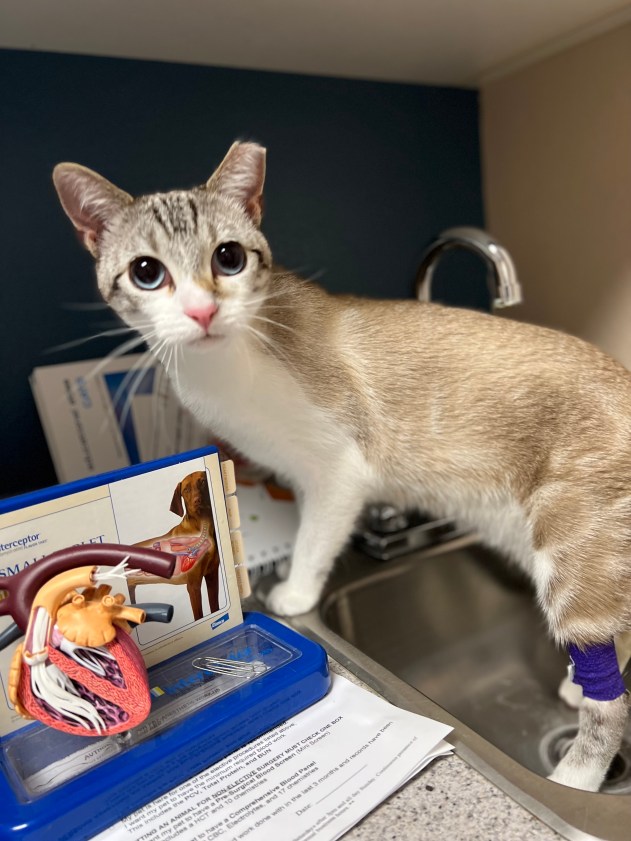
Parsnip at the vet
Parsnip being a little trooper during one of her many veterinarian visits.

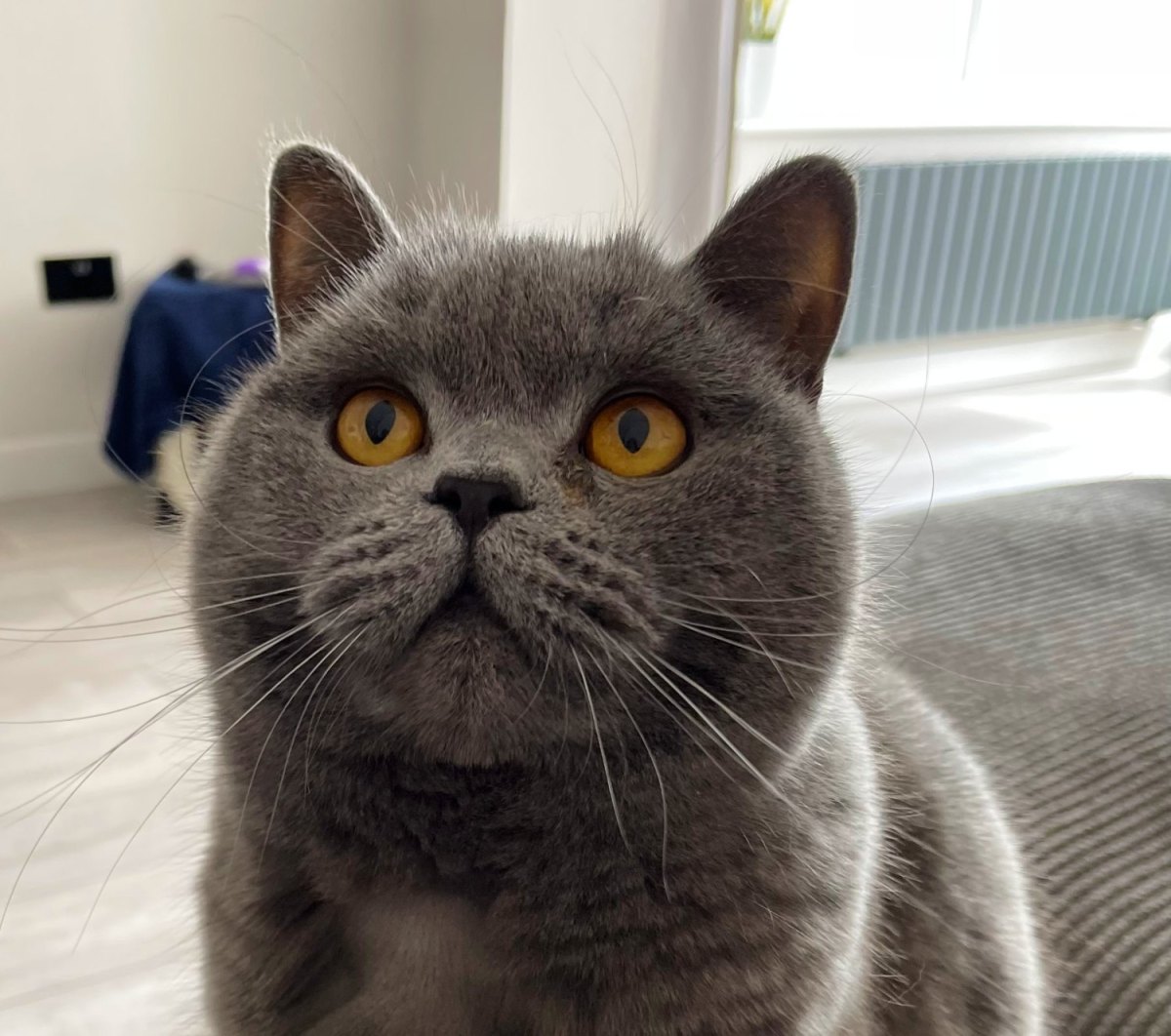
Londoner Billie’s cat, Jupiter, also suffers from FIPV. When she went to adopt him, Billie knew the British shorthair had Feline herpes virus (FHV) and that it would require careful monitoring. But the infection wasn’t life-threatening and Billie had already fallen in love with the golden-eyed chonkster.

When Jupiter’s appetite waned and his behavior changed earlier this year, Billie thought the little guy was just suffering from a FHV flare-up.

“He is very loving, he is like my shadow and he loves to play,” Billie told PITB, “but he wasn’t doing any of these things.”

As was the case with Parsnip, the veterinarians didn’t think Jupiter was seriously ill. They sent Billie and Jupiter home with antibiotics and anti-inflammatory medication, but after a week Jupiter still hadn’t improved. He was subject to a battery of tests — bloodwork, ultrasounds, x-rays — and kept overnight for observation.

“FIP is notoriously hard to diagnose, and there are so many symptoms that you could mistake for other things,” Billie said, noting veterinarians often have to “work backwards” and eliminate other potential ailments before diagnosing a cat with FIPV. “Jupiter’s symptoms were so minor initially, he just seemed a bit off and hadn’t eaten much and felt hot. I think because I know him and his behavior so well, we were able to catch it early.”
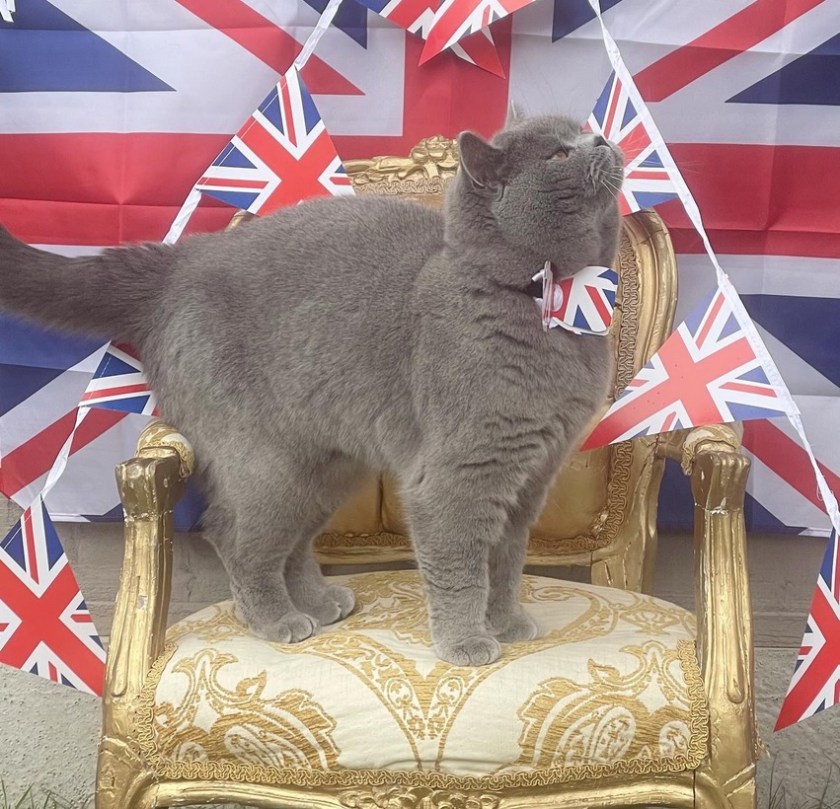
jupiterjubilee
Jupiter proudly displaying the Union Jack in celebration of Queen Elizabeth’s Platinum Jubilee.

Because the tests didn’t confirm FIPV, a third visit with more tests followed before Jupiter was placed on his meds. While the FDA has yet to approve GS-441524 treatment in the US, the UK had approved the drug in fall 2021, so Jupiter was able to begin treatment right away. Like Evangelista, who paid $5,000 for the FIPV drugs, not including the initial veterinary examinations, Billie was faced with hefty bills: The three initial veterinary visits, tests and five nights of observation added up to £5,500 (about $6,930 in USD), and the medication set her back £7,500 (about $9,400).

Her family helped her pay the initial veterinary bills, her sister started a GoFundMe campaign, and her nieces began making “FIP Warrior crystal healing bracelets,” with the proceeds from sales going to Jupiter’s treatment. (A GoFundMe for Parsnip also exists, and has raised $2,060 of its $2,500 goal so far.)

So far, Jupiter is responding well to the treatment and the signs are encouraging.

Both cats will enter an 84-day observation period after their regimens. They’ll have their bloodwork monitored and will be examined several times over that stretch to make sure they’ve recovered. They’ll also be closely watched at home for any symptoms.

Evangelista and Billie said they’re heartened by the 85 percent success rate.

Despite the cost, Billie said she didn’t balk at taking care of her cat.

“Jupiter is my whole world,” Billie said. “It is just the two of us, he is my one constant and he means everything to me. He is so loving, and so sassy. He has such a little personality and I would be so lost without him.”

Follow Jupiter on Instagram @_jupitersfipfight and Parsnip at @lilmissparsnip

Sunday Cats: Buddy The Philly Cat Makes A Friend, His Attackers Get A Trial Date

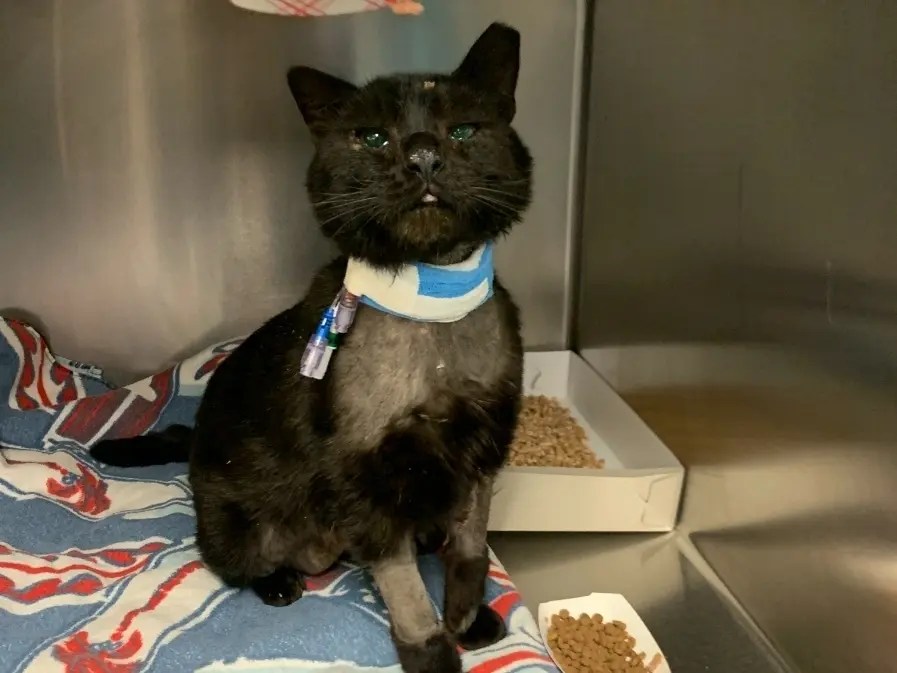
Buddy, the cat who survived an attack by two dogs, continues to recover in a foster home, where he lives with the emergency vet who cared for him after the attack.

Two Philadelphia minors will head to trial in May after they sicced their dogs on a cat sitting on a porch a month ago.

The juveniles, who are 17 and 12 years old, were walking their dogs in Philadelphia on March 22 when they set them loose on Buddy, a black cat who was cared for by a local family but spent most of his time outside. They shouted encouragement as their dogs mauled Buddy on his family’s porch and Buddy would have been killed if the commotion hadn’t drawn attention from inside.

When one of Buddy’s caretakers stepped outside and tried to stop the dogs, the teens pulled their canines back and fled. They turned themselves in to authorities a few days later after the story went viral and they realized the attack was captured by a doorbell camera system.

They each face felony and misdemeanor charges for animal cruelty, inflicting harm on an animal and other alleged offenses. Since they’re charged as minors the court system is not releasing their names, which is common practice in juvenile cases in most states.

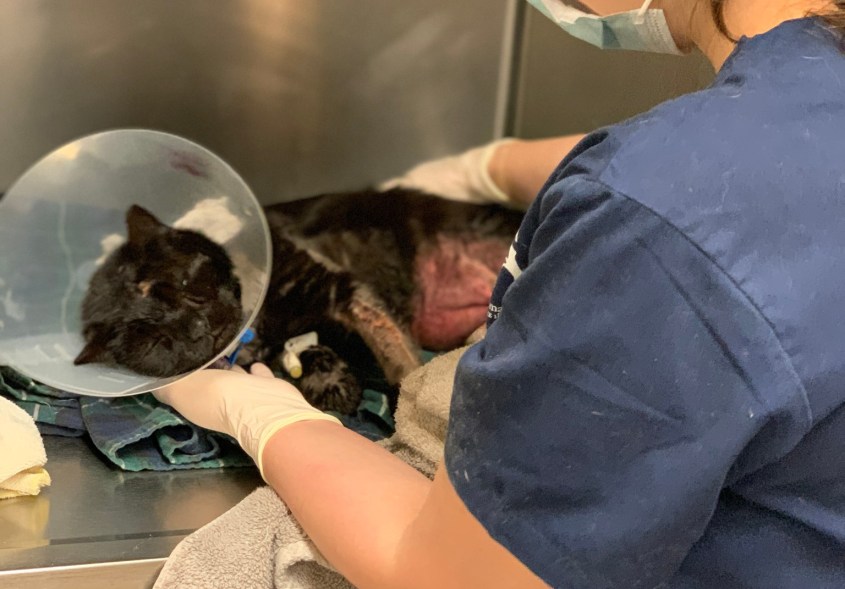
Buddy was so badly injured that veterinarians weren’t sure if he’d make it at first. With a lot of care and love, the little guy pulled through the first few critical days and continued to recover until he was well enough to go to a foster home in early April.

His new caretaker is Katie Venanzi, a veterinarian who specializes in emergency care and operated on him that first day when he was brought in to Blue Pearl Vet Hospital by the Pennsylvania SPCA.

“He was kept secluded in one room initially, but now he has a run of the house and he is doing so well with his foster sibling cat Teddy. His foster parents affectionately say they are the two most awkward cats in Philadelphia, but their relationship is blossoming and we hope it continues that way so that Buddy can officially stay in that home forever,” the SPCA’s Gillian Kocher said. “Hopefully in the coming weeks, we will have some additional details and will let everybody know when we can make an official announcement about Buddy’s adoption, but for now he’s doing wonderfully.”

The reason Buddy was outside in the first place is that, as a stray, he resisted an indoor life when his original family tried to keep him inside.

Venanzi told a local radio station that her and her husband are trying to help Buddy adjust to an indoor life and hope they can adopt him.

“We want to do whatever he needs,” she said. “We understand that he used to live outside. If he is not comfortable living in our house, we are willing to work with other people who are going to give him an opportunity to be in a safe environment but still exposed to the outdoors. We are going to take it day by day and see how he does, but we are really hoping to keep him.”

When Buddy’s story went viral, people around the world responded by making donations to the Pennsylvania SPCA and buying t-shirts with Buddy’s likeness on them, allowing the group to raise thousands. Meanwhile, in a post to social media, the Pennsylvania SPCA noted it had taken in 158 abused animals since Buddy was attacked: “That’s more than five Buddys a day.”

Some of those dogs and cats were shot or stabbed, while others were neglected or starved, Kocher said. Leftover money from Buddy’s surgeries and treatment will be used to help the other abused animals in the SPCA’s care.

Maryland Joins New York In Banning Barbaric Declawing Procedures

Two down, 48 to go.

Two U.S. states have now banned declawing as ‘Merica inches closer to joining the rest of the civilized world in prohibiting the brutal practice.

With a stroke of Gov. Larry Hogan’s pen, Maryland became only the second state to ban declawing, joining New York, which outlawed the practice in 2019. Like New York’s version, the new Maryland law prohibits declawing unless it’s deemed medically necessary.

As most cat lovers know, declawing isn’t the manicure-like operation it sounds like. It’s the totally unnecessary, horrific amputation of a cat’s toes up to the first knuckle.

Declawing inflicts a lifetime of pain on cats, changes feline gait and posture, leads to early arthritis and causes a long list of secondary problems. For example, declawed cats are much more likely to bite because they have no other form of defense when they feel threatened, and they’re also much more likely to stop using litter boxes because it hurts to walk on the sand-like and granule texture of the litter with half-amputated toes.

The fact that so much misery is inflicted on innocent animals to protect furniture is indefensible.

The law goes into effect on Oct. 1, and veterinarians who perform the procedure after that time face fines of $1,000 and disciplinary action by the state veterinary board. We’d have preferred immediate implementation and stiffer penalties to prevent a last-minute rush on declawing appointments and discourage anyone considering breaking the law, but a win is a win, and all the major animal advocacy groups are celebrating, as they should.

Now we’ve only got 48 states to go.

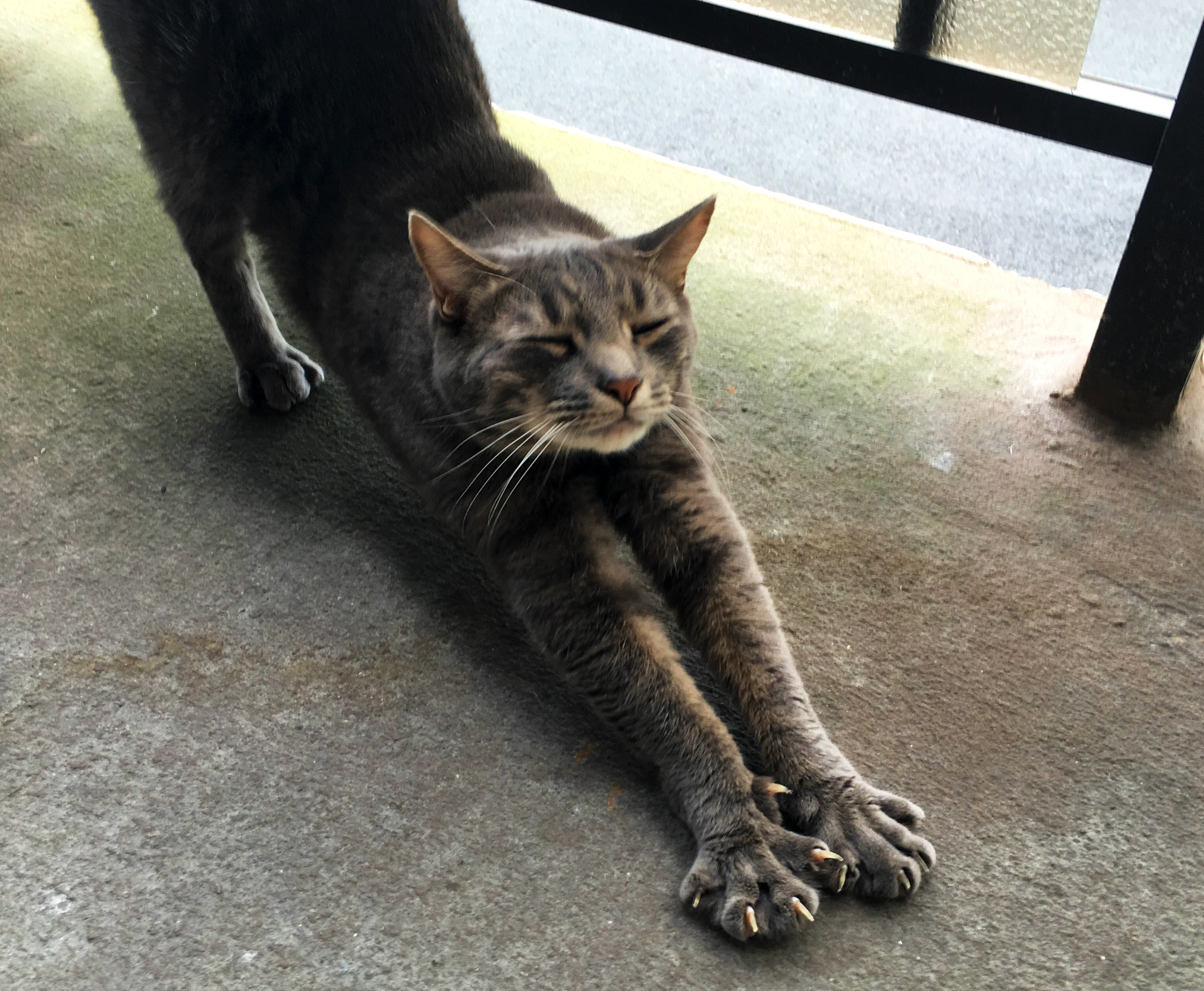
buddy_stretching
Buddy and his Claws of Cosmic Doom.

Sunday Cats: Adopt A Cat And All Your Wildest Dreams Will Come True! PLUS: Buddy Has Left The Building!

A new study reveals some surprises, while The Other Buddy continues to make progress after surviving an attack by two dogs.

I know you’re going to read this and think, “Okay, what have these two wiseasses come up with this time?” but I swear we didn’t make this one up!

It even appears to be a legitimate research paper, despite first attracting media attention on April Fool’s Day. (The paper itself was accepted in late 2021 and published in the journal PeerJ on March 25.)

To put it simply, adopting a cat will make all your wildest dreams come true. Buddy was right!

Cat servants are rated more attractive than people who don’t share their homes with cats, rate higher on traditional measurements of attractiveness like facial symmetry, and even weigh less (women) or, if they’re men, have higher levels of testosterone.

That’s according to a multinational research team led by Javier Borráz-León of Finland’s University of Turku.

How is this possible?

The team — which also consists of scientists from Latvia, Estonia and Mexico — believes it’s because of the infamous toxoplasma gondii, a parasite that infects cat droppings and can pass to humans and other animals.

T gondii nudges its hosts toward behavior that propagates the parasite itself.

“First, we found that infected men had lower facial fluctuating asymmetry whereas infected women had lower body mass, lower body mass index, a tendency for lower facial fluctuating asymmetry, higher self-perceived attractiveness, and a higher number of sexual partners than non-infected ones,” the study authors wrote. “Then, we found that infected men and women were rated as more attractive and healthier than non-infected ones.”

There’s precedent for this. Earlier studies have found that while most parasites make their hosts less likely to reproduce because they cause detectable negative health defects, toxoplasma gondii does the opposite. Male rats who are infected by t. gondii are more attractive to potential sexual partners in an example of a parasite that “can indeed manipulate host sexual signaling to their own advantage.”

That’s not to say you’d want to go and get yourself infected. Toxoplasma gondii can cause negative health effects, most famously in pregnant women, and may be responsible for agitating certain mental health issues. Some scientists have said fears about the parasite are overblown, and cats aren’t actually the primary culprits: People are more likely to become infected by drinking water from unsanitary sources, eating undercooked meat or shellfish, or eating unwashed vegetables and fruits from contaminated soil.

Still, it’s possible to get the parasite from being careless around cat litter, especially if your cat spends time outdoors. It’s another good reason to keep your kitties inside.

Buddy has left the building

After surviving a brutal and intentional attack when two teenagers sicced their pitbulls on him, Buddy the Philadelphia Cat has been upgraded to stable condition and he’s off to a foster home!

The little guy made headlines and captured hearts around the world with his ordeal, his bravery and the strength he showed as he clung to life in those first few days, when veterinarians feared he could succumb to his many wounds.

But late this week, Buddy was able to stand up for the first time since the attack, and he had a big appetite after so many days spent incapacitated and on pain medication.

The little fighter still needs time to recover before the Pennsylvania SPCA finds a good home for him. From what we hear, there are no shortage of applications from people who would love to give him the best life possible. For the time being, he’s staying with one of the veterinarians who cared for him during those fraught early days, so it’s good to know the good boy will have a familiar face around.

These Men Need To Go To Prison For Siccing Their Dogs On A Cat Named Buddy

A cat named Buddy has life-threatening injuries after two men set their dogs on him.

I took a pass on this story when I first saw it because there’s only so much senseless violence toward cats people can tolerate, and I don’t want people to feel like they’re going to be stressed out when they visit PITB.

Our primary goal here, after all, is to celebrate cats and have a laugh.

But this story is too infuriating to keep quiet about, and when I realized the victimized cat’s name is Buddy, I couldn’t ignore it.

Buddy, a black cat, was on his front porch in Philadelphia on Tuesday when two men passed by, let their dogs loose and ordered them to attack poor little guy.

The men cheered their dogs on with “Get him!” and “Good boy!”, and Buddy probably would have died there if his human didn’t hear the commotion and run outside to intervene.

The two suspects collected their dogs and ran off, while Buddy’s human rushed the injured kitty to the Pennsylvania SPCA, where he underwent surgery for life-threatening injuries.

“Buddy is still hanging in there,” the SPCA announced on Thursday. “He remains in critical condition, but we are cautiously optimistic.”

Buddy, who suffered bite wounds and other injuries over his entire body, was a stray who was cared for — but not fully adopted — by a Philadelphia family. The family told the SPCA that Buddy “didn’t want to live inside,” so after getting him neutered they let him stay on their porch and fed him daily.

“He has lots of puncture wounds,” the SPCA’s Gillian Kocker told KYW-TV, the local CBS affiliate. “They’re worried about infections, but mostly what they’re doing right now is making sure that he’s comfortable and has the medication he needs, especially pain meds.”

While Buddy is recovering and is under 24-7 monitoring, donors from around the world have chipped in, giving more than $30,000. Any money left over after veterinary costs will be used for “Buddy’s buddies,” the SPCA said, meaning other cats in their care.

If and when Buddy recovers, the SPCA said, he will be placed with another family. Meanwhile, the suspects could face felony charges for animal fighting and cruelty to animals if they’re caught, Kocher said. Let’s hope they are.

Anyone who recognizes the suspects should call the SPCA at 866-601-7722.