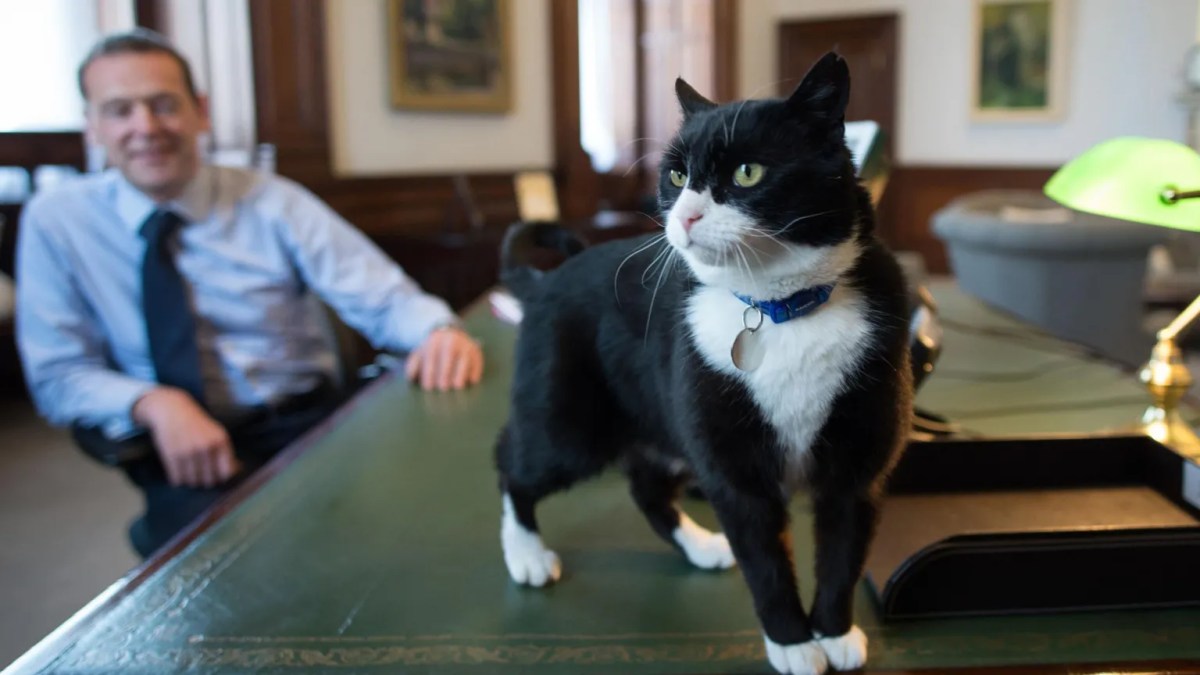
Named after a powerful prime minister, Palmerston was a hungry stray who was found on the streets of London and quickly made his mark when he was appointed mouser to the UK’s Foreign Office.
Some sad news today: Palmerston, the UK Foreign Office’s strong-willed mouser and foil to Larry the Cat, has passed away.
Palmerston was scooped up in 2016 “as a hungry, underweight stray wandering the streets of London, with no owner traced and no microchip,” London’s Battersea Cats and Dogs noted in a post.
The Foreign Office staff were looking for a new mouser to keep rodents at bay in Whitehall when Battersea recommended the cute tuxedo, and recognizing greatness, the staff brought the little guy on immediately and named him after Henry John Temple, better known as Lord Palmerston, who served as prime minister in the 1850s during the height of the British Empire.
Palmerston the cat, just two years old at the time, took to his new job with enthusiasm — perhaps too much so. The territorial tuxedo quickly developed a reputation for turf battles with his rival mouser, No. 10 Downing St.’s Larry the Cat.
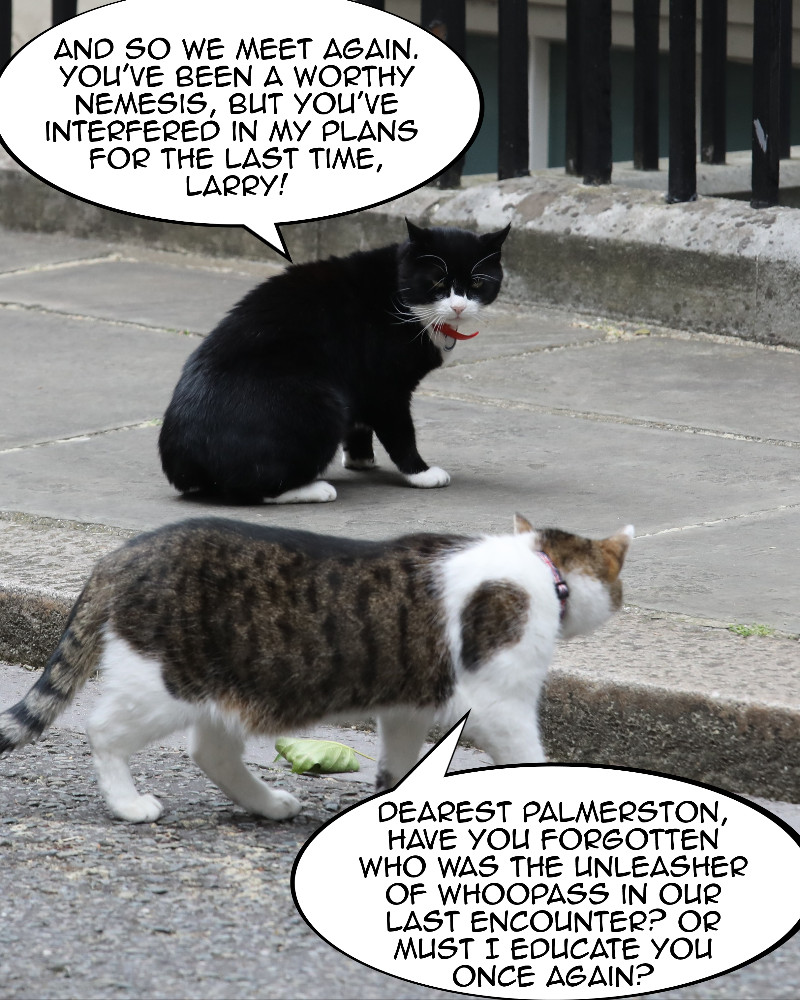
Their skirmishes, which often occurred within the full view of reporters and photographers covering UK government, soon became the stuff of legend, producing several iconic images of the two felines in battle in their eternal struggle for status as top cat in the UK government.
The fearless feline’s hijinx included invading Larry’s inner sanctum in 2016 when he snuck through an open door at No. 10, and while Larry was known for visiting his “lady friend,” Maisie, Palmerston struck up a relationship with Freya, another mouser with a post on Downing Street.
When society’s gears grinded to a halt with the 2020 lockdowns in response to the COVID pandemic, Palmerston “retired” to the countryside with his loyal human, former Royal Navy officer Andrew Murdoch.
Little Lord P enjoyed the quiet life for several years before thrilling fans a year ago with his announcement that he was returning to public life as “feline relations consultant” to Murdoch in his new post as governor of Bermuda.
Admirers followed Palmerston’s antics in the tropical locale via updates on social media. He was living the high life, free of Larry’s evil machinations.
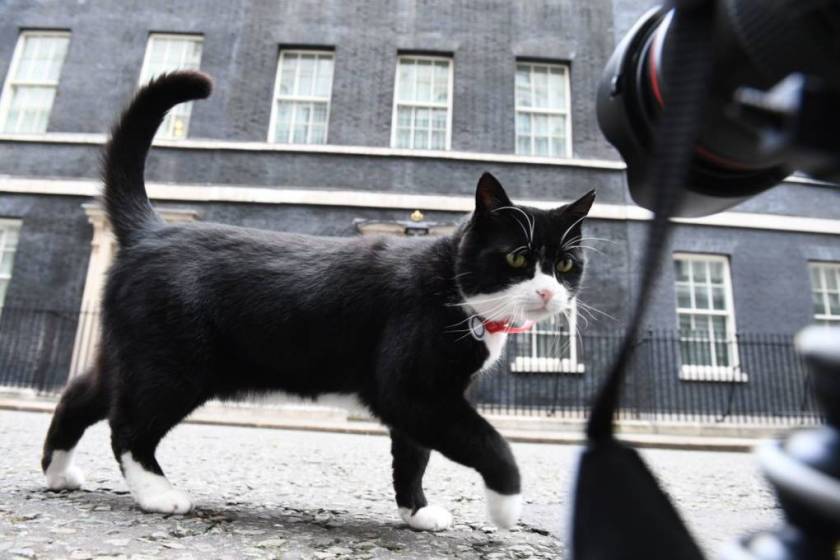
Palmerston patrolling Downing Street.
Palmerston died on Feb. 12, Murdoch wrote in a post on the famous feline’s X account.
“‘Palmy’ was a special member of the Government House team in Bermuda, and a much loved family member,” the post reads. “He was a wonderful companion, with a gentle nature, and will be sorely missed.”
A reply from Larry’s account indicated the former rivals had called a truce: “Farewell old friend,” Larry’s servants wrote on his behalf.
Palmerston, left, and Larry, right, during one of their epic battles while Palmerston was still top cat at Whitehall.We had a lot of fun with the Palmerston-Larry rivalry here on PITB, admiring both mousers.
While this is sad news, Palmerston will not be forgotten, and we’re confident he’ll take to his new post across the rainbow bridge with the same zeal he applied to his work on behalf of the people of the UK. RIP, little guy.
Hat tip to our friend Platypus Man, who notified us of today’s sad news. If you enjoy photos of far-flung locales, check out his blog, which features posts about his many travels around the world. Thanks, P!
Some names climbed the rankings, while others are perennial favorites tied to coat colors, patterns and personalities.
Another year, another list of the most popular names for our furry overlords.
This one is based on data from a pet insurance company commissioned by US News & World Report, and while there are others based on things like chip registrations and veterinary records, they agree on pretty much all the most popular names.
So what are the top names we bestow on our little pals?
Unsurprisingly, Bella and Luna retained their top spots for female cats, while Leo ane Milo were the most popular names for male cats.
There’s not even a mention of the name Buddy, which is either a heresy which shall not go unpunished, or pretty cool because it’s kind of unique, and there are probably only like 25,000 Buddies in the US. Buddy hasn’t made up his mind yet, although I think he’s too lazy to go around punishing alleged heretics.
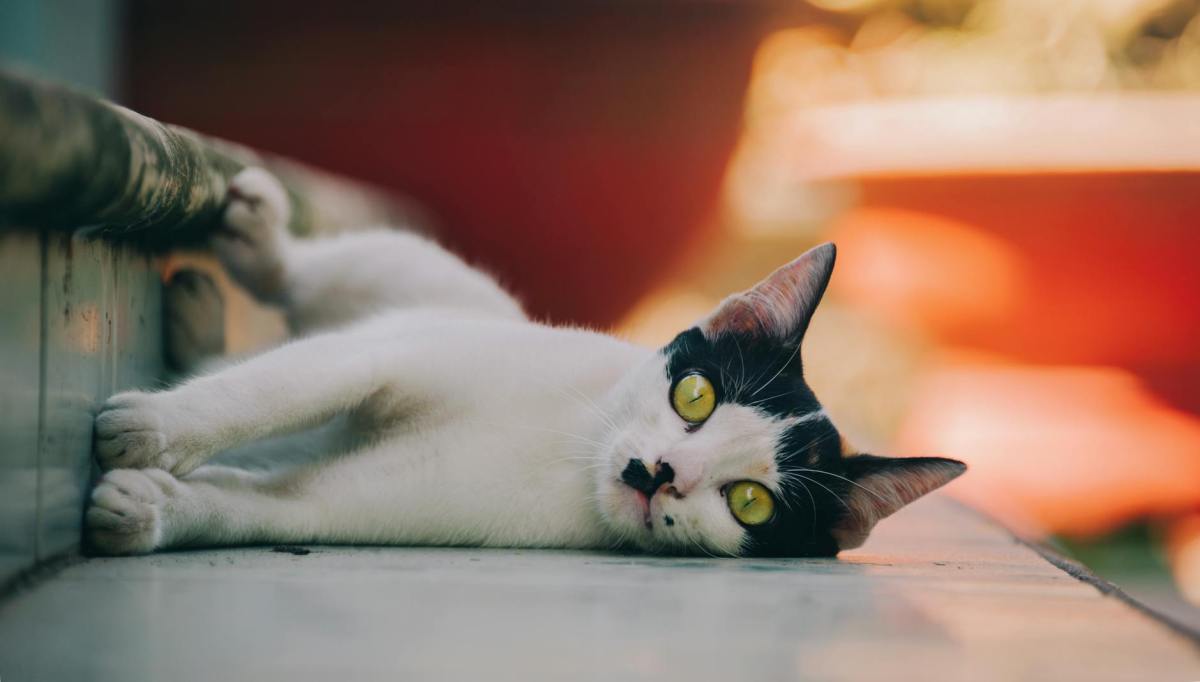
Credi5: Mahmoud Yahyaoui/Pexels
Interestingly, Luna and Bella are also the top names for female dogs. Leo enjoys enduring popularity due to its association with lions (panthera leo) while Milo owes its popularity at least in part to the film The Adventures of Milo and Otis.
Rounding out the list are Simba (Disney’s The Lion King), Nala from the same film, and traditional cat names like Kitty, Oreo, Shadow and Smokey, with the latter three referencing coat patterns and colors.
The more bunk studies claim cats are driving wildlife to extinction, the more people in media and government call for extreme measures to contain them.
Seventy nine cats.
That’s how many felines stood in for the entirely of the UK in a 2022 study, which is the genesis for the claim that cats kill 270 million birds and small animals in that country.
Using GPS collars, owner questionnaires and samples of prey brought home by those 79 outdoor cats, a research team from the University of Reading applied data from a mix of studies dating as far back as 23 years ago, extrapolated and massaged numbers using things like “kernel density estimates” and “generalized mixed models,” and came up with that 270 million figure, which is cited routinely and credulously by UK media.
Actually, their estimate was between 140 and 270 million. An earlier study put the number at 92 million, and a 2016 study estimated UK cats kill 55 million birds and small animals. That’s a range of 215 million!
The Reading team even quotes the infamous US meta-analysis that claims domestic cats kill as many as 4 billion birds and 22.3 billion mammals a year here. That paper, as skeptics in the science community have noted, has virtually no relationship with reality, involves no original research, and relies on data from unrelated studies and surveys in which cat owners were asked to rate their pets’ hunting prowess on a point scale while imagining what the little ones get up to when they’re outside.
All of this is to say that aside from the thorough, labor-intensive and expensive D.C. Cat Count, which brought together cat lovers, birders and scientists to work cooperatively, the 2022 UK study and its counterparts in the US and Australia are exercises in pushing an agenda masquerading as honest academic research.
That’s how we get editorials like The Spectator’s “We need a cat lockdown now” by Zoe Strimpel. Though the tone isn’t tongue in cheek, I can’t imagine Strimpel dislikes cats nearly as much as she claims, and the post was probably written with wry anticipation for the click-generating fury of cat lovers indignantly sharing it on Facebook and X.
Still, it quotes the Reading study without skepticism and portrays cats as furry little wretches who abuse their human caretakers with their claws and their disdain while gleefully eating their way through endangered birds.
A cat stares down a mouse. Credit: Wikimedia Commons
Cats are predators, that much we can agree on, and outdoor cats are much more likely to negatively impact local wildlife, for obvious reasons.
Likewise, I can understand the concern with cat culture in the UK, where allowing pet cats to roam outside is the norm.
But every time the media cites the above-mentioned studies, more people are given an inaccurate impression of feline ecological impact, and more lawmakers at the local and national level consider “solutions” ranging from prohibiting people from keeping pet cats, as a government commission in Scotland recently proposed, or exterminating them outright, as some Australian states and municipalities in New Zealand have tried to do.
It’s worth pointing out that there is no data, not even a single study, showing that air-dropping poisoned sausages or arbitrarily shooting cats actually has any positive impact on birds and small mammals. All it does is terrorize sentient, intelligent domestic animals who have real emotions and experience real fear and pain.
The primary drivers of declining bird and small mammal populations — including habitat loss, environmental destruction, wind turbines and glass buildings — have nothing to do with cats. We have killed off 73 percent of the planet’s wildlife since 1970 and every species of iconic megafauna — from orangutans and gorillas to tigers and pangolins — is headed toward extinction. Are domestic cats responsible for that too, or can we be adults and fess up to our role as the main antagonist here?
An orange tabby and a mouse. Credit: Wikimedia Commons
Strimpel actually goes even further, claiming cats don’t have real affection for their caretakers and are more like psychopaths, faking love because it gets them what they want, primarily food and shelter.
Dogs have true affection for their humans but cats do not, she additionally claims, while adding that cat people are undateable because they share qualities with the “loutish and numerous creatures” they care for.
There was a time when I would have been ambivalent about Strimpel’s attitude toward cats, if not her cavalier treatment of basic facts. But then a drool-happy, friendly tuxedo cat showed me I could interact with his species without my allergies going haywire, and a tiny gray tabby kitten became my animal cognition teacher while blindsiding me with love.
Now every time I hear about some psychopath abusing cats, or terribly misguided politicians advocating a plan to kill millions of domestic felines, I think about my Bud. I think about how he cries for his Big Buddy when he’s hurt or stuck, how he meows and trills with excitement when he experiences something new, and how he began shaking, then threw up from overwhelming relief and happiness the first time I returned from a vacation after adopting him.
Buddy the Cat chillin’ on the balcony in the summer. Credit: PITB
He’s got a vibrant mind in his little head, with strong opinions and emotions. So does every cat on the street, in a shelter cage, and in the cross hairs of a birder or biologist playing God by “culling” or “harvesting” cats to protect another species.
Real science, not activism packaged as science, has proven that many times over in recent years. If people want to do harm to cats because they think birds and other animals will benefit, the burden of proof is on them to show not only that their methods work, but that the results could somehow justify the fear and misery they would inflict on innocent animals to achieve their goals.
Cats are obligate carnivores who don’t have a choice. We do.
Tux the cat was found frightened, dehydrated and “covered in fleas.” It’s still not clear precisely what happened to her.
For a nightmarish 34-hour stretch, Palash Pandey thought he’d never see his cat again.
On Saturday afternoon the Austin man took a Lyft to an animal hospital in his city, got out of the car and was walking around to get his cat, Tux, out from under the passenger seat on the other side when the driver pulled away. Pandey ran after the car, yelling for the driver to stop.
“I like ran behind him, screaming like ‘wait, wait, wait,’ I banged on his windows hoping that he would notice me and just stop. But instead of that he just like, peeled off, he drove away,” Pandey told Austin NBC affiliate KXAN. “I don’t know how else you would perceive somebody who you just dropped off running behind you and banging on your windows and doors. I don’t know if there’s a charitable explanation for that.”
He sent a series of frantic messages to the driver through the Lyft app, offering to pay him to return Tux and begging for information, but didn’t hear back until several hours later when the driver texted: “she isn’t there, sorry”.
You're right. The initial response was awful. Since then, we've done a lot behind the scenes, but I know we haven't communicated enough. We're very focused on this and will keep the community up to date.
The driver said he didn’t see the carrier or the cat in the car, and said several riders he’d picked up later didn’t mention a cat either.
After Lyft’s live customer service wasn’t helpful, Pandey turned to Twitter and Reddit, explaining the situation in detail, providing information and asking people in Austin to share a missing cat flyer with Tux’s photo and information.
In the meantime Lyft’s CEO got involved, apologized for the poor initial response and devoted significant resources to the incident. The company sent alerts to all of its drivers and riders in the Austin area, notified police and dispatched its own staff to help find Tux.
Canvassing the area around the animal hospital and following tips from the public, Lyft’s team eventually tracked her down at about 1:30 a.m. Monday morning, spotting her in the rear of an office building a little more than a mile from the animal hospital. Tux was frightened and climbed a flight of stairs when the Lyft staffers approached, but they were able to wrap her in a t-shirt and get her into a carrier they’d brought with them.
Pandey was overjoyed to be reunited with Tux and thanked everyone who helped looked for her, but in an update said she was scared, “covered in fleas and dehydrated.” He said she was eating, which was a good sign, and he planned to bring her to the veterinarian on Monday.
However, the fact that Tux was found alone without her carrier, dirty and wandering near a busy road indicates someone intentionally took her, then dumped her like a hot potato after realizing thousands of people, the police and a corporate response team were looking for her.
The Lyft driver isn’t suspected of anything but perhaps poor customer service. He told his employers that he didn’t stop when Pandey began banging on his windows because he didn’t realize there was a cat in the car and thought Pandey had become belligerent for some reason.
Pandey believes the person who took Tux will be caught.
“F—ing coward saw what was coming for him and left her on the side of the road,” Pandey wrote on Reddit in an update. “There’s plenty of cameras around, he’s not going to get away with this.”
Gulliver was hit by a car and left for dead, but he never stopped clinging to life.
Gulliver was in a seriously bad way when a Good Samaritan found him on Oct. 27, on the outskirts of a “well cared-for cat colony” in New Jersey.
The little tuxedo cat had been hit by a car and left to die with a fractured pelvis, femur and tail. A veterinarian who examined him didn’t give him much of a chance to live, but his rescuer was familiar with Tabby’s Place in Ringoes, NJ, and knew if anyone would go to extraordinary lengths to save the little guy’s life, the staff there would.
Tabby’s Place took Gulliver in and their emergency veterinarians got to work on repairing his shattered body. It was touch and go, but Gulliver had a glorious will to live that saw him through the surgery and emerge on the other side with a ravenous appetite.
When the staff at Tabby’s Place saw him tuck into a bowl and begin “eating like a champ,” they knew Gulliver was probably going to make it.
Famished from his ordeal and in desperate need of nutrients to help his body heal, he displayed “the best appetite I have ever seen in twenty years of feline medicine” said “Dr. Fantastic,” the collective name Tabby’s Place staff use for the skilled veterinary surgeons who put the most catastrophically injured felines back together again.
And then there was a second surprise — despite all he’d been through, despite the unimaginable pain of getting flattened by 3,000 pounds of aluminum, steel, glass and rubber and left to suffer in a broken heap, and despite pain signals hammering their way through the fog of painkillers, Gulliver turned out to be an “extremely affectionate” kitty.
“He is so affectionate and snuggly,” said Bree, a sanctuary associate at Tabby’s Place who has been caring for the little survivor. “He leans his whole body into you and makes muffins. He has personally reminded me that there is good in this world, and it is worth fighting for.”
Gulliver was in a bad way when he arrived at the shelter. Credit: Tabby’s Place
Gulliver slowly got his strength back and began to look like a healthy cat again. Credit: Tabby’s Place
Gulliver ate like a champ while he convalesced. Credit: Tabby’s Place
Credit: Tabby’s Place
Three weeks after his surgery, Gulliver summoned the strength to stand on his own for the first time since he was hit. He took his first few uncertain steps, Bree said, to get close enough to her so she could pet him while she cleaned his crate. His tail was so badly damaged that it had to be amputated and he’s going to require care — including manually expressing his bladder — for the near future, but the staff at Tabby’s Place will find a forever home for him.
Despite the trauma he endured, Gulliver “should enjoy a long, healthy life like any other cat,” said Angela Hartley, the sanctuary’s development directory. “It would take a special adopter to learn how to express his bladder, but as we learn continually, there are many, many special adopters out there.”
It’s not clear yet whether Gulliver will regain the ability to use the litter box on his own, but Bree said she’s “hopeful that this will not be permanent.”
Because a sickly cat from Gulliver’s colony had found his way to Tabby’s Place earlier, the colony managers knew of the shelter and Gulliver found himself “in the care of a person who knew his life was worth saving,” Bree said.
“She was so right. Gulliver’s life was saved because there are good people in the world. I feel like his loving and gentle personality is a reflection of that.”
All images courtesy of Tabby’s Place. To fill out an online application or browse the adoptable cats of Tabby’s Place, click here.
Now that he’s a month removed from his brush with death, Gulliver’s much healthier and even has a regal look about him. Credit: Tabby’s Place





 Pain In The Bud