What It’s Like To Care For World’s Oldest Cat, Plus: Utah Zoo’s New Kitten Is Cute But Deadly!

A London woman’s cat, Flossie, just celebrated her 29th birthday, making her the oldest cat in the world. And in Utah, a zoo just debuted an adorable little predator.

Happy Sunday, everyone, and if you’re on the east coast of the US like we are, we hope you’re safe and warm during this year’s first snow.

We’ll start off with a bit of significant news first reported in the The Buddesian Times: the famous artist and sculptor Meowchelangelo has unveiled a glorious marble statue of our favorite feline hero, “striding like a colossus toward evil-doers in the distance, his rippling muscles rendered in magnificent Calacatta Borghini,” which is marble from the same quarry in Carrara, Italy, that supplied the raw material for another masterpiece, the Renaissance sculpture commonly known as “David.”

The statue, which honors Buddy’s recent valorous defense of a helpless dog during a vicious attack by a pack of 72 coyotes, will likely be installed in Manhattan, although Washington’s city council is lobbying hard for it, promising the famous statue of Abraham Lincoln in his eponymous monument would be removed for the Buddesian likeness.

buddesiantimes
Today’s edition of the Buddesian Times with a front-page story on the statue.

The World’s Oldest Cat still moves like a kitten

The Guardian has an interesting column from Vicki Green, cat mom to Flossie, who at 28 years old is the Guinness World Records certified oldest domestic cat in the world.

Flossie, who was born in December of 1995, is as old as Green, who attributes the tortoiseshell’s longevity to “luck, and because she was loved by her previous owners.” Flossie was initially an outdoor kitten who lived in a managed colony until she was adopted by her first human, who died when Flossie was 14 years old.

The woman’s sister took Flossie in next but died after 10 years. Her son became the long-lived feline’s third servant, but after three years he brought her to Cat’s Protection in London, saying he could no longer provide the level of care Flossie deserved and needed.

Shortly after, Green was looking to adopt a cat and saw Flossie’s listing online.

“At the time, I thought it was an error and that she must be 17,” she wrote. “Cats Protection told me she was still available to adopt and that no, she was in fact 27, the same age as me.”

Green thought Flossie would likely only live a few more months, but “she’d at least spend them in a nice, warm flat, be fed well and get treats as well as a comfy bed.”

“To my surprise,” Green wrote, “I’ve had her for over a year now and she’s still going strong.”
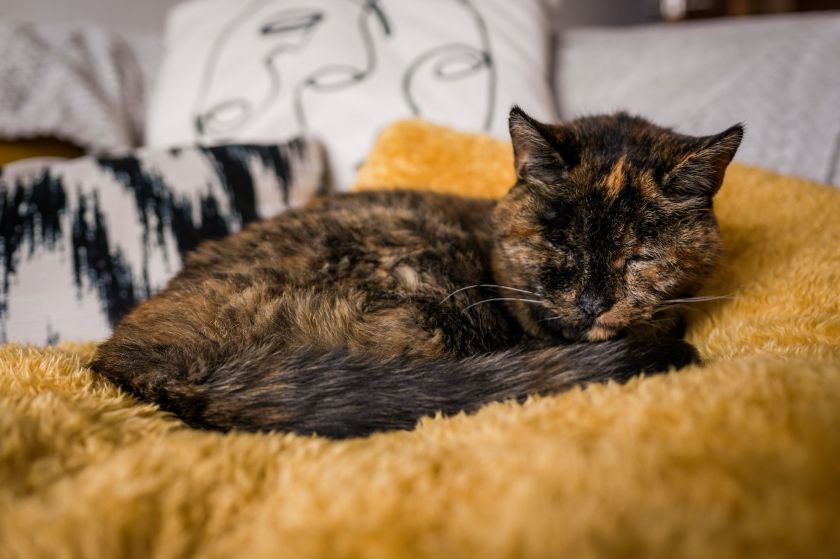
Flossie napping
Flossie takes lots of naps but is surprisingly active and playful for her age. Credit: Vicki Green

Despite her advanced age, Flossie is active, seeks attention and still plays with her favorite toys. Green got miniature stairs for the senior kitty to easily reach the couch, but Flossie doesn’t use them, preferring to jump up instead.

“The biggest difficulty is dealing with the fact that there may soon come a time when she passes. I’m in denial about that. I look at her and just think she doesn’t look old at all,” Green wrote. “Yet who knows? She could well be on the way to becoming the oldest cat in history. Though even if she doesn’t break the current record of 38 years and three days, at least I’ll know she had a great retirement home.”

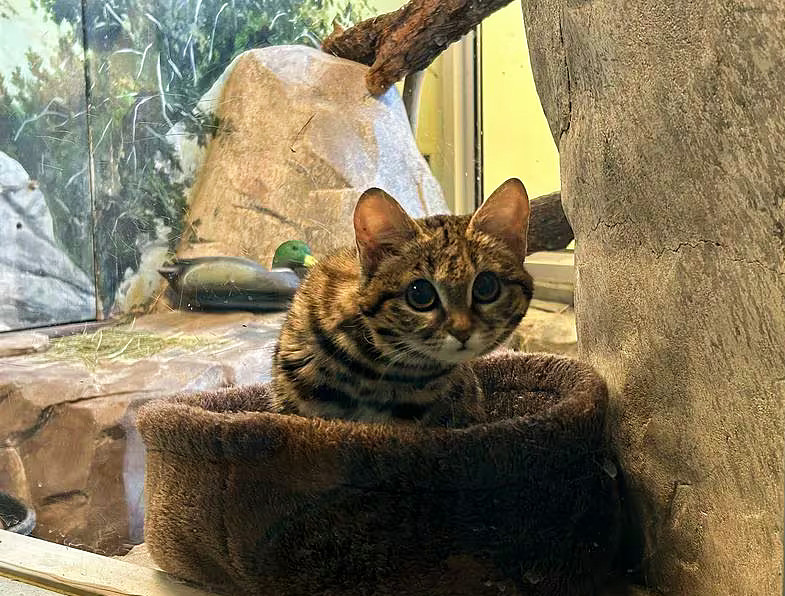
Gaia the three-pound terror debuts in Salt Lake City

Black-footed cats are known primarily for three things: they’re outrageously cute, they’re diminutive and they’re remarkably deadly.

Of course with a maximum weight of three pounds, only tiny prey have to worry about the fury of these furry little guys. The rest of us get to point and go “Aww!”
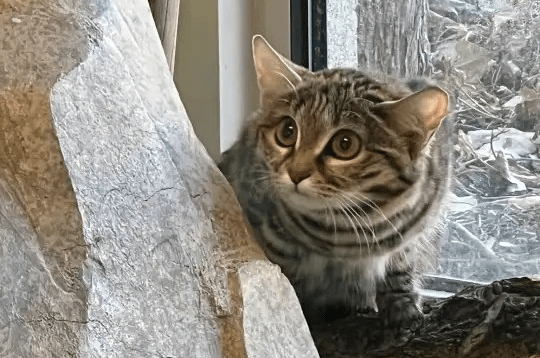
Gaia the black-footed kitten
Gaia’s personality is “large and feisty” according to zookeepers. Credit: Hogle Zoo

Native to the savannas of southern Africa, black-footed cats are excellent hunters, but like all felines they’re also prey, and they’re the subject of a worldwide zoological breeding and conservation program due to declining numbers in the wild.

The newest success story for those breeding efforts is Gaia, an eight-month-old black-footed kitten who just made her debut at Hogle Zoo in Utah.

Zookeepers describe baby Gaia’s personality as “large and feisty,” and they expect she’ll be popular with zoo visitors.

She’s now the second of her species at Hogle, joining Ryder, a male. They haven’t been introduced yet. A carefully supervised introduction is “in the cards, but we’ll let these two feline friends get acquainted when Gaia reaches maturity,” the zoo said.
NASA Photo Shows ‘Cats’ Got To Mars Before Humans Did

A rock on Mars resembles a crouching cat ready to pounce.

Cats are sneaky, quiet as a ghost when they want to be and have a habit of seemingly teleporting between spots, but could they somehow use their feline superpowers to beat us to Mars?

As the Perseverance rover continues to chug along and take photos as well as samples of rock and soil, people following the rover’s progress can vote for “image of the week,” and this time around they picked an image that, when seen from a distance, appears to show a crouched cat with its behind raised, in mid butt-wiggle as it prepares to pounce on some unfortunate Martian.

marscatloaf
A Martian Desert Cat spots a rich vein of Temptatiums in a natural deposit and is ready to pounce.

This isn’t the first time Mars enthusiasts have spotted a “cat” in an image from the red planet. In 2015, some people said a group of rocks resembled a “giant cat statue” poking out from the Martian soil in a photo taken by the Curiosity rover.

I don’t really see it. YMMV:

Perseverance is exploring the site of a former crater lake and an adjoining former river delta. The Bad Astronomy blog says it was “very clearly a lake of standing water at some point in the past.”

The blog provides a breakdown of the geography of the crater and what it can tell us about the Mars of the past. Knowing there was water on Mars makes the idea of life elsewhere in the solar system seem possible. Astronomers believe Jupiter’s moon Europa, for example, potentially hosts life. The satellite exists so far from the sun it’s in a permanent deep freeze and would normally be inhospitable to life, but the evidence strongly suggests there are oceans beneath Europa’s icy surface, and those oceans are heated by massive vents on the ocean floor.

Water, warmth, energy. The conditions for life are there. If Mars was covered with lakes at one point, what’s swimming in the oceans of Europa?

mars_jezerocrater_landingsite
Credit: NASA

So Mars had water and the entire planet was pristine litter box. If it had some prey to hunt and an atmosphere, the red planet could have been the perfect homeworld for felis sapiens, who would rival humanity in technology if not for the tragic fact that their species is only awake eight hours a day.

Now that’s a scary thought!

Odaiba: Protected By A Giant Japanese Robot

A 78-foot-tall mecha guards Tokyo’s entertainment district.

Chances are you’ve seen a Gundam even if the name seems unfamiliar.

Gundam are sleek androform robots piloted by humans and often seen wielding massive guns, utility-pole-size katanas and other outrageous weaponry.

The name Gundam is synonymous with “Japanese robot,” and the IP is one of the top 15 highest-grossing media properties in the world, putting it in the same company as franchises like Star Wars, the Marvel Cinematic Universe, the Batman/DC Comics universe and Lord of the Rings.

In other words, Gundam is serious business in Asia.

F323CEF3-FA7C-4F84-A012-DDCEE2B20C7D
A typical Gundam figurine assembled from a model kit.

The cult franchise began with a 1979 cartoon series and expanded to include movies, manga and spinoffs, but the real moneymakers are plastic model kits of the many mecha in the wider Gundam universe. Gundam mecha account for 90 percent of all model kit sales in Japan, and they’re wildly popular worldwide, including the United States.

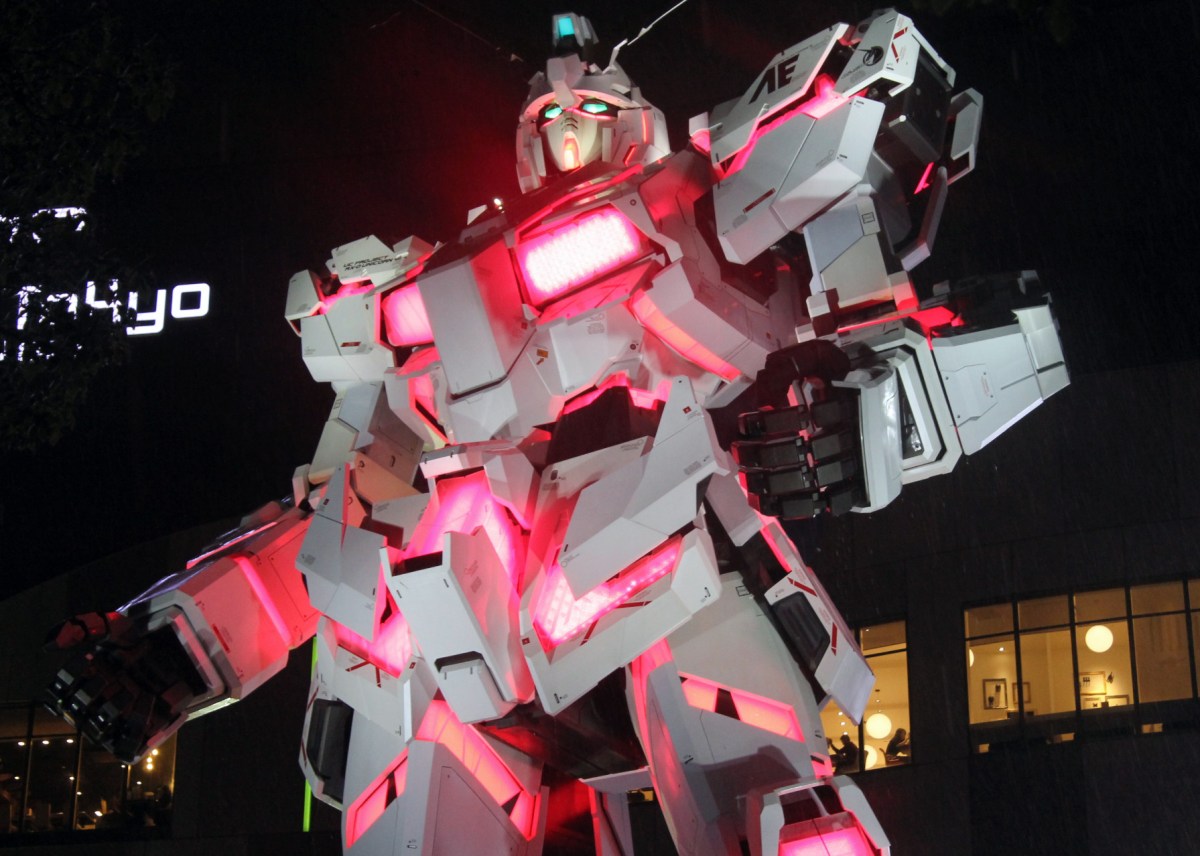
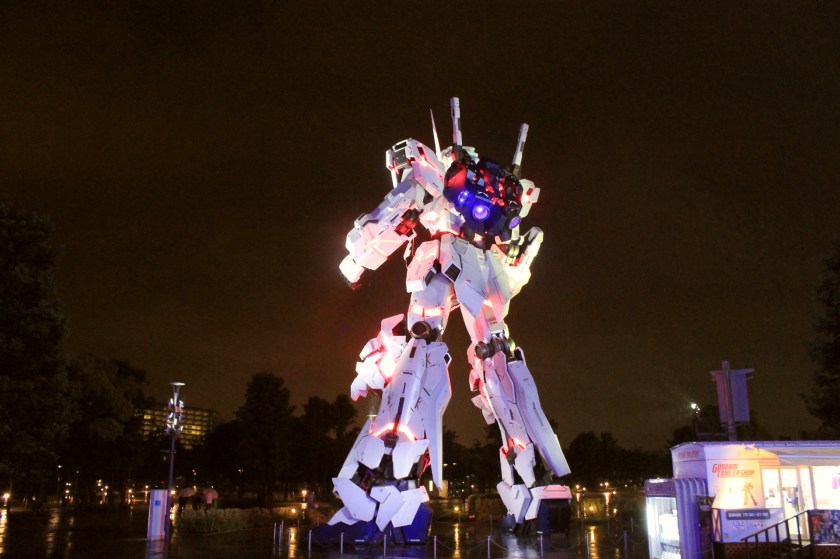
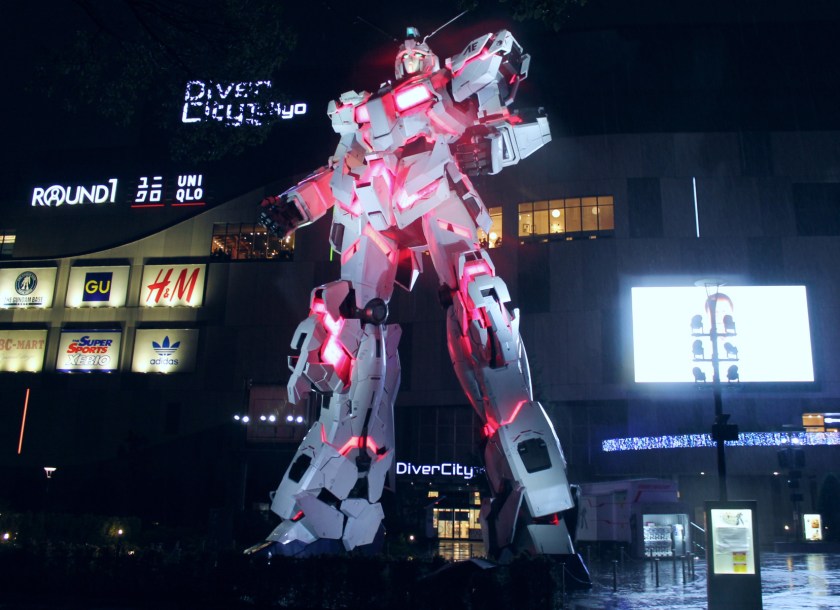
With all of that in mind, maybe it’ll seem a little less crazy that Tokyo has a life-size Gundam standing guard over Odaiba in a major commercial plaza. The 24-meter (78-foot) statue is impressive in its own right, but at night it reaches new levels of awesomeness when the robot’s lights activate, bathing the behemoth in ambient crimson.

Life size Gundam
A life-size Unicorn Gundam statue keeps watch over the Odaiba district of Tokyo.
Life-size Gundam in Tokyo
Facing out from the complex, Unicorn Gundam seems to guard Diver City.

After spending a few hours wandering Tokyo’s incredible Digital Art Lab, it was past sundown and pouring when we reached the statue. I got soaked for my efforts, but it was worth it to see the iconic mecha with my own eyes.

To provide a sense of scale, the average adult male is about as tall as the Gundam’s ankle.

Every half hour after sundown passersby can watch the Gundam transform between “Unicorn Mode” and “Destroy Mode.” Panels and sections on the robot’s torso fold into a new, more aggressive-looking pose, while alternate lights are activated and more protective armor encases the machine’s head.

Life-size Gundam in Tokyo
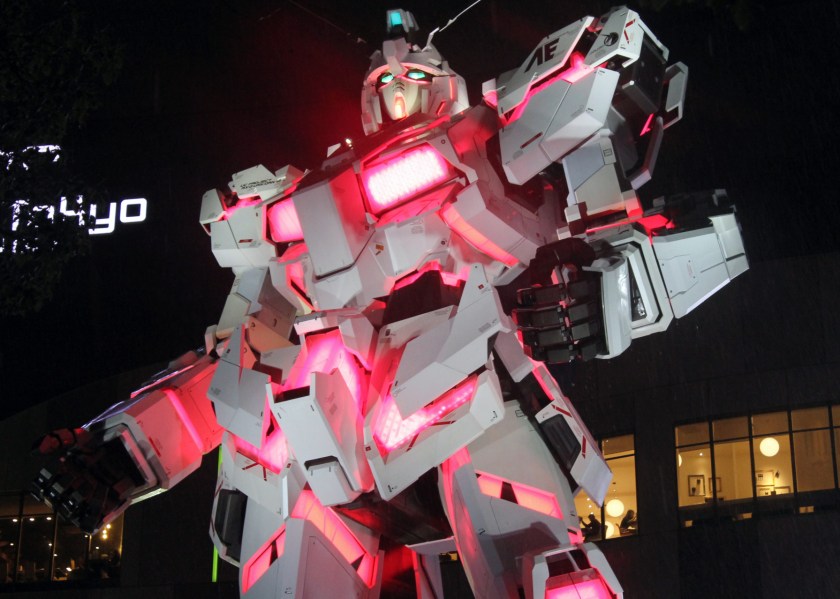
A close-up shows the illumination of the Unicorn Gundam statue at night.
Tokyo’s life-size Unicorn Gundam statue
The statue is remarkably detailed and captures the sleek — and iconic — look of the franchise’s mecha.