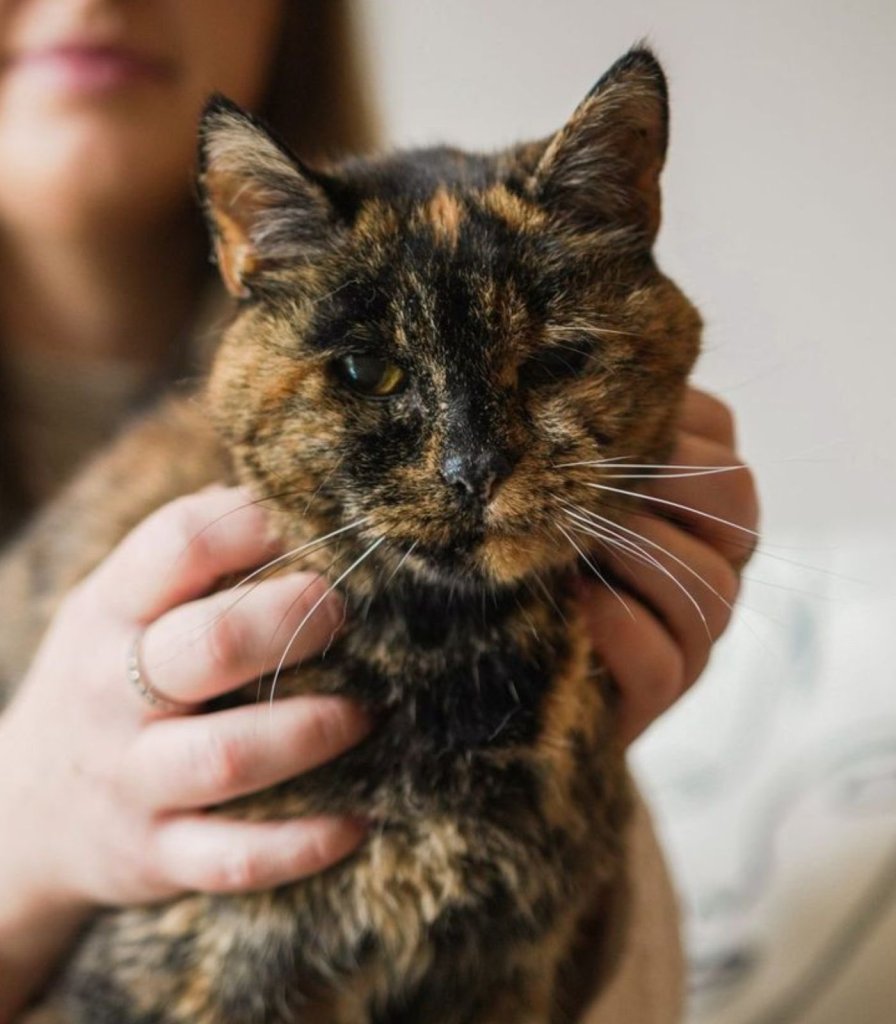
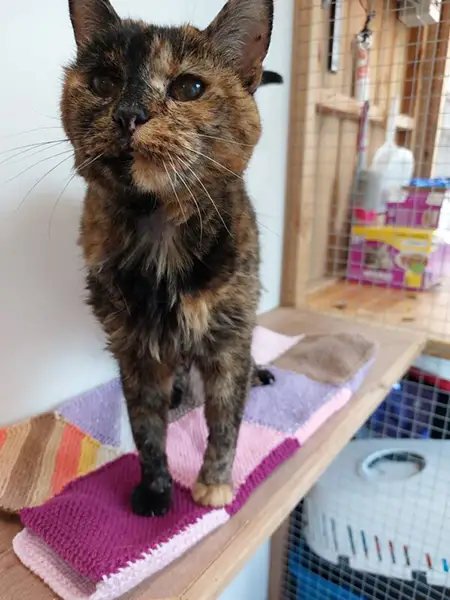
Despite her advanced age and loss of hearing, Flossie is still “affectionate and playful,” her human says.
When Flossie was born, Mariah Carey, Coolio and Pearl Jam ruled the airwaves alongside a band called Deep Blue Something with their hit, “Breakfast At Tiffany’s.”
Robert Deniro and Al Pacino were kings of the box office for their film, Heat, alongside Robin Williams’ Jumanji and Steve Martin’s Father of the Bride Part II. Bill Clinton was still serving his first term as president, and the internet was in its infancy as a network available to the wider public after years of use by the military and academics, with users connecting via cumbersome and painfully slow modems.
Your humble correspondent was just a kid, and Buddy wouldn’t be born for almost another 20 years.
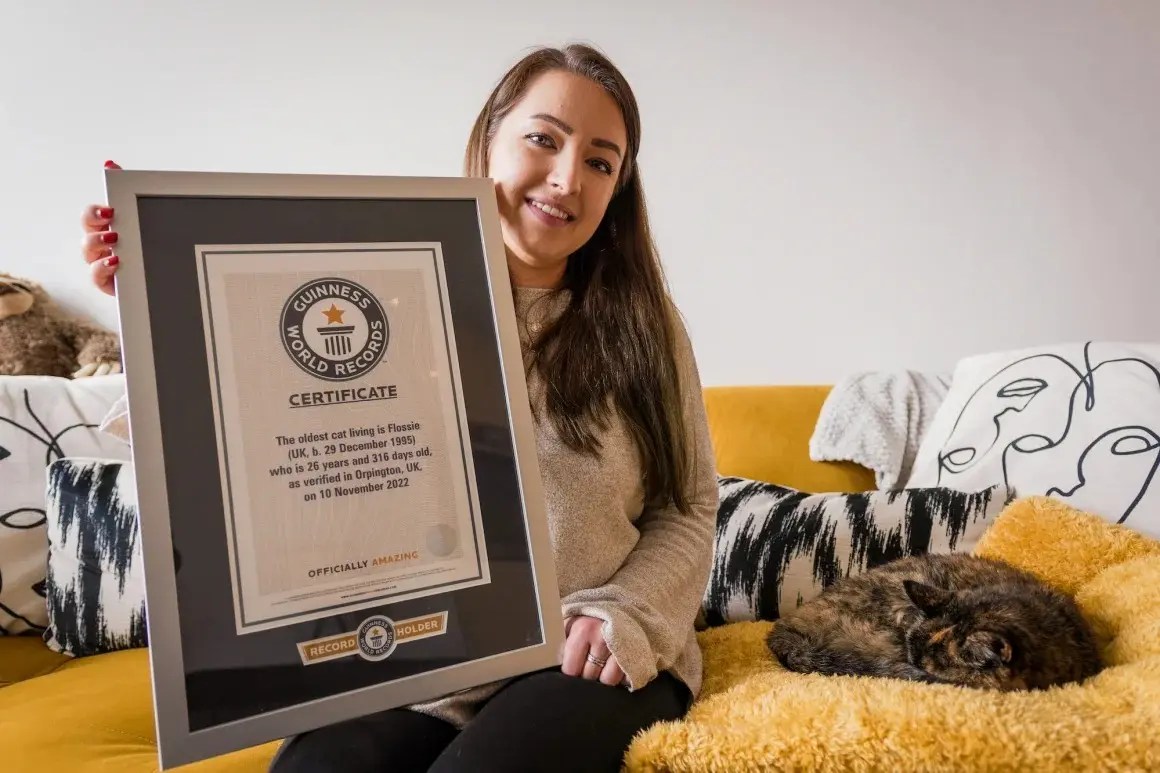
Yet Flossie’s still going and just celebrated her 30th birthday on Dec. 29. The tortoiseshell was officially named the world’s oldest cat in 2022 when she was 26 years old. Flossie, originally a stray living near a hospital, was adopted by her first human, a healthcare worker. When that woman passed away, her sister became Flossie’s caretaker. And in August of 2022, having outlived two of her humans, Flossie was taken in by the UK’s Cats Protection, who carefully screened applicants until settling on Victoria Green, who lived in Orpington, UK.
“I’ve always wanted to give older cats a comfortable life,” Green said when she was chosen as Flossie’s caretaker.
Flossie was deaf and had “limited eyesight,” veterinarians noted when they helped Guiness World Records verify the long-lived feline’s age. But despite that, Flossie remains “affectionate and playful,” Green said.
“I feel like I’m not sharing my home with the oldest cat. I feel like this is her home and I’m encroaching on her space,” Green told Guinness World Records at the time. “She’s a very nice roommate and we get on very well. I don’t feel like I’m living with a senior.”
The oldest cat on record was Creme Puff of Austin, Texas, who was born in August of 1967 and lived until 1995, when Flossie was born.
We wish the birthday girl a happy one and hope she’s got at least a few more birthdays in her.
Kristi Noem thought she was burnishing her image as America’s tough cowgirl politician by telling the story of how she shot her hunting dog. Instead, she united the country in disgust.
Before a commercial publishing house sends a book off to print — especially a political memoir expected to create buzz and move copies in high volume — dozens of sets of eyes have looked over the manuscript.
The author — in this case the author and ghostwriter — her PR team, consultants, editors, fact-checkers, attorneys and test readers all have eyes on the text as they prepare it for the printers.
Thanks to Politico’s reporting, we now know several of those people — including the ghostwriter, the imprint’s editors and her own advisors — actively discouraged South Dakota Gov. Kristi Noem from including an ugly anecdote about shooting a “problem” dog in her book, but Noem was insistent on using it. She thought the story would burnish her brand and appeal to rural voters, signaling that she’s a salt of the earth type who doesn’t balk at making hard decisions.
That was an epic miscalculation, and as the fallout continues with backlash from Americans across the political spectrum, it shows the days of thoughtless disregard for animals are over in the US, at least as far as public life goes.
South Dakota Gov. Kristi Noem. Credit: Wikimedia Commons
As most people know by now, Noem wrote about how she shot a 14-month-old dog named Cricket on her family farm for “ruining a hunt” and going after a neighbor’s chickens. Cricket, Noem wrote, was “worthless as a hunting dog” because she got overly excited and went into sensory overload during a pheasant hunt that Noem wanted to be memorable for a group of guests.
“I hated that dog,” she says in the book, via her ghostwriter, before describing how she dragged the excited puppy out of her truck and into a gravel pit, then ended the Cricket’s 14-month-old life with a gunshot to the face.
In a series of disastrous interviews over the past week, Noem has tried to reframe the story as an example of the hateful “fake news” media digging for dirt on her, but not only did the South Dakota governor enthusiastically include the dog-killing story in her new book, she was so confident it would win her points that she used the story as a teaser in social media posts and other marketing for No Going Back. (It’s her second book and follows 2022’s Not My First Rodeo: Lessons from the Heartland. Noem really wants people to think she’s the embodiment of a Yellowstone character, a CrossFitting avatar of the real America.)
Noem thought she’d be hailed as the farm girl hero she wants to be, an image she’s cultivated during a political career that’s taken her from the state house to South Dakota’s lone congressional seat and, in 2019, the governor’s mansion.
Noem’s book, No Going Back.
I’ve spent my entire life in urban and suburban environs and I’ve essentially taken a Jainist attitude toward animal life. I’ve never hunted an animal and never will, so I’ll defer to longtime South Dakota scribe and hunter Kevin Woster, who thoughtfully writes about the experience of raising hunting dogs and the challenges it involves.
Woster believes Noem put a puppy in situations that would challenge even an experienced hunting dog, says the dog’s “shortcomings” were the fault of her owners, and thinks the dog could have had a long and happy life with a little patience and love. (It’s also worth pointing out that by killing chickens, the dog was doing precisely what Noem trained her to do. It’s not the dog’s fault Noem didn’t differentiate between the types of birds she wanted Cricket to attack.)
Other rural scribes have echoed those sentiments and pointed out that even on farms, being forced to kill an animal is a solemn and personal thing. Even if Noem had justification, it’s one thing to handle a regrettable situation and another thing entirely to choose to celebrate it in a memoir, even using it as a marketing teaser.
Politics is performative, and Noem isn’t alone in that respect. Here in New York our disgraced former governor, Andrew Cuomo, speaks in a heavy New York accent that borders on parody. During the pandemic, he once interrupted Dr. Anthony Fauci to muse about how Fauci was the “Al Pacino of COVID” and Cuomo himself was the Robert DeNiro of the killer virus, then derailed an explainer on safety measures to wax poetic on the Italian bakeries of the Bronx’s Arthur Avenue and “the old neighborhood,” as if Cuomo grew up playing stickball on the street in Brooklyn instead of ping-ponging between New York, D.C. and Albany when his dad was a three-term governor.
George W. Bush, the scion of a generational political family and son of a former president, grew up in Connecticut. But he wanted the American public to see him as a cowboy, so he affected a Texas accent, peppered his speech with folksy-sounding nonsense and famously landed a fighter jet on an aircraft carrier to declare an end to the Iraq War on May 1, 2003, 18 years before the last US combat units left the country.
Politicians put on these costumes because voters respond to them. But the backlash against Noem — who’s now banned from 20 percent of the land in her own state and also in hot water for allegedly inventing anecdotes about North Korean dictator Kim Jong Un, French President Emmanuel Macron and former UN Ambassador Nikki Haley — proves that, like a prince choosing to don a Nazi uniform for Halloween, a politician’s choice of costume says a lot about her judgment and values. In this case even the people of America’s heartland, the voters Noem was condescending to with her book, were horrified by the ambitious governor’s callous disregard for animal life.
The fallout has apparently destroyed any chance that Noem could be chosen as a vice presidential candidate on the Republican ticket, and term limits mean the sun is setting on Noem’s time as a “public servant.” Good riddance.





 Pain In The Bud