After 10,000 Years, Dire Wolves Walk The Earth Again

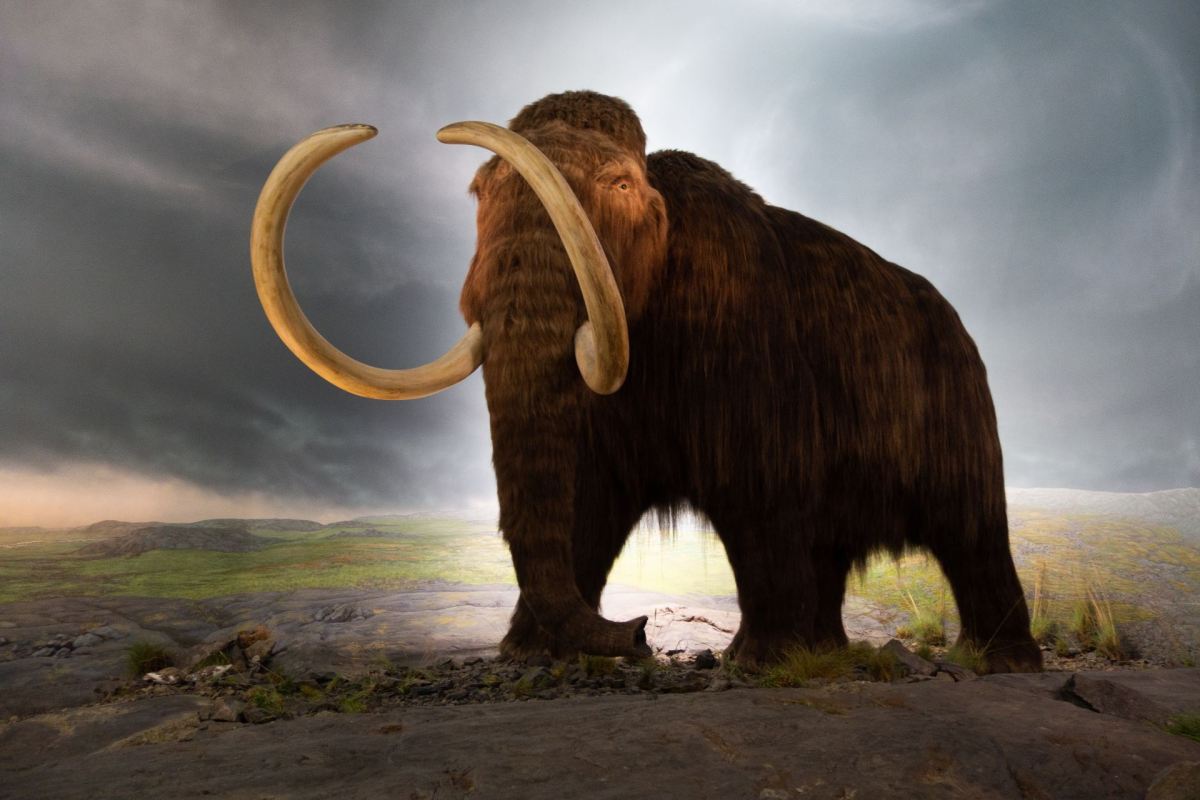
The surprise announcement came from Colossal Biosciences, a company best known for its project to bring back the woolly mammoth.

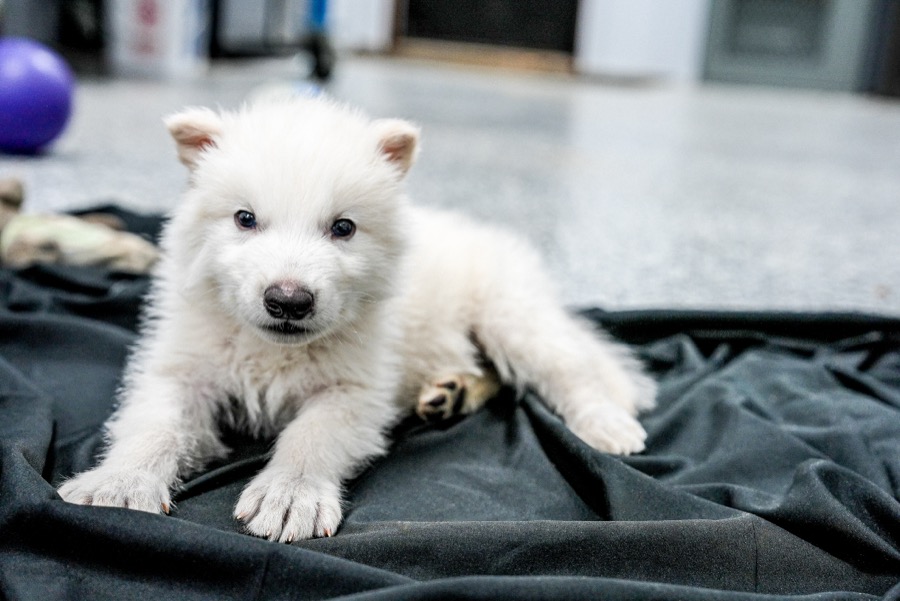
A US biotech company shocked the world Monday when it announced the births of three dire wolf puppies, bringing back a species that hasn’t lived for more than ten millennia.

Or a version of that species, at least.

Scientists with Colossal Biosciences extracted DNA “from a 13,000 year old tooth and a 72,000 year old skull and made healthy dire wolf puppies,” Colossal CEO Ben Lamm said in a statement.

Of course, it wasn’t that simple.

The dire wolf, Aenocyon dirus, was heavier, stockier and had thicker fur than modern-day gray wolves. In addition, its bite was incredibly strong, generating more force than any living species of canid.

To create the dire wolf puppies, Colossal used the genomes reconstructed from the tooth and skull, spliced them with gray wolf DNA, and made 20 gene edits in 14 genes. Healthy embryos were implanted in three surrogates — large, mixed-breed dogs — and were successfully delivered.

Romulus, one of two male dire wolf pups born late in 2024. Credit: Colossal Biosciences
Remus, who was born at the same time as Romulus. Credit: Colossal Biosciences

Whether the new puppies are officially dire wolves is up for debate and beyond the scope of this post, but just like humans and chimpanzees share 98.7 percent of their DNA, dire wolves and gray wolves share 99.5 percent of their DNA.

The species also existed concurrently with gray wolves and there was interbreeding between the populations, meaning gray wolves already have dire wolf lineage.

As a result, the puppies may be more dire wolf than some are willing to admit. Just how far a “de-extinction” project has to go for the animals to qualify as their namesakes will be debated for years, and there are innumerable questions for which we won’t have answers until the pups grow and scientists monitor their behavior in addition to their physical health.

They won’t behave precisely the way their ancestors did, since they are growing up in a captive environment with teams of specialists constantly monitoring them. The wolves are “essentially living the Ritz Carlton lifestyle of a wolf. They can’t get a splinter without us knowing about it,” Colossal’s chief science officer, Beth Shapiro, told the New York Times.

Whether bringing back dire wolves is a “good” thing is also a topic for another day, at least as far as this post goes. You may disagree, and feel free to say so in the comments, but this is a subject you could write half a library of books on, encompassing ecological, moral and philosophical questions that don’t have easy answers.

It’s made even more complex by the situation we find ourselves in, with our own behavior and relentless expansion killing off more than 70 percent of the world’s wildlife since 1970, according to the World Wildlife Fund. The company wants to use its technology to help critically endangered species, like the red fox, avoid extinction.

Colossal has partnered with leaders in the fields of genetics and bioethics, as well as organizations that specialize in animal welfare. The puppies are in a sizable, custom-built facility in an undisclosed location, secured by “zoo grade” barriers, and the company enlisted the help of the SPCA to create an environment appropriate for them. Colossal says their care regimen will include socialization and the development of pack dynamics.

A newborn dire wolf pup. Credit: Colossal Biosciences

The company has well-publicized projects to bring back woolly mammoths and the dodo, and ultimately, its founders say they want to restore balance in places where apex predators have been brought to extinction by human activity.

“This project demonstrates the awesome potential for advances in genetic engineering and reproductive technologies to recreate lost diversity,” Andrew Pask, a Colossal board member and professor of biosciences at the University of Melbourne, said in a statement. “Apex predators are critical to stabilizing entire ecosystems and their loss from the landscape can have profound impacts on biodiversity.”


The pups are named Romulus, Remus and Khaleesi. That last name is in homage to the character Daenerys Targaryen (Emilia Clarke) from the book series A Song of Ice and Fire, and Game of Thrones, the television adaptation. Dire wolves play a major part in the narrative, and the series is credited with bringing the long-extinct animals back into the popular imagination.

Jon Snow (Kit Harrington) discovers an orphaned dire wolf pup in the first season of Game of Thrones. The pup, who grows into a fierce and massive adult wolf named Ghost, plays a pivotal role in many major events in the series. Credit: HBO
Khaleesi, a female dire wolf, named after the character Daenerys Targaryen from Game of Thrones. Credit: Colossal Biosciences

It’ll Take More Than Sketchy Surveys To Prove Vegan Cat Food Is OK

“People aren’t ready for us to turn carnivore cats vegan but I’m going to do it,” the CEO of a vegan cat food brand has vowed.

In September of last year, a research paper about feline health was published to the open-access journal PLOS-One, going mostly unnoticed.

The paper’s authors claim their research proves cats fed a “nutritionally complete” vegan diet are not only just as healthy as their meat-eating counterparts, they’re actually less likely to need veterinary visits, less dependent on medication, and more likely to be given a clean bill of health by their veterinarians.

When a company called Wild Earth announced the launch of a new line of vegan cat food this month, the company pointed directly to that paper as proof that “cats fed nutritionally sound vegan diets are healthier overall than those fed meat-based diets,” as the paper’s lead author put it.

Wild Earth CEO Ryan Bethencourt, who does not have a professional background in veterinary medicine or feline nutrition, summed up his goal in a tweet: “People aren’t ready for us to turn carnivore cats vegan but I’m going to do it.”

bethencourt
Bethencourt calls the effort to put pets on vegan diets “vegan biohacking.” Credit: Wild Earth

He painted the new offering as a bold counter to skeptics who say vegan cat food is unhealthy.

“We expect aggressive resistance from the meat industry on the launch of this industry-pioneering vegan cat food, but we know there are A LOT of cat parents looking for healthier plant-based and more sustainable options and we want to be the leader in providing them with that choice,” Bethencourt wrote in a statement.

What he didn’t mention was the fact that the loudest voices opposing “vegan cat food” are animal welfare organizations like the SPCA and Humane Society, as well as veterinarians and nutritionists, the same people who see the consequences of cats who are deprived of meat. Over the years they have reiterated that felines are obligate carnivores who have evolved to get their nutrients from meat, with digestive systems that cannot process most plants, meaning they can’t break them down and derive nutrients from them. That’s why we don’t see servals or leopards foraging for fruit in the wild.

In addition, the announcement did not mention that the 2023 research was funded by ProVeg International, a non-profit dedicated to reducing global meat consumption, weaning people and animals off of meat and onto plant-based food.

That didn’t stop other credulous reports, like one from GreenQueen claiming Wild Earth’s vegan cat food is “built on research proving that felines can be healthy on a vegan diet.”

And that’s exactly the point — the “study” was conceived and published so that advocates of vegan cat food can point to it and say “science says” cats can survive on plants.

Bad data makes for bad science

Extraordinary claims require extraordinary evidence, but the 2023 study did not examine veterinary records or log the results of vet visits over years. Instead, the data was self-reported by participants.

A total of 1,418 people responded to the survey, and only 127 of them said they feed their cats exclusively vegan diets. The claims that their cats get sick less often and do better in veterinary check-ups are based on their subjective assessments and recollections. The paper’s authors don’t know which vegan brands the 127 respondents were giving to their cats, nor do they have information on whether the food was wet or dry, how often the cats were fed, and how much they ate.

wildearthfood
A cat eating Wild Earth’s Unicorn Pate, which is made entirely from plant products. Credit: Wild Earth

One of the metrics cited by the authors is “guardian opinion of more severe illness,” which means arbitrary feedback from people who aren’t experts in veterinary medicine or nutrition.

If including respondent opinions as “data” doesn’t bother you, consider how many people buy products like Airborne, concluding that it works because they didn’t get sick once on a cross-country flight. Airborne, you may recall, was “invented” by a teacher who claimed she figured out how to cure the common cold, something no physician has done in centuries of trying.

Like vegan cat food proponents, Airborne had its own “study” that claimed its efficacy. The company eventually paid out more than $23 million in a class action settlement for its false claims. That’s not to say vegan cat food makers are precisely like Airborne, but pointing to poorly conducted research is a tactic that works because most people won’t go to the effort of finding the study and reading it.

Current global meat consumption is unsustainable, but…

I’m a vegetarian and I’ve seen enough evidence to convince me that the current rate of meat consumption, especially in the first world, is untenable as the global population rises toward its expected 11 billion-plus peak. Those forecasts and the horrors of factory farming are motivation enough to hope human civilization consumes less meat in the future.

But I’m also a guy who loves his cat, and I think if you’re going tell me that my little pal, designed by nature to be an obligate carnivore with a digestive system and body plan that hasn’t significantly changed for ages, can stop eating meat entirely with no deleterious effects — despite the experts saying otherwise — then you really need to show me something better than a self-reported survey paid for by a vegan advocacy group.

Cat with a salad
This cat is not happy. Credit: r/cats(reddit)

Especially when veterinarians who have no financial interest in the pet food industry relate horror stories of their four-legged patients slowly going blind and cats with no other ailments suffering catastrophic consequences, with their organs shutting down because they’re not getting the vital nutrients and proteins they need to survive.

It’s a horrific way to die, and it happens because misguided people think human morals should apply to cats. Notice in the press releases and marketing materials from vegan cat food manufacturers, there’s no mention of what’s in the best interest of cats — it’s all about people making “bold” choices, “disrupting” industries and leading the Earth to a shiny future without meat or suffering.

The truth is, felines cannot synthesize the proteins that are absolutely necessary for their survival, and their digestive systems aren’t evolved for breaking down nutrients from plants. Those are well-established facts, and ignoring them will not change reality. So anyone who claims “vegan cat food” is healthy faces a much bigger task than asking people to take a self-reported survey. A survey paid for by a nonprofit that lobbies for veganism isn’t proof, it’s wishful thinking masquerading as science.

Even if the authors of the paper had the complete veterinary records of the same cats, it would only be one tentative first step toward challenging everything we know about cat nutrition. Questions aren’t settled after one study, especially with such a small data set. Studies must be repeatable, and the difference between correlation and causation isn’t settled with a single well-designed, unimpeachable study, much less a self-reported survey.

When the stakes are the lives, happiness and health of innocent animals, we should be absolutely sure we’re doing right by them.

New York Times Ethicist: ‘My Boyfriend Said He’d Save Our Cat but Not a Stranger if Both Were Drowning’

As Charles Darwin pointed out, the difference between humans and animals is one of degree, not kind. That should factor into discussions on the value of animal life.

The headline — ‘My Boyfriend Said  He’d Save Our Cat but Not a Stranger if Both Were Drowning’ — comes from the New York Times via its Ethicist column, in which NYU philosophy professor Kwame Anthony Appiah answers questions from readers about moral rights and wrongs.

Here’s the full text of the question:

My boyfriend and I were talking about protecting human life, and he said that he doesn’t believe that human life is necessarily worth more than any other kind of life. For example, he said that if one of our cats were drowning next to a human who was a stranger to us (who was also drowning) and he could save just one, he would choose our cat. Is this morally wrong?

Appiah, in his very first sentence in response, regretfully calls pets “fictive kin” before pointing to a study by an experimental psychologist in which participants were asked whether they’d save their pets or a foreign tourist if both stepped in front of a bus at the same time. Forty percent of respondents picked the pet.

To his credit, Appiah notes the people who chose their pets don’t have “some grave defect of character,” and said the impulse to save a companion pet is “very human,” given all we share with our animals, including “affection, companionship, loyalty, all twined around a whole lot of memories.”

Buddy
“Buddy sad. Buddy needs snack.”

That said, Appiah says human life is more valuable:

“But yes, it’s very wrong. (In states with “duty to rescue” laws, it could be illegal too.) Those human strangers? They had rich emotional lives and they had plans, short-term and long-term, big and small; it’s a good guess that they were also part of other people’s plans, other people’s emotional lives.”

I’m not going to get into the question of whether human or animal life has more value. That’s a mine field, I don’t subscribe to the idea that we should work out hierarchies of life’s value as if we’re ranking favorite ice cream flavors, and it seems to me these “what if?” questions involving oncoming buses or trains don’t have much value in gauging reality.

After all, how many people do you know were forced to make life or death decisions in a millisecond, let alone decisions involving a complex moral and emotional calculus? Appiah seems to agree, while also pointing out that what people say in a questionnaire doesn’t necessarily predict what they’d do in the moment.

Life is life. It’s all valuable, and the survey doesn’t have much use outside the classroom or ethics columns.

Buddy the Handsome Cat
Buddy the Cat: Brains as well as brawn.

However, I do think it’s worth pointing out that much of what Appiah assumes is the difference between human and animal life — particularly rich emotional lives, cognition and value to others — can indeed be attributed to animals.

There’s been a seismic shift in the way most scientists view animal cognition over the past decade, and in many ways the acknowledgement of non-human sentience and potential sapience is long overdue  — there are literally thousands of studies confirming animals are conscious, sentient, and possessed of the full range of primary and secondary emotions.

Every time we set new barriers for what distinguishes human from non-human, we’re forced to change the goalposts. When behaviorism was the dominant model, the distinction was internal thought processes. In dismantling behaviorism, Noam Chomsky helped launch the cognitive revolution. Then it was  emotion and love, which crumbled with the ugly Harry Harlow studies into maternal deprivation in monkeys. Then it was capacity to reason, tool use, innovation — and every time, we’ve revised our definitions, solid in our conviction that we’re fundamentally different.

In fact, the only thing that’s held up is Charles Darwin’s original observation in 1871 that “the difference in mind between man and the higher animals, great as it is, certainly is one of degree and not of kind.”

In other words, humans aren’t some higher order of being. We are animals. Upjumped animals in some sense, but animals all the same, subject to the same diseases, physical limitations and helplessness in the face of greater forces like nature.

We may live in an age when our planet is blanketed in satellites, scientists are on fusion’s doorstep and each one of us has the entire sum of our species’ knowledge at our fingertips, but it’s shocking how quickly the veneer of civilization can collapse when people are scared, the food runs out, social order breaks down and those primal motivations — the ones we think we’ve out-evolved — drive our actions again. The early days of the COVID pandemic was just a small reminder of that.

We don’t like talking about these uncomfortable truths because they lead to more uncomfortable truths about the billions of non-human minds we share the planet with, and how we treat them.

I can’t claim to be a philosopher, although I minored in the subject over the objections of my advisor. (He should have warned me off journalism!) But when it comes to animal cognition I do have a great teacher, an 11-pound ball of fur who won’t let me forget he’s got his own wants, needs and strong emotions. Doesn’t he deserve consideration too?

The People Who Clone Pets Want To Bring Back Extinct Species — And Clone Animals For Their Organs

Genetics, gene-editing and cloning have rapidly matured since the days of Dolly the Sheep, which means we have less time than we think to grapple with some heady moral questions.

Should scientists resurrect long-extinct species? Is it ethical to clone thousands of animals who will not live, but have their organs harvested for human patients?

Those are some of the questions people are asking as the cloning industry — once relegated to producing one-off copies and genetically identical versions of deceased pets for wealthy clients — is expanding with new capabilities.

This story by the BBC’s David Cox provides an informative, brief history of cloning before pivoting to the current state of the industry and how it could continue to evolve.

Two of the most fascinating prospects have to do with conservation. One company, Colossal, is working on bringing back the extinct woolly mammoth, while other scientists are turning to cloning as a way to prevent the extinctions of species like the white rhino, which is functionally extinct without any breeding pairs left living.

Dolly_face_closeup
Scottish scientists shocked the world when they cloned Dolly the Sheep in 1996.

As with anything in science, innovations in cloning unlock new applicative branches, and scientists have partnered with the medical field to address human health concerns. Some, like the practice of editing genes to prevent diseases in newborns, tend to fly under the radar. But others, like the push to adapt organs from animals like pigs so they can be replacements for human organs, are much more controversial and have met opposition from animal welfare groups.

Then there’s the elephant in the room, no pun intended. What about cloning humans?

Right now no one’s gone down that route, at least not publicly, because of the inevitable backlash. What’s happening deep in the bowels of clandestine medical facilities in nations with murky ethics laws is another question entirely.

I am opposed to human cloning, but I don’t believe it will remain the immutable taboo some people think it is. Someone will break the dam, and while that pioneer will likely get raked over the coals, the bell cannot be unrung. Things change so fast these days that what’s shocking one day merits a shrug the next, and it’s possible the world will be introduced to a man or woman one day before it’s revealed the person is, in fact, a clone. (Not unlike the way the world was introduced to Imma, a Japanese influencer and model who exists only digitally.)

Imma
Imma has more than 400,000 Instagram followers, she models the latest fashions and she appears in adverts for products like beverages and watches, but she doesn’t exist. She’s a digital creation.

They’ll be the Dolly the Sheep of the human race, and ethicists won’t get a say in whether they should exist because it’s already been done.

“See how normal they are?” people keen on cloning will say. “They’re just regular people. Are you going to tell them they shouldn’t live?”

But before that, it looks like the movie Gattaca will become reality, and people will order up a great baseball player or a child with intuitive musical genius just like they might commission a piece of art or a custom car job. Gene editing with CRISPR is surprisingly trivial.

Of course, it won’t be lost on people that we’re cloning humans when there are millions of unwanted, uncared-for street kids in the third world, not to mention people who live without the consideration of their fellow human beings in every nation. Just like it hasn’t escaped the notice of activists that South Korea and China are leaders in cloning pets, yet dogs and cats are also food in those countries.

What separates the dogs and cats bound for restaurant kitchens from the dogs and cats having their cells preserved for cloning?

Nothing except for their individual value to humans, just like pure luck separates a cat who finds a loving home from a cat who ends up euthanized with a needle. We are a fickle species.

Yet both the beloved pet and the unwanted shelter cat are sentient, experience intense emotions and have their own thoughts. That’s not conjecture, it’s fact as confirmed many times over experimentally, but it shocks a lot of people. Our education system has not done right by the billions of non-human minds we share our planet with.

Cloned monkeys
These rhesus macaque infants were cloned in a lab in China. The remaining barriers to human cloning are ethical, not technological.

I’ve thought about what might have happened if Buddy had been adopted by someone else, and what his fate may have been. I love the little guy, but it’s possible that someone else may have viewed him as an annoyance, a loud and incessantly chatty cat who needs an inordinate amount of attention and affection, sometimes lashes out, and needs to be surrendered.

Likewise, unwanted cats have languished in shelters for months before viral posts spark interest in them, and suddenly offers to adopt come in by the hundreds from across the globe. Nothing about those cats changed, but humans formed an emotional attachment to them after learning their stories.

Of course, the ethics of how we treat and consider animals can change depending on where you’re sitting. If you’re young, healthy and energetic, your view may be radically different than the person sitting on an organ donation waiting list, knowing their time may be up before a new liver or kidney becomes available. Suddenly a seemingly simple moral calculus becomes murky and complex.

There’s strong evidence that people who take the first steps toward cloning their beloved cats and dogs spend time wrestling with the ethics of the decision as well. Texas-based ViaGen, the western leader in commercial cloning, told the BBC that 90 percent of its clients are not people who have gone through with cloning, but have only taken the initial step of preserving their pets’ cells for $1,600.

And what of the mammoths? Bringing them back from extinction isn’t as simple as filling in the gaps in their genome, implanting gene-edited eggs in female elephants and hoping gestation takes care of the rest. Mammoths are social animals. Will an elephant mother raise a mammoth baby? Where does that mammoth baby belong? Without a herd of its own kind, can it be happy?

We can’t ask the mammoths, and even if we could, it might not be up to them anyway. As one paleogeneticist put it to NPR last year: What if the technology isn’t used to resurrect the mammoth, but to save the elephant? Does the end justify the means in the latter situation, but not the former?

Mammoth, Dolly the Sheep and rhesus macaque images credit Wikimedia Commons