“I found myself subconsciously rationing my popcorn as I sat in the theater,” one critic wrote of the harrowing experience that is ‘The Empty Bowl.’
With a Rotten Tomatoes critic score of 94 percent and an equally enthusiastic reception by fans, Buddy the Cat’s directorial debut. “The Empty Bowl,” has already cemented his place among the modern masters of the horror genre.
The movie follows Dubby, a tabby cat from New York who awakens one day to find his human gone, and most horrifically, his food bowl essentially empty, with just a few morsels pushed to the sides of the ominously hollow container.
Time is measured in the growls of Dubby’s stomach and the lengthening shadows inside his domicile as a sinister score ratchets up the tension.
“Buddy the Cat presents a master class in exploring trauma via the absence of yums,” Associated Press critic Misty Lemire wrote. “We feel Dubby’s hunger as he carefully rations out his remaining pieces of kibble, made worse by the unknowns in front of him: when will Dubby’s human return? Will it be five minutes from now, or five hours? What if there’s nothing left in the cat food cupboard, and he has to go to the store? These are harrowing questions the audience is asked to ponder.”
The film “makes us feel Dubby’s hunger on a visceral level,” feline horror aficionado site YummyDisgusting noted in its review.
Indeed, test audiences indicated they “felt guilty” chowing down as they watched Dubby writhe with hunger.
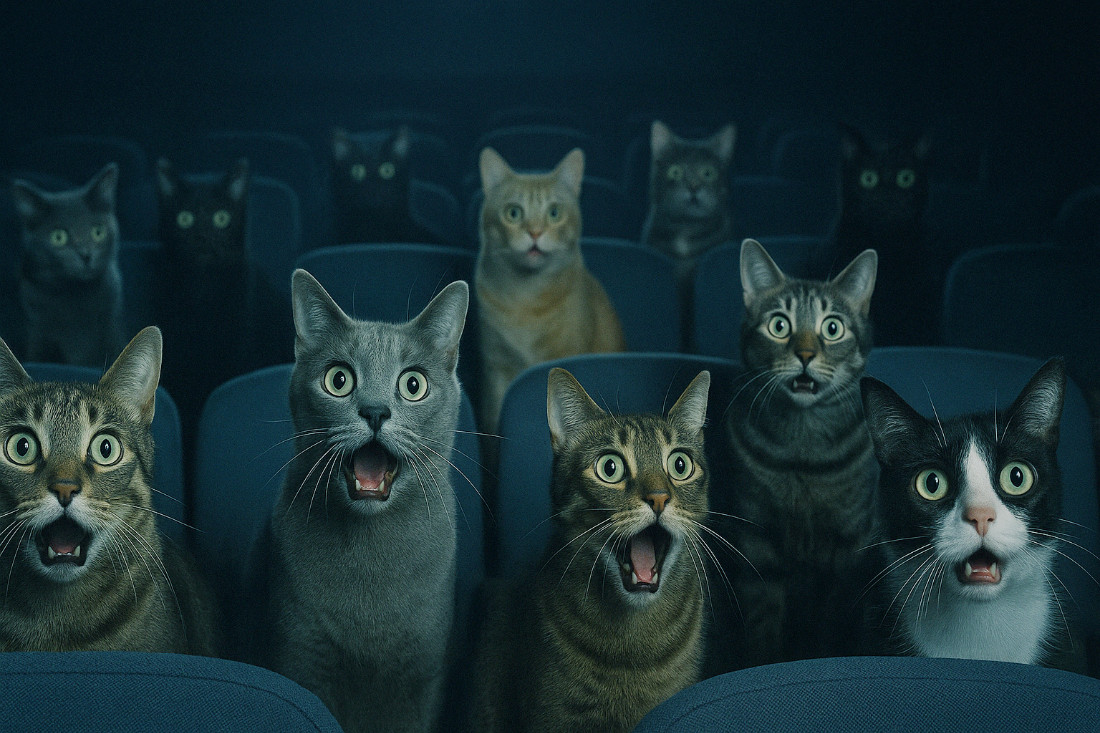
“I found myself subconsciously rationing my popcorn as I sat in the theater,” New York Times critic Meowchio Mewkatani wrote. “How could I enjoy the buttery goodness in the bucket on my lap as Dubby’s stomach growled in excruciating Dolby surround sound? This is a film that really makes you stop and consider.”
The director told reporters he “wanted to tap into authentic fear, not the fantasy violence that often comes with genre cinema.”
“Obviously there’s something aesthetically primal about an evil, slobbering dog emerging from the shadows,” he said. “But I’m interested in pushing boundaries, not taking the well-padded path. The fear that our minds create is often much more terrifying than any trope.”
In one particularly brutal sequence, Dubby’s human returns home toting several heavy grocery bags, and the snap of a tin can of tuna opening is precisely timed to the crescendo of the orchestral score.
The camera focuses on the meaty morsels tumbling into the bowl, landing with saliva-inducing, moist thuds.
Dubby races toward the feast, his tongue comes within millimeters of the juicy tuna…and he awakes tragically in a cold sweat to find himself laying in a still-empty apartment rendered dark as the last of the sun’s rays disappear over the horizon.
“If that doesn’t hit you right in the feels,” Lemire wrote, “then you’re not a real feline.”
The horror-drama from Netflix is more interested in untangling uncomfortable questions from the abstract than it is in providing answers. And that’s just fine.
Movie: The Platform (2020) Director: Galder Gaztelu-Urrutia Genre: Horror, social commentary Medium: Netflix
The premise of The Platform is simple: A man wakes up in a concrete prison cell. The center of the cell is dominated by rectangular gaps in the floor and ceiling, and when our protagonist warily steps closer he can see levels of identical cells above and below him. The cells extend as far as the eye can see in both directions, each populated by two prisoners.
Every day, a platform is lowered level-by-level, laden with a massive feast: Meats, wine, cheese, bread, cake, soup, pie, fish, escargot, paella, salads, grapes, apples and other fresh fruit, vegetables, juice. Every kind of food you can imagine, cooked and prepared to perfection by professional chefs.
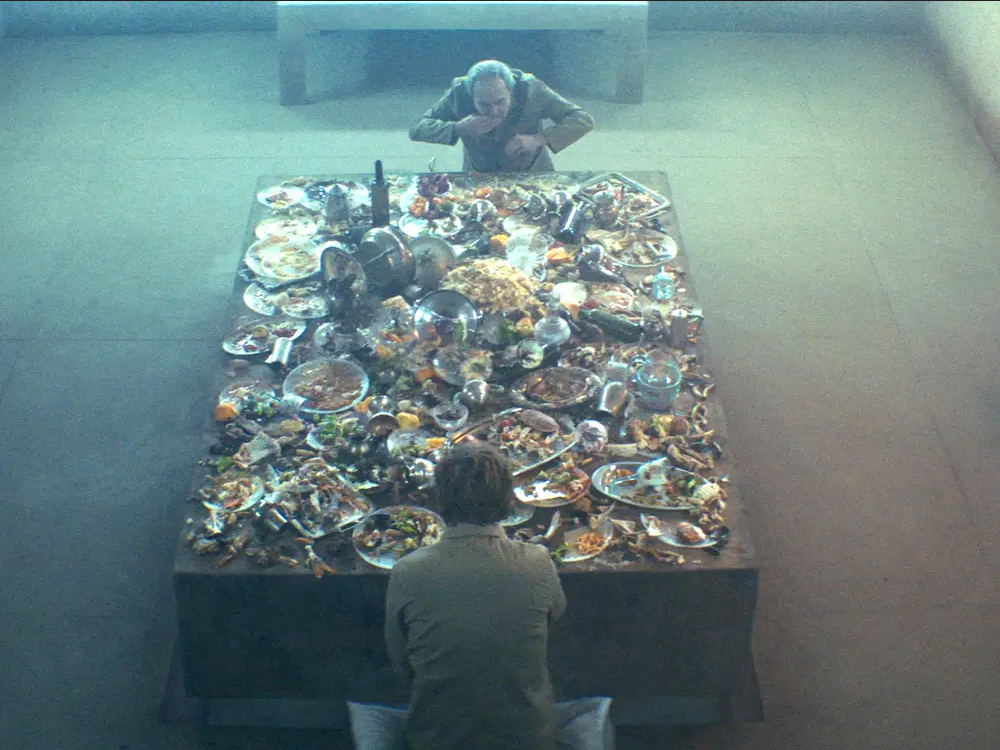
Goreng, our protagonist, is greeted by his cell mate, a kindly old man named Trimagasi who sits down next to the edge of the hole in the floor in anticipation of the platform’s arrival. When it descends to their level he pigs out, shoveling as much food as he can into his mouth before a buzzer sounds and the platform descends another level.
Goreng looks on, digusted: The food is scattered all over the platform, much of it half-eaten. Clearly, these are someone’s disgusting leftovers.
Trimagasi, top, pigs out while Goreng picks at food scraps.
Trimagasi urges Goreng to eat, and explains that they are very fortunate indeed: At level 48 there’s still enough food leftover from the prisoners on the 47 levels above that they won’t starve this month. At the end of every month, he says, each pair of cellmates are put to sleep with gas and wake up on a new level that is chosen at random by the people operating the cruel social experiment.
Trimagasi tells Goreng he once spent a month on level 132, where not a scrap of food is left by the time the platform descends. Goreng asks the old man how he survived, and Trimagasi demures.
We also learn that Goreng voluntarily entered in exchange for a real-world opportunity promised to him after he spends six months inside. Trimagasi was sent there as punishment: Infuriated by a TV commercial for a self-sharpening knife called the Samurai Plus after he’d just purchased a knife sharpening kit, Trimagasi threw his TV out of his window and unintentionally killed an illegal immigrant who was riding a bicycle below. He’s approaching the end of his two-year sentence in what the authorities call the VSC, short for Vertical Self-management Center.
Each prisoner is allowed to take one item with them inside: Goreng takes a copy of The Ingenious Gentleman Don Quixote of La Mancha, harboring romantic notions of finally reading the book with his time in the prison. Trimagasi, who loves to use the word “obviously,” told Goreng his choice of item was obvious: His prized Samurai Plus, which he cradles lovingly as he boasts about how it can cut concrete without dulling.
Goreng puts two and two together, realizing how Trimagasi survived on level 132.
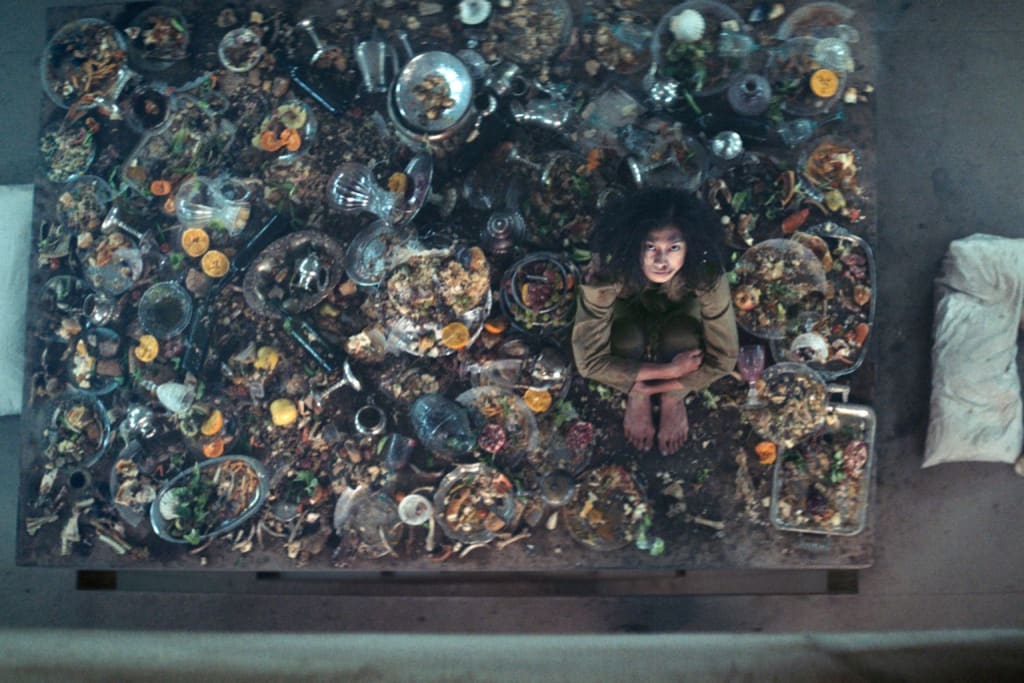
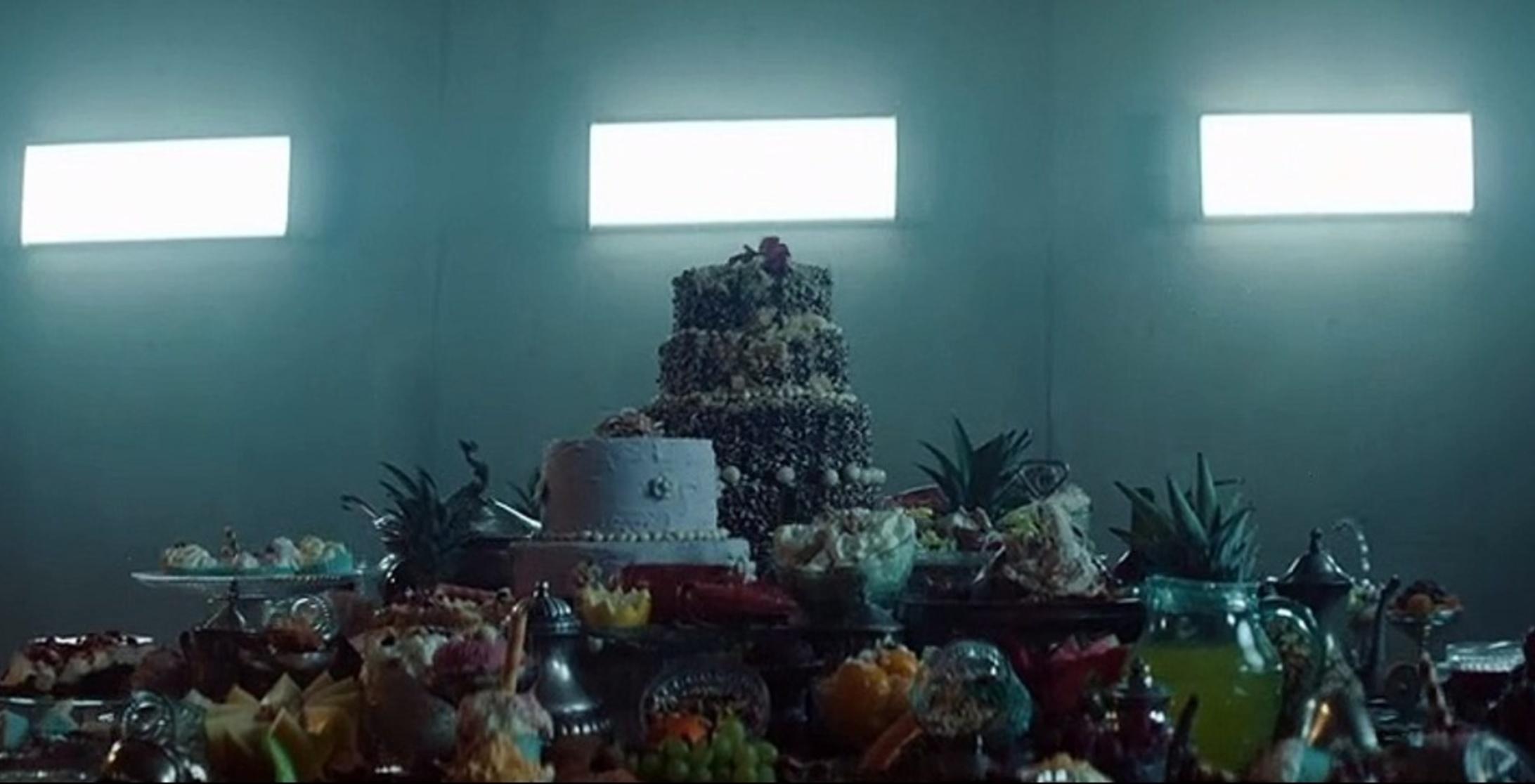
Going down: Just a portion of the feast as it exists on the platform before it’s consumed, defiled and excreted, level by level.
The Platform is a blunt allegory for human civilization, specifically the enormous wealth disparities of modern societies. The occupants of level 1 are the Jeff Bezoses and Walton families of the world, people with unimaginable, multigenerational wealth pigging out on life’s resources without thinking of the starving street children of India, the homeless of cities like New York and San Francisco, the families in North Korea eating tree bark.
Some reviewers think it’s a critique of capitalism, but I think it’s more universal than that: The kleptocrats of countries like Mexico, Russia and Brazil, the monarchies and emirates of the Middle East, and the party bigwigs of communist countries like China pig out on their own respective first levels while the people 130 “levels” down starve just the same.
The rest of us? We’re in the 30s, 40s and 50s, happily scarfing down the scraps from above, the ad revenue the Zuckerbergs and Pichais allow us by their forbearance, the slightly comfortable salaries allowed by corporate shareholders, the house and garage we might enjoy if we’re fortunate enough to run a successful small business in an industry that hasn’t been pillaged by the multinationals yet.
Looking down at the levels below in The Platform.
A plan to preserve food for the lower levels by force.
Trimigasi with his beloved Samurai Plus.
A poster for the Japanese release of The Platform. Credit: Netflix
Some people might find the movie heavy-handed, but I don’t see it that way. As uncomfortable as it is to watch at times, reality is much, much worse. The fact that some of the movie’s scenes are difficult to watch is testament to how lucky we are to be born in circumstances where that kind of suffering isn’t part of our experience, let alone our daily lives. Show The Platform to one of the handful of people to ever escape a North Korean hard labor camp, for instance, and they probably won’t even blink.
It also shows how our betters divide and conquer to keep the rest of us distracted and themselves secure. The idea that most people who receive social services are lazy bums is a popular one in some quarters, encouraging people not to have empathy for the less well off, but to loathe them. Likewise, the people occupying the higher floors of The Platform’s prison don’t feel sorry for those beneath them. In one scene, two cellmates tell a man they’ll help him ascend to their floor, then literally shit on him as he’s just within reach, cackling with delight as he falls.
I didn’t take it as a call for socialism either. The movie makes it pretty clear that neither asking people to moderate their consumption, nor trying to enforce sharing works out for the people who try those methods. Indeed when socialism has worked in real world circumstances, it’s been part of a hybrid model that still uses capitalism as its economic engine.
Mostly, The Platform exists to make people think. While Jeff Bezos goes to sleep tonight in his $50 million compound estate, dreaming of his next vanity flight to low Earth orbit or the next hypercar he’s going to buy, there’s someone shivering on a park bench with 15 cents in their pocket, stomach grumbling, knowing the people who pass them by every day don’t even see them as human.
Mitzy the Cat has a bright future in scoring horror movies if she wants to. Check out her eerie, tension-building keyboard work here:
Her technique is far superior to Bud’s, which consists mostly of running across the keyboard to create stabs of discordant noise. If Mitzy’s horror music is a tense, slow burn, then Bud’s is a cheap jump-scare.
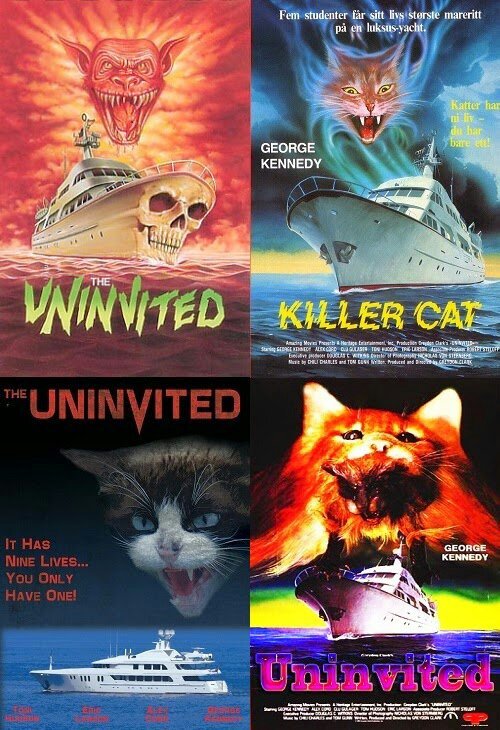
Perhaps Mitzy’s score could be put to use if anyone ever reboots the 1988 cat-centric horror cheese, The Uninvited. Yes, this is a real movie:






 Pain In The Bud