Reason #94 To Keep Your Cat Indoors: He’s A Bully

A California woman’s cat is a burglar, a bully and an aggressive napper!

Most of the time when we talk about reasons to keep your cat(s) inside, it’s because the great outdoors pose innumerable risks to the lives of cats.

People make a big deal of cats retaining many of their wild instincts, but the truth is they’ve been domestic animals for 10,000 years, and the only “natural habitat” for them is under the care of kind people in a safe home or a managed colony where they’re protected, fed and given veterinary care.

But cats are predators, technically an invasive species in most places, and they have a jerk streak, so there are plenty of valid reasons to protect others from them.

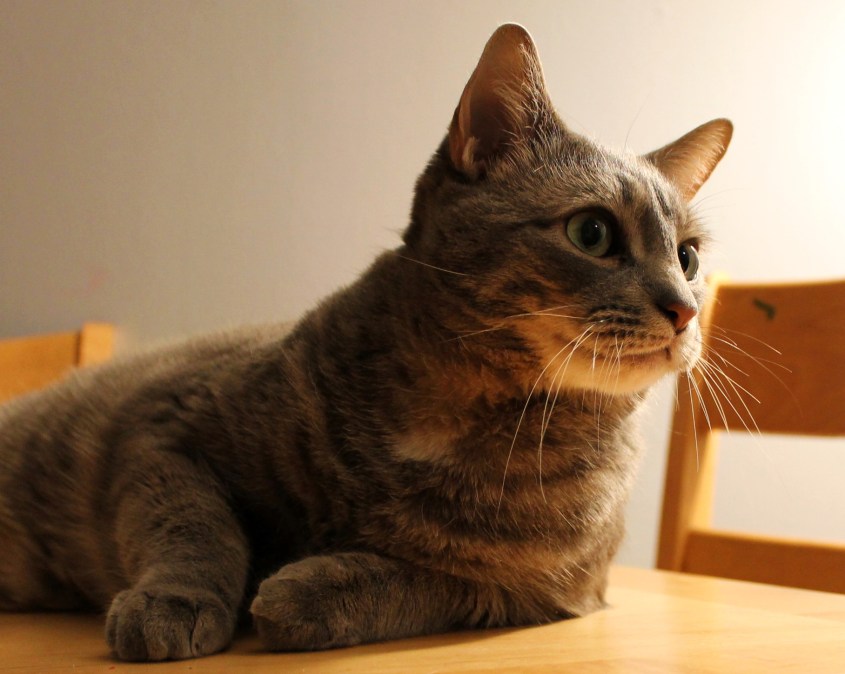
A cat in Pleasant Hill, California — about 20 miles east of Oakland — illustrates that last point perfectly. Apparently he’s been inviting himself into the neighbor’s house via the cat flap, where he bullies the neighbor’s cat, helps himself to its food and adds a final insouciant insult to injury by taking a nap in the neighbor’s house. Then he strolls back into his own home in the morning, enjoys breakfast and has another nap.

Lisa, the offending cat’s human, said she found out about her cat’s jerktastic behavior via social media, and wrote to The San Jose Mercury News’ pet advice columnist for counsel on how to handle the situation. The neighbors have begun hiding their cat’s food in a closet, but understandably they want Lisa’s aggressively napping cat burglar to stay away.

“Not sure how to curtail his activities. Neighbor is not happy with our cat’s behavior,” Lisa wrote. “Locking our cat inside at night is not a good option; he is very vocal when locked up.”

Columnist Joan Morris offered blunt but perfect advice: Stop letting your cat out.

“I think both of you should keep your cats indoors, and the neighbors should lock the cat door, but as it’s your cat burglar that’s causing the issue, it’s up to you to curtail him,” Morris wrote. “Keeping your cat indoors at night is the simplest solution. The adjustment might be difficult — probably more for you than for him — but in time he’ll get used to it.”

I understand it can be very difficult to curtain feline behavior. If there were an Olympics for being annoying, Buddy would take gold many times over for his relentless meowing when he wants something and isn’t getting it. But the one thing you can never do is give in, or the little stinkers will learn that they get what they want when they yowl incessantly.

Do you agree with Morris, or should the bullying moggie get his way?
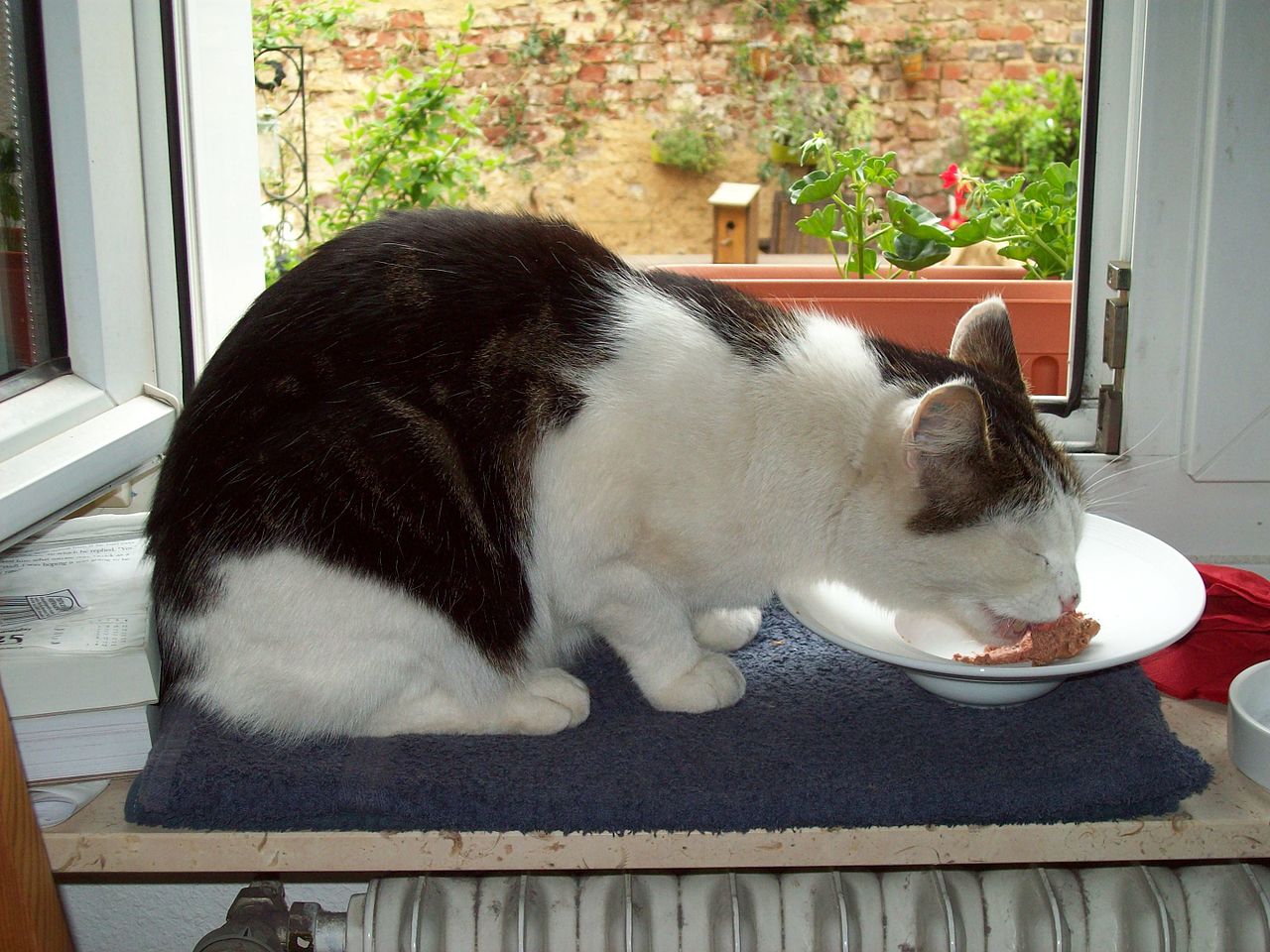
A_cat_eating_a_meal
“I’m up in your house, eatin’ ur foodz, bro.” Credit: Wikimedia Commons

New Human Surprisingly Easy To Manipulate, Rescue Cat Says

After arriving in his Forever Kingdom, a newly-adopted cat began the hard work of training his new human.

NEW YORK — It took only six seconds for Jenna, Mikey’s new human, to open the bathroom door when guilted with mournful meows on Wednesday, the newly-homed cat reported.

The 28-year-old human woman entered the bathroom without her recently-adopted feline at approximately 6:22 pm on Wednesday.

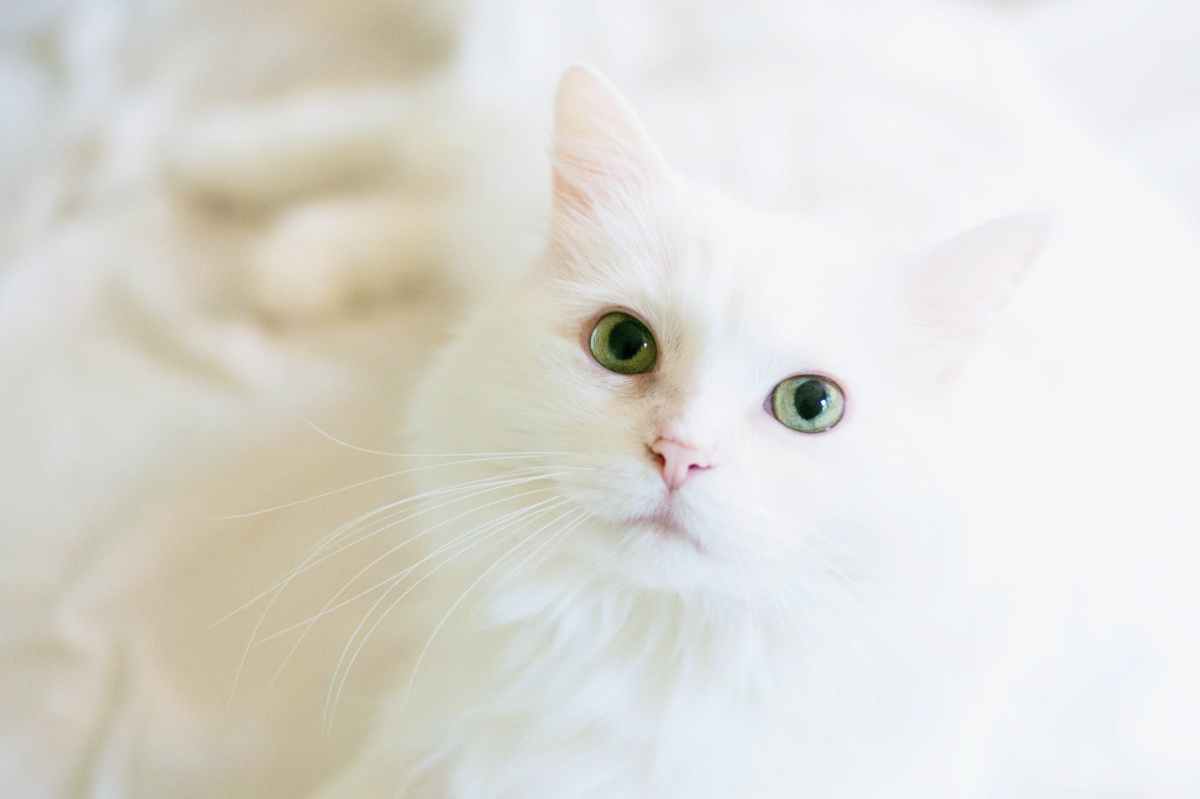
“I said to myself, ‘Mikey, we gotta nip this in the bud right away. We can’t have her thinking she can use the bathroom without us, can we?'” the white moggie said.

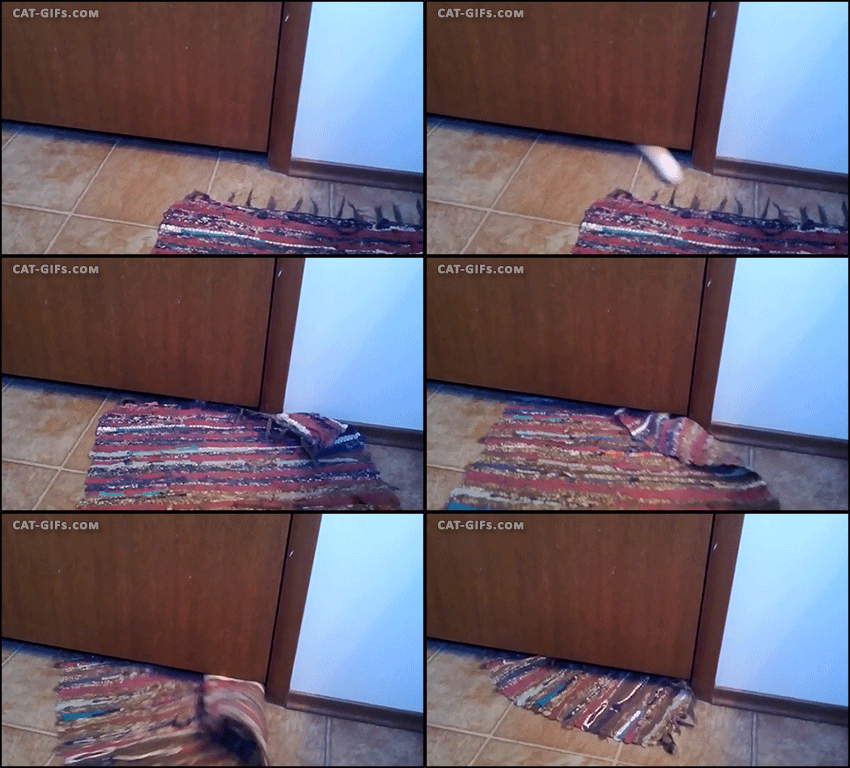
Mikey launched into a routine that involved scratching the frame, reaching under the door and meowing frantically — “the classics,” he said.

Six seconds later the bathroom door opened, revealing a concerned Jenna.

“Oh my poor baby, are you okay?” she asked, extending a hand as Mikey padded into the bathroom. “I was worried! It sounded like someone was strangling you!”

Mikey said he milked his new human’s sympathy for all he could get.

“I flopped onto my back, gave out a little ‘Muurrrp!’ and looked at her with my big, sad eyes,” he told reporters. “A few minutes later she was in the kitchen, showering me with snacks. Easy peasy!”

catpaw
Paws under the door: A classic feline manipulative strategy that almost always yields results, especially if you can grab something!

Mikey, who spent almost three months in a local shelter as younger cats were adopted during kitten season, said he’s proceeding cautiously in his new home and plans to use his keen feline powers of observation to develop a meticulous catalogue of which buttons to push at specific times “to yield maximum snackage and massages.”

“I haven’t used my solicitation purr yet,” he said. “So far my human’s been pliable and gives me what I want, when I want it. The other night she spent four hours laying in a very uncomfortable-looking position to avoid disturbing me while I napped on her shoulder. I want to see how far I can take it before bringing out the big guns.”

Patience has paid off, Mikey said.

“Her boyfriend came over the other night,” he said. “I could have hissed, peed in his shoes, chased him off. After all, there can only be one man of the house. But he brought a gift for me, one of those track towers with the ball you swat around, you know? I have to admit, I was impressed that he knew enough to pay tribute to me. That guy’s alright.”

How Long Can You Leave Your Cat Alone?

“Cats take care of themselves,” the conventional wisdom insisted for decades. These days we know that’s not true.

Back in the Dark Ages of kitty cognitive knowledge, when scientists wouldn’t go near a cat with a 20-foot pole because they were considered impossible to work with, the conventional wisdom was that as long as a cat was fed and watered, its needs were met.

Going away for three days? Leave a few bowls of dry food and water and you’re good to go, or if you really want to splurge, get an automatic feeder, the prevailing wisdom went. Gonna be away for a week or two? Get someone to check in on the cat a few times a week just to make sure food and water is available.

“If you want a dog but you don’t have time to meet all of its needs, get a cat,” people would say. “They take care of themselves.”

It didn’t take me long to realize how wrong the “prevailing wisdom” on cats really was, and thankfully in recent years we’ve seen a boom in research into cat behavior, intelligence and emotional needs. Among the many things verified by those studies is the fact that cats absolutely are emotional animals and are not the cold, indifferent automatons many people insisted they were.

One reason for that enduring myth may be cats’ famous stoicism. Ignore a dog and she might cry, become destructive or pee in your house, but one thing’s for sure — she’s going to let you know she’s not handling the isolation well. Ignore a cat, and he’ll just withdraw.

I’ve seen plenty of examples of the latter in the homes of friends and acquaintances. The cats are just sort of there, existing like the furniture or plants, interacted with rarely and given affection only occasionally. Those poor cats are quiet, seemingly indifferent, expecting nothing and sadly accepting of their place. They are neglected.

But when you pay attention to your cats they come out of their shells, so to speak. They warm to you. They reveal their hidden emotional core.

Of course, when you raise a cat with attention and love, that’s there from the very beginning, and they WILL let you know when they’re not happy with your absence.

Who do we know who’s like that? His name sounds like Bum, or maybe Bunny, or…oh yeah! God forbid I should ignore Buddy. I’ll never hear the end of it. In fact, he’s on my desk right now, butt parked next to the mouse, and I’m sure any minute now he’s going to decide that I’ve been writing for too long and declare it’s Buddy Time.

Of course, the little jerk attacked his own cat sitter, a friend who has been caring for him when I’m away since he was a kitten! That complicates things.

“Oh servant! Servant, come here at once! I’d like a massage!”

If you’ve made it this far, you might be wondering how long you can really leave your cat alone. The answer is no more than 24 hours without someone dropping by to check on kitty, refill the water and food bowls, and give him some attention.

If you’re gone longer you’re going to want to make concrete plans for a cat sitter to be there every day.

“You should not leave your cat alone for a prolonged period,” veterinary postdoc Mikel Delgado told Inverse. “Cats also have emotional and social needs that can’t be met when they are left alone for extended periods.”

If your cat likes to play, that’s great, but even if the little one doesn’t, your cat sitter can make things easier by simply hanging out, Delgado said.

Now if you’ll excuse me, His Grace needs me…

The Very Reverend Buddy: ‘Let Us Pray’

An odd, unexplained cat behavior caught on video. Why do cats make this gesture?

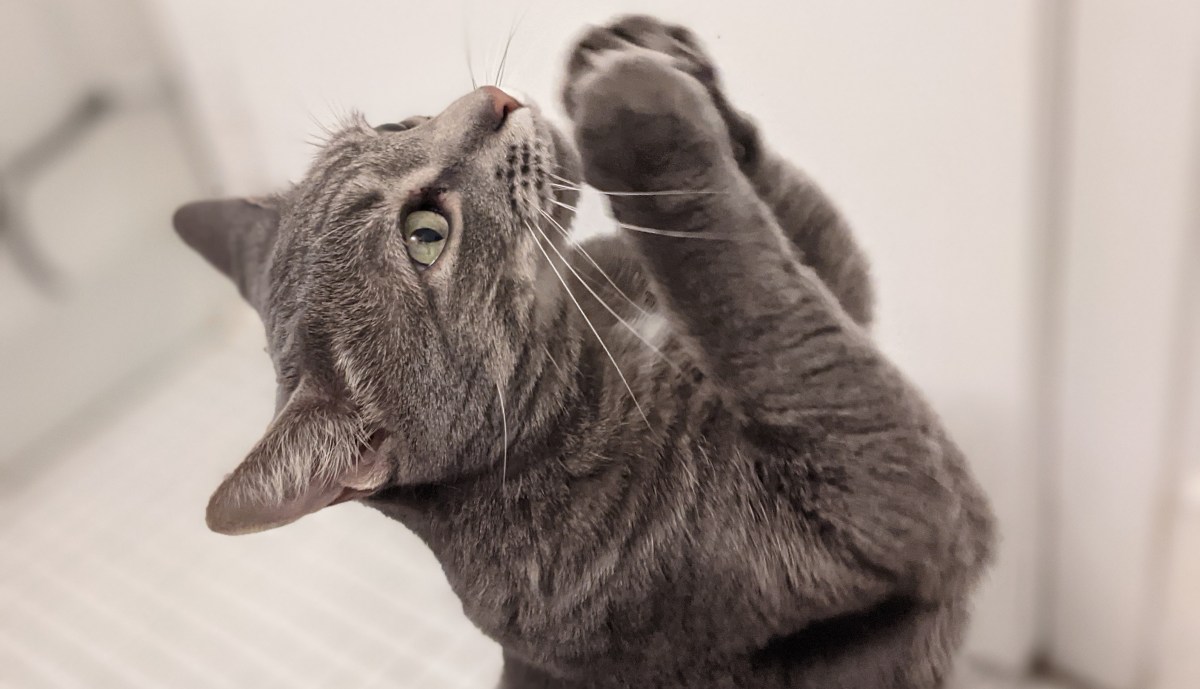
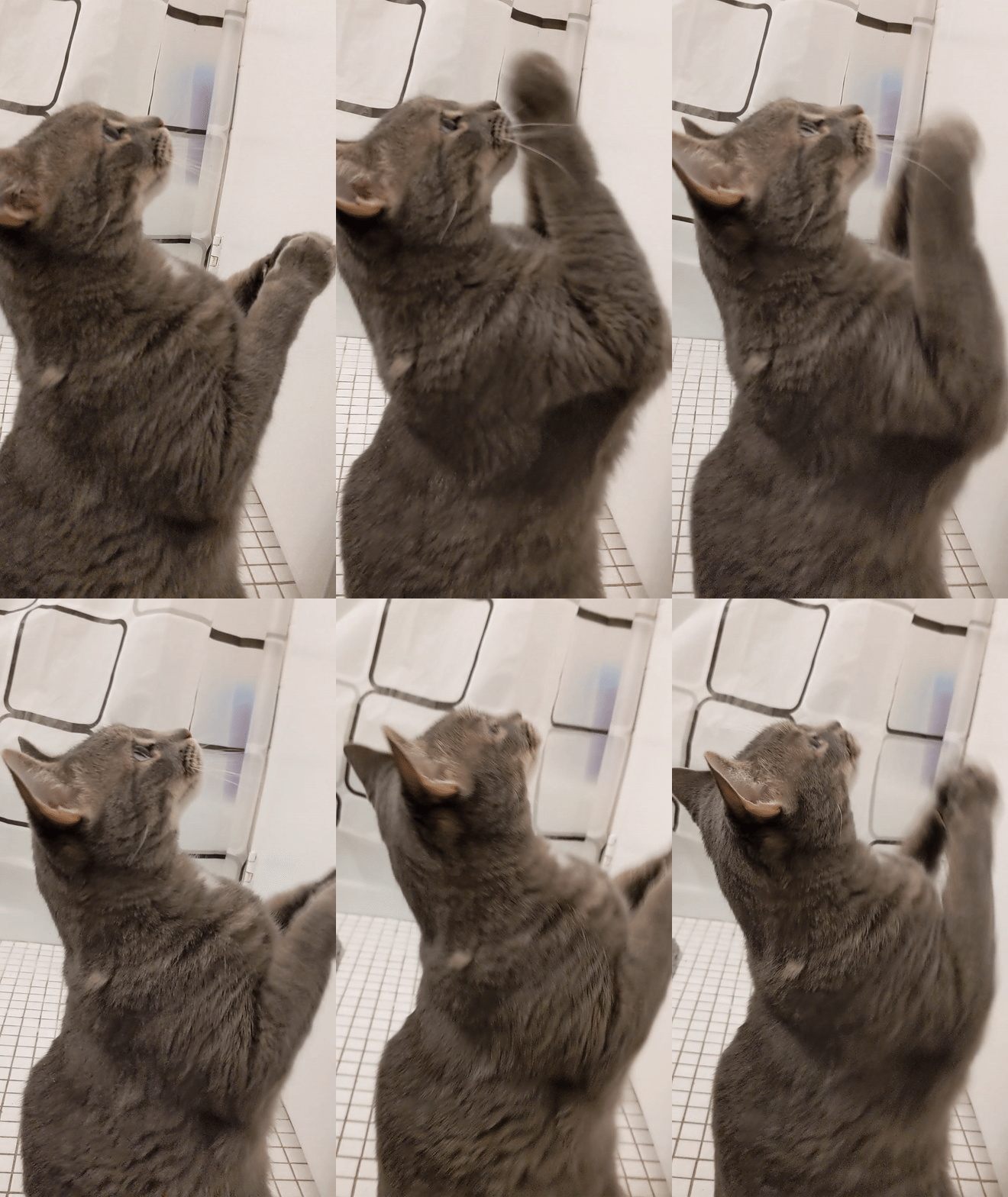
I managed to film a brief clip of Buddy enthusiastically “praying.”

This gesture is also called cat pleading or begging in various corners of the interwebs, but as far as I can tell it really doesn’t have anything to do with asking or pleading. I’ve seen my cat do the same motion while he doesn’t think anyone else is around, while he’s at the window looking at birds, and at other random times.

The gesture is so random that this is the first time I’ve managed to get a decent clip of it. Usually by the time I’ve got my phone pointed at His Grace and begun recording, he’s finished his “prayers.”

I have no clue what it means or why some cats do it. All I know is that it’s a fairly rare thing. Perhaps a cat behaviorist somewhere could offer some insight.

Reverend Bud
“Dear Lord, provide me with turkey.”

Also: Happy Adoptaversary to Holly B, Retro Dee’s cute furball. Holly is named after Buddy Holly, so she’s a little buddy too, and she’s been with Dee for two years now. We wish Holly good health and many more years with her loving human, Dee.

sleepsweird3-1
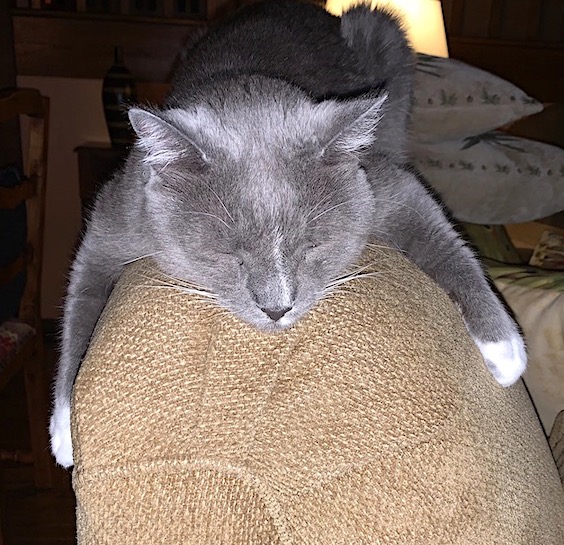
Holly getting some Z’s in a uniquely feline way. Credit: RetroDee

Study: Cats Will Happily Accept Food From Jerks

A new study shows cats will take food from anyone, even people who refuse to help the cats’ owners with a problem.

Taking studies designed for children and dogs and applying them to cats has been all the rage lately after a series of studies yielded new insights about the way cats bond with their humans.

Earlier studies showed cats, like kids and dogs, look to their humans for reassurance in strange situations and derive comfort from the latter’s presence. Likewise, they’re less confident if they’re forced to face unknown situations without the “security blanket” of their big buddies nearby.

Now a research team in Kyoto has taken another study designed for dogs — known as the “helpful stranger” study — and placed cats in the same situation to find out how they react.

Sure, I'll Take A Treat!
A new study shows cats don’t discriminate when it comes to who’s giving them food.

Both humans and dogs show a preference for what researchers call “prosocial individuals.” In plain language, it means they pay attention to the way strangers treat the people they care about. A dog who sees a stranger respond negatively to its caretaker will avoid the stranger, even if the latter is waving a delicious treat.

In the study, cats watch their owners try to open a box while two strangers are present:

“[C]ats watched as their owner first tried unsuccessfully to open a transparent container to take out an object, and then requested help from a person sitting nearby. In the Helper condition, this second person (helper) helped the owner to open the container, whereas in the Non-Helper condition the actor refused to help, turning away instead. A third, passive (neutral) person sat on the other side of the owner in both conditions.

After the interaction, the actor and the neutral person each offered a piece of food to the cat, and we recorded which person the cat took food from. Cats completed four trials and showed neither a preference for the helper nor avoidance of the non-helper.”

At first glance it looks like cats really don’t care if a person is helpful or friendly toward their “owners.” If a person is offering them yums, why shouldn’t they take them?

That sounds like exactly the sort of thing cats would do, but the research team says we should hold off on judging our food-loving feline friends. It may be that cats simply don’t understand that the stranger(s) aren’t being helpful. After all, if your cat sees you struggling with a package, does she offer to help?

If it is true, it’s not necessarily cats’ fault: We’ve long known they aren’t as well-attuned to human social cues as dogs are, a fact that can be attributed to their route to domestication. There simply wasn’t any reason to carefully breed cats to pick up on those cues, as we did historically with dogs, because cats were already wildly successful at their primary job, which was rodent extermination. Taking on cuddle and companionship duties didn’t happen until later when people began to value the little ones for more than their sharp claws and teeth.

“We consider that cats might not possess the same social evaluation abilities as dogs, at least in this situation, because unlike the latter, they have not been selected to cooperate with humans,” the scientists wrote.

The research team says the results are suggestive, but more studies should be done before drawing any real conclusions about our furry friends. Knowing cats often get a bad rep due to stereotypes and misunderstandings, we agree.