After 10,000 Years, Dire Wolves Walk The Earth Again

The surprise announcement came from Colossal Biosciences, a company best known for its project to bring back the woolly mammoth.

A US biotech company shocked the world Monday when it announced the births of three dire wolf puppies, bringing back a species that hasn’t lived for more than ten millennia.

Or a version of that species, at least.

Scientists with Colossal Biosciences extracted DNA “from a 13,000 year old tooth and a 72,000 year old skull and made healthy dire wolf puppies,” Colossal CEO Ben Lamm said in a statement.

Of course, it wasn’t that simple.

The dire wolf, Aenocyon dirus, was heavier, stockier and had thicker fur than modern-day gray wolves. In addition, its bite was incredibly strong, generating more force than any living species of canid.

To create the dire wolf puppies, Colossal used the genomes reconstructed from the tooth and skull, spliced them with gray wolf DNA, and made 20 gene edits in 14 genes. Healthy embryos were implanted in three surrogates — large, mixed-breed dogs — and were successfully delivered.

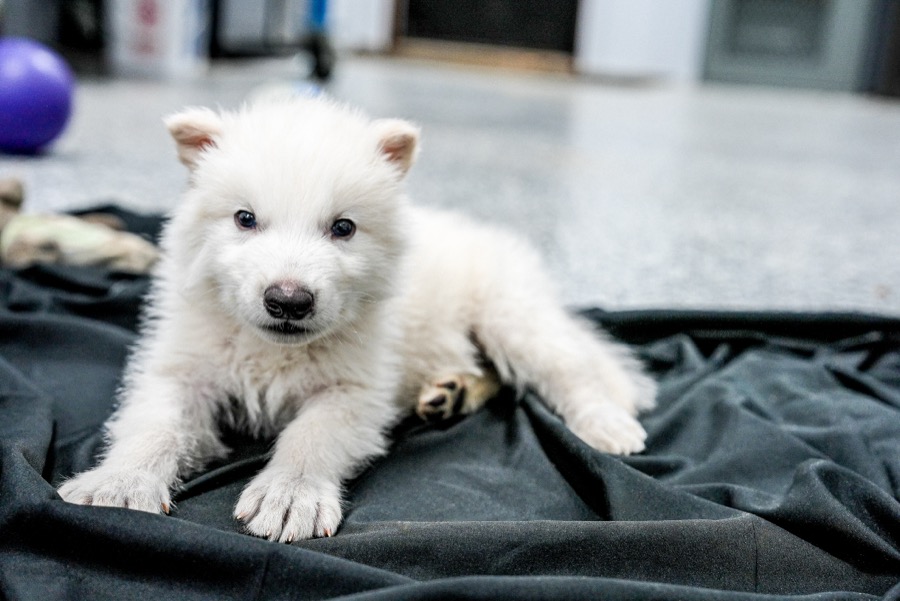
Romulus, one of two male dire wolf pups born late in 2024. Credit: Colossal Biosciences
Remus, who was born at the same time as Romulus. Credit: Colossal Biosciences

Whether the new puppies are officially dire wolves is up for debate and beyond the scope of this post, but just like humans and chimpanzees share 98.7 percent of their DNA, dire wolves and gray wolves share 99.5 percent of their DNA.

The species also existed concurrently with gray wolves and there was interbreeding between the populations, meaning gray wolves already have dire wolf lineage.

As a result, the puppies may be more dire wolf than some are willing to admit. Just how far a “de-extinction” project has to go for the animals to qualify as their namesakes will be debated for years, and there are innumerable questions for which we won’t have answers until the pups grow and scientists monitor their behavior in addition to their physical health.

They won’t behave precisely the way their ancestors did, since they are growing up in a captive environment with teams of specialists constantly monitoring them. The wolves are “essentially living the Ritz Carlton lifestyle of a wolf. They can’t get a splinter without us knowing about it,” Colossal’s chief science officer, Beth Shapiro, told the New York Times.

Whether bringing back dire wolves is a “good” thing is also a topic for another day, at least as far as this post goes. You may disagree, and feel free to say so in the comments, but this is a subject you could write half a library of books on, encompassing ecological, moral and philosophical questions that don’t have easy answers.

It’s made even more complex by the situation we find ourselves in, with our own behavior and relentless expansion killing off more than 70 percent of the world’s wildlife since 1970, according to the World Wildlife Fund. The company wants to use its technology to help critically endangered species, like the red fox, avoid extinction.

Colossal has partnered with leaders in the fields of genetics and bioethics, as well as organizations that specialize in animal welfare. The puppies are in a sizable, custom-built facility in an undisclosed location, secured by “zoo grade” barriers, and the company enlisted the help of the SPCA to create an environment appropriate for them. Colossal says their care regimen will include socialization and the development of pack dynamics.

A newborn dire wolf pup. Credit: Colossal Biosciences

The company has well-publicized projects to bring back woolly mammoths and the dodo, and ultimately, its founders say they want to restore balance in places where apex predators have been brought to extinction by human activity.

“This project demonstrates the awesome potential for advances in genetic engineering and reproductive technologies to recreate lost diversity,” Andrew Pask, a Colossal board member and professor of biosciences at the University of Melbourne, said in a statement. “Apex predators are critical to stabilizing entire ecosystems and their loss from the landscape can have profound impacts on biodiversity.”


The pups are named Romulus, Remus and Khaleesi. That last name is in homage to the character Daenerys Targaryen (Emilia Clarke) from the book series A Song of Ice and Fire, and Game of Thrones, the television adaptation. Dire wolves play a major part in the narrative, and the series is credited with bringing the long-extinct animals back into the popular imagination.

Jon Snow (Kit Harrington) discovers an orphaned dire wolf pup in the first season of Game of Thrones. The pup, who grows into a fierce and massive adult wolf named Ghost, plays a pivotal role in many major events in the series. Credit: HBO
Khaleesi, a female dire wolf, named after the character Daenerys Targaryen from Game of Thrones. Credit: Colossal Biosciences

New York Times Ethicist: ‘My Boyfriend Said He’d Save Our Cat but Not a Stranger if Both Were Drowning’

As Charles Darwin pointed out, the difference between humans and animals is one of degree, not kind. That should factor into discussions on the value of animal life.

The headline — ‘My Boyfriend Said  He’d Save Our Cat but Not a Stranger if Both Were Drowning’ — comes from the New York Times via its Ethicist column, in which NYU philosophy professor Kwame Anthony Appiah answers questions from readers about moral rights and wrongs.

Here’s the full text of the question:

My boyfriend and I were talking about protecting human life, and he said that he doesn’t believe that human life is necessarily worth more than any other kind of life. For example, he said that if one of our cats were drowning next to a human who was a stranger to us (who was also drowning) and he could save just one, he would choose our cat. Is this morally wrong?

Appiah, in his very first sentence in response, regretfully calls pets “fictive kin” before pointing to a study by an experimental psychologist in which participants were asked whether they’d save their pets or a foreign tourist if both stepped in front of a bus at the same time. Forty percent of respondents picked the pet.

To his credit, Appiah notes the people who chose their pets don’t have “some grave defect of character,” and said the impulse to save a companion pet is “very human,” given all we share with our animals, including “affection, companionship, loyalty, all twined around a whole lot of memories.”

Buddy
“Buddy sad. Buddy needs snack.”

That said, Appiah says human life is more valuable:

“But yes, it’s very wrong. (In states with “duty to rescue” laws, it could be illegal too.) Those human strangers? They had rich emotional lives and they had plans, short-term and long-term, big and small; it’s a good guess that they were also part of other people’s plans, other people’s emotional lives.”

I’m not going to get into the question of whether human or animal life has more value. That’s a mine field, I don’t subscribe to the idea that we should work out hierarchies of life’s value as if we’re ranking favorite ice cream flavors, and it seems to me these “what if?” questions involving oncoming buses or trains don’t have much value in gauging reality.

After all, how many people do you know were forced to make life or death decisions in a millisecond, let alone decisions involving a complex moral and emotional calculus? Appiah seems to agree, while also pointing out that what people say in a questionnaire doesn’t necessarily predict what they’d do in the moment.

Life is life. It’s all valuable, and the survey doesn’t have much use outside the classroom or ethics columns.

Buddy the Handsome Cat
Buddy the Cat: Brains as well as brawn.

However, I do think it’s worth pointing out that much of what Appiah assumes is the difference between human and animal life — particularly rich emotional lives, cognition and value to others — can indeed be attributed to animals.

There’s been a seismic shift in the way most scientists view animal cognition over the past decade, and in many ways the acknowledgement of non-human sentience and potential sapience is long overdue  — there are literally thousands of studies confirming animals are conscious, sentient, and possessed of the full range of primary and secondary emotions.

Every time we set new barriers for what distinguishes human from non-human, we’re forced to change the goalposts. When behaviorism was the dominant model, the distinction was internal thought processes. In dismantling behaviorism, Noam Chomsky helped launch the cognitive revolution. Then it was  emotion and love, which crumbled with the ugly Harry Harlow studies into maternal deprivation in monkeys. Then it was capacity to reason, tool use, innovation — and every time, we’ve revised our definitions, solid in our conviction that we’re fundamentally different.

In fact, the only thing that’s held up is Charles Darwin’s original observation in 1871 that “the difference in mind between man and the higher animals, great as it is, certainly is one of degree and not of kind.”

In other words, humans aren’t some higher order of being. We are animals. Upjumped animals in some sense, but animals all the same, subject to the same diseases, physical limitations and helplessness in the face of greater forces like nature.

We may live in an age when our planet is blanketed in satellites, scientists are on fusion’s doorstep and each one of us has the entire sum of our species’ knowledge at our fingertips, but it’s shocking how quickly the veneer of civilization can collapse when people are scared, the food runs out, social order breaks down and those primal motivations — the ones we think we’ve out-evolved — drive our actions again. The early days of the COVID pandemic was just a small reminder of that.

We don’t like talking about these uncomfortable truths because they lead to more uncomfortable truths about the billions of non-human minds we share the planet with, and how we treat them.

I can’t claim to be a philosopher, although I minored in the subject over the objections of my advisor. (He should have warned me off journalism!) But when it comes to animal cognition I do have a great teacher, an 11-pound ball of fur who won’t let me forget he’s got his own wants, needs and strong emotions. Doesn’t he deserve consideration too?

Is Giving ‘Nip To Your Cat The Equivalent Of Handing A Beer To A Toddler?

If cats are like small children emotionally and intellectually, is it ethical to give them a mind-altering drug?

That’s a question posed in a new article in The Conversation, and it’s something I’ve never really considered before.

It’s generally accepted that our little buddies are more or less equivalent to small children in terms of intellect and emotional intelligence. In fact kittens develop much more quickly than human children and come to certain understandings — like theory of mind and object permanence — considerably earlier than young kids do.

They also seem to possess some sapient qualities. My niece was born a year before Bud, for example, but in their early interactions he understood she was still developing motor skills and did not intend to cause him harm. I have photos of a young Buddy, still a kitten, cautiously allowing her to touch his fur and being uncharacteristically gentle with her.

There’s growing evidence that pet cats are “kittens in perpetuity.” Not only do their behaviors toward us mirror their behaviors toward their mothers — like meowing and using us as a “secure base” when faced with uncertainties — but they depend on us completely. We care for them, in turn, at least in part because they have neotenous (baby-like) features, which trigger our protective instincts.

Bud is basically a “kid,” so is it ethical for me to give him a potentially mind-altering substance?

Catnip isn’t really a drug

While some catnip companies lean into the whole “marijuana for cats” thing, naming catnip after famous marijuana strains, selling it in gag pharmaceutical bottles and even calling themselves “dispensaries,” those are marketing efforts aimed at us servants. As the authors note, it’s not accurate to consider catnip the equivalent of a drug.

It’s not physically addictive, its effects only last a few minutes and cats can’t overdose on the stuff. In fact the primary “danger” of giving too much catnip is your four-legged friend getting desensitized completely to the effect, which is why it’s an occasional treat, not a routine pick-me-up.

Meowijuana Catnip Company really leans into the whole “weed for cats” thing with catnip packaged like marijuana.

Catnip “won’t induce psychosis and won’t lead to addiction or withdrawal symptoms,” wrote authors Anne Quain, a professor of veterinary science at the University of Sydney, and Mia Cobb, a research fellow at the University of Melbourne’s Animal Welfare Science center.

We don’t have to worry about cats driving on the stuff, and they have no responsibilities to speak of so catnip and silver vine can’t impact important decisions. If they have any deleterious social effects, they end at making our furry friends drool, look silly and rendering them even more drowsy than usual.

The mysteries of the nip effect

But what about a kitty’s subjective experience? How does catnip make your feline overlord feel?

We don’t have a very good answer to that question other than what we can observe, which is that they love the stuff. (Some cats don’t respond to catnip but are put in a state of bliss by silvervine. Some respond to both. A small number may not derive much pleasure from either of the plants.)

Even when they aren’t technically impacted by it, cats seem intrigued by the scent and use their secondary olfactory receptor, the vomeronasal organ, to do that odd-looking “mouth-sniffing” thing they do.

Buddy loves catnip and silver vine. I keep his ‘nip in an out-of-reach cabinet, inside a sealed container, which is itself inside an air-tight plastic bag. Bud can be in a deep sleep yet within seconds of opening it he’ll appear like an overly enthusiastic djinn who thinks the wish thing works in reverse, meowing impatiently and trilling with anticipation as I set the good stuff down for him.

That’s as close to consent as we’re going to get from cats, and I think we can safely conclude Bud’s response is “Hell yes! Gimme that sweet ‘nip and silver vine blend!”

He gobbles the stuff down, by the way, so YMMV on your feline overlord’s reaction. The conventional wisdom is that cats who sniff catnip get more animated while cats who eat it tend to roll around in bliss and meow.

Making life more interesting for your fuzzy liege lord

Which brings us to the final point: catnip and silver vine are ultimately enrichment tools that help make indoor life more exciting for our little buddies, like toys, cat furniture, boxes, intriguing smells and most importantly, time playing with us.

We don’t talk about it enough, but keeping our cats stimulated and happy indoors is important, especially as pressure mounts for everyone to keep their felines inside. If your local area isn’t enforcing curfews and outright bans, it seems only a matter of time before they follow states in Australia, New Zealand and Europe in passing new laws. Every day there are news articles detailing the efforts of city councils and town boards to deal with outdoor, unmanaged feline populations, and it’s a safe bet that most of those elected officials will not have the welfare of the animals high on their list of priorities.

If we want to avoid cruelty toward cats, getting our own pets comfortable with living indoors is a good first step to making sure government doesn’t become involved.

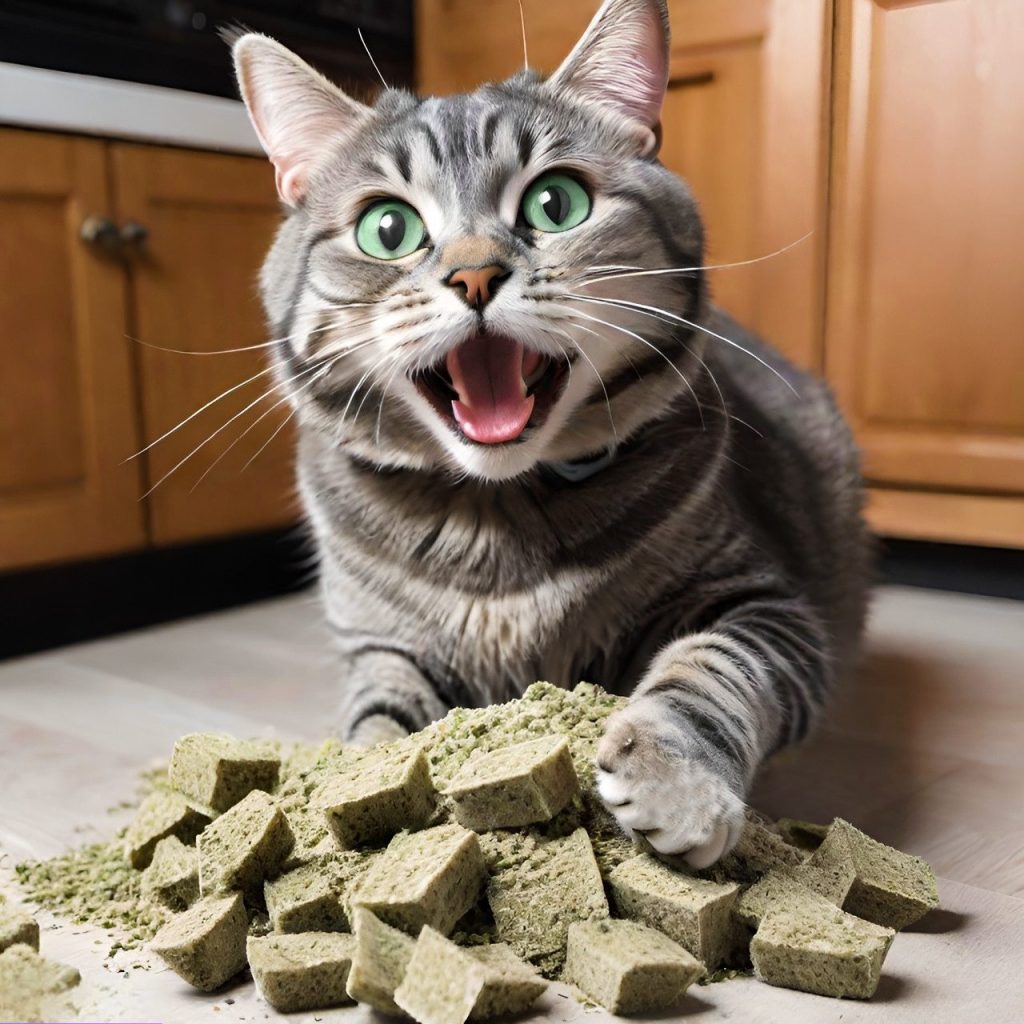
A happy cat with a huge stash of the good stuff.

Texas Pols Secretly Plot Cat Slaughter: ‘The More The Public Knows, The Uglier It Gets’

Another day, another abhorrent plan to kill cats.

Unaware they were being recorded, elected leaders in a small Texas city let their imaginations run wild in a closed-door meeting about dealing with feral cat colonies.

One proposed mass poisoning to take out as many as 50 cats at a time. Another, perhaps fancying himself a mafia hit man, envisioned taking care of the city’s cat “problem” execution-style with a “.22 round to the back of the head.”

A third proposed dumping the bodies of the dead cats in an area the city already uses to dispose of unwanted animals.

“We have a location on this property that’s called deer heaven,” the committee member told colleagues at the Nov. 6 meeting. “I’m sure it could be kitty cat heaven too.”

Now the city council and wildlife advisory council of Granite Shoals, a city of about 5,100 in central Texas, are trying to explain themselves to an infuriated public, the local Humane Society and their own police, who rebuked them in a public statement that asserted their plans are illegal.

State and local laws “do not allow any cruelty to animals, including feral cats in our community,” police chief John Ortis wrote in a letter to the public.

The Hill Country Humane Society took the extraordinary step of “terminating its relationship” with the city, calling the committee’s plans “blatantly unethical and illegal” in a statement posted on Facebook.

“This recording reveals that not only was there an attempt to develop a plan to inhumanely shoot captured cats and dispose of their carcasses, but there was open discussion between members of the committee and the City Manager about the need to conceal such activities from the general public,” the Humane Society wrote.

Staff at the Humane Society said they’ll still take in stray cats from the city, but they’ve ended their official partnership.

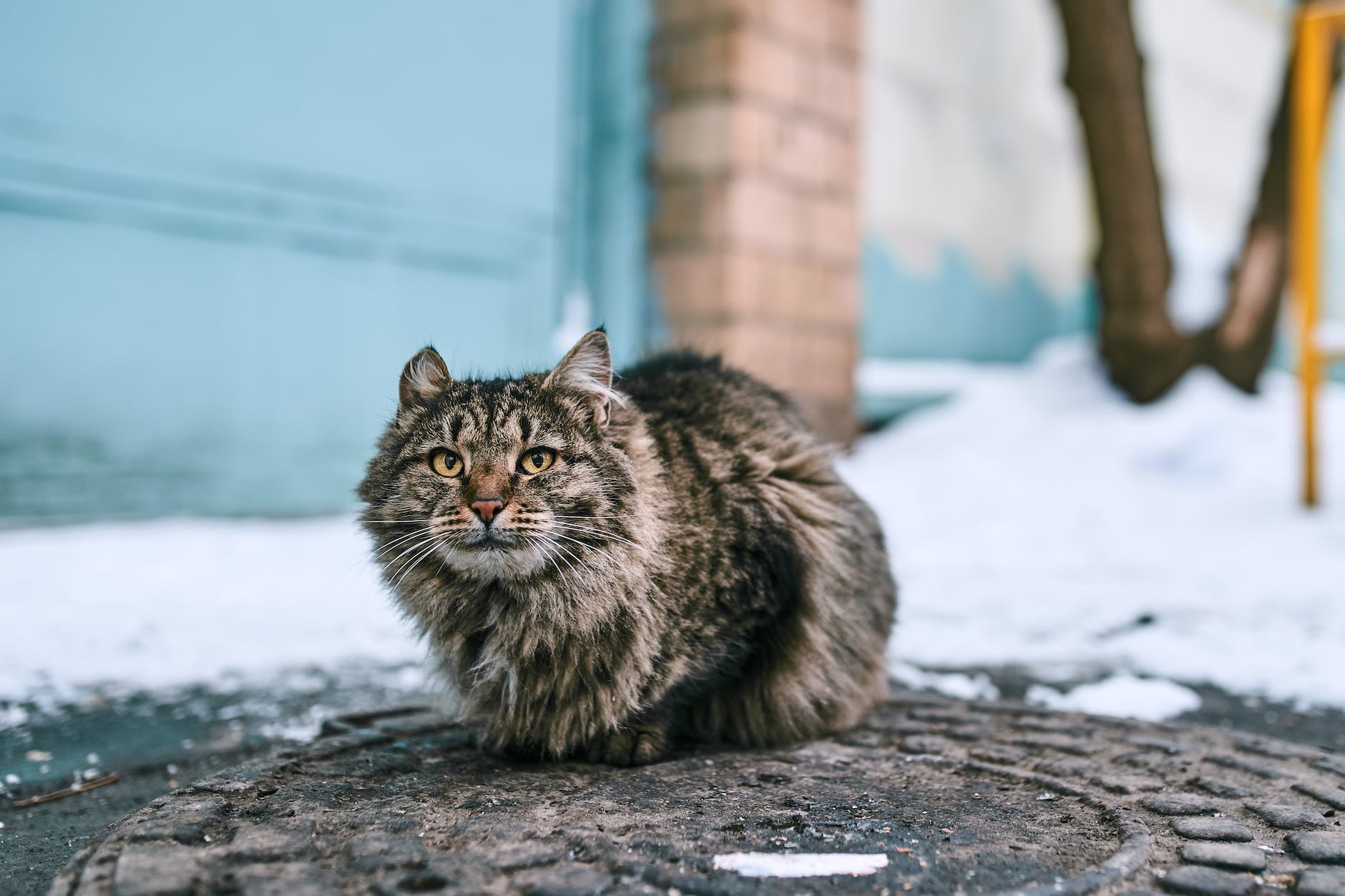
A stray cat. Credit: Aleksandr Nadyojin/Pexels

Todd Holland, the committee chair, denied that his members wanted to keep details of their plans from the public and told local newspaper the Daily Trib that the committee was merely trying to work out the “intricate details” of how to handle a population of about 400 cats. It’s not clear how the city arrived at that number, and there’s been no mention of an official effort to get an accurate tally.

“It’s not like we’re a bunch of cowboys running wild,” Holland said.

But in the recording, committee members clearly discussed hiding details from the public, and the Daily Trib noted that the committee used the word “remove” interchangeably with “euthanize” in written materials detailing the plan, perhaps to soften the language or obscure the fact that the proposed solution was to kill the cats.

Granite Shoals Mayor Ron Munos called the recording “disturbing” and said the committee’s plan will not be put into practice.

“The city is not doing this,” he told the Daily Trib. “We’re not going out and killing cats.”

Here at PITB we feel like a broken record regularly referring back to the junk studies blaming cats for killing billions of birds annually, but the reason we do is because those studies have real-life consequences.

Ill-advised, unethical and illegal plans to eradicate stray cats wouldn’t be explored at municipal and county levels if elected leaders weren’t told that trap, neuter, return (TNR) programs do not work and that outdoor cats pose the most significant thread to local wildlife.

Likewise, we wouldn’t hear about schools sponsoring cat hunts for children or so-called conservationists gunning down entire stray colonies if a small but vocal group of ostensible scientists weren’t routinely publishing dubious studies making improbable and unsupportable claims about feline predatory impact.

In plain terms there’s been a concerted effort to paint domestic cats as dangerous, ruthless killing machines, the media hasn’t treated the claims with skepticism, and the result is a whole lot of cruelty and misery inflicted on innocent animals.

City councils, wildlife biologists, park rangers and others are not armed with the facts when they rely on those studies, and the result is bad policy and decision-making.

Stories like this one out of Texas have become more frequent over the past few years, and we suspect things will get a lot worse for cats without injecting some much-needed sanity and evidence-based solutions to counter the tidal wave of misinformation.

The People Who Clone Pets Want To Bring Back Extinct Species — And Clone Animals For Their Organs

Genetics, gene-editing and cloning have rapidly matured since the days of Dolly the Sheep, which means we have less time than we think to grapple with some heady moral questions.

Should scientists resurrect long-extinct species? Is it ethical to clone thousands of animals who will not live, but have their organs harvested for human patients?

Those are some of the questions people are asking as the cloning industry — once relegated to producing one-off copies and genetically identical versions of deceased pets for wealthy clients — is expanding with new capabilities.

This story by the BBC’s David Cox provides an informative, brief history of cloning before pivoting to the current state of the industry and how it could continue to evolve.

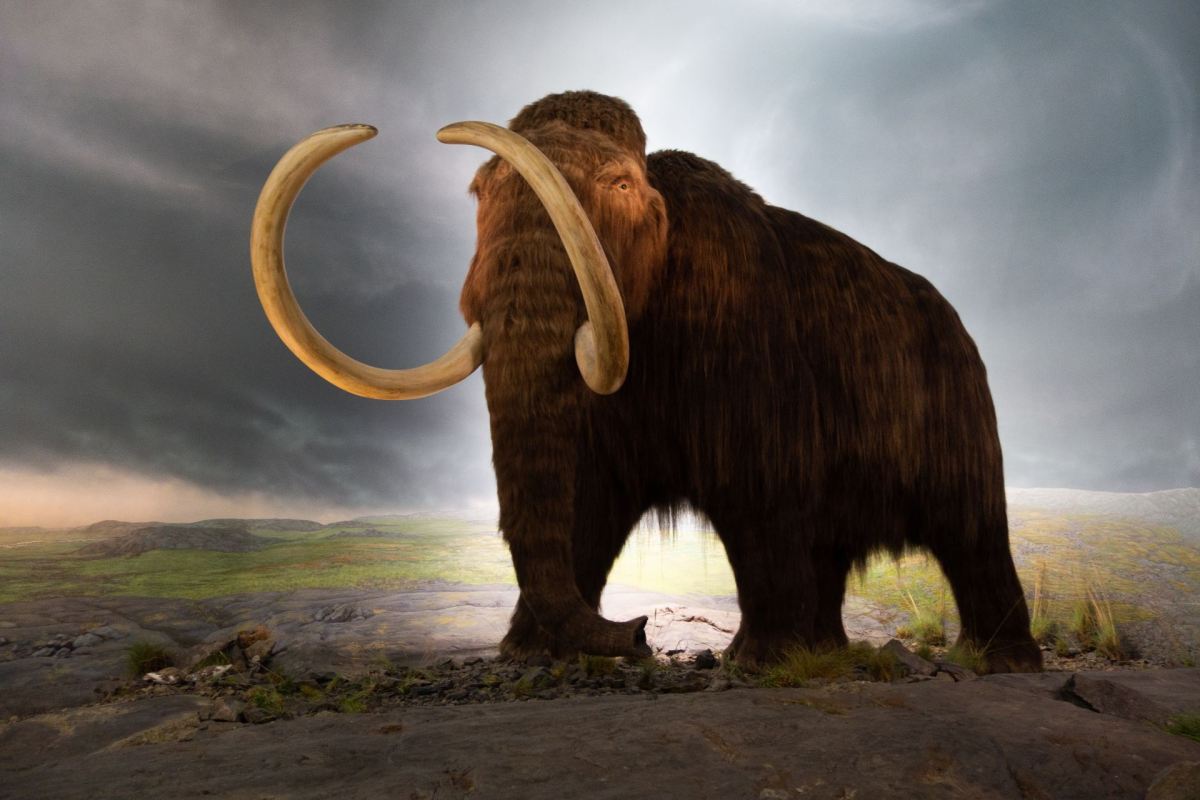
Two of the most fascinating prospects have to do with conservation. One company, Colossal, is working on bringing back the extinct woolly mammoth, while other scientists are turning to cloning as a way to prevent the extinctions of species like the white rhino, which is functionally extinct without any breeding pairs left living.

Dolly_face_closeup
Scottish scientists shocked the world when they cloned Dolly the Sheep in 1996.

As with anything in science, innovations in cloning unlock new applicative branches, and scientists have partnered with the medical field to address human health concerns. Some, like the practice of editing genes to prevent diseases in newborns, tend to fly under the radar. But others, like the push to adapt organs from animals like pigs so they can be replacements for human organs, are much more controversial and have met opposition from animal welfare groups.

Then there’s the elephant in the room, no pun intended. What about cloning humans?

Right now no one’s gone down that route, at least not publicly, because of the inevitable backlash. What’s happening deep in the bowels of clandestine medical facilities in nations with murky ethics laws is another question entirely.

I am opposed to human cloning, but I don’t believe it will remain the immutable taboo some people think it is. Someone will break the dam, and while that pioneer will likely get raked over the coals, the bell cannot be unrung. Things change so fast these days that what’s shocking one day merits a shrug the next, and it’s possible the world will be introduced to a man or woman one day before it’s revealed the person is, in fact, a clone. (Not unlike the way the world was introduced to Imma, a Japanese influencer and model who exists only digitally.)

Imma
Imma has more than 400,000 Instagram followers, she models the latest fashions and she appears in adverts for products like beverages and watches, but she doesn’t exist. She’s a digital creation.

They’ll be the Dolly the Sheep of the human race, and ethicists won’t get a say in whether they should exist because it’s already been done.

“See how normal they are?” people keen on cloning will say. “They’re just regular people. Are you going to tell them they shouldn’t live?”

But before that, it looks like the movie Gattaca will become reality, and people will order up a great baseball player or a child with intuitive musical genius just like they might commission a piece of art or a custom car job. Gene editing with CRISPR is surprisingly trivial.

Of course, it won’t be lost on people that we’re cloning humans when there are millions of unwanted, uncared-for street kids in the third world, not to mention people who live without the consideration of their fellow human beings in every nation. Just like it hasn’t escaped the notice of activists that South Korea and China are leaders in cloning pets, yet dogs and cats are also food in those countries.

What separates the dogs and cats bound for restaurant kitchens from the dogs and cats having their cells preserved for cloning?

Nothing except for their individual value to humans, just like pure luck separates a cat who finds a loving home from a cat who ends up euthanized with a needle. We are a fickle species.

Yet both the beloved pet and the unwanted shelter cat are sentient, experience intense emotions and have their own thoughts. That’s not conjecture, it’s fact as confirmed many times over experimentally, but it shocks a lot of people. Our education system has not done right by the billions of non-human minds we share our planet with.

Cloned monkeys
These rhesus macaque infants were cloned in a lab in China. The remaining barriers to human cloning are ethical, not technological.

I’ve thought about what might have happened if Buddy had been adopted by someone else, and what his fate may have been. I love the little guy, but it’s possible that someone else may have viewed him as an annoyance, a loud and incessantly chatty cat who needs an inordinate amount of attention and affection, sometimes lashes out, and needs to be surrendered.

Likewise, unwanted cats have languished in shelters for months before viral posts spark interest in them, and suddenly offers to adopt come in by the hundreds from across the globe. Nothing about those cats changed, but humans formed an emotional attachment to them after learning their stories.

Of course, the ethics of how we treat and consider animals can change depending on where you’re sitting. If you’re young, healthy and energetic, your view may be radically different than the person sitting on an organ donation waiting list, knowing their time may be up before a new liver or kidney becomes available. Suddenly a seemingly simple moral calculus becomes murky and complex.

There’s strong evidence that people who take the first steps toward cloning their beloved cats and dogs spend time wrestling with the ethics of the decision as well. Texas-based ViaGen, the western leader in commercial cloning, told the BBC that 90 percent of its clients are not people who have gone through with cloning, but have only taken the initial step of preserving their pets’ cells for $1,600.

And what of the mammoths? Bringing them back from extinction isn’t as simple as filling in the gaps in their genome, implanting gene-edited eggs in female elephants and hoping gestation takes care of the rest. Mammoths are social animals. Will an elephant mother raise a mammoth baby? Where does that mammoth baby belong? Without a herd of its own kind, can it be happy?

We can’t ask the mammoths, and even if we could, it might not be up to them anyway. As one paleogeneticist put it to NPR last year: What if the technology isn’t used to resurrect the mammoth, but to save the elephant? Does the end justify the means in the latter situation, but not the former?

Mammoth, Dolly the Sheep and rhesus macaque images credit Wikimedia Commons