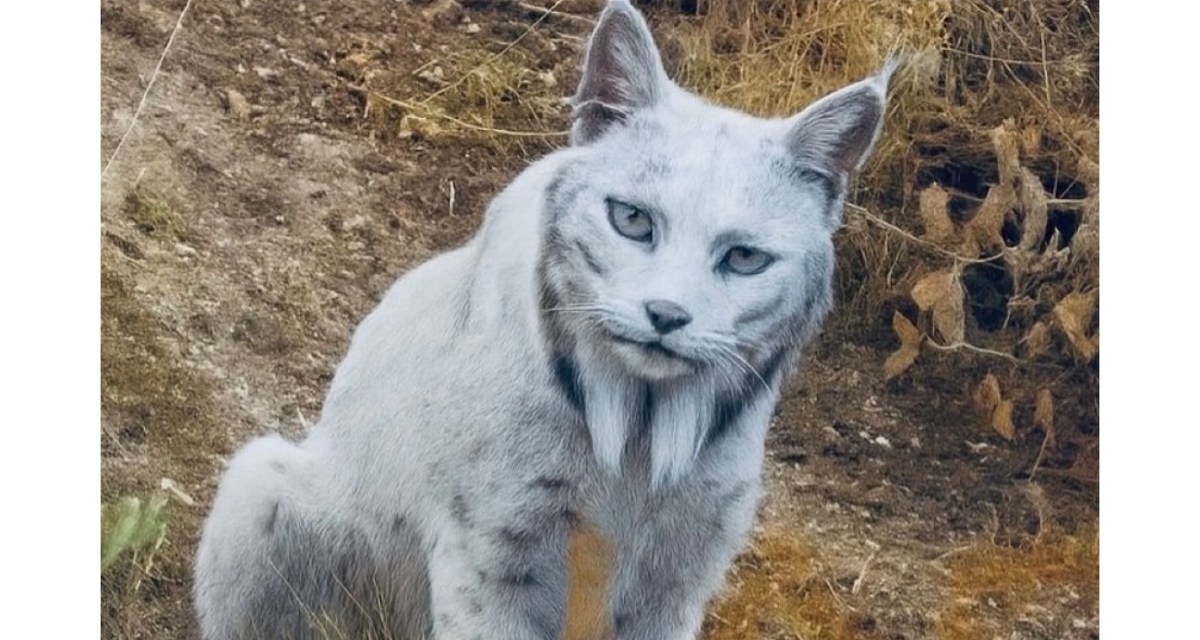
Photographer Angel Hidalgo thought the color was a trail camera malfunction until he saw the incredible feline for himself.
For the first time in history, a white Iberian lynx has been photographed.
A Spanish man who works in a factory by day and photographs wildlife as a hobby was behind the camera for the unprecedented shots.
It wasn’t easy.
Angel Hidalgo told National Geographic that first spotted fleeting images of the extraordinarily rare feline on one of his camera traps, but he was skeptical.
“I couldn’t believe it,” the 29-year-old said. “I thought it was a camera effect, and from then on, I dedicated myself to the search for the lynx. I’m still in shock.”
While hiking in late October, Hidalgo saw the “ghost cat” with his own eyes and quickly took a handful of shots and a short video before the cat vanished.
Credit: Angel Hidalgo
The Iberian lynx, as its name indicates, is native to Spain and a small range in Portugal. The cats call mountain ranges like Sierra Morena and Montes de Toledo home.
The white color morph is due to leucism, not albinism: the difference is the former causes only partial loss of pigmentation, and the eyes are unaffected.
In the video footage, the cat sits calmly and regards Hidalgo for about 15 seconds before blinking and turning its head. It’s a fleeting but fascinating look at an animal that most of us will never have the opportunity to see in the flesh.
Hidalgo won’t say where he encountered the white lynx, which is a smart move in an age when bored rich kids in places like Dubai can throw money at wildlife poachers and help themselves to the rarest and most vulnerable wildlife.
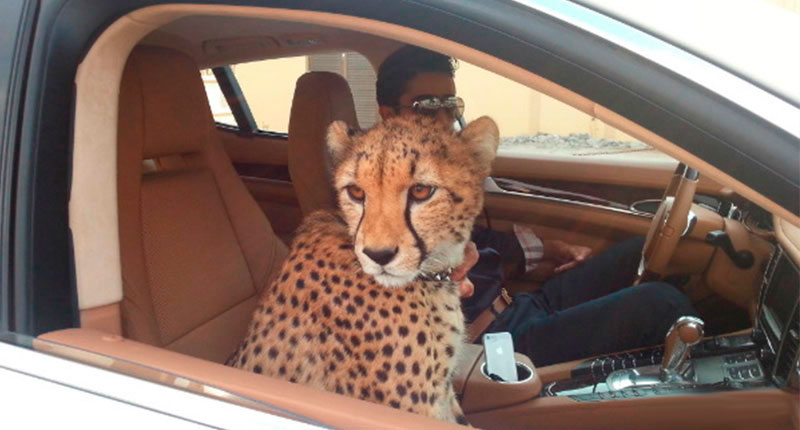
Because they know the authorities in their countries won’t bother them, the sons of oil oligarchs and emirs openly flaunt their wild “pet” collections: Instagram and TikTok host thousands of photos and videos of young men and women posing with cheetahs, lions and tigers, with the cats often riding shotgun in hypercars from Lamborghini, Ferrari and McLaren.
We hope the location remains a secret for the sake of the wild cat and because the Iberian lynx is a conservation success story. The species was on the brink of extinction in the 1990s and now has a healthy breeding population that numbers in the thousands.
The palm oil and logging industries have killed so many orangutan mothers, there are now more than a dozen major orangutan orphanages in Borneo and Sumatra. The pressure on orangutans, with whom we share 97% of our DNA, shows no signs of abating.
Orangutans are critically endangered, and the biggest threat to their continued existence comes from the agricultural sector, which has razed 55 percent of the species’ habitat in recent decades.
Jarang, a baby orangutan born in 2023. Credit: Blackpool Zoo
Logging companies clearing irreplaceable, old-growth jungle to claim more land for palm oil plantations have no compunction when it comes to flattening jungles despite the presence of orangutans hiding in the trees. The loggers often shoot the large apes on sight, leaving terrified, traumatized babies still clinging to their dead mothers, or taking them to sell as pets.
Of those left to die, the lucky babies are rescued before they starve and are brought to one of the many orangutan orphanages in Borneo and Sumatra, where they attend “school” to learn how to do everything from climb to forage. It takes at least eight years to teach them how to survive on their own, which is about the time it takes orangutan mothers to do the same job in the wild.
The unlucky babies end up as local pets, sold off to entertainment troupes or shipped off to places like Dubai, where wealthy clients will pay a premium for them.
Caretakers must start by teaching rescued orphans the most basic things, like how to climb and move through the jungle Credit: Borneo Orangutan Survival FoundationLogos, an orphaned baby orangutan who was rescued in 2023 by the Jakarta Animal Aid Network (JAAN) Credit: International Animal Welfare Fund (IAWF)Baby Galaksi (Indonesian for galaxy), was found wandering the jungle without his mother in 2021 by a villager in Borneo. He’s now in a “school” that teaches orphaned orangutans how to do everything from evading predators to discerning edible fruit from harmful and poisonous varieties. Credit: Samboja Lestari Orangutan Rehabilitation Centre
So what is palm oil, and why are countries in Asia bulldozing ancient jungles and forests to clear room and make more plantations?
Per the WWF:
“Palm oil has been and continues to be a major driver of deforestation of some of the world’s most biodiverse forests, destroying the habitat of already endangered species like the Orangutan, pygmy elephant and Sumatran rhino. This forest loss coupled with conversion of carbon rich peat soils are throwing out millions of tonnes of greenhouse gases into the atmosphere and contributing to climate change. There also remains some exploitation of workers and child labour. These are serious issues that the whole palm oil sector needs to step up to address because it doesn’t have to be this way.
…
Palm oil is in nearly everything – it’s in close to 50% of the packaged products we find in supermarkets, everything from pizza, doughnuts and chocolate, to deodorant, shampoo, toothpaste and lipstick.”
Palm oil is in constant demand, and it’s an easy to grow, incredibly efficient crop. Indonesia and Malaysia, the only two countries in the world where orangutans exist, produce 85 percent of the world’s palm oil.
Images of orangutan babies in wheelbarrows are common on social media, but usually stripped of context. Orphanages use the wheelbarrows to bring infants and toddlers to and from “school” every day. Credit: International Animal RescueAsoka was found crying in the jungle by a fisherman in Borneo. He was brought to an orphanage in Borneo. Credit: International Animal Rescue’s rehabilitation Centre in Ketapang, West Kalimantan
We share 97 percent of our DNA with orangutans, making the species our second-closest cousins from a genetic standpoint. Some studies claim orangutans are our closest relatives based on our phenotypical similarities.
Orphaned orangutans attending “school” to learn how to survive in the wild. Credit: Borneo Orangutan Survival FoundationA baby at an orangutan orphanage is fed by a caretaker. Credit: Borneo Orangutan Survival Foundation
Want to read more and learn how to help?
Here are some links to get you started. PITB is a big fan of the Jakarta Animal Aid Network, which successfully pushed Jakarta’s municipal government to ban the incredibly cruel “topeng monyet” monkey street shows:
Cheetahs are on the precipice of extinction because of relentless poaching on behalf of the children of oligarchs, and showing off collections of rare big cats has become de rigueur on social media.
Imagine you’re an obscenely wealthy Emirati heir, a Saudi prince, or the scion of a global business empire in Dubai.
You started an Instagram account, but sadly photos of your Lamborghinis and McLarens aren’t really moving the needle. In the circles you run in, everyone has those. Likewise, your $20 million digs are pedestrian by the standards of Gulf opulence, and showing off private jets is so 2023.
You need something to stand out, to show the peasants that you’re not just a fabulously affluent heir, you’re also really cool and everyone should envy you.
You need a big cat.
Maybe even cats, plural, if you can’t swing an ultra rare white lion or an 850lb liger on the illegal wildlife market.
“I’m not trying too hard in this photo, am I?”
Just imagine your follower count blowing up, and how jealous the peasantry will be when you post images of your apex predator pet chillin’ in the passenger seat of your Sesto Elemento, with a pair of $20,000 sunglasses on his head for the lulz.
That’s what’s currently happening in the Gulf among the incredibly well-off children of royalty, aristocrats, oil oligarchs, shipping magnates and other bigwigs, a report in Semafor notes.
“Of course you can’t put them in the Lamborghini, beratna! You don’t want those claws near your leather seats. Besides, my liger shall have his own custom made Koenigsegg with a gear shift he can operate by paw!”
In addition to providing compelling ‘tent to their social feeds in the form of photos and videos, it’s clear the owners believe big cats offer a kind of osmotic badassery: if you have your very own lion, you must be a powerful and interesting person!
This kind of thing is not new. Years ago there was a brief outcry when wildlife groups begged authorities to protect cheetahs, who are already critically endangered and risk extinction if global elites are allowed to continue to poach them and their cubs from the wild.
“While many of these states – including the United Arab Emirates and Saudi Arabia – ban the private ownership and sale of wild animals, enforcement is lax.
The overwhelming majority of these cheetahs end up in Gulf Arab mansions, where Africa’s most endangered big cats are flaunted as status symbols of the ultra-rich and paraded around in social media posts, according to CCF and trafficking specialists.”…
The trend is of “epidemic proportions,” according to CCF, an organization devoted to saving cheetahs in the wild. At the current rates of trafficking, the cheetah population in the region could soon be wiped out.
“If you do the math, the math kind of shows that it’s only going to be a matter of a couple of years [before] we are not going to have any cheetahs,” said Laurie Marker, an American conservation biologist biologist and founder of CCF.
Youtube has its share of dauphins showing off cats and cars, and Instagram has an entire sub-genre of pages featuring men in pristine white robes posing in million-dollar hyper cars next to cheetah cubs or tigers who have been sedated to their eyeballs.
As the Semafor report explains, technically keeping big cats is illegal in most Gulf states, except for the super rich. They can skirt existing wildlife laws by getting permits as private “zoo” and “sanctuary” operators, and who’s to say a good zookeeper can’t keep his jaguars in an enclosure with Maseratis and Aston Martins?
One guy even runs a place called Fame Park, a private zoo. The only way to get in is if he deems you famous enough, and thus worthy, to gaze upon his wondrous menagerie of endangered beasts.
The park’s motto is “Where luxury meets wildlife wonder,” and its operator styles himself as a conservationist who just happens to enjoy rubbing elbows with esteemed figures like Andrew Tate and Steven Seagal.
“What pet? I am a licensed zookeeper! In my zoo, enrichment is provided by Ferrari.”
Things really haven’t changed much in the last few hundred years, have they? One way royals and aristocrats amused themselves was by sending explorers to far off lands and instructing them to bring back strange animals.
That’s how elephants ended up in the courts of European kings, and how Hanno the Navigator found himself in mortal danger when he tried to capture gorillas, then decided they were “too violent” to drag back home and had them executed.
A court elephant photographed in 1851 by Eugene Clutterbuck Impey, an English administrator in the British Raj. This elephant is pictured in regalia used for royal processions and other ceremonies. Credit: National Gallery of Scotland
These days, the centers of power have shifted, but human behavior has not. Part of me still has hope, but the cynic in me fears people with the means to exploit rare and endangered animals will continue to do so until there are no more animals left to exploit.
Another critically endangered pet cheetah in a hyper car. Credit: Some clown’s Instagram
Everyone knows that in the wild, big cat cubs nurse from Ferraris and Lamborghinis, and cheetahs learn to run fast by participating in drag races against the hyper cars. Credit: Another clown’s Instagram





 Pain In The Bud