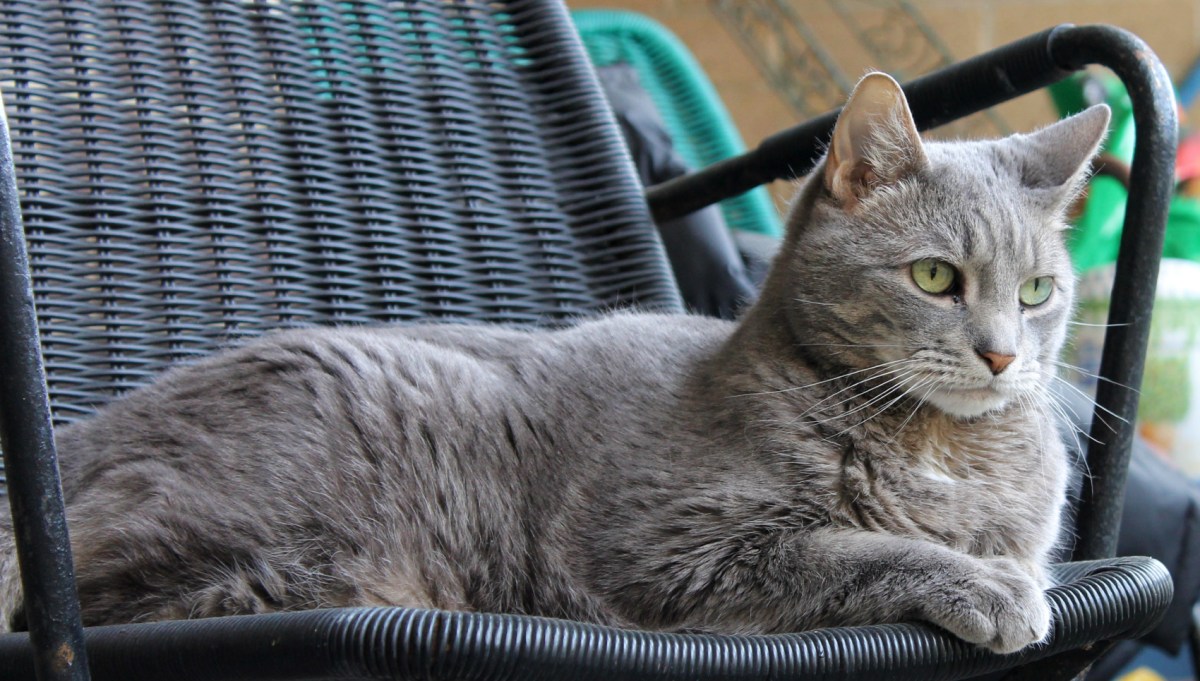
Buddy claims he’s a tiguar, not a domestic cat, and says allowing him outside is tantamount to Queen Daenerys allowing her dragons to roam the countryside in Game of Thrones.
Dear Buddy,
Dude. Everyone’s getting so uptight lately about making sure we stay inside. We’re predators! We should be running our neighborhoods, but no, our humans want to “protect” us.
As a famously fierce and ripped feline, what’s your take?
Frustrated in Fallbsurg
Dear Frustrated,
I empathize with you, I really do, but the way it was explained to me is that I’m a terrifying cat with huge meowscles, and by keeping me indoors, my human is protecting dogs, humans and other lower life forms from my potential wrath.
“Do they let tigers and jaguars run around New York?” Big Buddy asked me.
“Uh, no, I guess they don’t,” I said.
“Of course not. And that’s exactly why we can’t have you roaming the neighborhood. Think of the quandary Daenerys Targaryen had in Game of Thrones when her dragons were feasting on livestock from the farms of her subjects!”
And he’s right. A Buddy on the loose would cause all sorts of panic and other problems. I don’t want to be responsible for what happens when a bunch of humans freak out and go recklessly running in every direction, terrified I’m going to catch them.
If it takes sacrifice on my part to keep people comfortable, then I’m willing to endure the hardship of living indoors with a servant who heeds my every beck and call. It’s just the honorable thing to do.
Your friend, Buddy
Buddy the Tiguar
Dear Buddy,
Hey, pal! How have you been?
Friendly in Florida
Hey Friendly,
I’ve been handsome, how have you been?
Buddy
Dear Buddy,
You’re not a tiger! Or a jaguar! You’re a chubby, sedentary, spoiled house cat with an enabler of a human who encourages your delusions of being a powerful big cat!
Just stop already, it’s embarrassing!
Cringing In Connecticut
Dear Cringing,
First of all, I am a tiger/jaguar, or a tiguar if you will. I just haven’t hit my growth spurt yet. My human assures me it’s gonna happen.
I also asked my human if it’s true that he’s “an enabler” who encourages my supposed delusions. His response: “That’s absurd. Who’s a big, bad cat? You are, aren’t you? Yes, you are!”
So obviously you’re a hater and soon you’ll see me prowling the jungle with David Attenborough talking about how dangerous I am! Just wait!
The surprise announcement came from Colossal Biosciences, a company best known for its project to bring back the woolly mammoth.
A US biotech company shocked the world Monday when it announced the births of three dire wolf puppies, bringing back a species that hasn’t lived for more than ten millennia.
Or a version of that species, at least.
Scientists with Colossal Biosciences extracted DNA “from a 13,000 year old tooth and a 72,000 year old skull and made healthy dire wolf puppies,” Colossal CEO Ben Lamm said in a statement.
Of course, it wasn’t that simple.
The dire wolf, Aenocyon dirus, was heavier, stockier and had thicker fur than modern-day gray wolves. In addition, its bite was incredibly strong, generating more force than any living species of canid.
To create the dire wolf puppies, Colossal used the genomes reconstructed from the tooth and skull, spliced them with gray wolf DNA, and made 20 gene edits in 14 genes. Healthy embryos were implanted in three surrogates — large, mixed-breed dogs — and were successfully delivered.
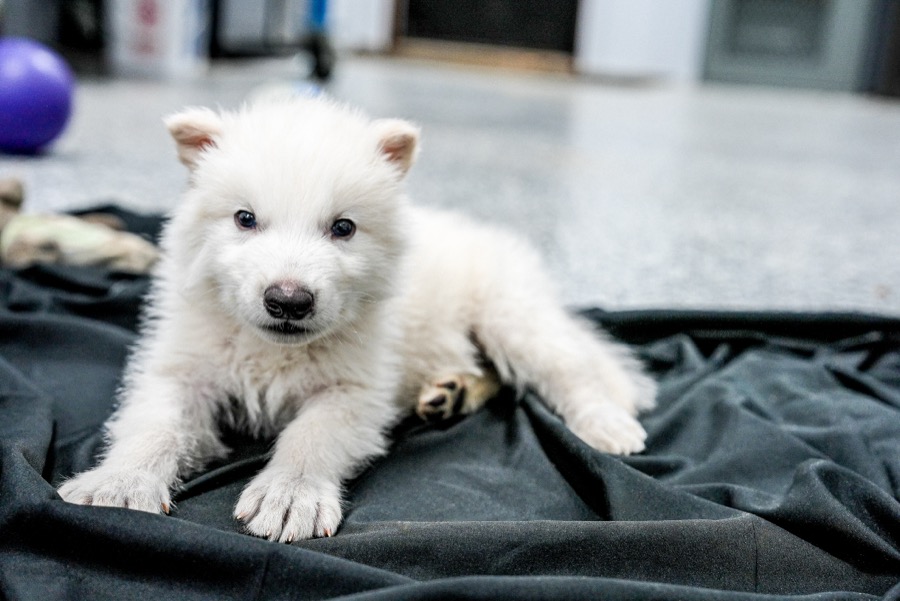
Romulus, one of two male dire wolf pups born late in 2024. Credit: Colossal BiosciencesRemus, who was born at the same time as Romulus. Credit: Colossal Biosciences
Whether the new puppies are officially dire wolves is up for debate and beyond the scope of this post, but just like humans and chimpanzees share 98.7 percent of their DNA, dire wolves and gray wolves share 99.5 percent of their DNA.
The species also existed concurrently with gray wolves and there was interbreeding between the populations, meaning gray wolves already have dire wolf lineage.
As a result, the puppies may be more dire wolf than some are willing to admit. Just how far a “de-extinction” project has to go for the animals to qualify as their namesakes will be debated for years, and there are innumerable questions for which we won’t have answers until the pups grow and scientists monitor their behavior in addition to their physical health.
They won’t behave precisely the way their ancestors did, since they are growing up in a captive environment with teams of specialists constantly monitoring them. The wolves are “essentially living the Ritz Carlton lifestyle of a wolf. They can’t get a splinter without us knowing about it,” Colossal’s chief science officer, Beth Shapiro, told the New York Times.
Whether bringing back dire wolves is a “good” thing is also a topic for another day, at least as far as this post goes. You may disagree, and feel free to say so in the comments, but this is a subject you could write half a library of books on, encompassing ecological, moral and philosophical questions that don’t have easy answers.
It’s made even more complex by the situation we find ourselves in, with our own behavior and relentless expansion killing off more than 70 percent of the world’s wildlife since 1970, according to the World Wildlife Fund. The company wants to use its technology to help critically endangered species, like the red fox, avoid extinction.
Colossal has partnered with leaders in the fields of genetics and bioethics, as well as organizations that specialize in animal welfare. The puppies are in a sizable, custom-built facility in an undisclosed location, secured by “zoo grade” barriers, and the company enlisted the help of the SPCA to create an environment appropriate for them. Colossal says their care regimen will include socialization and the development of pack dynamics.
A newborn dire wolf pup. Credit: Colossal Biosciences
The company has well-publicized projects to bring back woolly mammoths and the dodo, and ultimately, its founders say they want to restore balance in places where apex predators have been brought to extinction by human activity.
“This project demonstrates the awesome potential for advances in genetic engineering and reproductive technologies to recreate lost diversity,” Andrew Pask, a Colossal board member and professor of biosciences at the University of Melbourne, said in a statement. “Apex predators are critical to stabilizing entire ecosystems and their loss from the landscape can have profound impacts on biodiversity.”
The pups are named Romulus, Remus and Khaleesi. That last name is in homage to the character Daenerys Targaryen (Emilia Clarke) from the book series A Song of Ice and Fire, and Game of Thrones, the television adaptation. Dire wolves play a major part in the narrative, and the series is credited with bringing the long-extinct animals back into the popular imagination.
Jon Snow (Kit Harrington) discovers an orphaned dire wolf pup in the first season of Game of Thrones. The pup, who grows into a fierce and massive adult wolf named Ghost, plays a pivotal role in many major events in the series. Credit: HBOKhaleesi, a female dire wolf, named after the character Daenerys Targaryen from Game of Thrones. Credit: Colossal Biosciences





 Pain In The Bud