Under South Carolina law pets are considered property, and the maximum penalty for stealing someone’s beloved animal amounts to a slap on the wrist.
Another day, another story about a delivery driver stealing a cat.
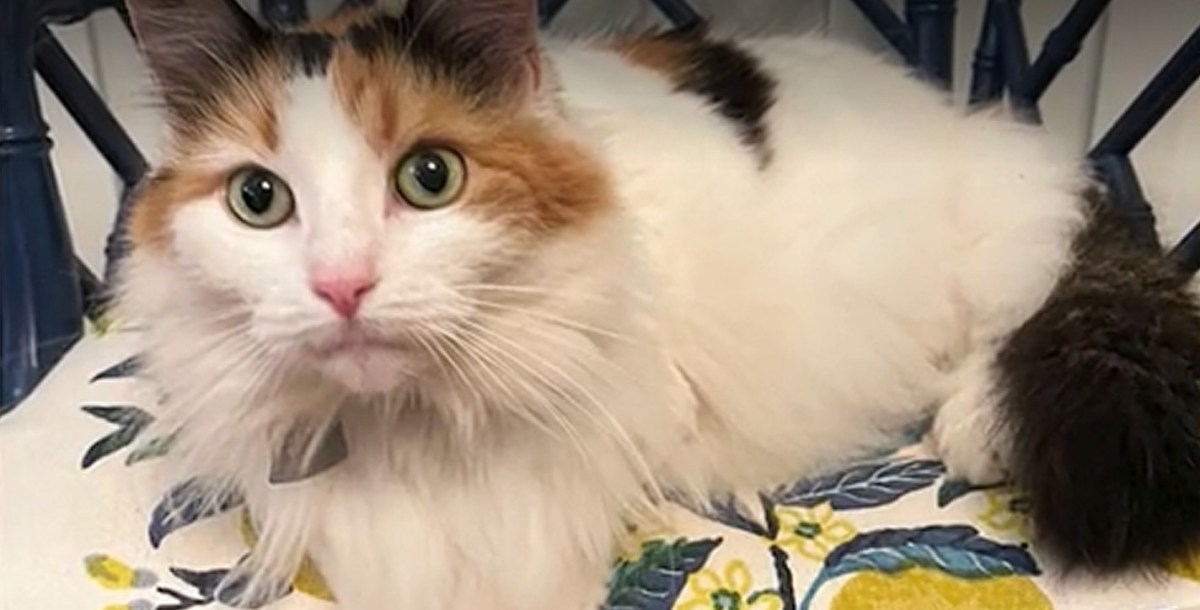
This time it happened in Charleston, South Carolina, and while local police worked quickly to identify the woman behind the wheel and arrest her, the feline is still missing.
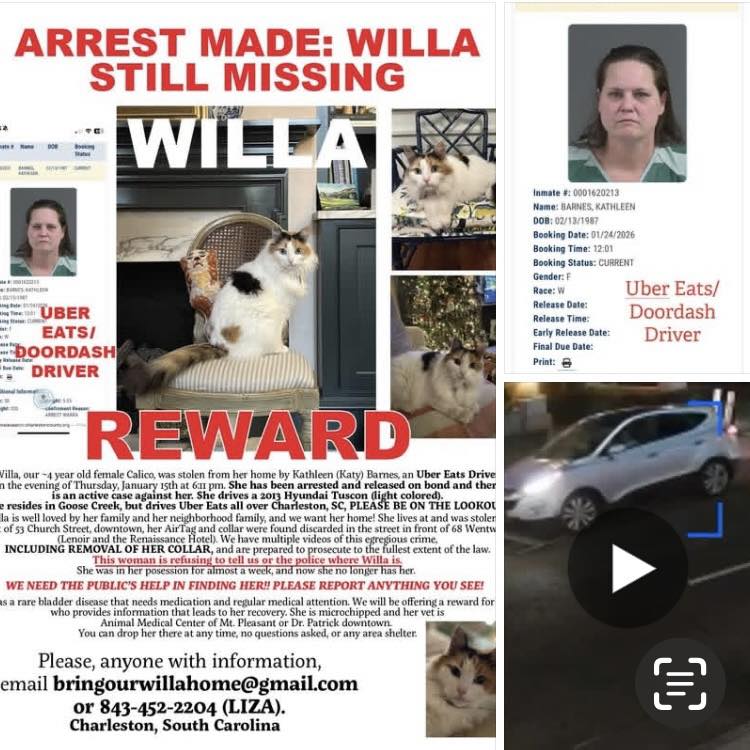
Daniel and Liza Layfield said they knew something was wrong on Jan. 15 when an AirTag attached to their cat’s collar showed she was several blocks away. After checking their own security camera footage and video captured by other cameras on the street, they saw a local food delivery driver stop her car, scoop up four-year-old Willa, then drive off with her.
The woman tossed Willa’s collar and AirTag nearby. Thankfully, police took the matter seriously and the local community helped spread the word, leading to a quick arrest.
The family is relying on help from the community to find Willa.
But there are two problems that are common to these thefts of opportunity: Willa is still missing, and the most severe charge police could lodge against the suspect is petty larceny. That’s a misdemeanor that carries light penalties (a fine and up to 30 days in county jail) on conviction. That’s not a deterrent.
We wrote about this problem just last week, when the quick recovery of a cat stolen by an Amazon delivery driver in the UK illustrated the difference a stronger law makes.
Stealing a pet in the UK can land the thief in prison for up to five years in addition to fines. Police are more likely to devote resources when the law gives them appropriate charges to file, and five years in prison would make most people think twice about impulsively stealing a family’s well-loved pet.
By contrast, most US states treat pets as property, meaning courts do not take into account their sentimental value, bond with their people, or trauma to animal and human when someone steals a pet. South Carolina is among those states: in that state’s penal code, petty larceny is a charge that applies when someone steals property worth less than $2,000.
The suspect, a DoorDash/Uber Eats driver, has not been helpful in the Layfield family’s efforts to find their feline family member. In the meantime, the family hopes a $1,000 reward will prompt someone to come forward, or that Willa turns up at a local shelter and has her microchip scanned.
“We want to find Willa, we want to know where she is. It’s going to be 20 degrees for the next several days,” Liza Layfield told the local NBC affiliate. “The idea of her being loose and on the run is horrific.”
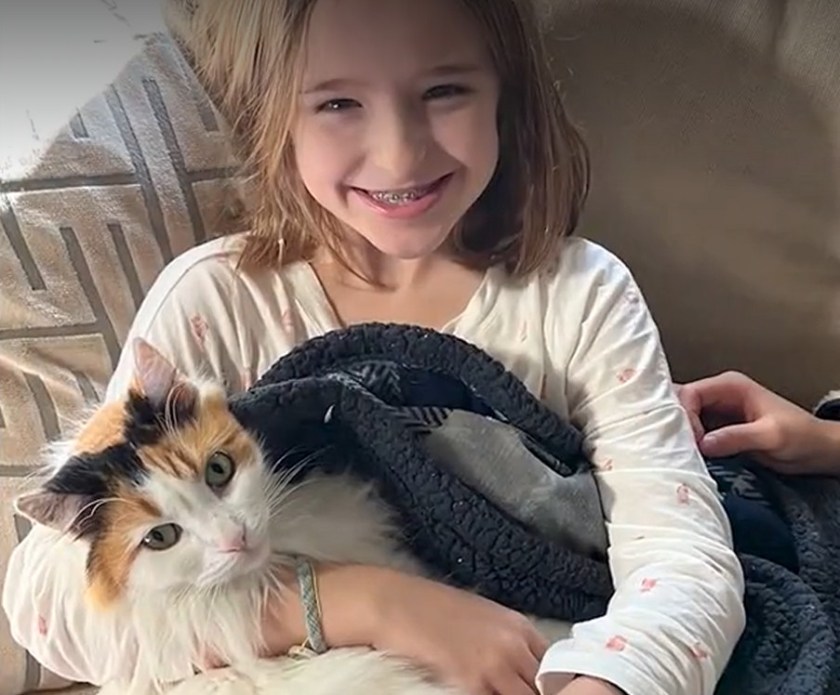
The Layfields’ daughter holding Willa, who has been missing since she was stolen on Jan. 15 by an Uber Eats/DoorDash driver.
PLUS: Today’s the deadline for UK residents to get their cats microchipped under a new law that levies a hefty fine for people who don’t comply.
Another day, another story about a person who can’t tell if the cat they’ve brought inside is their own or a random lookalike.
In this case, a woman named Amber Porter says her indoor-only cat bolted outside, and after a few hours she was able to bring him back in — only to have doubts about whether he’s actually her cat. Meanwhile, an identical-looking black cat is hovering around Porter’s home, and she’s trying to lure it inside.
“I’m still a little worried about it,” Porter said. “I have fully convinced myself I have the wrong cat but I also think I do have the right one.”
This absolutely blows my mind. If someone asked me how long it would take to determine if a gray tabby is Buddy, I’d say approximately half a second. It’s not because of his “bib,” that unique white tuft of hair on his chest, or his pronounced muzzle, although both would offer confirmation.
It’s his behavior, his mannerisms and movement, the fact that if we were separated, he’d meow loudly the second we’re reunited and I’d hear that familiar half-trill, half-meow he does that seems to be Buddesian for “Hello, servant!”
In any case, I hope Amber Porter figures out which cat is hers, and the story looks like it’ll have a happy ending because she says she intends to keep both cats.
Today’s the deadline to get your cats microchipped in the UK
A reminder to our British readers: today, June 10, is the deadline to have your cat microchipped under a new law that makes chips mandatory.
If you’re caught with an unchipped cat, the fine is a hefty £500, or about $635 in ‘Merican greenbacks. That’s some serious chop, so get your little buddy chipped!
“Chip me, human!” Credit: FOX/Pexels
Alice Potter, a cat welfare specialist with the RSPCA, told Sky News that microchips with up-to-date information are the biggest factor in reuniting cats with their humans when the former go missing.
“On average, 11% of all cats coming into the RSPCA’s care are still not microchipped. We’ve also rescued cats who have been microchipped but the details haven’t been kept up to date, which is arguably even more frustrating as it means cats spend a long time in our care whilst we fruitlessly try to contact the owner with out-of-date information,” Potter said.
“However, we’ve also seen countless stories of cats that have been reunited with their owners thanks to a tiny microchip – showing what this change of legislation will achieve for animal welfare.”
What does it mean to “own” a cat? If you believe a cat is neglected, can you take custody? As UK law changes, those questions need answers.
For the second time this week, two people are fighting over a cat after the original “owner” received a request from a microchip company to confirm another person’s claim on the feline.
Charlotte Sawyer of Swindon, a town in southwest England, told her local newspaper she was livid when she got the request to sign over her claim to one-year-old Oreo.
“I can’t believe the audacity of this person trying to steal our beautiful cat,” she told the Swindon Advertiser.
But Sawyer readily admitted Oreo was going out for days and sometimes weeks at a time before returning home, and she hasn’t seen him for four months now.
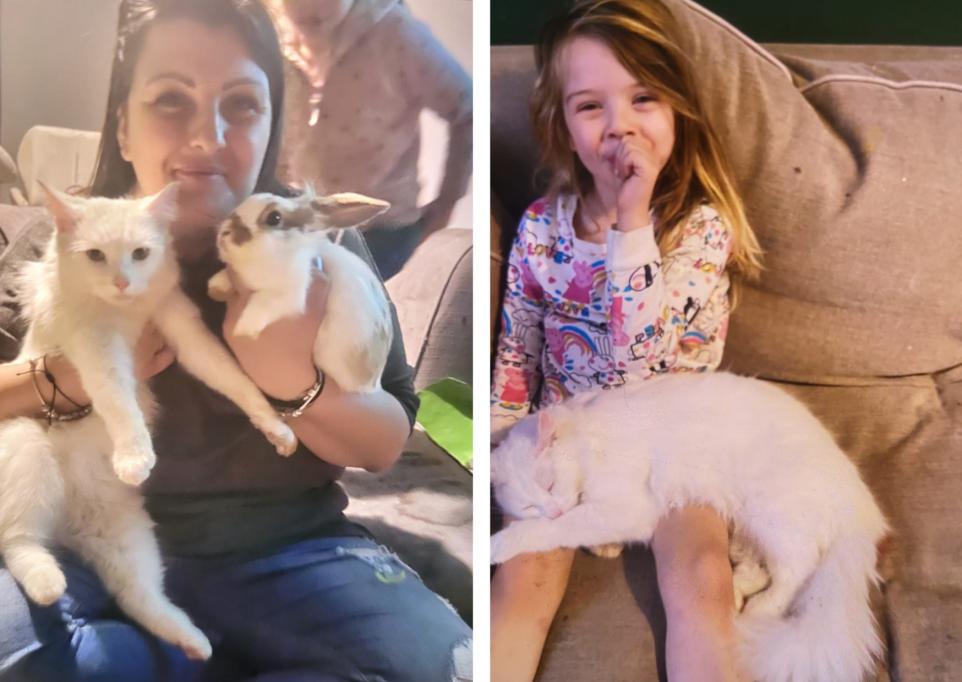
Charlotte Sawyer, left, with her cat Oreo and a pet rabbit. Sawyer’s daughter, right, with Oreo. Credit: Charlotte Sawyer via Swindon Advertiser
Like many cats in the UK, Oreo not only had access to the outdoors, he was accustomed to coming and going as he pleased. Other families were feeding him, and it’s likely he made the rounds among several houses before returning home. Because “home” is a nebulous concept in this instance, it’s not the first time someone has asked Sawyer to relinquish custody of Oreo.
“A woman claiming to be someone who looks for missing cats once knocked on my door and handed me a form asking for permission to change Oreo’s microchip,” Sawyer said. “I wanted to rip it up, I was furious, and told her he was my cat. Now it’s happened again. At least it’s provided some reassurance that he’s still alive.”
While I feel for anyone who loses a pet, I don’t know how someone who truly loves a cat can accept the kitty being gone for days or weeks at a time, not knowing if he’s in danger, hurt or still breathing. That kind of arrangement isn’t in the cat’s best interests, and it’s not compatible with our responsibility to ensure the welfare of our four-legged friends, an obligation all of us take on when we adopt our pets.
The people who encountered Oreo likely thought he was a stray or an abandoned former pet. If they’re requesting a change to microchip registration, it probably means they spent their own money to take the little guy to the vet, where the chip was discovered and scanned.
This is emphatically not a blanket criticism of UK norms regarding outdoor access, by the way. Americans cannot claim moral superiority. In the past week or so we’ve had a Pennsylvania man kill a cat with a blow dart because the feline “was trying to kill my birds,” a vulgar approximation of a human being in New Jersey “repeatedly raped” his pet cat before torturing her to death, and some deranged lunatic in Florida used a cat as target practice, leaving 30 pellets lodged in the innocent animal’s little body.
That represents a tiny fraction of the cat abuse stories from the last 10 days and I’ve omitted the worsted examples because I know we have readers who can’t handle this stuff. (I can’t either, which is why I paused my Google News alerts for most of the past two weeks.)
My point here is not to shock. It’s to underscore the fact that we have absolutely no moral authority when it comes to telling people in other countries how to care for animals.
A cat exploring outdoors. Credit: Openverse
Moral authority concerns aside, the two examples of ownership claims by microchip this week raise important questions about the definition of “ownership” and what it means to properly care for a cat.
Like many cat lovers I don’t like the term “owner” and I describe myself as a caretaker, but where the law is concerned, ownership is important concept because it determines who has claim over the animal. The law views cats and dogs as property, whether we like it or not. That’s why animal welfare statutes fall under agriculture and markets law in many US states instead of the criminal code, and it’s why so many of those laws need updating.
Cat culture across the Atlantic is different in that the majority of people who have cats believe our furry friends must have access to the outdoors to live a complete, fulfilled life. In the US, 63 percent of cat caretakers keep their felines strictly indoors, while in the UK it’s virtually the opposite, with 70 percent allowing cats to roam outdoors. Not all definitions of outdoor access are equal: Some people allow only supervised outdoor time in the backyard (or “garden”), some make sure their kitties are safely indoors by nightfall, while others have cats who return at their own whim.
There are also differences regarding geography, traffic density, the prevalence of natural predators and the nature of city life that account for how much outdoor access they allow their cats.
As the UK sets a June 2024 date for the mandatory microchipping of pet cats, disputes like this are going to become more common, which means people would be wise to make sure their cats’ microchips have up-to-date information and have readily available proof that they own their felines. If cat owners don’t establish the criteria for what it means to “own” a feline, the government will.


 Pain In The Bud