Or if your sense of humor tends toward the scatological, you can donate to put your ex’s name on a litter box.
Like other nonprofits, animal shelters face steep competition when it comes to scoring charitable donations, so the more a shelter can stand out, the better.
For some that means stories about their rescues and pets-in-waiting going viral. For others, it means finding clever ways to use occasions like Valentine’s Day to raise money.
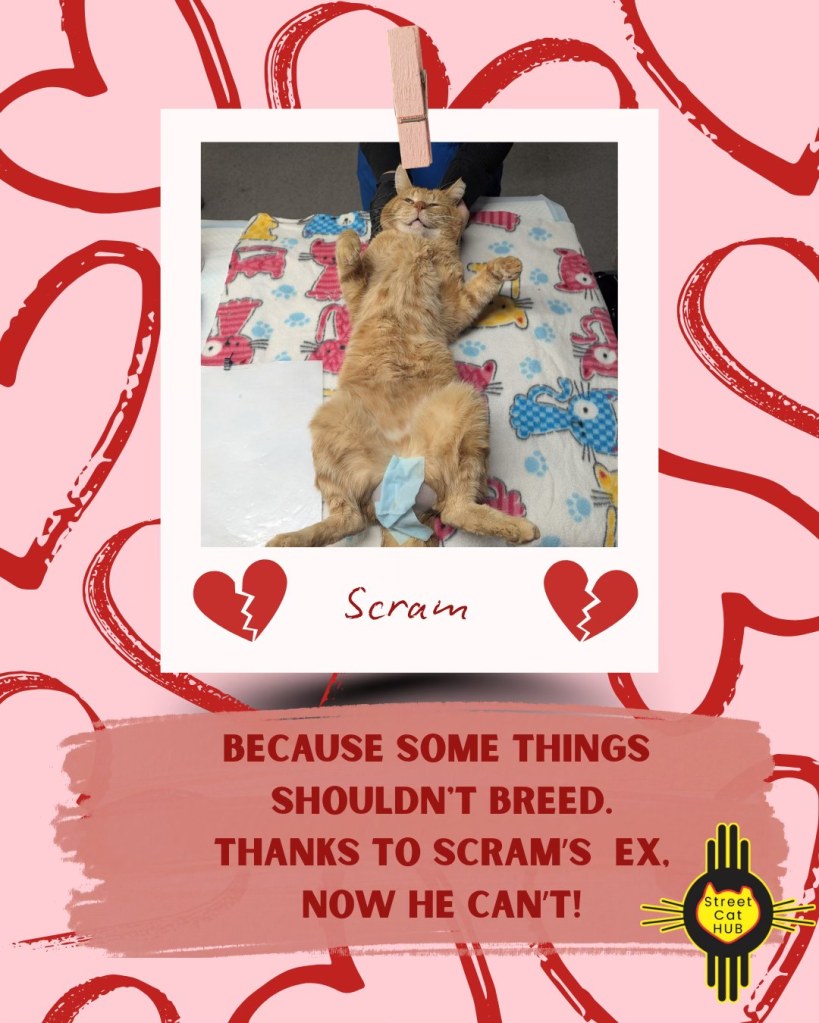
One of the latest fads involves making a donation to pay for spay/neuter surgery for a street or shelter cat — and having the cat named after your ex. As one shelter puts it, “because some things shouldn’t breed.”
Poor Scram has no idea he’s a stand-in for a despised ex.
If the idea of castrating an ex seems a little morbid to you, you’ve still got options.
For just $5, Albuquerque, New Mexico’s Nine Lives Shelter will write your ex’s name on a litter box.
“Our foster cats and kittens will handle the rest by doing what they do best,” the shelter’s staff wrote on Facebook.
Of course, there’s another option for people who prefer a more positive take: donating out of love for cats in general, because despite the encouraging drop in animal euthanasia over the past two decades — the result of relentless campaigns to get pets and street cats spayed/neutered — a few hundred thousand cats are put down every year. Every time a cat is fixed, that number drops, and existing cats have a better chance of finding forever homes.
Amazon says it has identified the driver who stole a California woman’s cat and is working with local police, but they still haven’t recovered the beloved pet.
You’d think it would be relatively trivial to reunite a woman with her cat after an Amazon delivery driver stole the kitty on Dec. 11.
After all, the victim’s own Amazon Ring camera system captured video of the driver walking away with Piper the cat after dropping off a package. Amazon knows precisely who the driver is, where he lives and how to contact him, because he’s a contractor for the company.
And it’s difficult to imagine how it would stretch the resources of the Lakewood (California) Sheriff’s Department to send a deputy out to arrest the guy and retrieve the cat.
The driver picks Piper up by the scruff of her neck, which could cause serious injury in an adult cat.
This wasn’t a high stakes heist by pros with a plan to disappear.
It was a local delivery driver who made an impulsive decision to steal a cat from a customer.
Do the police really think the man is hiding out in a local motel with the shades down and the cat tied to a chair, cutting out letters from a magazine for a ransome note?
Getting Piper back matters very much to Diane Huff Medina and her children, who miss the chatty Siamese mix.
It doesn’t matter at all to the police or to Amazon, which finally issued a statement calling the theft a “horrible act” and saying it was cooperating with police.
“The Amazon Flex delivery partner in question is no longer eligible to deliver to our customers,” an Amazon spokesman said.
That doesn’t help Diane Huff-Medina get Piper back, nor does it help her reassure her children that the feline, who has been with the family for six years, will be returned unharmed.
“Every day they ask, ‘Is she back yet?’ It’s hard to tell them,”Huff-Medina told local media this week.
In our last post, we noted that in cases where people were reunited with their pets, they did not wait for Amazon or the police to act. Neither has the same sense of urgency as an animal’s own family, and unfortunately police are often reluctant to devote time or manpower to these cases because pets are considered property. When the most severe potential charge is petty larceny — which takes into account a cat or dog’s monetary value, but not its emotional value — stolen pets are considered minor crimes.
Huff-Medina has done well to shame Amazon and local police by going to the media and getting Piper’s story out there. We hope she gets good news soon.
Amazon has not been helpful when its drivers have stolen pets from customers, treating the incidents as customer service issues.
A woman in California is in a panic after her cat went missing and her home security cameras showed an Amazon driver carrying the kitty away.
Diane Huff-Medina’s footage shows a driver bending down to pet her cat, Piper, during a delivery this weekend. After delivering the package, the Ring camera footage shows, the driver grabbed Piper on the way out, put her in his vehicle and drove off.
“I thought he was just petting her for a second, but yeah … I had to rewatch it a couple of times because it is hard to see, it’s dark, and he doesn’t carry her very nicely,” Huff-Medina told LA’s KABC. “I see her little tail and I was like, ‘Oh my God.’ I couldn’t believe what I was seeing.”
Piper the cat. Credit: Diane Huff-Medina
Unfortunately incidents like this seem to happen regularly, and Amazon continues to fall woefully short when it comes to handling them and helping reunited their customers with their pets.
In an incident from last year when one of the company’s drivers stole Feefee, a cat belonging to the Ishak family of Everett, Washington, Amazon’s customer service representatives told the family the company could not force the woman to return the cat, and refused to give the woman’s address or even her general neighborhood to the family so they could search for Feefee.
In a similar incident from August, an Amazon driver stole Murphy, a cat belonging to Kathy Souza from Massachusetts. While Souza thankfully was reunited with Murphy, Amazon was not helpful, she said.
“I spoke with someone at Amazon who asked, ‘Is the cat worth more or less than $200?’” Souza wrote incredulously on Facebook while Murphy was still missing.
Credit: Diane Huff-Medina
This time, an Amazon rep told Huff-Medina they’d identified the driver, but couldn’t get in touch with him.
It’s amazing that after all these incidents, Amazon still treats the theft of cats and dogs by their delivery drivers as a customer service issue, and seems to have no standard protocol for working with law enforcement to get the animals returned.
Indeed, there’s one common thread to all the stories that end happily — in those cases the victims did everything they could to find their pets and did not wait for Amazon or local police to take the thefts seriously.
In the Ishak family’s case, they spent several days posting flyers, talking to local media and driving around in a widening circle to look for the car they’d seen on their doorbell camera. That’s ultimately how they found Feefee: instead of surrendering the scared feline as she told Amazon she would, the driver simply dumped Feefee outside her own building. The Ishaks found Feefee scared and hungry, hiding in the bushes outside the driver’s apartment complex, but otherwise unharmed.
In Souza’s case, her relentless efforts to make noise and draw attention to the driver and Amazon ultimately prompted the driver to return Murphy.
So we’re hoping Huff-Medina takes a similar route, because unfortunately these cases are not a priority for the corporate behemoth, nor for local police, as most state laws consider pets property, and stealing a pet is considered a small time crime. Let’s hope there’s good news soon.
In disrupting another industry, AI has moved into a realm where its use has physical consequences.
I’d planned on taking a break and easing up on posts after the glut of cat-related news the past few days, but this story is disturbing, timely, and sadly we’ll almost certainly hear about more of these incidents in the near future.
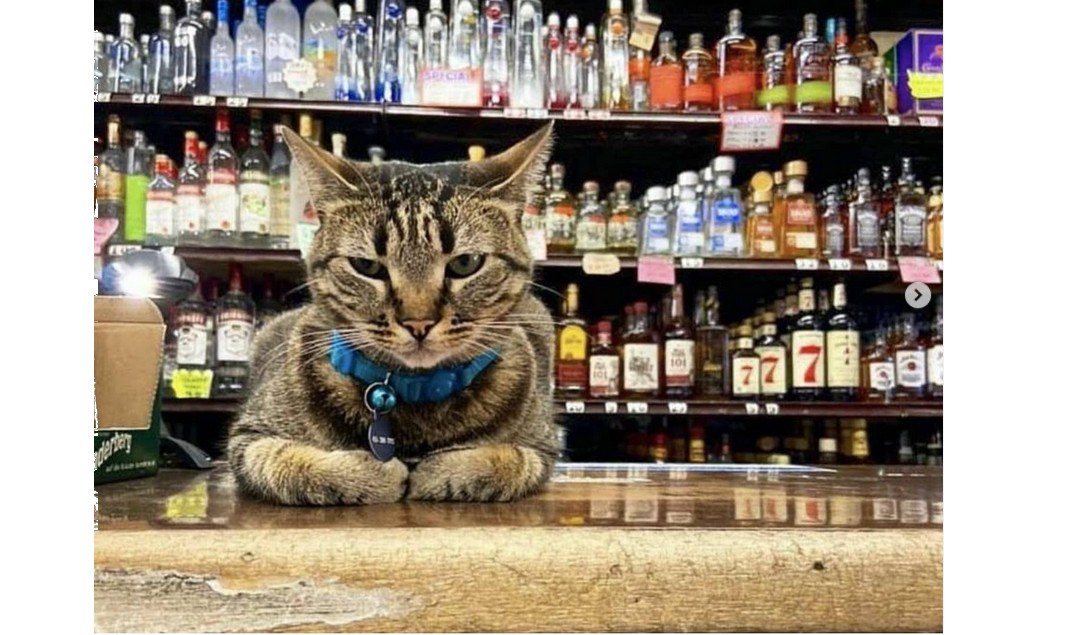
KitKat, a nine-year-old tabby who called Randa’s Liquor Store in San Francisco’s Mission District home, was killed late Monday night by a vehicle owned by Waymo, an autonomous ride-hailing service.
Witnesses said they saw the Waymo hit the cat and pulled him out from under the self-driving car. They say KitKat was sitting on the sidewalk at the time. It’s not clear if the Waymo vehicle drove up onto the sidewalk or if its bumper was the impact point.
A witness who filed a report with 311 via smartphone said the Waymo vehicle “did not even try to stop.” The car continued on to its next pickup.
Several people rushed the injured tabby to a 24-hour emergency veterinary clinic, but his injuries were too severe and he died five minutes before his human arrived.
KitKat was extremely popular with people in the neighborhood, patrons of the neighboring bar and sandwich shop, and passersby. They described him as a feline who liked to patrol the sidewalk and pop into the bar and sandwich shop to “supervise,” making sure all was well in his little realm.
“Everyone’s heartbroken,” Jessica Chapdelaine, who tends bar next door and lives in an apartment above the liquor store, told Mission Local. “He’s the baby. He was everyone’s best friend and he was just the sweetest boy.”
Waymo didn’t respond to requests for comment by Mission Local, TheSFist and other media. The Google-owned company had not addressed the incident on its website’s press page, nor on its X account despite several users bringing it up, as of Thursday morning.
“You can’t even drive in the dark in normal weather without killing a cat,” one user wrote, while others weren’t nearly as diplomatic.
The San Francisco Standard provides a bit of context on the autonomous vehicle issue in California:
“The state had logged 884 autonomous vehicle collision reports as of Friday, according to the Department of Motor Vehicles (opens in new tab). A dog was struck and killed by a Waymo in Bernal Heights in 2023. A week later, a Labrador survived getting hit by a Cruise self-driving car; the company no longer tests its cars in San Francisco.”
On the other hand, there have been several dramatic incidents involving autonomous vehicles that have successfully avoided collisions with other cars, people and animals, even when given a fraction of a second to respond. In an incident in LA from earlier this year, a home security camera caught footage of a Waymo stopping instantly to avoid a dog that ran out into the street directly in the car’s path:
A human driver almost certainly could not make a safe decision in that time interval, but a machine can confirm there is no car immediately behind it and execute the stop within a few milliseconds.
Still, as more ride hailing services roll out autonomous fleets and expand into more cities — as the major players in the still-developing industry are already doing — this will become more of an issue. Waymo operates fleets in San Francisco, Los Angeles, Phoenix, Austin (TX) and Atlanta, and plans to roll out its service in Miami and Washington, D.C., in the near future.
The obvious question is whether AI-driven vehicles are safer than cars with people behind the wheel, for drivers and pedestrians. The answer seems to be yes, especially as the technology improves. Machines don’t text while driving, don’t get distracted fiddling with radios and don’t get behind the wheel after drinking. Sensors and software have improved dramatically in just a few years.
But that won’t be enough. There’s a psychological hurdle in giving up control. It’s the same reason why so many people are terrified of flying even though we’re statistically much more likely to die in car collisions. When you’re behind the wheel, you have control over your fate — or the illusion of control, anyway.
A close-up shot of hardware and some of the sensors on the Jaguar I-PACE Waymo autonomous vehicle. Credit: Waymo
Parallel to the questions about safety are concerns about whether any corporation should be permitted to put driverless cars on the road, especially when the companies with the resources to commit to a major venture like this are the familiar Big Tech conglomerates run by the same handful of tech oligarchs.
Should they be allowed to wipe out yet another industry, taking away work from people who drive taxis or for rideshare companies? Do we need the government to step in and place some guiderails on tech that has developed at an unprecedented pace and threatens to upend huge swaths of society? Should we demand a much more robust regulatory process and risk falling behind other countries in the AI race?
These are questions we’ll all have to grapple with, and there are no easy answers.
This is just one reason why animal advocates are not fond of breeders.
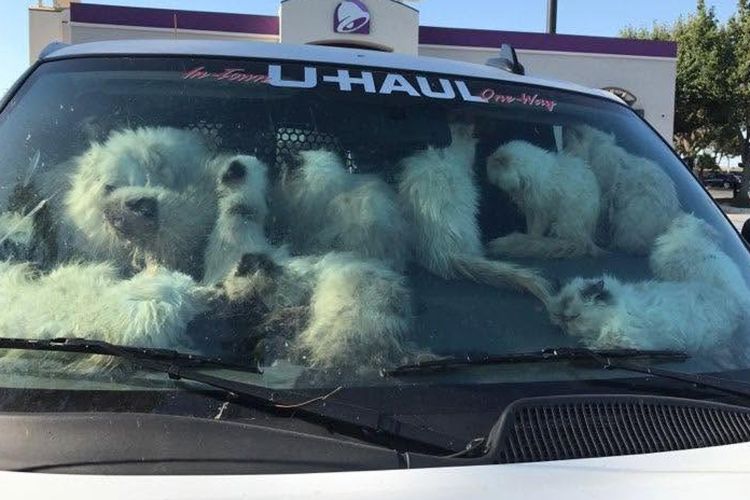
A California woman faces animal cruelty charges after police say she abandoned 134 cats in a U-Haul van without food or water in the sweltering summer heat.
The cats, ranging in age from a week to eight years old, have been removed from the van and the 106 survivors, described as “extremely emaciated,” are receiving veterinary treatment at the Merced County Animal Shelter, according to the Merced County Sheriff’s Office.
Jeannie Maxon/Facebook
A deputy found the van at 5:30 p.m. on Sunday in Santa Nella, a small town about 40 miles south of Modesto. The cats were stuffed in the U-Haul, which was left in a Taco Bell parking lot, and about 20 of them had taken up spots on the dashboard, center console and driver’s seat.
Jeannie Maxon, a 69-year-old woman from Long Beach, Calif., was charged with 93 counts of animal cruelty.
Maxon is the owner of a cat breeding business called Magicattery, which she’s touted on her personal Facebook page and an Instagram page specifically dedicated to the breeding operation. A separate site on its own domain remained up as of Tuesday evening and says the breeding operation specializes in Persian and Himalayan kittens.
A screenshot of Maxon’s Instagram page for her breeding business.
Many of the cats and kittens are dressed up, wrapped in pearls and ribbons, and posted with accessories in the photographs Maxon shared on social media. Maxon was active on Facebook and Instagram until late 2024, according to her visible public activity on both sites.
It’s not clear why she abandoned the cats. California does not have a state licensing system for breeders, but individual towns and cities may require breeders to obtain a license.
It wasn’t immediately clear if Maxon had retained an attorney.
Merced County Animal Shelter said in a Facebook post that the cats will be put up for adoption once they’re all stabilized and receive proper veterinary care.
The cats were found in extremely poor condition and were described as “severely emaciated” by police. They were abandoned without food or water. Credit: Merced County Sheriff’s Office









 Pain In The Bud