Scientists Finally Figure Out Why Some Cats Are Orange, PLUS: Are Street Cats Really ‘Taking Over?’

More Americans say they can’t afford to keep their cats because of inflation, leading to an increase in surrendered and dumped cats in some places.

More than 110 years ago, American geneticist Clarence Cook Little developed a theory explaining why some cats have orange coloring and some don’t.

Now Little has been proven correct thanks to the work of separate teams in Japan and the US, which discovered the mechanism that leads to orange coloring, including fully ginger felines as well as calicos and tortoiseshells.

The explanation may be a bit too heavy on genetics for some readers, but essentially the researchers found the specific gene that leads to the growth or orange fur. They’ve known about the gene for a long time, but didn’t realize the totality of its function. Its official name is ARHGAP36, but for the sake of simplicity, scientists are calling it “the orange gene.”

“The orange gene has a known role in hair follicle development, but scientists didn’t previously know it is also involved in pigment production,” a team of geneticists and biotechnologists wrote in The Conversation, a science publication. “This means that a new pathway for pigment production has been discovered, opening the way for exciting and important research into a basic biological process.”

calico cat relaxing on wooden bench outdoors
In partially orange cats like calicos and tortoiseshells, the blotches of color are the result of imperfect gene copies and a secondary pigment-related gene switching “on and off.” Credit: Mehmet Guzel/Pexels

Ginger cats are usually male, but the pigmant can also appear in female cats due to an error in gene copying which deletes one segment of the orange pigment-producing genetic code.

That’s why calicos and tortoiseshells have orange blotches or mixed orange fur. “[T]he orange gene is persistently switched on in orange areas but is mostly switched off in non-orange areas of a cat’s coat,” the authors wrote.

Are there more strays in 2024?

Time magazine has a story examining the problem of stray cats in America’s urban and suburban population centers, why it’s happening, and what can be done about it.

First, might as well get this out of the way: We don’t know if there are “more” cats. The claim that there are more relies on anecdotes, and there’s no hard data to back that up. You have to be highly motivated to invest the time and money into a proper census like the D.C. Cat Count, and it’s an understatement to say most towns and cities are either not willing to do that, or don’t have the resources.

What we do know is there may be more cats in certain areas, with individual shelters in some places reporting record numbers of surrenders and cats scooped up by animal control.

close up of a stray cat on the metal railing
Rescuers say people who can’t afford food, supplies and veterinary care are surrendering or dumping their cats in larger numbers than in years past. Credit: Dou011fu Tunce/Pexels

The story quotes rescuers who say they’ve seen more surrendered pets, as well as data from Shelter Animals Count, which tallies self-reported information from shelters and rescues. The latter says 32 percent of cats taken in were owner surrenders in 2024, compared to 30.5 percent in 2019.

“It’s a combination of people surrendering their pets and people not adopting because they’re not sure they can take on the financial commitment,” Animal Care Centers of NYC’s Katy Hansen told Time.

Rescuers say that’s reflected in their experiences trapping the felines, who are friendly and acclimated to humans.

The people surrendering their pets cite inflation, not only impacting the cost of essentials like food and litter, but also more expensive veterinary care.

The story additionally includes this eye-popping detail:

“At Veterinary Care Group, a private equity-owned practice in Brooklyn, the cost of spaying or neutering a cat has soared to $850 per animal. By contrast, at the nonprofit veterinary clinic Zweigart recently founded in Brooklyn, the cost of spaying or neutering a cat is $225 and a mid-sized dog is $300.”

The lesson here: Steer well clear of veterinary clinics that aren’t vet-owned or are obtuse about their ownership. Private equity groups don’t buy clinics out of love for animals.

a close up shot of a tabby cat
The cost of spay/neuter procedures ranges dramatically at different veterinary practices. Credit: Tima Miroshnichenko/Pexels

As for solutions to local spikes in stray populations, the story doesn’t offer any. It mentions TNR (trap, neuter, return) but only in the context of a lawsuit against the San Diego Humane Society for its neuter/vaccination program.

That said, there probably isn’t a one-size-fits-all technique. What works for a small town won’t necessarily work in a city, and there are dozens of factors that could influence the prevalence of stray cats and colonies. Still, city councils and town boards don’t need to reinvent the wheel. Chances are if they look, they’ll find a municipality similar to their own where locals have successfully stabilized feline populations.

As for the Buddies, I’d live in my car before giving Bud up. He wouldn’t be thrilled about that situation, and we’d have to head south because the winters here are brutal, but as long as Bud has his servant, he’s good.

A previous version of this post incorrectly described cat chromosomes. The story has been updated to remove the error.

Paleontologists Recover Shockingly Intact Saber-Toothed Kitten Buried For 35,000 Years

The find is extraordinary, allowing scientists to directly study the extinct cat’s musculature, fur, head shape, and even its claws and whiskers.

A team in Russia stumbled on the find of the century when they located the stunningly well-preserved remains of a saber-toothed kitten in Siberia.

The kitten, which was found near the Badyarikha River in northeastern Siberia, was about three weeks old when it died, scientists estimate.

Unlike typical finds — a fang here, a mandible or partial skeleton there — this specimen still had its fur, claws, whiskers and muscles, which means scientists have already learned more about the species, Homotherium latidens, than they have with almost any other long-extinct animal.

homotheriumpawpads
Images of the extinct cub’s paws compared to (D), the paw of a 3-week-old lion cub pictured on the bottom right. The Homotherium paw is thicker but less elongated. Credit: Borissiak Paleontological Institute, Russian Academy of Sciences, Moscow, Russia

While the saber-toothed cub is a true felid, it boasts adaptations unlike any surviving member of the panthera genus.

It has wide paws wrapped in heavy fur, a short tail and a stockier, lower-to-the-ground build than modern lions and tigers. Those adaptations, scientists believe, made it easier for Homotherium latidens to traverse environments with ice and heavy snow.

Its head shape is slightly different, with smaller ears than modern big cats, and its neck is enormous, more than twice as thick as the neck of a comparable three-week-old lion cub which was used for comparison. Likewise, its mouth is capable of opening significantly wider, although the team did not compare it to the jaguar, which has the widest-opening jaw among extant felids.

Homotherium cub
A photograph of the cub, top, and a scan revealing facial, ear and neck structure, below. Credit: Borissiak Paleontological Institute, Russian Academy of Sciences, Moscow, Russia

The frigid, arid clime of Siberia made it possible for the cub’s body to endure for so long. The team that made the discovery conducted radiocarbon dating that puts the cat at between 35,000 and 37,000 years old, according to reports.

It’s not clear how the cub died, although its species went extinct about 10,000 years ago, likely as a direct result of fewer prey animals in the frigid zones it occupied. Additional bones belonging to the rear of the cub skeleton were encased in a large cube of ice immediately next to the intact upper body.

The cub’s remains were recovered in 2020, but the results of the research team’s analysis were just released on Nov. 14 and published in the journal Nature. The paper’s authors have a lot more to share about the species’ physical characteristics, they noted in the text, and plan to follow up soon with a second paper going into more detail about what they learned from the cat’s intact musculature.

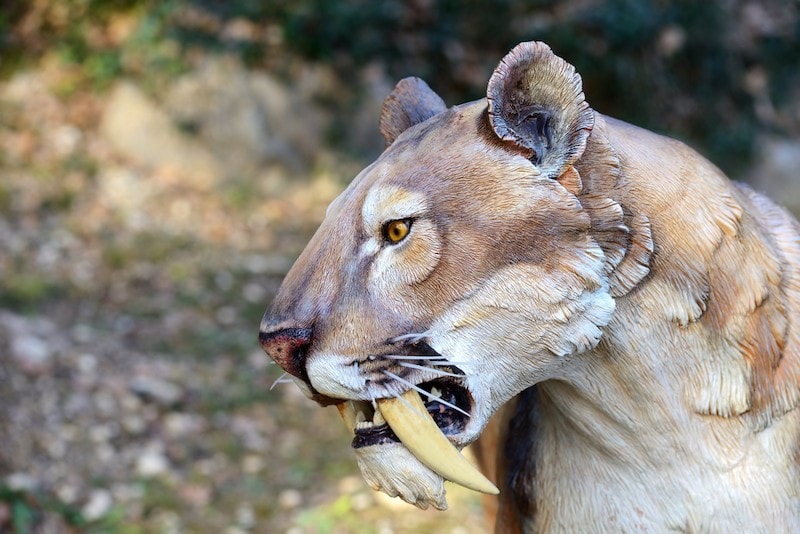
Top image: An artist’s impression of an adult member of homotherium.

Homotherium cub
Credit: Borissiak Paleontological Institute, Russian Academy of Sciences, Moscow, Russia

Tribe Discovers Ancient Three-Toed Cat’s Fossilized Footprint Deep In Forest

The strange footprint may date back as far as 35 million years ago, according to a preliminary analysis.

Before house cats, tigers and lions, before sabretooth cats and their scimitar-toothed relatives, Pseudaelurus (pseudo-cat) stalked the forests and plains of Europe, Asia and North America between eight and 20 million years ago.

Before Pseudaelurus, Proailurus — an animal whose name literally means “before cats” — stalked the Earth beginning 30 million years in the past.

Proailurus was thought to be the earliest true feliform ancestor, but now there may be evidence of a felid or feliform animal that predates both Proailurus and Pseudaelurus. Feliform is a term that encompasses cat-like creatures both extinct and extant, from familiar felines to civets and mongoose.

Deep in South India’s Nallamala Forest, near one of the country’s largest tiger reserves, members of the aboriginal Chenchu tribe found a fossil that could put the cat lineage back even further.

The fossil is well-preserved and clearly defined, made by an animal whose paw was about the size of an adult man’s hand. It bears a striking resemblance to tiger pug marks, but perhaps the most striking feature is its three toes.

Feliform fossil
The recently discovered fossil. Credit: Times of India

“Based on the distinctive characteristics of the sandstone, identified as the Cuddapah subgroup Quartzitic sandstone, the estimated rock’s age is approximately 35 million years,” archaeologist Arun Vasireddy told the Times of India. “It was around this time that sandstones were formed and it is likely that the animal would have cast its prints.”

Biologists have had to reshuffle their picture of felid lineage many times over the past century and a half as new discoveries uncover previously unknown species of cats and cat-like creatures. Since they first appeared, cats have taken hundreds of different forms with significant variations in size, appearance, hunting methods and preferred terrain.

The experts aren’t popping the champagne yet. There’s a lot more work to do before they can declare a newly-discovered species or even offer more than educated guesses about its niche and appearance.

Nallamala Forest may yet hold more secrets, and research teams will look for additional prints as well as potential remains. It’s a process that will unfold over years and decades, perhaps even longer.

Still, it’s a tantalizing clue about the past and the origin of some of Earth’s most iconic animals.

In the meantime, Vasireddy said, “nothing can be said clearly until further research.”

Homotherium_serum
A reconstruction of Homotherium, a scimitar-tooth cat that first appeared about four million years ago. Credit: Wikimedia Commons
OLYMPUS DIGITAL CAMERA
Styriofelis lorteti predates modern pantherine cats and was the size of a small leopard. Credit: Spanish National Research Council and the National Museum of Natural Sciences in Madrid
Fossil foot
The recently-discovered fossil compared to a man’s foot. Credit: Times of India

The New York Times Is Back To Spread Misinformation About Cats

Protecting birds from extinction will take a lot more than passing laws requiring people to keep their cats indoors.

Prompted by the recent news that Polish scientists have added cats to a list of invasive alien species, the New York Times ran an enterprise story on Tuesday titled “The Outdoor Cat: Neighborhood Mascot Or Menace?”

I’m highly critical of print media stories on animals because I’ve been a journalist for almost my entire career, and I know when a reporter has done her homework and when she hasn’t. Unfortunately it looks like Maria Cramer, author of the Times story, hasn’t.

Her story identifies the stray cats of Istanbul as “ferals,” cites bunk studies — including meta-analyses based on suspect data — and misrepresents a biologist’s solutions “to adopt feral cats, have them spayed or neutered and domesticate them.”

Doubtless the biologist understands cats are domesticated, but Cramer apparently does not, and her story misrepresents the domestication process.

Individual animals can’t be domesticated. Only species can. It’s a long, agonizingly slow process that involves changes at the genetic level that occur over many generations. Domestication accounts for physical changes (dogs developing floppy ears while their wolf ancestors have rigid ears, for example) and temperamental ones. A hallmark of domestication is the adjustment to coexisting with humans.

agriculture animal beautiful cat
Photo by Pixabay on Pexels.com

In other words, if cats were wild animals it would take hundreds of years to fully domesticate them, and I’m sure no one’s suggesting we wait hundreds of years to solve the free-ranging cat problem.

Ferals can be “tamed,” but the majority of cats living in proximity to humans are strays, not ferals. The difference? Strays are socialized to humans and will live among us, while ferals are not and will not. Strays can be captured and adopted. In most cases ferals can’t, and the best we can hope for is that they become barn cats.

To her credit, Cramer does make efforts to balance the story and quotes the Royal Society for the Protection of Birds in the U.K., which places the majority of the blame squarely at the feet of humans, noting “the decline in bird populations has been caused primarily by man-made problems such as climate change, pollution and agricultural management.”

Even our structures kill billions of birds a year. That’s the estimated toll just from the mirrored surfaces of skyscrapers, and no one’s suggesting we stop building skyscrapers.

Indeed, Saudi Crown Prince Mohammed bin Salman al Saud (MBS), the de facto ruler of Saudi Araba, has been busy commissioning science fiction city designs when he’s not murdering journalists critical of his policies. The design he’s chosen for his ultra-ambitious future city, which he hopes will rival the pyramids in terms of lasting monuments to humanity’s greatness, is a 100-mile-long mirrored megacity called Neom, which is Arabic for “Dystopian Bird Hell.” (Okay, we made that up. Couldn’t resist.)

Take a look:

The point is, of the many factors driving bird extinction, humans are responsible for the majority of them, and if we want to save birds we have to do more than bring cats inside. Additionally, sloppy research portraying cats as the primary reason for bird extinction has resulted in cruel policies, like Australia’s effort to kill two million cats by air-dropping poisoned sausages across the country.

This blog has always taken the position that keeping cats indoors is the smart play, and it’s win-win: It protects cats from the many dangers of the outdoors (predators like coyotes and mountain lions, fights with other neighborhood cats, diseases, intentional harm at the hands of disturbed humans, getting run over by vehicles), ensures they’re not killing small animals, and placates conservationists.

At the same time, we don’t demonize people who allow their cats to roam free, and we recognize attitudes vary widely in different countries. Indeed, as the Times notes, 81 percent of pet cats are kept indoors in the US, while 74 percent of cat caretakers allow their pets to roam in the U.K.

We have readers and friends in the U.K., and we wouldn’t dream of telling them what to do, or suggest they’re bad people for letting their cats out.

Ultimately, tackling the problem depends on getting a real baseline, which Washington, D.C. did with its Cat Count. The organizers of that multi-year effort brought together cat lovers, bird lovers, conservationists and scientists to get the job done, and it’s already paying off with new insights that will help shape effective policies. To help others, they’ve created a toolkit explaining in detail how they conducted their feline census and how to implement it elsewhere.

Every community would do well — and do right by cats and birds — by following D.C.’s lead.