Located in modern-day Jordan and accessible via a winding path through its sandstone formations, Petra is one of the most fascinating and mysterious sites on Earth.
Known as the Rose City for the color of the timeless sandstone it was carved from, Petra is one of the oldest known human settlements, with its first inhabitants claiming the site as far back as 7,000 BC.
Petra’s iconic carved structures date back almost 2,000 years to the construction of Al-Khazneh, an Arabic name that means “the treasury.” It was actually a mausoleum and meeting place for the Nabataeans, an ancient Arab people whose kingdom existed in what is now present-day Jordan.
The Treasury is a misnomer that was bestowed on the rock-hewn building centuries later, when legends claimed priceless treasures were sealed within. Today, visitors can see bullet holes in the stone from raiders who thought the structure would shatter, leading to an avalanche of gold pouring from the cracks opened by their firearms.
Petra is a UNESCO World Heritage site and is one of the 7 Wonders of the New World. It may be most familiar to movie fans as the site of key scenes in 1989’s Indiana Jones and the Last Crusade.
These photos were taken by Brother of Big Buddy (BoBB), who selfishly visited without me and thought he was Indiana Jones as he posed in front of The Treasury atop his camel mount. Thanks for the photos, bro!
“If you keel over and die, I’ll know not to eat the food,” Buddy told his human.
NEW YORK — Driven to paranoia by reports of spreading bird flu, Buddy the Cat has appointed his human as his food taster, sources confirmed.
The decision was made on Friday after the self-described “brave and fearless” tabby cat heard a news report about new cases of bird flu, including a cluster of the deadly virus in several cats in Hunterdon County, New Jersey, only 60 miles from Casa de Buddy.
Little Buddy made the act official, naming his human as “praegustator,” a title borne by imperial food tasters of ancient Rome.
“Your lunch, Your Meowjesty,” Buddy’s human, Big Buddy, said as he placed a bowl of chicken pate and fresh water before the feline.
Buddy looked at his human.
“What?” Big Buddy asked. “You want me to eat it for you, too?”
Big Buddy chuckled, but Little Buddy remained stone-faced.
“As a meowter of fact, I do,” the feline said. “Dig in.”
Big Buddy made a disgusted face.
“I’m not eating that, that’s your food, little dude,” he said. “What’s gotten into you?”
Buddy chuffed derisively.
“Bird flu, that’s what!” he said. “If you keel over and die, I’ll know there’s bird flu in the food!”
“Taste my food, human!”
The human rolled his eyes.
“If I die, who feeds you? Who gets your claws unstuck from the door screen, rubs your head and tells you what a brave little guy you are? Who serves as your human pillow? Who gives you scritches while you purr and tells you about your website, and how many people all over the world love you?”
Buddy’s satellite dish ears twitched.
“I hadn’t thought of that,” he admitted. “But I’m still not eating that until I know it’s safe!”
Big Buddy picked up the bowl.
“Fine,” he said. “I’m sure Smudge next door will be thrilled with another meal.”
Buddy’s eyes went wide.
“Do not give my food to that…that scoundrel!” he meowed indignantly.
Big Buddy sighed. “Then we’re back to square one.”
“Yes,” Little Buddy said. “Now eat the food, human!”
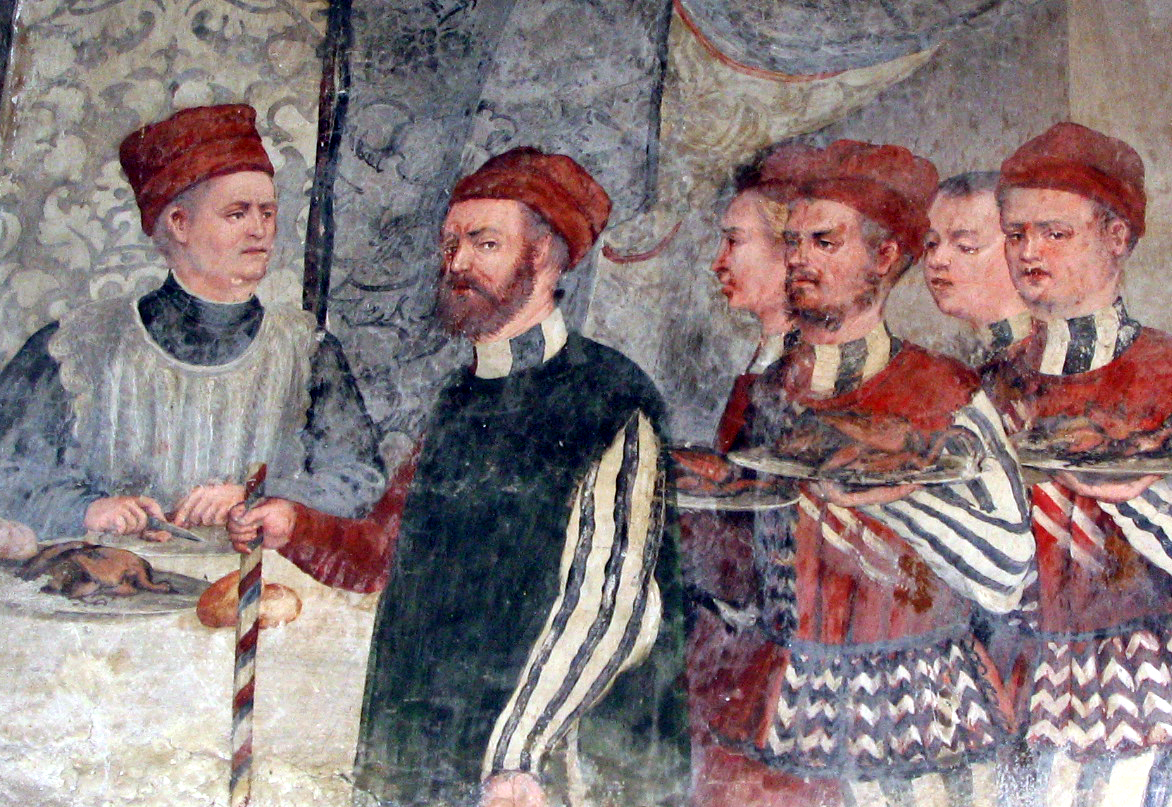
Top image: Food tasters at the Feast of Bartolomeo Colleoni in honor of Christian I of Denmark, 1467/ Wikimedia Commons
“Noooo! We surrender, okay? Just don’t hurt the cats!”
Before the great civilizational clashes at Thermopylae, Plataea and Salamis, there was Pelusium.
The strategically important city on the Nile Delta was where the Egyptians under Pharoah Psametik III made their stand against the invading armies of Cambyses II, the king of Persia, in 525 BCE.
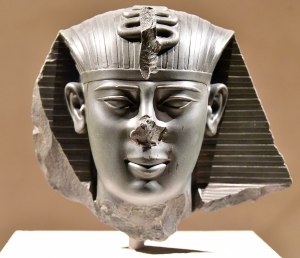
Amasis II was the last great Egyptian pharaoh before Persian King Cambyses defeated his son, Psametik II, and took that title for himself, beginning two centuries of Persian rule over Egypt.
It was a sound decision: Pelusium was heavily fortified, with high stone walls and ramparts. The pharaoh dedicated tens of thousands of men to the city’s defense, lining the ramparts with archers, stone throwers and catapults designed to launch flaming projectiles at the attacking, lightly-armored Persians.
For his part, Cambyses faced the prospect of a long siege or a bloody frontal assault that would cost thousands of lives as his men were tasked with scaling the walls under fire.
But the Persian king knew the Egyptians were not only famously fond of cats, they believed cats were representations of deities.
In a shrewd early example of psychological warfare, Cambyses figured out a way to use felines to his advantage in battle.
Cats were everywhere in ancient Egypt: Goddesses like Sekhmet and Bastet were portrayed as lion- and cat-headed, while Egyptian artists and craftsmen produced statues, rings, pendants and hieroglyphic cartouches with feline imagery. The beloved pets of royalty and other powerful Egyptians were buried in their own elaborate sarcophagi, while regular people mourned the deaths of their family cats by shaving notches in their eyebrows.
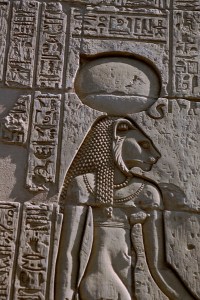
An image of the Egyptian cat goddess Sekhmet carved in relief among hieroglyphic inscriptions.
Cats are found in virtually every significant ancient Egyptian archaeological site, often elaborately mummified alongside their humans, and Egypt is home to the largest and most enduring cat statue in the world, the Great Sphinx. Not only do weathering patterns show the Sphinx is older than previously thought, it’s believed the Sphinx was originally carved with a cat’s head, then later defaced in the image of a pharaoh. That theory is supported by the fact that the head is disproportionately small compared to the Sphinx’s body, indicating it was carved down from its original form.
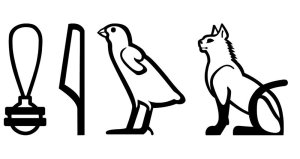
An Egyptian hieroglyph for “miu,” an umbrella word for “cat” that could mean domestic or wild cats, including big cats.
Cambyses realized there was a way to turn the Egyptian fondness for all things feline to his advantage: He had his men round up thousands of cats and carry them into battle as if they were just another part of the soldier’s kit along with weapons and armor.
If they opted to fight they would be killing sacred animals who were avatars of some of their most important gods. If they surrendered Egypt would be subsumed into the growing Achaemenid Empire, joining the Medians, Babylonians, Elamites and other once-proud nations in bending the knee to Persia’s king.
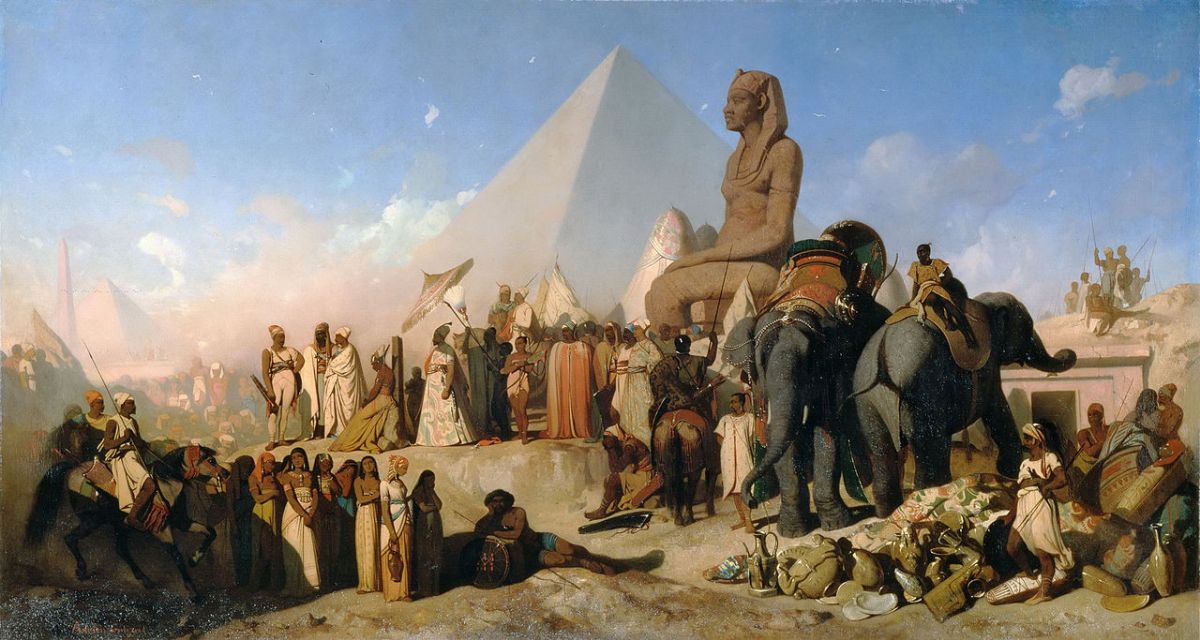
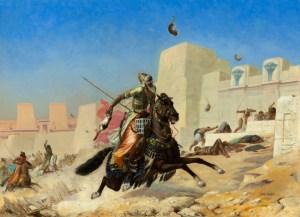
An artist’s depiction of the battle shows Cambyses atop a horse as his men catapult cats over the city walls.
They chose the latter, bringing about two centuries of Persian rule in Egypt and leaving the Persians with no remaining obstacles between them and the loose confederation of city-states of Greece.
The kitties, however, would have their revenge against the Persians, for it was a man named Leonidas (“lion”) who led the fabled Spartan warriors to the narrow mountain pass of Thermopylae, where they and a few thousand fellow Greeks held the pass for three days against an invading Persian army that was the largest fighting force the world had ever seen. (Herodotus, the Greek historian prone to patriotic exaggeration, said the Persians were a million strong, drinking entire rivers dry en route to mainland Greece. Modern historians put the number at about 300,000.)
Regardless, the Lion of Sparta and his men inflicted so many casualties on the Persians that the latter’s morale was shattered, and held the pass long enough to give the other Greeks time to muster their army.
When the Persians finally broke through they sacked Athens and rampaged through Attica, until they met an unstoppable force: All of Greece united under the co-leadership of Athens and Sparta, with 50,000 pissed off Spartan Peers leading the defense. The combined forces of the Greek city-states routed the invading army.
We’re sure the Greeks broke out plenty of catnip for their kitties to join in the resulting celebration, and Herodotus just forgot to include that little detail in his histories.



 Pain In The Bud