South Carolina Cat Dies After Surgery To Remove 38 Hair Ties From Her Stomach

Veterinarians tried their best to save Juliet, but noted “even with the best care, not every animal makes it.”

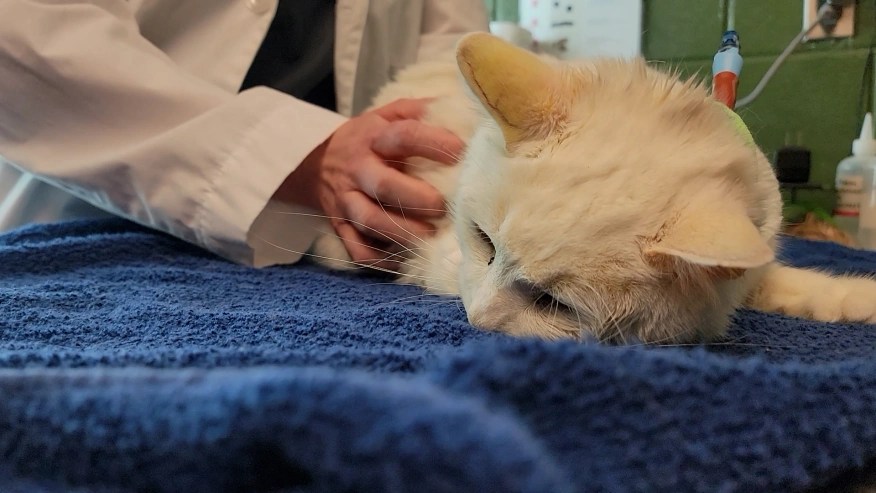
Juliet the cat and her two feline siblings were unceremoniously dumped outside their former home when their humans moved out of state a few weeks ago.

A Good Samaritan realized the trio had no one taking care of them and nowhere to go, and brought the cats to the Charleston Animal Society in South Carolina. After some time, Juliet stopped eating. A scan revealed why: The cream-and-white cat had an amorphous mass inside her stomach, a “seemingly endless bundle of strings” in the words of one veterinarian, which blocked Juliet’s stomach and prevented her from being able to eat or process food.

A vet performed emergency surgery on Juliet earlier this week and removed 38 hair ties.

“I’ve never seen anything like it,” said Leigh Jamison, the shelter’s associate director of veterinary care.
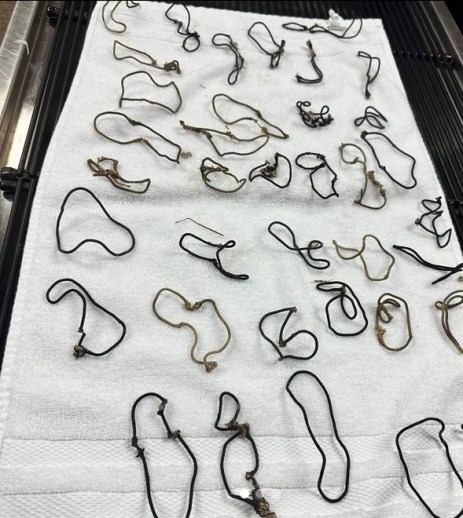
julietcathairties
Hair ties removed from the stomach of Juliet the cat.

Vet techs monitored Juliet closely and fed her carefully, making sure she got the nutrients she desperately needed without overwhelming her shocked system, which had suffered a buildup of fat in her liver.

They thought Juliet would pull through, but the ailing kitty took a turn for the worse on Friday and died a few hours later, the shelter announced.

“Our expert veterinarians and lifesaving team perform what we think are miracles every single day. Unfortunately, even with the best care, not every animal makes it,” staff wrote in an Instagram post. “Even though Juliet was loved and was not suffering during her last days, she did succumb to this tragic accident. We are all heartbroken.”

Pica, an eating disorder that affects humans, also occurs with cats. Defined as the consumption of items which are not food, pica can manifest in cats as a predilection for things like paper, plastic bags, rubber bands, small pieces of plastic and, as was the case with Juliette, items like hair ties that are made of fabric, wool or synthetic materials.

While there are medical reasons pica can present in felines, it’s also sometimes brought on by environmental stress, and it wouldn’t be a stretch to imagine the kind of people who would abandon their pet cats may not have been good caretakers. No one except her former caretakers know what Juliet’s been through, and they’re unlikely to come forward.

Likewise, adoption isn’t a part time, halfway or temporary thing. Adopting a cat means committing to taking care of the animal for his or her entire life. Despite the stubbornly persistent idea that cats are aloof, solitary animals who are indifferent to companionship, research studies show felines are just as sociable as dogs and form strong emotional attachments with their humans. They care deeply, but they express affection in different and less overt ways. That doesn’t mean they suffer less when they lose their homes and the people they’ve grown to love.
cute black kitten
Credit: beytlik/Pexels


Kitten With No Sex Organs Up For Adoption, Plus: Cat Proves The Dog Is HIS Pet (VIDEO)

Hope the Cat’s condition is so rare it doesn’t have a name, but her rescuers say it won’t lead to health complications and Hope is otherwise a very normal and friendly cat.

We all know what it’s like — you’re trying to get something done when your pet, beloved as he or she is, has decided to be really annoying in insisting on treats.

Finn the cat was in this position recently when his pet, Piper the Cavalier King Charles Spaniel, had her eye — or more likely her nose — on a small bowl of Cinnamon Toast Crunch on the kitchen counter. Piper couldn’t reach the tasty snack, so Finn climbed up, fished out a piece of cereal one at a time and dropped them for his loyal canine companion. (Finn himself had no interest in the sugary cereal, lacking in meat as it is.)

This should settle any remaining questions about where cats and dogs stand relative to each other:

Homeless kitten from UK has rare condition, is neither male nor female

A kitten rescued by a shelter in Warrington, about 20 miles west of Manchester, was originally listed as female and given the name hope. However, during a routine exam, a veterinarian found Hope does not have reproductive organs, according to The Guardian.

“There’s an outside possibility of some ectopic ovarian tissue hiding away internally but we think this is extremely unlikely … This is so rare that there isn’t really a commonly used term for this condition, but it is effectively sexual organ agenesis,” said Fiona Brockbank, senior veterinarian at Cats Protection in Warrington. “While this means we don’t have any previous cases [on which] to base our knowledge of how this will affect Hope in the future, we spent time monitoring this cat to ensure they can urinate and defecate appropriately before they were considered ready for rehoming.”

Hope’s condition is so rare it doesn’t have a name, but shelter manager Beni Benstead told the newspaper that shouldn’t dissuade potential adopters. Hope is very friendly with other cats at the shelter and “has been a delight to care for.”

Is Your Cat In Pain? The Feline Grimace Scale Can Tell You

For the first time, veterinarians and regular cat parents have a tool that can tell them if their cats are hurting.

Although there’s been lots of talk claiming cats don’t have facial expressions humans can parse — or even the muscles to noticeably change expressions — that’s not actually true.

It’s more accurate to say feline facial expressions are far more subtle than their human or even canine equivalents, and it takes an expert — a veterinarian or behaviorist with specialized training — to accurately read them.

This is a brand new frontier for veterinary science, and it’s all thanks to the feline grimace scale, a system developed by researchers at the University of Montreal in 2019. Using video clips of cats in various moods and stages of pain or pain-free expression, the researchers built a system that could reliably determine how a cat is feeling. (You can read more about how they did that here.)

“I call it the Rosetta Stone for interpreting how a cat is feeling,” veterinarian Liz Bales says in a new video at dvm360. “It turns out that very subtle changes in cat’s facial expressions can tell us whether or not they’re in pain. It includes the position of the ears, the opening of the eyes, the expression on the mouth, how the cat is holding its whiskers, and how they’re holding their head.”

Each of the five elements of feline facial expression are scored on a three-point scale, then added up. The result provides an accurate assessment of how a cat feels.

“It’s amazing, and it allows us to interpret feline pain in a way we never could before,” Bales says. “The hard part is, it can be a little bit tricky to learn. It is learnable, but I specialize in this and I’m still struggling to get it right every single time.”

Despite the challenge, she says, it’s well worth learning.

“The applications of this are so far and wide, and I think as the technology grows and it becomes easier and easier to use the grimace scale, the more exciting it’s going to be.”

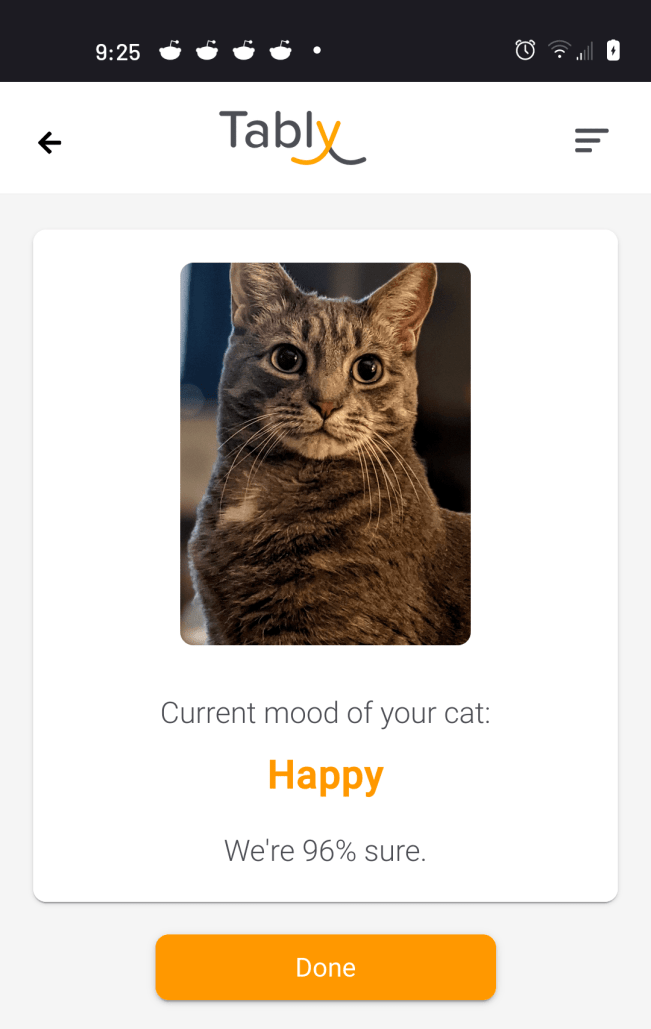
Thanks to an app named Tably, cat servants don’t have to know how to read the most subtle feline facial expressions anymore. By running a photo of your cat through the app’s algorithm, Tably can read your cat’s expression for you.

Tably Bud
Tably gauges cats’ moods in addition to their pain levels. We used the web app to evaluate Buddy last year. Thankfully he was happy!

Bales says she envisions a near future in which pet parents monitor their cats’ health and mood daily, and the scale becomes the standard for end-of-life care. With a “validated, consistent way to measure pain, we can look into more pain drugs for cats, what’s working, what isn’t.”

“A cat in pain looks like a resting cat to most people, but now we have this tool,” Bales says. “And I think as the tool evolves and we give cats a way to really speak for themselves through this Rosetta Stone of the grimace scale, then the more we understand that we can do for them, the more we’re going to do for them.”

We wrote about the feline grimace scale and Tably last year, and noted it had a lot of promise for veterinarians and us cat servants. At the time Tably was in beta and had a web app that allowed anyone to use the technology.

Unfortunately the web app seems to have disappeared, and the app is now available only to iOS users. Since we switched from an iPhone to Android, we can’t access Tably for the time being. (Let’s hope an Android version is forthcoming.) But if you have an Apple device, the app is definitely worth checking out.

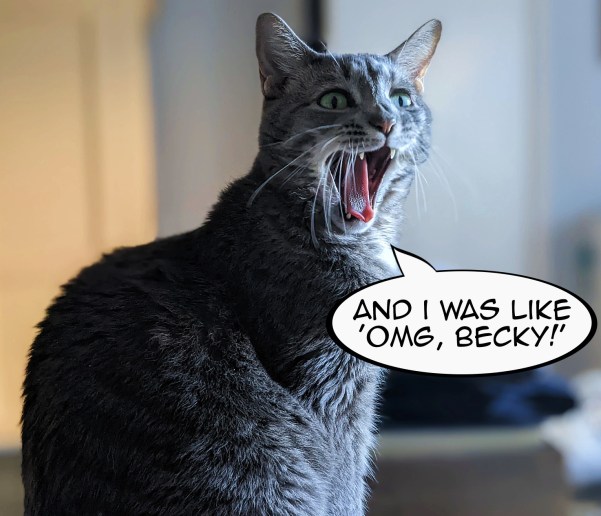
Bud and Becky
“You go, girlfriend!”

At Tabby’s Place, A New Center Will Take In ‘Cats The Rest of the World Forgot’

The sanctuary’s expansion will allow staff to care for FeLV-infected cats who are highly contagious and cannot be housed with the other kitties.

In 2015, a Good Samaritan found a tiny kitten abandoned in the snow and brought her to Tabby’s Place.

Staff at the Ringoes, New Jersey-based sanctuary nursed her back to health, but tests confirmed the little one had Feline leukemia virus (FeLV). While they set up a makeshift isolation ward (FeLV is highly contagious), a woman came by and told the staff she wanted to adopt a cat no one else wanted.

She chose the FeLV+ kitten, who was dubbed Quinn, even though she knew they might only have a few months or perhaps a year or two together.

Seven years later and despite the odds, Quinn is still with her human mom. The latter decided she wanted to thank Tabby’s Place with a $3.5 million donation to help FeLV+ cats like Quinn. With the hefty donation and the support of many other donors, the sanctuary is closing in on the $5.5 million to cover the construction of Quinn’s Corner, a first-of-its-kind center for treating cats infected with FeLV.

“These little ones are really the ‘final frontier’ in terms of cats who have nowhere to turn,” Tabby’s Place Development Director Angela Hartley told PITB, “and we’re thrilled to finally be in a position to welcome them at Tabby’s Place.”

Staff at Tabby’s Place see Quinn’s Corner as a major step forward in caring for kitties who normally don’t have a chance. Because they don’t have the facilities, know-how or resources to treat FeLV+ cats, many shelters simply euthanize them.

In the initial announcement, the sanctuary described Quinn’s Corner as a place where “cats who wandered the world looking for love will find cage-free bliss, matchless medical care, and the dignity and tenderness that every Tabby’s Place cat enjoys.”

The construction crew broke ground about a year ago and, if factors like supply chain issues for construction materials and the weather cooperate, the staff at Tabby’s Place hope to celebrate with a grand opening in autumn.

Because of how contagious and deadly FeLV is — it can pass by grooming, sharing food and water bowls, and close contact — infected cats must be kept apart from the other feline residents. Quinn’s Corner will have its own entrance and lobby, individual suites and a large communal room for FeLV cats, and “solaria,” which are like fancy catios for the ailing furballs to get fresh air and enjoy chirping at birds.

Separately, the project will add a nursery and adoption suite for kittens and an “operations center” where staff can attend to all the behind-the-scenes work of caring for felines, including laundry and food prep.

Tabby’s Place will match donations until they reach the $2 million goal to supplement the initial donation of $3.5 million, but cat lovers can continue to donate at any time, Hartley said.

All construction photos and renderings provided by Tabby’s Place. Top photo credit Asish Aji/Pexels.


Sunday Cats: Adopt A Cat And All Your Wildest Dreams Will Come True! PLUS: Buddy Has Left The Building!

A new study reveals some surprises, while The Other Buddy continues to make progress after surviving an attack by two dogs.

I know you’re going to read this and think, “Okay, what have these two wiseasses come up with this time?” but I swear we didn’t make this one up!

It even appears to be a legitimate research paper, despite first attracting media attention on April Fool’s Day. (The paper itself was accepted in late 2021 and published in the journal PeerJ on March 25.)

To put it simply, adopting a cat will make all your wildest dreams come true. Buddy was right!

Cat servants are rated more attractive than people who don’t share their homes with cats, rate higher on traditional measurements of attractiveness like facial symmetry, and even weigh less (women) or, if they’re men, have higher levels of testosterone.

That’s according to a multinational research team led by Javier Borráz-León of Finland’s University of Turku.

How is this possible?

The team — which also consists of scientists from Latvia, Estonia and Mexico — believes it’s because of the infamous toxoplasma gondii, a parasite that infects cat droppings and can pass to humans and other animals.

T gondii nudges its hosts toward behavior that propagates the parasite itself.

“First, we found that infected men had lower facial fluctuating asymmetry whereas infected women had lower body mass, lower body mass index, a tendency for lower facial fluctuating asymmetry, higher self-perceived attractiveness, and a higher number of sexual partners than non-infected ones,” the study authors wrote. “Then, we found that infected men and women were rated as more attractive and healthier than non-infected ones.”

There’s precedent for this. Earlier studies have found that while most parasites make their hosts less likely to reproduce because they cause detectable negative health defects, toxoplasma gondii does the opposite. Male rats who are infected by t. gondii are more attractive to potential sexual partners in an example of a parasite that “can indeed manipulate host sexual signaling to their own advantage.”

That’s not to say you’d want to go and get yourself infected. Toxoplasma gondii can cause negative health effects, most famously in pregnant women, and may be responsible for agitating certain mental health issues. Some scientists have said fears about the parasite are overblown, and cats aren’t actually the primary culprits: People are more likely to become infected by drinking water from unsanitary sources, eating undercooked meat or shellfish, or eating unwashed vegetables and fruits from contaminated soil.

Still, it’s possible to get the parasite from being careless around cat litter, especially if your cat spends time outdoors. It’s another good reason to keep your kitties inside.

Buddy has left the building

After surviving a brutal and intentional attack when two teenagers sicced their pitbulls on him, Buddy the Philadelphia Cat has been upgraded to stable condition and he’s off to a foster home!

The little guy made headlines and captured hearts around the world with his ordeal, his bravery and the strength he showed as he clung to life in those first few days, when veterinarians feared he could succumb to his many wounds.

But late this week, Buddy was able to stand up for the first time since the attack, and he had a big appetite after so many days spent incapacitated and on pain medication.

The little fighter still needs time to recover before the Pennsylvania SPCA finds a good home for him. From what we hear, there are no shortage of applications from people who would love to give him the best life possible. For the time being, he’s staying with one of the veterinarians who cared for him during those fraught early days, so it’s good to know the good boy will have a familiar face around.