Is Your Cat In Pain? The Feline Grimace Scale Can Tell You

For the first time, veterinarians and regular cat parents have a tool that can tell them if their cats are hurting.

Although there’s been lots of talk claiming cats don’t have facial expressions humans can parse — or even the muscles to noticeably change expressions — that’s not actually true.

It’s more accurate to say feline facial expressions are far more subtle than their human or even canine equivalents, and it takes an expert — a veterinarian or behaviorist with specialized training — to accurately read them.

This is a brand new frontier for veterinary science, and it’s all thanks to the feline grimace scale, a system developed by researchers at the University of Montreal in 2019. Using video clips of cats in various moods and stages of pain or pain-free expression, the researchers built a system that could reliably determine how a cat is feeling. (You can read more about how they did that here.)

“I call it the Rosetta Stone for interpreting how a cat is feeling,” veterinarian Liz Bales says in a new video at dvm360. “It turns out that very subtle changes in cat’s facial expressions can tell us whether or not they’re in pain. It includes the position of the ears, the opening of the eyes, the expression on the mouth, how the cat is holding its whiskers, and how they’re holding their head.”

Each of the five elements of feline facial expression are scored on a three-point scale, then added up. The result provides an accurate assessment of how a cat feels.

“It’s amazing, and it allows us to interpret feline pain in a way we never could before,” Bales says. “The hard part is, it can be a little bit tricky to learn. It is learnable, but I specialize in this and I’m still struggling to get it right every single time.”

Despite the challenge, she says, it’s well worth learning.

“The applications of this are so far and wide, and I think as the technology grows and it becomes easier and easier to use the grimace scale, the more exciting it’s going to be.”

Thanks to an app named Tably, cat servants don’t have to know how to read the most subtle feline facial expressions anymore. By running a photo of your cat through the app’s algorithm, Tably can read your cat’s expression for you.
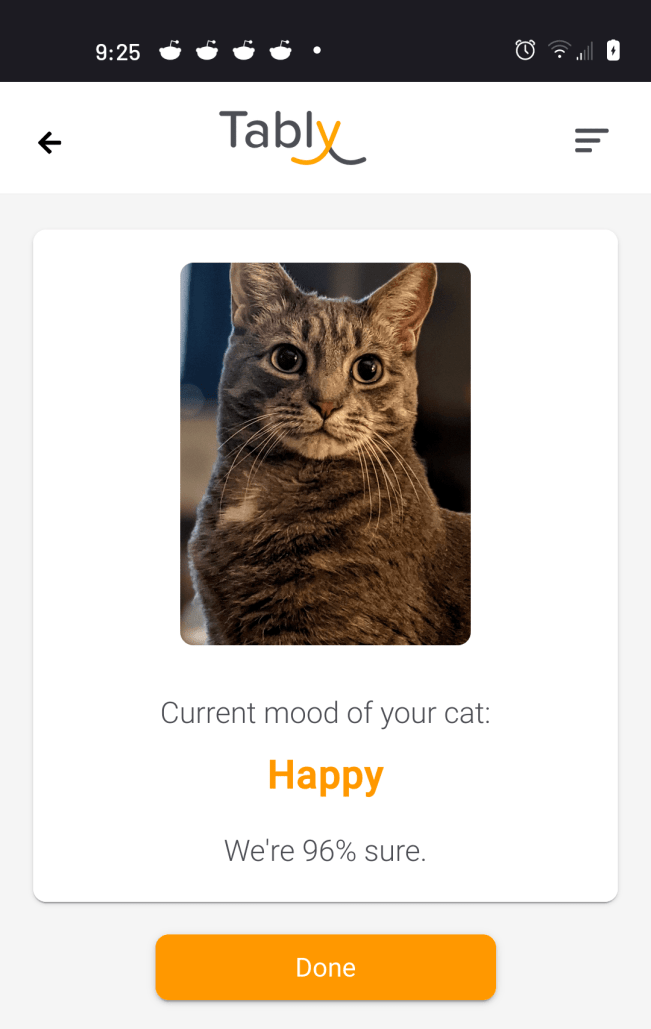
Tably Bud
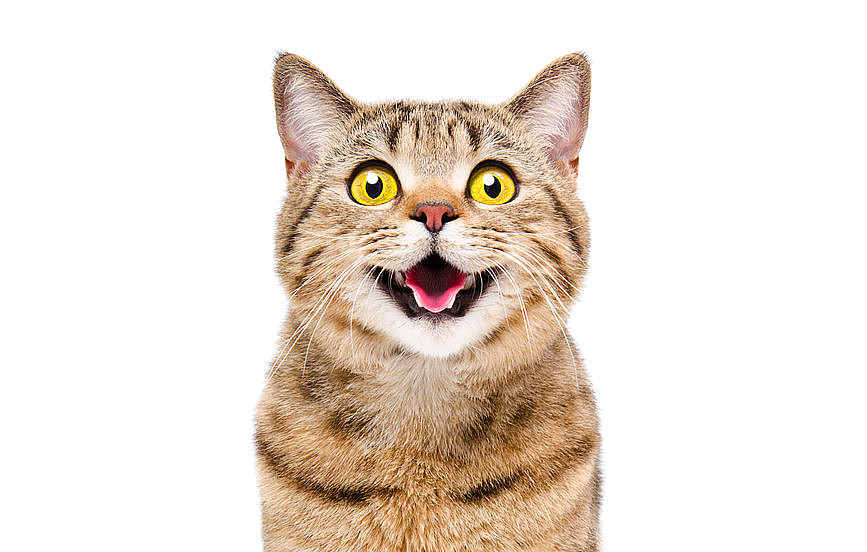
Tably gauges cats’ moods in addition to their pain levels. We used the web app to evaluate Buddy last year. Thankfully he was happy!

Bales says she envisions a near future in which pet parents monitor their cats’ health and mood daily, and the scale becomes the standard for end-of-life care. With a “validated, consistent way to measure pain, we can look into more pain drugs for cats, what’s working, what isn’t.”

“A cat in pain looks like a resting cat to most people, but now we have this tool,” Bales says. “And I think as the tool evolves and we give cats a way to really speak for themselves through this Rosetta Stone of the grimace scale, then the more we understand that we can do for them, the more we’re going to do for them.”

We wrote about the feline grimace scale and Tably last year, and noted it had a lot of promise for veterinarians and us cat servants. At the time Tably was in beta and had a web app that allowed anyone to use the technology.

Unfortunately the web app seems to have disappeared, and the app is now available only to iOS users. Since we switched from an iPhone to Android, we can’t access Tably for the time being. (Let’s hope an Android version is forthcoming.) But if you have an Apple device, the app is definitely worth checking out.
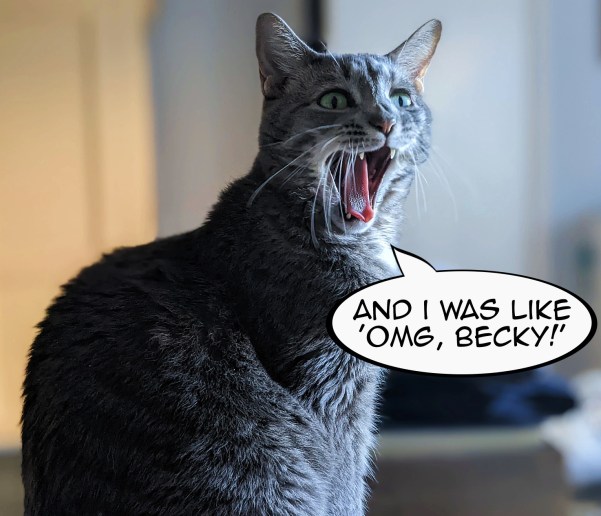
Bud and Becky
“You go, girlfriend!”

At Tabby’s Place, A New Center Will Take In ‘Cats The Rest of the World Forgot’

The sanctuary’s expansion will allow staff to care for FeLV-infected cats who are highly contagious and cannot be housed with the other kitties.

In 2015, a Good Samaritan found a tiny kitten abandoned in the snow and brought her to Tabby’s Place.

Staff at the Ringoes, New Jersey-based sanctuary nursed her back to health, but tests confirmed the little one had Feline leukemia virus (FeLV). While they set up a makeshift isolation ward (FeLV is highly contagious), a woman came by and told the staff she wanted to adopt a cat no one else wanted.

She chose the FeLV+ kitten, who was dubbed Quinn, even though she knew they might only have a few months or perhaps a year or two together.

Seven years later and despite the odds, Quinn is still with her human mom. The latter decided she wanted to thank Tabby’s Place with a $3.5 million donation to help FeLV+ cats like Quinn. With the hefty donation and the support of many other donors, the sanctuary is closing in on the $5.5 million to cover the construction of Quinn’s Corner, a first-of-its-kind center for treating cats infected with FeLV.

“These little ones are really the ‘final frontier’ in terms of cats who have nowhere to turn,” Tabby’s Place Development Director Angela Hartley told PITB, “and we’re thrilled to finally be in a position to welcome them at Tabby’s Place.”

Staff at Tabby’s Place see Quinn’s Corner as a major step forward in caring for kitties who normally don’t have a chance. Because they don’t have the facilities, know-how or resources to treat FeLV+ cats, many shelters simply euthanize them.

In the initial announcement, the sanctuary described Quinn’s Corner as a place where “cats who wandered the world looking for love will find cage-free bliss, matchless medical care, and the dignity and tenderness that every Tabby’s Place cat enjoys.”

The construction crew broke ground about a year ago and, if factors like supply chain issues for construction materials and the weather cooperate, the staff at Tabby’s Place hope to celebrate with a grand opening in autumn.

Because of how contagious and deadly FeLV is — it can pass by grooming, sharing food and water bowls, and close contact — infected cats must be kept apart from the other feline residents. Quinn’s Corner will have its own entrance and lobby, individual suites and a large communal room for FeLV cats, and “solaria,” which are like fancy catios for the ailing furballs to get fresh air and enjoy chirping at birds.

Separately, the project will add a nursery and adoption suite for kittens and an “operations center” where staff can attend to all the behind-the-scenes work of caring for felines, including laundry and food prep.

Tabby’s Place will match donations until they reach the $2 million goal to supplement the initial donation of $3.5 million, but cat lovers can continue to donate at any time, Hartley said.

All construction photos and renderings provided by Tabby’s Place. Top photo credit Asish Aji/Pexels.


Sunday Cats: Adopt A Cat And All Your Wildest Dreams Will Come True! PLUS: Buddy Has Left The Building!

A new study reveals some surprises, while The Other Buddy continues to make progress after surviving an attack by two dogs.

I know you’re going to read this and think, “Okay, what have these two wiseasses come up with this time?” but I swear we didn’t make this one up!

It even appears to be a legitimate research paper, despite first attracting media attention on April Fool’s Day. (The paper itself was accepted in late 2021 and published in the journal PeerJ on March 25.)

To put it simply, adopting a cat will make all your wildest dreams come true. Buddy was right!

Cat servants are rated more attractive than people who don’t share their homes with cats, rate higher on traditional measurements of attractiveness like facial symmetry, and even weigh less (women) or, if they’re men, have higher levels of testosterone.

That’s according to a multinational research team led by Javier Borráz-León of Finland’s University of Turku.

How is this possible?

The team — which also consists of scientists from Latvia, Estonia and Mexico — believes it’s because of the infamous toxoplasma gondii, a parasite that infects cat droppings and can pass to humans and other animals.

T gondii nudges its hosts toward behavior that propagates the parasite itself.

“First, we found that infected men had lower facial fluctuating asymmetry whereas infected women had lower body mass, lower body mass index, a tendency for lower facial fluctuating asymmetry, higher self-perceived attractiveness, and a higher number of sexual partners than non-infected ones,” the study authors wrote. “Then, we found that infected men and women were rated as more attractive and healthier than non-infected ones.”

There’s precedent for this. Earlier studies have found that while most parasites make their hosts less likely to reproduce because they cause detectable negative health defects, toxoplasma gondii does the opposite. Male rats who are infected by t. gondii are more attractive to potential sexual partners in an example of a parasite that “can indeed manipulate host sexual signaling to their own advantage.”

That’s not to say you’d want to go and get yourself infected. Toxoplasma gondii can cause negative health effects, most famously in pregnant women, and may be responsible for agitating certain mental health issues. Some scientists have said fears about the parasite are overblown, and cats aren’t actually the primary culprits: People are more likely to become infected by drinking water from unsanitary sources, eating undercooked meat or shellfish, or eating unwashed vegetables and fruits from contaminated soil.

Still, it’s possible to get the parasite from being careless around cat litter, especially if your cat spends time outdoors. It’s another good reason to keep your kitties inside.

Buddy has left the building

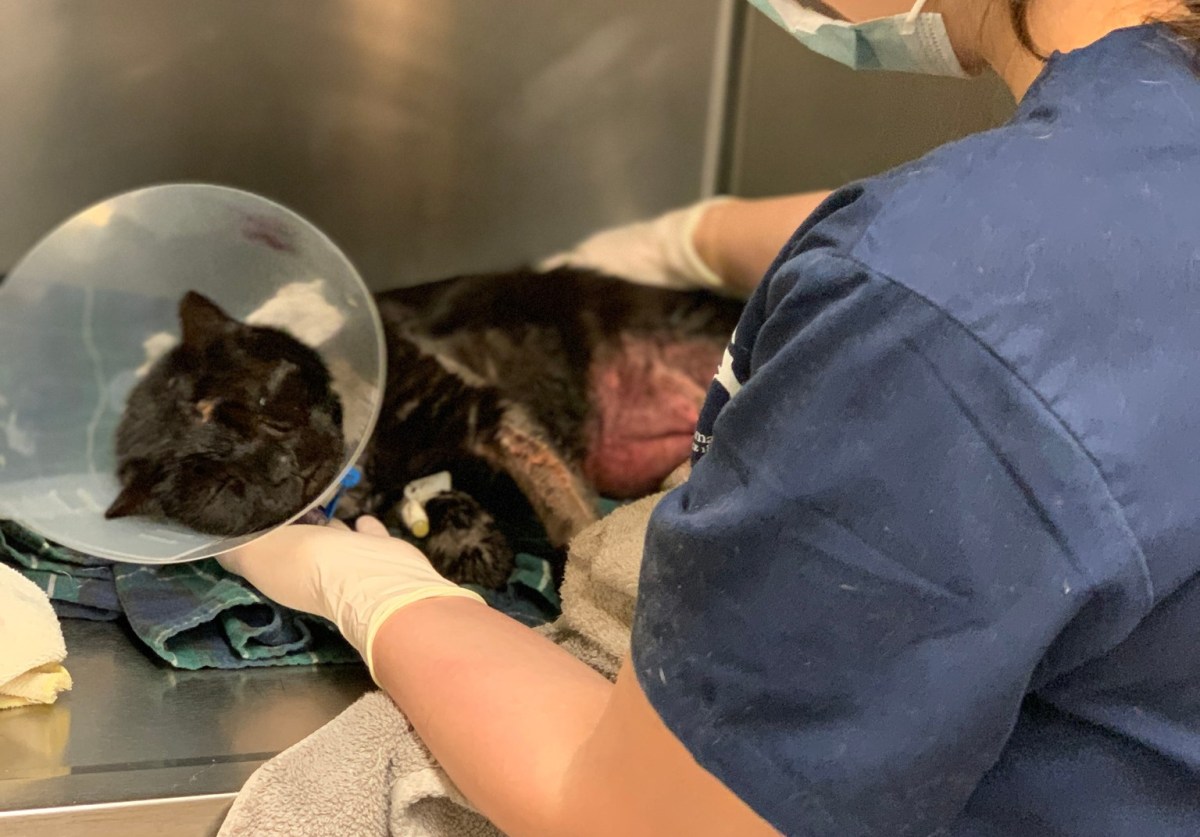
After surviving a brutal and intentional attack when two teenagers sicced their pitbulls on him, Buddy the Philadelphia Cat has been upgraded to stable condition and he’s off to a foster home!

The little guy made headlines and captured hearts around the world with his ordeal, his bravery and the strength he showed as he clung to life in those first few days, when veterinarians feared he could succumb to his many wounds.

But late this week, Buddy was able to stand up for the first time since the attack, and he had a big appetite after so many days spent incapacitated and on pain medication.

The little fighter still needs time to recover before the Pennsylvania SPCA finds a good home for him. From what we hear, there are no shortage of applications from people who would love to give him the best life possible. For the time being, he’s staying with one of the veterinarians who cared for him during those fraught early days, so it’s good to know the good boy will have a familiar face around.

Buddy’s Attackers Have Turned Themselves In

They face animal fighting and aggravated animal cruelty charges.

Two people responsible for a vicious attack on a Philadelphia cat have owned up to it and will hopefully face justice.

While the surveillance footage appeared to show a pair of men siccing pitbulls on a semi-stray cat named Buddy, the suspects are 17 and 12 years old respectively, according to the SPCA.

Investigators were able to ID the pair after getting leads from the public, and on Friday the 17-year-old came in accompanied by a parent to surrender himself to authorities. The 12-year-old has agreed to turn himself in today, March 26, according to the local NBC affiliate.

Authorities said they’ll charge the pair with animal fighting, aggravated animal cruelty and conspiracy for the unprovoked attack, in which they encouraged their dogs to hurt the much smaller cat. The first two charges are felonies.

However, there are caveats. Because the suspects qualify for youthful offender status, they cannot be tried as adults and may be able to wipe the convictions from their records in the future. Such deals are at the discretion of judges, and typically involve the completion of certain programs and require that the offenders stay out of trouble for a set time period after conviction.

Because of that, their names will be sealed in court records. Youthful offender deals are usually reserved for first-time offenders. It’s not clear if the teenagers in this case have priors, and it will be up to the judge to decide the terms of their sentencing if they are convicted or agree to plead to the charges.

The SPCA has taken custody of the dogs, although their fate remains unclear. Hopefully they can be rehabilitated and adopted by experienced owners.

There’s been an outpouring of support for Buddy, with well-wishers across the world donating tens of thousands of dollars toward his veterinary care and related costs, Pennsylvania SPCA’s Julie Klim said.

“While we certainly see a lot of bad as we fight to end animal cruelty, we also see how much good there is, especially in a case like this, from all corners of the globe,” Klim said. “We will do everything humanly and medically possible to ensure Buddy’s future will be a bright one.”

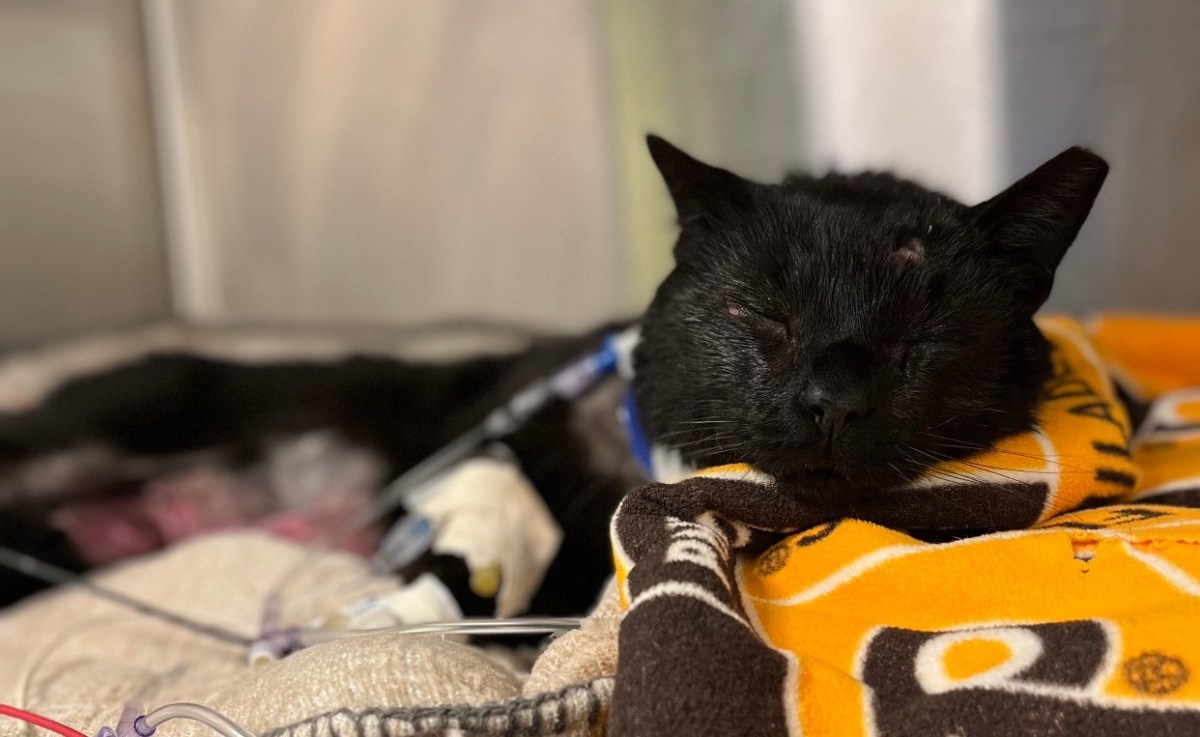
In the meantime, Buddy still clings to life. He remains in critical condition, according to the SPCA, but veterinarians are “hopeful” he’ll pull through. Here’s a video of the little fighter trying to comfort himself by making biscuits on a soft blanket at a veterinary hospital:

Welcome, new readers! This blog is about a different Buddy the Cat, but we also cover news about felines, animal welfare, the pet industry and other cat-centric topics, in addition to frequent humor posts about our benevolent, furry overlords. Buddy the Cat from New York is pulling for Buddy the Cat from Philadelphia, and hopes his fellow Buddy makes a full recovery before finding a loving family and forever home.

These Men Need To Go To Prison For Siccing Their Dogs On A Cat Named Buddy

A cat named Buddy has life-threatening injuries after two men set their dogs on him.

I took a pass on this story when I first saw it because there’s only so much senseless violence toward cats people can tolerate, and I don’t want people to feel like they’re going to be stressed out when they visit PITB.

Our primary goal here, after all, is to celebrate cats and have a laugh.

But this story is too infuriating to keep quiet about, and when I realized the victimized cat’s name is Buddy, I couldn’t ignore it.

Buddy, a black cat, was on his front porch in Philadelphia on Tuesday when two men passed by, let their dogs loose and ordered them to attack poor little guy.

The men cheered their dogs on with “Get him!” and “Good boy!”, and Buddy probably would have died there if his human didn’t hear the commotion and run outside to intervene.

The two suspects collected their dogs and ran off, while Buddy’s human rushed the injured kitty to the Pennsylvania SPCA, where he underwent surgery for life-threatening injuries.

“Buddy is still hanging in there,” the SPCA announced on Thursday. “He remains in critical condition, but we are cautiously optimistic.”

Buddy, who suffered bite wounds and other injuries over his entire body, was a stray who was cared for — but not fully adopted — by a Philadelphia family. The family told the SPCA that Buddy “didn’t want to live inside,” so after getting him neutered they let him stay on their porch and fed him daily.

“He has lots of puncture wounds,” the SPCA’s Gillian Kocker told KYW-TV, the local CBS affiliate. “They’re worried about infections, but mostly what they’re doing right now is making sure that he’s comfortable and has the medication he needs, especially pain meds.”

While Buddy is recovering and is under 24-7 monitoring, donors from around the world have chipped in, giving more than $30,000. Any money left over after veterinary costs will be used for “Buddy’s buddies,” the SPCA said, meaning other cats in their care.

If and when Buddy recovers, the SPCA said, he will be placed with another family. Meanwhile, the suspects could face felony charges for animal fighting and cruelty to animals if they’re caught, Kocher said. Let’s hope they are.

Anyone who recognizes the suspects should call the SPCA at 866-601-7722.