‘Why I Took 50,000 Pictures Of My Cats Pooping’

One software engineer went to incredible lengths to monitor her cat’s bathroom habits.

When Alan Turing, the father of artificial intelligence, posed the heady question “Can machines think?”, he inspired generations of computer scientists, philosophers, physicists and regular people to imagine the emergence of silicon-based consciousness, with humanity taking the godlike step of creating a new form of life.

And when science fiction writer Philip K. Dick wrote his seminal 1968 novel, “Do Androids Dream of Electric Sheep?” — the story that would eventually become Ridley Scott’s 1982 classic Bladerunner — he wondered what makes us human, and whether an artificial being could possess a soul.

It’s safe to say neither of those techno-prophets were thinking of fledgling AI algorithms, representing the first small steps toward true machine-substrate intelligence, announcing themselves and their usefulness to the world by helping us watch felis catus take a shit.

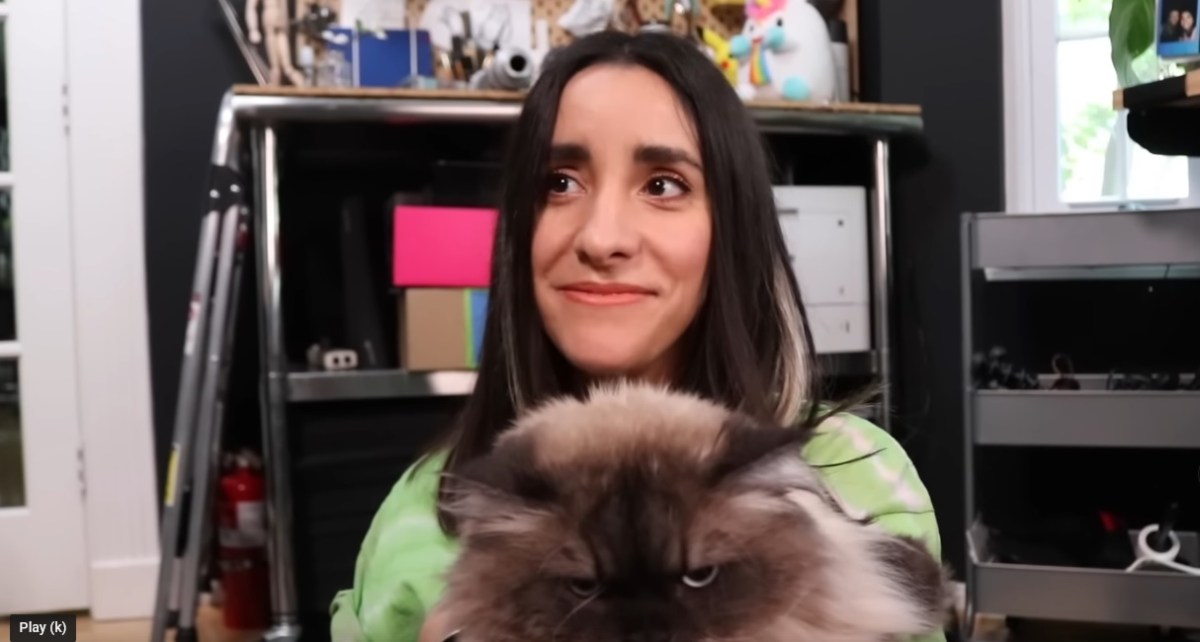
And yet that’s what the inventors of the LuluPet litter box designed an AI to do, and it’s what software engineer and Youtuber Estefannie did for her cat, Teddy, who’s got a bit of a plastic-eating problem.

“The veterinarian couldn’t tell me how much plastic he ate, and it would cost me over $3,000 [to find out]. So I didn’t do it,” Estefannie explains in a new video. “Instead, the vet gave me the option of watching him go to the bathroom. If he poops and there’s no plastic in his intestines, then he won’t die, and he might actually love me back.”

Estefannie casually described how she wrote a python script, set up a camera and motion sensor, and rigged it to take photos of Teddy doing his business. But, she explained, there was “a tiny problem”: Luna the Cat, aka her cat’s cat.

“This is Luna, this is technically not my cat, this is Teddy-Bear’s cat, and she uses the same litter box as Teddy,” she explained.

For that, she’d need more than a script. She’d have to build a machine learning algorithm to gorge itself on data, cataloguing tens of thousands of photos of Teddy and Luna along with sensory information from the litter box itself, to learn to reliably determine which cat was using the loo.

So Estefannie decided it was a good opportunity to “completely remodel” Teddy’s “bathroom,” including a compartment that would hide the bespoke system monitoring his bowel movements. The system includes sensors, cameras and lights to capture still images of Teddy dropping deuces in infrared, and a live thermal imaging feed of the little guy doing his business. (Teddy’s luxurious new bedroom turned out to be too dark for conventional cameras, thus the pivot to infrared.)

From there, Estefannie manually calculated how long Teddy’s number ones and twos took, and cross-referenced that information with photo timestamps to help determine the exact nature of Teddy’s calls of nature.

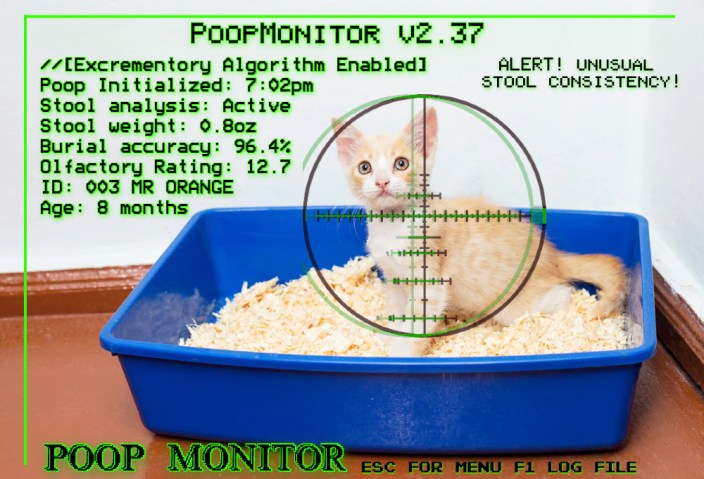
catpoopinggui
The future! (Note: This is our cheesy photoshopped interpretation, not Estefannie’s actual stool monitoring interface.)

When all the data is collected, Estefannie’s custom scripts sends it to an external server, which analyzes the images from each of Teddy’s bathroom visits and renders a verdict on what he’s doing in there.

Finally, Estefannie gets an alert on her smartphone when one of the cats steps into the litterbox, allowing her the option of watching a live feed and, uh, logging all the particulars. The software determines if a number two was successful, and keeps detailed records so Teddy’s human servant can see aberrations over time.

“So now I definitely know when Teddy-Bear is not pooping and needs to go to the hospital,” she said.

I am not making this up.

For her part, Estefannie says she’s not worried about a technological singularity scenario in which angry or insulted machines, newly conscious, exact revenge on humans who made them do unsavory tasks.

“Did I make an AI whose only purpose in life is to watch my cats poop?” Estefannie asked, barely keeping a straight face. “Mmmhmm. Will it come after me when the machines rise? No! Ewww!”

Every Attempt To Translate Meows Has Failed. Why?

A New York Times science writer tries MeowTalk, the app that says it can tell you what your cat is saying.

New York Times science writer Emily Anthes details her experience with MeowTalk in a new story, and has more or less come to the same conclusions I did when I wrote about the app last year — it recognizes the obvious, like purring, but adds to confusion over other vocalizations.

Back in January of 2021, in MeowTalk Says Buddy Is A Very Loving Cat, I wrote about using MeowTalk to analyze the vocalizations Bud makes when he wants a door opened. After all, that should be a pretty basic task for an app that exists to translate meows: Cats ask for things, or demand them, some would say.

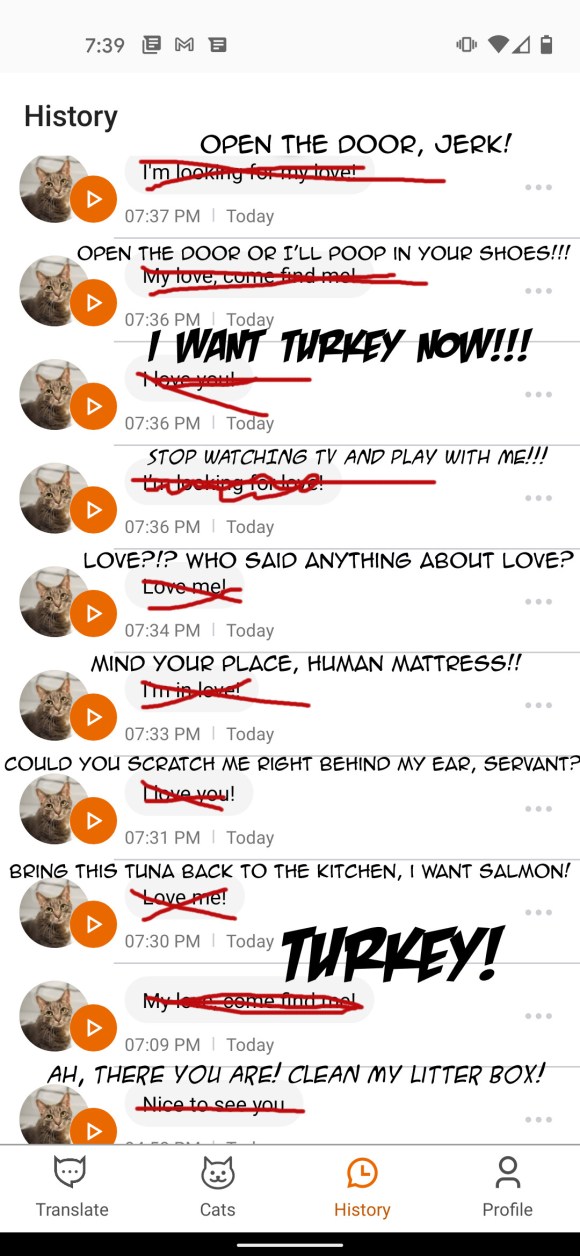
But instead of “Open the door!”, “I want to be near you!”, “Human, I need something!” or even “Obey me, human!”, it told me Bud was serenading me as he pawed and tapped his claws on the door: “I’m looking for love!”, “My love, come find me!”, “I love you!”, “Love me!”, “I’m in love!”

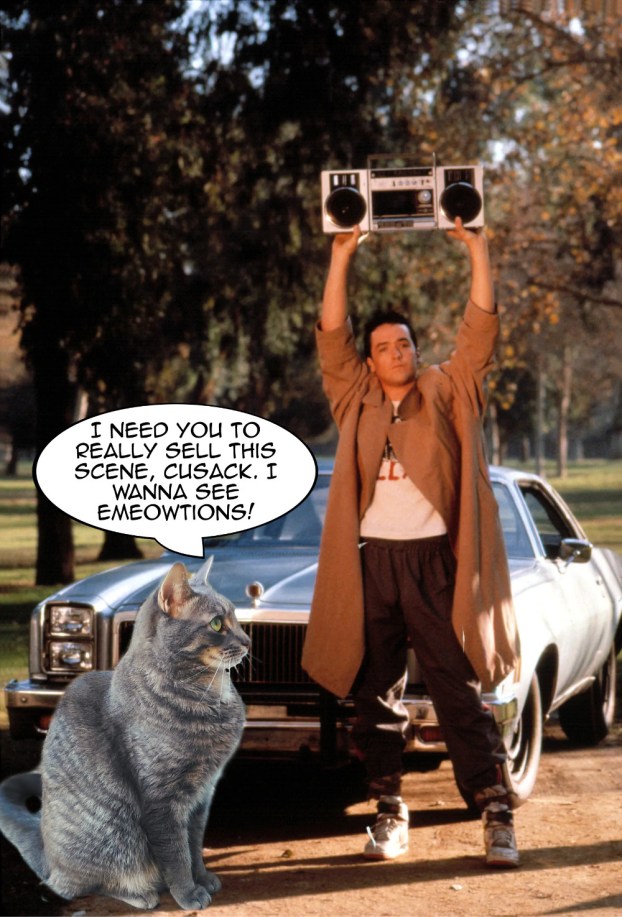
According to MeowTalk, my cat was apparently the author of that scene in Say Anything when John Cusack held up a boombox outside of Ione Skye’s bedroom window.

John Cusack and Buddy the Cat
Buddy the Director.

Anthes had a similar experience:

“At times, I found MeowTalk’s grab bag of conversational translations disturbing. At one point, Momo sounded like a college acquaintance responding to a text: ‘Just chillin’!’ In another, he became a Victorian heroine: ‘My love, I’m here!’ (This encouraged my fiancé to start addressing the cat as ‘my love,’ which was also unsettling.) One afternoon, I picked Momo up off the ground, and when she meowed, I looked at my phone, ‘Hey honey, let’s go somewhere private.’ !”

On the opposite side of the emotional spectrum, MeowTalk took Buddy’s conversation with me about a climbing spot for an argument that nearly came to blows.

“Something made me upset!” Buddy was saying, per MeowTalk. “I’m angry! Give me time to calm down! I am very upset! I am going to fight! It’s on now! Bring it!”

In reality the little dude wanted to jump on the TV stand. Because he’s a serial swiper who loves his gravity experiments, the TV stand is one of like three places he knows he shouldn’t go, which is exactly why he wants to go there. He’s got free rein literally everywhere else.

If MeowTalk had translated “But I really want to!” or something more vague, like “Come on!” or “Please?”, that would be a good indication it’s working as intended. The app should be able to distinguish between pleading, or even arguing, and the kind of freaked-out, hair-on-edge, arched-back kind of vocalizations a cat makes when it’s ready to throw down.

buddytranslations
Accurate translations of Buddy’s meows.

Still, I was optimistic. Here’s what I wrote about MeowTalk last January:

“In some respects it reminds me of Waze, the irreplaceable map and real-time route app famous for saving time and eliminating frustration. I was one of the first to download the app when it launched and found it useless, but when I tried it again a few months later, it steered me past traffic jams and got me to my destination with no fuss.

What was the difference? Few people were using it in those first few days, but as the user base expanded, so did its usefulness.

Like Waze, MeowTalk’s value is in its users, and the data it collects from us. The more cats it hears, the better it’ll become at translating them. If enough of us give it an honest shot, it just may turn out to be the feline equivalent of a universal translator.”

There are also indications we may be looking at things — or hearing them — the “wrong” way. Anthes spoke to Susanne Schötz, a phonetician at Lund University in Sweden, who pointed out the inflection of a feline vocalization carries nuances. In other words, it’s not just the particular sound a cat makes, it’s the way that sound varies tonally.

“They tend to use different kinds of melodies in their meows when they’re trying to point to different things,” said Schötz, who is co-author of an upcoming study on cat vocalizations.

After a few months in which I forgot about MeowTalk, I was dismayed to open the app to find ads wedged between translation attempts, and prompts that asked me to buy the full version to enable MeowTalk to translate certain things.

The developers need to generate revenue, so I don’t begrudge them that. But I think it’s counterproductive to put features behind paywalls when an application like this depends so heavily on people using it and feeding it data.

To use the Waze analogy again, would the app have become popular if it remained the way it was in those first few days after it launched? At the time, I was lucky to see indications that more than a handful of people were using it, even in the New York City area. The app told me nothing useful about real-time traffic conditions.

These days it’s astounding how much real-time traffic information the app receives and processes, routing drivers handily around traffic jams, construction sites and other conditions that might add minutes or even hours to some trips. You can be sure that when you hear a chime and Waze wants to redirect you, other Waze users are transmitting data about a crash or other traffic impediment in your path.

Bud
“I’m thinking deep thoughts about turkey.”

MeowTalk needs more data to be successful, especially since — unlike Waze — it depends on data-hungry machine learning algorithms to parse the sounds it records. Like people, machine learning algorithms have to “practice” to get better, and for a machine, “practice” means hearing hundreds of thousands or millions of meows, chirps, trills, yowls, hisses and purrs from as many cats as possible.

That’s why I’m still optimistic. Machine learning has produced algorithms that can identify human faces and even invent them. It’s produced software that can write prose, navigate roads, translate the text of dead languages and even rule out theories about enduring mysteries like the Voynich Manuscript.

In each of those cases there were innovators, but raw data was at the heart of what they accomplished. If MeowTalk or another company can find a way to feed its algorithms enough data, we may yet figure our furry little friends out — or at least know what they want for dinner.

Influencers Are Cloning Their Famous Pets, Leaving Misery In Their Wake

Cloning still has a disturbingly low success rate, more often than not leading to the birth of sickly animals with fatal defects, or animals who don’t make it to term.

I’d like to call your attention to a paragraph in this CNBC story about Instagram and TikTok influencers cloning their famous pets.

The story begins with an anecdote about Kelly Anderson, a woman from Austin, Texas, whose cat Chai had become Internet Famous:

The white and tan ragdoll had 85,000 followers on Anderson’s Instagram account @adogandacat when she died from complications following a surgery.

“I lost about 20,000 followers on Instagram after Chai passed,” she explained.

Anderson said she sent a sample of Chai’s DNA to the Texas-based pet cloning company ViaGen Pets shortly after she died. It took four years and $25,000 for Anderson to get a successful clone, and now she’s back in business with Chai’s identical genetic clone named Belle, who was born in 2021. 

Stop.

Read it again.

Now think about that last bit: Anderson sends the DNA sample to ViaGen, one of two commercial pet cloning operations in the world. (The other is in South Korea.) “It took four years” the article says “to get a successful clone.”

It doesn’t take four years to extract DNA from a viable sample. It doesn’t take four years to implant that DNA in an unfertilized egg, and it sure doesn’t take four years to bring a cloned cat to term.

So what happened in that interregnum between Anderson submitting Chai’s DNA and ViaGen producing “a successful clone”?

A damn horror show, that’s what.

The first cloned dog, an Afghan hound named Snuppy, was “successfully” brought to term and survived after birth in 2005, but only after the South Korean lab implanted more than 1,000 embryos into 123 surrogates.

Things have improved since then, if you can call it improvement: Success rates reached the high single digits by about 2010, and now the most successful labs produce “viable” clones about 20 percent of the time, according to geneticists.

What happens to the other animals?

The cloning industry likes to talk about its victories and present stories about grieving people reunited with their beloved cats and dogs, but cloning companies suddenly go mum when they’re asked about the animals who don’t make it to term, the kittens and puppies who are born with horrific defects, and the many animals put down because they don’t match the customers’ specifications. (Cloning companies don’t talk about the puppies and kittens who don’t physically match the clients’ late pets, but it’s safe to say they wouldn’t be reticent if the “wrong” babies had happy endings.)

Cloning results in “lots of abnormalities and genetic defects–and a significant percent of newborn animals die in the first few days or weeks of life,” geneticist Robert Lanza says.

Or as a paper in the peer-reviewed journal Science put it: “In all mammalian species where cloning has been successful, at best a few percent of nuclear transfer embryos develop to term, and of those, many die shortly after birth…. Even apparently healthy survivors may suffer from immune dysfunction or kidney or brain malformation, perhaps contributing to their death at later stages. Most frequently cloned animals that have survived to term are overgrown, a condition referred to as ‘large offspring syndrome.’”

Even when it appears a cloning has been successful, the cloned pets often succumb to ailments caused by congenital defects both in the short term and long term.

By 2008, just three years after the birth of Snuppy, “a total of 3,656 cloned embryos, more than 319 egg ‘donors,’ and 214 surrogate mothers ha[d] been used to produce just five cloned dogs and 11 cloned cats who were able to survive 30 days past birth,” the Humane Society and American Anti-Vivisection Society warned in a report about the trend.

The failed clones aren’t the only ones who suffer. The cloning industry has created “a whole canine underclass that remains largely invisible to us but whose bodies serve as a biological substrate” bioethicist Jessica Pierce wrote in a 2018 op-ed in the New York Times. A similar “underclass” of feline surrogate mothers exists, constantly being impregnated and giving birth to kittens who will mostly suffer brutally short lives.

Belle and Chai
Kelly Anderson had her cat, Chai, cloned. The result is Belle, left, who looks the same but “is completely different” personality-wise.

Indeed, cloning doesn’t guarantee anything: It doesn’t mean the genetic copy of your pet will have the same coat color, pattern or personality. It does not produce the same animal, nor a real copy of the animal.

Barbra Streisand admitted as much in 2018 when she let slip in an interview that she’d had her late dog cloned, then wrote an op-ed in the New York Times to defend her decision after taking criticism from animal welfare groups. Streisand wanted another dog just like her late Sammie.

“One of the reasons I chose cloning was because I couldn’t find another curly-haired Coton [de Tulear],” Streisand wrote.

Cotons de Tulear usually sell for between $2,000 and $4,000 from breeders. Five puppies were born to a successful litter using Sammie’s DNA. The runt died shortly after birth, while Streisand gave two puppies away to friends and kept two.

Streisand said she’s happy with her decision and thinks of her Sammie every time she looks at the puppies, but says neither of them have Sammie’s disposition.

“You can clone the look of a dog,” she wrote, “but you can’t clone the soul.”

Really what the cloning companies are offering is a replacement built off the same genetic template. The clones are brought to life by crude, Frankensteinesque processes, and opponents say cloning takes away potential homes for lovable cats and dogs who already exist in our shelters.

Then there’s the whole nature versus nurture debate. Doubtless the way a cat or dog is raised will have a significant impact on personality, but a clone with the same DNA, raised precisely the same way as the original, could still have a much different personality.

Cloning opponents argue commercial pet cloning companies are grief vampires in the same way self-proclaimed mediums and psychics are in their willingness to exploit people for profit. The desperate daughter willing to fork over $800 so a vulgar woman with a beehive hairdo can abuse the memory of her father by “connecting” with him in death to discuss trivialities is in an emotionally fragile state, but so is the grieving cat or dog lover reeling from the loss of an animal companion who was closer to them than most humans.

I realize it’s easy to criticize. I can’t even contemplate the eventuality of saying goodbye to Bud, and I haven’t walked a feline companion to the foot of the rainbow bridge yet.

But there is no other Buddy. The idea that I could replace him like getting a new car or a new phone would be an insult to his memory, to his dignity and to his existence as a genuine individual. It’s an insult to our friendship, our bond, our shared experiences. The time he wouldn’t leave my side when I was stricken with Bell’s Palsy and the mother of all headaches, the many times he’s sensed my discomfort and offered comfort in his way, purring and nuzzling, the wonders he’s done for my seasonal affective disorder.

The time he pigged out on closed pistachios and I comforted him as he cried and cried until his tummy was better. The time I forgot he was sleeping on my back, let slip a fart and heard a confused “Mmmmmrrrrrppp?”, prompting me to laugh so hard, tears were streaming down my cheeks.

Buddy the Handsome Cat
“Big Buddy lies! I did NOT cry.”

The time he jumped off the balcony as a kitten without thinking of how he’d get back inside, and I realized how much I loved the little guy as I searched for him and tried to bury the thought that I might never see him again.

No. A clone wouldn’t be Buddy, wouldn’t have his friendly nature, his boldness, his kittenish meow or, dare I say it, his singular obsession with turkey.

We can’t honor our little friends by paying large sums of money for a laboratory horror show to create a clone so we can pretend that clone is the pet we miss. But we can honor them by doing for other cats what we did for them, opening our homes and our hearts and making a difference to one animal at a time.

As for me, I’m pretty sure Bud would haunt me for the rest of my days if I cloned him. “That’s my turkey!” ghost Buddy would say. “That’s my toy! That’s my laser laser! That’s MY spot on the couch, that’s MY spot on your lap and your chest! Who is this pretender, and why does he look like me except less handsome and charming? Big Bud, you have some splainin’ to do!”

Sunday Cats: FitBit For Felines, Plus CFA’s Top Breeds For 2021

Now you can track how much time your cat spends exercising, grooming herself and sleeping.

A Japanese company that sells FitBit-like devices for cats released its first data-driven report this week and promises new revelations to come as more people buy the devices for their cats, leading to more data.

The company and its device are both called Catlog. To mark “Cat Day” in Japan, which falls on Feb. 22, researchers at the Shibuya, Tokyo-based firm issued a report saying data shows cats sleep progressively longer as they age, and cats in general sleep longer in winter.

Yeah. Not exactly a whopper.

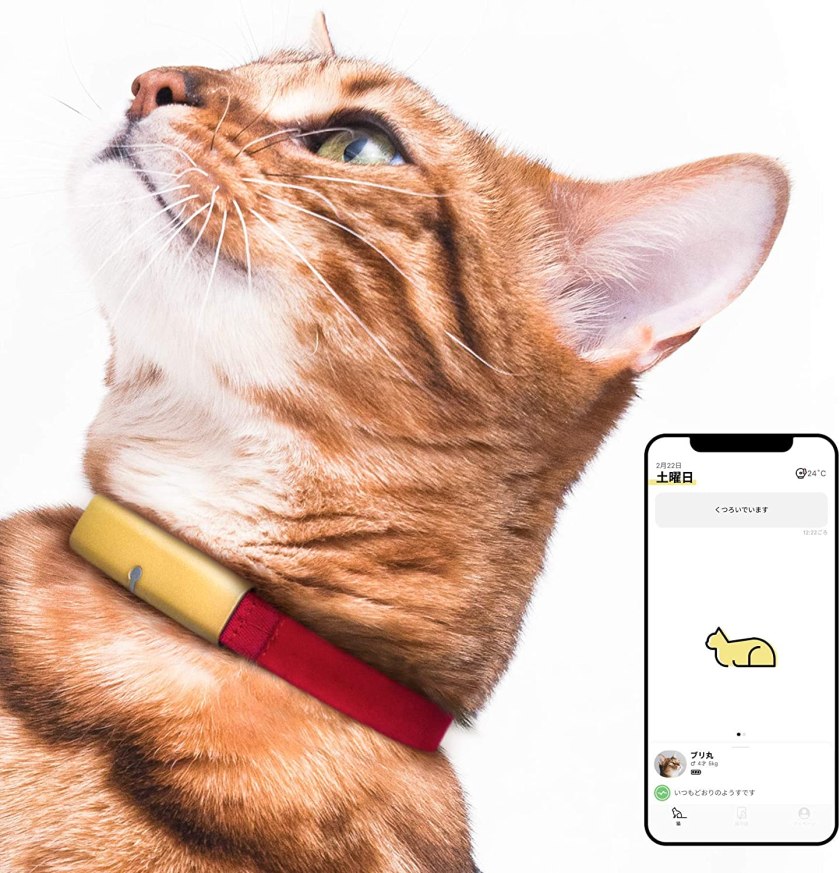
Still, it’s one thing to know something anecdotally and another to prove it, and there are tantalizing possibilities as more kitties are equipped with Catlog. The collar-like device uses “biologging” technology to record and sort data on things like eating, drinking, sleeping, grooming and exercise. The data is relayed to caretakers via a mobile app and added to the information coming from every other Catlog, giving the research team behind the app hard data for cats across all ages and breeds.

The Catlog has received Japan’s Good Design Award, a sought-after mark of excellence among Japanese products.

Catlog
Catlog looks like a regular collar with an unobtrusive device attached.

Unfortunately Buddy won’t be contributing to that data even if Catlog pushes into the US market. Little dude won’t tolerate a collar at all and is not shy about loudly, repeatedly, incessantly communicating when he doesn’t like something. 🙁

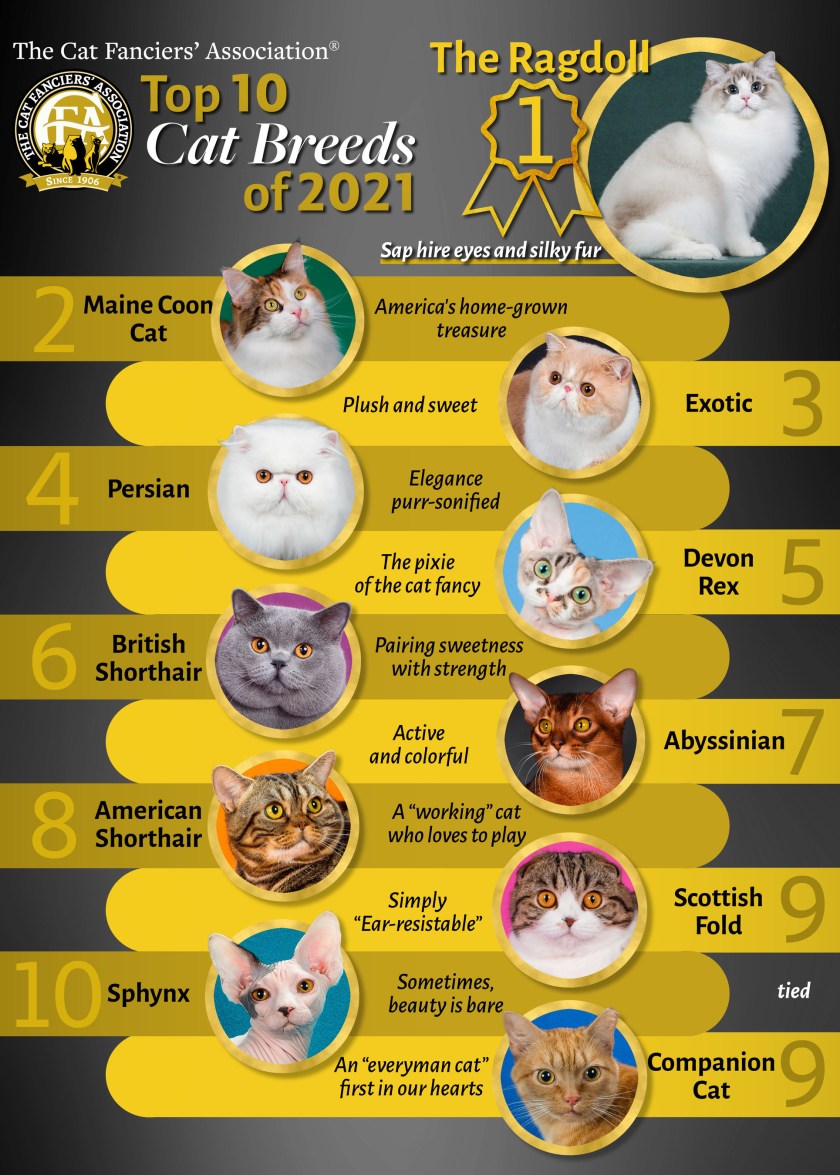
Most Popular Cat Breeds of 2021, According to CFA

The Cat Fanciers’ Association has released its annual list of the most popular cat breeds. While the CFA recognizes 45 breeds and registers “non-pedigreed” cats as well, the list is based only on CFA registered cats. That means it provides a good snapshot of which breeds are trendy, but it’s not a definitive most popular breeds list.

Cats without a particular breed still account for the vast majority of all pet felines, but among people who registered their cats with CFA, Ragdolls were the most popular in 2021, followed by gentle giant Maine Coones and exotic shorthairs. (Note that this list does not include the fearsome and elusive Buddinese Tiger.)

2021-breeds-with-CC
The world’s largest registry of pedigreed cats has again determined the world’s most popular cat breeds, based on registrations. This year’s Top 10 list reflects the increasing popularity of certain breeds. However, registrations of ALL cats have increased substantially, reflecting the growing popularity of pet cats since the beginning of the pandemic.

How Much Can AI Teach You About Your Cat?

A new AI algorithm promises to help you gauge your cat’s mood — and determine if she’s in pain — by analyzing facial expressions.

In the photograph, Buddy is sitting on the coffee table in the classic feline upright pose, tail resting to one side with a looping tip, looking directly at me.

The corners of his mouth curve up in what looks like a smile, his eyes are wide and attentive, and his whiskers are relaxed.

He looks to me like a happy cat.

Tably agrees: “Current mood of your cat: Happy. We’re 96% sure.”

Screenshot_20210730-092555

Tably is a new app, currently in beta. Like MeowTalk, Tably uses machine learning and an algorithmic AI to determine a cat’s mood.

Unlike MeowTalk, which deals exclusively with feline vocalizations, Tably relies on technology similar to facial recognition software to map your cat’s face. It doesn’t try to reinvent the wheel when it comes to interpreting what facial expressions mean — it compares the cats it analyzes to the Feline Grimace Scale, a veterinary tool developed following years of research and first published as part of a peer-reviewed paper in 2019.

The Feline Grimace Scale analyzes a cat’s eyes, ears, whiskers, muzzle and overall facial expression to determine if the cat is happy, neutral, bothered by something minor, or in genuine pain.

It’s designed as an objective tool to evaluate cats, who are notoriously adept at hiding pain for evolutionary reasons. (A sick or injured cat is a much easier target for predators.)

But the Feline Grimace Scale is for veterinarians, not caretakers. It’s difficult to make any sense of it without training and experience.

That’s where Tably comes in: It makes the Feline Grimace Scale accessible to caretakers, giving us another tool to gauge our cats’ happiness and physical condition. With Tably we don’t have to go through years of veterinary training to glean information from our cats’ expressions, because the software is doing it for us.

Meanwhile, I used MeowTalk early in the morning a few days ago when Buddy kept meowing insistently at me. When Bud wants something he tends to sound whiny, almost unhappy. Most of the time I can tell what he wants, but sometimes he seems frustrated that his slow human isn’t understanding him.

I had put down a fresh bowl of wet food and fresh water minutes earlier. His litter box was clean. He had time to relax on the balcony the previous night in addition to play time with his laser toy.

So what did Buddy want? Just some attention and affection, apparently:

Screenshot_20210801-181618

I’m still not sure why Buddy apparently speaks in dialogue lifted from a cheesy romance novel, but I suppose the important thing is getting an accurate sense of his mood. 🙂

So with these tools now at our disposal, how much can artificial intelligence really tell us about our cats?

As always, there should be a disclaimer here: AI is a misnomer when it comes to machine learning algorithms, which are not actually intelligent.

It’s more accurate to think of these tools as software that learns to analyze a very specific kind of data and output it in a way that’s useful and makes sense to the end users. (In this case the end users are us cat servants.)

Like all machine learning algorithms, they must be “trained.” If you want your algorithm to read feline faces, you’ve got to feed it images of cats by the tens of thousands, hundreds of thousands or even by the millions. The more cat faces the software sees, the better it gets at recognizing when something looks off.

At this point, it’s difficult to say how much insight these tools provide. Personally I feel they’ve helped me understand my cat better, but I also realize it’s early days and this kind of software improves when more people use it, providing data and feedback. (Think of it like Waze, which works well because 140 million drivers have it enabled when they’re behind the wheel and feeding real-time data to the server.)

I was surprised when, in response to my earlier posts about MeowTalk and similar efforts, most of PITB’s readers didn’t seem to share the same enthusiasm.

And that, I think, is the key here: Managing expectations. When I downloaded Waze for the first time it had just launched and was pretty much useless. Months later, with a healthy user base, it became the best thing to happen to vehicle navigation since the first GPS units replaced those bulky maps we all relied on. Waze doesn’t just give you information — it analyzes real-time traffic data and finds alternate routes, taking you around construction zones, car accident scenes, clogged highways and congested shopping districts. Waze will even route you around unplowed or poorly plowed streets in a snowstorm.

If Tably and MeowTalk seem underwhelming to you, give them time. If enough of us embrace the technology, it will mature and we’ll have powerful new tools that not only help us find problems before they become serious, but also help us better understand our feline overlords — and strengthen the bonds we share with them.

Buddy is bored
Buddy’s bored of all this AI talk and wants a snack.