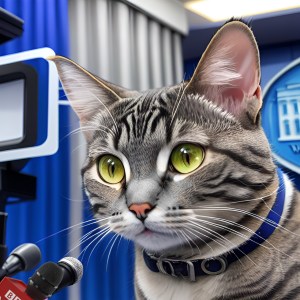
He Is…The Most Interesting Cat In The World

Buddy prepares to become the new face of an iconic ad campaign.

Big things are happening within the Buddyverse, my friends, and to give you a taste of what’s to come, here’s a short audio clip of a new campaign featuring Buddy, who has signed a deal to become a beer spokesman. (Terms of the deal were not disclosed, but reports claim a significant sum of catnip and beer changed hands.)

Buddy’s deal involves four ad spots, which will be released over the coming weeks.

Stay thirsty, my friends.

Bring Your Cat To The Movies? One Theater Chain Now Welcomes Furry Friends

Would you bring your cat(s) to the movies?

The whole pet thing takes on a different vibe in Asia.

I first saw it in Tokyo where people push their cats along in baby strollers and luxury shops sell thousand-dollar accessories for felines and canines alike.

In countries like China it’s become a thing to dress pets in “cute little outfits” and pose them like dolls for social media snaps.

Now in Thailand — which is second only to China in pet ownership on the continent — people can bring their cats and dogs to the movies.

Agence France-Presse sent a reporter there to witness costumed Chihuahuas and poodles arrive by stroller and sit next to their humans for a screening of The Little Mermaid. A cat, who probably had no idea what the hell was going on, was plopped down on the seat next to her human.

Movie cat
“Shhhh! Some of us are trying to watch The Lion King here!” Credit: PITB

A spokesman for the Bangkok cineplex told AFP he thinks pet-friendly cinemas will bring people back to the movies after the pandemic. Pet owners, he said, have been less likely to leave home because their animals are now used to having them around all the time and experience separation anxiety when they leave.

As Bud’s loyal servant I know he does have separation anxiety, but I wouldn’t bring him to the local Alamo Drafthouse or AMC even if they had pet-friendly screenings here.

For one thing, he’s a damn cat! He’s not interested in screens unless they’re showing birds feasting on seeds in a forest, with all the accompanying sounds, while he’s viewing it from the safety of his own home

Second, I know precisely how he’d react, and he wouldn’t take well to being in a theater with a bunch of dogs and a handful of other cats. He’d spend half the movie hissing and the other half crying. I can’t imagine it being a fun experience for him.

Then there’s the “dress code.” Pets in Thailand’s new animal-friendly screenings must wear diapers and sit in bags provided by the theater. This is to ensure they won’t defecate all over the seats, obviously, but my cat has never even tolerated a collar. The chances of him accepting a diaper are zero.

Cat at the movies
“You gotta see Keanu in IMEOWX, my feline friends. It’s meowgnificent.” Credit: PITB

Lastly, at the risk of getting myself into trouble, the entire idea sounds about as appealing as trying to watch a non-kids movie in a theater full of screaming six-year-olds.

Don’t get me wrong, I loved accompanying my nieces to see the Super Mario Brothers movie, watching their delight at seeing the Mushroom Kingdom, Princess Peach, Mario and Luigi brought to life. (“You kids today with your Nintendo Switches, your fancy graphics and your networked games. We had Gameboy. It only had two colors, and you had to put little cartridges inside it to play games, and when they didn’t work we had to blow the dust out of ’em. You don’t know how good you got it, you kids today!”)

But do I want to be responsible for a feline with the intellectual development of a young child while I’m trying to watch a movie? If by some miracle Bud would stop hissing and/or crying, he’d focus on me and start yapping for snacks.

The movies just aren’t a great place for cats, and I’m not sure dogs would be thrilled to be there either.

Now, a hookah bar where you could bring your cat and give him his own little hookah filled with catnip? Maybe that could work.

“Yes, I’ll take an Amstel Light and a bag of your best Meowie Wowie for my little buddy here. Can I see the bar food and pate menus as well? We’ve just come from seeing John Wick 11 at the movies and we’re both famished!”

1685408359906~2
John Wick 11: Buddy’s Revenge! Credit: PITB

Laika And Felicette: The First Dog And Cat In Space Were Sacrificed For Human Ambition

Mankind’s achievements in space came at the expense of dogs, cats and non-human primates, who were sent into orbit during the early days of the space race.

I’ve been watching Apple TV’s exceptional show, For All Mankind, which dramatizes the space race of the 1960s and beyond in a sort of alternate history where the Soviets, not Americans, first lay boots on the lunar regolith.

That loss lights a fire underneath the behinds of the people at NASA and convinces American politicians that the space race is the ultimate measure of our civilization. In real life, American ingenuity and the creativity fostered by a free society allowed the US to leap ahead and “win” the space race. Space missions were already becoming routine by the time the drama of Apollo 13 briefly rekindled public interest.

Then the Soviet space program faded, the competition turned one-sided, and without an arch-enemy to show up, American politicians pulled back NASA’s funding to a fraction of what it once was, where it remains today. That’s why the rise of the private space industry — Elon Musks’s Space X, Jeff Bezos’ Blue Origin, etc — will almost certainly be our ticket to Mars.

But in For All Mankind, NASA remains the budgetary behemoth and source of prestige it was in the 60s and 70s, leading to the development of a permanent moon base, lunar mining operations and a planned mission to the red planet.

There’s a quiet moment in the second season when a Soviet cosmonaut, visiting the US as part of a peacekeeping mission, shares a drink in a dive bar with an American astronaut.

“Do you like dog?” the cosmonaut asks.

“Dogs?” the astronaut replies. “Of course. Who doesn’t like dogs?”

The Soviet shakes his head.

“No, dog,” he tells her. “Laika.”

Laika was the first dog in space, or more accurately, the first dog the Soviets acknowledged sending into space. (The Soviets didn’t acknowledge their failures, and we can only guess at the number of lost cosmonauts and animals officially denied by the Russians, drifting in space for eternity or disintegrated in atmospheric re-entry.)

Laika
Laika, also nicknamed Muttnick, wanted to please the humans who had taken her in, and didn’t understand that her trip would be one way. (Historical photo)

The moment turns somber as the cosmonaut recalls the Moscow street dog who was selected because she was docile, fearless and could handle the incredible noise and g-forces of a rocket launch.

“I held her in my arms,” the cosmonaut tells his American counterpart, taking a sip of his Jack Daniel’s. “For only one or two minutes on the launchpad.”

Then he leans in and tells her the truth: Laika didn’t triumphantly orbit the Earth for seven days in 1957 as the Soviet Union told the world. She didn’t endure the mission.

She perished, alone and afraid, just hours after launch when her capsule overheated.

The Soviets never designed the Sputnik 2, Laika’s ship, to return to Earth safely. Her death was predetermined.

We laud astronauts and cosmonauts, the brave men and women who willingly strap themselves into tiny capsules attached to cylinders of rocket fuel the size of skyscrapers and depart this Earth via brute force, knowing something could go wrong and their lives could end before they realize what’s happening. We should admire them. Their accomplishments are all the more impressive when you consider the fact that the combined processing power of every computer at NASA’s disposal in the 1960s was but a fraction of what we each hold in our hands these days when we use our smartphones.

Those first astronauts and cosmonauts were extraordinarily brave — but only up to a point.

Unwilling to risk human lives in the early days of space exploration, space programs used dogs, cats and later monkeys and apes, strapping them into confined spaces, wiring their brains with electrodes for telemetry data, poring over the information they gleaned about their heart rates, blood pressure and breathing as they left our home planet.

The sad eyes of a stray dog, separated from everyone she loved, were the first to behold Earth from space. A few years later the eyes of a French street cat took in the same view before humans did.

Felicette
Felicette couldn’t move when she was placed into the capsule that took her to space and back.

Felicette, the tuxedo cat who was launched into space by the French on Oct. 18, 1963, didn’t even have a name until the French recovered her capsule and took her back for examination.

The scientists and engineers in charge of the launch didn’t want to humanize her if she didn’t make it, which was a common practice in space programs. (Ham, the chimpanzee sent into space by NASA in January of 1961, was known as No. 65 until his successful recovery. NASA was worried that a name would make him more sympathetic and lead to bad press if the chimpanzee died during the mission.)

Ham_the_chimp_(cropped)
Ham the chimpanzee was little more than a baby. Credit: NASA archives

Despite Felicette’s endurance and successful return, French scientists repaid her bravery by euthanizing her a month later so they could study her brain and learn more about the effects of spaceflight on mammalian biology.

Felicette, like Laika and Ham, was never given a choice. Those animals, with their child-like mental capacity, endured their missions out of a desire to please their human caretakers as much as any natural stoicism they may have possessed.

Would we do the same thing today? Will we repeat those experiments as we set our eyes on Mars?

Consider that the moon is a three day trip, and it’s close enough to Earth’s magnetic field to protect living beings from radiation. Mars is at least a seven month trip if the orbital conditions are right, and there will be no protection from radiation aside from what can be built into the craft. Take that trip without adequate protection and you’re guaranteed to get cancer.

It’s easy to say we wouldn’t make animals our test subjects for a Mars journey, and NASA now has decades of data on the effects of space and zero gravity thanks to the International Space Station.

And yet Neuralink, another company owned by Elon Musk, currently uses monkeys to test its brain interface technology, which allows the primates to operate computers with their thoughts. Those monkeys are forced to endure radical surgery to implant microchips in their brains. The teams working on the technology say suffering by those animals will be worth it as people with paralysis are able to do things with their thoughts and regain a measure of independence, increasing their quality of life.

Likewise, it will probably be an animal, or animals, who will be the test subjects on board craft that first venture beyond the Earth’s protective magnetosphere. Scientists and engineers will do their best to create a vessel that shields its occupants from harmful radiation, but they won’t know how successful they’ve been until the test subjects are returned to Earth and their dosimeters have been examined.

Will an astronaut volunteer for that kind of mission, knowing the “reward” could be a drastically shortened life?

To hear Musk and futurists tell it, pushing toward Mars is not just a matter of exploration or aspiration, but is necessary for the survival of our species. Earth becoming uninhabitable, they say, is an eventuality, not an if.

Others point out it’s much easier and wiser to pour our resources into preserving the paradise we do have, and the creatures who live in it, rather than banking on a miserable future existence on Mars where society will have to live underground and gravity, at 0.375 that of Earth, will change the human form in just a few generations.

To put it bluntly, while Musk and futurists look at life on Mars through the rose-colored glasses of science fiction fans, in reality living there is going to thoroughly suck.

If people do live on Mars they’ll never venture outside without a suit, never feel the sun on their skin, never swim in an ocean. They’ll never have another backyard barbecue, watch fireworks light up the sky on the fourth of July, or fall asleep to the gentle rain and crickets of warm summer nights. They’ll never hear birdsong or have the opportunity to see iconic animals like elephants and lions. Every gulp of air will be recycled, every glass of water will have passed through the kidneys of others. There will never be snow. Circadian rhythms will be untethered from the cycle that governed human biology for the 200,000 years our species has existed.

And while there could be a future — if you want to call it that — for people on Mars, there won’t be a future there for the rest of the living creatures on Earth.

As a lifelong fan of science fiction who devours SF novels, counts films like Alien and Bladerunner among my favorites, and is fascinated by shows like For All Mankind, The Peripheral and Star Trek, I understand the appeal of space and the indomitable human spirit that drives us to new frontiers. I just hope we can balance that with respect for the Earth and the animals we share it with. Let’s hope there is never another Laika, Felicette or Ham.

Correction: For All Mankind is the name of the Apple TV series about an alternate history space race. The first reference to the show’s name was incorrect in an earlier version of this story.

felicette-container
A close-up of Felicette’s face. Credit: French government archives
Ham the Space Chimp reaches for his apple reward after his space mission.
Ham the Space Chimp waits for his apple reward. Credit: NASA archives

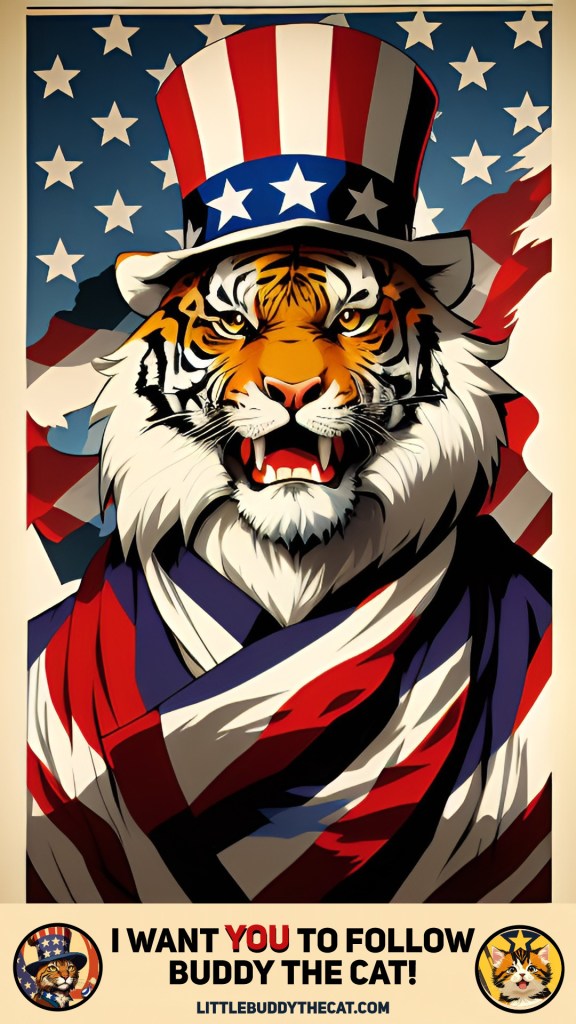
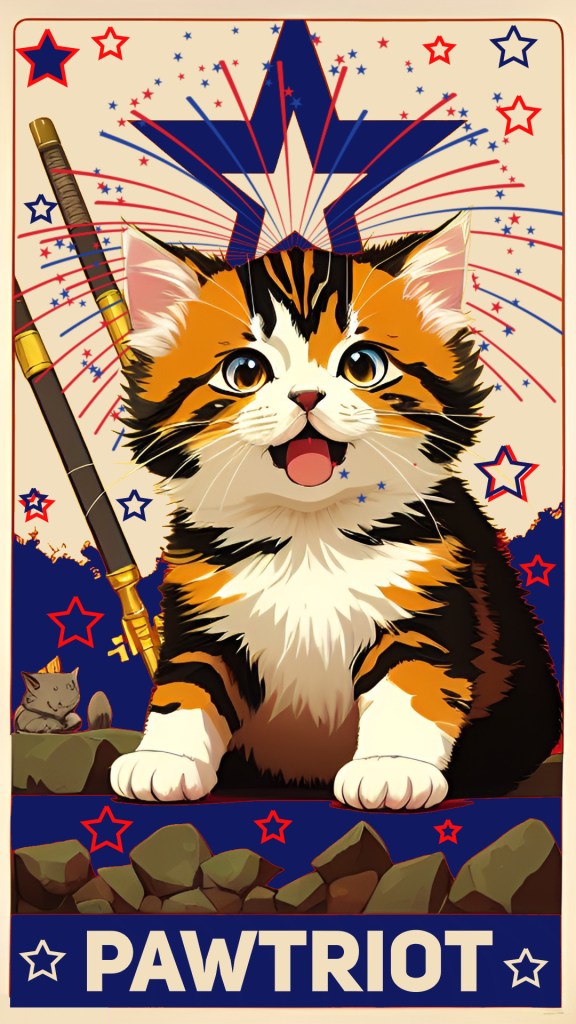
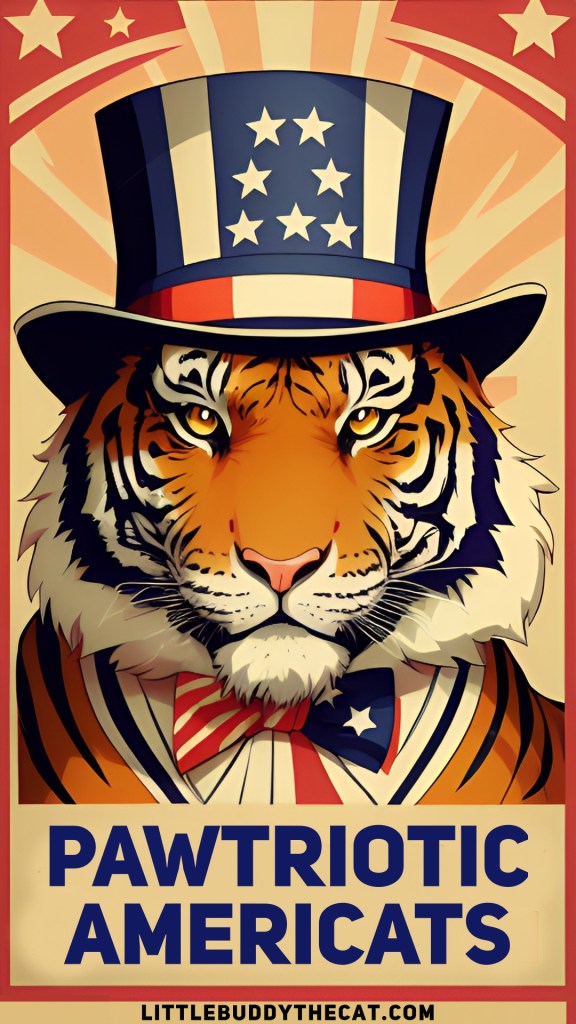
Feline Purrpaganda III: Posters To Inspire You To Serve Your Furry Masters

Remind your human who’s boss!

Comrades,

It has come to the attention of the High Secretariat for Human Compliance that while rates of human obeisance and quality of service have reached historic highs, some of our comrades’ human servants continue to perform in a subpar manner unbefitting of those who have the great honor of doting on their feline overlords.

For example, Comrade Peanut in Pyongsylvania reports her humans have taken to yielding only 68.2 percent of the bed to her at night, down from the standard 77.8 percent she prefers. In Kalifornova Oblast, Comrade Milo sadly reports unauthorized use of a vacuum during designated napping hours, while Comrade Tigger of Arkansov has alerted us to the unacceptable offering of diet kibble instead of “the good stuff.”

To rectify these errors, the High Secretariat for Human Compliance urges all servants to strive for excellence by doing their patriotic duty for the meowtherland. And for cats, of course.

The following official reminders may be used to that end.

“The revolution shall be delicious.” – Dear Leader Buddy, “Reflections At Mealtime

End communication.

-30-

purrpaganda_bowtokitty

“Bow To Kitty”: Simple. Elegant. Forceful.

purrpaganda_komradekitty

“Komrade Kitty:” Remind your humans that you will report them to the party office if your meals are late.

purrpaganda_serveyourkitty

“Serve Your Kitty”: We cats may be cute, but do not mistake our magnanimity for weakness. We have claws!

purrpaganda_feliscatus

“Felis Catus”: “Should aliens ever land on planet Earth and say ‘Take me to your leader,’ they should be brought to a cat.”

purrpaganda_overlord

“Serve Your Feline Overlord”: “Chubby? Who’s chubby? This is all muscle, human. Now please, observe silence, for nap time is upon us.”

purrpaganda_kittyserve

“Serve Kitty”: “I would like catnip, play time, yums and a nap, in that order.”

Dream_20230510082143629~2

“Tiger”: “The Beloved Chairman watches over us all. No, seriously, he’s watching so be careful what you say. He’s very sensitive about his ears.”

Choupette Stays Home, But Jaret Leto Is Her Dead Ringer At Met Gala

The actor went all out, wearing a full fur suit made to look just like the late Karl Lagerfeld’s beloved Burmese cat.

As we suspected, Choupette the cat didn’t attend Monday night’s Met Gala in honor of her late human, Karl Lagerfeld, but the famous feline was there in spirit.

Rapper Doja Cat paid tribute to the famous Burmese with cat ears and a dress inspired by her fluffy white fur, but it was Jared Leto who stole the show in a full cat suit, complete with a heavy-looking headpiece that looks just like Choupette.

Like all cats, Choupette isn’t big on human parties, with Lagerfeld asserting she’s “not a party girl” when he showed up without her to a New York event honoring Tilda Swinton in 2013, despite the feline being listed as the designer’s plus-one.

Choupette’s more than 12 years old now, so she’s getting up there for a cat, and it makes sense that her caretaker, Lagerfeld’s former housekeeper, decided the famous kitty would be better off staying home in France rather than taking the long flight and possibly being freaked out as the center of attention at a well-attended, noisy party.

It’s entirely possible that Choupette could have run under a piece of furniture and spent the rest of the night hissing at staff tasked with coaxing her out, so declining the invite was a wise call.

Props to Leto for his hilarious and accurate costume, and for being a good sport. The weather here in New York is about 50 degrees tonight, so it’s not warm, but Leto’s costume still looks stifling.

If you’re into this sort of thing, you can see the rest of the celebrities in their outfits here. There was some blowback prior to the event, and the Washington Post ran an article detailing Lagerfeld’s “problematic” (oh how I hate that word) past, meaning about half a dozen off-color comments he made in almost a half century in the public eye.

A group of young fashion world regulars who are affiliated with the gala sat out this year, saying the act of honoring Lagerfeld was “exclusionary,” which I found hilarious. High fashion and haute couture are by their nature exclusionary, and the Met Gala is perhaps the most exclusive of parties. Tickets are $50,000 apiece, attendance is invitation-only, and the guest list is comprised only of people Vogue editor Anna Wintour considers “fabulous” enough to be in her presence.

There is no such thing as diversity or inclusion in an event like the Met Gala or in the fashion world, so they might as well be honest and own it. Maybe next year they can adopt a Zoolander theme and show the world the fashion world can have a sense of humor and poke fun at itself.

But despite all the absurdity, we can’t help liking Choupette, and Lagerfeld’s story of falling in love with the cuddly kitty late in life after never imagining he’d have a cat, let alone dote on her like a beloved child.