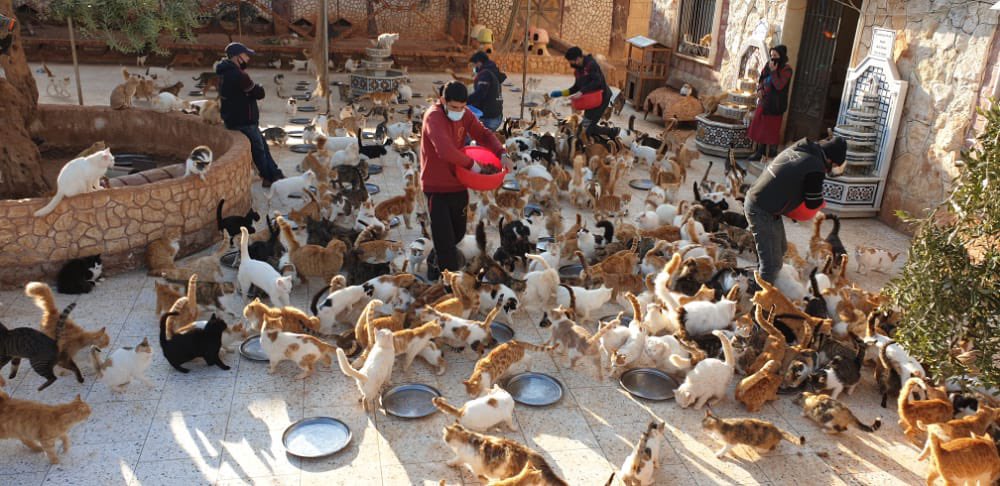
The Cat Man of Syria Cares For Forgotten Felines

The Cat Man of Aleppo has survived bombs, chemical gas, a siege and a risky flight to Turkey as he’s cared for people and cats suffering in Syria’s civil war.

Human beings have lived in the city known as Aleppo for more than 4,000 years, making it one of the oldest continually-inhabited settlements in human history.

But as the raging civil war in Syria expanded and bombs began to fall on the country’s largest city, there was an unprecedented mass exodus — reducing Aleppo’s population from 4.6 million in 2010 to less than 600,000 by 2014.

Mohammad Alaa Aljaleel was one of the stubborn few who stayed. His wife and children fled to safety in Turkey in 2015, but anchored by his commitment to people who couldn’t leave, Aljaleel stayed behind to continue driving his ambulance and feeding a growing population of abandoned cats.

At first friends and acquaintances turned to Aljaleel to take their cats as they prepared to flee the crumbling city, knowing he was fond of felines and would care for them as his own.

Others heard about the “cat man of Aleppo,” and soon Aljaleel’s home became a sanctuary for former pets from all over the city, which was becoming a ghost town.

With few remaining people to feed them — and food sources like restaurant dumpsters drying up — hungry stray cats started showing up too.

“Since everyone has left the country, including my own friends, these cats have become my friends here,” Aljaleel said in 2016, as a BBC camera crew filmed him among the hundreds of cats in his care.
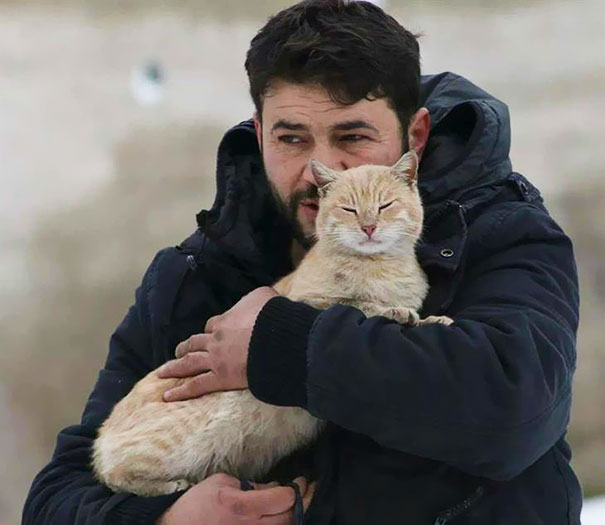
Aljaleel
Aljaleel, the Cat Man of Aleppo, hugs a tabby in his care.

One day a car pulled up and a little girl stepped out, cradling a cat.

Her parents “knew there was a cat sanctuary here,” Aljaleel told the BBC at the time. “The girl had brought the cat up since she was a kitten. She cried as she handed her over to me, and they left the country.”

For many people leaving the city in search of refuge in Europe or elsewhere in Syria, the decision to leave a beloved pet was agonizing.

But entrusting a cat to Aljaleel and his makeshift sanctuary — where the animal would be fed and well cared for — was much more palatable than making it to the border of an EU country only for a border guard or customs official to refuse the cat entry, forcing families to choose between pet and safety.
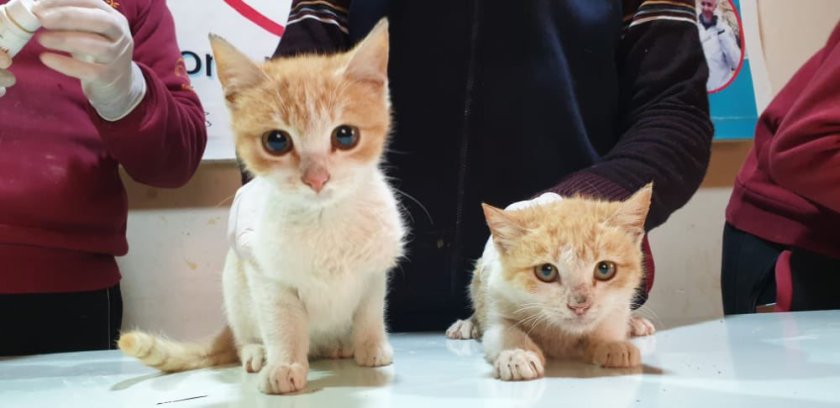
Ernesto's Sanctuary kittens
Kittens who were brought to Ernesto’s Sanctuary with their mother.

For people like the little girl, knowing their cats were in Aljaleel’s sanctuary meant maintaining a tie to home and hope that they could return.

“I’ve been taking photos of the cat and sending them to her in Turkey. She begs me, ‘Send me photos of her. I miss her. Please promise to return my cat to me when I get back.'”

That was in 2016. Almost five years later it looks like the young girl won’t be returning to Syria, and her cat is likely dead.

After Aljaleel’s makeshift cat sanctuary swelled to include more than 200 cats, things took a turn for the worse.

The Syrian government and rebel forces dug in, calling on allies for support and resources. ISIS and Iranian-backed insurgents entered the fray, seeing opportunity to advance their own interests amid the chaos.

So too did Russia and the United States. Both countries treated the conflict as a proxy war, with Russia backing Assad and his Syrian government forces, while the US and its allies threw their support behind an opposition that grew out of the Arab Spring in 2011.

The US and Russia provided the combatants with training and weapons systems, increasing the destructive firepower at the command of the belligerents. Both countries sought to advance their geopolitical ambitions in the region when they entered the conflict.
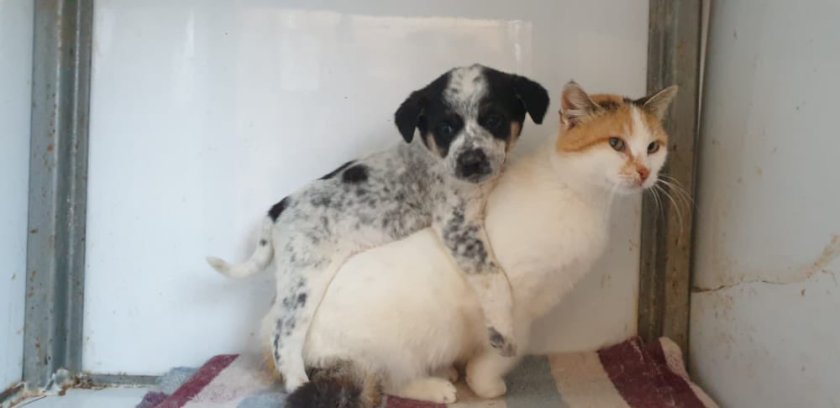
Ernesto's Sanctuary
Not just cats: Alina and Samira are best friends and are inseparable. Credit: Ernesto’s Paradise

In internal memos justifying intervention in Syria, the US State Department predicted the civil war would flare out in months. Instead, the war has now lasted more than a decade, and in a move The Guardian called “a bloody end to [former President Barack] Obama’s reign,” in 2016 the US dropped 26,171 bombs on countries in the Middle East, with Syria absorbing the lion’s share.

Perhaps it was one of those bombs — or a bomb from Russia, or one of Syrian dictator Bashar al Assad’s own warheads — that obliterated Aljaleel’s sanctuary. It’s unlikely anyone will ever know. But one thing all sides agree on is that the chlorine gas was courtesy of Assad, who has not hesitated to use chemical weapons against his own people in the bloody war.

Weeks after Aljaleel was featured in a BBC short about the impact of the war, Aljaleel “watched helplessly as his cat sanctuary was first bombed, then gassed during the intense final stages of the siege of Aleppo,” per the BBC.

Some 180 of the 200 or so cats who found refuge with Aljaleel were killed by the bomb and the chlorine gas, and the stubborn man who dug in his heels and cared for Aleppo’s cats while everyone else fled finally gave up on his city.

Aljaleel and his cats survived the power outages, the destruction of the water works, the food shortages and a military siege of the city, but now the Cat Man of Aleppo was just a cat man in an ambulance.

He packed the few surviving cats, his meager possessions and a few sick, injured or elderly people into an ambulance and joined a convoy of civilians escaping the crumbling city. It was a tense and perilous journey, as those who fled knew Assad had no reservations about targeting his own people if it served his goals.

After seeing his family and recovering in Turkey, and with the help of an Italian benefactor and a growing community of supporters on social media, Aljaleel took his cats and his friends to a rural area in Syria, far from targets of opportunity, where he purchased a plot of land, put down roots and began his sanctuary anew.
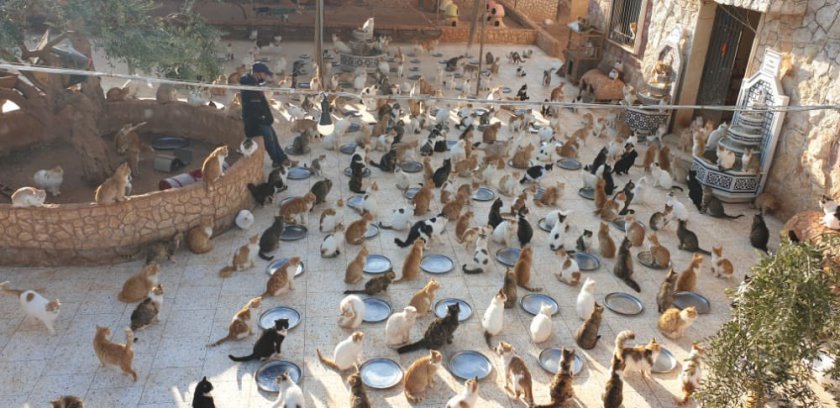
Ernesto's Paradise
Even in war, cats know when it’s time to eat. The kitties of Ernesto’s Paradise wait by the more than 100 plates set out for them, eager for meal time. Credit: Ernesto’s Sanctuary.

That sanctuary is called Ernesto’s Paradise, named after Aljaleel’s own cat.

Ernesto’s Paradise is home to several hundred cats, plus four monkeys, horses, rabbits and dogs. There’s a playground for kids and — after a long search to find a veterinarian who hadn’t fled — Ernesto’s finally has a doctor in the house too.

The civil war in Syria has created perhaps the worst refugee crises in modern history, with millions fleeing to Europe and elsewhere in search of sanctuary.

The war had claimed 387,118 souls as of December 2020, according to the UK-based Syrian Observatory for Human Rights. Another 205,300 were missing and presumed dead, according to SOHR. In addition, more than 88,000 people have been tortured to death in Assad’s prisons, while thousands more were taken by ISIS and other terrorist groups operating in the country.

But “children and animals are the big losers” in war, Aljaleel told the BBC, and that’s why he chose to return.

“I’ve always felt it’s my duty and my pleasure to help people and animals whenever they need help,” he said. “I believe that whoever does this will be the happiest person in the world, besides being lucky in his life.”

You can follow and support Aljaleel’s work via Twitter, Facebook and by visiting his sanctuary’s official site. Direct donations to the sanctuary can be sent here.
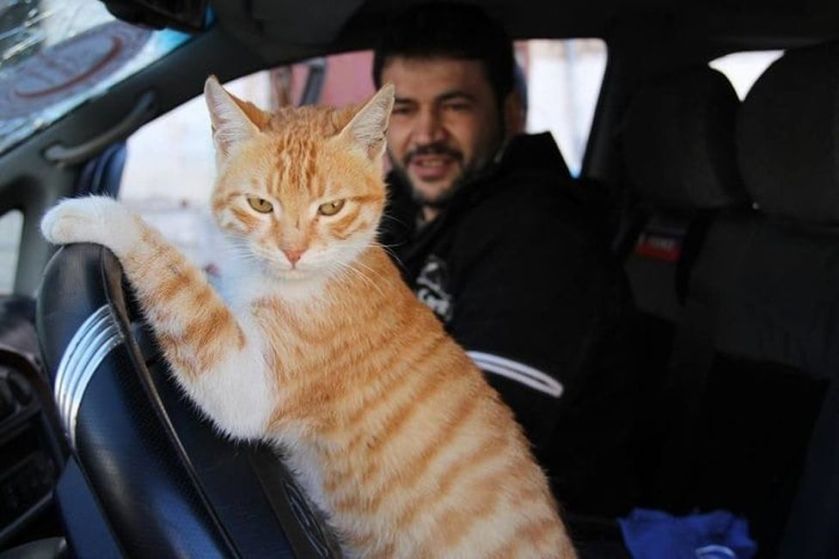
Ernesto and Alaa
Ernesto the cat and Alaa Aljaleel.

Reason #53 To Keep Your Cats Indoors: Vigilantes

A cat killer warns people in one neighborhood to get their cats off the streets.

One bad thing about having Google News alerts for cat-related stories is the sheer, sickening volume of articles about cats who are maimed, tortured, killed by vigilante lunatics, dispatched by overzealous birders, shot with BB guns or arrows, poisoned with antifreeze, murdered as proxies in domestic violence incidents, kicked like soccer balls by juvenile psychopaths, or tragically killed by someone’s epic stupidity.

The amount of violence directed at felines is mind-boggling, and it doesn’t reflect well on the US: For example in Istanbul, a city of more than 15 million people, there are some 130,000 cats living on the streets, not including pets. While many ‘Mericans see an animal and think “Let’s shoot it!” the people of Turkey are overwhelmingly compassionate, going to incredible lengths to make sure street cats are fed, watered, sheltered and have access to veterinary care.

Today’s story fits in the “vigilante lunatics” category.

It’s not clear if the person in question simply hates cats or is acting out of some misguided campaign to “protect” small wildlife, but we do know that a would-be cat killer is threatening to kill outdoor kitties in Joplin, Missouri, a city about 230 miles east of Oklahoma City.

photo of british shorthair cat sitting on grass field
Credit: Kirsten Bu00fchne/Pexels

The suspect slapped warning letters and posters on the front doors of homes along four separate streets between 2:40 and 5 a.m. on Monday, local police said.

Cops haven’t released the full text of the letters, but said the letter-writer threatened to kill any stray or feral cats he or she comes across in the neighborhood. Likewise, while police did say images of the letter-writer were captured on doorbell cameras, they’re holding the identifying details close to the vest right now, which they may do for any number of reasons.

One of the homeowner who received the letter said he fears his two missing cats are now dead. Another neighbor said the letters follow similar threats by a woman wearing a red jacket, who told some people in the neighborhood to keep their cats inside or else.

“The lady, she was walking up and down the streets going door to door telling everybody that they better watch out for our cats because they were going to start being euthanized,” the neighbor told WKSN, the local NBC affiliate.

Joplin police are offering $2,500 to anyone with information that leads to the arrest of the letter-writer.

California Shelter Is Out Of Cats: Adoptions At Record Highs

With unprecedented adoption rates have come cat food shortages in the US and UK.

A shelter in Orange County, California, reached a milestone on Monday after it adopted out the very last of its cats.

“It’s really weird. We have five rooms for cats to roam free, and they’re all empty,” WAGS Pet Adoption’s Cortney Dorney told the Orange County Register. “Normally, we hang out with the cats while we eat our lunch, and now there’s none to hang out with.”

A brown and white tabby named Sphinx was the last kitty to go, scoring a home with a 27-year-old IT specialist who works from home. When he found out all the others were gone, adopter Jairo Granado said he was “glad to be the one who ended up with” Sphinx.

Staffers say they know the reprieve will be short-lived as there are always cats who need homes, but what they’ve seen reflects a much larger trend across the US and UK since the pandemic began forcing people to shelter in place and practice social distancing.

Shelters are setting new adoption records, and in some areas the “supply” of adoptable cats and dogs currently exceeds demand.

“It’s a great time to have a buddy in the house,” Dorney said.

And it’s a great time for buddies to find homes.

Unfortunately, the unprecedented surge in adoption is also a major factor in the pet food shortages currently impacting both countries now. A lack of materials to manufacture cat food packaging, especially tins, is making it more difficult for brands to meet demand for wet food, and disruptions to links in the supply chain — like COVID outbreaks in meat packing plants — are exacerbating the problem.

Companies like Royal Canin, FreshPet and Purina have either apologized or have tried to ease concerns by saying they believe the shortage will ease in May.

Stories about the shortages have me glad I started rotating as many different kinds of food as possible when Buddy was a kitten, so he’d never get picky enough to pass up food as long as it’s decent quality. Some people and their cats haven’t been so lucky.

One story details the frustrations of a Massachusetts man, 49-year-old David Saltz, whose cat Tiger will only eat one type of food from one brand: Fancy Feast Classic Tender Beef Paté.

“I tried literally every other variety of soft canned cat food in the store — including a few cans of some way overpriced, niche, microbrew, small-batch, all-natural, wild-animal-approved, non-GMO, grass-fed (did I mention ridiculously overpriced?) canned food,” Saltz told AARP. “Almost all were turned down. Only occasionally would she eat a bit of a particular flavor, and I would go buy more of that kind, but she was having none of it.”

Bud’s always got a rotation, and it usually looks something like this: Turkey, chicken, salmon, turkey, tuna, beef, turkey, seafood entree, chicken and liver, turkey, and so on. The Buddy-approved ratio is turkey every third meal. And it’s not just about making sure he eats his food: He seems to really enjoy his meals thanks to the variety and good quality (but not outrageously expensive) cat food.

Man Awakes With Robber Pointing Gun At His Head, Demanding His Cats

This cat dispute went too far.

LAURIUM, Michigan — A Michigan man woke up at 4:15 am Wednesday to find another man standing over him, pointing a gun at his head and demanding the victim hand over his two cats.

The cat burglar — or cat robber, to be precise about it — got impatient, snatched one of the furballs and bolted from the home in Laurium, a town in Michigan’s Upper Peninsula about 220 miles north of Green Bay.

The victim, who knew the robber, called police and detectives caught up with the suspect later the same day. He’s a 52-year-old man who has been charged with home invasion and felonious assault, charges that could land him in prison for up to 20 years if he’s convicted. He was also in possession of a gun, which was seized by police.

Cops haven’t publicly released the name of the suspect, who was booked in Houghton County Jail, but said the incident wasn’t random.

“There was a dispute over the cats,” Laurium police Sgt. Kurt Erkkila told People magazine. “I think there was some ownership dispute but it wasn’t [the suspect’s] cats.”

Cops found the suspect with a cat when they arrested him, but did not confirm if it was the same kitty he’d allegedly taken at gunpoint.

It’s unusual for police to withhold the names of people who have been charged with crimes unless the suspects are minors and qualify as youthful offenders, a status in some states that allows minors to get their convictions wiped if they meet certain conditions and stay out of additional trouble for a year.

It’s not clear why police would withhold the name of an adult charged with two serious felonies.

The original MLive report was based on a press release from the Laurium Police Department, while a People reporter spoke to a department spokesman but still did not receive information on the suspect.

We’ll keep an eye on this story and update our readers when more information is available.

photo of gray and white tabby kitten sitting on sofa
Photo by Tranmautritam on Pexels.com

Florida Woman Reunited With Lost Cat [UPDATED]

The SPCA says it has already agreed to adopt the cat to another family and won’t reunite her with her original owner.

UPDATE: Charlene High was reunited with her cat, Donna, after staff at the Humane Society were able to work out a solution between her and the New York family that was going to adopt the 5-year-old Cornish Rex.

Little Donna went missing in February when contractors were installing a wheelchair ramp in High’s home and she got spooked as so many cats do, running out of the house.

She was found on March 14 and brought to the Humane Society of Highlands County, where staff held her for the mandatory five days before listing her for adoption.

In the meantime, High — who had been calling around to local shelters, posting Donna’s photo online and looking for her in the neighborhood — saw a social media post about a cat who had been found. The staff at the Humane Society named her Karena, but she was High’s Donna, and High said she was “ecstatic” her kitty was alive.

High and Donna couldn’t be immediately reunited, however. A family from New York had filed adoption papers for Donna and were planning on driving down to Tampa to pick up the cat.

Staff at the Humane Society worked to find a solution for everyone involved.

“We had to do some backchanneling and talking to the adopters and trying to find a solution with the adopters while also talking to Ms. Charlene,” said Sara Olivero, a staffer at the Humane Society of Highlands County. “We’ve had to do a lot of shuffling, a lot of phone calls, a lot of phone tagging.”

Ultimately, Donna’s would-be adopters agreed that she should be returned home, and will adopt a kitten instead, Olivero said. Donna was spayed, given a day to recover at the shelter, and was reunited with High on Tuesday.

“Ms. Charlene felt bad. The situation was bad to begin with,” Olivero said. Thankfully the solution was satisfactory to all and “every party is happy” with the outcome.

A Fox13 Tampa Bay (WTVT) story about the situation was aired and published to the web on Monday after the resolution, but presented the story as if the dispute was ongoing in addition to including several errors of fact.

We contributed to the flow of misinformation by linking to the WTVT story 11 hours after it was published, a practice called aggregation, and added our own commentary based on the misinformation. We got burned, and the result was presenting an inaccurate and outdated account of events to our readers.

We regret the error and promise to do better in the future. We’re glad the Humane Society found a satisfactory solution in a difficult situation, and we’re glad that Donna the cat has been returned to her original home.

donnathecat
Credit: Charlene High