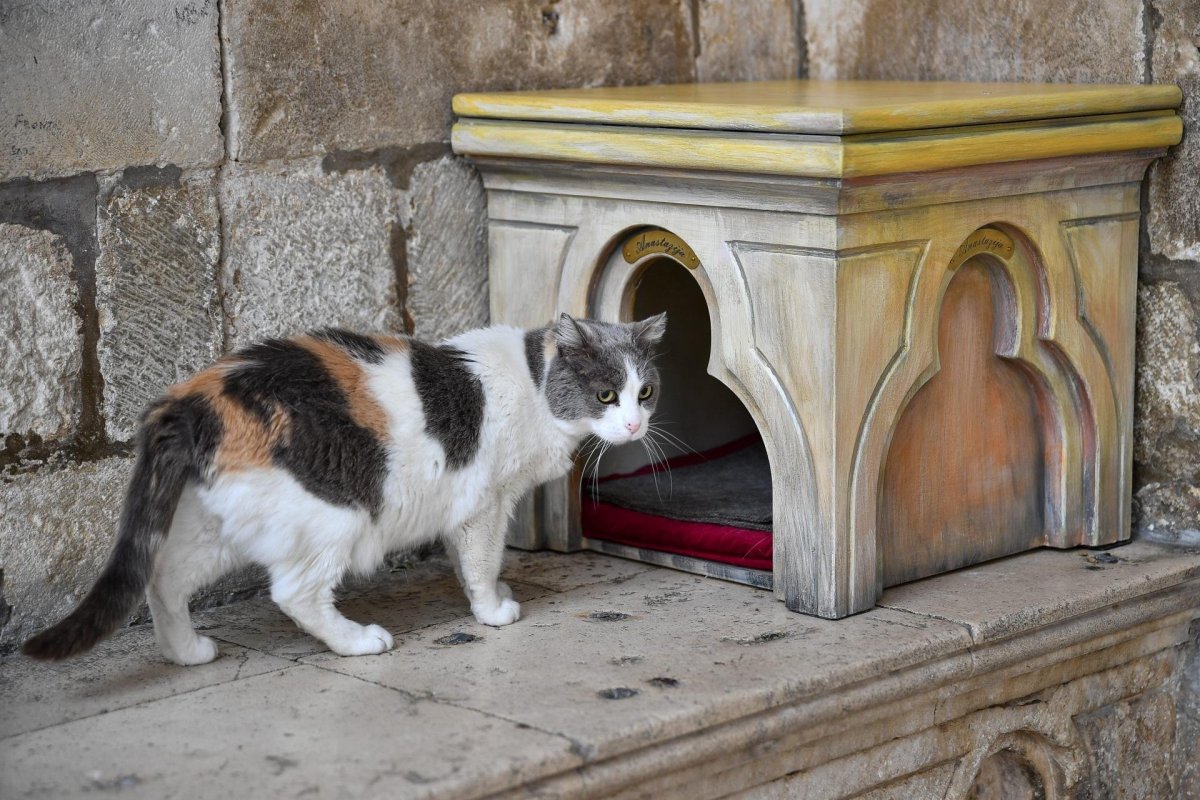
The 17-year-old Anastasia has been living on the grounds of the Rector’s Palace in Dubrovnik her entire life.
Anastasia is still living the palace life.
The community cat found herself in the middle of an uproar after staff at the Rector’s Palace, a historic site in Dubrovnik, Croatia, kicked her off the palace grounds which had been her home for 17 years.
In 2021 staff at the Rector’s Palace, a six-century-old structure which is now a museum, said Anastasia’s little nook, with food and water bowls on top of cardboard, was an eyesore and wanted her gone.
They took away her belongings in May, prompting local carpenter Srdjan Kera to build a beautiful wooden cat house that mimicked the color and architectural details of the palace, giving Anastasia a dwelling that would shield her from the elements as well as blend in with the historic building’s facade.
But palace staff wouldn’t accept the compromise and had the wooden home removed, sparking an outcry among Dubrovnik’s locals and tourists. A petition demanding Anastasia be allowed to stay was signed by more than 12,000 people — a figure greater than the number of people who voted for the city’s mayor, representing more than a fourth of the city’s population.
The furor died down and there hasn’t been much news since then, but Mark Thomas, editor of the English-language Dubrovnik Times, told PITB Anastasia is back at the Rector’s Palace and basking in her fame.
“She doesn’t have her fancy home that was built for her,” the U.K. expat told us, “but rather her spot on a piece of cardboard. She is well fed and seems to be more than happy and enjoying having her photo taken with tourists.”
Thomas said he’d last seen Anastasia just a few days ago in her usual stomping grounds at the palace.
It seems odd that staff at the palace wanted her gone because they found her original nook unsightly, then removed the aesthetically pleasing cat house created by Kera only to go back to the old cardboard arrangement, but we’re glad the senior kitty isn’t subjected to the stress of being forcibly moved from the only home she’s ever known.
Previously, staff at the Rector’s Palace said Anastasia didn’t need her shelter all year round, so perhaps they’ve come to a compromise and will allow it during the winter. Dubrovnik enjoys a mild Mediterranean climate, with temperatures bottoming out at about 50ºF (10ºC) in January, its coldest month, but while the city remains temperate, it experiences significantly more rain in the winter months.
Boka is one of about 10,000 cats who prowl New York’s delicatessens, keeping them free of rodents.
A beloved bodega cat is back where he belongs a week after a thief snatched him from the store.
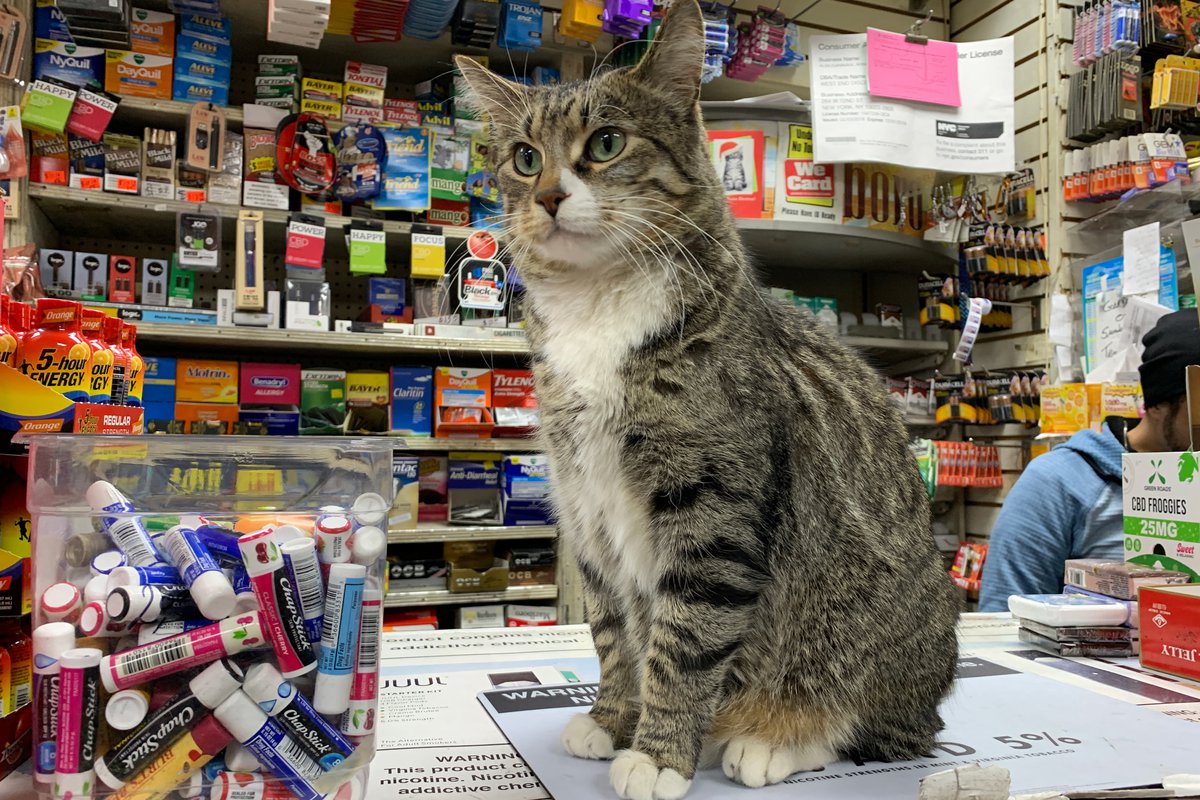
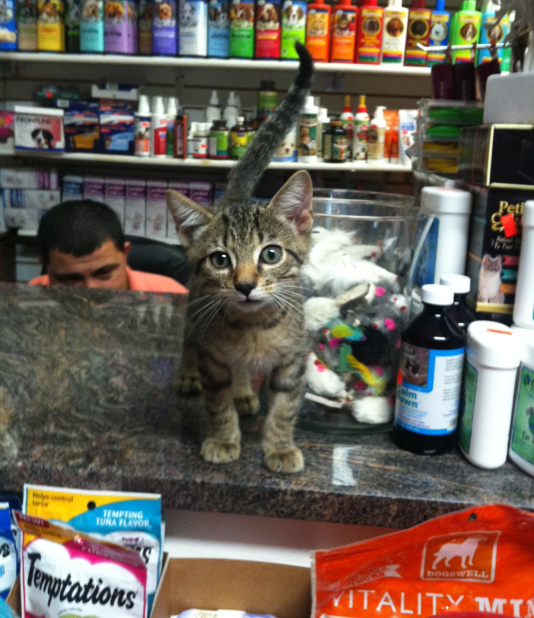
The cat, Boka, is actually a kitten. Majeed Albahri, owner of Green Olives Deli in Brooklyn, adopted the little guy in January and in seven months the all-gray feline has become a familiar face in the neighborhood, where people are used to seeing him sitting on Albahri’s shoulder as he works the register, or napping on the nearest convenient pile of newspapers.
Boka “brings life to the store,” Albahri said, noting people stop by just to give Boka a head scratch.
But on July 29 a guy “skulking around” outside the store took a liking to the neighborhood mascot and swooped him up. Albahri didn’t know what happened until he checked the store’s surveillance feeds and saw the thief in action.
Boka’s abduction mobilized an entire neighborhood, generated headlines in the New York papers, segments on local TV news and posts on neighborhood blogs. The thief must have felt the heat, because he contacted the deli through an intermediary and returned Boka to Albahri safe and sound.
On Aug. 5, exactly a week since Park Slope’s favorite feline was filched, Albahri posted online to share the good news.
“Best news I’ve heard all week,” one neighbor wrote, while another one posted: “Yes Boka! We missed you!”
Others urged Albahri to invest in some AirTags, the Apple-made locators that were designed for keys, phones and other easy-to-lose items, but have been repurposed by some as pet trackers.
For those unfamiliar with city life, particularly in New York, bodegas (Spanish for wine cellar or warehouse) are corner stores that stock grocery staples, snacks, and usually some sort of combination deli/salad bar. They also sell everything you’d find in a convenience store, from newspapers, magazines and gum to cigarettes and cigars.
Because there are very few grocery stores in New York, and because suburban-style grocery shopping isn’t an option for millions of people who don’t own cars, bodegas are essential in neighborhoods that would otherwise be “food deserts.” (Some sociologists consider such neighborhoods food deserts anyway, especially if the local stores don’t offer fresh produce, dairy and meat. Most bodegas do.)
“Bodega cat trainee reporting for duty, sir!”
Bodega cats occupy a legally precarious but widely loved position in the fabric of New York. They’re pets, but they also have primal jobs that call back to the original reason humans and felines began their partnership thousands of years ago: rodent control.
Technically they’re illegal according to the city’s Department of Health, but the New York Times estimates there are more than 10,000 bodega cats across all five boroughs. In a city that produces viral videos of rats dragging full slices of pizza down subway stairs, and rodents run rampant at night, bodega owners are faced with two choices: Accept the rodents and pay a fine, or get a cat and pay a fine, but have their stores free of rodents.
With the fines for rodent infestations and cats both around $300, bodega proprietors say the choice is easy, and cats have become ubiquitous. New Yorkers have created petitions to get the Department of Health to relax the rules on bodega cats, with no luck so far.
A Mississippi man was jolted awake by his cat when two armed men tried to break into his home overnight.
Fred Everitt woke at 2:30 a.m. to his cat’s “loud guttural meows” coming from the kitchen.
The retiree didn’t think much of it until the cat, Bandit, came running into the bedroom, leaped onto Everitt and began tugging his comforter off. Then she clawed at his arms, trying to communicate how urgent the situation was.
“She had never done that before,” Everitt said. “I went, ‘What in the world is wrong with you?’”
Bandit was trying to alert her human to the presence of two men outside — one carrying a handgun, the other trying to pry the back door open with a crowbar.
Everitt, a 68-year-old retiree, said he ran to his bedroom and retrieved his own gun after getting a look at the men through his kitchen window, but by that point the would-be robbers had either been scared off by the noise Bandit was making — and the probability that someone was awake inside — or they split to find easier pickings.
Either way, Everitt credits Bandit for preventing an armed robbery and possibly saving his life. The incident happened on July 25.
“It did not turn into a confrontational situation, thank goodness,” Everitt said. “But I think it’s only because of the cat.”
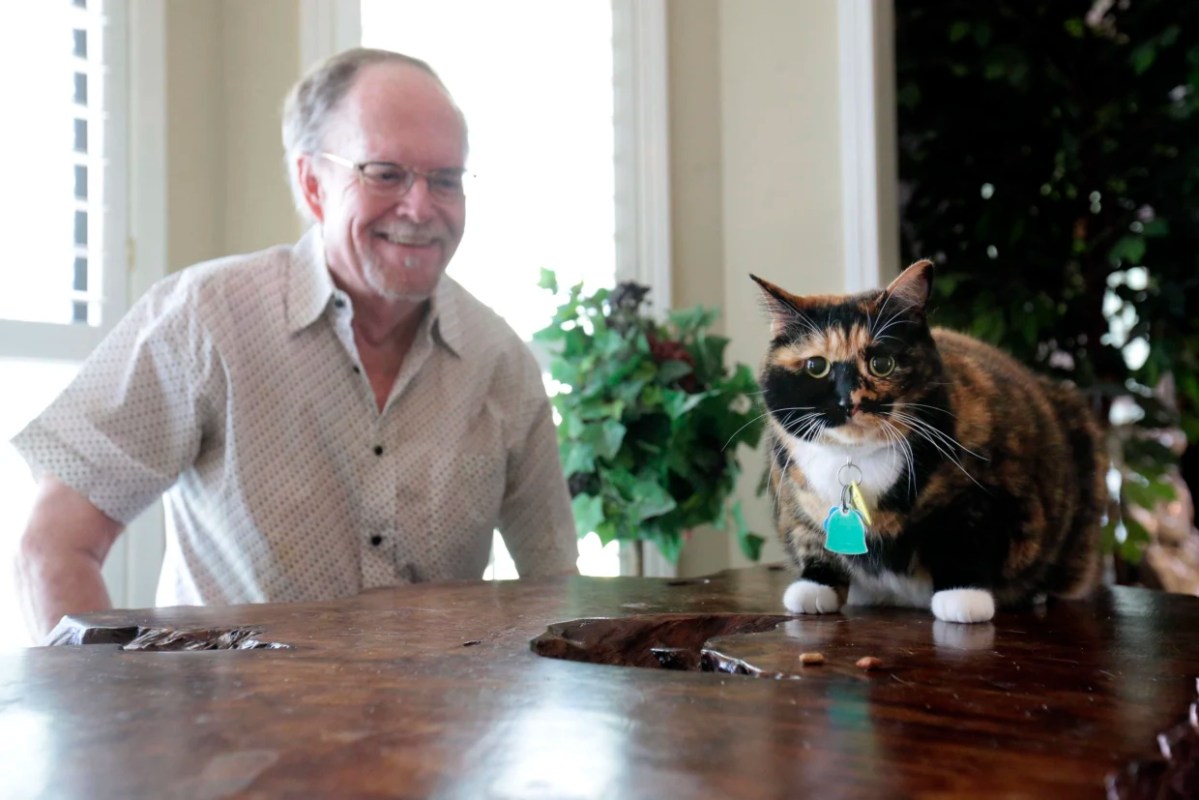
Everitt welcomed the delightfully chonky Calico into his home four years ago after he went to the Tupelo Humane Society in Tupelo, Miss., about 115 miles southeast of Memphis, Tenn. He was writing a donation check when shelter staff introduced him to Bandit. Even though he hadn’t planned on adopting a cat, Bandit came home with him and she’s been his companion ever since.
He said he’s telling his story because it’s important for people to know pets can give back to their humans.
“I want to let people know that you not only save a life when you adopt a pet or rescue one,” Everitt told the Northeast Mississippi Daily Journal. “The tides could be turned. You never know when you save an animal if they’re going to save you.”
It’s nice to know some cats are just as good as dogs when it comes to alerting their humans to potential danger. Given Buddy’s long track record of hiding behind my legs and moaning nervously when something scary happens — and the fact that he literally slept through a mouse encounter in July — I wouldn’t hold out much hope for the Budster heroically raising hell to wake me up if armed men ever tried to break in.
It’s more likely he’d watch the burglars break in without raising the alarm, and satisfied that they have no interest in the turkey pate and treats in his Buddy Food Cabinet, return to my bed to stretch, yawn and go back to sleep.
SPCA staff and veterinarians believe the well-socialized wildcat was the illegal pet of someone living in or near Central Islip.
The saga of a “big cat” spotted on Long Island this week has come to an end with the animal’s capture.
Authorities believe the cat is a Eurasian Lynx and was a pet who escaped or was abandoned by his owner. The frightened feline was first spotted on Wednesday in Central Islip, Long Island, a suburb that stretches for 118 miles just south of New York City.
“Scared the daylights out of me,” Diane Huwer, a self-proclaimed cat lover who was the first to encounter the lynx, told the local ABC affiliate.
The area encompasses two counties and is one of the most densely populated places in the U.S. with more than 7.6 million people. It’s one of the worst places in the world for a wild cat to be abandoned, with heavy traffic, ubiquitous environmental noise and endless shopping plazas surrounded by labyrinthine residential neighborhoods.
It’s illegal to own wild animals in New York, and the cat’s “owner” likely would have kept it without a proper enclosure to avoid attention from authorities.
The lynx’s sightings made the headlines in the New York papers, as well as coverage by local TV news and online publications. It went viral on social media, with users trying to determine what kind of cat it was from the handful of blurry photos witnesses were able to snap. Some media coverage suggested it was a true big cat. (Here at PITB, we thought it was possibly a Savannah cat or an American lynx.)
Authorities said the Eurasian Lynx was clearly socialized and wasn’t aggressive when they finally caught him. Credit: SPCA
Local authorities searched fruitlessly for three days and were about to give up early Saturday morning when someone spotted the wild cat in a residential neighborhood and called police.
The hungry feline was pawing through garbage cans next to a house in Central Islip. Authorities said the young lynx was friendly and socialized to humans.
“He was rubbing his face on the cage, looked like he was a friendly cat and from the tips we’ve gotten,” Frankie Floridia of Strong Island Animal Rescue said. “It seems these people have had him since he was a baby.”
Veterinarians have named the lynx Leonardo de Catbrio and said he’s about a year old. Despite his ordeal, the 40-pound cat was not malnourished or dehydrated, and the vets who gave him a check-up said he’s in good health. They’re waiting on lab results to confirm his species.
“Someone obviously had it as a pet,” the SPCA’s Roy Gross told Newsday. “These are wild animals, not the type of animals anyone should have. … They don’t belong in captivity this way.”
In the meantime, police, the state Department of Environmental Conservation and the SPCA are looking for Leonardo’s “owner,” who faces misdemeanor charges and a fine of up to $1,000 if he or she is convicted. They’re sure to have questions about how the person acquired a wild cat, let alone a non-native species. It’s been illegal to “import” wild animals since the Wildlife Act of 1976, and the illegal wildlife market has been a scourge on law enforcement and conservationists alike.
Eleven is a silver tabby who’s been returned to the shelter twice by would-be adopters, and staff at the shelter are appealing to the public to find her a forever home with patient humans.
The four-year-old with bright green eyes has been with Battersea Cats and Dogs in south London since April. Her rescuers say she takes a while to adjust to new surroundings, and they believe that’s why Eleven was returned twice within days. If Eleven’s failed adopters had been more patient, shelter staff said, they would have discovered she’s a loving lap cat once trust is established.
Eleven the Cat takes a while to warm up to new people. Credit: Battersea Cats and Dogs
They hope to place her in an “understanding home” with people who “will give her the time and space to settle in, as she would be a wonderful addition to a home.”
“Eleven needs her own space when she’s settling in, so she can hiss and swipe if pushed into interactions that she is not ready for,” a shelter spokesman told the Mirror. “She expects respect, but once given she will reward you with plenty of love. She is a super clever cat, who enjoys learning and she will sit on command for a treat of course.”
Humans are an invasive species who are spectacularly adept at destroying life, a new study has found.
Homo sapiens are an invasive species who do irreparable harm to the environment and other animals on an unprecedented scale, a new study by the Feline Science Institute has found.
The results prompted feline scientists to add homo sapiens, commonly known as humans, to a database of destructive and invasive animals maintained by the Academy of Scientific Studies.
Cat scientists have only just glimpsed the breadth of human-initiated impact on other animals, Dr. Oreo P. Yums, lead author of the newest research paper, told reporters.
“We found humans are astonishingly, almost indescribably destructive,” Yums said. “For instance, although they fret about birds, humans kill more than a billion of them a year just with their skyscrapers, which birds are prone to fly into due to their mirrored surfaces. Add in wind turbines, cell towers, power lines, habitat loss and slow die-offs due to chemicals, and by conservative estimates we’re talking about billions of birds killed by humans every year without even tallying active measures like hunting.”
Humans have killed off an estimated 70 percent of the world’s wildlife in the last 50 years alone and show no sign of stopping. Oceans are overfished, animals like pangolins and big cats are ruthlessly hunted to extinction to feed demand within the Chinese traditional medicine market, and human addiction to palm oil means the “two-legged demon monsters don’t even have sympathy for their fellow primates,” mewologist Charles Clawin said.
“In Borneo and Sumatra there are entire schools, filled to capacity, for critically endangered orangutan babies who were orphaned by human contractors clearing ancient jungles to make room for more palm oil plantations,” he said. “Often, the humans use industrial equipment to tear down trees while the orangutans are still in them. Other times, they dispatch the mothers with pistols, not realizing there are babies clinging to them.”
In Africa, where the elephant population has plummeted in the last century, more than 110,000 elephants have been slaughtered in the past 10 years alone for their tusks. The elongated incisors are used to make jewelry and piano keys, and items made from ivory have become a status symbol in China, where growing middle and upper classes seek to show off their wealth with luxuries.
In 2019, Chinese businesswoman Yang Felan, dubbed the “Ivory Queen,” was arrested and charged with smuggling $2.5 million worth of tusks from Tanzania to her home country. Yang, “a key link between poachers in East Africa and buyers in China for more than a decade,” was a respected businesswoman, investor, restaurateur and vice chairwoman of the China-Africa Business Council.
“Poachers continue to slaughter elephants and our big cat brothers and sisters,” said Luna Meowson, who tracks the illegal wildlife market for the University of Nappington. “Having extirpated tigers from virtually their entire range, poachers are turning to South America, where jaguar poaching increased 200 fold between 2015 and 2020. It never stops.”
A human hunter poses victoriously after heroically slaying a lion (panthera leo) from atop his trusty steed, a mobility scooter, after a team of guides drove him around the bush in an air-conditioned SUV, then lured the animal directly into his line of sight. A female of the species, presumably his mate, looks on proudly.
Although the earliest details remain murky, fossil records show Homo sapiens first emerged in Africa about 200,000 years ago. The invasive species, which has a gestation period of about nine months, began rapidly breeding and immediately went to war with fellow members of the genus Homo.
After wiping out two-legged rivals including Homo neanderthalensis, Homo altaiensis, Homo denisova and Homo bodoensis, the victorious Homo sapiens set their eyes on other species. Throughout their history they’ve also proven remarkably adept at murdering themselves and continue to hone their skills.
“Those OG humans, they had to really work at slaughtering other species and extirpating wildlife,” said Chonkmatic the Magnificent, King of North American cats. “They didn’t have attack helicopters, stealth bombers, tanks, carrier battle groups, daisy cutters, artillery, mortars, phosphorous, napalm, biological weapons, or even small arms like rifles. In those days a pimply kid from Oklahoma sitting in an air-conditioned base in Virginia couldn’t wipe out an entire city 5,000 miles away by pressing a button ordering a drone to drop a nuke. They had to put some sweat into violence, you know?”
Breakthroughs in recent centuries have led to innovative and more convenient ways for Homo sapiens to author mass destruction and render entire sections of the Earth lifeless.
The species, known for its aptitude for tool-making in addition to eating ultra-processed foods and staring at screens, began with simple tools of destruction like the Mark I Spear, early bows and even torches. Over the centuries they innovated, coming up with clever and inventive new ways to inflict pain and end life until the advent of electricity, the industrial era and the brutally destructive war machines of modern times.
Human scientists have tried to obscure their species’ impact on wildlife and the planet by declaring species like felis catus “invasive” and “alien,” but even if cats are “guilty of grabbing a forbidden snack every now and then,” they don’t have the coordination, technology or will to carve up habitats, render entire swaths of the Earth uninhabitable with nuclear fallout, create Everest-size mountains of garbage, or effortlessly drive millions of species to extinction, Clawin said.
“They’re so good at it, they don’t even have to try,” he noted, pointing out human accidents or incidents of negligence like oil spills and chemical run-off into rivers. “We tend to think of humans out there with shotguns and rifles, cackling maniacally as they shoot anything that moves. And, sure, they do that, especially in places like Texas where the sight of any animal always prompts the question ‘Should we shoot it?’ But our research shows they can wipe out entire categories of fauna in their sleep. It’s remarkable.”