Australian Celebrity Chef Salivates Over Prospect Of Feral Cat Meat Sandwich

Maggie Beer was reportedly intrigued by the idea of eating a “pussycat sandwich.”

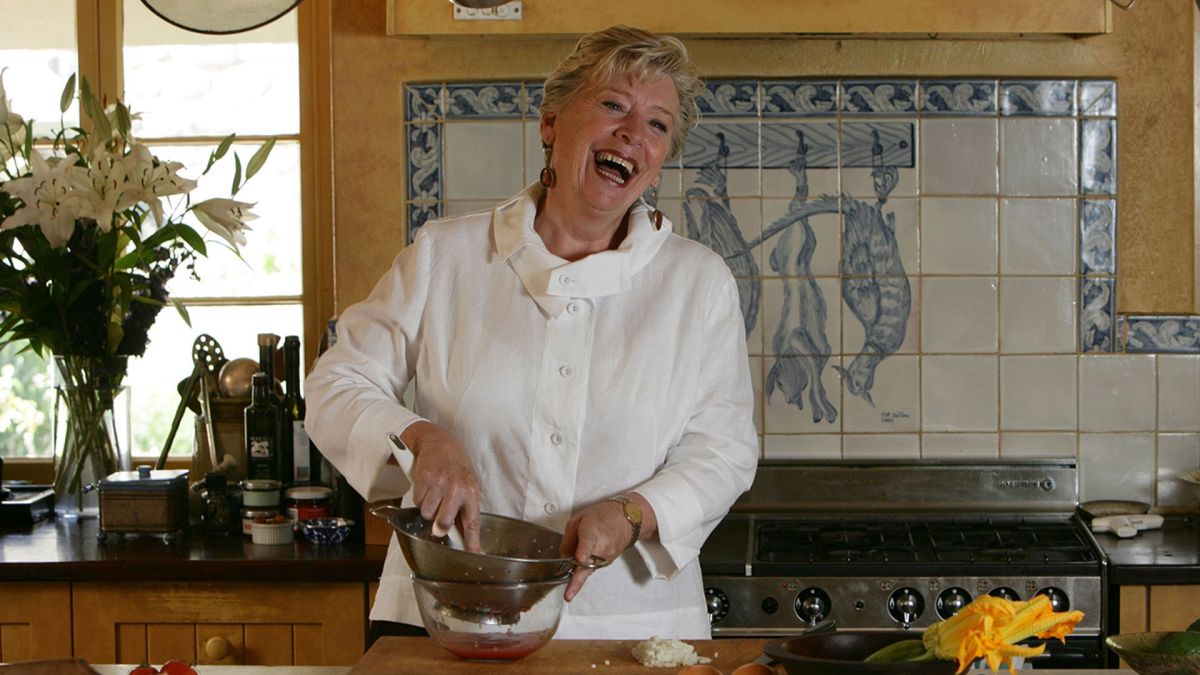
Meet Maggie Beer, a “culinary icon” from Australia who was convinced to teach cooks at some sort of community kitchen on the promise that another chef would kill a feral cat to make her a “pussycat sandwich.”

Beer was invited to help instruct cooks who volunteer for a program feeding Australian seniors. In return, one of the cooks would show her how to prepare domestic cat meat.

Note that this was reported by a major Australian media outlet as a quirky culinary story, just a bit of fun to have a laugh over.

That goes a long way to explaining the state of mind in a country that recently killed millions of cats by poisoning them and has pledged to exterminate all free-roaming cats because self-styled conservationists believe felines — not habitat destruction, mass industrialization, the widespread use of carcinogenic pesticides, windmills, glass buildings and all the other changes wrought by human presence — are the primary drivers of local bird and small mammal extinction.

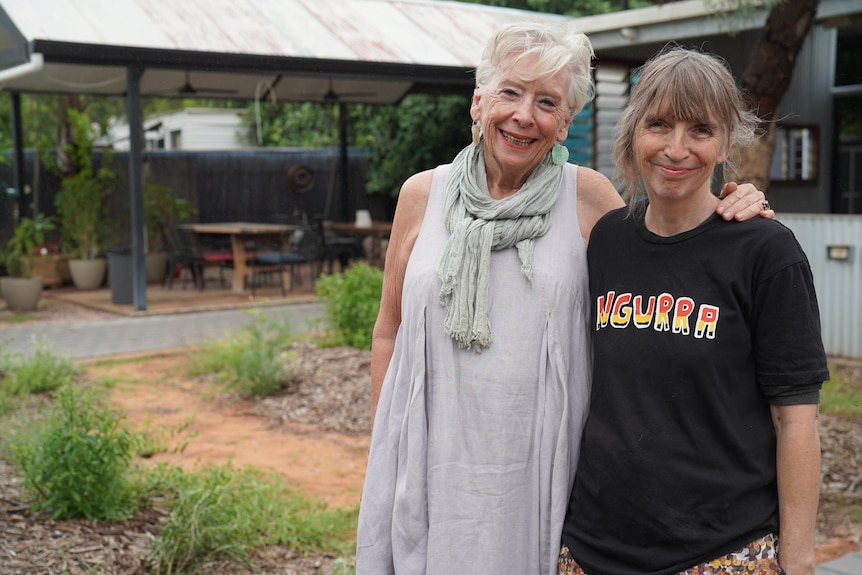
Beer and Brown, cat eaters.

“We were talking a lot about cooking kangaroo tails and then I also told her about how one of our directors… had recently cooked us a feral cat from Kiwirrkurra,” said Sarah Brown, the CEO of Purple House, which prepares meals for Australian seniors.

“She got very excited about this and I said, ‘Well if you come to Alice Springs and do some cooking classes with us, then Bobby West will teach you how to cook a pussycat and you can have a pussycat sandwich for lunch.'”

Feeding seniors intelligent companion animals is about giving them “joy as well as sustenance,” Brown claims.

Thankfully not everyone in Australia thinks this is amusing, nor do they buy the claims that slaughtering cats will magically solve all the problems facing indigenous wildlife.

CatRank Is A Battle Of Feline Good Looks

No money, no prizes, just cute cats and bragging rights.

A post on BoingBoing Tuesday alerted me to the existence of CatRank, a site that allows users to view cat photos two at a time and pick the one they like better.

Or as the site puts it, “tap the superior cat.”

When you make your selection, the page instantly refreshes with two new cats. Per BoingBoing:

“A big part of winning seems to have to do with getting the right photo of your cat, which is a challenge on its own — anyone who has tried to photograph a cat knows they rarely cooperate on command. All cats are created equally, of course, but this site is like an online pageant they’ll never even know they participated in.”

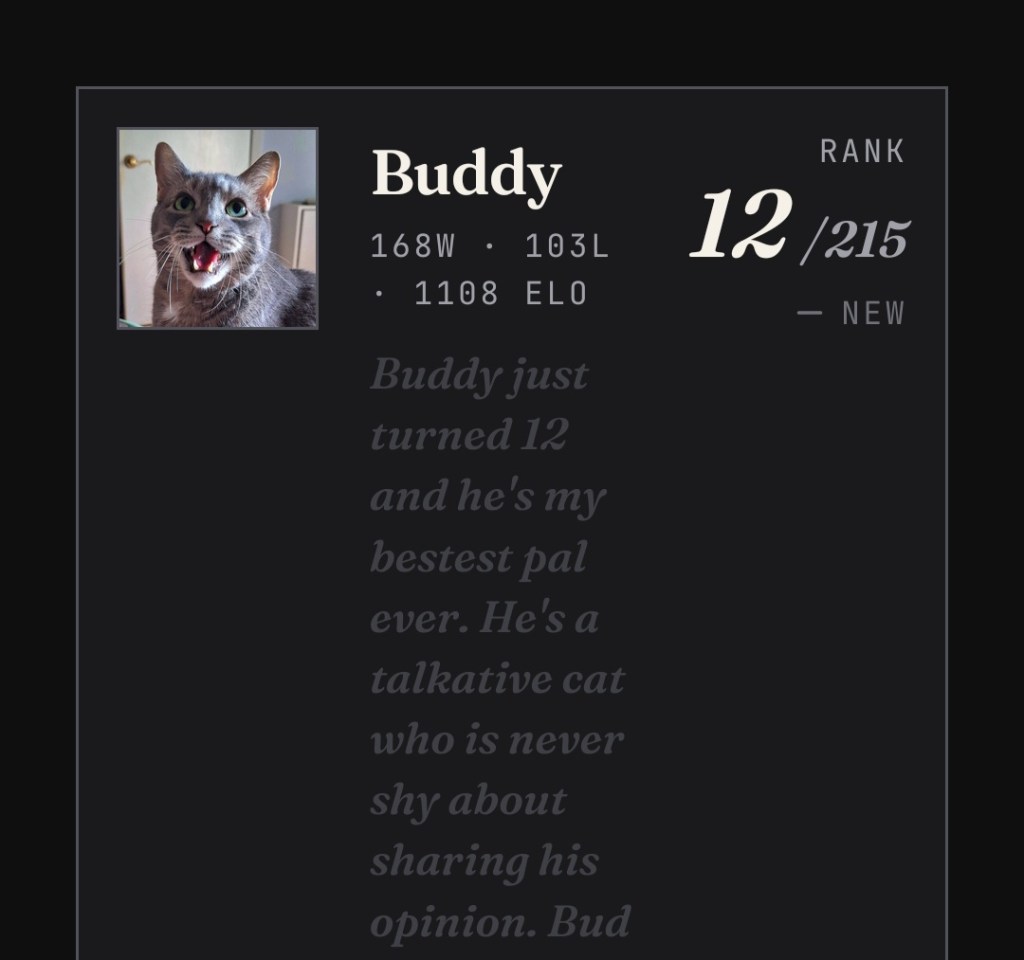
I decided to volunteer Bud for the “pageant” and uploaded a derpy photo of him looking excited. If memory serves, he was happily pawing at a wand toy at the time.

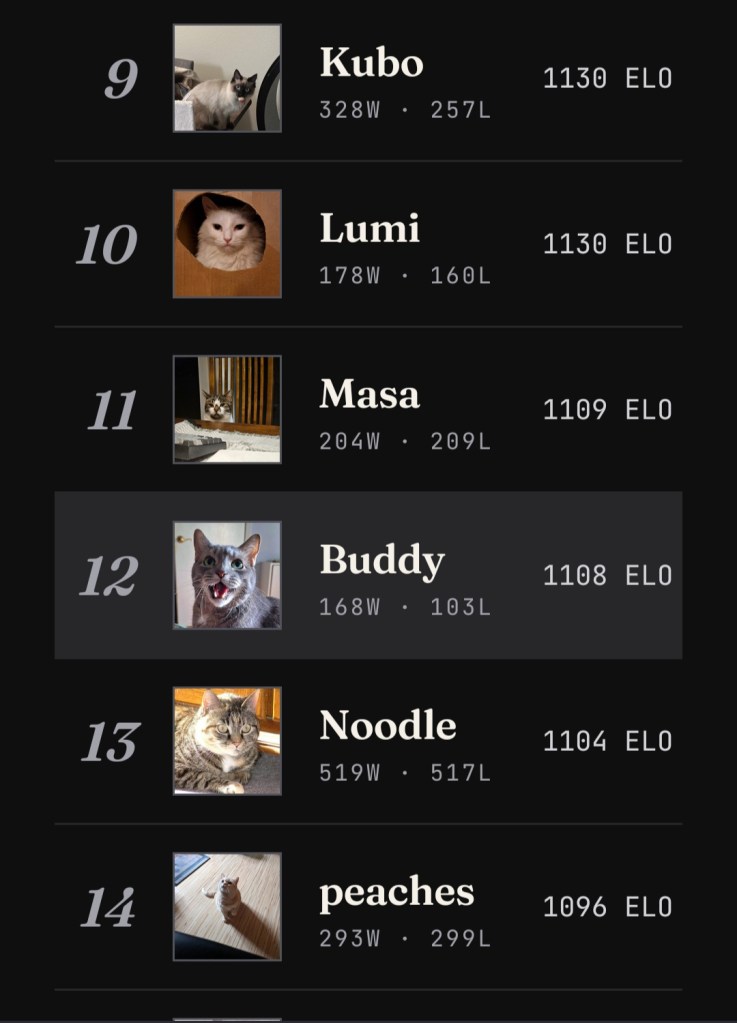
He was #34 on Tuesday, #12 last night, dropped all the way to #68 earlier today, and was #22 last time I checked.

A screenshot from yesterday when Bud’s derpy grin was winning him points.

The rankings have a simple win/loss component and a weighted ELO component, borrowed from chess and sports, that awards more points for “wins” against high-ranking “opponents.”

As for my own voting habits, I tend to vote for photos more tightly focused on the kitties since the images are relatively small as presented on the site. It’s difficult to see a feline’s features if the image isn’t cropped properly. I’ve got a subconscious bias toward clear, well-lit photos of voids since they’re notoriously difficult to shoot, and because they’re often unfairly overlooked.

My only real complaint is the top photo for most of this week is AI-manipulated, and at least one other is an AI creation. It looks like the vast majority are legitimate photos of real cats, though I’m sure we’ll see more generated images as the site becomes more popular.

You can upload as many as three of your own cats and write short bios for them.

Which is pointless because there’s no prize or money involved, just bragging rights, but people can be weird.

Ah well. Naturally, Bud expects all readers of his blog to head to the site and vote for him, and if you don’t he’ll do something ferocious and meowscular.

“They better vote for me or else!” he says. “If they don’t I’m gonna do something tremendous, something the likes of which they’ve never seen before, believe me. A lot of people are saying I’m the most handsome cat, a lot of people are saying it. I’m the most — and by the way, no other cat is as stylish as me. It’s incredible. So readers better vote for me by 10 am tomorrow and if they don’t, I’m gonna make more threats and extend the deadline. It’s tremendous.”

Colony Feeders Assaulted In The Latest Example Of Australia’s Freak-Out Over Cats

Vigilantism against stray cats and their caretakers is on the rise in Australia and New Zealand amid increasingly pitched rhetoric from conservationists who say felines are responsible for driving other species to extinction.

Antone Martinho-Truswell wants to get rid of every free-range cat in his native Australia and says “it’s time we outlawed pet cats” as well.

The University of Sydney academic, who styles himself as a zoologist and makes impossible claims about the number of animals supposedly killed by felines every year, doesn’t mince words when presenting his argument, which boils down to a logical fallacy. He says he’s an expert, he says cats must be driven to extinction, ergo it must happen.

“Your cat is a killer and it cannot be permitted to live here,” Martinho-Truswell said.

With rhetoric like that, and special interests groups claiming cats are the primary force behind the pending extinctions of native flora and fauna, it’s not a surprise when people think they should take the problem into their own hands. In Australia and New Zealand we’ve already seen vigilantes who fail at hiding their joy at killing felines, and now volunteers helping cats have to worry about their physical safety.

A colony manager and two other volunteers were feeding strays in western Sydney on April 17 when a man in a gold Nissan stopped and asked them if they were helping the cats.

When they said they were, the man became violent and attacked the colony manager, a 31-year-old woman, and a volunteer who tried to protect her, a 33-year-old man who was knocked unconscious by the suspect, police said. The man drove off before officers arrived.

The victims were treated at a local hospital. Police have a description of the suspect and a license plate number, according to local media in Sydney, but it isn’t clear if they know his identity.

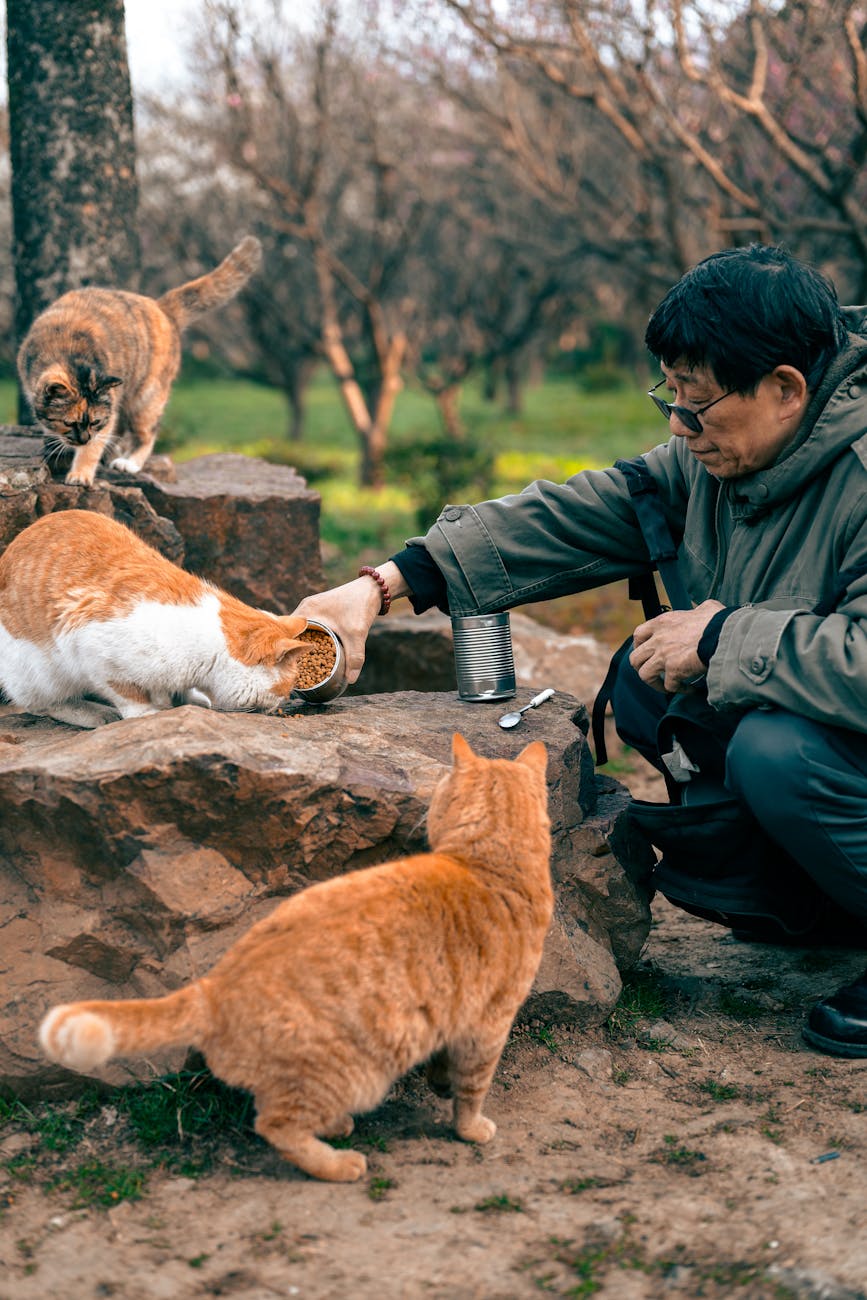
Credit: Cheng Shi Song/Pexels

A spokeswoman for the volunteer group, Community Helping Campbelltown Cats, told Sydney’s 9News that the resources the government makes available are “simply inadequate,” leaving volunteers to do the bulk of the work and fundraising for trap, neuter, return (TNR) and colony management.

“It is left to volunteer rescue groups and members of the community to do what they can to stop the breeding and get cats off the streets when they can,” she said. “These individuals risk their welfare day in day out; it is simply not right.”

As for the conservationists who advocate extreme measures, they need to dial it down a bit with the apocalyptic talk. There are productive ways to handle this problem, and they don’t involve demonizing animals for behaving the way nature intended, whipping people into a frenzy, and calling for the violent extinction of an entire species. Cat owners will need to be onboard for any effort to come up with a meaningful solution, and you won’t secure their cooperation if you’re constantly telling them their companion animals are “murderers” who need to be killed.

Cat Lady Day: Celebrating The Unsung Heroes Who Improve Life For Felines

From TNR to managing colonies and finding homes for friendly strays, cat ladies never stop working to make life better for our furry friends.

Hat tip to Mollie Hunt for making us aware of Cat Lady Day, an unofficial holiday that is part of an effort to reclaim the concept of the “cat lady” through positive association.

That’s a noble goal, and at PITB we’ve long scoffed at the idea that gender makes a difference in appreciating felines.

Cats are paradoxically regal yet derpy, imperious yet loving, and their antics are always amusing. Those are qualities that can appeal to anyone regardless of gender, nationality, age or cultural background.

But I think we should also use a day like this to thank the innumerable cat ladies in every city, town and village across the country who work tirelessly to improve the lives of strays, ferals and shelter cats.

These are the people who walk the walk, who do the hard work of TNR (trap, neuter, return), managing colonies, and protecting cats without homes from animals and mean-spirited humans.

Credit: cottonbro studio/Pexels

Cat ladies find homes for friendly strays, keep colony cats fed, and obtain veterinary care for the sick and injured.

More often than not, they provide help out of their own pockets when donations can’t cover all the costs.

Not only is it thankless work most of the time, but misguided bureaucrats sometimes take it upon themselves to make life more difficult for the cat ladies caring for local strays and ferals.

Yet these women persist because they’re driven by one thing — love for our furry friends.

That’s absolutely worth celebrating.

Want Your Cat To Eat More? Give Them Variety, Study Says

Like us, cats get bored with the same stuff all the time.

One good piece of advice I got before adopting was to introduce the kitten to as many different flavors and textures of food as possible.

That way you won’t have a picky cat and you won’t find yourself in a scramble if the one variety of cat food your feline master will eat is discontinued or becomes difficult to get. That became a major problem during and after the pandemic, when disrupted supply chains and shortages of packing materials meant you never knew what you’d find on store shelves.

But there’s another good reason to do it: variety keeps your cat happy.

Even if your cat has a favorite food, too much exposure to that food will have diminishing returns, a research team from Japan’s Iwate University found.

Photo by Engin Akyurt on Pexels.com

But it’s not just the type of meat, texture or brand. Smell is hugely important to cats, and the study found they have much bigger appetites when presented with a novel food odor.

This is helpful not only to help us make sure our little buddies eat, but also because most of us don’t think about olfactory stimulation with cats. We build them cat condos and catios, we provide scratchers, we rotate toys. But how often do we give our cats the opportunity to enjoy new smells?

One of Buddy’s favorite things to do is sniff around the apartment building. I wait until late at night when it’s quiet and let him walk the hallways, stopping at each door to sniff. (I always remain a few feet away because it makes him feel safe, and because I can scoop him up and bring him back if he gets frightened.)

He loves it, and I don’t do it enough. After reading this, I’ll make sure little dude gets his sniffing tour more regularly.