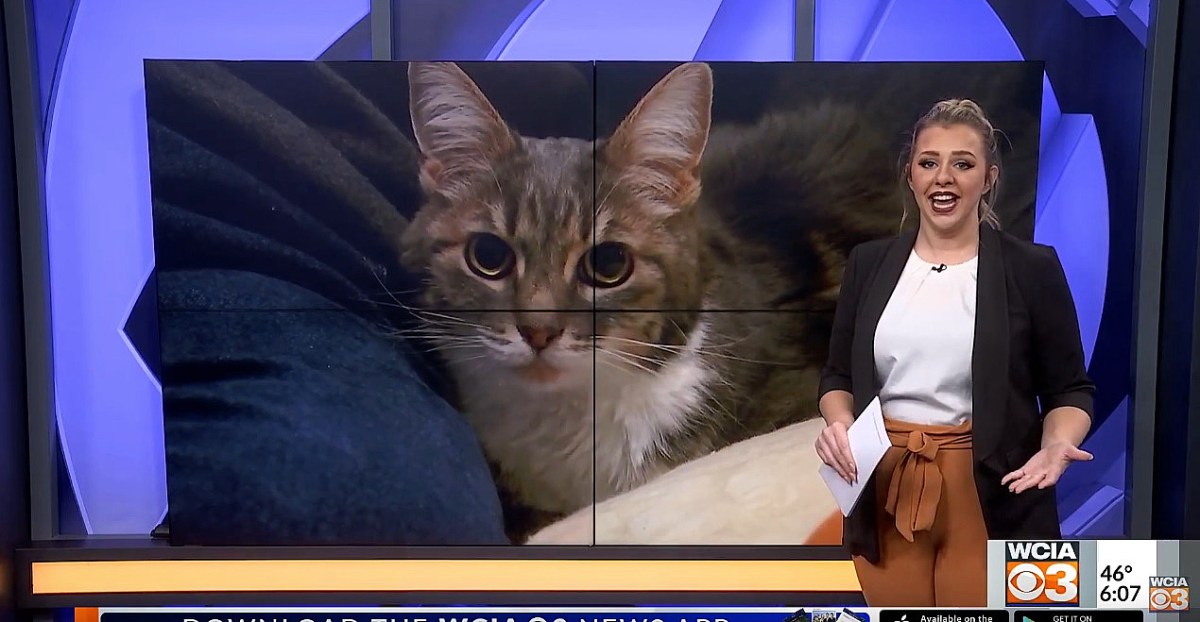
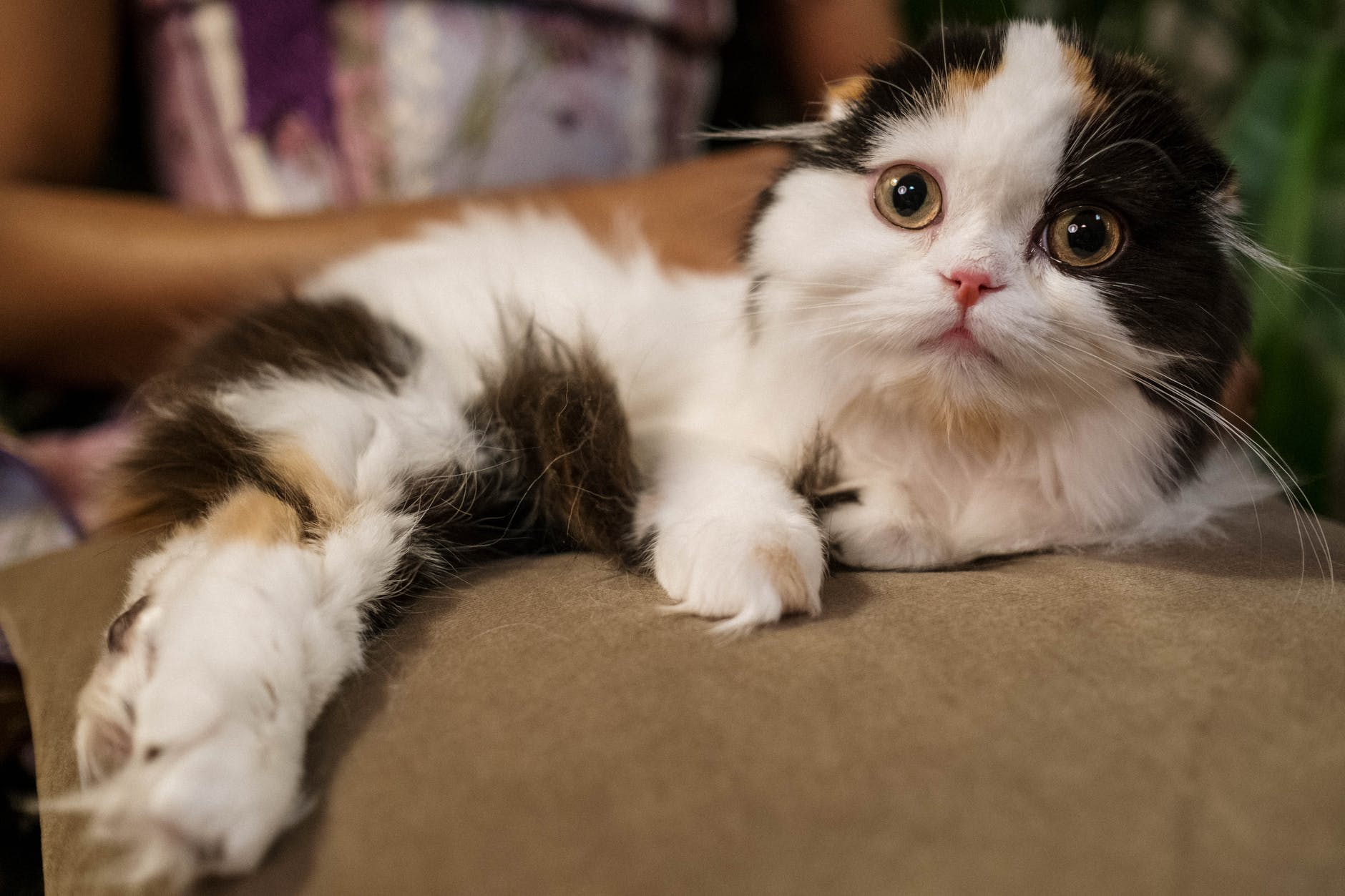
She’s now called Sadie the Wonder Cat after enduring 46 days trapped without food or water.
An Illinois family has been reunited with their cat after the resilient feline survived six weeks trapped in a box spring that was wrapped in heavy-duty plastic for shipping.
The Gaines family was moving from Fresno, Calif. to Charleston, Ill. and was packing up, with movers picking up their furniture and belongings on Sept. 22. The family’s cat, Sadie, went missing and the family thought the worst.
“She’s outside a lot during the day. She always comes in the house at night, but she didn’t show up, and it’s common for the coyotes to get the pets,” Mike Gaines told WCIA, a local CBS affiliate. “So, we figured she got taken by a coyote because she always comes home.”
Instead, Sadie was likely spooked by the commotion, the strange people in her home and the stress of seeing her familiar life upended, and found a way to burrow inside the box spring to hide.
In normal times Sadie’s ordeal would have lasted a few days, maybe a week tops, but because transportation companies are hurting for truck drivers, the Gaines’ furniture was put in a storage unit in Sacramento until it could be moved cross country.
“So, it sat there from September 22nd to November 3rd. So, several weeks with Sadie, the wonder cat locked in the box springs,” Mike Gaines said. “No food, no water, no sunlight, no nothing.”
On Nov. 7 the Gaines’ furniture arrived, and after more than 46 days Sadie was freed when Gaines’ daughter found her.
“She hollered dad, there’s something dead in the box springs it stinks,” Gaines said. “So, I came down here, and on my way down the stairs she said there’s a rat in there. She just saw her little ears and thought it was rat, but it wasn’t. I came down and looked in there and it was Sadie. She was sitting there looking up at me.”
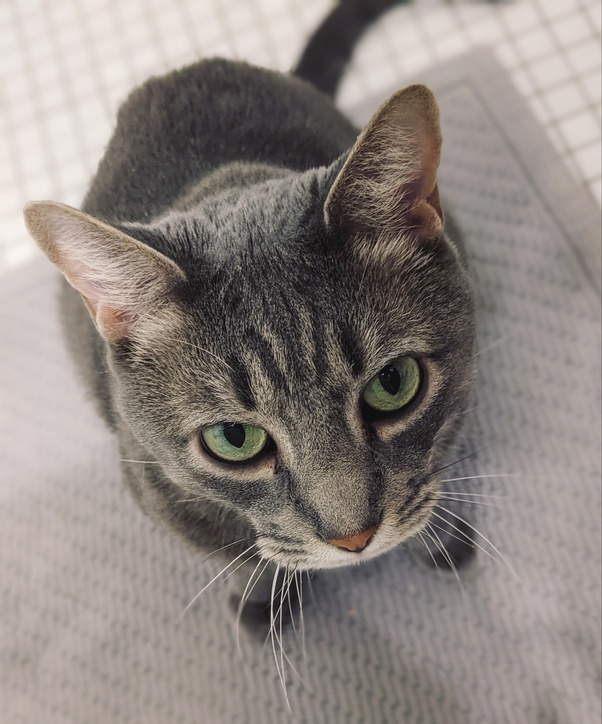
The little survivor lost a whopping seven pounds, which is a huge deal for a cat. Most domestic house cats weigh about 10 pounds. Gaines said she went limp in his hands when he lifted her out of the box spring, and endured a vet visit. The veterinarian said the silver tabby was lucky to be alive, and didn’t suffer any injuries or ailments aside from obvious malnutrition and dehydration. It’s not clear if there were any perforations in the plastic around the box spring. Perhaps little Sadie caught herself a mouse or two to tide her over.
I think I’ll show this to Bud the next time he puts on a Shakespearean performance while trying to convince me he’s starving after two hours without a meal, although with the way he shrieks for food and yaps constantly, it’s difficult to imagine he’d get trapped in a piece of furniture without the entire block knowing about it.
The Electric Life of Louis Wain tells the story of one of Victorian England’s most revered artists who was known almost exclusively for his humorous cat illustrations.
Movie: The Electrical Life of Louis Wain Director: Will Sharpe Genre: Biopic, drama Medium: Amazon Original (streaming and in theaters)
Louis Wain was an artist in the employ of The Illustrated London News, one of the most popular newspapers in Victorian England, when advances in photography and printing made it possible for newspapers to regularly include photographs in their pages.
Demoted from staff illustrator to contributor, Wain’s professional skills seemed destined for obsolescence when he and his wife, Emily, returned to their cottage one rainy afternoon in 1886 and heard the distressed mews of a kitten. They found an adorable tuxedo cat soaked and shivering in their garden, brought him inside and were instantly smitten.
They named the baby Peter, and in the months that followed Wain made the growing kitten the subject of most of his idle drawings, sketching him in various situations and with increasingly anthropomorphic features. Wain’s cat sketches were only intended for his wife, but when Sir William Ingram, editor at The Illustrated News, saw the whimsical cat drawings he commissioned Wain to fill two pages with cats as a special feature for the paper’s Christmas edition.
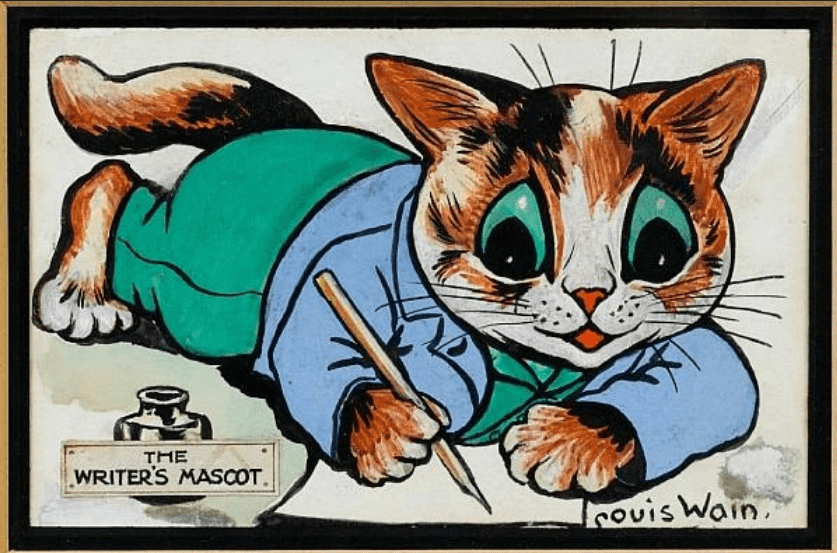
Wain’s cats were a huge hit with readers, marking the beginning of a second, much more successful career as a pet portraitist and one of Victorian England’s most beloved artists. Wain gave his cats human expressions, had them do human things, and put them in contemporary clothing to the delight of newspaper readers and, later, book publishers who sold many thousands of copies of illustrated books featuring nothing but Wain’s anthropomorphic cats.
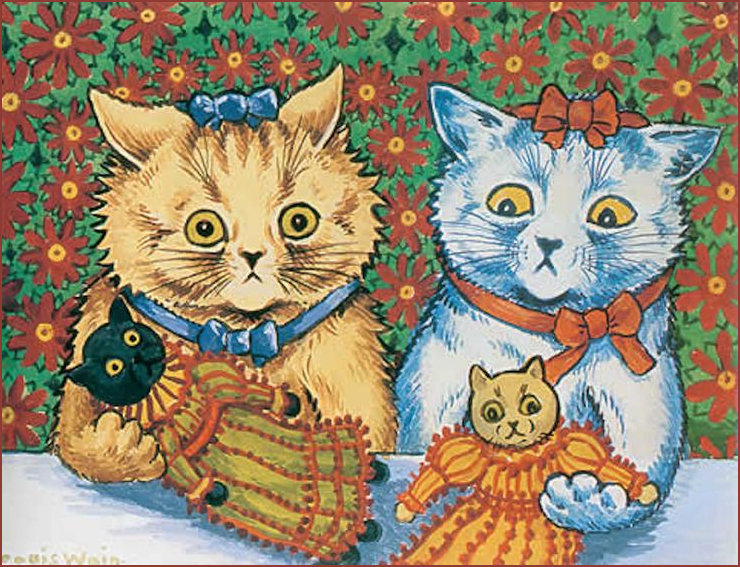
A pair of young female cats play with cat dolls.
The Electrical Life of Louis Wain weaves a narrative from its subject’s professional life and his lesser-known private life. A polymath, philosopher, amateur boxer and author of some particular ideas about cats and electricity, Wain (played by the always-excellent Benedict Cumberbatch) was an eccentric and not particularly happy with his life until his family hired Emily Richardson (Claire Foy) as governess — a home teacher — for Wain’s younger sisters.
Despite the fact that Emily was a decade his senior and such relationships were looked down upon in Victorian England, Wain and Emily married, made it clear they didn’t care what others thought about them, and learned to enjoy life in each other’s company. With the addition of little Peter, the Wains were a happy family.
Louis Wain did not, however, have an easy life. Three years into their blissful marriage, Emily was diagnosed with terminal breast cancer. Her illness, the subsequent mental deterioration of one of Wain’s younger sisters, and Wain’s own eventual struggles with mental illness cast long shadows over his outlook and his work.
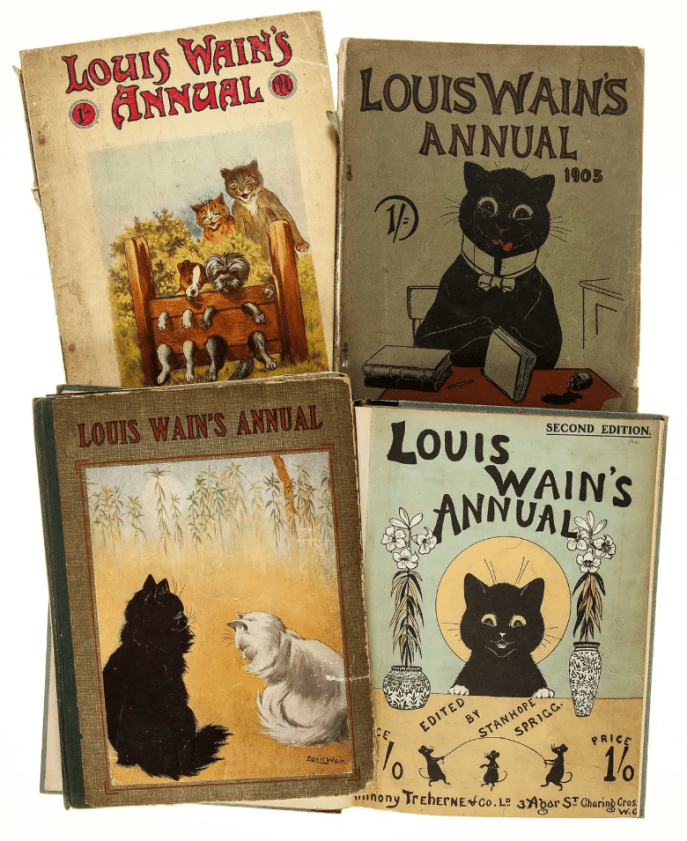
Wain’s cat drawings were so popular, they were sold in stand-alone books in addition to filling the pages of widely-read publications in Victorian England.
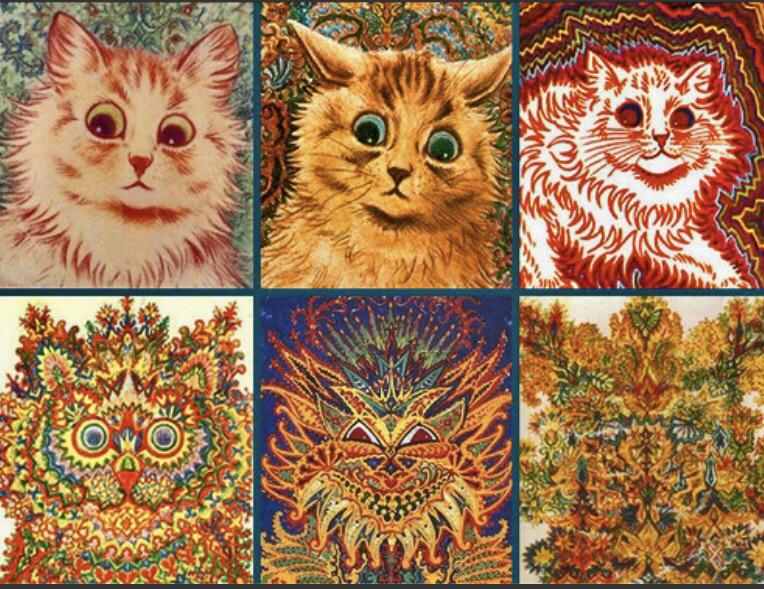
Today, psychologists, art critics and scholars of the man’s career still debate whether — and to what degree — his mental state was reflected in his artwork as his cats took on increasingly psychedelic and abstract qualities. What began as simple kitten sketches morphed into whimsical scenes of expressive cats and eventually trippy images that wouldn’t have looked out of place as album art in the late 1960s and 1970s.
Did Wain truly suffer from severe mental illness, or was he a casualty of a society that banished its “undesirables” to asylums and “lunatic houses”? Was Wain on the autism spectrum? Did the increasingly psychedelic bent of his drawings stem from medications he was given at a time when mental illness was poorly understood and poorly treated?
It depends on what you see in the illustrations. For a man so revered by the public, Wain was remarkably casual about his output — a quality Cumberbatch displays admirably throughout the film — and he didn’t bother to date his drawings. He was prolific, completing many hundreds of cat images throughout his career, in addition to the journalistic images and livestock renderings of his early career, when he was a newspaperman.
Wain’s cat illustrations took on more psychedelic qualities as the years passed.
What is absolutely clear is that Wain saw something in cats that others didn’t see until he showed it to them with his pencils. He was credited with a major shift in attitude toward cats and the normalization of keeping cats as pets rather than as mousers. Although cats enjoyed companion animal status in various other cultures earlier in human history, the idea of keeping a feline as a pet was novel in Victorian England.
The shift in public attitude was treated humorously — as much of the subject matter is — by the film, with a bewildered Wain accepting the presidency of the Cat Society of England at a fete in his honor, then explaining his theory that tabby markings were the result of electricity flowing through fur.
The subject of electricity comes up again and again in the film, bringing to mind Tesla and another famous British eccentric, Alan Turing, who was also played by Cumberbatch in the 2014 biopic The Imitation Game. Not coincidentally, both movies show that service to crown and country mattered little when British eccentrics were deemed too odd to tolerate. Like Wain, Turing — a war hero who famously cracked the legendary German Enigma cryptography machine — found himself on the wrong side of the UK’s mental institutions when he was convicted of indecency in 1952 after admitting to police, during an interview in an unrelated investigation, that he’d once had a relationship with another man.
Turing was subsequently placed on synthetic estrogen and drugs prescribed to “cure” his mental condition, which had the opposite effect: Turing, a shadow of his former self, his genius blunted by chemicals, committed suicide by eating an apple he’d laced with cyanide in 1954.
The Electrical Life of Louis Wain finds humor in both the light and dark moments of its subject’s life, and it’s a credit to the film’s writers, director and actors that lighthearted moments don’t spoil the more serious narrative themes. For his part, Wain was a man who endured a lot of suffering in his life, and if there’s a lesson to be learned here, it’s that no matter what life throws at us, spending time with cats makes things more bearable.
A man ended his relationship with his girlfriend after she tried to get rid of his cat.
Reddit’s “Am I The Asshole?” is described as a “catharsis for the frustrated moral philosopher in all of us, and a place to finally find out if you were wrong in an argument that’s been bothering you.” It’s also a goldmine for people who wish they could read an advice columnist’s slush pile.
On Tuesday, a user asked the community if he’s “the asshole” for kicking his girlfriend out of his home after she tried to get rid of the kitty by “pick[ing] him up and put[ting] him outside to wander off.” Here’s the full post:
According to the OP, his cat didn’t do anything to prompt his girlfriend from booting the little guy.
“She knows he can’t survive outside… She didn’t seem to have any regrets about her actions and no, she never lived with cats before,” the poster added in response to follow-up questions from the community. “She said she couldn’t stand cats and that she couldn’t live with one.”
A few users pointed out that kicking a house cat with no survival skills out of a home is not only dangerous, but kicking a black cat out on or near Halloween could have tragic consequences. As for the original poster, he says he’s placed Raven in the temporary care of a friend until his girlfriend moves out, as he’s worried she might try to hurt the cat — or throw him out again — out of spite.
Others said he was doing the right thing even if Raven wasn’t in danger.
“If she thinks it’s acceptable to do that with something as important as a pet, then she thinks she can do that with any aspect of your life she doesn’t like,” one user wrote. “The cat is important, but almost irrelevant in the scope of red flags she’s throwing out.”
For whatever reason, even though women are more likely to be cat caretakers than men — and men are statistically more likely to take their relationship frustration out on pets, especially cats — the last few viral stories about relationship conflicts over cats have implicated women. Obviously if the situation had been reversed, the boyfriend should have been thrown out, or the girlfriend should have left with her cat. Gender isn’t the issue here: The issue is jerks who take their frustrations out on innocent animals.
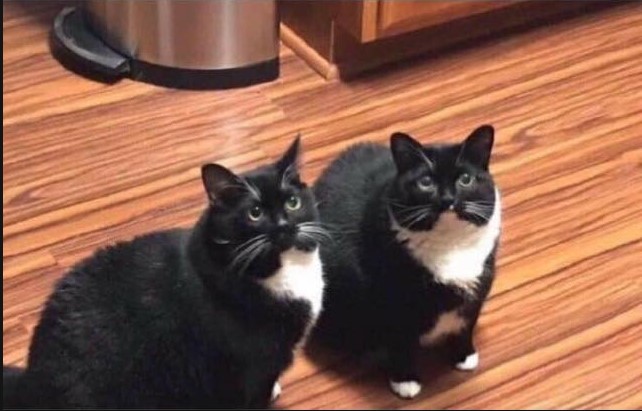
A man ends up with two identical cats after “reuniting” with what he thought was his lost cat, only to have his original cat come home the following week.
I may be late to the party on this one, but I’m fascinated by this story about a guy who lost his cat and recovered what he thought was his little guy three weeks later, only for his actual cat to come home the following week.
Some people commenting on the photo claim there are obvious differences, but in my opinion the differences are very small and probably indistinguishable unless the moggies are side by side. The markings are virtually identical on both cats, and the deviations look mostly like they’re attributable to angle, position and shadows.
People who aren’t familiar with cats might wonder how someone can “reunite” with a cat who doesn’t know them, but that can also be explained away by feline quirks: It’s not unusual for cats to behave differently, even to people and other kitties they know well, after a period of separation.
If the cat was acting a bit off, it would be easy to chalk it up to readjustment and re-acclimating to the sights, sounds and smells of home.
The most unbelievable aspect, for me at least, is how both cats in the photo seem to be cool with having a doppleganger and sharing territory.
Maybe the photo’s not representative of their interactions, but if somehow I found Bud’s doppleganger on the street and brought him home, the consequences would include an epic shitstorm of proportions I probably cannot even imagine.
“WTF is THIS?!?” I can imagine Bud thinking, expressing his incredulity with annoyed chirps and meows. “This is a joke, right? Right? Speak before I murder you!”
“I’m Little Buddy, yes I’m the real Buddy, all you other Little Buddies are acting all funny, so will the real Little Buddy please stand up? Please stand up, please stand up!”
The truth is I’ve never seen a Bud doppleganger, or a Buddyganger, if you will. Over the years I’ve done more than a few image searches for gray tabbies while looking for funny photos of cats who look like Bud, and none of them bear more than a superficial resemblance to His Grace.
Bud has three major characteristics setting him apart from other cats with the same coat pattern and coloring:
His bright green eyes complemented by “guyliner,” which itself is ringed by neat white lines.
The unique white patch on his chest. It’s just a tuft of white fur, but I’ve never seen a gray tabby with a marking that matches its size, shape and position.
Most of all, his pronounced mouth and nose area, alternately called a muzzle, snout or rostrum on various species, terms which are sometimes used for cats as well.
The latter was one of the first things I really noticed after meeting him for the first time and taking him home. Even as a baby it was pronounced in a way that very few cat mouths are.
Finally, while it doesn’t have any bearing on the strictly visual comparison with similar-looking kitties, I can’t imagine another cat acting like Buddy. He’s such a weirdo, so unique in his voice, vocalizations and habits, so opinionated and willing to express those opinions as loudly and often as possible, that I just can’t picture another cat fooling me.
A wife says she “feels bad” for her husband after telling him to surrender his elderly cat, but feels she made the right decision.
How could you force your husband to dump his beloved 18-year-old cat?
That’s the question many incredulous Redditors are asking after a woman told her story on a popular sub-Reddit called “Am I The Asshole?” for people second-guessing their decisions.
The woman who wrote the post said she and her husband got married about a year ago and they took the usual steps when introducing her pit bull to her husband’s cat. They started, she wrote, “by initially separating them, then by introducing them to each other’s smells, followed by letting them see each other whilst at a safe distance.”
“They appeared to get along, but after a day, the cat began making [its] dislike for the dog VERY clear,” she wrote.
The couple hasn’t been successful keeping the peace, she added, and a veterinarian who examined the cat said he was in perfect health, apparently eliminating health reasons for the cat’s alleged hostility toward the dog.
Finally, the wife “brought up the idea” of surrendering the cat. “Brought up” may mean “demanded” in this instance, but the nature of stories like this means both parties would be unreliable narrators. We just don’t know. She said she’s pregnant, which was another factor in her decision.
“We argued virtually nonstop about this for days, until my husband finally agreed to take his cat to said cat sanctuary,” she wrote. “However, he is still pretty upset with me.”
Credit: cottonbro/Pexels
Most users weren’t too happy with the wife, others waved the post off as the work of a troll — albeit one who forgot the cardinal rule of trolling, that it should be funny — and some blamed the husband for caving.
“Anyone that rehomes an animal for someone they are screwing deserves the shit they will have to put up with being with that person,” one ticked-off user wrote.
Most of the condemnatory posts came from people who were incredulous not only that the wife made her husband give up his cat, but that the poor cat is 18 years old and has known nothing but a life with his human.
“Dear God, I hope this isn’t real,” one user wrote, while another summed it up succinctly: “Everything about this sucks.”
The feedback wasn’t split along gender lines either. Most users who identified themselves as female expressed concern for the cat.
“My husband’s cat passed 3 years ago at 18 years. And he would absolutely have rehomed me before he rehomed his cat,” one woman wrote. “Not that I would ever have suggested it, of course – I loved that little fart machine.”
I don’t have much to add to this, as the people who responded pretty much covered the bases. I’d like to believe this was someone’s misguided idea of humor, but in one sense it doesn’t matter because scenarios like this one play out all the time. If it is authentic, then the subtext says a lot: While the author says she “brought up the idea” of rehoming, she also says she and her husband “argued virtually nonstop” about the situation for days, and acknowledges that “he’s still pretty upset with me.”
It’s probably safe to say that’s an understatement, especially if she’s soliciting judgment from strangers on the internet as she second-guesses herself. (Side note: The idea of a sub-Reddit specifically for “catharsis for the frustrated moral philosopher in all of us, and a place to finally find out if you were wrong in an argument that’s been bothering you,” is pretty cool. All of us could use some outside perspective at times.)
As cat-lovers (and animal-lovers in general) know, rehoming is brutal on the pet, leads to depression and can cause serious physical ailments. For an 18-year-old cat, it’s even worse.
I hope the wife has a change of heart and they take the cat back, then get to work on figuring out how to keep the peace for real this time.




![Screenshot 2021-11-07 at 06-19-42 2_1890c_Louis_Wain_CatsNightmare_IllustrationChronicles_1500 jpg (WEBP Image, 1123 × 1536[...]](https://i0.wp.com/littlebuddythecat.com/wp-content/uploads/2021/11/screenshot-2021-11-07-at-06-19-42-2_1890c_louis_wain_catsnightmare_illustrationchronicles_1500-jpg-webp-image-1123-c397-1536....png?w=169&h=231&ssl=1 "Screenshot 2021-11-07 at 06-19-42 2_1890c_Louis_Wain_CatsNightmare_IllustrationChronicles_1500 jpg (WEBP Image, 1123 × 1536[...]")





 Pain In The Bud